Indigenous Pennsylvania Populations: Native Peoples of Pennsylvania Before and After Colonization
Before Pennsylvania: The Indigenous Nations Who Shaped the Land
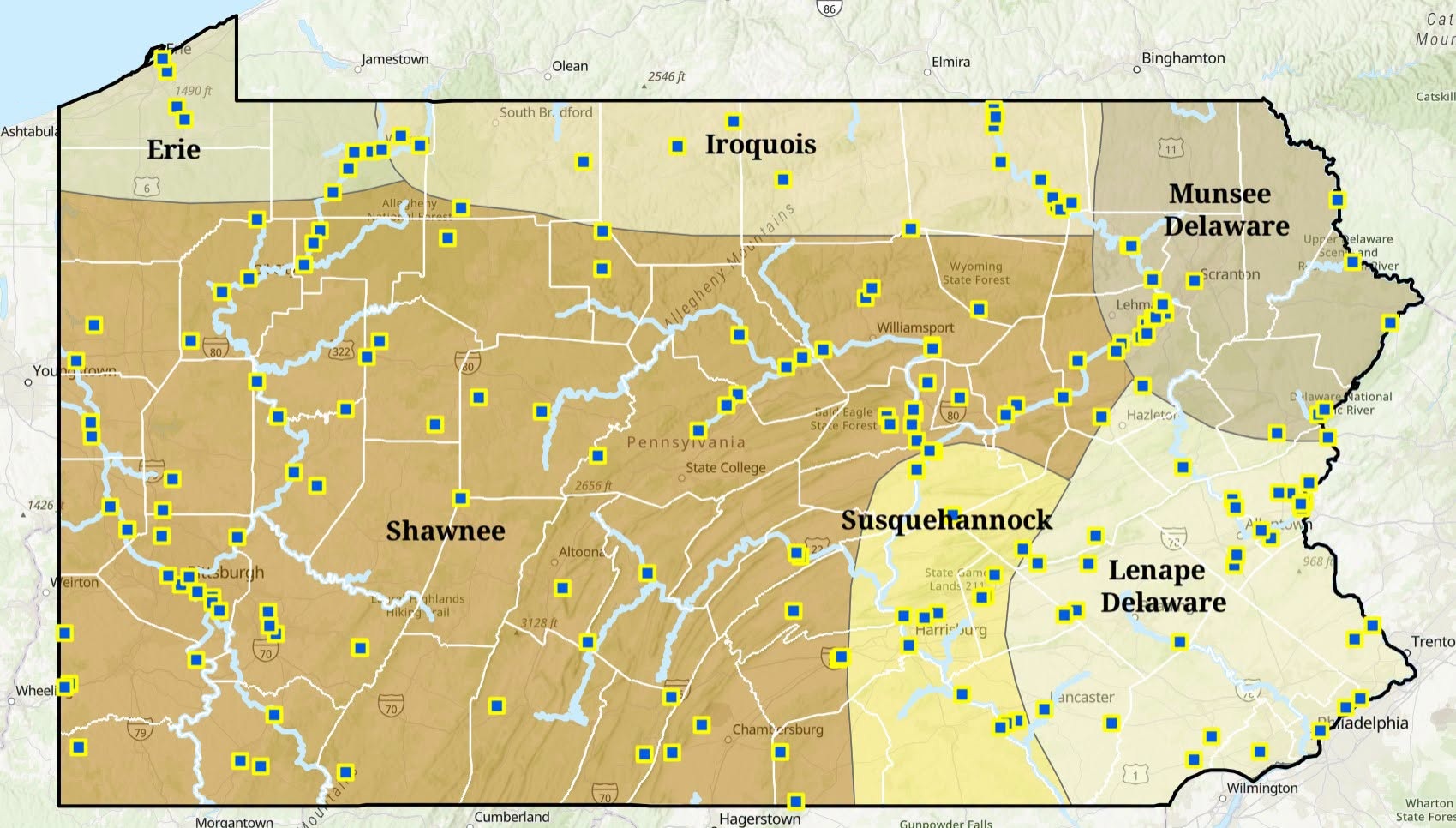
Long before William Penn, before colonial maps, before the state itself, Pennsylvania was Indigenous country—home to nations whose villages, trade routes, farms, and hunting grounds stretched across forests, river valleys, and mountain ridges for thousands of years.
Long before Pennsylvania had borders, courthouses, or colonial charters, it was a Native landscape. The rivers that now define the state—the Delaware, Susquehanna, Allegheny, and Ohio—were once arteries of Indigenous life, carrying trade, stories, diplomacy, and war. Forest trails linked villages and hunting grounds. Corn, beans, and squash grew in river valleys. Fishing camps, ceremonial sites, and seasonal settlements dotted the land. For thousands of years, what is now Pennsylvania was not wilderness waiting to be “settled.” It was already inhabited, cultivated, contested, and deeply known.
Archaeological evidence suggests Native peoples lived in this region as early as 16,000 years ago. By the time Europeans arrived, Pennsylvania was home to a diverse mosaic of Indigenous nations, including the Lenape Delaware, Munsee Delaware, Susquehannock, Shawnee, Erie, and the powerful Haudenosaunee, or Iroquois Confederacy. They did not form a single culture, nor did they occupy neat, permanent boundaries on a modern map. Their worlds overlapped. Alliances shifted. Hunting grounds were shared in times of peace and fought over in times of war. Some communities moved seasonally; others migrated over generations. Pennsylvania’s Native history was not static. It was alive, adaptive, and constantly in motion.
A Land of Many Nations
The people who lived in what is now Pennsylvania spoke languages from two major families: Algonquian and Iroquoian. The Lenape, Munsee, and Shawnee spoke Algonquian languages. The Susquehannock, Erie, and Haudenosaunee spoke Iroquoian languages. But language alone does not capture the complexity of these nations. Each had its own social structures, political systems, foodways, trade networks, and spiritual traditions.
Among the most prominent Native peoples in Pennsylvania were the Lenape, especially the Unami-speaking Lenape of the eastern and southeastern parts of the state. They were not merely hunters living at the edge of the forest, as colonial stereotypes often implied. They were farmers, fishers, traders, diplomats, and stewards of a sophisticated society. Lenape communities cultivated crops, managed land, maintained trade relationships, and developed political structures that allowed them to navigate both internal disputes and external pressures.
Closely related to them were the Munsee Delaware, who shared common origins with the Lenape but had developed distinct cultural practices by the time Europeans arrived. Farther west, the Erie occupied lands near the Great Lakes and western Pennsylvania. Along the Susquehanna River, the Susquehannock became known as formidable traders and warriors, occupying one of the most strategically important corridors in the region. The Shawnee, a mobile and resilient people with a long history of migration, also moved through and settled in parts of Pennsylvania and the Ohio Valley. And over all of this loomed the influence of the Haudenosaunee Confederacy, whose diplomatic and military power shaped the politics of the Northeast for centuries.
Trying to draw exact tribal borders on a modern map can be misleading. Native nations did not govern land the way European empires did. Boundaries were often fluid, especially where tribes hunted seasonally, traded with one another, or shared territory in periods of peace. In wartime, those frontiers could shift quickly. A map of Indigenous Pennsylvania is therefore best understood not as a fixed political diagram, but as a snapshot of a living landscape.
William Penn and the Myth of a Fair Colonial Beginning
When William Penn received his charter for Pennsylvania in 1681, he presented himself as a different kind of colonizer. Penn’s Quaker beliefs led him to advocate for more humane treatment of Native peoples, and he is often remembered for trying to negotiate rather than simply conquer. Compared with many of his contemporaries, Penn did show a greater willingness to recognize Native people as human beings with whom agreements should be made rather than obstacles to be erased.
But the larger colonial machine did not stop with Penn’s better intentions. European settlement kept expanding. Disease spread into Native communities. Forests were cleared, hunting grounds were fragmented, and pressure for land intensified with every new wave of colonists. The result was not coexistence. It was dispossession.
No Native nation in Pennsylvania felt that dispossession more sharply than the Lenape. Over time, they were pushed off their land through a familiar colonial combination of coercion, manipulated treaties, violence, and deceit. The most notorious example was the Walking Purchase of 1737, in which Penn’s sons used fraud to seize a vast stretch of Lenape land along the Delaware River. Instead of honoring a reasonable walking distance, they cleared a path in advance and hired fast walkers to maximize the claim. The result was a land grab on a massive scale. The Lenape were forced westward, in some cases onto lands controlled by the Iroquois, creating new tensions and accelerating the collapse of Native control in eastern Pennsylvania.
The Walking Purchase was not an isolated incident. It was part of a broader pattern repeated across Pennsylvania and throughout North America: Indigenous land was first negotiated over, then manipulated away, then taken outright when negotiation no longer served colonial interests. Every lost treaty line pushed Native communities farther from their homes and farther from the rivers, burial grounds, and agricultural lands that had anchored them for generations.
War on the Frontier
As British and French empires fought for control of North America, Native nations in Pennsylvania were forced into impossible choices. By the mid-eighteenth century, many Indigenous groups had already endured decades of betrayal, displacement, and violence at the hands of British colonists. Some therefore aligned with the French during the conflict later called the French and Indian War. That alliance was not simply about choosing one European power over another. It was often a calculated effort to resist British settlement and preserve what remained of Native autonomy.
The frontier that emerged in colonial memory—forts, raids, massacres, retaliations—was not a story of random violence erupting from nowhere. It was the result of pressure building over generations. Native attacks on settlements did occur, sometimes brutally, but they came after years of land theft, broken agreements, and military encroachment. Pennsylvania’s colonial frontier was violent because colonization itself was violent.
What Became of Pennsylvania’s Native Peoples?
By the nineteenth century, many of the Native nations that once lived in Pennsylvania had been driven west, absorbed into other communities, or shattered by disease and war. Some no longer survive as distinct tribal entities in the state, though their descendants remain part of living Indigenous nations elsewhere.
- Erie — An Iroquoian-speaking people generally considered extinct as a distinct tribe, though descendants likely survive within other Iroquoian lineages.
- Susquehannock — Also Iroquoian-speaking, the Susquehannock were devastated by disease, warfare, and massacre and no longer survive as a recognized tribal nation.
- Haudenosaunee (Iroquois Confederacy) — Still active today, with populations in New York and Canada.
- Shawnee — An Algonquian-speaking people now centered primarily in Oklahoma, with a modern population of roughly 14,000.
- Munsee Delaware — Today found largely in Ontario and on a reservation in Wisconsin.
- Lenape Delaware (Unami Delaware) — Descendant communities remain in Oklahoma, parts of the Mid-Atlantic, and Canada.
That matters, because the story of Native Pennsylvania is too often told as if it ended the moment settlers arrived. It did not. Indigenous communities were pushed out of Pennsylvania, but they were not erased. Their descendants still preserve language, ceremony, identity, and memory. The fact that many of them can no longer protect ancestral sites within Pennsylvania is itself part of the story of colonialism—not evidence that the story is over.
The Markers, the Maps, and the Missing Story
Across Pennsylvania, roadside historical markers and plaques preserve fragments of this past. The Pennsylvania Historical and Museum Commission has identified dozens of Native-related sites: villages, trails, cultural centers, forts, battlefields, and memorials to Native leaders. Taken together, they reveal how deeply Indigenous history is woven into the geography of the state.
But they also reveal something else: how often Native history has been told through a colonial lens. Many of the markers were erected more than a century ago and still use outdated language such as “Indians.” Some commemorate explorers or colonists who “cooperated” with Native peoples, while downplaying the price of that cooperation for Native communities. Others focus on forts and frontier conflicts without fully explaining the dispossession that made those conflicts inevitable.
The historical record is there, but it is fragmented. A trail marker here. A fort plaque there. A battlefield memorial somewhere else. To read Pennsylvania’s landscape carefully is to realize that these are not isolated sites. They are pieces of a much larger story—one in which Native nations shaped this land for millennia, then fought to remain on it as colonial expansion closed in around them.
Before Pennsylvania Was Pennsylvania
It is tempting to imagine Native history as a prelude—a chapter that ends when the colonial one begins. But Pennsylvania was Indigenous long before it was British, American, or Pennsylvanian. Its rivers carried Native trade before they carried colonial commerce. Its forests fed Native communities before they were cut for timber and farms. Its trails became roads. Its villages became towns. Its place names, pathways, and contested frontiers still echo the people who knew this land first.
To understand Pennsylvania honestly is to begin there: not with William Penn’s charter, but with the nations that came before it. Not with colonial settlement, but with the Indigenous world that settlement disrupted. The history of Pennsylvania did not start when Europeans arrived. It started thousands of years earlier, in Native homelands whose legacy still survives—sometimes visibly, sometimes only in fragments, but never entirely gone.
Native American Historical Markers in Pennsylvania
The Pennsylvania Historical and Museum Commission’s Native-related markers reflect both the scale of Indigenous presence in the state and the ways that history has been memorialized:
- Native American leaders: 9
- Colonists or Americans connected to Native history: 18
- Native American sites and routes: 92
- Colonial sites and routes (including many forts): 34
- Conflicts involving Native peoples and colonists: 44