Songs about the climate science of climate change.
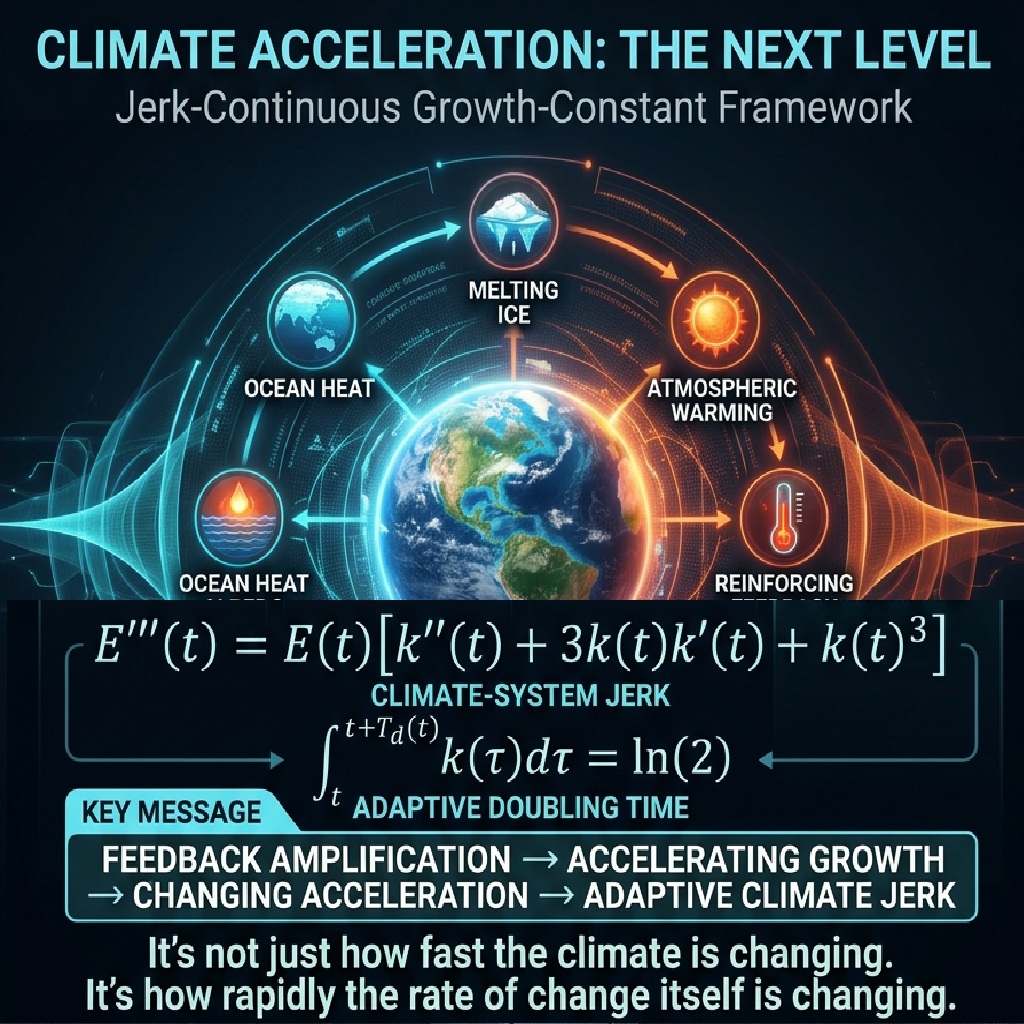
The most concerning development is the acceleration itself. The observed acceleration in Earth's climate system is already alarming, but the possibility that this acceleration is itself increasing represents an even greater concern. In 2025, we moved beyond relying primarily on second-derivative calculations to measure climate change, recognizing a shift from 2¹ to approximately 2⁵–2¹⁰ in acceleration behavior. Now, the evidence increasingly points toward third-derivative behavior.
Our climate model has consequently evolved into an adaptive, jerk-continuous growth-constant framework. It examines not just warming velocity and acceleration, but how rapidly acceleration itself is changing as interacting feedback mechanisms amplify Earth's energy imbalance.
Unlike conventional exponential models or simplified cubic approximations, our updated framework does not assume a fixed growth trajectory or constant climate jerk. It estimates the changing growth constant and its derivatives from observations, allowing the model to adapt to evolving climate conditions.
This is a significant escalation in the level of concern. We are no longer examining simply exponential warming. We are investigating a climate system in which the rate of acceleration is itself changing, potentially amplifying an already alarming trajectory.
Daniel Brouse and Sidd Mukherjee
Explore the Updated Climate Jerk-Continuous Growth-Constant Framework
The fundamental concern is no longer just how fast the climate is changing. It is how rapidly the rate of change itself is changing.This is a significant escalation in the level of concern. We are no longer examining simply exponential warming. We are investigating a climate system in which the rate of acceleration is itself changing, potentially amplifying an already alarming trajectory.
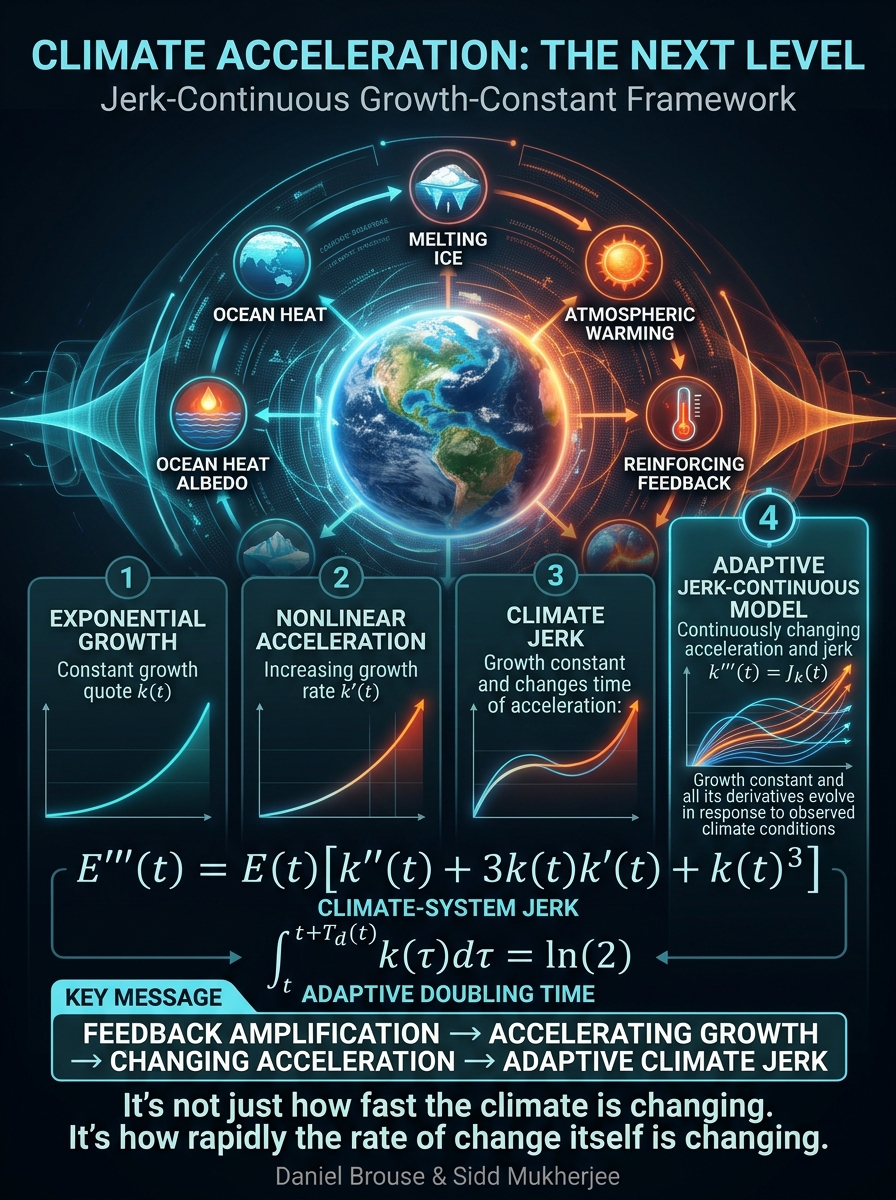
CLIMATE SCIENCE: WE’VE MOVED BEYOND SECOND-DERIVATIVE ANALYSIS.
Our climate model has evolved.
In 2025, we recognized that the scale of observed acceleration demanded a more advanced mathematical framework. Now, we’re taking the next step: an adaptive, jerk-continuous growth-constant model.
What does that mean?
We’re no longer examining just how fast the climate is warming, or how rapidly warming is accelerating. We’re examining how rapidly that acceleration itself is changing as interacting climate feedbacks amplify Earth’s energy imbalance.
The new framework incorporates:
Most importantly, the model does not assume that climate jerk remains constant. It estimates changing growth behavior from observations, allowing the framework to adapt as the climate system evolves.
This represents a significant progression beyond conventional exponential-growth models.
It’s not just how fast the climate is changing. It’s how rapidly the rate of change itself is changing.
[Intro]
Change is moving
(Moving fast)
Acceleration
(First and second pass)
Now look closer
(What’s in store?)
The third derivative
(And something more!)
[Verse 1]
It’s not just warming anymore
It’s what the warming has in store
The rate of change is changing too
A different picture coming into view
[Refrain]
Jerk-continuous
(Growth-constant)
For all of us
(Dangerous)
This very instant
(Dangerous)
[Verse 2]
Second derivative tells the tale
Of acceleration on the scale
But there’s another level still
A changing force beyond our will
The third derivative enters in
Climate jerk begins to spin
Not just the speed, not just the rate
But how the rate accelerates
[Refrain]
Jerk-continuous
(Growth-constant)
For all of us
(Dangerous)
This very instant
(Dangerous)
[Post-Refrain]
How fast?
(Faster!)
How much?
(Greater!)
What’s next?
(Changing!)
The system’s rearranging!
First derivative…
(Velocity)
Second derivative…
(Acceleration)
Third derivative…
(Jerk)
The changing rate…
(Of acceleration)
… talking damnation
[Bridge]
Don’t be a climate jerk!
(No assumption!)
No single curve!
(No conclusion!)
Watch the data!
(Track the change!)
Let the model
(Adapt and rearrange!)
Time-dependent doubling
(Intervals change!)
Growth behavior
(Doesn’t stay the same!)
[Refrain]
Jerk-continuous
(Growth-constant)
For all of us
(Dangerous)
This very instant
(Dangerous)
It’s not just warming!
(It’s acceleration!)
It’s not just acceleration!
(It’s acceleration accelerating!)
The energy imbalance!
(The feedback coupling!)
The changing growth!
(The model adapting!)
[Final Refrain]
Jerk-continuous
(Growth-constant)
For all of us
(Dangerous)
This very instant
(Dangerous)
Jerk-continuous
(Growth-constant)
The system moves
(And the pace compounds)
This very instant
(Dangerous)
[Outro]
Velocity…
(Changing)
Acceleration…
(Changing)
Don’t be a climate jerk…
(Get to work)
JERK-CONTINUOUS!
[Intro]
One thing leads to another
(And another!)
(And another!)
(And another!)
One system feeds the next
(Perplexed)
(Reflex)
Land and sea
(You and me!)
The domino effect
(What the heck!)
[Verse 1]
Melting ice, the albedo falls
More heat absorbed, another call
The oceans warm, the energy grows
The atmosphere responds, and the feedback flows
[Chorus]
The cross-scale
(Cascade)
Gonna fall like a domino
(You know)
Let’s hear you wail:
(The cross-scale)
Cascade
(It’s an air-raid)
See land and sea, too
(I’m telling you)
The cross-scale
(Cascade)
Gonna fall like a domino
(You know)
[Verse 2]
The clouds, the ice, the ocean flow
The changing patterns amplify and grow
A thousand links, a network wide
With energy shifting side to side
[Pre-Chorus 2]
Activate!
(Amplify!)
Couple up!
(Multiply!)
[Chorus]
The cross-scale
(Cascade)
Gonna fall like a domino
(You know)
Let’s hear you wail:
(The cross-scale)
Cascade
(It’s an air-raid)
See land and sea, too
(I’m telling you)
The cross-scale
(Cascade)
Gonna fall like a domino
(You know)
Ice and ocean!
(Land and air!)
Are you aware
(As we spin)
They mix again
(Again and again)
Heat and drought!
(There’s no doubt)
Fire and forest!
(Feedback grows!)
One affects another!
(That’s how it goes!)
[Bridge]
A single domino can fall
But then it knocks them all
A single feedback has its place
But coupling changes the entire pace
Don’t mistake a limit for a cure
The warming already set in motion endures
The energy imbalance remains
While other feedbacks join the chain
Land!
(Sea!)
Understand…
(There)
Air!
(See!)
Ice!
(Thaw!)
Fire!
(Flaw!)
Couple!
(Amplify!)
Feedback!
(Multiply!)
One by one!
(They all connect!)
Cross-scale!
(What comes next?)
[Final Chorus]
The cross-scale
(Cascade)
Gonna fall like a domino
(You know)
Let’s hear you wail:
(The cross-scale)
Cascade
(It’s an air-raid)
See land and sea, too
(I’m telling you)
The cross-scale
(Cascade)
Gonna fall like a domino
(You know)
[Outro]
One thing leads to another
(And another!)
(And another!)
The land and sea
(Connected endlessly!)
Our children, grandchildren
(They’re counting on us!)
Understand the science
(Don’t be oblivious!)
THE CROSS-SCALE CASCADE!
(No just won’t fade)
About the Song
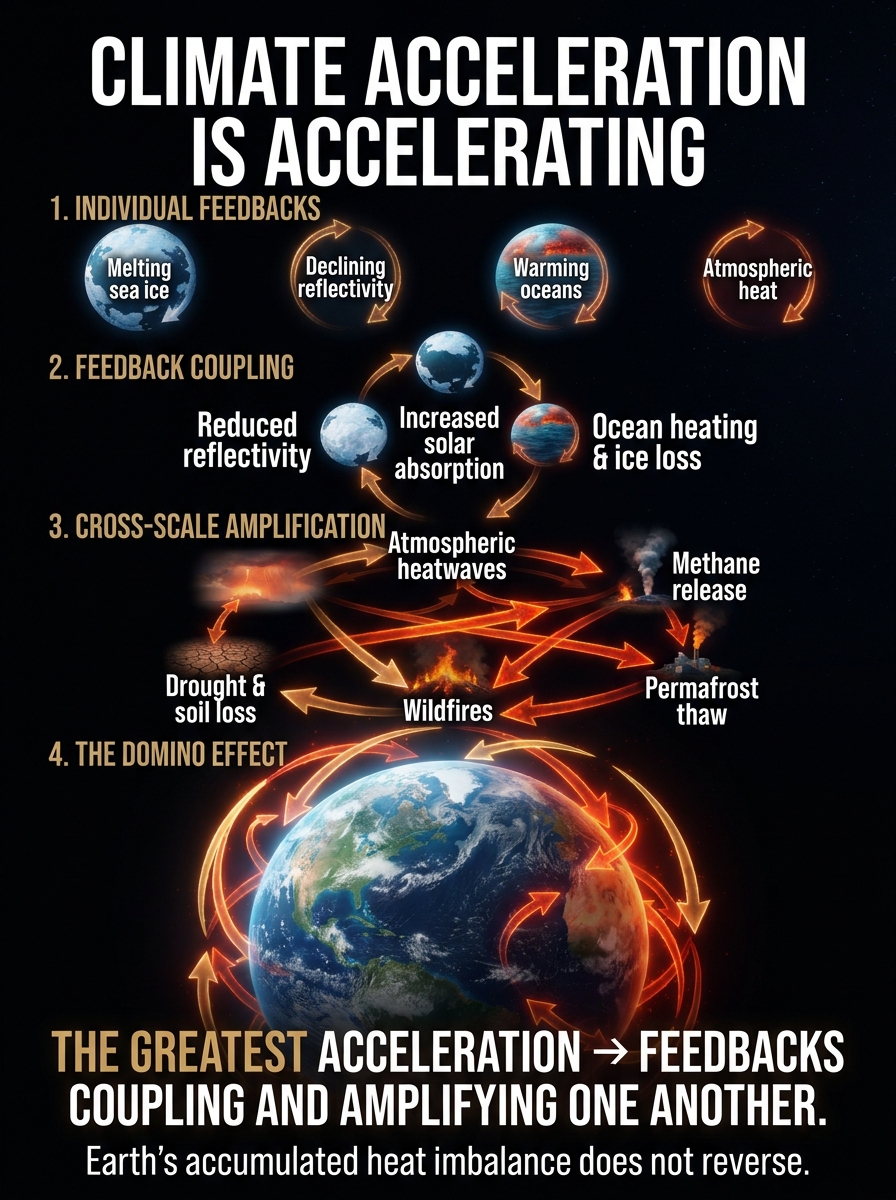
Climate Change Is Accelerating—and the Acceleration Is Accelerating.
The most dangerous part of climate change isn’t any single feedback. It’s how they interact.
Melting ice reduces Earth’s reflectivity. Warming oceans add energy. Heatwaves intensify drought. Drying landscapes fuel wildfires. Thawing permafrost releases additional greenhouse gases.
These processes don’t operate independently. They activate, amplify, and reinforce one another across Earth’s interconnected systems.
Individual feedbacks eventually encounter physical limits, but that doesn’t reverse accumulated warming or restore Earth’s energy balance. Meanwhile, other feedbacks continue developing and coupling.
The greatest danger is the accelerating domino effect created when multiple climate feedbacks amplify one another.
Understanding which feedbacks are accelerating matters. Understanding which are coupling fastest—and how that coupling amplifies the entire climate system—matters even more.
Our children and grandchildren are counting on us to understand the science and act accordingly.
[Intro]
This song was written and recorded during serious storm and a power outage…
… however, we kept up the wattage
Well, that was a loud one!
Power’s out…
But we’re still here!
(Yes! We’re still hear!)
Hear?
(Here!)
[Verse 1]
The wind is howling down the street
Tree limbs dancing to the beat
Lights go blink, then disappear
Is everybody ready here?
The grid goes down, the screens go black
No easy way to bring it back
But when the storm begins to rage
Dress rehearsal turns to stage
[Refrain]
Whatcha gonna do
(When the power goes out)
Whatcha gonna do
(… tell me true)
Hard to be in outrage
(In a power outage)
… in this day and age
(No doubt)
When the power goes out
(Doesn’t help to cry or shout)
[Verse 2]
Keep enough to last the night
Don’t discover at two tonight
That the tank is running dry
And there’s no gas station nearby
(Especially on a holiday… Say:)
[Refrain]
Whatcha gonna do
(When the power goes out)
Whatcha gonna do
(… tell me true)
Hard to be in outrage
(In a power outage)
… in this day and age
(No doubt)
When the power goes out
(Doesn’t help to cry or shout)
Keep it up
(Keep running!)
Already
(Ready!)
Sure beat dumb numbing
[Bridge]
Risk management
(Emergency management)
They go hand in hand
(That’s the plan)
Woe, oh, oh
(Whoa, whoa)
Practice is over
(It’s time to go)
The curtain lifted
(The lights shine bright)
Better get goin’…
(We ain’t got all night)
It’s time to shine
(Shine, shine)
Come on! Shine On!
(Shine, shine)
Insight…
(Into the night)
… We’re on!
[Final Refrain]
Whatcha gonna do
(When the power goes out)
Whatcha gonna do
(… tell me true)
Hard to be in outrage
(In a power outage)
… in this day and age
(No doubt)
When the power goes out
(Doesn’t help to cry or shout)
Whatcha gonna do
(When the power goes out)
Whatcha gonna do
(… tell me true)
[Outro]
Woe, oh, oh
(Whoa, whoa)
Practice is over
(It’s time to go)
The curtain lifted
(The lights shine bright)
Better get goin’…
(We ain’t got all night)
It’s time to shine
(Shine, shine)
Come on! Shine On!
(Shine, shine)
Insight…
(Into the night)
… We’re on!
And if the power stays on…
(More insight into incite)
We’re still good to go!
About the Song
# Emergency and Risk Management …They Go Hand in Hand
(Practice Is in Session: Nor’easter Edition) UPDATE: We’re On!
I just heard a loud BOOM! Must have been a transformer or sumpin’ big!
We’re now running the computer network and my living space on backup power. Looks like the practice session just turned into the real thing!
PECO reports: No estimated time of restoration.
VERIZON reports that there’s a commercial power outage in my area, but they’ve got my connection covered.
So, despite the nor’easter knocking out regional power, we’re good to go!
Yup. Did some lookin’ round… and it was indeed something big. See attached photo.
Original Post
Scenario planning, preparation, practice, and discipline are essential to managing risk—and, ideally, preventing it from ever becoming emergency management.
Whenever you have an opportunity to prepare for a real emergency, take advantage of it. A day like today is an excellent opportunity to put your emergency plans to the test.
It’s 42°F under a strong nor’easter impacting West Chester, Pennsylvania, and much of the East Coast today, Thursday, November 26, 2026.
The wind, and especially the gusts, are mind-blowing. Everything else is pretty well blown, too.
My yard looks like someone dropped a bomb on it.
We’ve already lost electricity twice, for about two minutes each time.
But I’m not waiting for the power to fail completely. I’m testing myself while I still have the luxury of electricity.
**Generator preparation is a good place to start.**
Under conditions like these, I keep my generator indoors at room temperature until it’s needed. In the past, when the generator and fuel were stored at temperatures near or below freezing, I’ve had trouble getting the generator started. And once you’ve lost power and the house starts getting cold, warming up a stubborn generator becomes considerably more difficult. That’s not exactly when you want to discover a problem.
So, I took the generator outside, checked the fuel supply, topped it off, started it up, and let it run for a while.
Afterward, I let it cool down for a few minutes before bringing it back inside to its climate-controlled storage conditions.
**Next comes the worst-case scenario.**
I’m calculating what happens if the power goes out for hours or even days.
I’ve got enough fuel on hand to run the generator for at least eight hours. That’s my minimum standard. I want to be able to get a full night’s sleep without having to get up in the middle of a storm to refuel.
And I certainly don’t want to discover at 2 a.m. that my only remaining option is to drive around looking for an all-night gas station that may or may not have electricity, fuel, or anyone particularly interested in helping me.
There’s a reason it’s called emergency preparedness, not emergency improvisation!
**Test complete.**
I can now eat, record music, sleep, take a hot shower, and generally rest easy.
That’s the beauty of emergency and risk management: A little preparation beforehand can save you an awful lot of excitement afterward.
And if the power stays on, at least I got some practice!
[Intro]
One storm…
Then another…
(And another?)
(And another?)
[Drums enter]
Here we go again!
(Back to begin.)
[Verse 1]
September came and made its mark
Ripped the shoreline, left it scarred
Thought we’d have some time to mend
Then October came again
Sand was gone and dunes were torn
Coastal defenses weather-worn
Before the damage could be cleared
Another storm was drawing near
[Pre-Chorus]
The waves keep coming
(The winds keep blowing)
The clock keeps running
(There’s no time for slowing)
What was lost
(Hasn’t been restored)
The next one hits
(And adds some more)
[Chorus]
Nor’easter
(Nor’easter)
(Nor’easter)
What a disaster!
(Oh, no, no, no)
Three in a row
(Who knows…)
There she blows!
[Verse 2]
Thanksgiving brought the third attack
The coastline couldn’t take it back
The roads, the homes, the power lines
Still bearing damage from the times
The beach won’t build itself again
The dunes can’t heal before the rain
When nature’s defenses disappear
The next big storm brings greater fear
[Chorus]
Nor’easter
(Nor’easter)
(Nor’easter)
What a disaster!
(Oh, no, no, no)
Three in a row
(Who knows…)
There she blows!
One more wave!
(Who will save?)
I don’t know…
(One more blow!)
[Chorus]
Nor’easter
(Nor’easter)
(Nor’easter)
What a disaster!
(Oh, no, no, no)
Three in a row
(Who knows…)
There she blows!
[Bridge]
It’s not just the storm
(It’s what came before)
It’s not just the waves
(It’s the weakened shore)
It’s not just the wind
(It’s the damage that stays)
It’s the loss of protection
(That compounds with the days)
A tipping point
(You may not see)
A threshold crossed
(Suddenly)
A little more
(Than systems can bear)
A cascade begins
(And there’s no repair)
The question isn’t just how much damage the next storm will cause…
It’s how much resilience will be left when it arrives.
(What survives….?)
Three storms!
(One coastline!)
Damage done!
(Over time!)
[Final Chorus]
Nor’easter
(Nor’easter)
(Nor’easter)
What a disaster!
(Oh, no, no, no)
Three in a row
(Who knows…)
There she blows!
Nor’easter
(Nor’easter)
(Nor’easter)
What comes after?
(Oh, no, no, no)
Damage remains
(Through wind and rain)
And the next one comes again!
[Outro]
Damage accumulates
(Resilience declines)
Thresholds are crossed
(Down the line)
Three in a row
(There she blows!)
What’s left to show?
(Who knows…)
Three nor’easters.
One cumulative problem.
And the next storm doesn’t start from zero.
(Oh, no, no, no!)
(Oh, no, no, no!)

About the Song
🌊 **THE CUMULATIVE DAMAGE PROBLEM: 3 NOR’EASTERS IN A ROW**
**When Storms Arrive Faster Than Nature Can Recover**
The September 2026 nor’easter was a major economic and environmental event. But it wasn’t the end of the story.
Two more coastal storm events followed, culminating in the powerful Thanksgiving Day nor’easter on November 26.
Three successive storms. Accumulating damage. Declining resilience.
There is an important climate and economic principle here that deserves greater attention:
**The damage from one storm doesn’t disappear when the storm passes.**
Beaches don’t instantly recover. Dunes don’t rebuild themselves overnight. Roads, utilities, homes, and businesses may remain damaged when the next storm arrives.
This creates three interconnected problems:
1. **CUMULATIVE DAMAGE:** Each successive storm adds to damage that has not yet been repaired or naturally restored.
2. **DECLINING RESILIENCE:** Natural protective systems and human infrastructure progressively lose their ability to absorb additional disturbances.
3. **TIPPING POINTS:** Gradual deterioration can eventually cross a physical threshold, producing sudden and disproportionately large consequences.
The same storm can produce substantially greater damage when it encounters a coastline that has already lost much of its natural protection.
And the economic consequences extend far beyond the initial disaster estimate.
Repeated repairs, infrastructure replacement, insurance losses, business interruptions, and diminished natural protection create an accumulating financial burden.
This is why evaluating extreme weather as a collection of isolated events misses an essential part of the problem.
**Damage accumulates. Resilience declines. Thresholds are crossed. Consequences cascade.**
I’ve updated my paper to examine the September, October, and Thanksgiving 2026 nor’easters through this broader scientific and economic framework.
The central question isn’t simply how much damage the next storm will cause.
**It’s how much resilience will remain when it arrives.**
Three Successive Nor’easters: Cumulative Damage, Declining Resilience, and Tipping Points
[Intro]
Your place…
My place…
One place!
[Verse 1]
Different roads, the same old sky
Different questions, wondering why
Draw the lines and stake your claim
But underneath, we’re all the same
Round and round the planets spin
Where you end is where I begin
No separate world for me and you
One little planet we’re passing through
[Refrain]
Your place or my place
(Tell me true)
… ‘suppose in either case
(We’re where “we” do)
Your place is mine
(Throughout time)
One place
(One race)
Human
Say it again:
Same space!
(One race)
Human
[Bridge]
No borders in the atmosphere
No other home to disappear
One little blue world in the sun
One human story, everyone
[Final Refrain]
Your place or my place
(Tell me true)
… ‘suppose in either case
(We’re where “we” do)
Your place is mine
(Throughout time)
Same space!
(One race)
Human
Say it again:
Same space!
(One race)
Human
[Outro]
Same space!
(One race!)
Human!
Same space!
(One race!)
Human!
Where we do…
Is what we do.