1Independent Climate Researcher, Economist, Membrane Institute, USA
2Independent Physicist, Membrane Institute, USA
Q: How fast is climate change accelerating?
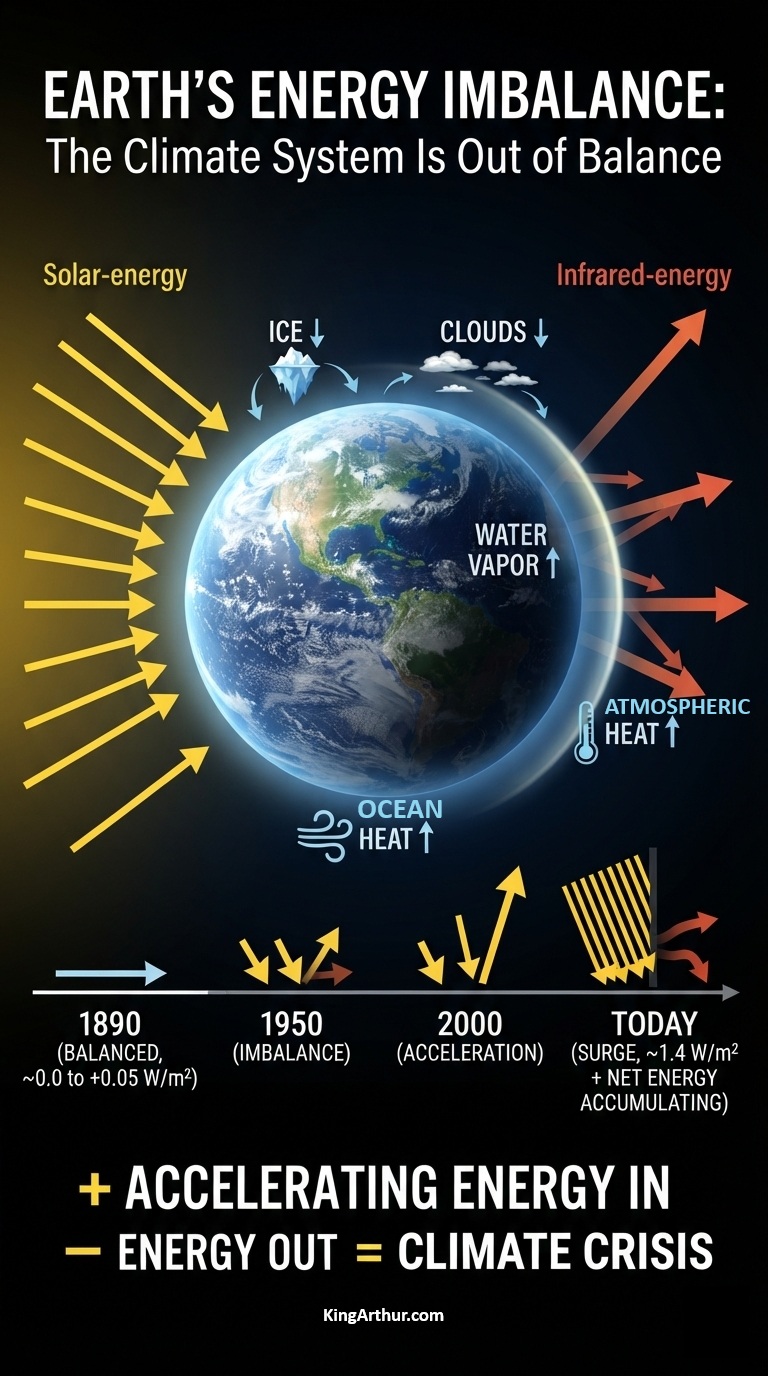
A: From the Industrial Revolution through the 1990s, key climate-acceleration indicators appear to have doubled on timescales closer to a century. Today, many major warming-related impacts are doubling on timescales closer to a decade.
In effect, the leading indicators suggest an approximately 2^6-fold compression in doubling times per decade—a dramatic acceleration in the pace of change. Multiple climate indicators now point to rates of warming-related disruption far beyond those observed during the modern instrumental era and potentially beyond much of the geological record.
This is not merely rapid climate change. It may represent one of the most abrupt large-scale climate transitions in Earth’s history.
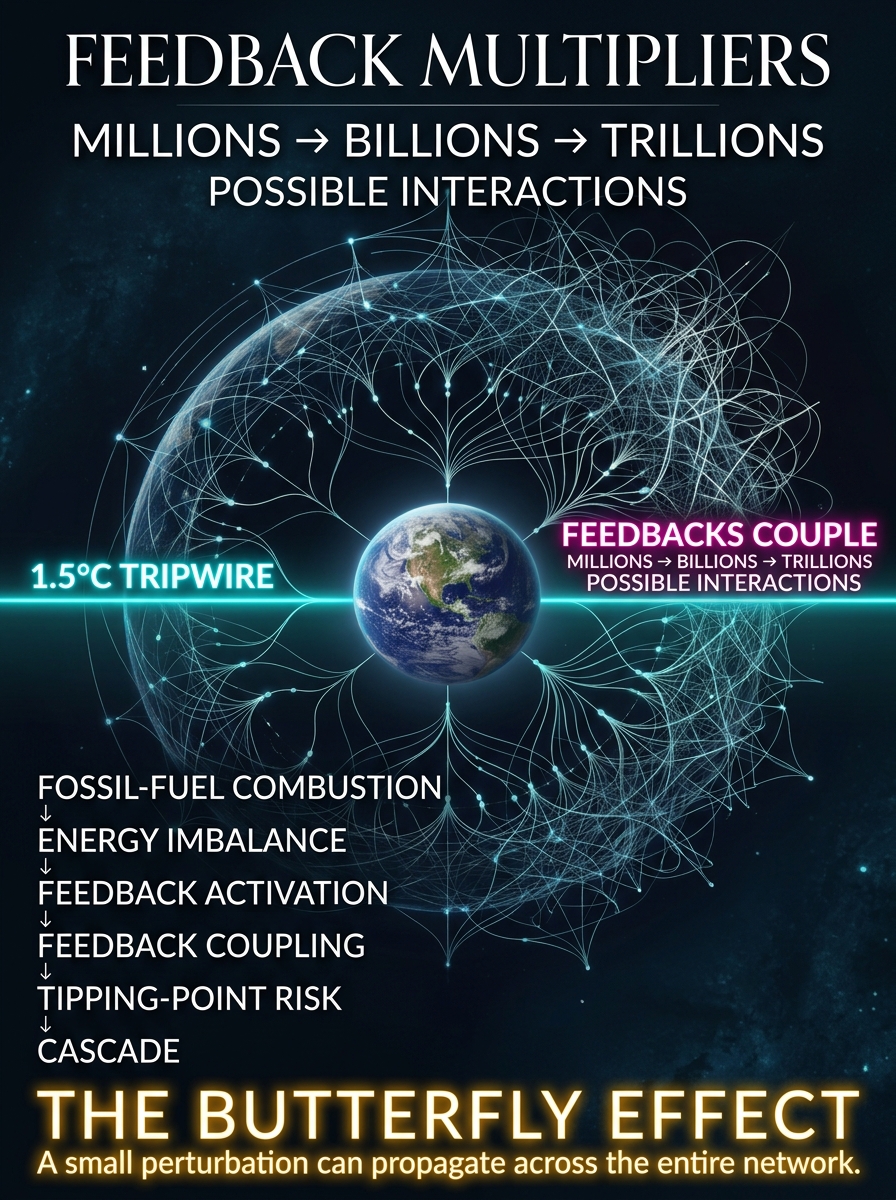
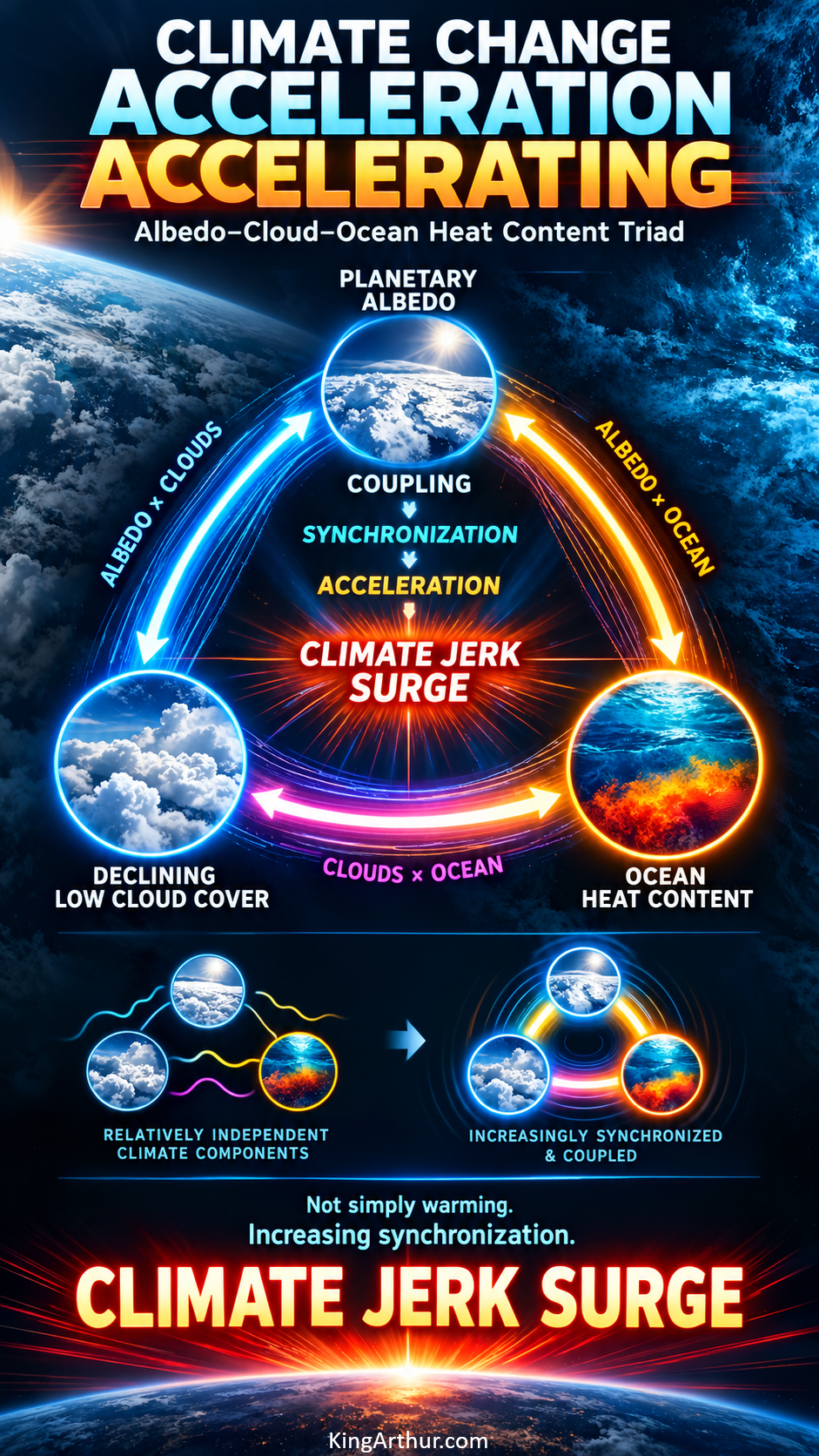
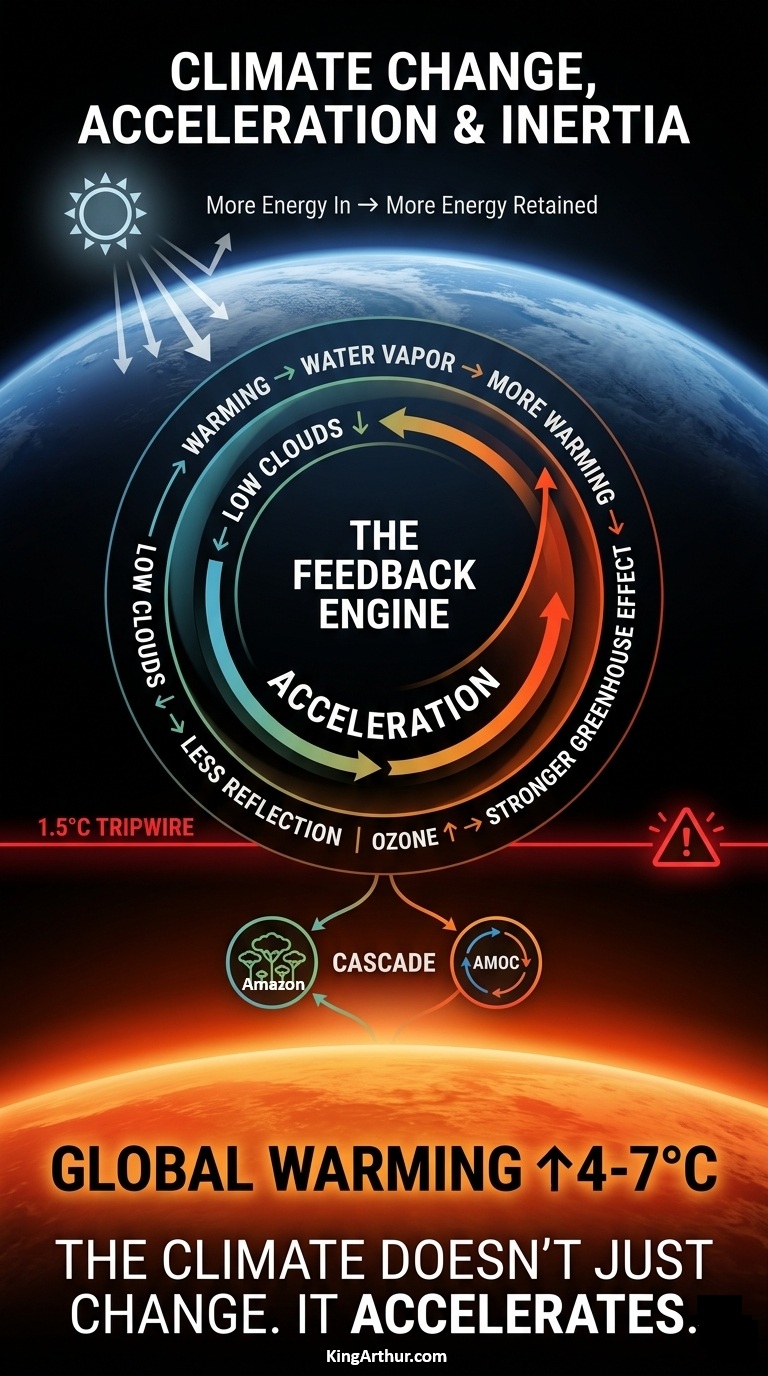
Interconnected tipping cascades are emerging across both biogeophysical and social-ecological systems. These interacting feedback loops are producing a Domino Effect that is accelerating climate change in increasingly nonlinear ways.
A useful rule of thumb is that many climate impacts now appear to be accelerating at roughly ~26-fold on a decadal basis.
The Nonlinear Acceleration framework focuses on the rate of acceleration of climate change.
At the time the hypothesis was first developed in the 1990s, observed acceleration rates were closer to ~21-fold per century doubling behavior. More recent analyses across multiple independent datasets suggest much shorter characteristic timescales consistent with stronger feedback amplification of 26-fold on a decadal basis.
* a ~60× increase in the effective growth constant
* or about two orders of magnitude faster system amplification
depending on formulation and interpretation.
In plain language:
* the first regime behaves like a slow century-scale doubling process
* the second behaves like a rapidly amplifying nonlinear feedback system with collapsing doubling times.
Due to feedback amplification, the system may exhibit increasingly nonlinear behavior over time. In that context, higher-end warming outcomes become more dependent on feedback strength and system response.
Current ranges discussed in the literature generally include:
* Linear estimates: ~3–5°C
* Higher-feedback scenarios: ~6–9°C (upper-range plausible outcomes under strong feedback participation)
* Long-term high-impact pathways: >10°C over centuries (often discussed in “Hothouse Earth” framework contexts)
If you have any doubts, you can apply this “rule of thumb” framework across a wide range of observed climate indicators. It has been extensively examined against datasets involving:
* Hydrological extremes and drought–flood climate whiplash
* Ocean heat content and marine heatwaves
* Greenland and Antarctic ice-sheet dynamic instability
* Sea-level rise doubling times
* Atmospheric river intensity
* Rossby wave amplification and persistence
* Wildfire feedback amplification cycles
* Permafrost thaw and thermokarst collapse
* Methane emissions from wetlands and thawing permafrost
* Atmospheric water-vapor amplification
* Arctic sea ice decline
* Polar amplification
* Wet-bulb temperature exceedances
* Lengthening and increasingly persistent heat waves
* Accelerating increases in nighttime minimum temperatures
* Wildfire frequency and burned area
* Temperature-gradient destabilization
* Moisture-gradient amplification
* Pressure-gradient amplification
* AMOC weakening
* Boreal forest stress and biome migration
* Amazon rainforest dieback
* Zombie fires / overwintering fires
Doubling time (discrete form):
Td = ln(2) / ln(1 + r)
Where:
For continuously evolving systems:
Td(t) = ln(2) / k(t)
Where:
The discrete and continuous formulations are related by:
k = ln(1 + r)
For small growth rates, k ≈ r, which explains why both expressions yield similar results in low-growth regimes.
In feedback-driven systems, k(t) may vary over time as system feedbacks strengthen or weaken. As a result, Td(t) varies over time as a diagnostic quantity derived from the instantaneous growth rate.
When k(t) increases, doubling times decrease, indicating acceleration of the underlying growth process.
One scientific nuance: this expression is exact under the assumption that k(t) is locally constant over the evaluation interval. If k(t) varies significantly over time, Td(t) should be interpreted as an instantaneous diagnostic measure rather than a predictive doubling interval.
A reasonable all-in estimate for the 2025 economic burden of climate change on the United States is about $1.5 trillion, or roughly $4,400 per person. For a family of four, the implied annual burden is roughly $17,600. That burden extends far beyond direct disaster losses and includes rising insurance costs, climate-related health expenses, food and utility inflation, lost productivity, tourism losses, and growing public disaster spending.
A bottom-up estimate of the all-in 2025 economic cost of climate change in the United States, with the goal of approximating the average cost per person when both direct and indirect burdens are considered. Because no official ledger exists for “total climate costs,” the analysis aggregates seven major categories of climate-related economic burden: (1) direct disaster damages, (2) property insurance and real-estate destabilization, (3) healthcare and health-insurance costs, (4) climate-driven inflation in food, utilities, and supply chains, (5) tourism and recreation losses, (6) government expenditures and public borrowing strain, and (7) productivity losses and business interruption.
Using a U.S. population of approximately 340 million, the paper estimates a 2025 climate burden of roughly $1.5 trillion, with a plausible range of $1.2 trillion to $1.8 trillion. On a per-person basis, this implies an average cost of approximately $4,400 per American in 2025, with a conservative range of $3,500 to $5,500 per person. For a family of four, the implied annual burden is roughly $17,600.
The core conclusion is that climate change now functions as a diffuse but powerful economic tax on American life. It raises insurance premiums, erodes home values, inflates electricity and food costs, worsens public-health burdens, strains local and federal budgets, and lowers productivity. Even when households are not directly hit by a flood, wildfire, or hurricane, they increasingly pay for climate change through the price system, the insurance system, the healthcare system, and the tax system. Climate change in the United States is therefore not just a future risk; it is already a major annual cost center embedded in the daily economy.
The long-run evolution of U.S. climate-related economic burdens and finds strong evidence of nonlinear acceleration. Using a reconstructed baseline in the late 19th century and an integrated 2025 estimate of approximately $1.5 trillion annually in climate-attributable economic losses, we estimate that the effective doubling time of climate-related economic burden has compressed from ~115 years (circa 1890) to ~8 years in the present regime. We project forward under continued compression dynamics to 2030 and 2040, showing that costs may enter multi-trillion-dollar annual regimes within the next two decades if current nonlinear amplification persists.
| Year | Total Economic Burden | Per Capita |
|---|---|---|
| 1890 | $0.2B | Negligible |
| 2025 | $1.5T | $4,400 |
| 2030 | $2.3T | $6,800 |
| 2040 (moderate) | $7.4T | $21,000 |
| 2040 (high stress) | $12T | $35,000 |
The CWAF estimates that the annual welfare cost of climate change in the United States in 2025 plausibly falls in a range of approximately $350 billion to $900 billion, with a central estimate near $560 billion, equivalent to roughly $1,650 per person using a U.S. population of 340 million. This estimate is intentionally narrower than a full “all-in” climate burden because it focuses on human welfare damages rather than total economic damages such as property losses, insurance-market destabilization, or climate-driven inflation. However, it captures a category of harm that GDP-centric approaches systematically undercount: the direct erosion of human health, longevity, and lived well-being.
The central implication is that climate change should be understood not only as a physical hazard or macroeconomic drag, but as a large and already measurable welfare tax on American life. Any estimate of the cost of climate change that omits mortality, chronic health degradation, and quality-of-life loss risks understating the true burden by a wide margin.
The Compression of Time: Where Are We in Climate Change?
You Are Here.
One of the simplest ways to understand climate change is through the changing frequency of extreme events.
In the 1990s, what was considered a 500-year flood was expected to occur, on average, once every five centuries. By the early 2000s, many of those same events were being reclassified as 100-year floods. By the 2020s, they increasingly resembled 10-year floods. Today, in some regions, comparable flood events are occurring every few years.
The flood itself did not change.
What changed was the climate system.
The same phenomenon can be observed across numerous climate indicators:
The key lesson is that climate change is not simply about gradual warming. It is about the acceleration of change itself.
For decades, scientists and policymakers often discussed climate impacts using relatively stable timelines. Yet as feedback loops strengthen and multiple systems interact, those timelines begin to collapse. What was expected centuries from now may arrive within decades. What was expected decades from now may arrive within years.
The question is no longer whether the climate system is changing.
The question is how rapidly interconnected climate, ecological, economic, and social systems respond as accelerating feedbacks compress the time available for adaptation.
Understanding where we are in that process is essential for understanding the risks that lie ahead.
What does climate change look like?
In many ways, it resembles a cracked windshield.
At first, you may not notice anything at all. Time passes. The damage appears minor or even invisible. Then one day, a small fracture catches your eye — just a tiny finger crack stretching across the glass.
You think:
“Maybe it won’t get worse.”
But during all that time, unseen stress fractures have already been spreading beneath the surface. Temperature changes, vibration, pressure, and repeated impacts continue weakening the structure. The windshield may appear stable right up until the moment it suddenly fails.
Then one day:
BOOM.
The entire system changes.
Climate systems often behave the same way.
The graphic is a simplified representation of an extraordinarily complex system. Nevertheless, it provides a familiar visual analogy that helps make nonlinear climate dynamics easier to understand.
Up through the 1990s, we were largely in Frame 1 — invisible stress. The underlying pressures were building, but most of the damage remained hidden from view.
By the early 2000s, the first visible cracks began to emerge. Evidence of accelerating climate change, ecological degradation, and feedback amplification became increasingly difficult to ignore. Even then, many observers assumed the system might stabilize on its own and argued that the damage would remain limited.
Today, we are in the phase where hidden fractures are propagating throughout the system and becoming increasingly apparent. The accumulating damage can now be observed across multiple interconnected indicators, including rising temperatures, ocean heat content, ice-sheet instability, biodiversity loss, extreme weather, and economic disruption. It is becoming clear that the system is not simply going to repair itself.
The central question is no longer whether the cracks exist, but how rapidly the system moves toward the next phase — the point where cascading failures become unavoidable and the damage accelerates dramatically.
Because this is a nonlinear system dominated by interacting feedback loops, historical timelines provide only limited guidance. As stress accumulates, change can occur gradually for long periods and then suddenly accelerate, making future conditions arrive much faster than past trends alone would suggest.
A useful way to think about climate change is through the analogy of an accelerating train.
Imagine riding on a train.
Looking out the window, you can clearly see that the train is moving faster than it was before. That increase in speed is observable and largely undisputed. At the same time, the ride is becoming less smooth. There is more vibration, more instability, and greater variability throughout the system.
The train is still on the tracks.
The engineer still has control.
But momentum is increasing.
The critical question is not whether the train is moving. The critical question is what lies ahead.
A train can safely accelerate for a very long time under favorable conditions. Problems arise when increasing speed encounters constraints that the system was not designed to handle.
A steep decline.
A sharp curve.
A damaged bridge.
The faster the train is moving when it reaches those conditions, the more difficult it becomes to avoid derailment.
Climate change presents a similar risk-management challenge.
The prudent course is not to wait until the curve becomes visible.
The prudent course is to reduce risk while options remain available.
Explore the Complete Runaway Train Scenario
One last analogy for musicians.
A band is on stage, and a guitar amp begins to feed back. Left unchecked, the feedback becomes self-reinforcing. As it grows more intense, it triggers feedback in the vocalist’s microphone, which in turn triggers feedback in the stage monitors. The cascading feedbacks spread throughout the sound system, resulting in pure chaos across the entire arena – “approaching” singularity.
So when the sound engineer yells at the guitarist to “turn it down,” that’s essentially where we are today.
The Earth has at least several dozen major tipping points. At present, roughly nine appear to have entered self-reinforcing feedback loops. This is like having a large band with nine guitarists, each trying to hear themselves over the others. As a result, each guitarist turns up their amplifier a little louder. Soon, all nine amps are feeding back.
Humanity is the sound engineer. We must take immediate action because these feedbacks can spill over and trigger additional feedbacks. Those new feedbacks can then amplify the original ones, creating a cascading network of self-reinforcing processes.
A simple real-world example is sea ice melt and the albedo effect. As highly reflective sea ice melts, it exposes darker ocean water that absorbs more solar energy. This is analogous to the first guitarist turning the amplifier up too loud and creating feedback. The darker ocean surface warms more rapidly, accelerating the melting of additional ice and exposing even more dark water.
It is possible that this process has entered a self-reinforcing runaway feedback loop. However, it is important to recognize that not all runaway processes continue indefinitely. Once the sea ice is largely gone, that particular feedback will eventually reach its limit and stabilize. In the meantime, however, it can amplify numerous other feedbacks throughout the climate system, including those that affect carbon storage and carbon dioxide sequestration.
Explore the Complete Runaway Guitar Feedback Scenario
Definitions of: runaway climate indicator feedbacks, runaway greenhouse effect, Hothouse Earth, Venus Syndrome, and singularity
Unfortunately, the underlying science increasingly points in that direction. More importantly, it highlights what may be the most critical issue facing society today: not whether climate change is occurring, but whether we are approaching thresholds beyond which many impacts become effectively irreversible on human timescales.
None of us are arguing that the entire Earth system is in a fully runaway state today. However, observations accumulated over the past four decades suggest that multiple climate indicators are accelerating faster than many earlier projections anticipated. We are also observing increasing evidence of self-reinforcing feedback loops emerging across interconnected climate, ecological, and economic systems.
The central question is no longer whether runaway behavior is possible in principle. The question is how we recognize the transition if and when enough individual subsystems enter self-reinforcing states that the larger coupled system begins exhibiting runaway characteristics of its own.
Our observations, along with those of many other researchers over the past four decades, indicate a significant acceleration in climate-related impacts and feedbacks. When we first developed portions of this hypothesis in the 1990s, observed acceleration rates were closer to what could be described as roughly 2¹-fold per century behavior. More recent analyses across multiple independent datasets suggest substantially shorter characteristic timescales, with amplification patterns closer to 2⁶-fold behavior on decadal scales.
Depending on how the calculations are formulated, this implies:
The exact numbers remain a matter of scientific debate, but the broader trend is increasingly difficult to ignore: the system appears to be accelerating faster than many earlier projections anticipated.
By 2023, multiple feedback loops were becoming directly observable in real-world data. Because of that, the question is no longer whether self-reinforcing climate processes are possible. The more important question is how we will recognize when enough interacting feedbacks have pushed the larger system beyond a critical threshold.
What is already clear is that substantial climate change has been locked in for at least the next several generations, even under extremely aggressive emissions reductions. If emissions continue and additional tipping elements become engaged, the probability of triggering broader system-wide instability increases significantly.
That is why the debate is shifting away from whether climate change is occurring and toward understanding the speed, scale, and interaction of the feedbacks that are now emerging.
Example: Amazon Rainforest Dieback
Example: Cryosphere Tipping Points and Ice Sheet Collapse
Polar amplification → weakened equator-to-pole temperature gradients → reduced thermal contrast that helps drive and stabilize large-scale atmospheric circulation → accelerated Greenland and Arctic ice melt → freshwater input into the North Atlantic and reduced salinity/density of surface waters → disruption and potential weakening of the Atlantic Meridional Overturning Circulation (AMOC) → reorganization of North Atlantic pressure fields and storm tracks → greater jet-stream waviness, slower progression, and amplified Rossby-wave behavior → more persistent blocking patterns, omega blocks, and meridional flow → stalled atmospheric rivers, prolonged heat domes, drought-flood swings, and other forms of hydroclimatic whiplash → destabilization of agriculture, infrastructure, ecosystems, and public health systems → accelerated land-ice loss and groundwater redistribution that shift mass across the planet → climate-driven mass redistribution sufficient to measurably alter Earth’s moment of inertia and contribute to changes in rotational dynamics, including a slight slowing of Earth’s rotation and changes in the length of day.
Example: Jerk-Behavior in Earth’s Rotation
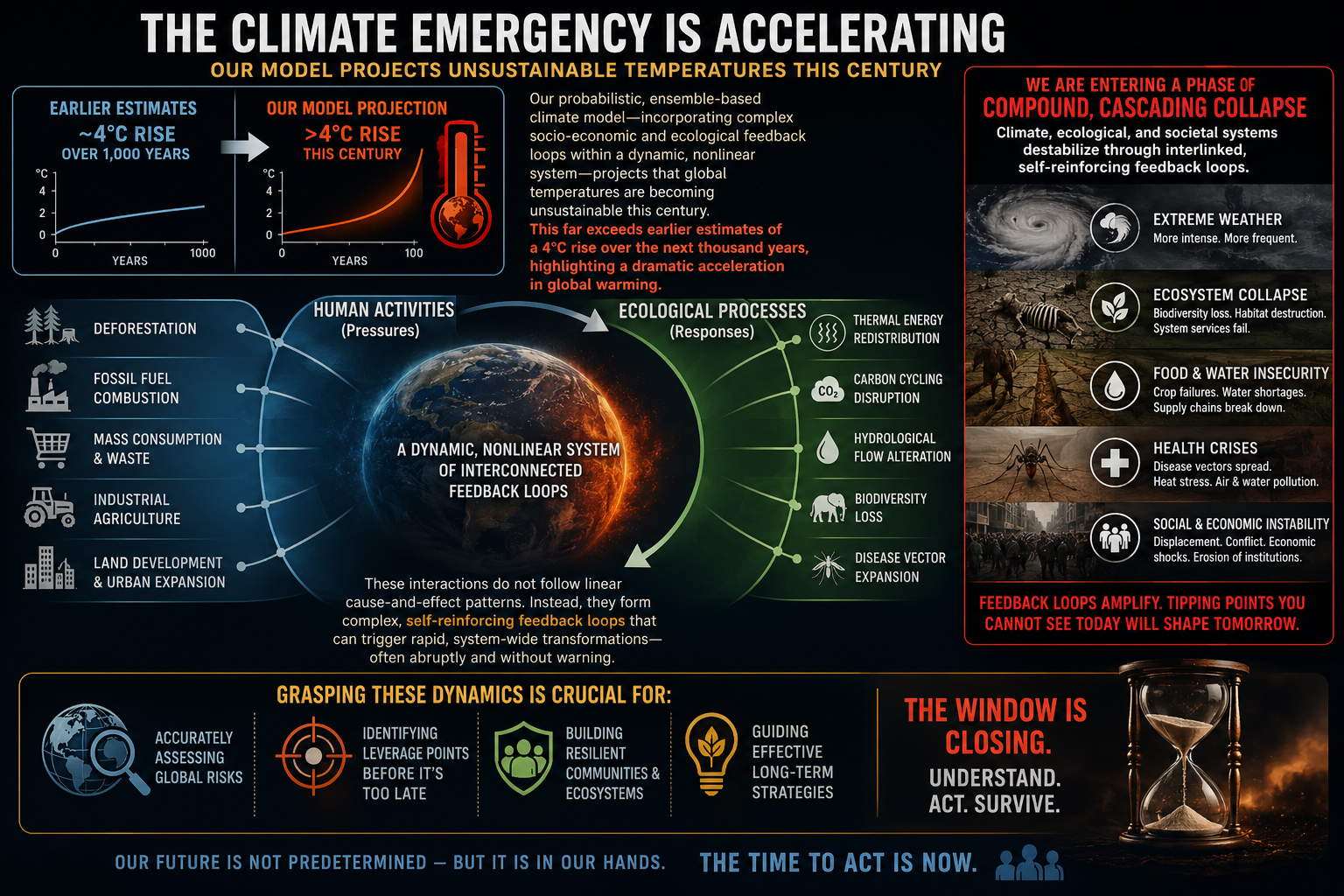
* Our probabilistic, ensemble-based climate model — which incorporates complex socio-economic and ecological feedback loops within a dynamic, nonlinear system — projects that global temperatures are becoming unsustainable this century. This far exceeds earlier estimates of a 4°C rise over the next thousand years, highlighting a dramatic acceleration in global warming. We are now entering a phase of compound, cascading collapse, where climate, ecological, and societal systems destabilize through interlinked, self-reinforcing feedback loops.
We examine how human activities — such as deforestation, fossil fuel combustion, mass consumption, industrial agriculture, and land development — interact with ecological processes like thermal energy redistribution, carbon cycling, hydrological flow, biodiversity loss, and the spread of disease vectors. These interactions do not follow linear cause-and-effect patterns. Instead, they form complex, self-reinforcing feedback loops that can trigger rapid, system-wide transformations — often abruptly and without warning. Grasping these dynamics is crucial for accurately assessing global risks and developing effective strategies for long-term survival.
→ “Solutions to the Fossil Fuel Economy and the Myths Accelerating Climate and Economic Collapse“