Low-Level Cloud Feedback: The Mega-Multiplier — An Additional 1.5°C to 2°C
The loss of low-level cloud albedo could contribute an additional 1.5°C to 2°C of global warming. In a tipping point scenario where clouds completely break up under extreme emission tracks, it could trigger a catastrophic, abrupt warming spike.
SIMPLIFIED INTRODUCTION
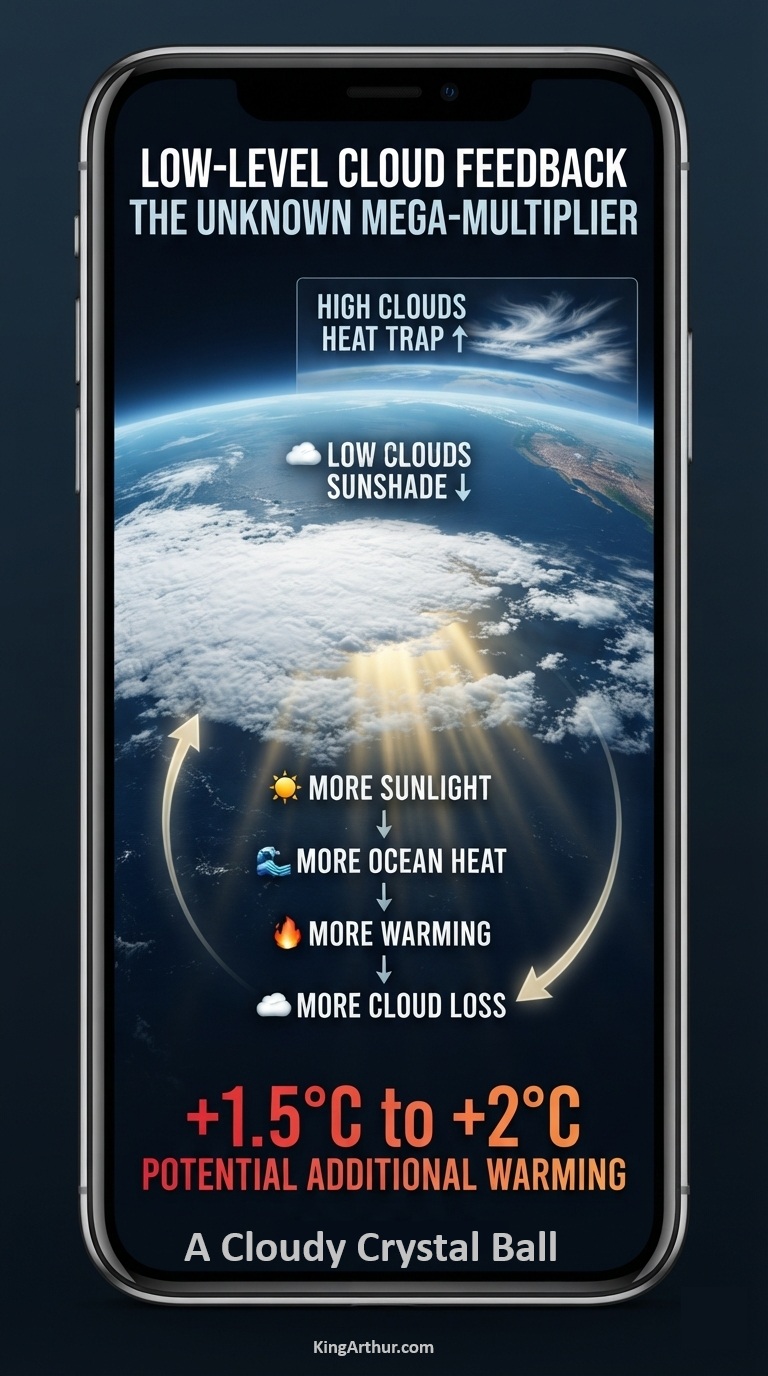
☁️🌎 LOW-LEVEL CLOUD FEEDBACK: THE UNKNOWN MEGA-MULTIPLIER
What if one of Earth’s most important climate amplifiers is something we still don’t fully understand?
Low-level marine clouds are more than weather. They are a planetary sunshade—reflecting enormous amounts of incoming sunlight back into space.
But what happens if that sunshade starts to disappear?
🔥 As the climate warms, low-level clouds over the Pacific may thin, weaken, and potentially reach a tipping point where marine stratocumulus cloud decks fragment.
Less reflective cloud cover means more sunlight reaches the dark ocean.
More absorbed solar energy means more warming.
And more warming can further disrupt the clouds.
That is a feedback loop.
But the bigger concern is what happens when this feedback couples with other warming feedbacks already accelerating across the Earth system.
🌀 Warming
↓
☁️ Low clouds diminish
↓
☀️ More solar energy enters the ocean
↓
🌊 Ocean warming accelerates
↓
🔥 Further climate warming
↓
☁️ More cloud disruption
Leading research suggests that the loss of low-level cloud albedo could contribute an additional 1.5°C to 2°C of global warming.
That would not be a minor correction to the climate trajectory.
It may be The Mega-Multiplier. In a tipping point scenario where clouds completely break up under extreme emission tracks, it could trigger a catastrophic, abrupt warming spike.
The climate system is not a collection of isolated feedbacks.
It is a coupled, nonlinear system in which feedbacks can interact, reinforce one another, and accelerate change.
☁️ The clouds may be one of the biggest unknowns.
And the Pacific may be where we need to look.
Read the full paper and explore the feedback cascade:
The Mega-Multiplier
The dynamic role of clouds is widely recognized as the single largest source of uncertainty in modern climate modeling. Cloud feedbacks can act as both blankets, trapping Earth’s heat, and sunshades, reflecting sunlight back into space.
As global warming has entered a faster decadal phase, leading research indicates that changes to both high- and low-level cloud structures are shifting toward a strong, positive warming-amplification loop.
1. High-Level Clouds: The Expanding Heat Trap
High-level clouds, such as cirrus clouds, reside above 20,000 feet. Composed primarily of ice crystals, they are relatively thin and transparent to incoming solar radiation, allowing sunlight to pass through them. However, they are highly effective at absorbing the outgoing longwave infrared radiation—heat—emitted from Earth’s surface and re-radiating it back downward.
The Anvil Cloud Expansion: Deep convective storms in the tropics create massive, fan-shaped high clouds known as tropical anvil clouds. As the upper troposphere warms and shifts, these clouds are expected to remain at higher, colder altitudes. Because they are colder, they radiate less heat out to space, increasing their efficiency as a planetary heat trap.
The High-Cloud Shift: Furthermore, climate models suggest that warming causes high-level clouds to shift toward higher latitudes, or poleward. This migration redistributes the heat-trapping effect over areas that are already experiencing accelerated melting, like the Arctic, compounding regional warming trends.
2. Low-Level Clouds: The Diminishing Planetary Sunshade
While high clouds act as greenhouse blankets, low-level clouds—specifically marine stratocumulus decks that sit below 6,000 feet—act as Earth’s primary solar sunshade. They cover roughly 20% of the subtropical oceans and reflect up to 30% to 60% of incoming sunlight back into space.
The shrinking of these low-level cloud decks, particularly over the northeast and southeast Pacific Ocean, is the focal point of intense scientific concern.
The Mechanics of Pacific Cloud Loss
Low-lying marine stratocumulus clouds depend heavily on a fragile thermal balance. They are sustained by a process called cloud-top radiative cooling, in which the tops of the clouds radiate heat out into space, cooling the air within the cloud layer. This cooling causes the air to sink, creating a convective loop that draws moisture up from the warm ocean surface below to maintain the cloud deck.
Global warming disrupts this system in two powerful ways:
Atmospheric Opacity: High concentrations of greenhouse gases render the lower atmosphere more opaque to infrared radiation. This traps heat above the clouds, warming their tops and stifling the cloud-top radiative cooling required to drive convection.
Enhanced Evaporation and Turbulence: As sea-surface temperature (SST) rises, the layer of dry air above the marine boundary layer grows warmer. This induces stronger turbulence that entrains—pulls down—dry, warm air from above, rapidly evaporating the thin cloud layer.
The Feedback Cascade
[Trapped Heat at Cloud Tops]
                 │
                 ▼
[Stifled Radiative Cooling]
                 │
                 ▼
[Weakened Convection / Increased Evaporation]
                 │
                 ▼
[DISAPPEARING LOW CLOUDS]
                 │
                 ▼
[More Sunlight Absorbed by Dark Ocean]
                 │
                 ▼
[Accelerated +1.5°C Warming]
The +1.5°C Climate Amplifier
Groundbreaking thermodynamic simulations, notably led by researchers at Caltech’s Linde Center, have revealed that low-level clouds possess a critical tipping point.
If greenhouse gas concentrations continue to rise unchecked, marine stratocumulus decks over the Pacific could reach an instability threshold where they fragment and dissolve into scattered, shallow cumulus clouds. Without the vast reflective white sheets to shield the ocean, the dark tropical and subtropical waters would absorb massive amounts of solar energy.
Calculations indicate that the loss of this cloud albedo feedback alone could add an additional 1.5°C to 2°C of global warming. In a tipping point scenario where clouds completely break up under extreme emission tracks, it could trigger a catastrophic, abrupt warming spike.
Even short of a total breakup, observational data from satellites indicates that a gradual thinning of these clouds is already underway. This slow degradation is believed to be a major factor behind the recent acceleration in Earth’s total energy imbalance and ocean heat uptake.
The Unknown Mega-Multiplier
Cloud feedback is different from many other climate feedbacks because the direction, magnitude, and interactions of cloud changes remain exceptionally difficult to constrain.
The fundamental physics are clear: clouds can either reflect incoming solar energy back into space or trap outgoing heat within the climate system. But their response to a warming planet depends on where clouds form, how high they are, how thick they become, how long they persist, how they interact with atmospheric moisture and circulation, and how those changes couple with other climate feedbacks.
That creates the possibility of a multiplier effect.
A reduction in low-level Pacific clouds allows more solar energy to enter the ocean. Additional ocean warming changes evaporation, atmospheric circulation, and moisture transport. Those changes can alter cloud formation and persistence, potentially producing further reductions in reflective cloud cover. At the same time, changes in high-level clouds can increase the retention of outgoing heat.
The result is not simply more warming.
It is a potentially coupled feedback cascade:
Warming → cloud changes → altered albedo and heat retention → more absorbed energy → additional warming → further cloud changes.
This is why low-level cloud feedback may represent one of the most consequential uncertainties in the future climate trajectory.
If Pacific low-level cloud cover continues to diminish, the planet loses part of its natural solar shield at precisely the time that greenhouse-gas concentrations are increasing and other climate feedbacks are accelerating.
The question is no longer simply whether clouds respond to warming.
The critical question is whether warming is pushing the cloud system toward a threshold where the loss of low-level marine cloud albedo becomes a self-reinforcing source of additional global warming.
If so, low-level cloud feedback could become the unknown mega-multiplier—a climate feedback capable of coupling with other tipping elements and accelerating an already nonlinear Earth-system response.
Taking the Temperature of Climate Change: Meeting of the Minds
Easy-to-Read Resources
→ The Hitchhiker’s Guide to Climate Change
For the basics: Climate Change Simplified
Climate Change: What Can I Do?
Anthropogenic Global Warming 101
Feedback Loops →
Tipping Points →
Acceleration →
Domino Effect
Feedback loops amplify climate change and can push interconnected Earth systems past critical tipping points. As tipping points are crossed, they can trigger additional feedback loops and destabilize other climate systems. This cascading "Domino Effect" compresses timescales, accelerates change, and increases the risk of rapid, nonlinear climate transformations.