bookmark_borderDispersion

[Intro]
White light enters
(Slowing down)
Wavelength splinters
(Bending round)

[Verse 1]
How does a rainbow know
(Which way to go)
Raindrops act
(Reflect and refract)

[Chorus]
White light enters
(Slowing down)
Wavelength splinters
(Bending round)

[Bridge]
Exacting (refracting)
Shorts got the blues
Erecting (reflecting)
Sure’s got the hues
Cannot disparage
(Dispersion)

[Verse 2]
Into the prism schism
(Change in medium)
Refraction separation
(Into the spectrum)

[Chorus]
White light enters
(Slowing down)
Wavelength splinters
(Bending round)

[Bridge]
Exacting (refracting)
Shorts got the blues
Erecting (reflecting)
Sure’s got the hues
Cannot disparage
(Dispersion)

[Chorus]
White light enters
(Slowing down)
Wavelength splinters
(Bending round)

[Bridge]
Exacting (refracting)
Shorts got the blues
Erecting (reflecting)
Sure’s got the hues

[Outro]
Cannot disparage
(Dispersion)

A SCIENCE NOTE
A prism or a rainbow separates colors through a process called dispersion, where light is refracted (bent) as it passes through a medium with varying refractive indices for different wavelengths.

In a prism:

  • White light enters, slowing and bending due to the change in medium.
  • Shorter wavelengths (blue/violet) bend more than longer wavelengths (red).
  • This separation spreads the colors into a spectrum.

In a rainbow:

  • Raindrops act like prisms, refracting and reflecting sunlight.
  • Different wavelengths emerge at slightly different angles, producing the arc of colors visible in the sky.

From the album “Dispersion” by Daniel

The Human Induced Climate Change Experiment

MegaEpix Enormous

bookmark_borderA Bolt From the Blue

[Intro]
When something appears suddenly
(As if from nowhere)
In the face… not so subtly
(Bringing on despair)

[Verse 1]
The rate of change
Irate we rearrange
Could it be too late
To appreciate?

[Chorus]
A bolt from the blue
(Strikes you)
Causing you to wake
(To an earthquake)

[Bridge]
When something appears suddenly
(As if from nowhere)
In the face… not so subtly
(Bringing on despair)

[Verse 2]
The acceleration rate
Why do we participate
With all the hate
And being late?

[Chorus]
A bolt from the blue
(Strikes you)
Causing you to wake
(To an earthquake)

[Bridge]
When something appears suddenly
(As if from nowhere)
In the face… not so subtly
(Bringing on despair)

[Chorus]
A bolt from the blue
(Strikes you)
Causing you to wake
(To an earthquake)

[Bridge]
When something appears suddenly
(As if from nowhere)
In the face… not so subtly
(Bringing on despair)

[Outro]
A bolt from the blue
(Strikes you)

A SCIENCE NOTE
The Past, Present, and Future of Climate Change
We first developed the hypothesis of the non-linear acceleration of climate change in the 1990s. By the early 2000s, this hypothesis evolved into established climate theory, now widely accepted as scientific fact. My lab partner, a Doctor of Physics from Ohio State, and I collaborated to provide crucial evidence supporting this theory. Over time, we have observed a significant shift in the doubling time of climate change impacts — the rate at which the effects intensify. Initially, the doubling time was approximately 100 years, but it has since decreased to 10 years, and more recently, to just 2 years.

This trend means that the damage caused by climate change today is double what it was two years ago, and in two more years, it could be four times worse. Unfortunately, this rapid acceleration does not appear to be an anomaly, especially given the record-breaking events we’ve witnessed this year, even during the typically cooler La Nina phase. If this trajectory continues, the outcomes will be far more catastrophic than previously expected.

From the album “A Bolt From the Blue” by Daniel

The Human Induced Climate Change Experiment

MegaEpix Enormous

bookmark_borderAs to the Flow

[Intro]
Hey, there
(Stunned. Unaware)

[Verse 1]
Hey, there!
(Dumb? Unaware?)
Say, there…
(Do you even care?)
Stay there…
No fear
(I’m good hear)

[Chorus]
The music’s free
Quite happy
What I hear here

[Bridge]
All’s glowin’ fine
(Showin’ shine)
You know…
(As to the flow)

[Verse 2]
So there
(Numb. Unaware.)
Pray, there…
(Does more despair)
Fray there…
From fear
(I’m good hear)

[Chorus]
The music’s free
Quite happy
What I hear here

[Bridge]
All’s glowin’ fine
(Showin’ shine)
You know…
(As to the flow)

[Chorus]
The music’s free
Quite happy
What I hear here

[Bridge]
All’s goin’ fine
(Showin’ shine)
You know…
(As to the flow)

[Outro]
’cause ya know, the flow is gonna go
(Where the flow is gonna go, so….)

A SCIENCE NOTE
If you’re wondering why rain-related severe weather events are becoming more frequent and intense, it’s due to climate change. Rising temperatures increase the amount of humidity in the atmosphere, as warmer air holds more moisture. The Clausius-Clapeyron equation shows that for every 1°C (1.8°F) increase in temperature, the air can hold about 7% more water vapor. This not only raises relative humidity, posing health risks, but it also amplifies the intensity of extreme weather events like storms, floods, and hurricanes.

Many areas in the U.S. are experiencing average temperature increases of up to 10°C, extending over more weeks during both spring and fall. This increase allows the atmosphere to hold about 70% more water vapor, leading to significantly more rainfall. Additionally, raindrops are becoming larger and falling faster, which increases their momentum. Using the formula p=mv (momentum = mass x velocity), larger and faster raindrops carry more energy.

Moreover, the number of raindrops is also increasing. A higher concentration of raindrops in a given time and area further boosts momentum. For example, if N raindrops, each with mass m and velocity v, hit a surface area A per second, the total momentum impacting the surface is Nmv per second. This contributes to increased force and damage during rainstorms.

The end result is an increase not only in the frequency and intensity of storms but also in the momentum of falling rain, which intensifies their impact.

Violent Rain
What turns these severe weather events into ‘violent rain events’ is the application of the drag equation and flow dynamics.

Mass and velocity are just part of the equation; density also plays a key role. The combination of these variables increases the intensity of flow forces. Wind and water forces scale with the square of velocity, meaning that as flow speeds increase — due to more intense heating or heavier rainfall — the damage scales accordingly. According to drag physics, force is proportional to density times the square of velocity.

For example, a 20-mile-an-hour wind exerts four times the force of a 10-mile-an-hour wind, while a 40-mile-an-hour wind exerts 16 times the force of a 10-mile-an-hour wind. At 50 miles an hour, the force is 25 times greater, and at 60 miles an hour, it’s 36 times greater than at 10 miles an hour. Now, add the density factor: water is about 800 times denser than air, so a 10-mile-an-hour water flow exerts 800 times the force of a 10-mile-an-hour wind.

As flow velocities increase due to climate change, the forces — and thus the damage — scale with the square of the velocities. While we may not know precisely how much velocities will rise with climate change, we’re already seeing the effects: overwhelmed flood and sewage systems, collapsing hillsides, and more.
From the album “Careful What You Wish For” by The Electric Slugs

The Human Induced Climate Change Experiment

MegaEpix Enormous

bookmark_borderNeversink Mountain

[Intro]
Fire!

[Verse 1]
Did you ever think
We’d see Neversink
On fire? (On fire!)
By the time you blink
You’re on the brink
Of fire (On fire!)

[Chorus]
The mountain’s on fire
Our situation’s dire
We lay our eyes
And realize

[Bridge]
Look out (there she blow’s)
Fire, shout! (so everyone knows)
Shout! (Shout it out)
On fire (On fire!)

[Verse 2]
Did you ever think
We’d see coasts sink
No higher? (No higher)
Sink in and think
’cause Neversink’s
On fire (On fire!)

[Chorus]
The mountain’s on fire
Our situation’s dire
We lay our eyes
And realize

[Bridge]
Look out (there she blow’s)
Fire, shout! (so everyone knows)
Shout! (Shout it out)
On fire (On fire!)

[Bridge]
The hand of Man
Cannot understand
The low is sinking
(The high is burning)
What’s he thinking?
Acquisition yearning
(Leaves Earth scorning)
Everything, but the kitchen sink…
(Stop! To think.)

[Outro]
Neversink’s sunk
You’re fired

A SCIENCE NOTE
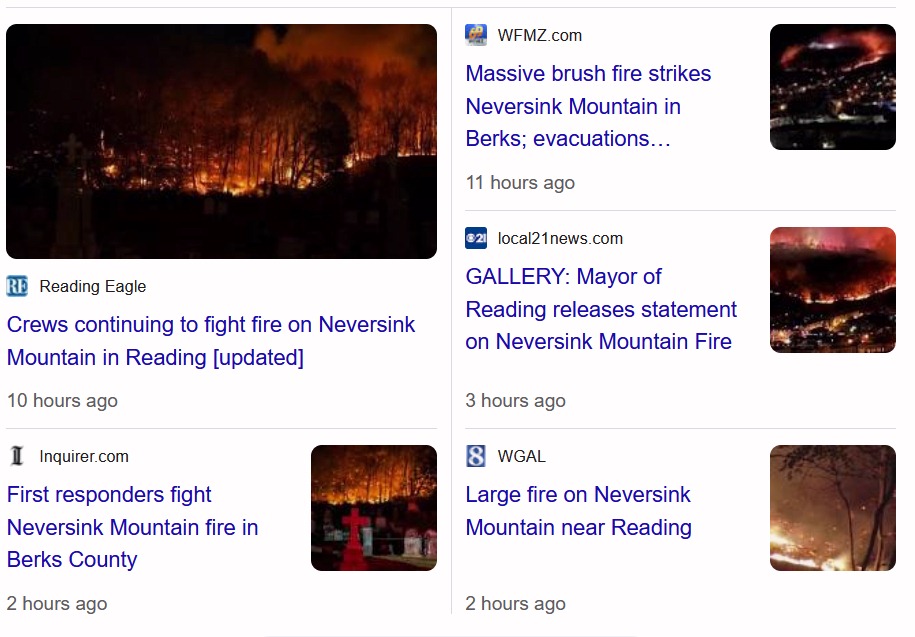
Reading, PA — Crews continued battling a wind-driven fire on Neversink Mountain November 9, which had broken out just after midnight. Visible from miles away, the blaze produced dense smoke and a striking ring of flames along the mountain’s edge, visible from Reading’s Pagoda landmark. Evacuations were ordered for residents in areas where flames neared structures, including neighborhoods from South 9th to 14th and 17th to 18th streets.

Climate change is contributing to the increased intensity and frequency of wildfires through a combination of factors that create favorable conditions for wildfires to ignite, spread, and become more destructive.

A report by the USDA and the U.S. Forest Service found that the risk of wildfires has been drastically underestimated. The updated model concluded that wildfires pose a high risk to one-third of all U.S. residents and buildings. “We’re more accurately reflecting climate changes that we’ve seen in the last few years,” said Kelly Pohl, associate director at the nonprofit Headwaters Economics, which released the findings with the Forest Service.

Here are some key ways in which climate change influences wildfires:


  1. Higher Temperatures:
    • Impact: Rising global temperatures increase the likelihood of extreme heat events.
    • Effect on Wildfires: Higher temperatures contribute to drier conditions, leading to increased evaporation and moisture loss from vegetation. Dry and hot conditions provide a more conducive environment for wildfires to ignite and spread.
  2. Drought Conditions:
    • Impact: Changes in precipitation patterns and prolonged droughts are linked to climate change.
    • Effect on Wildfires: Drought conditions result in dry vegetation, making it more susceptible to ignition. Reduced soil moisture levels also contribute to the flammability of ecosystems.
  3. Changing Rainfall Patterns:
    • Impact: Climate change alters regional rainfall patterns, leading to more intense rainfall in some areas and prolonged dry spells in others.
    • Effect on Wildfires: Areas experiencing reduced rainfall may face prolonged dry seasons, creating conditions favorable for wildfires. Intense rainfall in certain regions can lead to the growth of vegetation, which later dries out and becomes potential fuel for fires.
  4. Warming Winters:
    • Impact: Warmer winter temperatures can affect snowpack and contribute to earlier snowmelt.
    • Effect on Wildfires: Reduced snowpack and earlier snowmelt can result in drier soil and vegetation earlier in the year, extending the wildfire season and increasing the period of vulnerability to fire ignition.
  5. Extended Fire Season:
    • Impact: Changes in climate contribute to longer and more intense fire seasons.
    • Effect on Wildfires: A longer fire season means that conditions conducive to wildfires persist for a more extended period, increasing the likelihood of ignition and the potential for wildfires to become larger and more destructive.
  6. Insect Infestations:
    • Impact: Warmer temperatures allow for the proliferation of certain insects, such as bark beetles.
    • Effect on Wildfires: Insect-infested trees become more susceptible to disease and wildfire. Dead and dry trees contribute to the fuel load, increasing the intensity and spread of wildfires.
  7. Wind Patterns:
    • Impact: Changes in climate can influence wind patterns.
    • Effect on Wildfires: Changes in wind patterns can contribute to the rapid spread of wildfires. Strong winds can carry embers over long distances, leading to the ignition of new areas.
  8. Thawing Permafrost:
    • Impact: Warming temperatures contribute to the thawing of permafrost.
    • Effect on Wildfires: Thawing permafrost releases stored carbon, creating flammable conditions. It can also lead to changes in vegetation types, altering fuel availability for wildfires.

The combination of these factors creates feedback loops, where more intense and frequent wildfires release large amounts of carbon dioxide into the atmosphere, contributing to further climate change. This cycle reinforces the importance of addressing both the causes and consequences of climate change to mitigate the impact on wildfire risk. While the beautiful sunsets during forest fires create captivating visuals, it’s essential to recognize the environmental and health impacts associated with wildfires. Wildfires can cause significant damage to ecosystems, contribute to air pollution, and pose risks to human health. The mesmerizing sunsets are a visible reminder of the interconnectedness of atmospheric processes and the far-reaching effects of natural events like wildfires.

From the album “Rolling Boil” by The Beatless Sense Mongers

The Human Induced Climate Change Experiment

MegaEpix Enormous


bookmark_borderRicochet

[Intro]
Did you say…
(Ricochet)

[Verse 1]
Pulled the trigger
(Go figure)
Lost his mind
(Never to find)

[Chorus]
Do you mind
If I bounce it off you
Will you find
The sting of thing, too

[Bridge]
Did you say…
(Ricochet)

[Verse 2]
Missed the target
(Much regret)
Lack of aim
(What a shame)

[Chorus]
Do you mind
If I bounce it off you
Will you find
The sting of thing, too

[Bridge]
Did you say…
(Ricochet)

[Outro]
Out of the way
(Ricochet)

A SCIENCE NOTE
Climate change is primarily driven by the escalation of thermal energy affecting biogeophysical and socio-economic systems. While biogeophysical factors can be studied using math, physics, and historical records, socio-economic systems pose greater challenges due to the unintended consequences of human behavior and inexplicable consumer choices.

Some unintended consequences contributing to climate change include:

  1. Ozone and the Biofuel Paradox: One of the more troubling contributors to tropospheric ozone is the increased use of ethanol in gasoline. Over the past few years, ethanol has become a mandated additive to gasoline blends, touted as a cleaner alternative to traditional fossil fuels. For example, in Pennsylvania, a 10% ethanol blend in gasoline and a 30% ethanol blend in diesel fuel are required to reduce harmful emissions. However, this practice has resulted in unintended consequences — specifically, the creation of more ozone. A 2024 study found that human-derived ozone has caused a significant decline in net primary productivity (NPP) across all tropical forests, resulting in an estimated 17% reduction in the tropical land carbon sink since 2000.
  2. Increased Carbon Dioxide (CO2) Emissions: Switching to cleaner fuels with lower sulfur content can inadvertently lead to higher CO2 emissions. For example, marine vessels burning cleaner fuels may emit more CO2, a potent greenhouse gas, contributing to global warming and climate change.
  3. Deforestation for Biofuel Production: The use of biofuels as an alternative to fossil fuels can lead to deforestation as forests are cleared to make way for biofuel crops. Deforestation releases stored carbon into the atmosphere, exacerbating climate change.
  4. Land Use Change: Converting land for agricultural or urban development alters natural ecosystems, releasing stored carbon into the atmosphere. This change in land use can contribute to climate change by reducing the planet’s capacity to absorb carbon dioxide.
  5. Methane Leakage from Natural Gas Production: Natural gas is often touted as a cleaner alternative to coal; however, methane, a potent greenhouse gas, can leak during natural gas extraction, processing, and transportation. Methane emissions contribute to global warming and climate change.
  6. Albedo Effect from Land Use Change: Changes in land cover, such as deforestation or urbanization, can alter the Earth’s albedo, or its ability to reflect sunlight. Darker surfaces absorb more heat, leading to increased warming. For example, replacing forests with urban areas can decrease albedo, contributing to local and regional warming.
  7. Feedback Loops: Climate change can trigger feedback loops that further exacerbate warming. For example, melting ice caps reduce the Earth’s albedo, leading to more heat absorption and further melting. Similarly, thawing permafrost releases stored methane and carbon dioxide, amplifying greenhouse gas emissions.

These unintended consequences highlight the interconnectedness of human activities and their impacts on the Earth’s climate system. Addressing these unintended consequences requires comprehensive strategies that consider the broader environmental and societal implications of policy decisions and technological advancements.

From the album “Blazing” by Industrial Noize Pollution

A song about The Human Induced Climate Change Experiment

MegaEpix Enormous

bookmark_borderMarching

[Intro]
The howling wind
Won’t rescind
The blasting heat
Won’t retreat

[Verse 1]
Faster and faster
(Accelerate how fast)
Higher and higher
(How long can it last)

[Chorus]
The howling wind
(Won’t rescind)
The blasting heat
(Won’t retreat)

[Bridge]
Time keeps marching
(I keep searching)
Marching at double time
(Right past our prime)

[Verse 2]
Picking up the pace
(Of the human race)
Picking up the speed
(Man won’t recede)

[Chorus]
The howling wind
(Won’t rescind)
The blasting heat
(Won’t retreat)

[Bridge]
Time keeps marching
(I keep searching)
Marching at double time
(Right past our prime)

[Chorus]
The howling wind
(Won’t rescind)
The blasting heat
(Won’t retreat)

[Bridge]
Time keeps marching
(I keep searching)
Marching at double time
(Right past our prime)

[Outro]
Marching (past our past)
Can we outlast?

A SCIENCE NOTE
We first developed the hypothesis of the non-linear acceleration of climate change in the 1990s. By the early 2000s, this hypothesis evolved into established climate theory, now widely accepted as scientific fact. My lab partner, a Doctor of Physics from Ohio State, and I collaborated to provide crucial evidence supporting this theory. Over time, we have observed a significant shift in the doubling time of climate change impacts — the rate at which the effects intensify. Initially, the doubling time was approximately 100 years, but it has since decreased to 10 years, and more recently, to just 2 years.

A recent study has verified our thesis on accelerating climate change, aligning closely with the extreme conditions now affecting our area. In 2023, nearly half (48%) of the Earth’s land area experienced at least one month of extreme drought, a sharp increase from the 1980s’ average of just 15%. Notably, these droughts are often followed by extreme rainfall, a pattern identified as compound drought-extreme precipitation events (CDEPs), which are both highly destructive and increasingly common. The study highlights that these events, already on the rise, are expected to intensify as climate change progresses, with rising temperatures contributing to their frequency and severity. Given that our region is currently facing its worst drought on record, it’s reasonable to expect these figures may be climbing even faster than in previous years, emphasizing the urgent need for climate resilience planning.

From the album “Blazing” by Industrial Noize Pollution

A song about The Human Induced Climate Change Experiment

MegaEpix Enormous

bookmark_borderDensity

[Intro]
Before you go
Do you know
(The density)
Of the flow?
[Bridge]
Like a freight train
(Through your brain)

[Verse 1]
The lack of wit
Is getting thick
Can’t think quick
(My last bit)

[Chorus]
Before you go
Do you know
(The density)
Of the flow?

[Bridge]
Dare to square
(The velocity)
Won’t stay there
(New destiny)

[Verse 2]
In the course
(Of the force)
Gettin’ a divorce
(See reality)

[Chorus]
Before you go
Do you know
(The density)
Of the flow?

[Bridge]
Dare to square
(The velocity)
Won’t stay there
(New destiny)

[Chorus]
Before you go
Do you know
(The density)
Of the flow?

[Bridge]
Dare to square
(The velocity)
Won’t stay there
(New destiny)

[Outro]
Like a freight train
(Through your brain)

The Immediate Impact of Climate Change

If you’re wondering why rain-related severe weather events are becoming more frequent and intense, it’s due to climate change. Rising temperatures increase the amount of humidity in the atmosphere, as warmer air holds more moisture. The Clausius-Clapeyron equation shows that for every 1°C (1.8°F) increase in temperature, the air can hold about 7% more water vapor. This not only raises relative humidity, posing health risks, but it also amplifies the intensity of extreme weather events like storms, floods, and hurricanes.

Many areas in the U.S. are experiencing average temperature increases of up to 10°C, extending over more weeks during both spring and fall. This increase allows the atmosphere to hold about 70% more water vapor, leading to significantly more rainfall. Additionally, raindrops are becoming larger and falling faster, which increases their momentum. Using the formula p=mv (momentum = mass x velocity), larger and faster raindrops carry more energy.

Moreover, the number of raindrops is also increasing. A higher concentration of raindrops in a given time and area further boosts momentum. For example, if N raindrops, each with mass m and velocity v, hit a surface area A per second, the total momentum impacting the surface is Nmv per second. This contributes to increased force and damage during rainstorms.

The end result is an increase not only in the frequency and intensity of storms but also in the momentum of falling rain, which intensifies their impact.

Violent Rain
What turns these severe weather events into ‘violent rain events’ is the application of the drag equation and flow dynamics.

Mass and velocity are just part of the equation; density also plays a key role. The combination of these variables increases the intensity of flow forces. Wind and water forces scale with the square of velocity, meaning that as flow speeds increase — due to more intense heating or heavier rainfall — the damage scales accordingly. According to drag physics, force is proportional to density times the square of velocity.

For example, a 20-mile-an-hour wind exerts four times the force of a 10-mile-an-hour wind, while a 40-mile-an-hour wind exerts 16 times the force of a 10-mile-an-hour wind. At 50 miles an hour, the force is 25 times greater, and at 60 miles an hour, it’s 36 times greater than at 10 miles an hour. Now, add the density factor: water is about 800 times denser than air, so a 10-mile-an-hour water flow exerts 800 times the force of a 10-mile-an-hour wind.

As flow velocities increase due to climate change, the forces — and thus the damage — scale with the square of the velocities. While we may not know precisely how much velocities will rise with climate change, we’re already seeing the effects: overwhelmed flood and sewage systems, collapsing hillsides, and more.

From the album “Blazing” by Industrial Noize Pollution

A song about The Human Induced Climate Change Experiment

MegaEpix Enormous

bookmark_borderBlazing

[Intro]
We fell into summer in the fall
Yet you say, “Not unusual at all”

[Verse 1]
In a drought
(No doubt)
About to find out
The primate climate

[Chorus]
We fell into summer
(In the fall)
Yet you say,
“Not unusual at all”

[Bridge]
Blazing
(Raising concerns)
Amazing
(We’ll never learn)

[Verse 2]
When it rains
(It pours)
The aches and pains
(Who endures?)

[Chorus]
We fell into summer
(In the fall)
Yet you say,
“Not unusual at all”

[Bridge]
Blazing
(Raising concerns)
Amazing
(We’ll never learn)

[Chorus]
We fell into summer
(In the fall)
Yet you say,
“Not unusual at all”

[Bridge]
Blazing
(Raising concerns)
Amazing
(We’ll never learn)

[Outro]
Amazing
(We’re blazing)

A SCIENCE NOTE
The record drought and high temperatures observed on October 31, 2024, can be directly linked to the effects of climate change, which amplifies both the frequency and intensity of extreme weather events. Rising global temperatures driven by increased greenhouse gas emissions are causing prolonged heatwaves and abnormal weather patterns that disrupt natural seasonal cycles and precipitation.

  1. Warming Temperatures and Altered Rain Patterns: Climate change has caused a consistent rise in average temperatures worldwide, with the last decade being the hottest on record. This warming effect increases the atmosphere’s ability to retain moisture, resulting in more intense but often sporadic rainfall. Instead of consistent, moderate rainfall that nourishes soil, we’re seeing longer dry spells followed by extreme precipitation, which contributes to flash floods and soil erosion rather than soil replenishment, exacerbating drought conditionsa Niña and El Niño Disruption**: The natural weather patterns of La Niña and El Niño, which typically balance weather extremes, have become more erratic. This is due to oceanic and atmospheric changes caused by rising global temperatures. In 2024, for instance, the transition from a prolonged La Niña phase to an El Niño exacerbated dry conditions, leading to higher-than-average temperatures and worsened drought. Climate change is affecting these cycles, making extreme weather patterns more frequent and severe .
  2. Soil Moisture Depletion*: High temperatures increase evaporation rates, leading to dry soil and reduced water availability in the environment, which in turn makes the land more susceptible to drought. When soil loses moisture, it reflects more heat back into the atmosphere rather than absorbing it, which intensifies the heat in the area. This positive feedback loop worsens drought conditions and increases surface temperatures, leading to the type of record heat seen in October 2024 .

Without significant action, these intensified droughts and high temperatures will likely become more common as the planet continues to warm.

From the album “Blazing” by Industrial Noize Pollution

A song about The Human Induced Climate Change Experiment

MegaEpix Enormous

bookmark_borderWatch the Cobra

[Verse 1]
Watch the elephant
When the mouse comes through
(Not really sure what she might do)
If indeed, she stampedes
(The heart needs, pleads and bleeds)

[Chorus]
A delicate situation (on n’ on n’ on)
A vacate vacation (on n’ on n’ on)
Run, run, run (run on n’ on n’ on)

[Bridge]
Is it true…
(That all you do)
Comes back to you
(And you, too)

[Verse 2]
Watch the cobra
When the mongoose comes through
(Not really sure what she might do)
If I’m right, and she strikes…
(Yikes! My heart needs, pleads and bleeds)

[Chorus]
A delicate situation (on n’ on n’ on)
A vacate vacation (on n’ on n’ on)
Run, run, run (run on n’ on n’ on)

[Bridge]
Is it true…
(That all you do)
Comes back to you
(And you, too)

[Outro]
Would ya…
(Watch the cobra)

A SCIENCE NOTE
When a mongoose encounters a cobra, it usually leads to a high-stakes confrontation. The mongoose is one of the few animals that can take on venomous snakes like the cobra and often win. Here’s a breakdown of what happens:

  1. Defense and Agility: The mongoose is highly agile and uses quick reflexes to dodge the cobra’s strikes. Cobras try to defend themselves by rearing up, spreading their hood, and striking repeatedly, aiming to inject venom.
  2. Thick Fur and Immunity: The mongoose has a thick, dense coat that helps protect it from cobra bites. Additionally, it has a partial resistance to the cobra’s venom, though it can still be harmed if bitten repeatedly.
  3. Offensive Strategy: The mongoose will look for an opening to deliver a precise bite to the back of the cobra’s head or neck, aiming to kill it. If it succeeds, it often kills the cobra quickly by severing its spinal cord.
  4. Feeding or Moving On: After winning the fight, the mongoose might consume the cobra as prey, but it might also leave if it was primarily defending its territory.

While not all encounters end in the mongoose’s favor, its adaptations make it one of the few natural predators of the cobra, showcasing an impressive evolutionary rivalry.

From the album “What The?” by The Beatless Sense Mongers

A song about The Human Induced Climate Change Experiment

MegaEpix Enormous

bookmark_borderAttracted to Light (Positive Phototaxis)

[Verse 1]
Am I forgetting
The sun is setting
Don’t leave me in the dark…
(Regretting)

[Chorus]
Chase with all my might
(The fading light)
Run to become one
(Catching the sun)

[Bridge]
[Instrumental, Saxophone Solo]
Flight to the light
(Escaping night)
Keep love in sight
(And shine a light)
I’m drawn to you (too)

[Verse 2]
Positive phototaxis
(Light attracts us)
No disruption
(Navigation)

[Chorus]
Chase with all my might
(The fading light)
Run to become one
(Catching the sun)

[Bridge]
Flight to the light
(Escaping night)
Keep love in sight
(And shine a light)
I’m drawn to you (too)

[Outro]
Keep love in sight
(And shine a light)

A SCIENCE NOTE
Several creatures, besides moths, are drawn to light, a behavior called positive phototaxis. Here are a few:

  1. Beetles: Many beetles, especially June bugs, are attracted to lights at night, sometimes in large numbers.
  2. Flies: Certain types of flies, like crane flies, tend to swarm around light sources.
  3. Bees: Some species of bees are drawn to light, especially when disturbed at night.
  4. Wasps: While not strongly phototactic, some wasps will be drawn to light if it’s bright enough or if they’re seeking heat.
  5. Ants: Certain species of ants are drawn to light, especially during nuptial flights when they’re swarming.
  6. Spiders: While spiders aren’t phototactic, they often set up near lights to catch insects attracted to them.
  7. Birds: Many migratory birds can become disoriented by artificial lights at night, especially during foggy or stormy weather.
  8. Sea Turtles: Newly hatched sea turtles are attracted to light, which is normally the reflection of the moon on the ocean but can lead them to artificial lights on shore.
  9. Bats: Bats are drawn to lights indirectly because they hunt the insects congregating around light sources.

This attraction to artificial lights, especially at night, can disorient animals and disrupt natural behaviors, leading to challenges for some species in navigating their environments.

From the album “What The?” by The Beatless Sense Mongers

A song about The Human Induced Climate Change Experiment

MegaEpix Enormous

bookmark_borderAfraid to Jump In?

[Verse 1]
Afraid to jump in?
(Guess what?)
You’re already swimin’
(No, but)

[Chorus]
Hold on tight
(Or better let loose)
Hear comes the light
(Zest of Zeus)

[Bridge]
[Instrumental, Drum Solo]
What do we bring?
(Souls we sing!)
What do we give?
(We live to give!)

[Verse 2]
Really, it’s no joke
(As you soak)
You’re already swimin’
(Within)

[Chorus]
Hold on tight
(Or better let loose)
Hear comes the light
(Zest of Zeus)

[Bridge]
What do we bring?
(Souls we sing!)
What do we give?
(We live to give!)

[Outro]
What do we bring?
(Souls we sing!)

ABOUT THE SONG
This song, Afraid to Jump In?, explores the urgent yet overwhelming reality of climate change and the choices humanity faces. The opening line, “Afraid to jump in?” speaks to the hesitation and fear many people experience when confronting the climate crisis, but the follow-up reveals the twist: we’re already “swimming” in it, whether we realize it or not. This idea captures the way climate change is inescapably part of our world and daily lives, not a distant threat.

The chorus, with lines like “Hold on tight (Or better let loose),” hints at the dual approaches people can take—holding on and bracing for impact, or letting go and confronting the reality. “Zest of Zeus” suggests the intense power and force of nature, like lightning from Zeus, emphasizing that this force isn’t fully within our control.

The bridge and outro reflect a hopeful resilience: “What do we bring? (Souls we sing!)” and “What do we give? (We live to give!)” suggest a call for unity and selfless action. This imagery reinforces the theme of collective responsibility in facing climate change and hints at a shared purpose and dedication to making a positive impact. The song ultimately portrays climate change as an unavoidable challenge, but one that calls for both resilience and proactive choices from each individual.

From the album “What The?” by The Beatless Sense Mongers

A song about The Human Induced Climate Change Experiment

MegaEpix Enormous

bookmark_borderNo Exclusions

[Verse 1]
Do you know the time of day
Or which way
The ball’s in play

Is there time left on the clock
Ship left dock
Look for wood (knock)

[Chorus]
Pardon my intrusion
Into your confusion
There’s no exclusion
(No substitution)

[Bridge]
It’s your turn
(Did you learn)
It’s up to us
(Contagious)

[Verse 2]
Do you know the price we’ll pay
Along the way
There is no stay

There is no doubt
Clock’s run out
Shout it out (No doubt!)

[Chorus]
Pardon my intrusion
Into your confusion
There’s no exclusion
(No substitution)

[Bridge]
It’s your turn
(Did you learn)
It’s up to us
(Contagious)

[Chorus]
Pardon my intrusion
Into your confusion
There’s no exclusion
(No substitution)

[Bridge]
It’s your turn
(Did you learn)
It’s up to us
(Contagious)

[Outro]
There is no doubt
Clock’s run out
Shout it out (No doubt!)

A SCIENCE NOTE
There are no exclusions for humans from the effects of climate change because it impacts all parts of the planet and the systems that sustain human life. Climate change affects human health, economic stability, food security, and even social and geopolitical dynamics across the globe, meaning that everyone, regardless of location or background, is subject to its consequences.

Climate change is already affecting human health by increasing the frequency of extreme weather events, such as heatwaves, hurricanes, wildfires, and floods. These events lead to higher rates of heat-related illnesses, respiratory issues from air pollution, and waterborne diseases from contaminated sources. Additionally, mental health is affected, with trauma from disasters and economic losses contributing to stress and anxiety. Food and water security are also at risk; changing temperature and precipitation patterns disrupt agriculture, leading to reduced crop yields, higher food prices, and increased food insecurity worldwide. Even developed nations, dependent on global food supply chains, feel the impact of these disruptions.

Economically, climate change brings significant costs. Damage to infrastructure, increased energy demands, and disrupted global trade all contribute to economic instability. Sectors like agriculture, tourism, and insurance, which rely on stable weather patterns, face heightened risk and volatility, with effects that ripple across economies. Socially and geopolitically, climate change strains resources like water and arable land, increasing competition and potentially leading to conflict. Climate-induced migration further exacerbates tensions, as populations move from uninhabitable areas to more stable regions, pressuring resources and services in new locations.

In sum, climate change is a universal issue with far-reaching implications for everyone, regardless of location, socioeconomic status, or lifestyle. Addressing it is critical for ensuring a sustainable and equitable future for all.

From the album “What The?” by The Beatless Sense Mongers

A song about The Human Induced Climate Change Experiment

MegaEpix Enormous

bookmark_borderWhat The?

[Intro]
Hey! (What the….)
Say! (What the….)
What the?

[Verse 1]
Did I see what I saw
(Jaw dropping in awe)
Did I hear what I heard
(The word absurd)

[Chorus]
Hey! (What the….)
Say! (What the….)
It’s not O.K.
To play that way

[Bridge]
It’s that time of day
(To push that way)
It’s time to love
(When push comes to shove)

[Verse 2]
Did you do what you did
(No friction, no skid)
On the course to brute force
(Ohhh… of course)

[Chorus]
Hey! (What the….)
Say! (What the….)
It’s not O.K.
To play that way

[Bridge]
It’s that time of day
(To push that way)
It’s time to love
(When push comes to shove)
It’s time to love

[Chorus]
Hey! (What the….)
Say! (What the….)
It’s not O.K.
To play that way

[Bridge]
It’s that time of day
(To push that way)
It’s time to love
(When push comes to shove)
It’s time to love

[Outro]
(It’s time to love)
(Love, love, love)

A SCIENCE NOTE
Many people ask, “Why does a scientist engage with climate deniers?”

Thanks for the concern! You’re right that, for my mental health, it might be easier to ignore them. However, as an educator, I see these interactions as an opportunity to reach a wider audience. Engaging with climate skeptics — what some might call ‘climate dummies’ — gives me the chance to correct misinformation in real time and provide fact-based explanations to others who may be quietly observing the conversation.

By addressing these false claims head-on, I can offer a legitimate, scientifically backed source of information to those seeking clarity in a sea of misinformation. This outreach is critical, especially when so many people are exposed to conflicting or inaccurate claims about climate change. My aim is not to argue for the sake of it, but to ensure that there are trusted voices out there providing clear, evidence-based information on the urgent reality of climate change.

In addition, their opposition is immensely educative in our efforts. In reality, their persistent denial of climate change has forced us to rethink and drastically rebuild our climate models. What were once “worst-case” scenarios have now become the “best-case” outcomes we are seeing today.

Our updated climate model, now integrating complex social-ecological factors, shows that global temperatures could rise by up to 9°C within this century — far beyond previous predictions of a 4°C rise over the next thousand years. This kind of warming could bring us dangerously close to the “wet-bulb” threshold, where heat and humidity exceed the human body’s ability to cool itself, leading to fatal consequences.

Unfortunately, we rely on these so-called climate “skeptics” to remind us just how urgent and critical the climate crisis is becoming. Ironically, their denial helps highlight the importance of decisive action, as climate change continues to spiral out of control.

The window for meaningful intervention is closing, and the need for action has never been more critical.

What you can do today. How to save the planet.

A song about The Human Induced Climate Change Experiment

From the album “What The?” by The Beatless Sense Mongers

Reggae Sway” by Narley Marley

MegaEpix Enormous

bookmark_borderThe Message

[Intro]
The message is….
(The messages)

[Verse 1]
The message is….
(The messages)
On the final page
The message of our age
“Survive” (stay alive)

[Chorus]
The world’s (a stage)
Despite (your rage)
Don’t think (extinct)

[Bridge]
It’s up to you
What we do
We all sway
(Our day)

[Verse 2]
The message of….
(How to love)
On the final page
The message of our age
“Stirve” (to survive)
(Love, love, love)

[Chorus]
The world’s (a stage)
Despite (your rage)
Don’t think (extinct)

[Bridge]
It’s up to you
What we do
(Love, love, love)
The message of….
(Let us love)

[Outro]
The message of….
(How to love)
Love, love, love

A SCIENCE NOTE
The message about the climate crisis has reached a dire point for humanity due to several alarming trends and findings that underscore the urgent need for action.

  1. Rising Temperatures and Extreme Weather: Global temperatures have risen significantly, with the last few years being the hottest on record. This warming has led to an increase in the frequency and severity of extreme weather events, such as hurricanes, droughts, and wildfires. According to the Intergovernmental Panel on Climate Change (IPCC), failing to mitigate these changes could lead to catastrophic consequences, including widespread food and water shortagesty Loss**: The ongoing climate crisis is driving many species toward extinction. A report from the World Wildlife Fund (WWF) indicated that wildlife populations have declined by an average of 68% since 1970, primarily due to habitat loss, climate change, and pollution . This loss of bi threatens ecosystems that humans rely on for clean air, water, and food.
  2. Health Risks: Climate change is also becoming a significant public health issue. Increased temperatures can lead to heat-related illnesses, while changing weather patterns facilitate the spread of infectious diseases. The World Health Organization (WHO) has warned that climate change could cause an additional 250,000 deaths per year between 2030 and 2050 due to malnutrition, malaria, and heat stress .
  3. Economic Impact

    costs associated with climate change are mounting. According to a report from the National Oceanic and Atmospheric Administration (NOAA), the U.S. alone has faced over $1 billion in damages from weather-related disasters in recent years . The World Bank estimates that cli could push more than 100 million people into extreme poverty by 2030, exacerbating global inequalities .

  4. Public Awareness and Action: While fic consensus on climate change is strong, public awareness and action often lag behind. Recent surveys show that many people recognize climate change as a significant threat, yet only a fraction feel empowered to take action. This disconnect emphasizes the need for better communication and engagement to drive meaningful change .

Overall, the culmination of these factors highlightcollective action to address the climate crisis. Failing to act could have profound and lasting consequences for both current and future generations.

For more detailed information, you can explore these sources:

From the album “Nuntius” by Daniel

Reggae Sway” by Narley Marley

A song about The Human Induced Climate Change Experiment

MegaEpix Enormous

bookmark_borderNuntius

[Verse 1]
What is this I hear
(The End is near?)
What else did you hear
(If we don’t steer… clear)

[Chorus]
Nuntius
(Please save us)
Nuntius
(More or less?)
Nuntius
(To the test)

[Bridge]
What is best?
(Do suggest)
To address
(Nevertheless)

[Verse 2]
What is this you hear
(The End is near?)
It is time to fear
(If we don’t steer… clear)

[Chorus]
Nuntius
(Please save us)
Nuntius
(More or less?)
Nuntius
(To the test)

[Bridge]
What is best?
(Do suggest)
To address
(Nevertheless)

[Chorus]
Nuntius
(Please save us)
Nuntius
(More or less?)
Nuntius
(To the test)

[Bridge]
What is best?
(Do suggest)
To address
(Nevertheless)

[Outro]
Nevertheless
(Do our best)

A SCIENCE NOTE
The phrase “don’t shoot the messenger” is relevant to climate scientists because their role is to convey research findings and evidence about the climate crisis, not to create or worsen the problem. Climate scientists gather, analyze, and interpret data on climate patterns, greenhouse gas emissions, and environmental changes to help society understand the risks we face. This information is crucial for developing effective policies and strategies to address climate change. Targeting scientists for negative news deflects responsibility and distracts from tackling the root causes of the issue.

Climate scientists aim to keep the public informed and to drive constructive change through scientific evidence. Attacking or dismissing them can lead to distrust in science, hindering efforts to mitigate climate impacts. Instead, supporting climate scientists’ work can help drive awareness and mobilize collective action toward sustainable solutions.

From the album “Nuntius” by Daniel

A song about The Human Induced Climate Change Experiment

MegaEpix Enormous