bookmark_borderRiddled

[Intro]
There’s a meaning in there
(Somewhere)
In the middle of the riddle
(Unaware)

[Verse 1]
Searching for something
(Don’t know what it is)
In hopes of discovering
(What “it” is)

[Chorus]
There’s a meaning in there
(Somewhere)
In the middle of the riddle
(Unaware)

[Bridge]
Bound for the found
(Before becoming)
Unwound
(Mind numbing)

[Verse 2]
Searching for anything
(To make us whole)
In hopes of discovering
(What’s my role)

[Chorus]
There’s a meaning in there
(Somewhere)
In the middle of the riddle
(Unaware)

[Bridge]
Bound for the found
(Before becoming)
Unwound
(Mind numbing)

[Chorus]
There’s a meaning in there
(Somewhere)
In the middle of the riddle
(Unaware)

[Bridge]
Bound for the found
(Before becoming)
Unwound
(Mind numbing)

[Outro]
In the middle
(Riddled)

A SCIENCE NOTE
Many people ask, “Why does a scientist engage with climate deniers?”

Thanks for the concern! You’re right that, for my mental health, it might be easier to ignore them. However, as an educator, I see these interactions as an opportunity to reach a wider audience. Engaging with climate skeptics — what some might call ‘climate dummies’ — gives me the chance to correct misinformation in real time and provide fact-based explanations to others who may be quietly observing the conversation.

By addressing these false claims head-on, I can offer a legitimate, scientifically backed source of information to those seeking clarity in a sea of misinformation. This outreach is critical, especially when so many people are exposed to conflicting or inaccurate claims about climate change. My aim is not to argue for the sake of it, but to ensure that there are trusted voices out there providing clear, evidence-based information on the urgent reality of climate change.

In addition, their opposition is immensely educative in our efforts. In reality, their persistent denial of climate change has forced us to rethink and drastically rebuild our climate models. What were once “worst-case” scenarios have now become the “best-case” outcomes we are seeing today.

Our updated climate model, now integrating complex social-ecological factors, shows that global temperatures could rise by up to 9°C within this century — far beyond previous predictions of a 4°C rise over the next thousand years. This kind of warming could bring us dangerously close to the “wet-bulb” threshold, where heat and humidity exceed the human body’s ability to cool itself, leading to fatal consequences.

Unfortunately, we rely on these so-called climate “skeptics” to remind us just how urgent and critical the climate crisis is becoming. Ironically, their denial helps highlight the importance of decisive action, as climate change continues to spiral out of control.

The window for meaningful intervention is closing, and the need for action has never been more critical.
What you can do today. How to save the planet.

From the album “How Far Out?” by Daniel

A song about The Human Induced Climate Change Experiment

MegaEpix Enormous

bookmark_borderStaggering Clown

[Intro]
Stand them up
(To knock them down)
Broken cup
(Staggering clown)

[Verse 1]
Is this a circus
(Involving us)
Some sort-of zoo
(Have you a clue?)

[Chorus]
Stand them up
(To knock them down)
Broken cup
(Staggering clown)

[Bridge]
Wobbling
(Teeter-totter)
Waffling
(Should of, oughta)

[Verse 2]
Maybe a county fair
(Of the unaware)
A bizarre bizarre
(Taken too far)

[Chorus]
Stand them up
(To knock them down)
Broken cup
(Staggering clown)

[Bridge]
Wobbling
(Teeter-totter)
Waffling
(Should of, oughta)

[Chorus]
Stand them up
(To knock them down)
Broken cup
(Staggering clown)

[Bridge]
Wobbling
(Teeter-totter)
Waffling
(Should of, oughta)

[Outro]
About to discover
(Falling over)

A SCIENCE NOTE
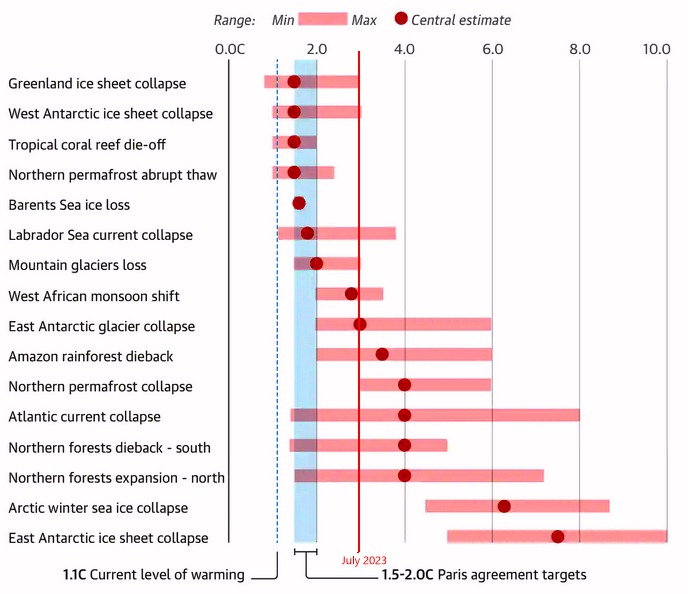
Tipping cascades have emerged between biogeophysical and social-ecological systems. This Domino Effect is causing climate change to accelerate at an exponential rate.

Tipping points are Critical Milestones that directly impact the rate of acceleration in climate change by multiplying the number and intensity of feedback loops. Identifying and understanding these tipping points is crucial for climate science and policymaking. Crossing multiple tipping points could lead to a domino effect, resulting in a much more rapid and severe climate change than currently projected.

Tipping Points

Push a glass toward the edge of a table and eventually it will fall off on its own. No matter how slowly or meticulously you push… no matter how you weight or fill the glass, it will reach a tipping point and fall off before being pushed completely off the table. No matter whether you believe the glass is half-empty or half-full, when the tipping point is reached it will plummet out-of-control to its end. This is science not fate, faith, nor belief. Human induced climate change has resulted in environmental tipping points being breached.

Tipping points, when crossed, trigger self-sustaining feedback loops that are no longer dependent on human activity. Similar to when a domino topples over hitting two more dominoes that in turn fall hitting more dominoes. Thus, the name The Domino Effect. It can also be visualized as The Snowball Effect. A tipping point is like a snowball rolling down a hill growing in mass and velocity (momentum). When a tipping point is crossed, it results in cumulative and reinforced global warming.

From the album “How Far Out?” by Daniel

Reggae Sway” by Narley Marley

A song about The Human Induced Climate Change Experiment

MegaEpix Enormous

bookmark_borderMarching Toward….

[Intro]
Marching forward….
(Too the pledge)
Marching toward….
(Over the edge)

[Verse 1]
Line up straight
All in a row
Evolution rate
Has gone retro

[Chorus]
Marching forward….
(Too the pledge)
Marching toward….
(Over the edge)

[Bridge]
Have we got a clue
What we’re about to do?
(I’ve a feeling…
It’s too few)

[Verse 2]
Follow the leader
Blind behind blind
Becoming bottom feeder
What do we have in mind?

[Chorus]
Marching forward….
(Too the pledge)
Marching toward….
(Over the edge)

[Bridge]
Have we got a clue
What we’re about to do?
(I’ve a feeling…
It’s too few)

[Chorus]
Marching forward….
(Too the pledge)
Marching toward….
(Over the edge)

[Bridge]
Have we got a clue
What we’re about to do?
(I’ve a feeling…
It’s too few)

[Outro]
What do we know
(Here we go!)

ABOUT THE SONG

The song “Marching Toward…” can be interpreted as a commentary on humanity’s reckless progression toward environmental destruction, particularly in the context of climate change.

Key Themes:

  1. Blind Obedience and Inaction: The imagery of people “lining up straight” and “following the leader, blind behind blind” suggests a society marching forward without questioning its path. This evokes the idea of following harmful practices like fossil fuel dependence or consumerism without recognizing the long-term consequences.
  2. Retrograde Evolution: The line “evolution rate has gone retro” may symbolize how humanity, instead of progressing toward sustainability, is regressing by continuing behaviors that damage the planet. In this sense, evolution is reversed as we undermine the very ecosystems we depend on for survival.
  3. Inevitability of Disaster: The repeated refrain of “marching toward… over the edge” portrays a society on the brink of irreversible environmental collapse. Despite warnings, humanity continues its destructive march, symbolizing our inability to change course even in the face of climate disasters.
  4. Lack of Awareness: Phrases like “have we got a clue what we’re about to do?” highlight the ignorance or denial of the consequences of climate change. The repetition of “it’s too few” could refer to the small number of people taking meaningful action to combat these issues, further emphasizing the gap between awareness and action.
  5. Descent into Lower Ecological Status: The term “bottom feeder” reflects a degraded state where humanity is reduced to a lower ecological role due to environmental degradation, potentially referring to the survival struggles in a future ravaged by climate instability.

Overall Message:

The song paints a bleak picture of humanity’s journey toward environmental catastrophe, driven by blind obedience and a lack of awareness or concern. It underscores the urgency of recognizing the crisis before marching off “over the edge.”

From the album “How Far Out?” by Daniel

A song about The Human Induced Climate Change Experiment

MegaEpix Enormous

bookmark_borderIrrefutable

[Verse 1]
The evidence
Irrefutable
The ignorance
Renders us unable

[Chorus]
Science
(Consciousness)
Do the math
(To nature’s wrath)

[Bridge]
Numbers don’t lie
Don’t even try
To bend the truth
(There is no use)

[Verse 2]
The statistics
Irrefutable
The logistics
Are we incapable?

[Chorus]
Science
(Consciousness)
Do the math
(To nature’s wrath)

[Bridge]
Numbers don’t lie
Don’t even try
To bend the truth
(There is no use)

[Chorus]
Science
(Consciousness)
Do the math
(To nature’s wrath)

[Bridge]
Numbers don’t lie
Don’t even try
To bend the truth
(There is no use)

[Outro]
The timetable
(Irrefutable)

A SCIENCE NOTE
Human-induced climate change is considered irrefutable based on an overwhelming body of scientific evidence demonstrating that human activities, particularly the burning of fossil fuels and deforestation, are driving significant changes in the Earth’s climate.

Here’s why the consensus on human-induced climate change is irrefutable:

1. Greenhouse Gas Emissions and Temperature Rise

  • Carbon Dioxide (CO₂) Increase: The burning of fossil fuels (coal, oil, and natural gas) for energy, transportation, and industry has significantly increased the concentration of CO₂ in the atmosphere. Since the Industrial Revolution, atmospheric CO₂ levels have risen by over 40%, from approximately 280 parts per million (ppm) to over 415 ppm today. This increase directly correlates with the rise in global temperatures.
  • Greenhouse Effect: CO₂, along with other greenhouse gases like methane (CH₄) and nitrous oxide (N₂O), traps heat in the Earth’s atmosphere. This process, known as the greenhouse effect, is well understood and has been extensively modeled. Human activity is now the primary driver of the increased greenhouse gas concentration.

2. Observed Temperature and Weather Changes

  • Global Temperature Rise: According to NASA and the National Oceanic and Atmospheric Administration (NOAA), the Earth’s average surface temperature has risen by approximately 1.2°C (2.2°F) since the late 19th century. The last decade has been the warmest on record, and this warming is accelerating. Studies show that human activities are responsible for at least 90% of this warming.
  • Extreme Weather Events: The frequency and intensity of extreme weather events, such as heatwaves, wildfires, hurricanes, and heavy rainfall, are increasing. Numerous studies link these events to climate change, and attribution science has grown more precise in identifying the role of human-induced climate change in making these events more severe.

3. Scientific Consensus

  • Intergovernmental Panel on Climate Change (IPCC): The IPCC’s comprehensive reports, which synthesize thousands of peer-reviewed studies, consistently conclude that human influence on the climate system is clear. The latest report (AR6, 2021) states with unequivocal certainty that human activities are responsible for the observed global warming since the mid-20th century.
  • Consensus in Scientific Literature: Studies reviewing the scientific literature consistently find that more than 97% of climate scientists agree that human activities are the primary cause of recent global warming. This near-unanimity among experts underscores the robustness of the evidence.

4. Physical Evidence

  • Ice Core Data: Ice cores from Antarctica and Greenland provide a long-term record of Earth’s climate. Analysis of these cores reveals a clear relationship between CO₂ levels and temperature over hundreds of thousands of years. The current spike in CO₂ levels due to human activities is unprecedented in both magnitude and speed.
  • Melting Ice and Rising Sea Levels: Arctic sea ice, glaciers, and ice sheets are melting at accelerating rates due to warming temperatures. This contributes to rising sea levels, which threaten coastal communities. The rate of sea-level rise has more than doubled in recent decades, and human-induced warming is the main driver.

5. Ocean Acidification

  • As the oceans absorb more CO₂, they become more acidic, which affects marine ecosystems, particularly coral reefs and shell-forming organisms. This acidification, caused by human CO₂ emissions, is another clear indicator of human influence on the climate system.

6. Observed Changes Align with Predictions

  • Climate Models: Climate models, which incorporate the physics of the atmosphere and ocean systems, have accurately predicted many of the changes we are now observing, such as temperature rise, ice melt, and changes in precipitation patterns. These models show that natural factors alone (e.g., volcanic activity, solar variations) cannot account for the observed warming. Only when human activities are included do the models align with the actual data.

7. Human Activity Signature

  • Spatial and Temporal Patterns: The patterns of warming observed (e.g., more warming over land than oceans, more warming at higher latitudes, and cooling in the stratosphere) are consistent with the warming caused by greenhouse gases and not with natural variability. The distinct fingerprint of human activity is clearly evident in these spatial and temporal patterns.

Conclusion

Human-induced climate change is not just a theory; it is a scientifically established fact supported by extensive empirical evidence and the overwhelming consensus of the scientific community. The link between human activities—mainly the burning of fossil fuels and deforestation—and the rapid changes in climate is clear and well-documented. Addressing this challenge requires urgent global action to reduce greenhouse gas emissions and transition to more sustainable energy sources.

From the album “How Far Out?” by Daniel

A song about The Human Induced Climate Change Experiment

MegaEpix Enormous

bookmark_borderThe Test of Time

[Intro]
Can I stand
The test of time
Understand
The human I’m

[Verse 1]
The clock keeps ticking
(Never looking back)
My bubble’s pricking
(Invincibility attack)

[Chorus]
Talk about a pop quiz
Set myself up to fail
Hear what Father Time says
Or end in a a constant flail

[Bridge]
Can I stand
The test of time
Understand
The human I’m

[Verse 2]
The world keeps turning
(Never looking back)
As hearts keep yearning
(Love picking up the slack)

[Chorus]
Talk about a pop quiz
Set myself up to fail
Hear what Father Time says
Or end in a a constant flail

[Bridge]
Can I stand
The test of time
Understand
The human I’m

[Chorus]
Talk about a pop quiz
Set myself up to fail
Hear what Father Time says
Or end in a a constant flail

[Bridge]
Can I stand
The test of time
Understand
The human I’m

[Outro]
Can I pass (the test of time)
Passing fast (midnight chime)

A SCIENCE NOTE
We first developed the hypothesis of the non-linear acceleration of climate change in the 1990s. By the early 2000s, this hypothesis evolved into established climate theory, now widely accepted as scientific fact. My lab partner, a Doctor of Physics from Ohio State, and I collaborated to provide crucial evidence supporting this theory. Over time, we have observed a significant shift in the doubling time of climate change impacts — the rate at which the effects intensify. Initially, the doubling time was approximately 100 years, but it has since decreased to 10 years, and more recently, to just 2 years.

This trend means that the damage caused by climate change today is double what it was two years ago, and in two more years, it could be four times worse. Unfortunately, this rapid acceleration does not appear to be an anomaly, especially given the record-breaking events we’ve witnessed this year, even during the typically cooler La Nina phase. If this trajectory continues, the outcomes will be far more catastrophic than previously expected.

Our updated climate model, now integrating complex social-ecological factors, shows that global temperatures could rise by up to 9°C within this century — far beyond previous predictions of a 4°C rise over the next thousand years. This kind of warming could bring us dangerously close to the “wet-bulb” threshold, where heat and humidity exceed the human body’s ability to cool itself, leading to fatal consequences.

From the album “How Far Out?” by Daniel

A song about The Human Induced Climate Change Experiment

MegaEpix Enormous

bookmark_borderSomething’s Gotta Give

[Verse 1]
Something’s gotta give
(Some things can’t outlive)
Something’s gotta give
(Nature cannot forgive)

[Chorus]
Reality
(Quite clearly)
Rules
(Destiny)

[Bridge]
We’ll come to see
The cause of “be”
Resides within we

[Verse 2]
Something’s gonna give
(Some won’t believe)
Something’s gotta give
(They can’t conceive)

[Chorus]
Reality
(Quite clearly)
Rules
(Destiny)

[Bridge]
We’ll come to see
The cause of “be”
Resides within we

[Chorus]
Reality
(Quite clearly)
Rules
(Destiny)

[Bridge]
We’ll come to see
The cause of “be”
Resides within we

[Outro]
I cause me
(To be)

A SCIENCE NOTE
Unintended Consequences and Inexplicable Consumer Behavior
Climate change is primarily driven by the escalation of thermal energy affecting biogeophysical and socio-economic systems. While biogeophysical factors can be studied using math, physics, and historical records, socio-economic systems pose greater challenges due to the unpredictable consequences of human behavior and inexplicable consumer choices, exacerbating tipping points and feedback loops.

Complex Feedback Loops:

Complex feedback loops in climate science refer to interactions between different components of the Earth’s climate system that can amplify or dampen the effects of initial changes, leading to non-linear and often unpredictable outcomes. These feedback loops play a crucial role in shaping the behavior of the climate system and can influence various climate phenomena, including temperature changes, ice melt, and precipitation patterns.

Tipping points are Critical Milestones that directly impact the rate of acceleration in climate change by multiplying the number and intensity of feedback loops. Identifying and understanding these tipping points is crucial for climate science and policymaking. Crossing multiple tipping points could lead to a domino effect, resulting in a much more rapid and severe climate change than currently projected.

From the album “How Far Out?” by Daniel

A song about The Human Induced Climate Change Experiment

MegaEpix Enormous

bookmark_borderMore or Less

[Intro]
If you were to take a guess…
More or less

[Verse 1]
When you say it’s more or less that way
And, you think things might be O.K.
I don’t rest assured
Having heard your word

[Chorus]
Perhaps it’s time
To name the crime
If it’s not too late
To proclamate

[Bridge]
(On the primate
In his climate)
A bad habit
(Habitat)
Imagine that

[Verse 2]
When you say it’s more or less the gist of it
Maybe it would be easier not to quit
I don’t rest assured
Having heard your word

[Chorus]
Perhaps it’s time
To name the crime
If it’s not too late
To proclamate

[Bridge]
(On the primate
In his climate)
A bad habit
(Habitat)
Imagine that

[Chorus]
Perhaps it’s time
To name the crime
If it’s not too late
To proclamate

[Bridge]
[Instrumental, Organ Solo]
(On the primate
In his climate)
A bad habit
(Habitat)
Imagine that

[Outro]
As a matter of fact
That exact

A SCIENCE NOTE
The song “More or Less” provides an introspective commentary on human-induced climate change through a mix of skepticism, frustration, and acknowledgment of our role in the planet’s deterioration. Here’s an interpretation of the lyrics in that context:

Intro

“If you were to take a guess… More or less”
This line suggests ambiguity and uncertainty about the state of the climate crisis. People are often unsure or complacent, downplaying the severity (“more or less”) rather than confronting it directly.

Verse 1

“When you say it’s more or less that way, And, you think things might be O.K. I don’t rest assured Having heard your word”
The speaker questions the complacency or half-hearted assurances that things might be “okay.” There’s a sense of distrust in these reassurances, especially when it comes to the environmental situation. They aren’t convinced by vague promises or incomplete solutions.

Chorus

“Perhaps it’s time To name the crime If it’s not too late To proclamate”
Here, the song challenges the idea that it’s still possible to act and bring attention to the issue (“name the crime”). The term “crime” implies that human behavior—perhaps the unchecked consumption of resources, pollution, and destruction of habitats—is culpable for the environmental degradation. It suggests urgency: it’s time to acknowledge our role in causing the crisis before it’s too late.

Bridge

“(On the primate In his climate) A bad habit (Habitat) Imagine that”
The reference to “the primate” (humans) reflects how we have shaped (or damaged) our climate through “bad habits”—perhaps referring to unsustainable lifestyles, overconsumption, and disregard for ecological balance. The play on “habitat” connects these bad habits directly to the degradation of our living environment.

Verse 2

“When you say it’s more or less the gist of it, Maybe it would be easier not to quit I don’t rest assured Having heard your word”
Again, there’s skepticism towards any effort that minimizes the severity of climate change or suggests that minimal action is sufficient. The line “Maybe it would be easier not to quit” could reflect the temptation to continue destructive behaviors for convenience, but the speaker remains unconvinced that this is the right approach.

Instrumental, Organ Solo, and Outro

The instrumental section provides a reflective pause, allowing the listener to contemplate the gravity of what has been said. The repetition of “On the primate In his climate, A bad habit (Habitat), Imagine that” emphasizes the connection between human actions and environmental impact.

“As a matter of fact That exact”
The closing line reaffirms the earlier message: humans are directly responsible for the current environmental state. There’s no escaping this reality.

Overall Interpretation

The song points to the uncertainty, half-hearted promises, and bad habits humans have developed in the face of climate change. It suggests a need for greater honesty, accountability, and action. The references to the “primate” in its “climate” serve as a reminder that humans, like other species, rely on the environment for survival but are causing its decline. The chorus, with its call to “name the crime,” underscores the urgent need for society to confront the truth of human-induced climate damage and take definitive action before it’s too late.

From the album “How Far Out?” by Daniel

A song about The Human Induced Climate Change Experiment

MegaEpix Enormous

bookmark_borderHow Far Out?

[Intro]
How far out
Do we need to go
Before we know?
(I ask him…
From out on a limb)

[Verse 1]
How much space
Do we need to displace
Before we know
(I mean… to what extreme
Do we need to go?)

[Chorus]
How far out
Do we need to go
Before we know?
(I ask him…
From out on a limb)

[Bridge]
Shall we go till we fail
(Fly right off the rail)
Push to exhaustion
(Flail in frustration)
Is there doubt
(As to how far out?)

[Verse 2]
How much waste
Do we need erased
Before we’ll grow
(I mean… to what extreme
Do we need to go?)

[Chorus]
How far out
Do we need to go
Before we know?
(I ask him…
From out on a limb)

[Bridge]
Shall we go till we fail
(Fly right off the rail)
Push to exhaustion
(Flail in frustration)
Is there doubt
(As to how far out?)

[Chorus]
How far out
Do we need to go
Before we know?
(I ask him…
From out on a limb)

[Bridge]
Shall we go till we fail
(Fly right off the rail)
Push to exhaustion
(Flail in frustration)
Is there doubt
(As to how far out?)

[Outro]
About…
How far out?

A SCIENCE NOTE
The urgency of the climate crisis is already evident today, but its full appreciation depends on how quickly impacts intensify and how much society acknowledges the severity of the problem.

We first developed the hypothesis of the non-linear acceleration of climate change in the 1990s. By the early 2000s, this hypothesis evolved into established climate theory, now widely accepted as scientific fact. My lab partner, a Doctor of Physics from Ohio State, and I collaborated to provide crucial evidence supporting this theory. Over time, we have observed a significant shift in the doubling time of climate change impacts — the rate at which the effects intensify. Initially, the doubling time was approximately 100 years, but it has since decreased to 10 years, and more recently, to just 2 years.

This trend means that the damage caused by climate change today is double what it was two years ago, and in two more years, it could be four times worse. Unfortunately, this rapid acceleration does not appear to be an anomaly, especially given the record-breaking events we’ve witnessed this year, even during the typically cooler La Nina phase. If this trajectory continues, the outcomes will be far more catastrophic than previously expected.

Our climate model was validated in the summer of 2024, as we observed a dozen billion-dollar climate disasters in the first part of the year. On September 26, Hurricane Helene made landfall, emerging as one of the most destructive climate events in recorded history. With over 200 fatalities and $126 billion in direct damages, the hurricane had ripple effects beyond its immediate destruction. For instance, it disrupted 60% of the U.S. IV fluid supply, causing critical shortages in the healthcare sector. Even more concerning, the global tech industry has been impacted, as 99% of the pure quartz used in semiconductor manufacturing has been affected, leading to potential long-term consequences for electronics production.

Hurricane Milton quickly followed, further compounding the devastation. Milton is expected to result in over $100 billion in insurance claims, complicating an already strained insurance market for Florida homeowners. On top of that, the public and government will likely bear an additional $50 billion in costs, placing further pressure on taxpayers and state resources. Much of the damage was caused by high winds and an unprecedented number of tornadoes — over 30 tornadoes hit eastern Florida, causing the highest number of fatalities and extensive financial losses.

The Grantham Institute for Climate Change and the Environment at Imperial College London confirmed that nearly half of the increased costs and intensity of Hurricanes Milton and Helene can be directly attributed to climate change. According to Professor Ralf Toumi, Director of the Grantham Institute and co-author of several studies, “With every fraction of a degree of warming, extreme weather events like Hurricanes Milton and Helene become more powerful and destructive. This should be a wake-up call for anyone who believes climate change is too expensive to address — every delay in reducing emissions only increases the cost of these catastrophic events.”

In summary, the evidence is clear: climate change is rapidly accelerating, and the costs — both economic and human — are growing exponentially. The future demands decisive and immediate action to curb greenhouse gas emissions and prevent further environmental and societal collapse.


From the album “How Far Out?” by Daniel

A song about The Human Induced Climate Change Experiment

MegaEpix Enormous

bookmark_borderBlew Me to Been

[Intro]
A fierce wind
Blew me to been
Tryin’ to claw my way back
And, start over again

[Verse 1]
When one step forward
Takes me two steps back
Should have been forewarned
But, the insight I lack

[Chorus]
Maybe it’s time to rethink
What could happen in a blink
The extreme rapid intensification
Ramification

[Bridge]
A fierce wind
Blew me to been
Tryin’ to claw my way back
And, start over again

[Verse 2]
Going to try to slide
(To the side)
Let the collide (pass wide)
Sure won’t miss this
(Piss contest)

[Chorus]
Maybe it’s time to rethink
What could happen in a blink
The extreme rapid intensification
Ramification

[Bridge]
A fierce wind
Blew me to been
Tryin’ to claw my way back
And, start over again

[Chorus]
Maybe it’s time to rethink
What could happen in a blink
The extreme rapid intensification
Ramification

[Bridge]
A fierce wind
Blew me to been
Tryin’ to claw my way back
And, start over again

A SCIENCE NOTE
What turns these severe weather events into ‘violent rain events’ is the application of the drag equation and flow dynamics.

Mass and velocity are just part of the equation; density also plays a key role. The combination of these variables increases the intensity of flow forces. Wind and water forces scale with the square of velocity, meaning that as flow speeds increase — due to more intense heating or heavier rainfall — the damage scales accordingly. According to drag physics, force is proportional to density times the square of velocity.

For example, a 20-mile-an-hour wind exerts four times the force of a 10-mile-an-hour wind, while a 40-mile-an-hour wind exerts 16 times the force of a 10-mile-an-hour wind. At 50 miles an hour, the force is 25 times greater, and at 60 miles an hour, it’s 36 times greater than at 10 miles an hour. Now, add the density factor: water is about 800 times denser than air, so a 10-mile-an-hour water flow exerts 800 times the force of a 10-mile-an-hour wind.

As flow velocities increase due to climate change, the forces — and thus the damage — scale with the square of the velocities. While we may not know precisely how much velocities will rise with climate change, we’re already seeing the effects: overwhelmed flood and sewage systems, collapsing hillsides, and more.

From the album “Too Much” by The Beatless Sense Mongers

A song about The Human Induced Climate Change Experiment

MegaEpix Enormous

bookmark_borderBasically

[Intro]
(Baa, baa, baa)
Basically
(Fa, fa, fa)
Factually

[Verse 1]
The basics
Boil down to facts
Similar to the beats
Of music

[Chorus]
So, scratch your head
And stomp your feet
Solving your dread
With the rhythm meet

[Bridge]
(Baa, baa, baa)
Basically
(Fa, fa, fa)
Factually

[Verse 2]
In other words
What seems absurd
Can be explained
Using your brain

[Chorus]
So, scratch your head
And stomp your feet
Solving your dread
With the rhythm meet

[Bridge]
(Baa, baa, baa)
Basically
(Fa, fa, fa)
Factually

[Chorus]
So, scratch your head
And stomp your feet
Solving your dread
With the rhythm meet

[Outro]
(Baa, baa, baa)
Basically

A SCIENCE NOTE
Many people ask, “Why does a scientist engage with climate deniers?”

Thanks for the concern! You’re right that, for my mental health, it might be easier to ignore them. However, as an educator, I see these interactions as an opportunity to reach a wider audience. Engaging with climate skeptics — what some might call ‘climate dummies’ — gives me the chance to correct misinformation in real time and provide fact-based explanations to others who may be quietly observing the conversation.

By addressing these false claims head-on, I can offer a legitimate, scientifically backed source of information to those seeking clarity in a sea of misinformation. This outreach is critical, especially when so many people are exposed to conflicting or inaccurate claims about climate change. My aim is not to argue for the sake of it, but to ensure that there are trusted voices out there providing clear, evidence-based information on the urgent reality of climate change.

In addition, their opposition is immensely educative in our efforts. In reality, their persistent denial of climate change has forced us to rethink and drastically rebuild our climate models. What were once “worst-case” scenarios have now become the “best-case” outcomes we are seeing today.

Our updated climate model, now integrating complex social-ecological factors, shows that global temperatures could rise by up to 9°C within this century — far beyond previous predictions of a 4°C rise over the next thousand years. This kind of warming could bring us dangerously close to the “wet-bulb” threshold, where heat and humidity exceed the human body’s ability to cool itself, leading to fatal consequences.

Unfortunately, we rely on these so-called climate “skeptics” to remind us just how urgent and critical the climate crisis is becoming. Ironically, their denial helps highlight the importance of decisive action, as climate change continues to spiral out of control.

The window for meaningful intervention is closing, and the need for action has never been more critical.

What you can do today. How to save the planet.

From the album “Too Much” by The Beatless Sense Mongers

A song about The Human Induced Climate Change Experiment

MegaEpix Enormous

bookmark_borderAftermath

[Intro]
Oh, woe (oh, oh)
Oh, no (Woah woe)

[Verse 1]
The creek had long run dry
But, soon turned to mud
After a river a tears cry
Turning into a flood

[Chorus]
Where have our minds gone
When kind is ruled by wrong
Where have our souls seeped
Now, we’re in too deep

[Bridge]
Our hearts had long run cold
(Empathy has… turned to mold)
After all could care less…
(The aftermath of their mess)

[Verse 2]
Over the banks, the river ran
The consequences of the damn
No thanks to our attention
As we have no retention

[Chorus]
Where have our minds gone
When kind is ruled by wrong
Where have our souls seeped
Now, we’re in too deep

[Bridge]
Our hearts had long run cold
(No sympathy… young or old)
After all could care less…
(The aftermath of their mess)

[Chorus]
Where have our minds gone
When kind is ruled by wrong
Where have our souls seeped
Now, we’re in too deep

[Outro]
After all could care less…
(The aftermath of their mess)

A SCIENCE NOTE

As an economist, I have spent my career studying risk management, and in the process, I have also become a climate scientist — because climate change is the greatest risk to humanity. Climate science is closely tied to our emotions, particularly hate and love. The hatred of scientists and intelligence is one of the most significant factors contributing to the potential demise of modern civilization. If you’re over 8 years old, you should NOT be reposting memes. Most memes are generated by foreign actors (e.g., Russia) attempting to sow division through hate. Memes that promote class warfare, advocate taxing the rich, reference corporate greed or the economy, criticize philanthropy, demonize immigrants, undermine climate science, or promote “drill, baby, drill” are prime examples. If you’re under 8 years old, you shouldn’t be on social media at all. STOP REPOSTING HATEFUL MEMES.

The solution lies in increased education and LOVE.

From a paper I coauthored: The government’s actions, or lack thereof, represent their constituents’ hate and ignorance, leading to a situation where “worst-case” predictions for climate change have become the “best-case” expectations. The ramifications of these decisions are dire, prompting a revision of climate models to reflect a much grimmer outlook. The new projections indicate a potential maximum global temperature increase of 9°C within this century, a stark rise from the previously estimated 4°C over the next millennium.

What Can I Do? There are plenty of things you can do to help save the planet: stop using fossil fuels, consume less, and love more.

Love has the transformative power to save the world in numerous ways:

  1. Fostering Connection and Unity: Love brings people together, transcending boundaries of race, religion, nationality, and ideology. By fostering a sense of empathy, compassion, and understanding, love promotes unity and solidarity among diverse individuals and communities. When people come together in love, they can work collaboratively to address shared challenges and create positive change on a global scale.
  2. Promoting Peace and Harmony: Love is the antidote to hatred, conflict, and violence. By promoting forgiveness, reconciliation, and mutual respect, love can help heal deep-seated divisions and promote peace and harmony within and between societies. When individuals and nations choose love over fear and hostility, they pave the way for peaceful coexistence and cooperation.
  3. Inspiring Empathy and Altruism: Love cultivates a sense of empathy and concern for the well-being of others. When individuals act out of love, they are motivated to alleviate suffering, promote justice, and advance the common good. Love inspires acts of kindness, generosity, and selflessness, creating a ripple effect of positive change that spreads throughout communities and across borders.
  4. Protecting the Environment: Love for the natural world motivates individuals to protect and preserve the planet for future generations. When people recognize their interconnectedness with all living beings and the delicate balance of ecosystems, they are inspired to adopt sustainable lifestyles, promote conservation efforts, and advocate for environmental stewardship. Love for the Earth compels us to take action to address climate change, protect biodiversity, and ensure a healthy and sustainable future for all.
  5. Empowering Social Justice: Love is inherently egalitarian, valuing the inherent worth and dignity of every individual. When people act out of love, they are committed to promoting social justice, equality, and human rights for all. Love drives efforts to dismantle systems of oppression, combat discrimination, and create inclusive societies where everyone has the opportunity to thrive. By standing up for justice and advocating for marginalized communities, love can help create a more just and equitable world for future generations.

In summary, love has the power to save the world by fostering connection and unity, promoting peace and harmony, inspiring empathy and altruism, protecting the environment, and empowering social justice. When individuals and communities choose love as their guiding principle, they can create a world where compassion, understanding, and cooperation prevail, paving the way for a brighter and more sustainable future for all.

From the album “Too Much” by The Beatless Sense Mongers

A song about The Human Induced Climate Change Experiment

MegaEpix Enormous

bookmark_borderToo Much

[Intro]
Oh, what a heavy load
Packin’ up my abode

[Verse 1]
Too much stuff
Too much junk
Got too rough
What the funk?

[Chorus]
The weight of this pack
(Gonna break my back)
Oh, what a heavy load
(Just might implode)
Too much stuff
Makin’ life tough

[Bridge]
At the height of the weight
(Are things going great?)
So, how long is wait
(Till things will be great?)
Too much stuff
(Had enough?)

[Verse 2]
Too much stuff
Too much crap
Got too rough
Called my bluff

[Chorus]
The weight of this pack
(Gonna break my back)
Oh, what a heavy load
(Just might implode)
Too much stuff
Makin’ life tough

[Bridge]
At the height of the weight
(Are things going great?)
So, how long is wait
(Till things will be great?)
Too much stuff
(Had enough?)

[Chorus]
The weight of this pack
(Gonna break my back)
Oh, what a heavy load
(Just might implode)
Too much stuff
Makin’ life tough

[Bridge]
At the height of the weight
(Are things going great?)
So, how long is wait
(Till things will be great?)

[Outro]
Too much stuff
(Had enough?)

A SCIENCE NOTE

Unintended Consequences and Inexplicable Consumer Behavior
Climate change is primarily driven by the escalation of thermal energy affecting biogeophysical and socio-economic systems. While biogeophysical factors can be studied using math, physics, and historical records, socio-economic systems pose greater challenges due to the unpredictable consequences of human behavior and inexplicable consumer choices, exacerbating tipping points and feedback loops.

Complex Feedback Loops:

Complex feedback loops in climate science refer to interactions between different components of the Earth’s climate system that can amplify or dampen the effects of initial changes, leading to non-linear and often unpredictable outcomes. These feedback loops play a crucial role in shaping the behavior of the climate system and can influence various climate phenomena, including temperature changes, ice melt, and precipitation patterns.

Tipping points are Critical Milestones that directly impact the rate of acceleration in climate change by multiplying the number and intensity of feedback loops. Identifying and understanding these tipping points is crucial for climate science and policymaking. Crossing multiple tipping points could lead to a domino effect, resulting in a much more rapid and severe climate change than currently projected.

From the album “Too Much” by The Beatless Sense Mongers

A song about The Human Induced Climate Change Experiment

MegaEpix Enormous

bookmark_borderReality’s Sober

[Verse 1]
Eighty in October
Makes reality sober
Coming to November
Can you remember?

[Chorus]
The temperature
Is sure
Going higher
(Higher and higher)
Consequences
Are sure
To be dire
(Dire, so dire)

[Bridge]
Looks like we’ll learn
(To burn)

[Verse 2]
What happened to the winter thing
(Turned into Spring)
And, it’s a sure thing
Spring turned into summer
(Remember?)

[Chorus]
The temperature
Is sure
Going higher
(Higher and higher)
Consequences
Are sure
To be dire
(Dire, so dire)

[Bridge]
Looks like we’ll learn
(To burn)

[Chorus]
The temperature
Is sure
Going higher
(Higher and higher)
Consequences
Are sure
To be dire
(Dire, so dire)

[Outro]
Looks like we’ll learn
(To burn)

A SCIENCE NOTE
The Past, Present, and Future of Climate Change

We first developed the hypothesis of the non-linear acceleration of climate change in the 1990s. By the early 2000s, this hypothesis evolved into established climate theory, now widely accepted as scientific fact. My lab partner, a Doctor of Physics from Ohio State, and I collaborated to provide crucial evidence supporting this theory. Over time, we have observed a significant shift in the doubling time of climate change impacts — the rate at which the effects intensify. Initially, the doubling time was approximately 100 years, but it has since decreased to 10 years, and more recently, to just 2 years.

This trend means that the damage caused by climate change today is double what it was two years ago, and in two more years, it could be four times worse. Unfortunately, this rapid acceleration does not appear to be an anomaly, especially given the record-breaking events we’ve witnessed this year, even during the typically cooler La Nina phase. If this trajectory continues, the outcomes will be far more catastrophic than previously expected.

Our climate model was validated in the summer of 2024, as we observed a dozen billion-dollar climate disasters in the first part of the year. On September 26, Hurricane Helene made landfall, emerging as one of the most destructive climate events in recorded history. With over 200 fatalities and $126 billion in direct damages, the hurricane had ripple effects beyond its immediate destruction. For instance, it disrupted 60% of the U.S. IV fluid supply, causing critical shortages in the healthcare sector. Even more concerning, the global tech industry has been impacted, as 99% of the pure quartz used in semiconductor manufacturing has been affected, leading to potential long-term consequences for electronics production.

Hurricane Milton quickly followed, further compounding the devastation. Milton is expected to result in over $100 billion in insurance claims, complicating an already strained insurance market for Florida homeowners. On top of that, the public and government will likely bear an additional $50 billion in costs, placing further pressure on taxpayers and state resources. Much of the damage was caused by high winds and an unprecedented number of tornadoes — over 30 tornadoes hit eastern Florida, causing the highest number of fatalities and extensive financial losses.

The Grantham Institute for Climate Change and the Environment at Imperial College London confirmed that nearly half of the increased costs and intensity of Hurricanes Milton and Helene can be directly attributed to climate change. According to Professor Ralf Toumi, Director of the Grantham Institute and co-author of several studies, “With every fraction of a degree of warming, extreme weather events like Hurricanes Milton and Helene become more powerful and destructive. This should be a wake-up call for anyone who believes climate change is too expensive to address — every delay in reducing emissions only increases the cost of these catastrophic events.”

In summary, the evidence is clear: climate change is rapidly accelerating, and the costs — both economic and human — are growing exponentially. The future demands decisive and immediate action to curb greenhouse gas emissions and prevent further environmental and societal collapse.

From the album “Dialogue” by The Beatless Sense Mongers

A song about The Human Induced Climate Change Experiment

MegaEpix Enormous

bookmark_borderDeniers and Liars

[Verse 1]
Deniers and liars
Can’t put out their fires
The rhetoric tires
As time expires

[Chorus]
There is no denying
(No one likes dying)
So why are we lying
(And frying)

[Bridge]
As reality…
begins setting in

[Verse 2]
A denier and/or liar
Can’t explain the fire
The tendency to lie
Makes ya more likely to die

[Chorus]
There is no denying
(No one likes dying)
So why are we lying
(And frying)

[Bridge]
As reality…
begins setting in

[Chorus]
There is no denying
(No one likes dying)
So why are we lying
(And frying)

[OUtro]
As reality…
begins setting in

A SCIENCE NOTE

Many people ask, “Why does a scientist engage with climate deniers?”

Thanks for the concern! You’re right that, for my mental health, it might be easier to ignore them. However, as an educator, I see these interactions as an opportunity to reach a wider audience. Engaging with climate skeptics — what some might call ‘climate dummies’ — gives me the chance to correct misinformation in real time and provide fact-based explanations to others who may be quietly observing the conversation.

By addressing these false claims head-on, I can offer a legitimate, scientifically backed source of information to those seeking clarity in a sea of misinformation. This outreach is critical, especially when so many people are exposed to conflicting or inaccurate claims about climate change. My aim is not to argue for the sake of it, but to ensure that there are trusted voices out there providing clear, evidence-based information on the urgent reality of climate change.

In addition, their opposition is immensely educative in our efforts. In reality, their persistent denial of climate change has forced us to rethink and drastically rebuild our climate models. What were once “worst-case” scenarios have now become the “best-case” outcomes we are seeing today.

Our updated climate model, now integrating complex social-ecological factors, shows that global temperatures could rise by up to 9°C within this century — far beyond previous predictions of a 4°C rise over the next thousand years. This kind of warming could bring us dangerously close to the “wet-bulb” threshold, where heat and humidity exceed the human body’s ability to cool itself, leading to fatal consequences.

Unfortunately, we rely on these so-called climate “skeptics” to remind us just how urgent and critical the climate crisis is becoming. Ironically, their denial helps highlight the importance of decisive action, as climate change continues to spiral out of control.

The window for meaningful intervention is closing, and the need for action has never been more critical.

What you can do today. How to save the planet.

From the album “Dialogue” by The Beatless Sense Mongers

A song about The Human Induced Climate Change Experiment

MegaEpix Enormous

bookmark_borderHarder and Harder

[Intro]
They’re fallin’ harder
(Harder and harder)
Need a retarder
(To slow things down)

[Verse 1]
It’s true:
(The bigger they come,
The harder they fall)
Point two:
(More smaller also fall harder)

[Chorus]
In conclusion:
(Shattered illusion)
The fact
(Of impact)

[Bridge]
Intensity’s intense
(Harder and harder)
Offense leaves no defense
(They’re fallin’ harder)
Harder and harder

[Bridge]
Raindrops keep falling
(Keep falling on my head)
No, can’t get ahead

[Verse 2]
It’s true:
(The more mass,
The more smash)
Point two:
(And, more small is equal)

[Chorus]
In conclusion:
(Shattered illusion)
The fact
(Of impact)

[Bridge]
Intensity’s intense
(Harder and harder)
Offense leaves no defense
(They’re fallin’ harder)
Harder and harder

[Bridge]
Raindrops keep falling
(Keep falling on my head)
No, can’t get ahead

[Chorus]
In conclusion:
(Shattered illusion)
The fact
(Of impact)

[Bridge]
Intensity’s intense
(Harder and harder)
Offense leaves no defense
(They’re fallin’ harder)
Harder and harder

[Outro]
Raindrops keep falling
(Keep falling on my head)
No, can’t get ahead

A SCIENCE NOTE
What is the past, present and future of climate change?

I originated the hypothesis of the non-linear acceleration of climate change in the 1990s. By the early 2000s, that hypothesis evolved into established climate theory and is now widely recognized as scientific fact. My lab partner, a Doctor of Physics from Ohio State, and I teamed up in the ’90s. He provided crucial evidence to support the hypothesis. Since then, we’ve observed that the doubling time for climate change impacts—how quickly the effects intensify—has dropped dramatically. Initially, the doubling time was around 100 years. However, over the last few decades, it has shortened to 10 years and more recently to just 2 years.

This means the damage from climate change this year is twice as bad as it was two years ago, and in another two years, it could be four times worse. Unfortunately, the sharp decrease in the doubling period doesn’t appear to be an anomaly, especially given the unprecedented events we’re witnessing this year, even during a La Niña phase. If this trend continues, the consequences will be far more devastating than originally anticipated.

Human-induced climate change is a dynamic element of an intricate and chaotic system, accelerating global warming in a complex and exponential manner. Over the period from 1992 to 2023 (update 2024), our climate model has presented evidence, proposed solutions, and engaged millions in understanding this escalating crisis. The data reveals that human activities are rapidly deteriorating our environment.

Our climate model employs chaos theory to assess human impacts. Global warming is driven by increased thermal energy within the climate system, a complex web of interconnected subsystems. Previous models often failed to account for “social-ecological systems,” where human activity significantly alters climate dynamics.

From the album “Dialogue” by The Beatless Sense Mongers

A song about The Human Induced Climate Change Experiment

Ocho Rios Rendezvous” by Narley Marley

MegaEpix Enormous