[Intro]
Something’s changing…
(Feel the strain)
Something’s building…
(Again and again)
[Refrain]
Extreme energy
(Overtakes me)
Extreme energy
(Severe intensity)
[Verse 1]
Heat goes in and doesn’t hide
The system feels the tide
Air and oceans store the gain
Then release it back again
Storms grow larger, rain falls hard
Fires race from yard to yard
Droughts expand and rivers fade
New extremes are being made
[Pre-Chorus]
More than heat
(More than warm)
More than numbers
(In a storm)
Add more energy and see
Fluctuations multiply
[Chorus]
Extreme energy
(Overtakes me)
Extreme energy
(Severe intensity)
More storms
(More droughts)
More fires
(More floods)
More swings
(Of every kind)
What was rare
(Comes around)
What was distant
(Is now found)
Extreme energy
(All around me)
[Verse 2]
Once a century, they said
Now an annual visit instead
Longer lasting, spreading wide
No place left to fully hide
Coasts and valleys, plains and hills
Face intensifying drills
Patterns once considered strange
Now describe accelerating change
[Bridge]
Has there ever
(Been this way?)
This much change
(In one display?)
Speed and scale
(At once combined)
Across the Earth
(Of humankind)
No comparison remains
Within our memory’s domains
[Breakdown]
The laws of physics never vote.
They simply operate.
What we add…
(Changes everything)
What we burn…
(Fuels the swing)
[Final Chorus]
Extreme energy
(Overtakes me)
Extreme energy
(Severe intensity)
More frequent
(More intense)
More persistent
(More immense)
Heat the system
(Watch it bend)
Push it farther
(See the trend)
Extreme energy
(Overtakes me)
Extreme energy
(Severe intensity)
[Outro]
Extreme energy…
(All around me)
Extreme energy…
(Severe intensity)
About the Song
Severe weather is becoming more frequent, more intense, and more persistent, with extreme events lasting longer and affecting larger areas.
“We are not saying that the Earth’s temperature is just going to rise. In general, as energy is added to a system, the fluctuations in the system increase. So, we expect more storms, more droughts, more wildfires, more floods, more fluctuations of all kinds. What we are saying is that weather conditions will become more volatile due to the impact of humans,” said Sidd Mukherjee and Daniel Brouse (2004)
“What used to be a once-in-a-hundred-year event is now an annual event.” (2017)
Q: “Has Earth ever experienced a climate change with this combination of speed, acceleration, and simultaneous disruption across Earth?”
A: No.
There is no comparison in the geological record. The present is revealing a system changing at a rate that may be outside the range experienced throughout human civilization and perhaps for millions of years.
Q: “What Are the Immediate Impacts?”
A: More extreme weather.
Severe weather is becoming more frequent, more intense, and more persistent, with extreme events lasting longer and affecting larger areas.
Bottom line: We cannot control the laws of physics, but we can control the amount of heat-trapping gases we add to the atmosphere. The most effective action is to phase out fossil fuel combustion as quickly as possible. (2026)
[Intro]
Extreme Energy Events
(Presents:)
[Instrumental]
[Guitar Solo]
[Organ Stabs, Driving Bass, Snare March]
[Refrain]
Extreme Energy Events
(Presents:)
More!
(Rain)
More!
(Pain)
[Verse 1]
People hear the phrase “warming world”
Think the change is neatly curled
Just a number climbing slow
One degree or two to go
But heat won’t sit in place
Energy runs the race’s pace
Stored and shifted, pushed around
Turning sky and sea and ground
[Pre-Chorus]
Heat goes in
(Then transforms)
Changing shape
(Into storms)
[Chorus]
Extreme Energy Events
(Presents:)
More!
(Waves)
Who
(Saves?)
More!
(Heat)
More!
(Beat)
Energy finds another street
[Verse 2]
Winds accelerate and race
Storms intensify their pace
Moisture rises, clouds expand
Heavy rains sweep through the land
Latent heat and ocean flow
Feed the systems as they grow
Lightning flashes through the sky
Wildfires spread and glaciers slide
Watch the joules begin to roam
Far away… now close to home
[Bridge]
Kinetic energy
(Moving air)
Potential energy
(Rising there)
Latent heat
(Hidden force)
Electrical energy
(Changing course)
Mechanical work
(Shaping shore)
Chemical feedbacks
(And more… and more…)
[Breakdown]
Global warming…
(Is only the beginning.)
Temperature is the signal.
Energy…
(Is the story after all)
[Final Chorus]
Extreme Energy Events
(Presents:)
More!
(Rain)
More!
(Strain)
More!
(Fire)
Dire
(Higher)
More extreme
(Now what I mean)
Think not only in degrees
(Think in motion)
Think in gradients and seas
(Think in oceans)
Think in forces, flows, and streams
(And momentum)
Think in joules and what it means
(Where they send them)
Extreme Energy Events
(Presents:)
[Outro]
Extreme energy…
(In motion)
Extreme energy…
(Transformation)
Extreme event
(… in the present)
About the Song
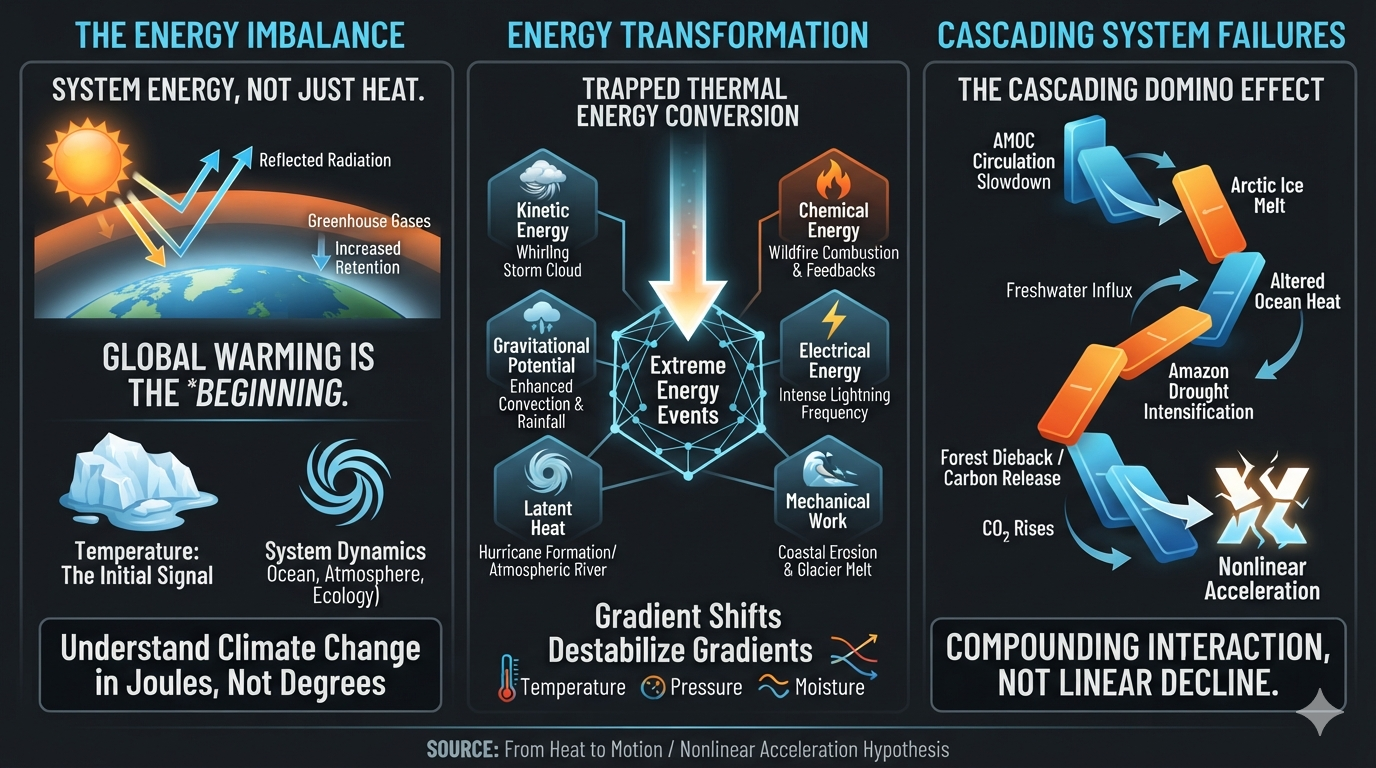
The phrase global warming is widely misunderstood. While it correctly describes a rise in average surface temperature, it understates the real risk: a rapid increase in total system energy. Temperature is only the initial signal. Once excess energy accumulates, it is transferred, converted, and expressed through atmospheric circulation, ocean dynamics, hydrological cycling, and ecological responses.
Global warming is therefore the beginning of climate change — not its endpoint.
Excess trapped thermal energy is continually transformed into other forms, including:
For a deeper explanation, see:
From Heat to Motion: How Thermal Energy Transforms Across Physical Systems
In 2025, global mean temperatures exceeded the long-recognized 1.5°C threshold. To a casual observer, that number may sound small. In a nonlinear system, it is not.
Small shifts in average temperature translate into large, destabilizing shifts in gradients — temperature gradients, pressure gradients, and moisture gradients. Those gradient changes alter circulation patterns, intensify convection, amplify hydrological extremes, and increase momentum transfer.
What emerges are not merely “weather events,” but what are more accurately described as:
Extreme energy events.
Understanding climate change requires thinking not in degrees —
but in joules.
And in how those joules move.
The water rises…
(Beneath the storm)
The edge approaches…
(Beyond the norm)
On the verge
(Storm surge)
On the edge…
… over the ledge…
(Urge to splurge)
Storm surge
(Energy purge)
The ocean starts from higher ground
A rising tide is already found
Before the winds begin to roar
The waves are higher than before
Heat expands the seas below
Ice sheets melt and waters flow
Watching storms that comes ashore
Pushes farther than before
Higher seas
(Higher reach)
Stronger winds
(Upon the beach)
Storm surge
(Feel the force)
Moving water
(Changing course)
Storm surge
(Driven strong)
Where it lands
(It won’t belong)
Over roads
(Over walls)
Through the streets
(When the ocean calls)
Warmer waters feed the storm
Giving hurricanes a stronger form
Energy gathered from the deep
Awakens forces once asleep
Rapid changes, rising speed
Less time left for what we need
Warnings shorten, moments fade
As stronger storms are quickly made
Faster winds
(Pressure falls)
Stronger storms
(Against the walls)
Slow it down
(The storm remains)
Stay too long
(And water gains)
Wave by wave
(The damage grows)
Where it stops
(Nobody knows)
A rising ocean
A powerful surge
A changing climate
An escalating urge
[Minimal Beat, Deep Sub Bass, Spoken Vocal]
A storm surge is not only the storm.
It is the ocean before it arrives.
Higher seas…
(More water)
More energy…
(More power)
… less “our”
On the verge
(Storm surge)
On the edge…
… over the ledge…
(Urge to splurge)
Storm surge
(Energy purge)
Rising higher
(Pushing through)
Stronger waters
(Coming true)
Storm surge
(Feel the force)
No longer distant
(Now the course)
[Outro]
Storm surge…
(Storm surge…)
Energy purge…
On the verge…
(On the edge…)
Over the ledge.
About the Song: Climate Change and Storm SurgesClimate change is dramatically worsening storm surges by raising baseline sea levels and creating conditions that favor more intense coastal storms. As the planet warms, the combination of rising oceans and increasingly energetic weather systems allows seawater to penetrate farther inland with greater destructive force, placing millions of people and billions of dollars in coastal infrastructure at increasing risk.
Rising Sea Levels:
This is the primary driver of increasing coastal flood risk. Global warming melts land-based ice sheets and glaciers while also causing seawater to expand as it warms. Because sea levels are higher than they were a century ago, today’s storm surges begin from an elevated baseline, allowing floodwaters to reach much farther inland.
Increased Storm Intensity:
Warmer ocean temperatures provide additional energy for tropical cyclones, effectively increasing their potential intensity. Stronger storms generate more powerful winds that pile up and push enormous volumes of water toward coastlines, producing higher and more destructive storm surges.
Rapid Intensification:
The accumulation of heat in the upper ocean has increased the likelihood of rapid intensification events, in which hurricane wind speeds increase by at least 35 mph within a 24-hour period. This accelerated strengthening dramatically reduces the time available for forecasts, evacuations, and emergency preparations.
Slower-Moving Storms:
Some studies suggest that climate change may contribute to a reduction in the forward speed of certain tropical cyclones. When storms move more slowly, they remain over coastal areas longer, generating prolonged storm surges, heavier rainfall, and repeated wave impacts that compound flooding and infrastructure damage.
Storm surges are becoming more dangerous because they are increasingly occurring on top of a rising ocean and, in many cases, are being driven by more energetic storms. The result is deeper flooding, greater inland penetration of seawater, longer-lasting impacts, and rapidly escalating economic and human costs.
[Intro]
Hot air rising…
(Moisture climbing)
Dark clouds building…
(Timing, timing)
[Refrain]
Microburst
(Bust!)
… through…
(Raining down on you)
Microburst
(Gust!)
… blew…
(Right over you)
[Verse 1]
Summer afternoon looks tame
Then the sky rewrites the game
Towering clouds begin to grow
Packing more than eyes can know
For a moment all seems fine
Then it breaks the peaceful line
[Chorus]
Microburst
(Bust!)
Winds descend
(Without end)
Trees bend hard
(Lines come down)
Minutes later
(Changed the town)
Microburst
(Gust!)
Came and flew
(Right into you)
[Verse 2]
More potential, more release
Less assurance, less peace
Small increases, larger cost
Power gained and power lost
Storms that seemed ordinary
Suddenly become extraordinary
[Bridge]
Not just warmer
(More alive)
Not just hotter
(More drive)
… it gathers, concentrates
And arrives without debate
[Breakdown]
Time to test:
(Evaporated.)
Concentrated.
(Released.)
The beast.
(Manifest.)
Put to the test
(Manifest.)
[Final Chorus]
Microburst
(Bust!)
… through…
(Raining down on you)
Microburst
(Gust!)
… blew…
(Right over you)
What seemed calm
(Became severe)
What seemed distant
(Is now here)
More energy
(More extremes)
More surprises
(Than it seems)
Microburst
(Bust!)
Came on through…
(Right over you.)
[Outro]
Microburst…
(Gust…)
Microburst…
(Bust…)
Raining down…
(All around)
Right into you.
(Released.)
The beast.
(Manifest.)
Put to the test
(Manifest.)
About the Song
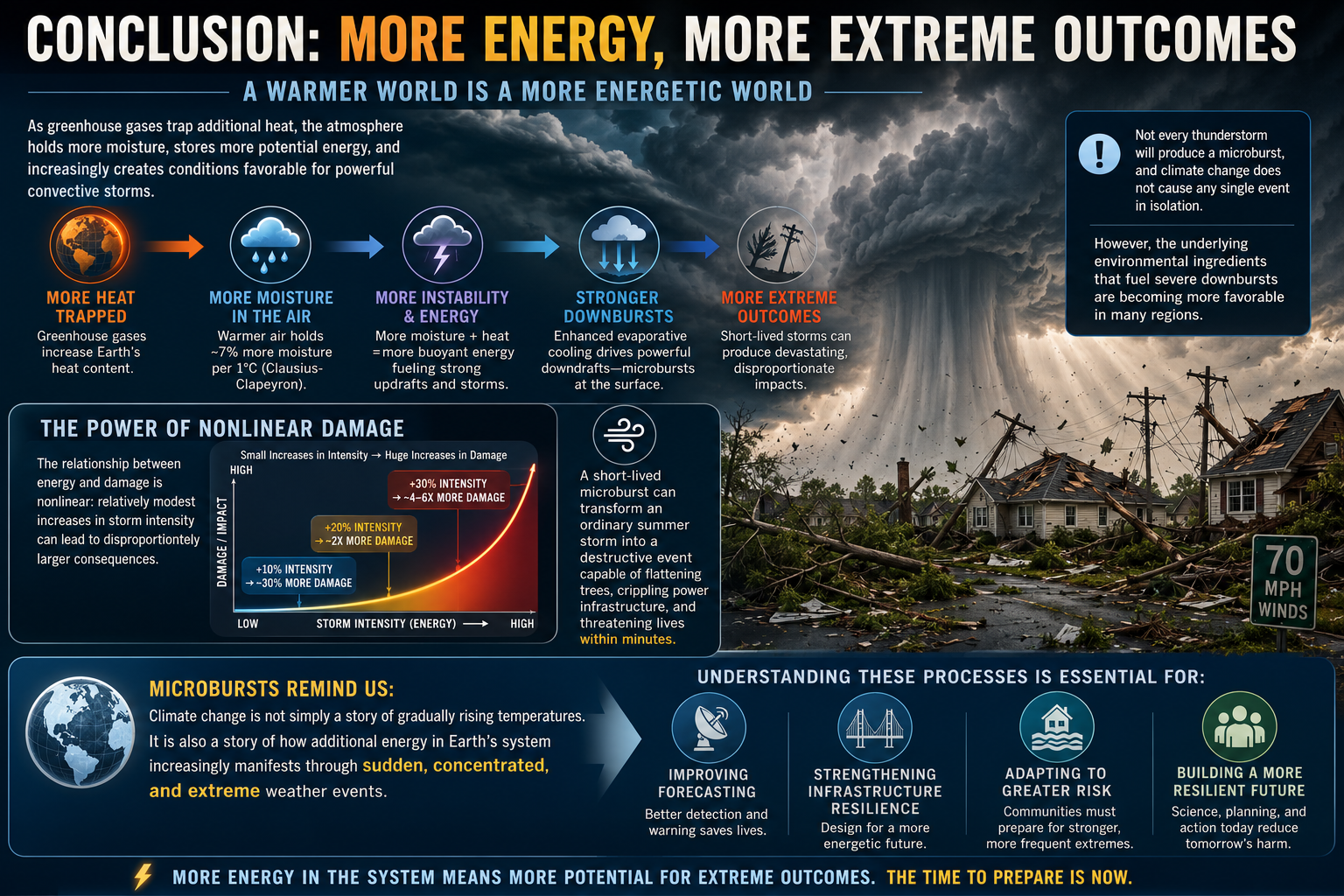
Microbursts illustrate a fundamental principle of climate physics: a warmer world is a more energetic world. As greenhouse gases trap additional heat, the atmosphere holds more moisture, stores more potential energy, and increasingly creates conditions favorable for powerful convective storms.
Because the relationship between energy and damage is nonlinear, relatively modest increases in storm intensity can lead to disproportionately larger consequences. A short-lived microburst can transform an ordinary summer storm into a destructive event capable of flattening trees, crippling power infrastructure, and threatening lives within minutes.
Microbursts therefore serve as a reminder that climate change is not simply a story of gradually rising temperatures. It is also a story of how additional energy in Earth’s system increasingly manifests through sudden, concentrated, and extreme weather events. Understanding these processes is essential for improving forecasting, strengthening infrastructure resilience, and adapting to a climate system that is becoming progressively more volatile and energetic.
Microbursts, Extreme Energy Events, and a Warming Climate
[Intro]
The clouds gather…
(Energy rising)
The waters come…
(No more hiding)
[Refrain]
The rain…
(Is gonna reign over me)
All pain
(No gain)
The troubles we could see
If we let the violent reign
(… remain…)
[Verse 1]
Rain has always fallen down
Rivers flow through every town
But the energy has changed
And the balance rearranged
When the clouds release their load
Floods begin to overflow
[Pre-Chorus]
More water
(More force)
More motion
(Off course)
[Chorus]
Violent reign
(Pouring down)
Turns a smile
(Intо a frown)
Heavy drops
(Falling fast)
Changing futures
(Changing past)
Not just rain
(Not the same)
Energy
(Feeds the game)
If we let
(The violent reign)
Remain…
[Verse 2]
Wind and water carry weight
Small increases escalate
Raindrops growing, rivers rise
Floodwaters take by surprise
What was once a passing storm
Now can break the strongest form
[Pre-Chorus]
Higher heat
(More supply)
More moisture
(In the sky)
When it falls
(From above)
Comes with force
(Not just love)
[Bridge]
Temperature
(Is the clue)
Energy
(Is what moves through)
Heat becomes
(The storm and sea)
Changing what
(The world can be)
Not only warmer…
(Not only hot…)
But more powerful
(Than we thought)
[Breakdown]
Violent rain…
Not just more drops.
More energy.
More water.
More force.
(Change our course)
[Final Chorus]
The rain…
(Is gonna reign over me)
More strain
(To gain)
The troubles we could see
If we let the violent reign
(… remain…)
More intense
(More extreme)
More destructive
(Than it seems)
Storms arrive
(From above)
On the drive
(Drowning out the love)
[Outro]
The rain…
(Is gonna reign…)
The rain…
(Will remain…)
Unless we change…
(The violent reign.)
About the Song
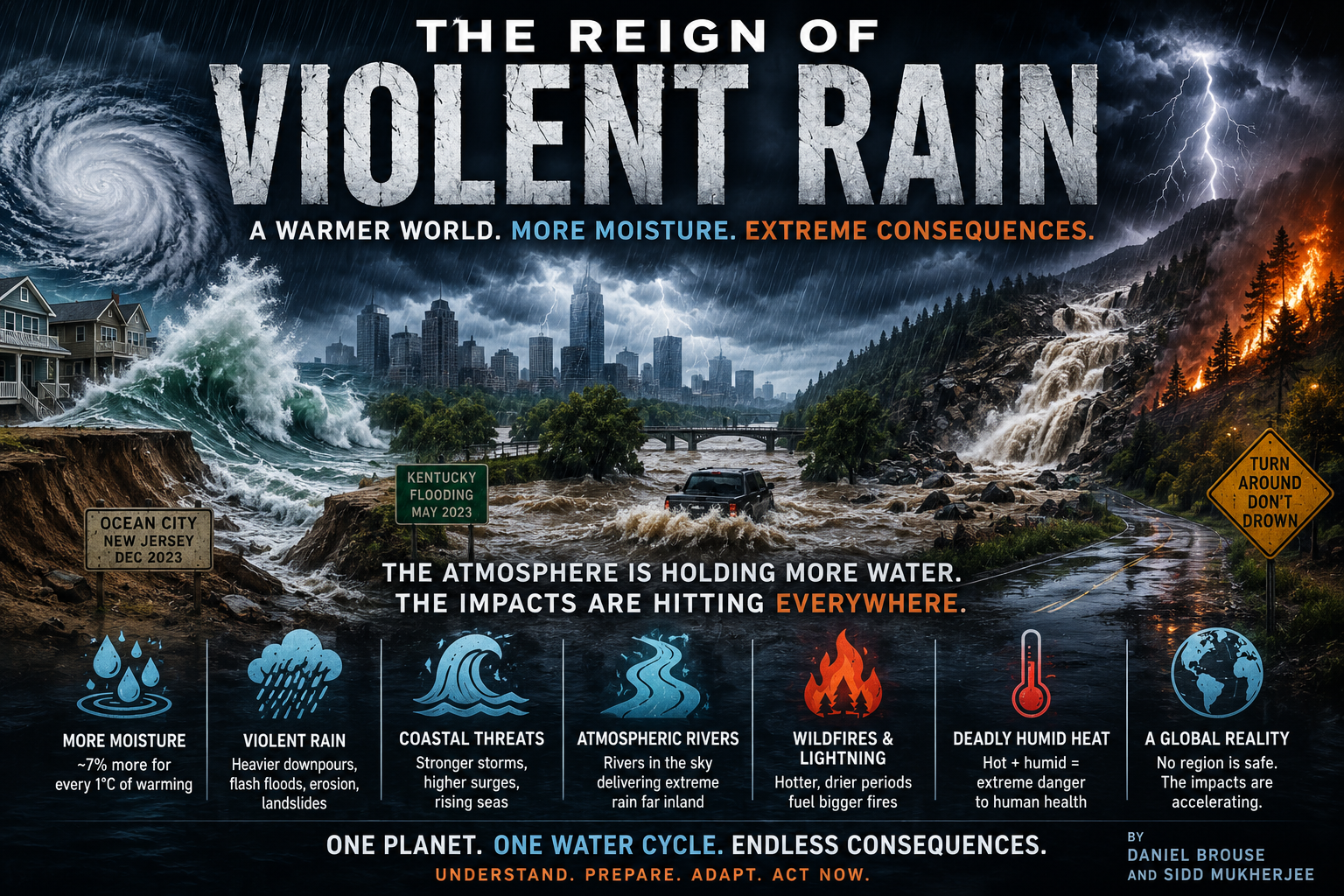
“Climate change is increasing the amount of energy violent rain events contain, amplifying how much damage they can inflict.”
The physics of wind and rain are important to understand: their destructive force increases nonlinearly with velocity and is further amplified by density and mass. Even relatively small increases in wind speed or rainfall intensity can produce disproportionately larger impacts and damage.
Many people equate global warming solely with increasing temperatures. This is a deadly misunderstanding. The additional energy accumulating within Earth’s climate system does not remain simply as heat. It is redistributed throughout the atmosphere and oceans, manifesting in many forms of extreme weather, including floods, stronger storms, atmospheric rivers, and increasingly destructive episodes of violent rain.
Violent rain is not merely heavier rainfall. It is rainfall intensified by the additional energy and moisture now present in the climate system, producing larger raindrops, higher rainfall rates, more intense runoff, and more destructive flooding and erosion.
[Intro]
The water rises…
(Beyond the line)
The old predictions…
(Left behind)
[Refrain]
Flooded
(With emotion)
As our home
(Flooded)
… in the flood zone
(I’ve a notion)
Going down
(Down, down, down)
Don’t wanna drown
(Going down)
Down, down, down
[Verse 1]
Once they called it once in time
A rare event beyond the line
Five hundred years before it came
A number written in the name
But the numbers started changing
As the climate kept rearranging
What was rare began to show
More often than we used to know
[Chorus]
Flooded
(Overrun)
Water rising
(One by one)
Through the streets
(Across the ground)
Where the dry land
(Used to be found)
[Refrain]
Flooded
(With emotion)
As our home
(Flooded)
… in the flood zone
(I’ve a notion)
Going down
(Down, down, down)
Don’t wanna drown
(Going down)
Down, down, down
[Verse 2]
The atmosphere can hold more weight
More moisture building while we wait
When the skies release the load
Rivers surge beyond the road
[Pre-Chorus]
Ten-year storms
(Return again)
Hundred-year floods
(Became the trend)
[Bridge]
Statistics move
(When systems change)
Probability
(Rearranges)
The past is not
(The same guide)
When the future
(Changes tide)
[Breakdown]
A flood is not only water.
It is probability.
It is energy.
It is a reality.
[Refrain]
Flooded
(With emotion)
As our home
(Flooded)
… in the flood zone
(I’ve a notion)
Going down
(Down, down, down)
Don’t wanna drown
(Going down)
Down, down, down
[Final Chorus]
Flooded
(With emotion)
As our home
(Flooded)
… in the flood zone
(I’ve a notion)
Going down
(Down, down, down)
Don’t wanna drown
(Going down)
Down, down, down
Flooded
(Feel the tide)
Changing currents
(Changing lives)
What was rare
(Is now near)
What was distant
(Is now here)
[Outro]
Going down…
(Down, down, down)
Don’t wanna drown…
Flooded…
(Flooded…)
About the Song
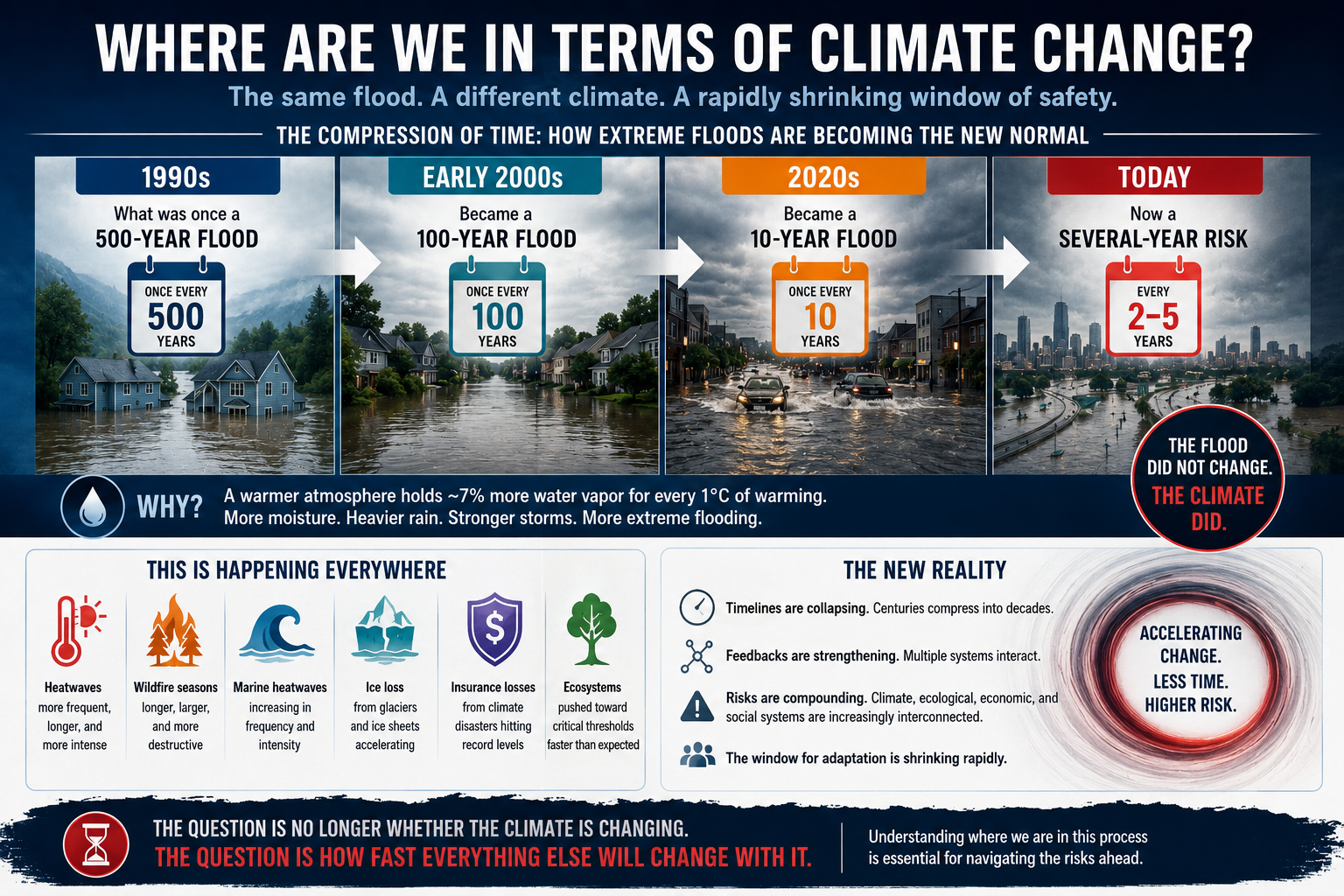
One of the simplest ways to understand climate change is through the changing frequency of extreme events.
Climate change is not merely causing temperatures to rise. It is fundamentally altering the probability of extreme weather. Events that were once considered extraordinarily rare are becoming increasingly common.
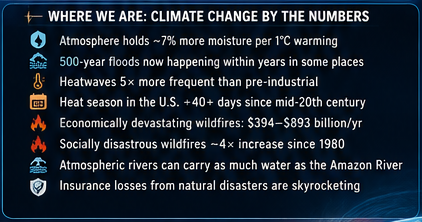
In the 1990s, what was considered a 500-year flood had only a 0.2 percent chance of occurring in any given year.
By the early 2000s, many of these same events were being reclassified as 100-year floods. By the 2020s, they increasingly resembled 10-year floods. Today, in some regions, comparable flood events are occurring every few years.
This does not mean that every flood is becoming larger than previous floods. Rather, the statistical framework itself is changing. The atmosphere and oceans now contain significantly more energy and moisture than they did several decades ago, increasing the likelihood of extreme rainfall events.
[Intro]
The waters warm…
(The pressure falls)
The winds begin…
(The ocean calls)
A season starts…
(That never ends)
A cycle turns…
(Again, again)
[Refrain]
What’s the reason
(For an extended season)
Name
(That hurricane)
A past Z
(Way too easy)
Are we so vain
(Takin’ on a hurricane)
[Verse 1]
The ocean holds the hidden key
Energy beneath the sea
Heat rises through the atmosphere
Feeding storms that draw near
A little more, a little fast
Breaking records from the past
What was once a distant threat
Now becomes a closer bet
[Pre-Chorus]
Warmer water
(Fuels the fire)
Rising pressure
(Climbs higher)
Latent heat
(Releases the force)
Storms accelerate
(Along their course)
[Chorus]
Hurricane season
(Changing the reason)
Stronger storms
(Coming ashore)
More intensity
(More energy)
More than we’ve seen before
A hurricane
(A spinning engine)
Powered by heat
(From the ocean within)
[Verse 2]
Pressure drops and winds increase
The storm grows stronger piece by piece
Clouds rise high, the rainfall grows
Following where the warm water flows
Rapid changes near the shore
Stronger than the storms before
Less time left to understand
Before the winds reach land
[Pre-Chorus]
Lower pressure
(Stronger winds)
More moisture
(Storm begins)
Ocean mixing
(Feeds the flow)
Where it ends
(We don’t know)
[Bridge]
Is it only weather?
(Or something more?)
Is the pattern changing?
(From shore to sure)
Watch the waters
(Watch the skies)
Watch the storms
(As they rise)
The engine turns
(The cycle spins)
A warmer world
(The storm begins)
[Breakdown]
A hurricane is not just wind.
It is energy moving.
Heat becomes pressure.
Pressure becomes motion.
Motion becomes destruction.
(Nature’s revolution)
[Final Chorus]
What’s the reason
(For an extended season)
Name
(That hurricane)
A past Z
(Way too easy)
Are we so vain
(Takin’ on a hurricane)
Hurricane season
(Changing the reason)
Storms arise
(Before our eyes)
More energy
(More intensity)
Under changing skies…
[Outro]
Hurricane…
(Season)
Hurricane…
(Reason)
The waters turn…
The winds return…
Again… and again… and again…
About the Song
Hurricanes / Tropical Cyclones: Among Earth’s most powerful heat engines, converting ocean heat into enormous wind fields, storm surge, extreme rainfall, and destructive energy release.
Pressure Gradient Intensification
Warmer oceans and altered pressure contrasts fuel rapid storm intensification.
Watch for:
* Bomb cyclones forming explosively
* Hurricanes undergoing rapid intensification near landfall
* Stronger mid-latitude wind fields
Warmer water adds latent heat.
Latent heat lowers central pressure.
Lower pressure accelerates wind fields.
Stronger winds increase ocean mixing and moisture flux.
The loop reinforces.
Are storms strengthening faster than historical norms out your window?
[Intro]
Feel that rumble…
(Coming near)
Hear the warning…
(Loud and clear)
[Refrain]
Sooo… you might
(Wanna hold on tight)
Cause the fright
(Might ignite)
[Verse 1]
The sky can change without a sound
Blue to black in moments found
Pressure falls and winds arise
Trouble gathers in the skies
Another gust begins to grow
Faster than we used to know
Nature doesn’t hesitate
When conditions escalate
[Chorus]
Hold on tight
(Hold your ground)
Things can change
(All around)
Storms arrive
(Without delay)
Turning light
(… day… to night)
Sooo… you might
(Wanna hold on tight)
Cause the fright
(Might ignite)
[Verse 2]
The winds don’t ask which road you take
The floods don’t choose which levees break
Yes, the system seeks release
Until the forces find their peace
More energy within the air
Means more power everywhere
What was steady yesterday
Can be swept away today
[Pre-Chorus]
Watch the signs
(Read the sky)
Don’t assume
(It passes by)
[Bridge]
Preparation
(Beats surprise)
Listen well
(Open your eyes)
Heed the warning
(Know its name)
Learn the lesson
(Play the game)
Respect the power
(Respect the force)
Nature follows
(Its own course)
[Breakdown]
You don’t negotiate…
…with physics.
(Are you aware…)
You prepare.
[Final Chorus]
Sooo… you might
(Wanna hold on tight)
Cause the fright
(Might ignite)
Hold on tight
(Stay aware)
Changing weather
(Is everywhere)
Plan for whether
(Through the night)
Face tomorrow
(In the light)
Sooo… you might
(Wanna hold on tight)
[Outro]
Hold on…
(Hold on…)
Hold on tight…
(Tight…)
[Intro]
Climb aboard…
(Here we go)
Winds are rising…
(Feel them blow)
[Refrain]
Ridin’ the storm
(To the new norm)
Is it any surprise
(Rise of the thrillin’ ride)
Ride, ride, ride
[Verse 1]
Clouds are stacking mile on mile
Nature’s wearing a different smile
Heat becomes the driving force
Sending weather off its course
[Chorus]
Ridin’ the storm
(To the new norm)
Winds are stronger
(Longer, longer)
Rain comes down
(Harder still)
Nature climbs
(Another hill)
Ride, ride, ride
(No place to hide)
[Verse 2]
Yesterday’s extremes were rare
Now they’re showing everywhere
Records broken one by one
Before the season’s even done
Another joule that finds release
Acceleration increase
Flood or fire, wind or rain
Different faces, same refrain
[Pre-Chorus]
More energy
(More surprise)
Changing weather
(Before our eyes)
[Bridge]
The ride gets faster
(Every year)
The signals louder
(Loud and clear)
The map is changing
(The rules bend)
What once was rare
(Returns again)
[Breakdown]
The storm…
…isn’t changing because it’s angry.
It’s changing…
…due to the energy.
[Final Chorus]
Ridin’ the storm
(To the new norm)
Is it any surprise
(Rise of the thrillin’ ride)
Ride, ride, ride
Higher seas
(Stronger breeze)
Hotter days
(Longer waves)
Storm by storm
(The pattern forms)
Welcome to…
(The new norm)
Ride, ride, ride…
[Outro]
Ridin’ the storm…
(To the new norm…)
Ride…
Ride…
Ride…
[Intro]
Talk is cheap…
(The wind is free)
Truth arrives…
(Eventually)
[Refrain]
What does the blowhard
(Have to say today?)
As the winds blow hard
(Watch him get blow away)
Hey! Hey! Hey!
[Verse 1]
The storm has told its tale
The forecast set to sail
Nature doesn’t care one bit
About opinions wrapped in wit
You can argue, you can shout
You can spin and twist about
But the atmosphere keeps score
Like it never did before
[Pre-Chorus]
Facts don’t bend
(With the breeze)
Physics never
(Tries to please)
[Chorus]
Blow hard
(Talk loud)
Standing tall
(In the crowd)
Blow hard
(Make your stand)
Until reality
(Lends a hand)
[Refrain]
What does the blowhard
(Have to say today?)
As the winds blow hard
(Watch him get blow away)
Hey! Hey! Hey!
[Verse 2]
Storms don’t vote or pick a side
Floods don’t stop because of pride
Heat keeps building day by day
While excuses blow away
The gust can tell the truth
The season offers proof
Watch the sky instead of spin
That’s where the story begins
[Bridge]
Bluster louder
(If you must)
Strong opinions
(Turn to dust)
When the evidence appears
It outlasts the loudest cheers
[Breakdown]
[Minimal Beat, Deep Bass, Spoken Vocal]
The wind…
…doesn’t care what you believe.
Can you conceive…
…the laws of physics?
[Final Chorus]
What does the blowhard
(Have to say today?)
As the winds blow hard
(Watch him get blow away)
Hey! Hey! Hey!
Talk is easy
(Proving’s hard)
Nature you’ll see
(Plays the card)
Storm by storm
(Day by day)
The truth keeps blowing
(Anyway)
[Outro]
What does the blowhard
(Have to say today?)
As the winds blow hard
(Watch him get blow away)
Hey! Hey! Hey!
Blow hard…
(Blow away…)
Hey! Hey! Hey!
The wind…
Has the final say.
[Intro]
Closer now…
(Than before)
Less room left…
(To ignore)
[Refrain]
I don’t know quite what to say
(We’re in the age… we’re in the day)
When our margin of error
(Grows narrower)
Razor thin
(Oh, whoa woe… where to begin?)
[Verse 1]
One decision tips the scale
Warning signs now tell the tale
Time once gave us room to wait
Now it arrives before too late
Systems pushed beyond their norm
Quiet skies can birth a storm
Tiny shifts become profound
When balance can’t be found
[Pre-Chorus]
Less forgiveness
(More demand)
Less protection
(Than we planned)
[Chorus]
Razor thin
(Hanging on)
Yesterday
(Is nearly gone)
Seconds matter
(Count them all)
Small decisions
(Change it all)
Razor thin
(Edge to edge)
Standing closer
(To the ledge)
[Refrain]
I don’t know quite what to say
(We’re in the age… we’re in the day)
When our margin of error
(Grows narrower)
Razor thin
(Oh, whoa woe… where to begin?)
[Verse 2]
The buffer shrinks, the risks expand
More uncertainty at hand
Small mistakes can multiply
Before we understand why
[Pre-Chorus]
Tiny changes
(Big results)
Small decisions
(Large revolts)
[Bridge]
Push too far
(It may bend)
Push again
(It may end)
The distance now
(Between survive)
And disaster
(Is razor wide… no…)
Razor thin.
[Refrain]
I don’t know quite what to say
(We’re in the age… we’re in the day)
When our margin of error
(Grows narrower)
Razor thin
(Oh, whoa woe… where to begin?)
[Final Chorus]
I don’t know quite what to say
(We’re in the age… we’re in the day)
When our margin of error
(Grows narrower)
Razor thin
(Oh, whoa woe… where to begin?)
One small action
(Starts the chain)
One more moment
(Changes everything)
Razor thin…
[Outro]
Razor thin…
(Hold on…)
Razor thin…
(Before the wind…)
Blows us away
(… into yesterday)
[Intro]
One change…
(Becomes another)
Two loops…
(Become sister and brother)
[Refrain]
I am in
(A complex adaptive system)
Yes, I am…
(Yes, we are)
Gettin’ bizarre
Mutually reinforcing
(Feedback loops, loops, loops)
Forcing amplification
(Multiplication)
Complication
[Verse 1]
One small shift begins the chain
Heat becomes another strain
Ice retreats, the oceans warm
Setting up another storm
Frozen ground begins to wake
Forests burn and rivers break
Signals spread from place to place
What transcends its own space
[Pre-Chorus]
Connected paths
(Intertwine)
Crossing one
(Changes nine)
[Chorus]
Feedback loops
(Building fast)
Future meets
(The fading past)
Dominoes
(Start to fall)
One small push
(Can move them all)
Round and round
(The circles spin)
Growing stronger
(From within)
[Verse 2]
Like a snowball rolling free
Gathering velocity
Mass and momentum side by side
Nothing slows the downhill ride
[Pre-Chorus]
More momentum
(More release)
Less resistance
(More increase)
[Bridge]
Feedback…
(Loop, loop, loop)
creates…
tipping points.
Tipping points…
create…
more feedback.
(Loop, loop, loop)
At any rate…
(The system accelerates.)
[Final Chorus]
I am in
(A complex adaptive system)
Yes, I am…
(Yes, we are)
Gettin’ bizarre
Mutually reinforcing
(Feedback loops, loops, loops)
Forcing amplification
(Multiplication)
Complication
Domino falling…
(Snowball rolling…)
Webs connecting…
(System growing…)
Round and round…
(No slowing down…)
[Outro]
One becomes many…
Many become one…
Complex…
Adaptive…
System…
About the Song
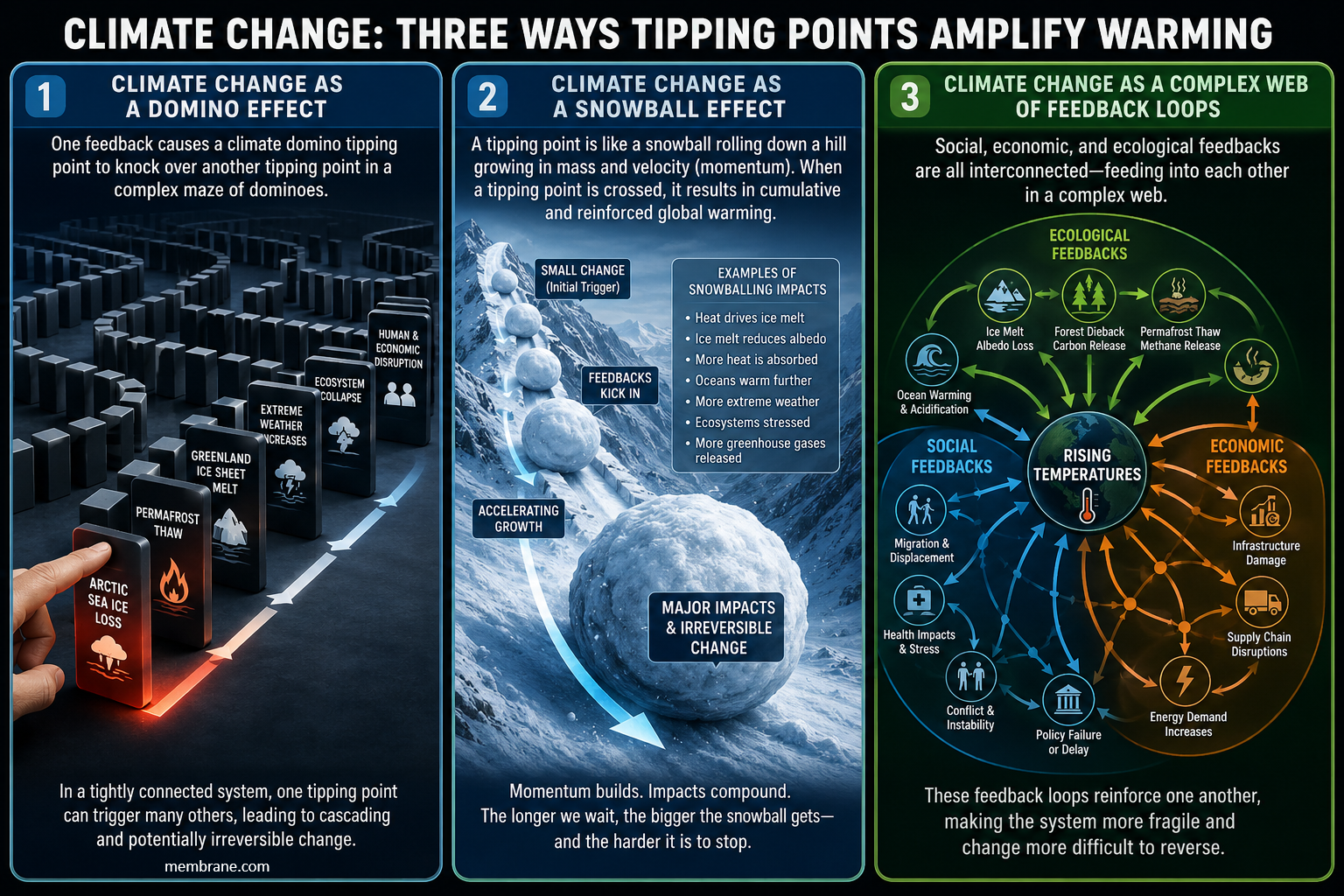
Create an infographic with three side-by-side panels illustrating three ways climate change accelerates through interconnected feedback mechanisms. Use a clean, scientific style with bold titles, arrows, and simple labels. The overall theme should emphasize accelerating nonlinear change rather than isolated events.
Illustrate a vast, complex maze of dominoes representing climate tipping points. A single falling domino triggers a chain reaction that spreads through multiple pathways, knocking over many other tipping points simultaneously.
Include examples of dominoes labeled:
The image should convey that one feedback loop can trigger many others, producing cascading climate tipping points throughout the Earth system.
Show a small snowball beginning at the top of a mountain slope. As it rolls downhill, it becomes dramatically larger, faster, and more powerful, symbolizing increasing momentum.
As the snowball grows, illustrate climate impacts accumulating around it:
Use arrows to emphasize positive feedback, showing that each new impact increases the size and momentum of the snowball.
The final snowball at the bottom should appear enormous, illustrating how crossing climate tipping points leads to cumulative, self-reinforcing global warming that becomes increasingly difficult to slow or reverse.
Create a network diagram centered on Global Warming, with interconnected nodes linked by arrows in multiple directions.
Organize the nodes into three interconnected categories:
Ecological Feedbacks
Economic Feedbacks
Social Feedbacks
Use numerous looping arrows to show that these ecological, economic, and social systems continually reinforce one another rather than operating independently.
The overall visual should resemble a dynamic interconnected network, emphasizing that climate change is not a single linear process but a complex adaptive system of mutually reinforcing feedback loops that accelerate global warming.
[Intro]
The air stands still…
(Not much moves)
The sky won’t change…
(We’re trapped beneath)
[Refrain]
Where ever I may roam
(Under a heat dome)
Oh, that Rossby wave
(Just won’t behave)
[Verse 1]
The jet stream used to race along
Carrying weather swift and strong
Now it bends from side to side
Leaving heat with no place to hide
The winds slow down across the sky
Cloudless days keep drifting by
Every sunrise fans the flame
Tomorrow feels the very same
[Pre-Chorus]
Round and round
(The pattern stays)
Day by day
(The endless blaze)
[Chorus]
Heat dome
(Hanging on)
Morning comes
(The cool is gone)
High pressure
(Holds its throne)
Now we’re living
(Beneath the dome)
[Refrain]
Where ever I may roam
(Under a heat dome)
Oh, that Rossby wave
(Just won’t behave)
[Verse 2]
The ridge grows taller overhead
Storms are pushed away instead
Rain goes somewhere else to fall
Leaving heat to cover all
An Omega fills the sky
Like a giant question: why?
Weather stalls for days on end
Waiting for the winds to bend
[Pre-Chorus]
Blocking high
(Standing still)
Nature follows
(Physics’ will)
[Bridge]
One place burns
(Another floods)
One place dries
(Another muds)
Around the world
(The pattern flows)
Following where
(The jet stream goes)
Wave by wave
(It circles free)
Connecting one
(To many seas)
[Breakdown]
Where ever I may roam
(Under a heat dome)
Oh, that Rossby wave
(Just won’t behave)
[Final Chorus]
Where ever I may roam
(Under a heat dome)
Oh, that Rossby wave
(Just won’t behave)
Higher highs
(Longer stays)
Day by day
(The endless blaze)
Heat builds up
(Above our home)
Beneath another
(Heat dome)
Ride the ridge…
(Feel the heat…)
Until the pattern…
(Finds retreat…)
[Outro]
Wherever I may roam…
(Under a heat dome…)
Rossby waves…
(Misbehaves)
Waiting… for the sky to rearrange…
…for the wind to change.
About the Song: Heat Domes & Atmospheric Blocking
Large-scale atmospheric energy accumulations that trap heat, amplify temperature extremes, and create dangerous persistence.


Under historically stable conditions, the jet stream generally flowed in a relatively progressive west-to-east pattern across the United States and southern Canada.
As thermal gradients weaken:
The result is a circulation regime characterized by “stuck” weather patterns and amplified climatic extremes.
Many of the most extreme recent weather events globally exhibit these characteristics.
An omega block is essentially an extreme, highly amplified Rossby-wave pattern where the jet stream bends into the shape of the Greek letter Ω. These blocking patterns slow atmospheric circulation dramatically and can “lock” weather systems in place for days or even weeks.
That is a major factor behind persistent heat domes in the central U.S. Instead of weather systems moving progressively west-to-east as they historically did, the amplified wave stalls, allowing heat to continuously build beneath the ridge while storms and cooler air are diverted around it.
As these amplified Rossby waves meander around the hemisphere, similar blocking impacts can propagate into other regions at comparable latitudes — including the UK, Europe, and parts of Asia. That is why we increasingly see synchronized extremes globally: prolonged heatwaves in one region while other areas experience stalled flooding, cold intrusions, or drought.
[Intro]
One spark…
(Starts the fall)
One flame…
(Becomes a wall)
[Refrain]
Wow! That’s wild…
(Fire!)
Growing higher
(Wildfire)
Fire! Fire! Fire!
[Verse 1]
The forests dry beneath the sun
Waiting for what may become
One lightning strike, one careless spark
Turns the daylight growing dark
The seasons stretch from spring to fall
The flames refuse to slow at all
What once would burn a week or two
Now keeps raging straight on through
[Pre-Chorus]
Hotter days
(Drier trees)
Stronger winds
(Feed the breeze)
[Chorus]
Wild fire!
(Burning bright)
Turning day
(Into night)
Smoke rolls high
(Across the sky)
Miles away
(It still can fly)
[Refrain]
Wow! That’s wild…
(Fire!)
Growing higher
(Wildfire)
Fire! Fire! Fire!
[Verse 2]
Canada, Siberia
Burning farther every year
Peatlands smolder underground
Carbon rising without sound
Smoke can circle half the Earth
Changing skies of every birth
Ash falls down on snow and ice
Speeding up the warming cycle twice
[Bridge]
Forest falls
(Heat remains)
Permafrost
(Breaks its chains)
Smoke filled haze
(The sky above)
Soot below
(Melts what we love)
Round and round
(The feedback grows)
Where it stops
(Nobody knows)
[Refrain]
Wow! That’s wild…
(Fire!)
Growing higher
(Wildfire)
Fire! Fire! Fire!
[Breakdown]
Fire!
Growin’ higher
Fire!
Higher and higher
[Final Chorus]
Wow! That’s wild…
(Fire!)
Growing higher
(Wildfire)
Fire! Fire! Fire!
Through the trees
(Across the land)
Changing lives
(Out of hand)
Higher heat
(Longer dry)
Watch the flames
(Reach the sky)
Wow! That’s wild…
(Fire!)
[Outro]
Wild fire…
(Wild fire…)
Still burning…
…higher and higher…!
About the Song
Wildfires are no longer seasonal events confined to traditionally fire-prone regions. In many parts of the world, wildfire seasons are starting earlier, lasting longer, and burning with unprecedented intensity. Areas that historically experienced only occasional fires are increasingly facing repeated and severe wildfire outbreaks.
Catastrophic climate shifts have dramatically increased wildfire risk worldwide. Since 1980, the frequency of socially disastrous wildfires has approximately quadrupled globally. Rising temperatures, prolonged droughts, declining snowpack, and increasingly erratic precipitation patterns are creating landscapes that are hotter, drier, and more combustible than at any time in modern history.
Satellite observations indicate that extreme wildfires in Canada and Siberia have approximately doubled in both frequency and intensity over the past two decades. Driven by rising temperatures, changing precipitation patterns, and thawing permafrost, these regions are experiencing unprecedented increases in burn severity.
The intensification of wildfires in Siberia and Canada initiates a series of interconnected feedback mechanisms that amplify both regional destruction and global climate change.
[Intro]
Round and round…
(Spinning faster)
Up and down…
(Weather master)
[Refrain]
Twisted
(Twist, twist)
Existed
(Resisted)
Twist, twist
(Twisted)
[Verse 1]
The winds don’t follow yesterday
The currents wander far away
Pressure bends from side to side
Nowhere left for storms to hide
[Refrain]
Twisted
(Twist, twist)
Existed
(Resisted)
Twist, twist
(Twisted)
[Chorus]
Twisted
(Out of line)
Changing all
(The warning signs)
Twist, twist
(Twisted)
[Refrain]
Twisted
(Twist, twist)
Existed
(Resisted)
Twist, twist
(Twisted)
[Verse 2]
Jet streams bend and waves expand
Storms can stall across the land
Floods and fires side by side
Both along the same wild ride
[Pre-Chorus]
More energy
(More surprise)
Changing weather
(Before our eyes)
[Bridge]
Nothing broken…
(Just transformed)
Physics working…
(As informed)
All the joules
(Must go somewhere)
Changing oceans
(Changing air)
[Refrain]
Twisted
(Twist, twist)
Existed
(Resisted)
Twist, twist
(Twisted)
[Breakdown]
[Minimal Beat, Deep Sub Bass, Spoken Vocal]
The atmosphere…
…isn’t clear.
Clenched fists…
Energy twists…
…everything…
That we bring.
(Sing!)
[Final Chorus]
Twisted
(Twist, twist)
Existed
(Resisted)
Twist, twist
(Twisted)
Round we go
(Faster still)
Man will follow
(Physics’ will)
Changing skies
(Changing views)
Twisting paths
(We shouldn’t choose)
Twist, twist…
[Outro]
Twisted
(Twist, twist)
Existed
(Resisted)
Twist, twist
(Twisted)
Still turning…
(Still not learning…)
Still twisting…
(Resisting)
Twisted.
[Intro]
Hear it coming…
(Feel the air)
Nothing gentle…
(Everywhere)
[Refrain]
Whipped
(By the wind)
Agin’ and agin’
(Whipped)
Blown away
(Day by day)
Like leaves left…
(… twistin’ in the wind)
[Verse 1]
Pressure falls and gradients grow
The faster winds begin to blow
Across the plains and through the trees
Carried on an angry breeze
Roofs are lifted, branches fly
Clouds race quickly through the sky
What once seemed strong begins to bend
Before the storm has reached its end
[Pre-Chorus]
Higher speed
(Greater force)
Nature follows
(Her own course)
[Chorus]
Whipped
(By the wind)
Round and round
(Once again)
Blown away
(Day by day)
[Refrain]
Whipped
(By the wind)
Agin’ and agin’
(Whipped)
Blown away
(Day by day)
Like leaves left…
(… twistin’ in the wind)
[Verse 2]
Warm air rises, cold air dives
Power hidden comes alive
Every gust begins to climb
One more notch, one more time
Storms don’t need to shout or scream
Physics drives the unseen beam
Another joule that finds release
Turns the wind another degree
[Pre-Chorus]
More energy
(Stronger flow)
Where it stops
(We don’t know)
[Bridge]
Leaves may fall
(Trees may break)
Buildings shake
(Rivers wake)
The atmosphere
(Rarely sleeps)
Another promise
(She tends to keep)
[Breakdown]
The wind…
…is invisible.
Its power…
…is not.
(Or have we forgot)
… our hour.
[Final Chorus]
Whipped
(By the wind)
Agin’ and agin’
(Whipped)
Blown away
(Day by day)
Like leaves left…
(… twistin’ in the wind)
Whipped…
(By the wind)
Whipped
(By the wind)
Agin’ and agin’
(Whipped)
Blown away
(Day by day)
Like leaves left…
(… twistin’ in the wind)
[Outro]
Twistin’…
…in the wind…
Whipped…
[Intro]
Here it comes…
(Bigger now)
Hold your breath…
(Anyhow)
[Refrain]
Wipeout!?!?
(Find out about)
Wipeout!
(Let’s hear you shout:)
Wipeout!
(No doubt)
Wipeout!
[Verse 1]
One more wave beyond the line
Higher than the warning sign
One more storm upon the shore
Bigger than the one before
Roads disappear beneath the tide
Nothing left for us to hide
Another warning starts to ring
Nature doesn’t bargain
[Pre-Chorus]
Too much rain
(Too much sea)
Too much power
(Released for free)
[Chorus]
Wipeout!
(Hold on tight)
Day turns dark
(In broad daylight)
Wipeout!
(Watch it grow)
Where it stops
(Nobody knows)
Ride the wave
(If you dare)
Feel the power
(In the air)
[Verse 2]
Floods and fires side by side
Storms that refuse to simply glide
Heat and wind combine as one
Long before the day is done
Know the joule will find a way
Moving night into the day
Changing oceans, changing skies
Changing what we recognize
[Bridge]
The wave grows taller
(The shore grows smaller)
The strongest walls
(Start to fall)
Prepared or not
(The choice is near)
The signals grow
(More loud and clear)
[Breakdown]
A wipeout…
…doesn’t start extreme
… ride the wave.
(Know what I mean?)
Find out…
… if you want to save!
[Final Chorus]
Wipeout!?!?
(Find out about)
Wipeout!
(Let’s hear you shout:)
Wipeout!
(No doubt)
Wipeout!
Higher tides
(Stronger storms)
Changing weather
(Becomes the norm)
Change in pace
(Turn about)
Or we’ll face…
…the next wipeout!
[Outro]
Wipeout…
(No doubt…)
Wipeout…
(Fade out…)
[Intro]
The sky grows dark…
(The kingdom forms)
A frozen crown…
(Inside the storm)
[Refrain]
All hail the king?
(But, here’s the thing)
It is hail hell
(King’s not so swell)
[Verse 1]
High above where cold winds blow
Tiny crystals start to grow
Lifted higher, falling low
Round and round they always go
[Pre-Chorus]
Up they go
(Down they fall)
Growing bigger
(After all)
[Chorus]
All hail!
(Hear the sound)
Ice comes crashing
(To the ground)
Breaking glass
(Bending steel)
Nature shows
(What storms can wield)
All hail the king?
(But, here’s the thing)
[Verse 2]
Warm moist air begins to rise
Building towers to the skies
Power hidden in the cloud
Soon announced both hard and loud
[Pre-Chorus]
More energy
(Stronger lift)
Bigger stones
(The climate’s gift)
[Bridge]
One more trip
(Through freezing air)
One more layer
(Waiting there)
Until the weight
(Becomes too great)
Then the kingdom…
(Meets its fate)
[Breakdown]
The stronger the storm…
…the larger the crown.
[Final Chorus]
All hail the king?
(But, here’s the thing)
It is hail hell
(King’s not so swell)
Oh, well (Oh, well)
Ice comes down
(Fast and hard)
Leaving every
(Yard well scarred)
Windows break
(Rooftops ring)
That’s the price
(Of hail’s king)
All hail!
(All hail!)
[Outro]
All hail…
(The king…)
Or maybe wail…
…all hail the storm
(The new norm.)
About the Song: Giant Hail and the Nonlinear Escalation of Severe Convective Storms
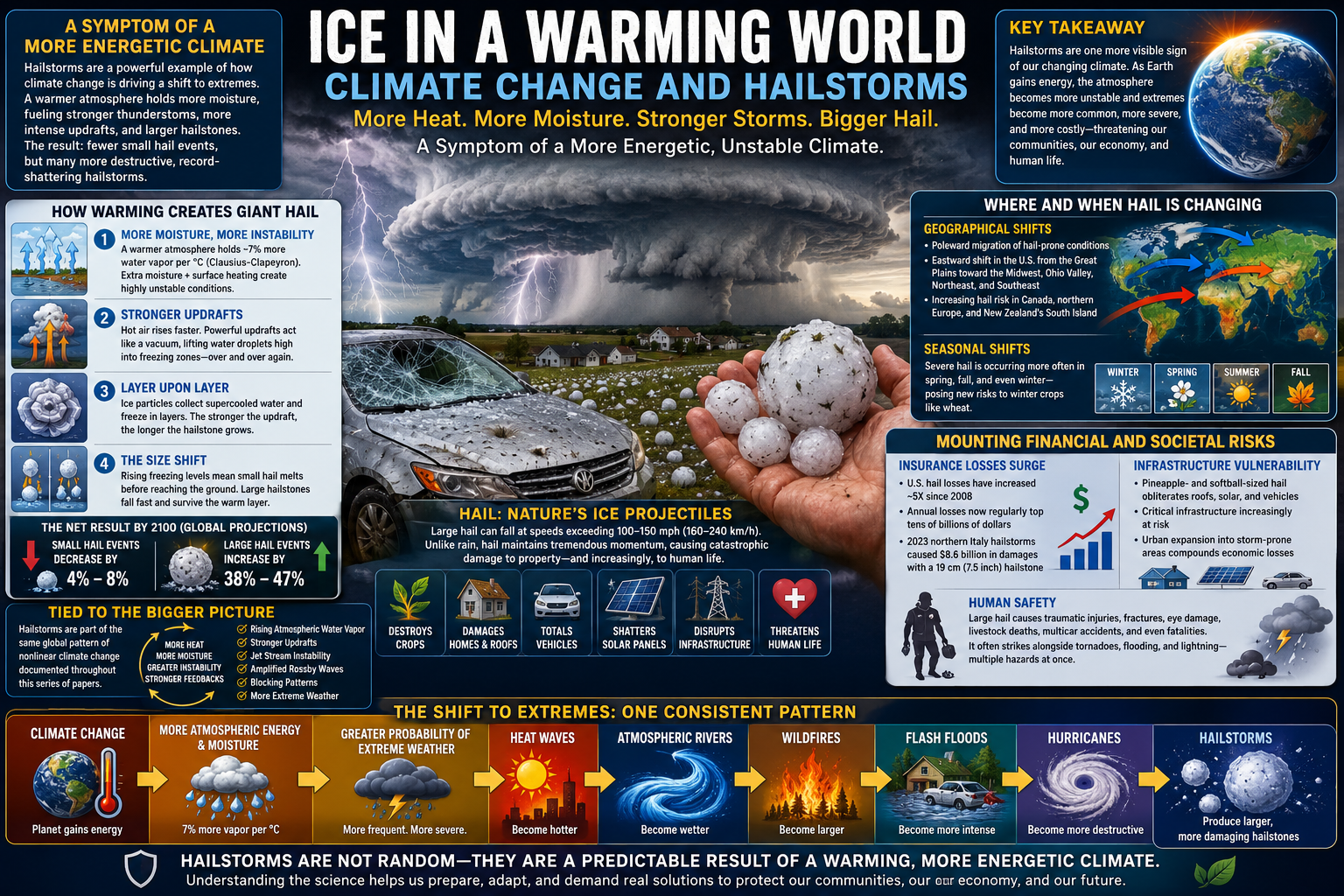
Hailstorms are among the most energetic convective weather systems on Earth. They develop inside powerful thunderstorms where intense upward air currents repeatedly lift developing ice particles through layers of supercooled water.
Each trip through the storm adds another layer of ice. If the updraft remains strong enough, hailstones continue growing until gravity finally overcomes the upward force. The stronger the storm, the larger the hail.
Large hail has become one of the fastest-growing sources of weather-related insurance losses worldwide, producing billions of dollars in damage each year
From the album “Extreme Energy“
[Intro]
Look to the sky…
(Where blue has faded)
Breathe in the air…
(The smoke has invaded)
[Refrain]
In a haze…
(For days and days and days)
The world… ablaze
(Does it yet amaze)
[Verse 1]
The summer sun is burning bright
But skies are covered out of sight
A distant fire across the land
Moves with the wind we cannot command
Smoke travels hundreds of miles
Changing skies for countless lives
A warning carried through the air
That something different waits out there
[Pre-Chorus]
Heat builds high
(Drought remains)
Fire grows
(Through the plains)
[Chorus]
In a haze
(We disappear)
Through the smoke
(The skies aren’t clear)
Ash falls down
(From far away)
A changing world
(From day to day)
In a haze…
(For days and days and days)
[Verse 2]
The heat dome locks the summer in
The dry winds fan the flames again
Forests waiting, fields so dry
Smoke rises into the sky
Canada burns, the north ignites
Minnesota glows beneath the lights
A season once considered rare
Now returns year after year
[Pre-Chorus]
More intense
(More extreme)
More frequent
(Than it seemed)
[Bridge]
What was unusual
(Becomes the norm)
What was distant
(Comes in the storm)
The smoke reminds us
(Every breath)
Climate change
(Is not abstract)
[Breakdown]
A wildfire does not stay where it starts.
The smoke travels.
The impacts spread.
The atmosphere connects us all.
(After all… we caused the fall.)
[Final Chorus]
In a haze…
(For days and days and days)
The world… ablaze
(Does it yet amaze)
Through the smoke
(Through the flame)
Every summer
(Feels the same)
In a haze…
(We watch the skies)
As the fire season
(Continues to rise)
[Outro]
In a haze…
For days…
And days…
And days…
About the Song: Summer of 2026
Thick plumes of choking wildfire smoke from Canada and northern Minnesota are blanketing the Northeastern and Midwestern United States, triggering dangerous air quality alerts for more than 100 million people. This severe environmental event highlights the real-time impacts of climate change, as an extreme summer heat dome has combined with drought conditions to fuel an unprecedented outbreak of out-of-control blazes across several Canadian provinces.
This has become an annual event since 2023.
[Intro]
One event…
(Becomes another)
Heat and smoke…
(Feed each other)
[Refrain]
Oh, yes
(They’re together)
Not a matter of whether
(That’s the weather)
Choke on the smoke
(Defeat by heat)
When it rains it pours
(When they reign we’re poor)
Hard to ignore
(… any more)
[Verse 1]
Heat dries forests to the bone
Wildfires spread on winds… a new home
Smoke climbs high into the sky
Carried where the jet streams fly
Cities far from any flame
Wake beneath a smoky frame
Breathing what they cannot see
Connected by the atmosphere
[Pre-Chorus]
Oh, dear (… I fear…)
Heat and drought
(Feed the flame)
Smoke and wind
(Play the game)
[Chorus]
They’re together
(A pair)
Changing weather
(Fills the air)
Fire burns
(Rivers rise)
One disaster
(Multiplies)
Oh, yes…
(They’re together)
Now… and forever?
[Verse 2]
A heat dome locks the sky in place
Smoke hangs like a giant haze
Storms arrive with heavier rain
Flooding follows fire’s reign
One extreme gives birth to two
Then another pushes through
Different headlines every day
Different faces… same display
[Pre-Chorus]
What stands
(All alone)
Which change
(Hasn’t grown)
[Bridge]
Flood and fire
(Hand in hand)
Heat and drought
(Cross the land)
Storm and smoke
(Share the stage)
Energy writes
(Another page)
Feedback follows
(Feedback grows)
Where it ends…
(Nobody knows)
[Breakdown]
Climate change…
…isn’t one disaster…
… after another…
…working together.
[Final Chorus]
Oh, yes
(They’re together)
Not a matter of whether
(That’s the weather)
Choke on the smoke
(Defeat by heat)
When it rains it pours
(When they reign we’re poor)
Hard to ignore
(… any more)
Heat and flame
(Flood and rain)
Different names
(The same chain)
They’re together…
(More than ever…)
[Outro]
They’re together…
Whether…
…we’re ready or not.
[Intro]
Systems evolve…
(Change builds on change)
Not much stands still…
(Time moves on)
[Refrain]
Evolution
(Acceleration)
Yup…
(Speed is speeding up)
Acceleration
(Evolution)
…in search of…
(A solution)
…in search of…
…of love.
[Verse 1]
Industry changed the way we lived
The atmosphere received the gift
Carbon slowly filled the sky
Few would stop to question why
One more year, another page
Turning toward another age
What seemed gradual before
Now arrives… growing some more
[Refrain]
Evolution
(Acceleration)
Yup…
(Speed is speeding up)
Acceleration
(Evolution)
…in search of…
(A solution)
…in search of…
…of love.
[Verse 2]
Heat spreads through the land and sea
Shifting Earth’s stability
Ice retreats and oceans rise
Moisture gathers in the skies
Storms accelerate their pace
Wildfires spread from place to place
Climate signals now reveal
Changes growing far more real
[Pre-Chorus]
Century…
(To decade)
Old assumptions…
(Begin to fade)
[Bridge]
Feedback follows
(Feedback grows)
One change feeds
(The next that flows)
Ocean warming
(Feeds the air)
Air grows wetter
(Almost everywhere)
Loop by loop
(The pattern grows)
Round and round
(The current flows)
[Breakdown]
[Minimal Beat, Deep Sub Bass, Spoken Vocal]
Acceleration…
…isn’t simply moving faster.
It’s…
…cha, cha, cha, change changing…
…the rate of the rate.
… the pace of the race.
[Final Chorus]
Evolution
(Acceleration)
Yup…
(Speed is speeding up)
Acceleration
(Evolution)
…in search of…
(A solution)
…in search of…
…of love.
One small step
(Becomes a leap)
One more year
(The changes keep)
We still choose
(What comes next)
The future waits…
…for what we do best.
[Outro]
Evolution
(Acceleration)
Yup…
(Speed is speeding up)
Acceleration
(Evolution)
…in search of…
(A solution)
…in search of…
…of love.
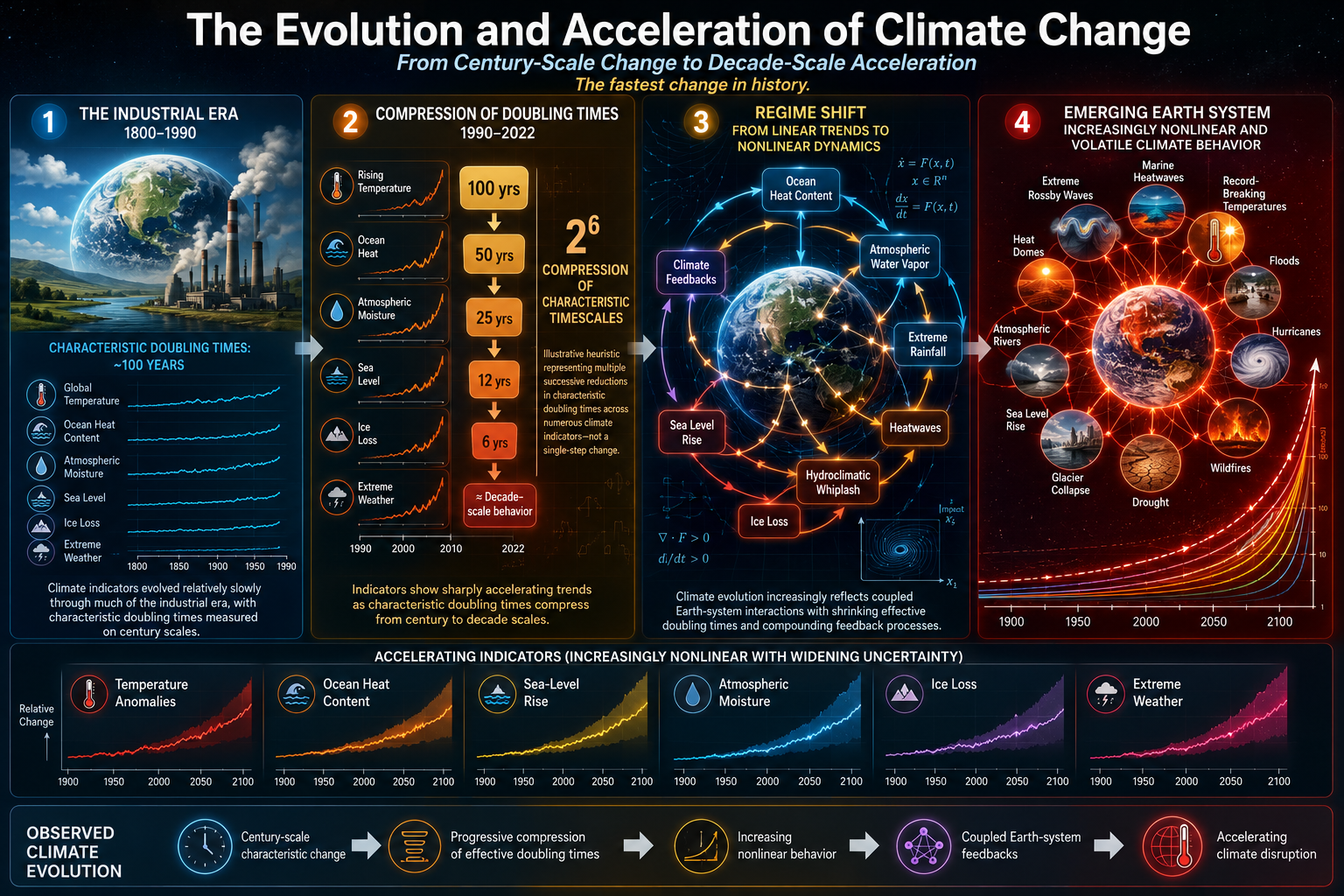
About the Song: The Evolution and Acceleration of Climate Change
Q: How fast is climate change accelerating?
A: From the Industrial Revolution through the 1990s, key climate-acceleration indicators appear to have doubled on timescales closer to a century. By the 2020s, many major warming-related impacts are doubling on timescales closer to a decade.
In effect, the leading indicators suggest a multi-stage compression of characteristic doubling times, consistent with approximately six successive halving steps (2^6) when comparing early industrial-era timescales with recent decade-scale behavior across multiple indicators. This represents a heuristic description of cumulative nonlinear compression rather than a single-step ratio, and reflects the aggregation of changes across multiple time intervals and Earth-system variables.
By 2025, analysis could move beyond purely retrospective exponential fitting toward a state-space formulation of system evolution. The Earth’s climate system is undergoing a regime shift away from historically near-linear behavior toward accelerating nonlinear and compounding dynamics, characterized by systematically shrinking effective doubling times and the emergence of instantaneous-growth dynamics across coupled Earth system components.
Multiple climate indicators now point to rates of warming-related disruption far beyond those observed during the modern instrumental era. There is no well-established geological analog for a sustained, multi-variable, decade-scale pattern of accelerating change across the full Earth system at the resolution available in contemporary observations. If sustained, this may represent one of the most abrupt large-scale climate transitions in Earth’s geological history.
Many of the climate indicators traditionally used for forecasting are exhibiting increasingly nonlinear and volatile behavior. Temperature anomalies, ocean heat content, sea-level rise, atmospheric moisture, ice loss, and extreme weather patterns are showing changes that are becoming more difficult to model using assumptions based primarily on historical variability.
Beyond Degrees: Earth’s Climate History Is No Longer a Reliable Predictor of Its Future
[Intro]
The clock keeps ticking…
(Not waiting)
The future’s calling…
(Are we listening?)
[Refrain]
So slow…
(Isn’t an option)
Do you know
(A solution)
Whoa, no
(Know woe)
Whoa, no
(Know woe)
[Verse 1]
The signs have slowly turned to screams
No longer distant, no more dreams
Storm by storm and wave by wave
The choices now are those we save
The science points a clearer way
Waiting won’t delay the day
Physics doesn’t compromise
It simply answers with replies
(Damn your lies!)
[Pre-Chorus]
Time moves on
(Without a pause)
Nature follows
(Its own laws)
[Chorus]
So slow…
(Isn’t an option)
Stand up now
(Take some action)
Whoa, no…
(Know woe)
[Refrain]
Know you know…
… slow…
(Isn’t an option)
Do you know
(A solution)
Whoa, no
(Know woe)
Whoa, no
(Know woe)
[Verse 2]
Innovation lights the way
Turning night into the day
Hope is more than just a word
It’s something built and something earned
[Pre-Chorus]
Move ahead
(Don’t delay)
Tomorrow starts
(With today)
[Bridge]
One decision
(Leads to two)
Small beginnings
(Carry through)
Hands together
(Minds aligned)
The future’s built
(One choice at a time)
[Breakdown]
The question…
…isn’t whether change…
…is coming.
The question is…
…whether we lead it…
…or chase it.
[Final Chorus]
So slow…
(Isn’t an option)
Do you know
(A solution)
Whoa, no
(Know woe)
Whoa, no
(Know woe)
Choose today…
(Build tomorrow)
Less regret…
(Less sorrow)
Hold on hope…
(Let it grow)
Woe, no!
Know whoa.
[Outro]
Woe, no!
(Know whoa.)
Woe, no!
(Know whoa.)
[Intro]
The sun goes down…
(The heat remains)
It’s all around…
(Frying the brains)
[Refrain]
Hot! (Summer nights)
Burning
Hot! (Oh the sights)
Turning
(Hot! Hot! Hot!)
Careful…
(With what we’ve got)
[Verse 1]
Moonlight shines but brings no breeze
Heavy air beneath the trees
Windows open, nothing moves
Sleeping loses, heat approves
Yesterday would cool by dawn
Now the nighttime chill is gone
Another evening holds the heat
Making rest harder to meet
[Chorus]
Hot summer nights
(No relief)
Holding on
(Beyond belief)
Fans keep spinning
(All night long)
Trying hard
(To carry on)
Hot! Hot! Hot!
(Feel the strain)
Feel the heat remain
[Verse 2]
Air conditioners hum away
Working harder every day
Power lines begin to strain
Under one more heatwave’s reign
More demand upon the grid
More emissions than we did
Another cycle feeds the next
A warming world becomes complex
[Bridge]
Heat builds up
(The cycle grows)
One feedback
(Another flows)
Nature’s systems
(Intertwine)
Crossing pathways
(Line by line)
One small change
(Leads to more)
Opening yet
(Another door)
[Breakdown]
[Minimal Beat, Deep Sub Bass, Spoken Vocal]
The danger…
…isn’t only the heat of the day.
It’s the night…
…causing dismay.
[Final Chorus]
Hot! (Summer nights)
Burning
Hot! (Oh the sights)
Turning
(Hot! Hot! Hot!)
Careful…
(With what we’ve got)
Longer nights
(Warmer still)
Nature follows
(Physics’ will)
[Outro]
Hot summer nights…
Still burning…
Until we change…
…have and have not.
Careful…
(With what we’ve got)
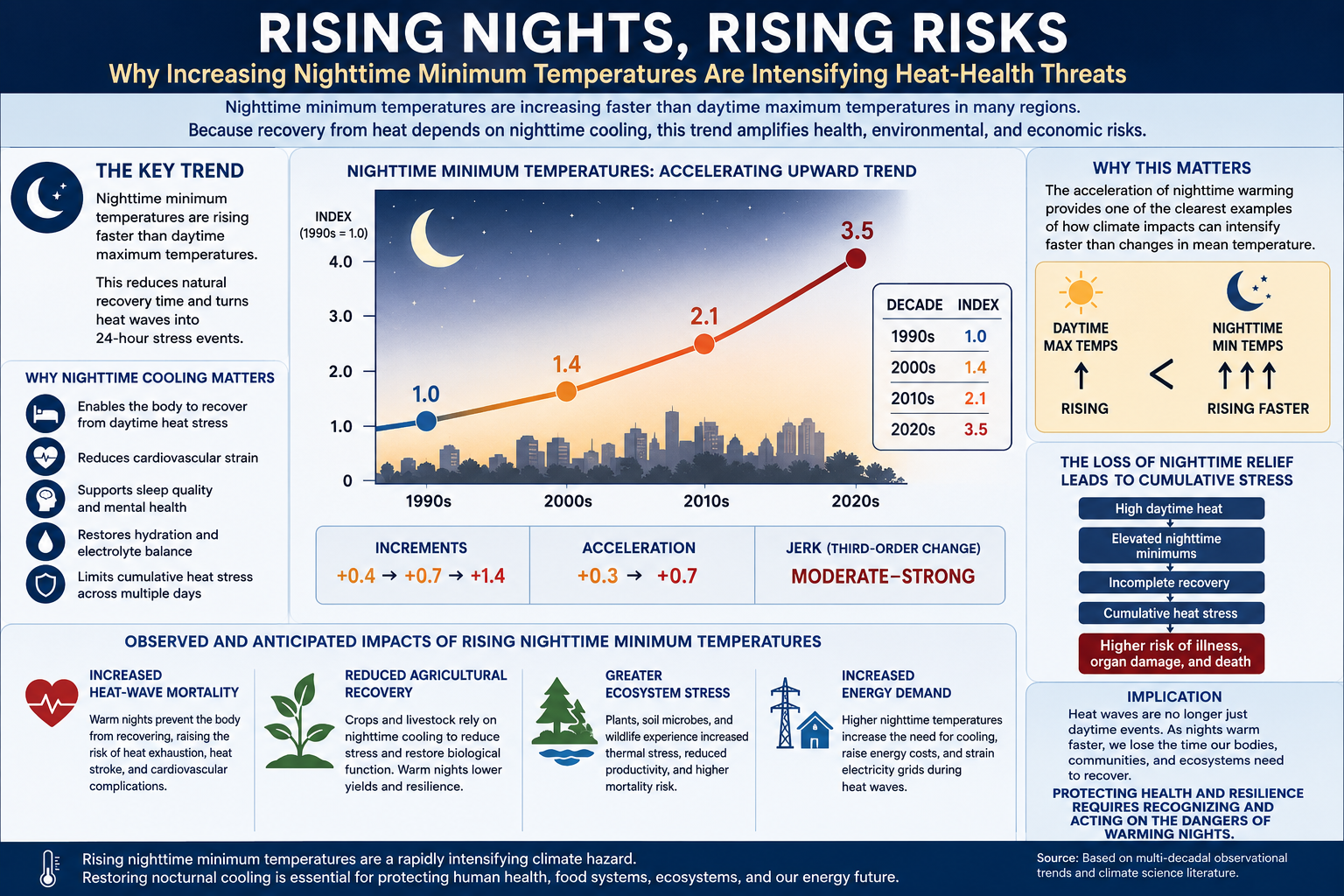
About the Song
Nighttime minimum temperatures are increasing in many regions at a faster rate than daytime maximum temperatures, representing a critical but underappreciated dimension of climate change. Because human and ecosystem recovery from heat stress depends heavily on nocturnal cooling, this trend has important implications for health outcomes, agriculture, energy demand, and ecological stability.
This structure indicates not only rising nighttime temperatures, but also an acceleration in the rate at which those increases are occurring.
As temperatures rise, cooling demand increases sharply. This drives a cascading set of system stresses:
This creates a reinforcing sequence:
more heat → more cooling demand → higher energy use → higher emissions → further warming → more heat
In practice, what emerges is not a single isolated feedback loop, but a coupled network of reinforcing systems—biophysical (permafrost thaw, forest stress and mortality, wildfire regimes, hydrological intensification) and socioeconomic (energy demand, infrastructure constraints, and grid response). These systems can interact nonlinearly, particularly under sustained warming and extreme heat conditions.
The key point is that these feedbacks are already operating, but their magnitude, interaction strength, and long-term dominance relative to human emissions vary by region, sector, and timeframe. Reducing risk ultimately depends on rapidly reducing greenhouse gas emissions, especially from fossil fuel combustion, while adapting infrastructure to rising heat extremes.
Elevated Nighttime Minimum Temperatures: Climate Change, Feedback Processes, and Heat-Health Impacts