by Daniel Brouse
July, 2026
One of the most common misconceptions about climate change is that a warmer planet should produce less ice. In reality, the opposite is increasingly true for severe thunderstorms. While winters are warming and snow cover is declining in many regions, the atmosphere is becoming more energetic, more moisture-laden, and more capable of producing exceptionally large hail.
Hailstorms illustrate one of the central themes found throughout modern climate science: global warming is not simply making the planet warmer—it is making the atmosphere more unstable. The climate system is undergoing a nonlinear increase in available energy, atmospheric moisture, and circulation instability. The result is not gradual change, but an acceleration toward more powerful and destructive weather extremes.
Hail is one manifestation of this broader transition.
Hailstorms are among the most energetic convective weather systems on Earth. They develop inside powerful thunderstorms where intense upward air currents repeatedly lift developing ice particles through layers of supercooled water.
Each trip through the storm adds another layer of ice.
If the updraft remains strong enough, hailstones continue growing until gravity finally overcomes the upward force.
The stronger the storm, the larger the hail.
Large hail has become one of the fastest-growing sources of weather-related insurance losses worldwide, producing billions of dollars in damage each year to:
Unlike heavy rainfall, which loses much of its kinetic energy through atmospheric friction, hailstones maintain tremendous momentum. Baseball-sized hail can strike the ground at speeds exceeding 100 mph (160 km/h), while the largest hailstones exceed 150 mph.
At those velocities, hail becomes a dangerous projectile capable of causing severe injuries and fatalities.
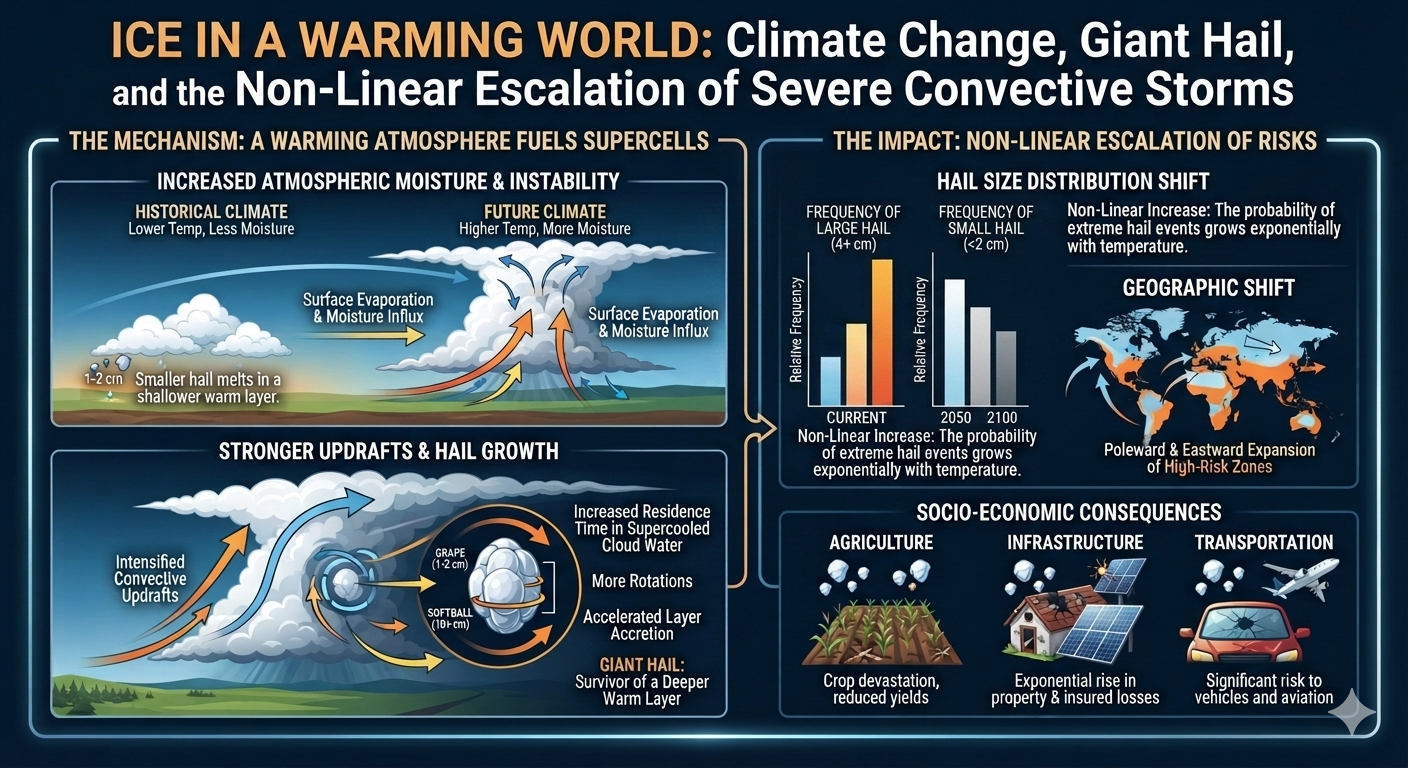
The same physical processes described in previous papers—especially the increasing atmospheric water vapor driven by the Clausius-Clapeyron relationship—also fuel hail growth.
Every degree Celsius of warming allows the atmosphere to hold approximately 7% more water vapor.
That additional moisture provides thunderstorms with more latent heat energy.
When this latent heat is released during condensation, it strengthens thunderstorm updrafts dramatically.
The result is a positive feedback:
This is another example of Earth’s climate system amplifying itself through reinforcing feedback loops rather than responding linearly.
Imagine a lava lamp operating at maximum power.
Instead of blobs of wax rising through liquid, enormous columns of warm, moisture-rich air accelerate upward through the atmosphere.
Inside these towers:
This process repeats many times.
The stronger the updraft, the longer the hailstone remains suspended.
Eventually the hailstone becomes too heavy.
Then gravity wins.
The result is giant hail capable of catastrophic destruction.
As climate warming strengthens convective energy, these powerful updrafts are becoming increasingly common.
Climate change does not necessarily increase every type of hail.
In fact, many regions may experience fewer small hail events.
This occurs because freezing levels are rising.
As temperatures increase:
The result is a dramatic shift in hail size distribution.
Instead of numerous harmless pea-sized hailstones, storms increasingly produce fewer—but much larger and more destructive—hailstones.
Current projections suggest that by the end of this century:
This represents another example of the climate system shifting toward extremes rather than averages.
Historically, the world’s most active hail regions included:
Today, climate models suggest these regions are changing.
Increasing hail environments are projected across:
The traditional “Hail Alley” of the Great Plains is expected to expand eastward while favorable atmospheric conditions migrate poleward as global temperatures rise.
These geographic shifts mirror changes already observed in atmospheric rivers, jet stream behavior, and storm tracks.
The timing of severe hailstorms is also evolving.
Rather than occurring primarily during midsummer, favorable conditions are increasingly appearing during:
Warmer winters allow severe thunderstorms to develop during months that historically experienced relatively stable atmospheric conditions.
This creates new risks for agriculture.
Winter wheat and other cool-season crops become increasingly vulnerable to destructive hail during critical stages of development.
Few weather hazards have produced such rapidly escalating insured losses.
Since 2008:
One of the most striking recent examples occurred in northern Italy during 2023.
A series of severe thunderstorms produced approximately $8.6 billion in damages while dropping a European-record hailstone measuring nearly 19 centimeters (7.5 inches) in diameter.
Across North America, giant hail is increasingly damaging:
As urban development expands into storm-prone regions, exposure continues to rise even as the storms themselves become more intense.
The result is a compounding economic feedback between climate risk and infrastructure vulnerability.
Although hail is often viewed as primarily a property hazard, it is increasingly becoming a public health concern.
Large hail can:
As giant hail events become more common, so do reports of injuries and fatalities.
The danger is amplified because hail often accompanies tornadoes, destructive straight-line winds, flash flooding, and frequent lightning, creating multiple simultaneous hazards.
Large hail is not an isolated phenomenon.
It is part of the same global pattern documented throughout this body of work.
The accelerating increase in atmospheric water vapor, ocean heat content, jet stream instability, atmospheric rivers, bomb cyclones, extreme rainfall, wildfire behavior, and severe convective storms all point to the same underlying driver:
An atmosphere containing more energy.
As Arctic amplification weakens the temperature gradient between the poles and the tropics, atmospheric circulation becomes increasingly distorted. Rossby waves become more amplified, blocking patterns persist longer, and weather systems slow or stall. At the same time, warmer oceans and land surfaces inject additional heat and moisture into the atmosphere, providing more fuel for explosive thunderstorms.
When these large-scale circulation changes coincide with abundant moisture and intense surface heating, the result is an environment capable of generating stronger updrafts, larger hail, heavier rainfall, more damaging winds, and more frequent tornado outbreaks. Hail therefore should not be viewed as an isolated weather event, but as one expression of a broader shift toward higher-energy atmospheric dynamics.
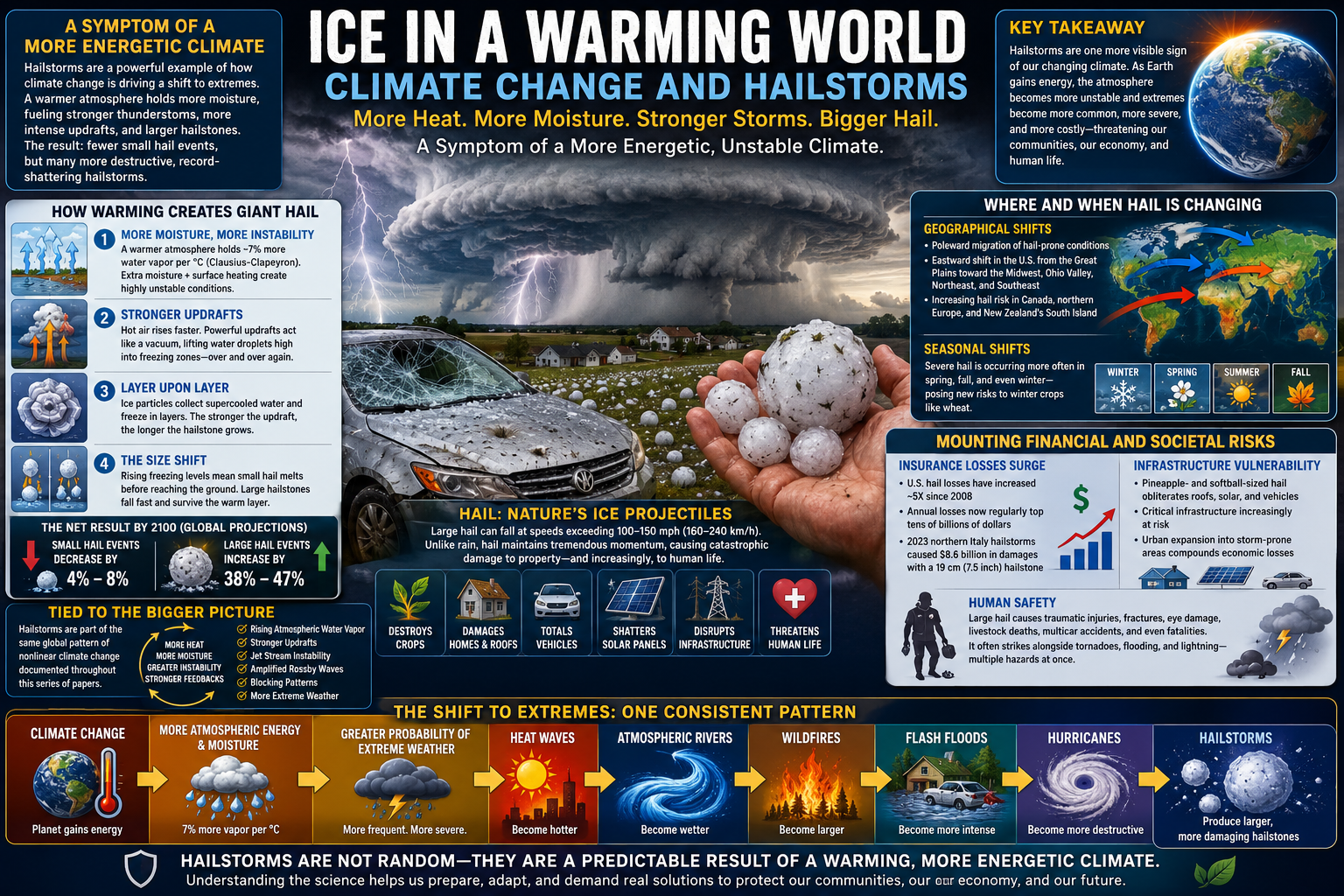
One consistent pattern emerges:
Climate Change → Energy Imbalance → More Atmospheric Moisture + Greater Instability → Stronger Storm Dynamics → More Frequent & More Severe Weather Extremes → Hotter Heat Waves → Wetter Atmospheric Rivers → Larger Wildfires → More Intense Flash Floods → Stronger Hurricanes → Giant Hailstorms
This is the hallmark of nonlinear climate change: a progressive shift from moderate conditions toward increasingly severe outcomes as Earth’s energy imbalance grows. Hail is another visible indicator that the climate system is moving beyond historical norms, where extremes become more common and their impacts more costly.
Understanding hail in this broader context helps connect individual weather disasters to the larger transformation underway in the Earth’s climate system. Rather than isolated anomalies, these events are increasingly linked by the same physical processes: rising atmospheric moisture, greater available energy, and amplifying feedbacks that are reshaping weather across the globe.
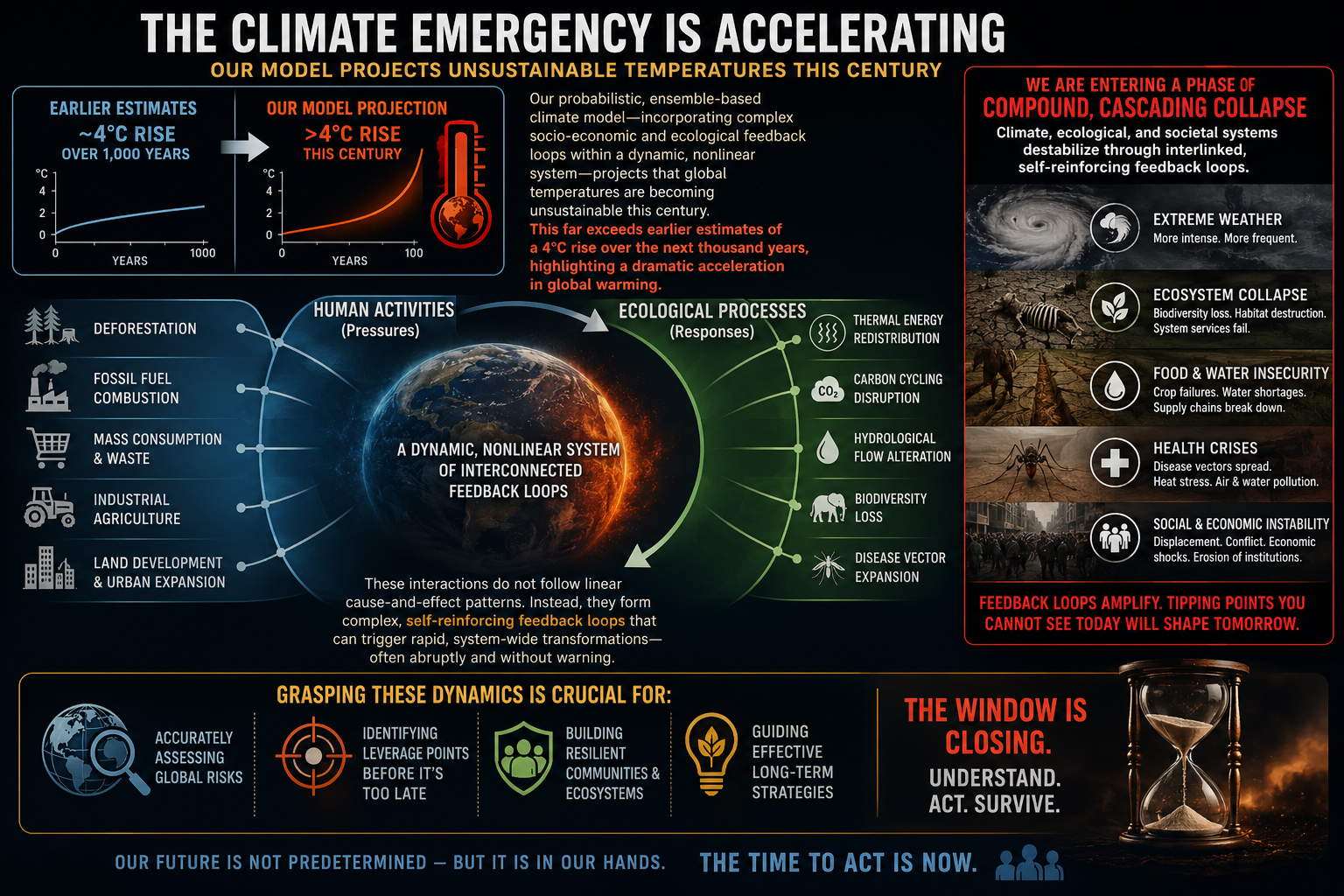
* Our probabilistic, ensemble-based climate model — which incorporates complex socio-economic and ecological feedback loops within a dynamic, nonlinear system — projects that global temperatures are becoming unsustainable this century. This far exceeds earlier estimates of a 4°C rise over the next thousand years, highlighting a dramatic acceleration in global warming. We are now entering a phase of compound, cascading collapse, where climate, ecological, and societal systems destabilize through interlinked, self-reinforcing feedback loops.
We examine how human activities — such as deforestation, fossil fuel combustion, mass consumption, industrial agriculture, and land development — interact with ecological processes like thermal energy redistribution, carbon cycling, hydrological flow, biodiversity loss, and the spread of disease vectors. These interactions do not follow linear cause-and-effect patterns. Instead, they form complex, self-reinforcing feedback loops that can trigger rapid, system-wide transformations — often abruptly and without warning. Grasping these dynamics is crucial for accurately assessing global risks and developing effective strategies for long-term survival.
Feedback Loops →
Tipping Points →
Acceleration →
Domino Effect
Feedback loops amplify climate change and can push interconnected Earth systems past critical tipping points. As tipping points are crossed, they can trigger additional feedback loops and destabilize other climate systems. This cascading "Domino Effect" compresses timescales, accelerates change, and increases the risk of rapid, nonlinear climate transformations.
Bottom line: The question is no longer how warm the planet becomes, but how life on Earth can endure when change outpaces our ability to adapt.
We cannot control the laws of physics, but we can control our pollution. The most effective action is to stop burning fossil fuels.