From 1.5°C to Climate-System Singularity
↑ 1.5°C → Coupling Feedbacks ↺ Tipping Points → Domino Effect → Climate-System Singularity
Daniel Brouse¹, Sidd Mukherjee²
¹ Climatologist, Economist
² Physicist
November 2026
Feedback Coupling, Tipping Points, and the Domino Effect
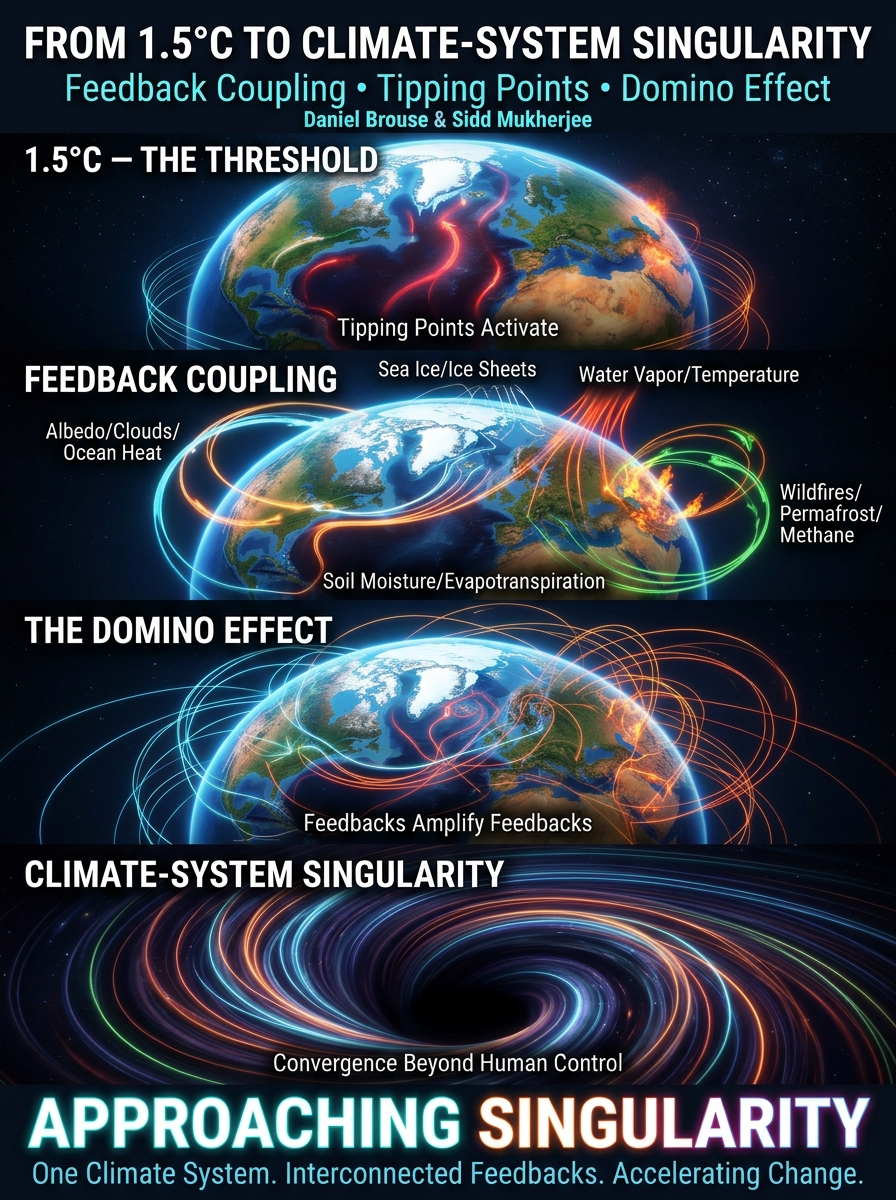
1. The 1.5°C Threshold: Tipping Points Activate
The 2023–2026 four-year average is projected to surpass 1.5°C above preindustrial levels. This is no longer simply a projection of future warming. We are observing the consequences of an increasingly interconnected climate feedback system in real time.
Climate Feedback and Tipping-Point Network
2. Feedback Coupling: The Domino Effect
The most observable emerging feedback couplings include:
- Albedo – low-level clouds – ocean heat content
- Ocean heat content – sea ice – ice-sheet melting
- Atmospheric water vapor – temperature – precipitation
- Soil moisture – evapotranspiration – temperature
- Wildfire – permafrost – carbon release – methane
As these feedbacks interact, individual climate processes become interconnected, mutually reinforcing drivers of accelerating change.
Observable Climate Feedback Coupling
3. Climate-System Singularity: Convergence of Feedback Networks
As individual feedbacks emerge, couple, and organize into self-reinforcing networks, those networks increasingly interact and converge toward a unified, interconnected climate system.
A climate-system singularity represents a critical tipping point where interacting feedbacks drive increasingly uncontrollable and irreversible planetary change. It is analogous to a gravitational singularity, such as a black hole, where converging forces produce a point beyond which conventional predictions and control break down. In the climate system, this represents a trajectory toward increasingly unpredictable, self-reinforcing change that becomes progressively decoupled from human policy intervention.
Sources
1. IPCC (2021) — Climate Change 2021: The Physical Science Basis, Chapter 7: Earth’s Energy Budget, Climate Feedbacks, and Climate Sensitivity.
Covers water vapor, clouds, surface albedo, and interconnected climate feedback processes.
IPCC Chapter 7
2. IPCC (2023) — Climate Change 2023: Synthesis Report.
Documents increasing risks of abrupt and irreversible climate changes, including tipping-point risks between 1.5°C and 2.5°C.
IPCC Synthesis Report
3. Global Tipping Points Report (2025).
Comprehensive scientific assessment of interacting Earth-system tipping elements and cascading risks.
2025 Report and downloads
4. Nature Geoscience (2025) — Destabilization of Earth System Tipping Elements.
Examines interactions among Greenland, Antarctic, AMOC, and Amazon tipping elements.
Read scientific paper
5. IPCC (2021) — Chapter 5: Global Carbon and Other Biogeochemical Cycles and Feedbacks.
Covers permafrost, vegetation, soil carbon, ocean carbon exchange, and greenhouse gas feedbacks.
IPCC Chapter 5
6. WMO (2026) — Global Annual to Decadal Climate Update 2026–2035.
Provides current temperature projections and the probability of temporarily exceeding 1.5°C.
WMO Climate Update
Additional research and original work
7. Daniel Brouse and Sidd Mukherjee — Climate Feedback and Tipping-Point Network
8. Daniel Brouse and Sidd Mukherjee — Observable Climate Feedback Coupling
9. Daniel Brouse and Sidd Mukherjee — Climate-System Singularity
Feedback Loops → Tipping Points → Feedback Loop and Tipping-Point Network → Acceleration → Domino Effect
Feedback loops amplify climate change and can push interconnected Earth systems past critical tipping points. As tipping points are crossed, they can trigger additional feedback loops and destabilize other climate systems. This cascading "Domino Effect" compresses timescales, accelerates change, and increases the risk of rapid, nonlinear climate transformations.
Current Status: Climate Tipping Point Crisis
The most significant emerging climate feedback accelerating the planetary energy imbalance is the decline in low-level clouds.
Low-Level Cloud Overview
Low-Level Cloud Feedback: The Mega-Multiplier — An Additional 1.5°C to 2°C • Albedo–Cloud–Ocean Heat Content Feedback Triad (Climate Jerk Surge Math & Methods) • Feedback Loop and Tipping-Point Network • The Global Feedback Cascade: Ozone and Cloud Feedback Coupling • Low-Level Ozone – Clouds = Slowing AMOC and Collapse • Water Vapor + Clouds: Coupled Feedbacks Driving a Warmer Planet
One of the least understood emerging climate feedbacks is tropospheric ozone.
Ozone Meta Analysis
Ozone : The #1 Climate Gas (Public Access Edition)
Ozone: The Atmospheric-Ecological Climate Multiplier (Advanced Scientific Edition)
The Ozone Feedback Theory: Tropospheric Ozone as a Driver of Ecosystem Decline, Carbon Sink Failure, and Climate Acceleration
Easy-to-Read Resources