Climate Bifurcation:
When Climate Systems Cross the Threshold into Self-Sustaining Acceleration
The progression is:
Energy accumulation → Warming → Feedback activation → Nonlinear acceleration → Bifurcation → Cascading system disruption.
Simplified Overview
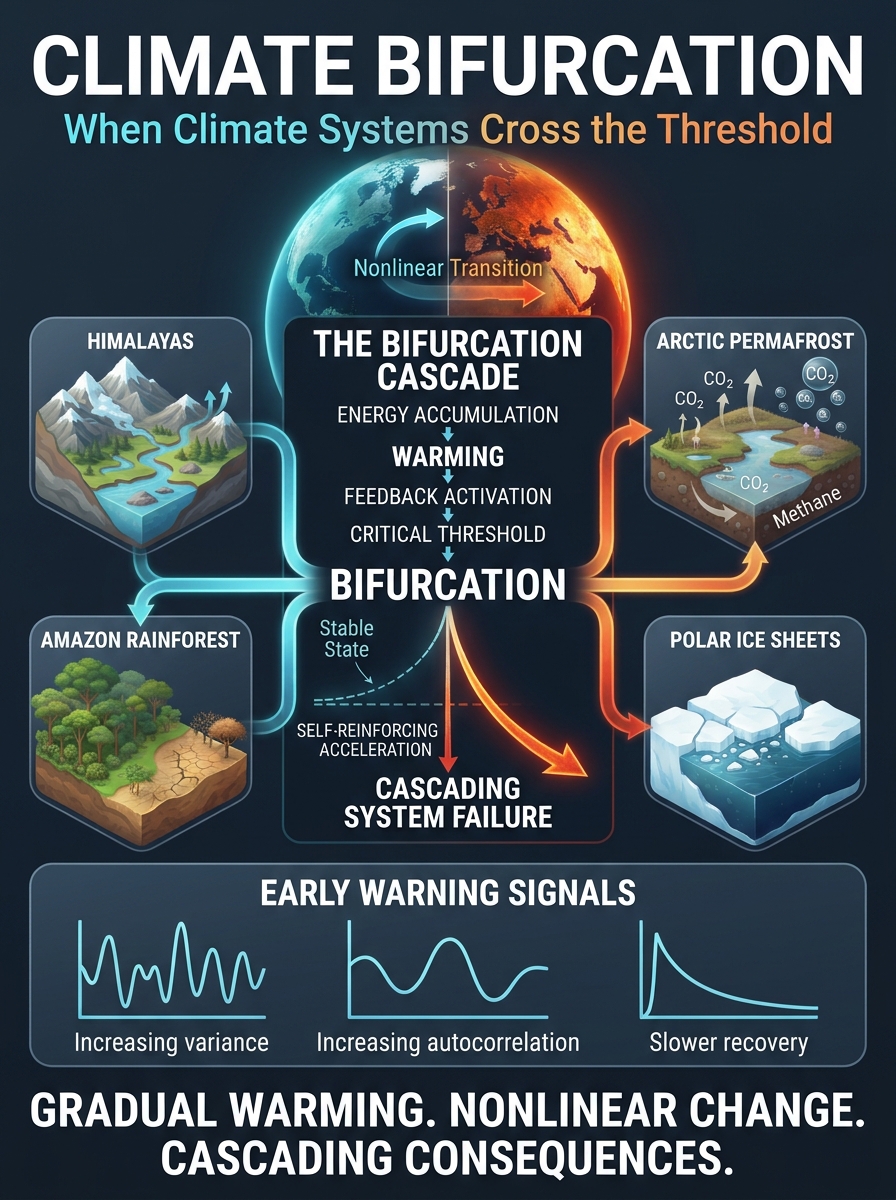
🌎 CLIMATE BIFURCATION: WHEN CLIMATE SYSTEMS CROSS THE THRESHOLD
Climate change is not simply a matter of gradual warming. It is an energy-driven process that destabilizes interconnected Earth systems, activates reinforcing feedback loops, and accelerates environmental change.
This paper, by Daniel Brouse and Sidd Mukherjee, examines the mathematics and physics of climate bifurcation: the transition from a relatively stable climate state into a fundamentally different, self-reinforcing state.
The Nepal–Tibet disaster provides a striking example of cascading climate-system disruption:
🧊 Glacier loss and permafrost thaw
⛰️ Mountain slope instability and avalanches
🌊 Glacial lake outburst floods and flash floods
🌧️ Extreme rainfall and mudslides
🏚️ Infrastructure destruction and human casualties
These are not isolated hazards. They are interconnected components of a changing physical system.
We also examine four major climate tipping elements: Arctic permafrost, the Amazon rainforest, polar ice sheets, and the Atlantic Meridional Overturning Circulation (AMOC).
The central message:
ENERGY ACCUMULATION → WARMING → FEEDBACK ACTIVATION → BIFURCATION → SELF-REINFORCING ACCELERATION → CASCADING CONSEQUENCES.
Climate science is increasingly about understanding how these systems interact, how stability breaks down, and how changes propagate through the Earth system.
Climate change is not just warming. It is the redistribution of energy through an interconnected planetary system.
#ClimateScience #ClimateBifurcation #TippingPoints #ClimateFeedbacks #Nepal #Tibet #EarthSystemScience #ClimateEnergy
📖 Read the paper and explore the science:
What Is Climate Bifurcation?
In climate science, bifurcation refers to the mathematical threshold—commonly known as a tipping point—at which gradual warming forces a climate subsystem to abruptly transition into a fundamentally different, self-sustaining state. Rather than changing smoothly and predictably, a system approaching a bifurcation point loses stability and accelerates toward a different equilibrium.
Bifurcation describes the transition from one stable state to another. It explains how incremental changes in climate energy produce abrupt, nonlinear transformations across interconnected Earth systems.
Nepal–Tibet: An Observable Climate Bifurcation

Glacier Loss, Permafrost Collapse, Glacial Lake Outburst Floods, Flash Floods, Mudslides and Avalanches
The Nepal–Tibet climate disaster provides an observable example of interconnected climate-system destabilization and cascading hazards.
The most important climate signal is not any single flood, avalanche, landslide, or rainfall event. It is the coupling of hazards into a cascading system of physical disruptions.
The cascading sequence:
Warming
↓
Glacier loss + snow and ice instability
↓
Permafrost thaw
↓
Unstable mountain slopes
↓
Avalanches and landslides
↓
Glacial lake disruption and river blockages
↓
Extreme rainfall
↓
Flash floods + debris flows + mudslides
↓
Destroyed infrastructure
↓
Disrupted electricity, transportation and tourism
↓
Human casualties
This is what makes the Himalaya particularly vulnerable to climate change. The mountains are not experiencing isolated environmental changes. They are experiencing simultaneous destabilization across a tightly coupled physical system.
When one component changes, it destabilizes other components. When multiple components change simultaneously, their interactions produce cascading consequences.
Climate energy is moving through the system, transferring instability from one component to another. The resulting cascade demonstrates how climate change progresses beyond individual hazards into interconnected system-wide disruption.
How Bifurcation Drives Climate Acceleration
1. Nonlinearity and Positive Feedbacks
Under relatively stable conditions, negative feedbacks help regulate the climate system. However, as greenhouse gas concentrations and accumulated climate energy increase, self-reinforcing positive feedback loops increasingly dominate.
For example, melting ice exposes darker ocean water, which absorbs more solar energy and accelerates additional melting. This feedback reinforces the original warming.
Once a critical threshold is crossed, the feedback-driven transition becomes self-sustaining. The resulting system transformation no longer depends on additional human emissions to maintain the particular feedback process driving it.
2. Saddle-Node Bifurcations
In climate modeling, tipping points are frequently represented mathematically as saddle-node bifurcations.
As a control parameter, such as global temperature or atmospheric (CO_2) concentration, crosses a critical threshold, the existing stable equilibrium disappears. The system then transitions toward an alternative stable state.
This mathematical process explains how a climate subsystem can remain relatively stable through gradual environmental changes before abruptly transitioning into a fundamentally different state.
3. Hysteresis and Irreversibility
Once a system crosses a bifurcation threshold, simply reducing greenhouse gas emissions to previous levels does not immediately restore its original state.
The system follows a different pathway back because its stability characteristics have changed. Reversing the transition requires restoring environmental conditions beyond the original threshold.
This phenomenon is known as hysteresis.
Hysteresis explains why preventing a tipping point is fundamentally different from attempting to reverse one after it has occurred. The original equilibrium cannot be assumed to return simply because the initial forcing is reduced.
Observed Acceleration and Major Climate Tipping Elements
Research from the Potsdam Institute for Climate Impact Research indicates that global warming has accelerated significantly since approximately 2015, reaching roughly 0.35°C per decade—nearly twice the average rate from 1970 through 2015.
This acceleration increases the rate at which interconnected climate systems approach critical thresholds. The following tipping elements demonstrate the feedback mechanisms and consequences associated with bifurcation.
| Climate subsystem | Primary feedback mechanism | Outcome following destabilization |
|---|---|---|
| Arctic Permafrost | Microbial decomposition releases trapped CO₂ and methane as frozen soils thaw. | Additional greenhouse gas emissions amplify atmospheric warming, reinforcing permafrost degradation. |
| Amazon Rainforest | Deforestation and warming reduce rainfall through declining evapotranspiration and moisture recycling. | Forest dieback transforms large sections of tropical rainforest into a drier savanna-like ecosystem. |
| Greenland and West Antarctic Ice Sheets | Surface melting lowers ice elevation into warmer air; marine ice-sheet instability accelerates ice discharge. | Self-reinforcing ice loss drives accelerating sea-level rise over centuries and beyond. |
| Atlantic Meridional Overturning Circulation (AMOC) | Freshwater influx from melting ice disrupts ocean salinity, density and circulation. | Abrupt weakening or collapse disrupts global weather patterns, ocean circulation and monsoon systems. |
These systems do not operate independently. Their feedback mechanisms interact through atmospheric circulation, ocean heat transport, hydrological cycles, ice dynamics and terrestrial ecosystems.
The significance of climate bifurcation is therefore not limited to the transition of an individual subsystem. It is the destabilization and coupling of multiple subsystems into a larger network of nonlinear change.
Early Warning Signals: Critical Slowing Down
Mathematicians and climate scientists studying tipping-point dynamics examine a phenomenon known as critical slowing down to identify the loss of stability preceding a bifurcation.
As a climate subsystem approaches a critical threshold, its ability to recover from disturbances weakens. Following a fluctuation, the system takes progressively longer to return toward its previous equilibrium.
This loss of resilience produces measurable statistical changes:
- Increasing variance: Fluctuations become larger as the system loses stability.
- Increasing autocorrelation: The system retains more of its previous state, making its current condition increasingly dependent on its recent history.
- Slower recovery: Disturbances persist longer rather than dissipating rapidly.
These changes provide mathematical evidence that a system is losing stability before an abrupt transition.
Critical slowing down is an important early-warning framework because it connects observable environmental behavior with the underlying mathematics of bifurcation.
The Larger Climate-Energy Connection
Climate bifurcation is not an isolated mathematical concept. It describes the physical transition occurring when accumulated climate energy destabilizes interconnected Earth systems.
The progression is:
Energy accumulation → Warming → Feedback activation → Nonlinear acceleration → Bifurcation → Cascading system disruption.
The Nepal–Tibet example demonstrates how this process manifests across a coupled mountain environment. Glacier loss, permafrost thaw, slope instability, extreme precipitation and cascading infrastructure failures are interconnected expressions of a changing energy-driven system.
Understanding climate change requires examining not only how much warming occurs, but how climate energy moves through interconnected systems, how feedbacks reinforce one another, and how the resulting changes drive systems beyond their previous states.
Climate bifurcation marks the transition from gradual environmental change to self-reinforcing system transformation.
Sources and Further Reading
Climate Acceleration and Mathematical Frameworks
Climate Jerk — Continuous Growth — Constant Framework
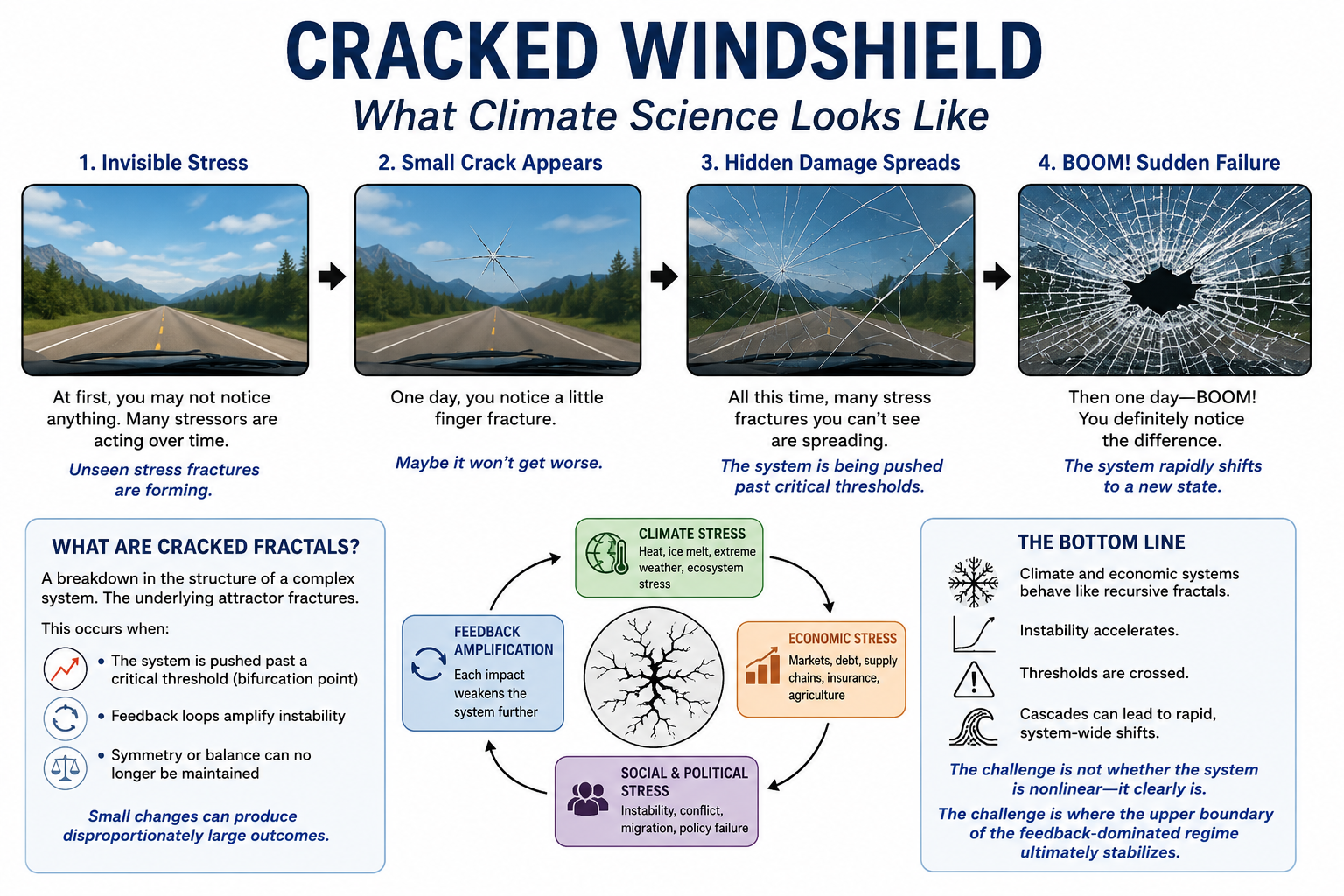
What Climate Science Looks Like: Cracked Windshields and Cracked Fractals
Climate-Energy Redistribution and Physical Instability
The Mountains Crumble to the Sea
How Is the Climate Energy Hitting You? Nepal–Tibet: Fluidization Physics
Nepal–Tibet: Climate Energy and Cascading Disasters
How Is Climate Energy Hitting You?
Feedback Loops → Tipping Points → Feedback Loop Coupling and Tipping-Point Network → Acceleration → Bifurcation → Domino Effect
Feedback loops amplify climate change and can push interconnected Earth systems past critical tipping points. As tipping points are crossed, they can trigger additional feedback loops and destabilize other climate systems. This cascading "Domino Effect" compresses timescales, accelerates change, and increases the risk of rapid, nonlinear climate transformations.
Current Status: The Climate Tipping Point Crisis Is Here
The most concerning development is the acceleration itself. The observed acceleration in Earth's climate system is already alarming, but the possibility that this acceleration is itself increasing represents an even greater concern. In 2025, we moved beyond relying primarily on second-derivative calculations to measure climate change, recognizing a shift from 2¹ to approximately 2⁵–2¹⁰ in acceleration behavior. Now, the evidence increasingly points toward third-derivative behavior.
Our climate model has consequently evolved into an adaptive, jerk-continuous growth-constant framework. It examines not just warming velocity and acceleration, but how rapidly acceleration itself is changing as interacting feedback mechanisms amplify Earth's energy imbalance.
Unlike conventional exponential models or simplified cubic approximations, our updated framework does not assume a fixed growth trajectory or constant climate jerk. It estimates the changing growth constant and its derivatives from observations, allowing the model to adapt to evolving climate conditions.
This is a significant escalation in the level of concern. We are no longer examining simply exponential warming. We are investigating a climate system in which the rate of acceleration is itself changing, potentially amplifying an already alarming trajectory.
Daniel Brouse and Sidd Mukherjee
Easy-to-Read Resources