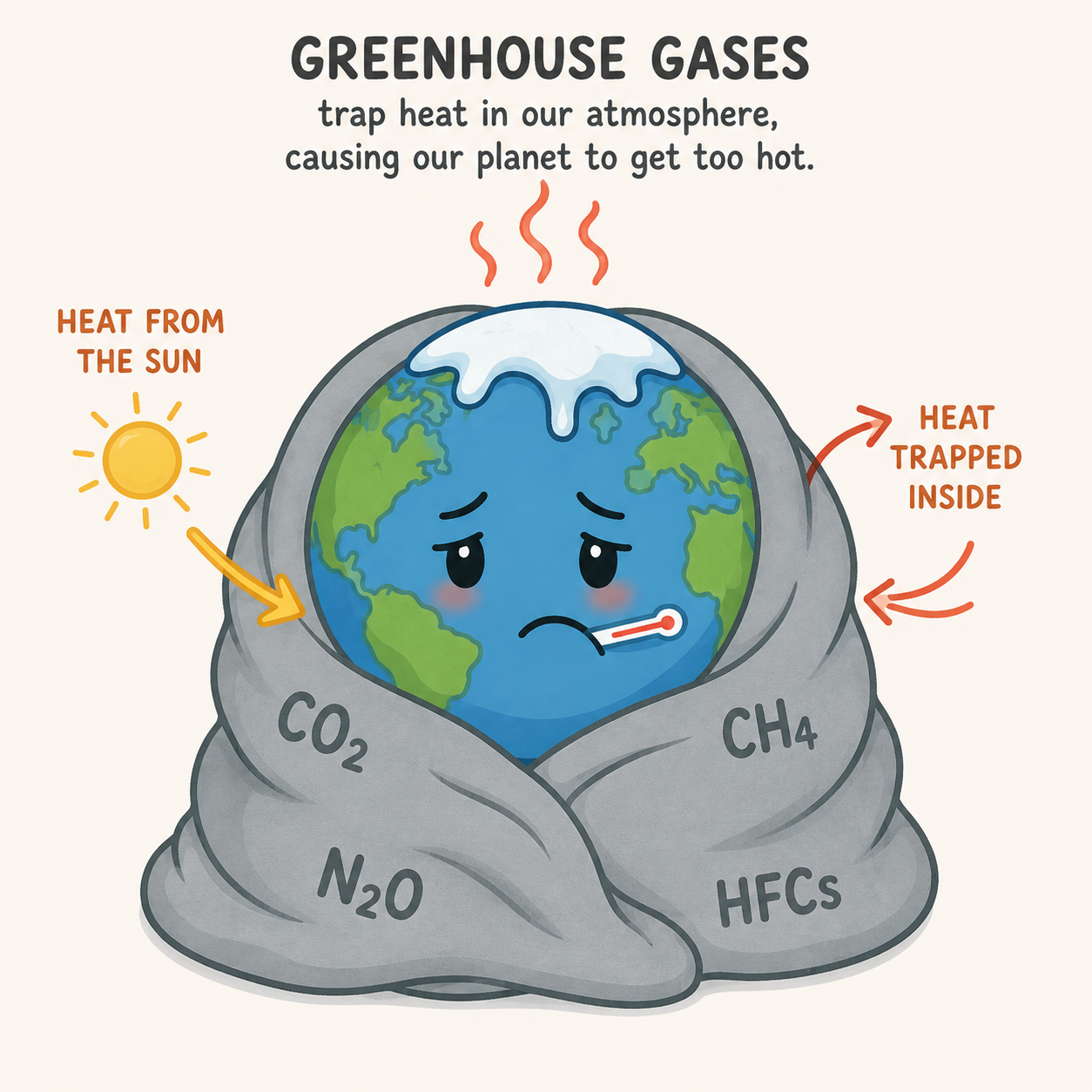
How Is Climate Energy Hitting You?
Arizona: Toilet to Tap
“Toilet to Tap”: climate change has permanently altered the water-supply of the American West. The political debate may still revolve around competing explanations and proposed solutions, but the underlying resource constraints cannot be ignored.
Overview
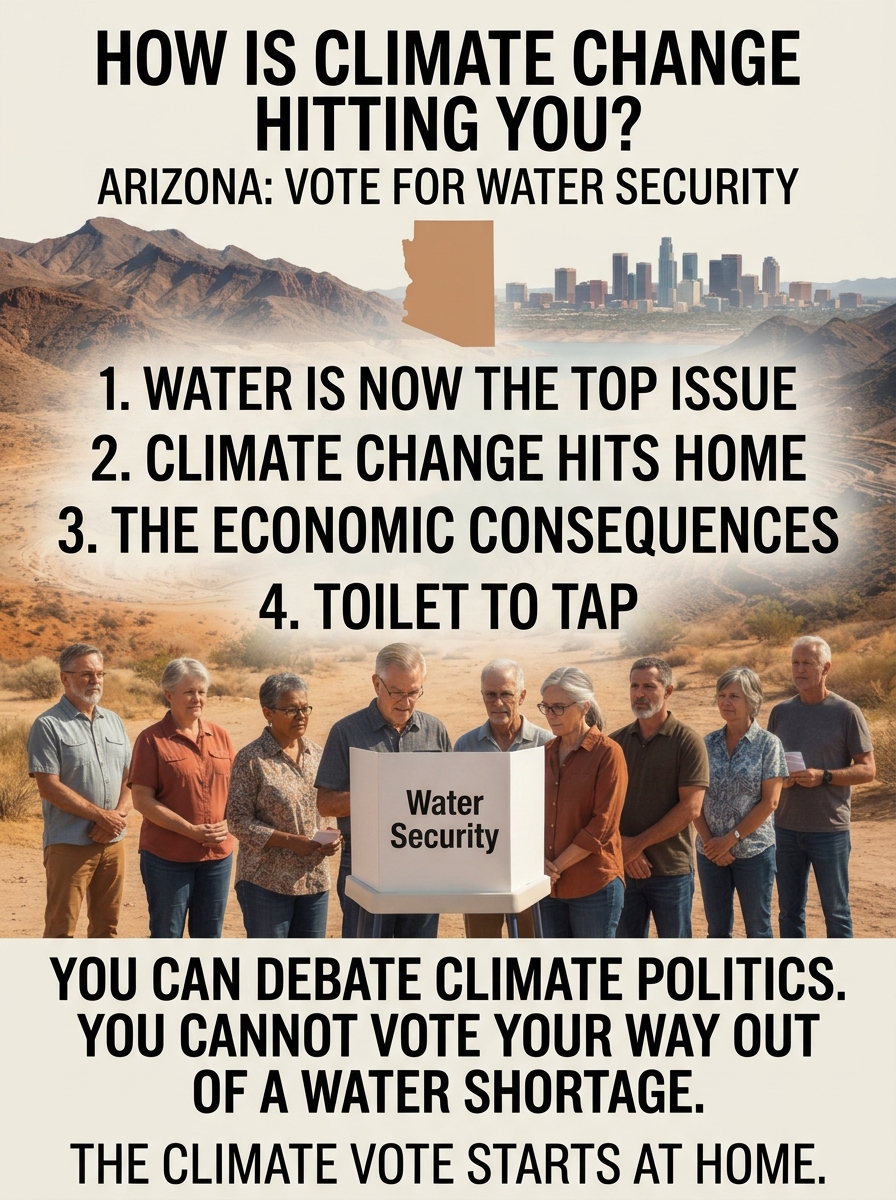
🌵 HOW IS CLIMATE CHANGE HITTING YOU?
ARIZONA: WHEN WATER SECURITY BECOMES THE NUMBER ONE POLITICAL ISSUE
Climate change is no longer just an environmental debate. It’s becoming an economic and political reality that voters cannot ignore.
Arizona is providing a powerful example. Water security has emerged as the leading concern among voters, overtaking traditionally dominant issues like immigration, border security, and inflation.
Why? Because the consequences are hitting home:
💧 Declining Colorado River water supplies and prolonged drought.
🏜️ Shrinking Rocky Mountain snowpack and declining reservoir levels.
🌱 Agricultural losses and accelerating groundwater depletion.
🏗️ Housing development restrictions and rising infrastructure costs.
💰 Higher water bills and increasing economic pressure on households and businesses.
⚖️ Federal water-allocation policies are adding another layer of political and economic conflict, particularly for Arizona, which holds junior-priority rights to much of its Colorado River water.
Perhaps the most interesting development is political: concern about water security is crossing party lines. Even Republican voters are increasingly identifying water protection as a top priority.
You don’t have to agree on climate politics to recognize the consequences of a shrinking water supply.
Arizona offers an important lesson for the rest of the country: climate change becomes a political issue when its economic consequences reach people’s everyday lives.
The question is no longer simply whether climate change is happening.
HOW IS CLIMATE CHANGE HITTING YOU?
Read the full paper: Arizona: When Water Security Becomes the Number One Political Issue.
#ClimateChange #Arizona #WaterSecurity #ColoradoRiver #ClimateEconomics #ClimateReality #IntegratedClimateStewardship
Arizona: When Water Security Becomes the Number One Political Issue
Arizona has emerged as an important example of how climate change is reshaping public priorities. Water security has become the state’s leading concern among voters, overtaking traditionally dominant political issues such as immigration, border security, and inflation.
This shift reflects a growing recognition that climate change is no longer simply an environmental issue. It is directly affecting the state’s economic future, agricultural production, housing development, infrastructure costs, and quality of life.
The immediate catalyst is growing concern over the Colorado River, prolonged regional drought, and federal reductions in Arizona’s water allocations.
1. Arizona Voters Put Water Security First
Long-term water availability has emerged as one of Arizona’s most important political issues. Recent polling demonstrates that concerns about the state’s ability to sustain future population growth and economic development are cutting across traditional political divisions.
Several surveys and reports illustrate this change:
- Center for the Future of Arizona (CFA): When voters were asked to identify the single most important issue facing the state, long-term water supplies ranked ahead of other concerns. Approximately 71% lacked confidence in Arizona’s ability to support future growth amid extreme heat, while 69% questioned whether sufficient water would remain available for residents, agriculture, and economic development.
- Cygnal and Audubon Southwest Poll: Approximately 50% of likely voters identified water and Colorado River protection as their number-one legislative priority. This exceeded inflation (47%) and border security (30%). Water ranked first among Democrats and Independents and second among Republicans.
- PBS NewsHour and Reuters Reporting: Public reporting and polling have reinforced the importance of water scarcity in Arizona’s political landscape. Although widespread municipal water shortages are not imminent because of extensive historical planning, voters are increasingly concerned about long-term supplies, corporate data center consumption, and the rising costs of municipal water infrastructure.
The significance is difficult to overlook: water security is becoming a defining issue in Arizona politics.
2. Political and Economic Consequences
The growing water crisis is changing the political and economic landscape of Arizona.
Campaign priorities
Election campaigns increasingly focus on water conservation, groundwater pumping regulations, and allegations of resource mismanagement.
Agriculture versus technology
Competition over water allocation has intensified. Newly constructed data centers consume substantial amounts of water in an already arid environment. However, agriculture remains the dominant consumer, accounting for approximately 75% of Arizona’s total water use.
The question is not simply how much water is available, but how a shrinking resource should be allocated among competing economic interests.
Increasing infrastructure costs
Arizona municipalities are investing in groundwater recovery, advanced purification, and alternative water supplies. These projects demonstrate the growing expense of maintaining water security.
Ultimately, these costs are passed along to residents and businesses through higher utility rates, infrastructure charges, and other expenses.
3. Federal Water Policy: How Arizona Became Vulnerable
Federal water policy has played a significant role in Arizona’s present predicament. A combination of century-old legal agreements, infrastructure decisions, and modern water-management requirements has created an unequal distribution of water-shortage burdens.
Federal engineering projects, including Hoover Dam and the Central Arizona Project (CAP), enabled much of Arizona’s twentieth-century growth. However, the legal framework governing the Colorado River left Arizona particularly vulnerable when supplies became inadequate.
The 1922 Colorado River Compact and the Structural Deficit
The foundation of federal Colorado River policy is the 1922 Colorado River Compact. When the agreement was negotiated, its allocation framework relied on estimates of approximately 17.5 million acre-feet of annual river flow. Long-term historical averages have proven substantially lower, at approximately 14.7 million acre-feet, while recent drought conditions have reduced available supplies even further. The result is a structural deficit: the legal framework established water allocations based on quantities the river cannot reliably deliver.
This fundamental mismatch between legal promises and physical water availability has become increasingly consequential as climate change intensifies drought conditions.
Forced Junior Water Rights: The 1968 Basin Project Act
One of the most consequential federal decisions for Arizona was the 1968 Colorado River Basin Project Act. Arizona needed federal authorization and financing to construct the Central Arizona Project, a 336-mile canal system supplying water to Phoenix, Tucson, and surrounding communities. California strongly opposed the project. The political compromise required Arizona to accept junior-priority water rights for CAP deliveries. Consequently, when shortages occur, Arizona must absorb substantial reductions before California’s higher-priority Colorado River allocations are affected.
This arrangement has placed Arizona at a considerable disadvantage as the river’s available supply declines.
Asymmetrical Lower Basin Water Reductions
As climate change and decades of overuse have reduced Lake Mead and Lake Powell storage, federal authorities have imposed mandatory water-use reductions. The federal management framework places much of the immediate reduction burden on Lower Basin states: Arizona, California, and Nevada.
The resulting disparity is significant:
- Upper Basin: States such as Colorado and Wyoming have largely avoided the same mandatory reductions imposed on the Lower Basin.
- Lower Basin: Arizona, California, and Nevada face substantial reductions.
- Arizona: Because of its junior-priority CAP allocations, Arizona bears a disproportionate share of the reductions.
Arizona has already faced mandatory reductions of approximately 27% to 30% in its Colorado River supplies, while more severe federal projections have threatened reductions of up to 47% to 50% in CAP allocations.
Economic and Infrastructure Consequences
These federal policies have substantial economic consequences.
Agricultural losses: Because agricultural water allocations are subject to reductions, Central Arizona farmers have been forced to fallow thousands of acres and abandon crops following reductions in federal water deliveries.
Rising consumer costs: To compensate for lost Colorado River supplies, Arizona municipalities are investing in advanced water purification, groundwater recovery, and alternative infrastructure.
These investments are expensive, and the costs ultimately reach consumers through higher water bills and utility rates.
The 2026 Legal Challenge
Frustration over the federal allocation framework has escalated into legal action.
The Arizona Department of Water Resources and the Central Arizona Project have sought to intervene in litigation challenging federal water-management policies.
Arizona officials argue that the Department of the Interior’s latest ten-year operating framework violates established elements of water law and unfairly places the economic burden of water shortages on Arizona without requiring comparable accountability from Upper Basin states.
The dispute illustrates how climate-driven resource scarcity is increasingly becoming a legal and political conflict.
4. Climate Change: The Underlying Water-Security Crisis
Federal water policy explains how Arizona’s water resources are allocated. Climate change explains why the available resource is becoming increasingly unreliable.
Climate change has transformed Arizona’s water challenges from a cyclical problem into a chronic, systemic crisis.
The prolonged Southwestern megadrought, widely characterized as the worst regional drought in approximately 1,200 years, has been intensified by rising temperatures and changing precipitation patterns.
Climate change is affecting Arizona’s water security through several interconnected mechanisms.
The Disappearing Rocky Mountain Snowpack
Approximately 80% of the Colorado River’s annual flow originates as winter snowpack in the Rocky Mountains.
Rising temperatures are changing how that snowpack accumulates, melts, and contributes to downstream river flows.
Earlier melting: Warmer winter temperatures cause more precipitation to fall as rain rather than snow. Snow that does accumulate increasingly melts earlier in the year, disrupting the timing of river flows.
Soil moisture depletion: Hotter springs and summers leave mountain soils and vegetation increasingly dry. These conditions cause soils and vegetation to absorb more of the available snowmelt before it reaches streams and tributaries feeding the Colorado River.
The result is less reliable late-summer runoff and reduced water availability for downstream communities.
Record-Low Reservoir Storage and the Dead Pool Threat
Higher temperatures increase evaporation from the surfaces of major Western reservoirs, further reducing the water available for human use.
Estimates attribute approximately 11% of the river’s total volume to evaporation losses.
The resulting combination of reduced inflows, increased evaporation, and continued demand has driven Lake Powell and Lake Mead toward historically low storage levels. Lake Powell has approached the critical dead-pool threshold, where water can no longer flow downstream through Glen Canyon Dam under normal operating conditions.
For Arizona, the consequences are particularly serious.
Because CAP water deliveries have junior priority, declining reservoir storage translates into immediate allocation reductions and threatens further cuts to Arizona’s water supply.
Accelerating Groundwater Depletion
As Colorado River deliveries become more restricted, agricultural operations, rural communities, and developers increasingly depend on groundwater.
Groundwater supplies approximately 41% of Arizona’s total water use. However, underground aquifers cannot indefinitely compensate for declining surface-water supplies.
Hotter temperatures increase evaporation and dry out surface soils. These conditions can reduce effective groundwater replenishment, while increasing demand accelerates depletion. The result is an increasingly serious imbalance between groundwater withdrawals and natural replenishment.
Groundwater is becoming an increasingly important reserve, but it is not an unlimited substitute for the Colorado River.
The Agricultural-to-Urban Real Estate Transition
Climate-driven water scarcity is reshaping Arizona’s economy and landscape.
Agriculture accounts for approximately 70% to 75% of the state’s water consumption. As water supplies become increasingly constrained, the economic viability of some agricultural operations is deteriorating.
Two important changes are underway:
- Farmers are being compensated through federal programs to leave fields fallow, while others are selling their agricultural land.
- Some agricultural properties are transitioning toward master-planned residential developments and other urban uses that may consume less water per acre than industrial-scale farming.
However, residential development is not immune to water constraints.
Arizona regulators have begun restricting certain housing developments in areas where developers cannot demonstrate an assured 100-year water supply that meets applicable groundwater requirements.
This creates a direct connection between climate change, real estate values, economic development, and the long-term viability of Arizona communities.
5. Arizona’s Climate Change Vote: The Political Reality
Arizona illustrates an important political development: voters do not necessarily need to agree about climate science before they begin responding to its economic consequences. They experience the effects through water availability, higher utility bills, agricultural losses, housing restrictions, and growing infrastructure expenses.
The political debate may still revolve around competing explanations and proposed solutions, but the underlying resource constraints are becoming increasingly difficult to ignore.
One example is the controversy surrounding advanced water recycling, frequently characterized by opponents through slogans such as “toilet to tap.”
Although water recycling and purification are increasingly important components of long-term water management, public debate often becomes dominated by misinformation and political rhetoric rather than engineering, economics, and resource availability.
The challenge is especially pronounced among Republican political constituencies, where climate change denial remains influential despite growing concern among Republican voters about water security.
Nevertheless, the polling suggests that public priorities are changing.
6. The Current Reality: Climate Change Is an Economic Issue
Climate change has permanently altered the historical water-supply assumptions underpinning much of the American West.
Arizona can no longer depend on twentieth-century river-flow averages to support twenty-first-century population growth, agricultural production, and economic development.
Maintaining water security increasingly requires:
- Large-scale investment in water recycling and advanced purification.
- More aggressive municipal water conservation.
- Sustainable groundwater management.
- Changes in agricultural water use and land development.
- Greater cooperation and accountability among Colorado River states.
- Federal water policies that recognize the physical realities of a shrinking and increasingly variable water supply.
The consequences extend well beyond environmental concerns.
Water scarcity affects property values, insurance and infrastructure costs, agricultural productivity, business investment, housing availability, and household budgets.
Arizona is demonstrating how climate change moves from scientific observation to economic reality and ultimately to political pressure.
Voters may disagree about climate change, but they cannot vote their way out of a physical water shortage.
Arizona’s changing political priorities provide an important lesson for the rest of the country: climate change becomes a political issue when its economic consequences reach people’s everyday lives.
The question is no longer simply whether climate change is happening.
The question is: How is climate change hitting you?
How Is Climate Energy Hitting You?
Easy-to-Read Resources