How Is the Climate Energy Hitting You?
SoCal Coastal Armoring
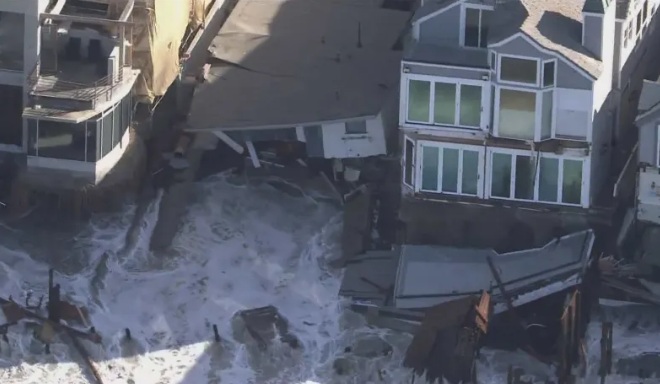
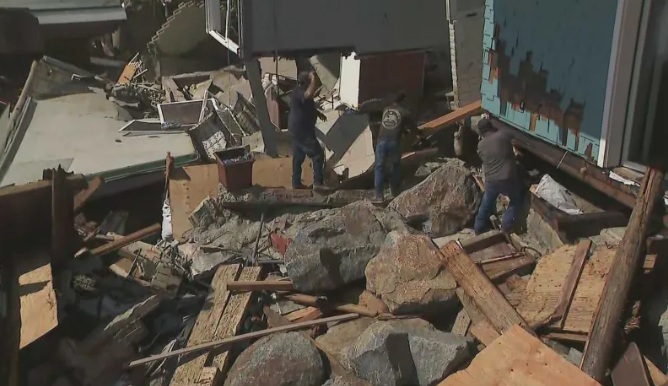
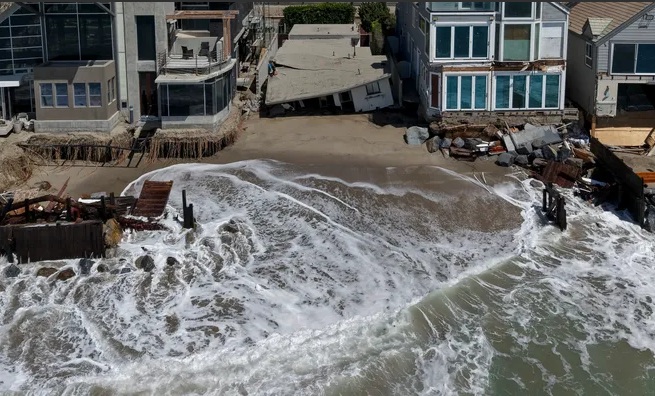
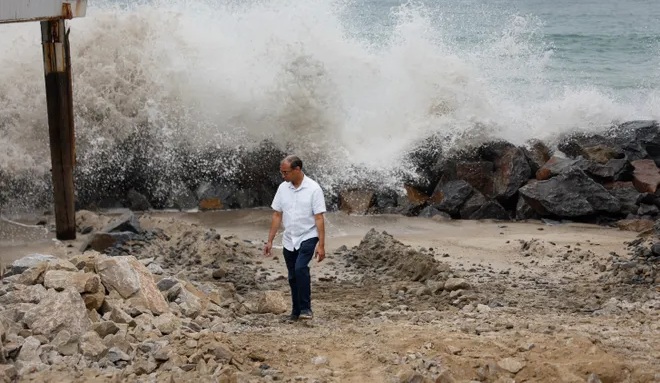
Managed retreat may ultimately become the only sustainable long-term strategy for coastal properties.
Sea Level vs. Private Property Rights
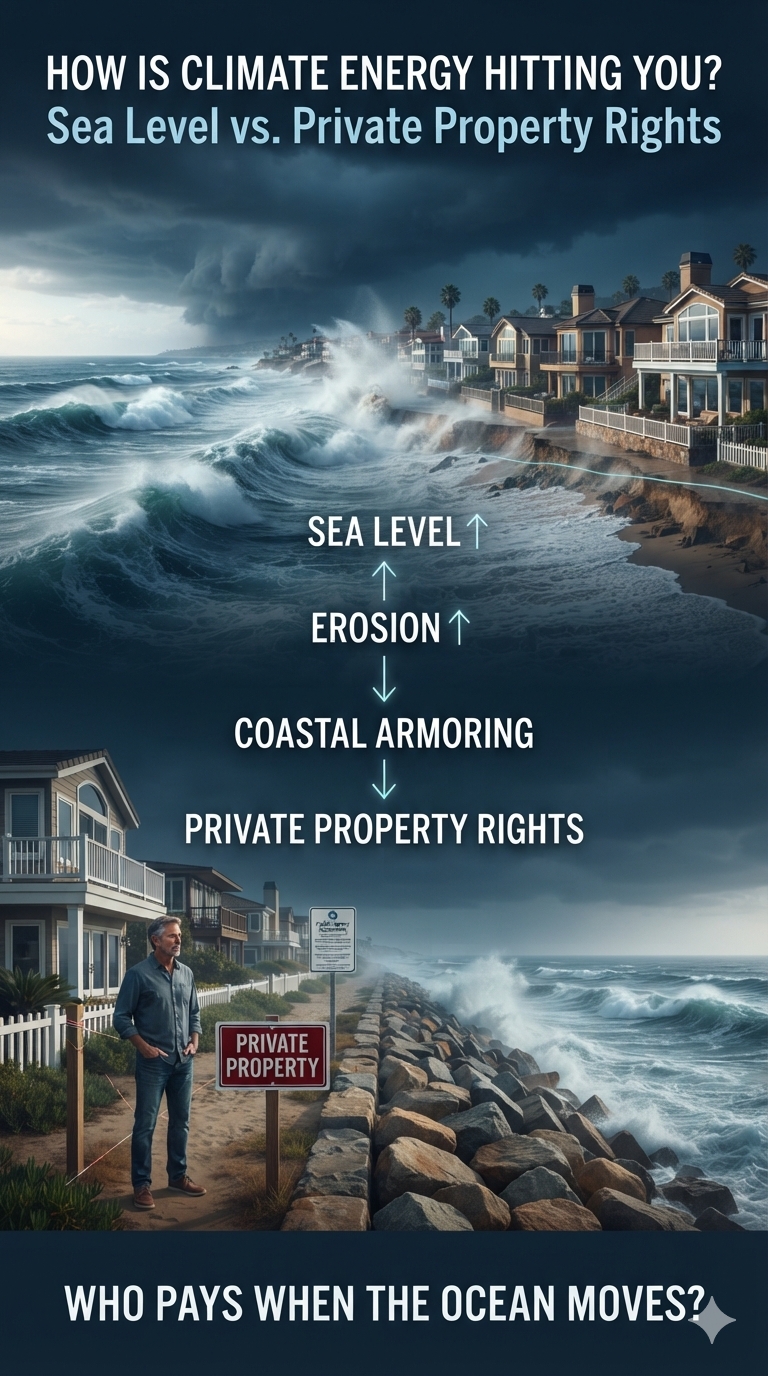
Simplified Introduction
How Is the Climate Energy Hitting You?
SoCal Coastal Armoring
Sea Level vs. Private Property Rights = Managed Retreat
🌊 Climate energy is hitting the coast.
When waves encounter a hard structure instead of dissipating their energy across a gradually sloping beach, some of that energy can be reflected back toward the ocean.
That can increase scour at the base of the structure and accelerate the loss of sand immediately in front of—and adjacent to—the armored shoreline.
A difficult feedback loop can develop:
Loss of sand → greater wave energy → erosion → emergency armoring → altered wave & sediment dynamics → further beach loss
The result is a fundamental conflict:
Protect individual properties — or preserve the beach as a public resource.
🌊 Climate Change Changes the Equation
This isn’t simply a dispute over seawalls.
It’s a preview of a much larger problem.
As sea levels rise, coastal storms and extreme-wave events interact with a progressively higher baseline ocean. More energy can reach vulnerable shorelines, while the loss of beaches and dunes removes natural buffers that once absorbed part of that energy.
The physical equation is changing.
🏖️ Managed Retreat
Managed retreat may ultimately become the long-term strategy for some coastal properties.
The fundamental physical reality is simple:
You can build a wall against the ocean.
You cannot build a wall against a changing climate.
The Beach Road conflict is therefore about much more than a temporary rock wall.
It is about what happens when accelerating climate change collides with private property rights, public resources, and the physical limits of coastal engineering.
The ocean doesn’t recognize property lines.
🌎 How Is the Climate Energy Hitting You?
Read the full report:
The Battle Over Coastal Armoring
The situation along Beach Road in Dana Point, California, illustrates an increasingly difficult collision between rising sea levels, intensifying coastal hazards, private property rights, and the public’s right to California’s beaches.
Powerful southern swells associated with Hurricane Marie, combined with an anticipated record El Niño season, have stripped away much of the protective sand buffer along the shoreline. Several multimillion-dollar beachfront homes have been severely damaged, with some collapsing directly into the Pacific Ocean.
At least 10 beachfront homes have been red-tagged, meaning they have been declared unsafe to inhabit, while another seven have been yellow-tagged, restricting their use. Facing the loss of their homes and investments, residents have taken matters into their own hands.
To protect what remains of their properties, a group of homeowners pooled their own money, contributing between $50,000 and $120,000 per household, to construct a massive temporary rock barrier, or riprap wall, extending across 17 vulnerable properties.
The California Coastal Commission granted temporary emergency permits for the barrier. But the decision has opened a much larger legal, environmental, and property-rights debate.
The Homeowners’ Position
The homeowners argue that they have a constitutional right to protect their homes and private property from destruction.
Many of the affected properties were built in the 1950s, long before today’s coastal development regulations were established. Residents point out that they pay substantial property taxes and argue that government agencies have failed to provide promised or expected beach-sand replenishment and other protective measures.
From their perspective, they are being asked to absorb enormous private losses while being restricted from taking reasonable measures to protect property they legally own.
The Environmental and Regulatory Position
The Coastal Commission and coastal scientists emphasize that hard coastal armoring—including seawalls, rock revetments, and similar structures—can alter natural coastal processes and contribute to beach erosion.
When waves encounter a hard structure rather than dissipating their energy across a gradually sloping beach, wave energy can be reflected back toward the ocean. This can increase scour at the base of the structure and accelerate the loss of sand immediately in front of and adjacent to the armored shoreline.
The result can become a difficult feedback loop:
Loss of sand → greater wave energy at the shoreline → erosion → emergency armoring → altered wave and sediment dynamics → further beach loss.
That creates a fundamental conflict between protecting individual properties and preserving the beach as a public resource.
The 120-Day Problem
The emergency permits for the rock barrier are temporary, lasting only 120 days.
If the homeowners cannot obtain permanent authorization—which is highly restricted for certain coastal properties, particularly homes constructed after 1977—they could ultimately be required to remove the expensive barrier.
That creates an extraordinary dilemma: homeowners may spend hundreds of thousands of dollars attempting to save their properties, only to face the possibility that the protective structure must be dismantled just as the most damaging winter storms arrive.
State authorities are instead encouraging communities to consider longer-term adaptation strategies, including cobblestone berms, elevating structures, and, where necessary, managed retreat.
Climate Change Changes the Equation
This conflict is not simply a dispute over seawalls.
It is a preview of a much larger problem.
As sea levels rise and coastal storms and extreme-wave events interact with a progressively higher baseline ocean, the amount of energy reaching vulnerable shorelines can increase. The loss of beaches and dunes removes natural buffers that once absorbed part of that energy.
That means yesterday’s shoreline protections may not be adequate for tomorrow’s climate.
The fundamental problem is that private property rights operate within a physical system that does not recognize property boundaries. The ocean does not distinguish between private property, public beaches, or political jurisdictions.
As climate change accelerates, coastal communities will increasingly have to confront the difficult question of where—and how—private property can realistically be protected.
Managed Retreat
Managed retreat may ultimately become the only sustainable long-term strategy for coastal properties.
A fundamental physical reality:
You can build a wall against the ocean, but you cannot build a wall against a changing climate.
The Beach Road conflict is therefore about much more than a temporary rock wall.
It is about what happens when accelerating climate change collides with private property rights, public resources, and the physical limits of coastal engineering.
How Is Climate Energy Hitting You?
Taking the Temperature of Climate Change: Meeting of the Minds
Easy-to-Read Resources
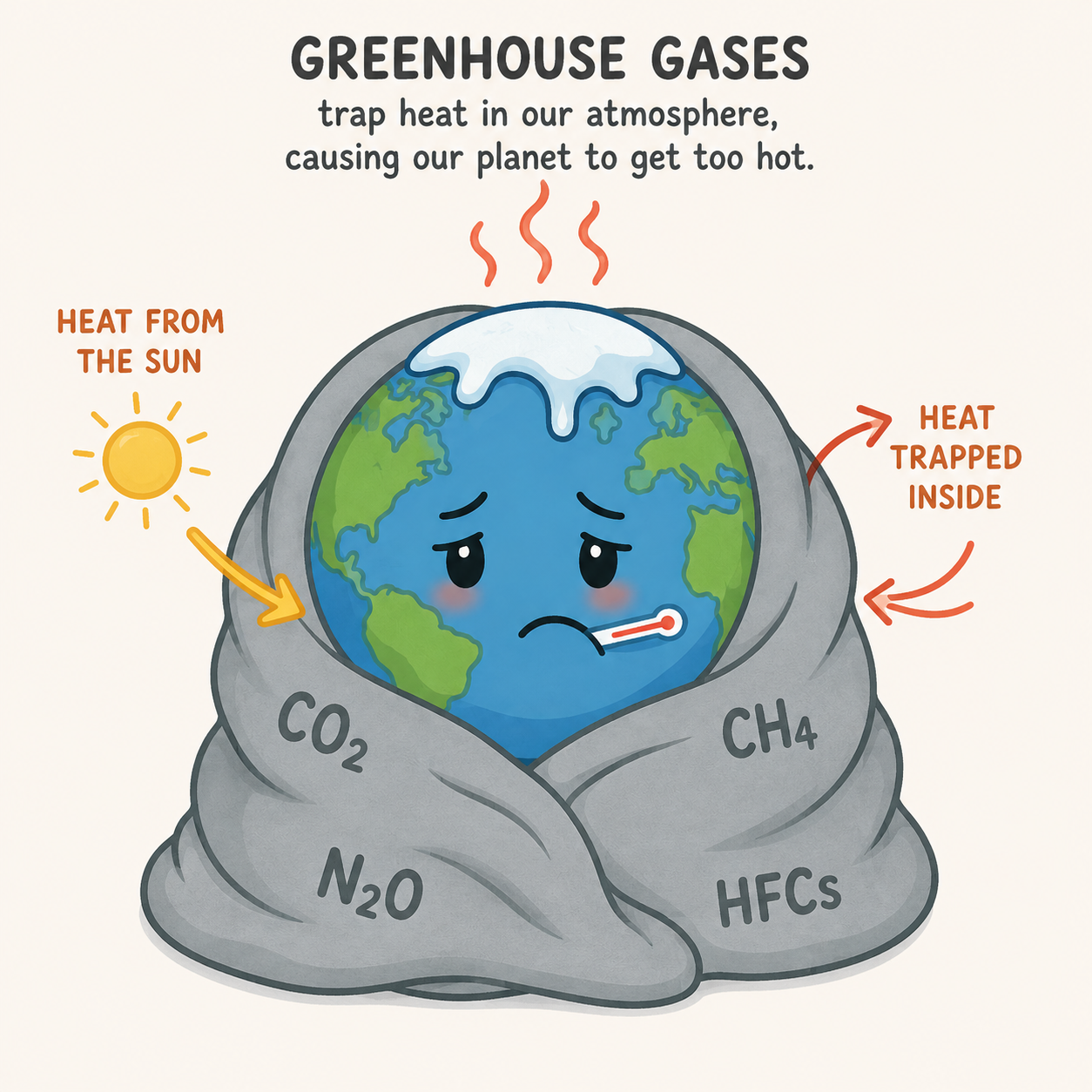
→ The Hitchhiker’s Guide to Climate Change
For the basics: Climate Change Simplified
Climate Change: What Can I Do?
Anthropogenic Global Warming 101
Feedback Loops →
Tipping Points →
Acceleration →
Domino Effect
Feedback loops amplify climate change and can push interconnected Earth systems past critical tipping points. As tipping points are crossed, they can trigger additional feedback loops and destabilize other climate systems. This cascading "Domino Effect" compresses timescales, accelerates change, and increases the risk of rapid, nonlinear climate transformations.