How Is Climate Energy Hitting You?
El Niño and the U.S. Economy: Inflation Risks Rise
El Niño could push inflation up by as much as 1 percentage point in 2027. Economic and climate feedbacks are increasingly coupling, with a single climate event triggering trillions of dollars in economic consequences.
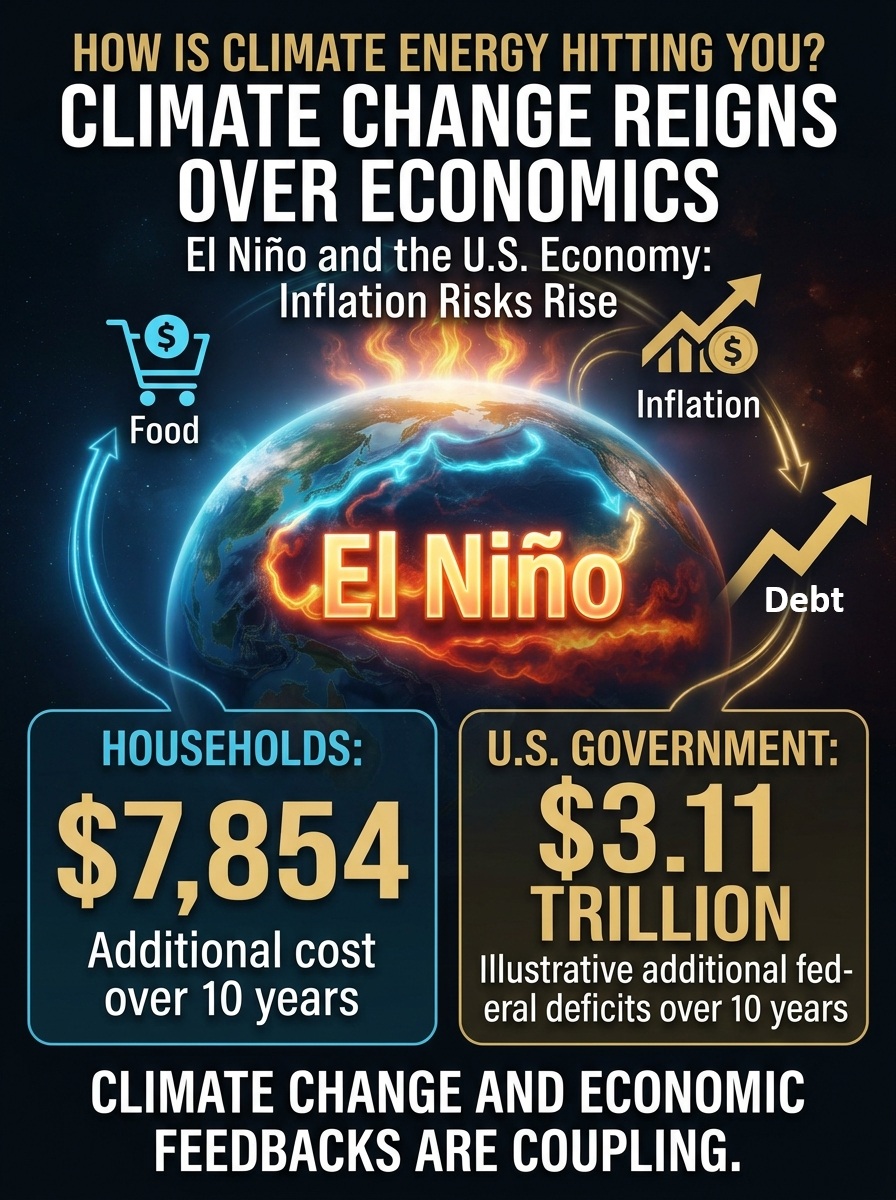
EL NIÑO: THE ECONOMIC RIPPLE EFFECTS
A 1-Percentage-Point Inflation Increase Could Cost Households, Increase Federal Spending, and Add Trillions to the National Debt
Federal Reserve research examines how El Niño can affect inflation, employment, household purchasing power, and the broader U.S. economy.
A new study from the Federal Reserve Bank of San Francisco identifies a significant economic risk associated with the current El Niño episode: U.S. inflation could increase by as much as 1 percentage point in 2027.
Although the initial price effects of the current episode are projected to fade by the end of 2026, historical estimates suggest that longer-term inflationary effects could emerge during 2027. These effects are linked primarily to core services and food prices, with the magnitude influenced partly by whether a La Niña episode follows El Niño.
The study also identifies potential employment gains, which may be widespread across industries and states during the year following El Niño.
An additional percentage point of inflation may sound relatively small, but its economic consequences extend far beyond higher grocery bills. It affects household purchasing power, government expenditures, interest rates, federal deficits, and the national debt.
1. What a 1-Percentage-Point Increase in Inflation Means for Household Budgets
The Federal Reserve study identifies an inflationary effect of as much as 1 percentage point in 2027.
Based on U.S. Bureau of Labor Statistics consumer expenditure data, the average American consumer unit spent approximately $78,535 annually in 2024.
An additional 1 percentage point of inflation, relative to the baseline, would translate into approximately $785 in additional annual household expenses, or about $65 per month.
| Additional household expense | Amount |
|---|---|
| Monthly | $65.45 |
| Annual | $785 |
| Five years | $3,927 |
| Ten years | $7,854 |
Illustrative calculations assume the additional 1% price-level difference persists, without further compounding.
The actual impact will vary depending on household spending patterns, particularly exposure to food, housing, transportation, and services.
The important distinction is that even when inflation subsequently slows, the higher price level generally remains. A reduction in the inflation rate does not reverse the previous price increases.
2. The National Economic Impact
The BLS reports approximately 135.76 million U.S. consumer units.
Applying the additional 1% expenditure to the national average produces an estimated:
$106.6 billion in additional annual household spending.
This is an illustrative national extrapolation, not a forecast of actual consumer spending. It demonstrates the potential economic scale of a relatively small change in the overall price level.
The consequences extend beyond consumer purchases:
- Prices rise faster than otherwise expected.
- Households pay more for food, services, and other necessities.
- Higher price levels generally persist even after inflation subsequently slows.
- Families whose incomes fail to keep pace with inflation experience declining purchasing power.
The effects also extend into employment, business operating costs, government expenditures, and financial markets.
3. Inflation and the Federal Budget
The combination of higher inflation and higher interest rates creates another economic challenge: the cost of financing the federal government.
The government faces pressure from two directions simultaneously.
Higher inflation increases government expenditures.
Social Security cost-of-living adjustments, federal contracts, military procurement, healthcare expenditures, and other government programs can become more expensive.
Higher interest rates increase the cost of financing the national debt.
As Treasury securities mature, the government must refinance portions of its outstanding debt at prevailing market rates. New borrowing also becomes more expensive.
The consequences extend beyond the immediate federal budget because additional interest payments contribute to future deficits and borrowing requirements.
The United States already carries an enormous national debt. Even relatively small changes in borrowing costs can translate into substantial additional federal expenditures.
4. What the Congressional Budget Office Estimates
The Congressional Budget Office (CBO) has examined how changes in inflation and interest rates affect federal revenues, expenditures, and deficits.
Its April 2026 analysis, How Changes in Economic Conditions Might Affect the Federal Budget: 2026 to 2036, provides useful estimates.
CBO examined a scenario in which inflation and nominal interest rates were each 0.1 percentage point higher every year than projected in its baseline forecast.
The resulting estimates include:
| Federal budget impact | Additional cost |
|---|---|
| Cumulative deficits, 2027–2036 | $311 billion |
| Higher direct interest costs | $339 billion |
| Additional interest from increased borrowing | $48 billion |
The $311 billion figure represents the estimated net increase in cumulative deficits, not the sum of the interest-cost components.
CBO’s sensitivity methodology provides a way to examine the potential consequences of larger changes.
For perspective, scaling its combined inflation-and-interest-rate scenario to a sustained 1-percentage-point increase in both variables produces an illustrative estimate of approximately:
$3.11 trillion in additional federal deficits over ten years.
This is a sensitivity calculation based on CBO’s model, not a prediction of the fiscal consequences of the current El Niño episode. It assumes the changes persist relative to the baseline throughout the projection period.
CBO also separately estimates that a sustained 0.1-percentage-point increase in interest rates alone would add approximately $379 billion to cumulative deficits over the same decade.
These scenarios should not be added together because they represent different economic assumptions.
5. The National Debt Feedback Loop
Inflation and interest rates can reinforce existing fiscal pressures.
The inflation-debt spiral:
- Higher inflation increases government expenditures.
- Higher interest rates make Treasury refinancing more expensive.
- Larger expenditures and interest payments increase federal deficits.
- Larger deficits require additional government borrowing.
- Additional borrowing increases the national debt.
- More debt eventually requires additional interest payments.
The result is increasing interest obligations and greater fiscal pressure.
This does not mean every increase in inflation automatically produces an equivalent increase in interest rates. Monetary policy, economic growth, Treasury market conditions, and inflation expectations all influence the outcome.
However, the combination presents a significant risk to long-term fiscal stability.
6. What Does This Mean for Taxpayers?
The consequences extend well beyond the federal budget.
- More tax revenue is directed toward servicing debt rather than public services and investment.
- Future taxpayers inherit higher debt-service obligations.
- Government borrowing competes with private investment for available capital.
- Higher borrowing costs can affect mortgages, business loans, and consumer credit.
- The government’s ability to respond to future economic emergencies becomes more constrained.
A 1-percentage-point increase in inflation accompanied by a 1-percentage-point increase in interest rates has implications for federal spending, debt financing, and future taxation.
The approximately $3.11 trillion CBO sensitivity calculation illustrates the potential scale of the problem under sustained changes in both variables. It should not be interpreted as the actual projected cost of El Niño.
The outcome depends on how long inflation persists, how Treasury yields respond, and how quickly outstanding federal debt reprices.
7. Climate and Economics: The Bigger Picture
The economic implications of El Niño demonstrate how climate patterns can influence more than agriculture and weather-related disruptions.
They can affect:
- Consumer prices and household purchasing power.
- Employment and labor markets.
- Government expenditures and federal deficits.
- Interest rates and the cost of financing debt.
- Long-term economic stability.
The economic implications of climate change extend well beyond the direct costs of storms, droughts, flooding, and extreme temperatures.
El Niño provides another example of how climate variability can transmit economic pressure through interconnected systems.
Climate risk is economic risk.
Understanding these connections is increasingly important for forecasting inflation, evaluating fiscal exposure, managing financial risks, and planning for the years ahead.
Original Research and Sources
Federal Reserve Bank of San Francisco
In Hot Water? The Macroeconomic Impacts of El Niño
Brigitte Roth Tran, Working Paper 2026-21, October 13, 2026.
U.S. Bureau of Labor Statistics
Source for average annual household expenditures and the number of consumer units.
Congressional Budget Office
How Changes in Economic Conditions Might Affect the Federal Budget: 2026 to 2036
Source for federal budget sensitivity to inflation and interest-rate changes.
How Is Climate Energy Hitting You?
Easy-to-Read Resources