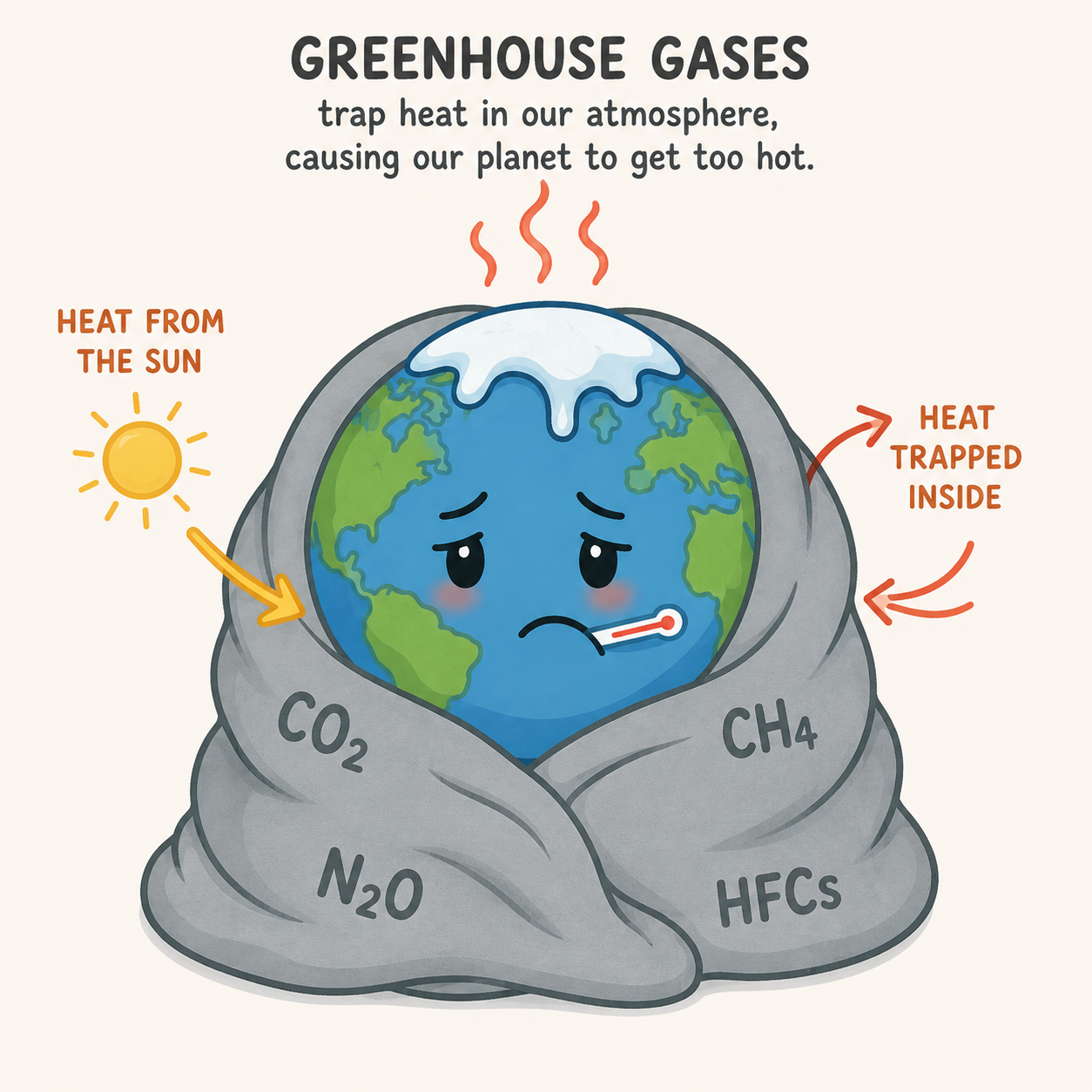
Beyond 1.5°C: The Climate Tripwire and Climate-System Singularity
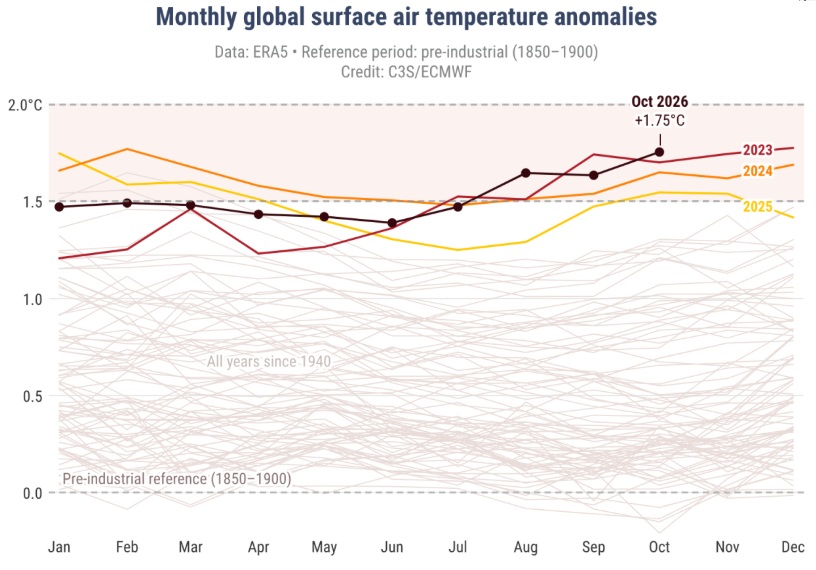
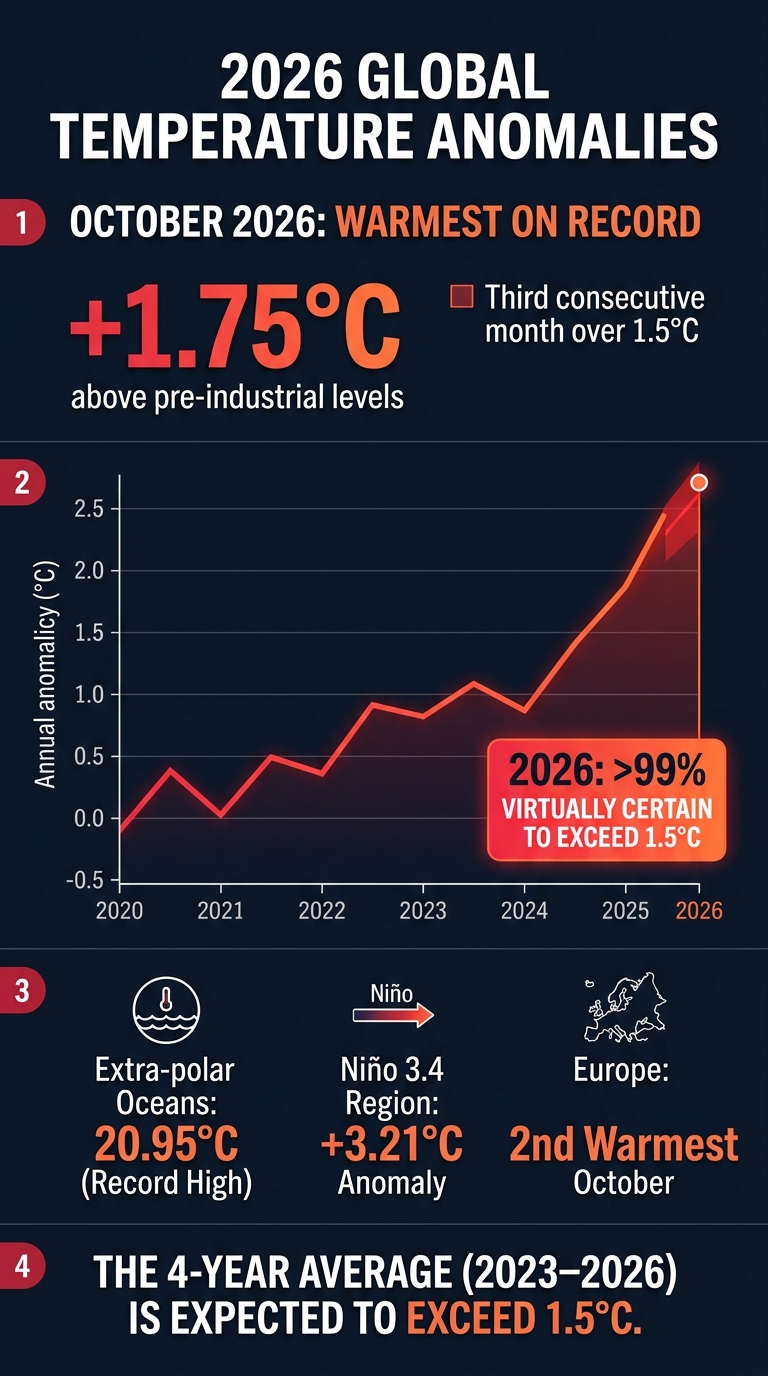
“October has continued the pattern of remarkable global warmth, with record global and surface ocean temperatures. An exceptionally strong El Niño is adding further heat to a climate already warmed by human activities, while 2026 is on track to become the second calendar year above 1.5°C. Particularly significant is that the four-year average is also expected to exceed 1.5°C, highlighting how sustained this period of global warmth has become.”
— Samantha Burgess, Strategic Lead for Climate at ECMWF
Daniel Brouse¹, Sidd Mukherjee²
¹ Climatologist, Economist
² Physicist
November 2026
Record Global Temperatures, Converging Feedback Networks, and the Emergence of a Climate-System Singularity
Simplified Overview
🌎 BEYOND 1.5°C: THE CLIMATE TRIPWIRE
Why is 1.5°C such an important number? And why is the accelerating pace of global warming only part of the story?
The climate system is not a thermostat. It is an interconnected network of oceans, atmosphere, ice, land, and ecosystems, with millions of interacting processes that influence one another.
As global temperatures rise, individual climate feedbacks strengthen, couple, and amplify. Ocean heat accumulation, melting ice, declining albedo, changing cloud patterns, and ecosystem deterioration are not isolated developments. They are interconnected processes capable of reinforcing one another.
The danger is not simply how much warmer Earth becomes. It is what happens as these feedbacks interact.
In our latest research paper, Daniel Brouse and Sidd Mukherjee explore the significance of the 1.5°C threshold, the convergence of climate feedback networks, and the concept of a Climate-System Singularity: a stage of increasingly interconnected, self-reinforcing planetary change that becomes progressively more difficult to predict, manage, or reverse.
We examine a fundamental question:
Are we approaching a point where the combined behavior of Earth’s climate feedback networks increasingly determines the planet’s trajectory?
1.5°C is not the destination. It is the tripwire.
And understanding what happens beyond it may be one of the most important scientific challenges of our time.
BEYOND 1.5°C: THE CLIMATE TRIPWIRE
By Daniel Brouse and Sidd Mukherjee
#ClimateChange #GlobalWarming #ClimateScience #ClimateFeedbacks #TippingPoints #EarthSystemScience #ClimateResearch #OceanHeat
1. Beyond the 1.5°C Threshold
Much of the world is focused on 1.5°C.
One reason the public has become so focused on this number is its simplicity. A 1.5°C (2.7°F) increase sounds like a straightforward, easily understood concept. It also doesn’t sound particularly frightening. After all, what’s the big deal about a couple of degrees of warming? Some people even portray higher temperatures as potentially beneficial.
Scientists take a very different view.
There are many ways to examine climate change. At the micro level, millions of individual feedback processes operate throughout the Earth system, connecting the atmosphere, oceans, ice, land, ecosystems, and human systems. At the macro level, these interactions combine to form one interconnected planetary climate system.
The critical question is not simply how much the planet warms, but what happens as warming changes the system itself.
Understanding how these feedbacks interact—and, more importantly, how they amplify one another—is at the frontier of climate science. The climate system is not a simple thermostat in which each additional degree produces a proportionally larger but otherwise predictable effect. It is a complex, nonlinear system capable of crossing thresholds, reorganizing feedback relationships, and shifting toward fundamentally different states.
That is why 1.5°C matters.
The 1.5°C threshold identified in the Paris Agreement, along with the approximately 2°C level associated with substantially greater climate risks, is not important because the difference between 1.4°C and 1.5°C is somehow magical. These benchmarks matter because increasing global temperatures raise the probability of activating major climate tipping elements and destabilizing interconnected Earth systems.
Once tipping processes become established, two fundamental characteristics make the consequences increasingly difficult to manage.
First, certain tipping processes can initiate self-reinforcing feedbacks that continue driving change even if the original forcing is reduced. Some changes can become effectively irreversible on human timescales.
Second, climate impacts do not necessarily increase gradually with temperature. They can accelerate, compound, and cascade as interconnected systems become destabilized and begin reinforcing one another.
Consequently, the distinction between 2°C, 3°C, or even 4°C of eventual warming cannot be understood through temperature alone. The trajectory of the Earth system, the activation of tipping elements, and the strength of interacting feedbacks become equally important.
In other words, 1.5°C is not a destination. It is not merely a warning sign or an alarm. It is a tripwire.
A warning sign tells us that danger lies ahead. An alarm tells us that danger may already be present. A tripwire represents something different: crossing a threshold that can initiate a chain of events that becomes increasingly difficult to contain, control, or reverse.
That is the critical distinction lost when climate change is reduced to a single temperature number.
The real danger lies not in the number itself, but in what the Earth system is doing as we move beyond it.
We are not simply adding another fraction of a degree to a static planet. We are increasing the energy accumulating within a dynamic, interconnected system—and that additional energy is altering the very processes that determine how the system responds.
The question, therefore, is not simply:
How many degrees warmer will Earth become?
The more important question is:
What happens as we cross the tripwires?
2. Climate-System Singularity: The Convergence of Feedback Networks
The answer requires looking beyond individual climate feedbacks and examining how they interact as interconnected networks.
Individual feedbacks do not operate in isolation. As warming intensifies, feedback processes emerge, strengthen, couple, and increasingly influence one another. These relationships form interconnected networks in which changes in one component propagate through multiple others.
Consider the relationships among:
- Atmospheric warming: Increasing temperatures raise atmospheric water vapor concentrations and alter circulation patterns.
- Ocean heat accumulation: The oceans absorb more than 90% of the excess energy accumulating in the Earth system, influencing ocean circulation, sea ice, and marine ecosystems.
- Cryosphere destabilization: Melting sea ice reduces planetary reflectivity, while ice-sheet deterioration contributes to sea-level rise and changes in regional circulation.
- Albedo changes: The loss of reflective ice and snow exposes darker surfaces that absorb more incoming solar energy.
- Cloud feedbacks: Changes in cloud distribution, altitude, and properties alter the balance between incoming solar radiation and outgoing terrestrial radiation.
- Ecosystem deterioration: Heat, drought, fire, and atmospheric pollution weaken vegetation and carbon sinks, changing the exchange of energy, water, and carbon between the land and atmosphere.
Each process influences other components of the system. Those interactions create additional pathways for amplification.
As these pathways multiply and strengthen, individual feedbacks increasingly become components of larger, interconnected feedback networks.
The result is a transition from isolated feedback responses toward increasingly coupled and self-reinforcing planetary processes.
We describe the potential convergence of these interacting networks as a Climate-System Singularity.
A climate-system singularity represents a critical stage in which interconnected feedback networks become increasingly self-reinforcing, driving planetary change that becomes progressively more difficult to predict, manage, or reverse through human intervention.
The concept draws an analogy to a gravitational singularity, such as the theoretical singularity associated with a black hole. It does not suggest that the climate system literally develops a gravitational singularity. Rather, it illustrates a fundamental concern: as multiple interacting forces converge, conventional assumptions about predictability, proportional responses, and human control become increasingly inadequate.
In the climate system, the concern is that feedback networks can become sufficiently interconnected and amplified that their collective behavior increasingly determines the direction and pace of planetary change.
Human emissions remain the principal external driver of contemporary global warming. However, once feedback processes become established and increasingly coupled, reducing emissions alone does not guarantee that every activated Earth-system process will immediately stop or reverse.
This distinction has profound implications for climate science, climate modeling, and public policy.
The challenge is no longer simply measuring how quickly global temperatures are rising. It is understanding how rapidly the underlying planetary systems are reorganizing, how feedback pathways are strengthening, and whether their interactions are accelerating toward cascading destabilization.
The defining question becomes whether humanity is approaching a point at which the combined behavior of Earth’s feedback networks increasingly governs the climate trajectory beyond the reach of conventional intervention.
Additional research and original work
Climate Change Threshold Dynamics and Climate Singularity
Daniel Brouse and Sidd Mukherjee — Climate Feedback and Tipping-Point Network
Daniel Brouse and Sidd Mukherjee — Observable Climate Feedback Coupling
Daniel Brouse and Sidd Mukherjee — Climate-System Singularity
Feedback Loops → Tipping Points → Feedback Loop and Tipping-Point Network → Acceleration → Domino Effect
Feedback loops amplify climate change and can push interconnected Earth systems past critical tipping points. As tipping points are crossed, they can trigger additional feedback loops and destabilize other climate systems. This cascading "Domino Effect" compresses timescales, accelerates change, and increases the risk of rapid, nonlinear climate transformations.
Current Status: Climate Tipping Point Crisis
The most significant emerging climate feedback accelerating the planetary energy imbalance is the decline in low-level clouds.
Low-Level Cloud Overview
Low-Level Cloud Feedback: The Mega-Multiplier — An Additional 1.5°C to 2°C • Albedo–Cloud–Ocean Heat Content Feedback Triad (Climate Jerk Surge Math & Methods) • Feedback Loop and Tipping-Point Network • The Global Feedback Cascade: Ozone and Cloud Feedback Coupling • Low-Level Ozone – Clouds = Slowing AMOC and Collapse • Water Vapor + Clouds: Coupled Feedbacks Driving a Warmer Planet
One of the least understood emerging climate feedbacks is tropospheric ozone.
Ozone Meta Analysis
Ozone : The #1 Climate Gas (Public Access Edition)
Ozone: The Atmospheric-Ecological Climate Multiplier (Advanced Scientific Edition)
The Ozone Feedback Theory: Tropospheric Ozone as a Driver of Ecosystem Decline, Carbon Sink Failure, and Climate Acceleration
Easy-to-Read Resources