Climate Welfare Accounting Framework (CWAF): The Welfare Cost of Climate Change in the United States
A Per-Capita Estimate of Mortality, Morbidity, and Life-Expectancy Loss in 2025
2Independent Physicist, Membrane Institute, USA
Abstract: Climate Welfare Accounting Framework (CWAF)
Climate change is often discussed in terms of physical damages, disaster losses, or aggregate effects on GDP. Those measures are important, but they understate a central reality: climate change is also a direct and growing threat to human welfare. It shortens lives, worsens health, erodes quality of life, and imposes diffuse costs on households that are only partly captured by property-damage accounting or macroeconomic output statistics.
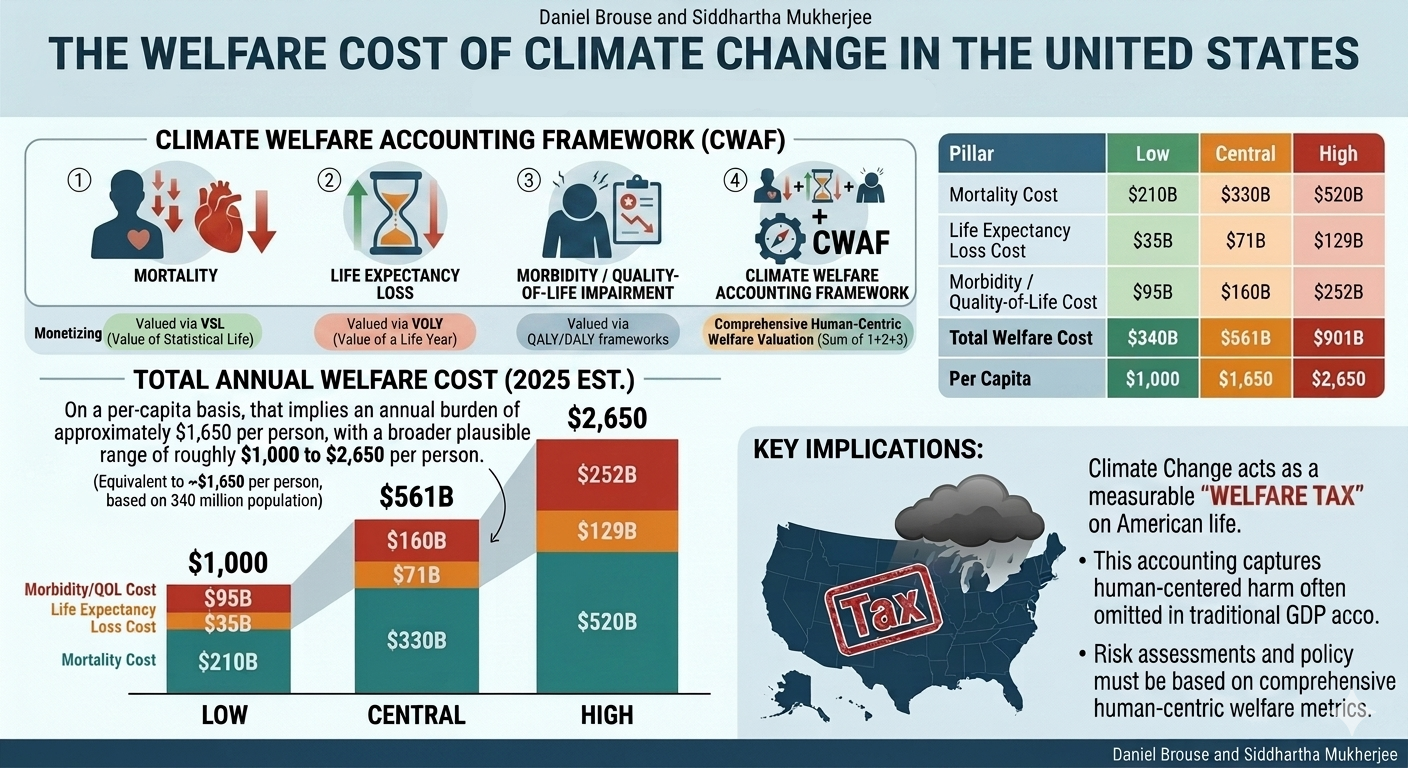
The Climate Welfare Accounting Framework (CWAF) develops a bottom-up estimate of the welfare cost of climate change in the United States in 2025, expressed on a per-capita basis. Rather than valuing climate damage solely through destroyed assets or reduced output, the analysis focuses on three human-centered pillars of welfare loss: (1) climate-attributable mortality, (2) life-expectancy loss from chronic climate-linked environmental exposure, and (3) non-fatal morbidity and quality-of-life impairment. These pillars are monetized using standard welfare-economics tools: the Value of a Statistical Life (VSL), the Value of a Statistical Life Year (VSLY), and quality-adjusted/disability-adjusted life-year frameworks (QALY/DALY).
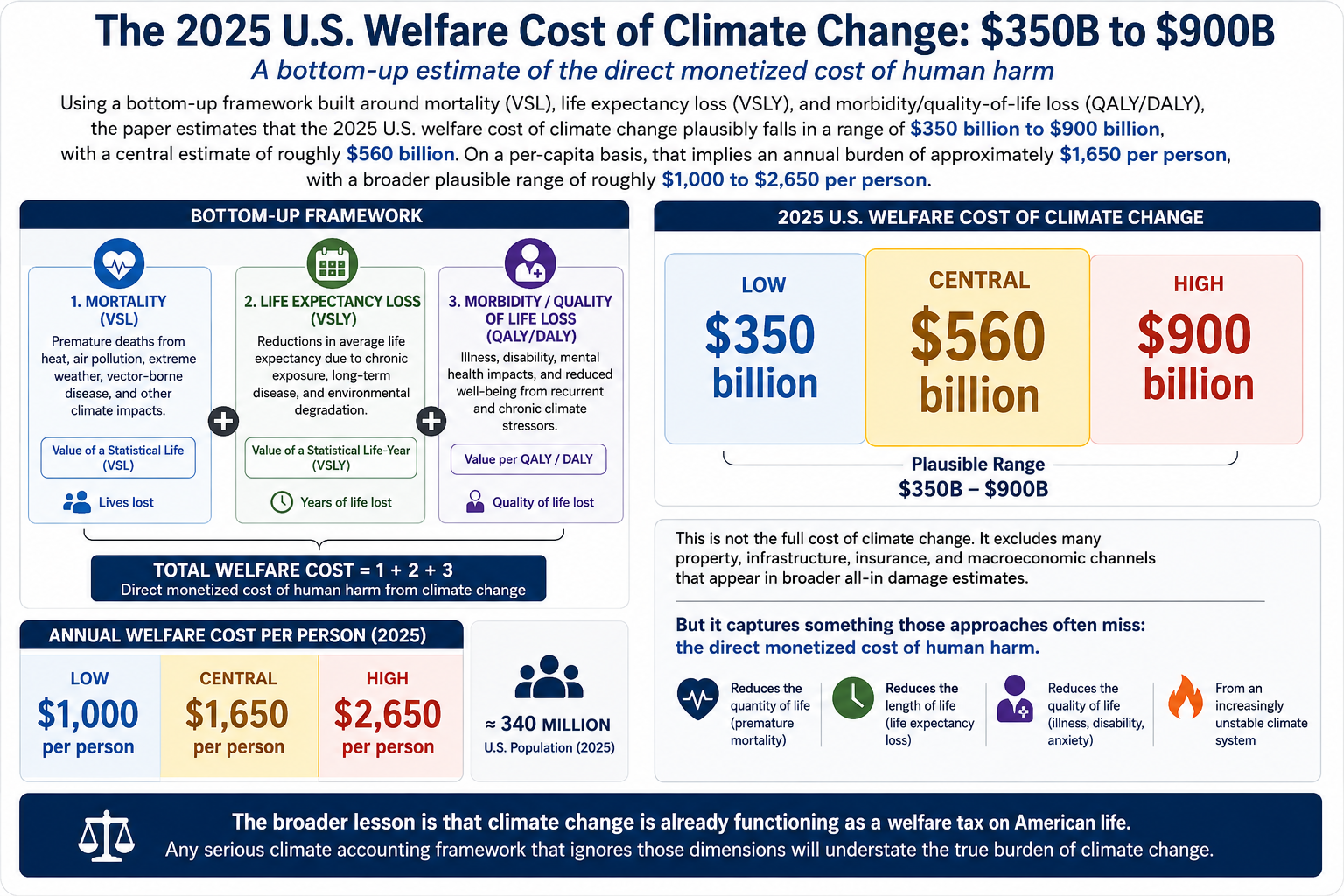
The CWAF estimates that the annual welfare cost of climate change in the United States in 2025 plausibly falls in a range of approximately $350 billion to $900 billion, with a central estimate near $560 billion, equivalent to roughly $1,650 per person using a U.S. population of 340 million. This estimate is intentionally narrower than a full “all-in” climate burden because it focuses on human welfare damages rather than total economic damages such as property losses, insurance-market destabilization, or climate-driven inflation. However, it captures a category of harm that GDP-centric approaches systematically undercount: the direct erosion of human health, longevity, and lived well-being.
The central implication is that climate change should be understood not only as a physical hazard or macroeconomic drag, but as a large and already measurable welfare tax on American life. Any estimate of the cost of climate change that omits mortality, chronic health degradation, and quality-of-life loss risks understating the true burden by a wide margin.
1. Introduction and Conceptual Framework
1.1 Climate change as a welfare problem, not only a GDP problem
Public and policy discussion of climate change often emphasizes sea-level rise, billion-dollar disasters, infrastructure damage, insurance losses, and aggregate economic output. Those categories matter. But they are not the whole story. Climate change also imposes a less visible but increasingly severe burden through human suffering: deaths from extreme heat and smoke, chronic respiratory disease, cardiovascular stress, lost healthy years of life, mental-health deterioration after disasters, vector-borne disease expansion, and reduced daily functioning in an increasingly hostile environment.
A climate impact that leaves GDP unchanged but increases premature death, chronic illness, anxiety, or lost years of healthy life is still a real welfare loss. In that sense, climate change is not merely an ecological or macroeconomic challenge. It is a growing assault on human well-being itself.
This framework therefore asks a different question from most climate-damage studies:
What was the welfare cost of climate change to the average person in the United States in 2025 once mortality, chronic health loss, and quality-of-life impairment are monetized using standard economic valuation tools?
That question is narrower than asking for the “total cost of climate change,” but it is also deeper in one crucial respect. It moves the accounting framework away from damaged property and toward damaged lives.
1.2 The core metric: willingness to pay and welfare valuation
The welfare framework used here draws on the standard economics of willingness to pay (WTP) for risk reduction and health preservation. Modern environmental cost-benefit analysis does not attempt to “price a human life” in a literal sense. Rather, it estimates how much people are willing to pay for small reductions in mortality risk or for improvements in health and longevity. When aggregated across a large population, those small risk reductions produce the familiar concept of the Value of a Statistical Life (VSL). Similarly, health losses that reduce expected years of life or quality of life can be monetized using the Value of a Statistical Life Year (VSLY) or QALY/DALY-based approaches.
This framework therefore defines the annual U.S. climate welfare cost as the sum of three monetized components:
Total Welfare Cost=Mortality Cost+Life-Expectancy Loss Cost+Morbidity / Quality-of-Life Cost
1.3 Scope of the analysis
The CWAF is bounded in five ways.
First, geographically, it focuses on the United States. The framework is designed to estimate the domestic welfare burden of climate change within a single national context, using U.S.-specific mortality, health, demographic, and valuation assumptions. It does not attempt to measure climate-related welfare losses borne outside the United States, nor does it capture cross-border spillovers except to the extent that they are already reflected in observed U.S. health outcomes.
Second, temporally, it estimates the annual welfare burden for 2025. The year 2025 is used as a baseline because it reflects a contemporary climate state characterized by substantial heat exposure, wildfire smoke, extreme-weather disruption, and rising public-health stress, while still allowing comparison with current U.S. policy metrics and population data. The CWAF is therefore an annual snapshot rather than a cumulative historical estimate or a long-run integrated projection.
Third, conceptually, the CWAF measures only human welfare losses—not the full economic burden of climate change. It does not attempt to monetize property destruction, infrastructure loss, insurance-market destabilization, food-price inflation, agricultural losses, public disaster spending, or other macroeconomic and fiscal costs except insofar as those phenomena are already embodied in mortality, morbidity, or life-expectancy degradation. In that sense, the CWAF is a welfare-centered companion estimate, not a replacement for broader all-in climate cost accounting.
Fourth, the CWAF is intentionally conservative with respect to climate-linked health burdens that are biologically plausible, increasingly documented, or partially visible in public-health data, but not yet fully attributable or consistently monetized in the U.S. climate-damages literature. Climate-sensitive infectious disease burdens are included only where a direct and empirically identified climate causal mechanism has been established; multifactorial pandemic events are excluded absent clear attribution linkage. These omitted or only partially captured pathways may include climate-sensitive infectious disease burdens; shifts in the ecology, seasonality, and geographic range of disease vectors and pathogens; waterborne and fungal disease exposure; and reproductive, maternal, neonatal, and developmental harms associated with heat, smoke, ozone, and related environmental stressors. They may also include portions of mental-health and social-trauma burdens—such as post-disaster psychological injury, chronic smoke and heat stress, displacement anxiety, and other nonfatal quality-of-life losses—that are not fully captured in annual morbidity accounting. Major pandemic events involving multifactorial drivers are not treated as climate-attributable costs unless a clearly identifiable climate-sensitive causal pathway has been established. Accordingly, these health-related pathways are not separately estimated except where they are already reflected in observed mortality, morbidity, or life-expectancy losses.
Fifth, the CWAF is bounded by an evidentiary attribution rule. It includes only welfare losses that can be linked to climate change through reasonably defensible attribution, exposure-response evidence, or clearly climate-sensitive causal pathways. Harms that may be climate-relevant in a broader systemic sense but remain too indirect, speculative, weakly quantified, or insufficiently attributable for bottom-up annual estimation are excluded. This attribution boundary is intended to keep the framework conservative and to reduce the risk of overstating climate-attributable welfare loss.
Taken together, these boundaries imply that the CWAF should be interpreted as a lower-bound estimate of the human welfare burden of climate change in the United States in 2025 rather than as a comprehensive measure of the nation’s total climate-related losses.
For an economic cost analysis, see: The Cost of Climate Change in the United States (2025)
2. Literature Review and Methodology
2.1 Relationship to the Social Cost of Carbon literature
The modern climate-economics literature provides two foundational starting points for welfare-based climate accounting.
The first is the U.S. Social Cost of Carbon (SCC) framework, used by federal agencies to estimate the monetized damages caused by an additional ton of CO₂ emissions. The SCC is intended to capture a broad set of climate damages, including agricultural losses, flood damages, energy costs, and human health effects. In practice, however, the SCC is typically used as a marginal emissions metric for regulatory analysis rather than as a direct estimate of the annual welfare burden already being experienced by a specific population. Moreover, some damages remain underrepresented because of data limitations, omitted morbidity pathways, and the difficulty of valuing non-market harms.
The second foundation is the emerging empirical work of the Climate Impact Lab, which has advanced a more spatially explicit, bottom-up architecture for climate damages through the Data-driven Spatial Climate Impact Model (DSCIM). This literature is especially important because it links climate variables to sector-specific damages—mortality, labor, agriculture, energy demand—using reduced-form empirical damage functions rather than highly aggregated macroeconomic assumptions.
The CWAF draws from both traditions but differs in emphasis. Rather than estimating the marginal damage of an extra ton of CO₂, it estimates the annual welfare burden of the climate state already experienced in 2025 by U.S. residents. Rather than using a top-down GDP damage function, it uses a bottom-up damage aggregation focused on mortality, life expectancy, and morbidity.
2.2 Why a bottom-up welfare approach
A top-down macroeconomic estimate asks how climate change affects GDP, consumption, or aggregate output. Those estimates are useful, but they can miss or obscure welfare losses that do not neatly pass through measured production. A rise in asthma, heat-related hospitalizations, anxiety after repeated evacuations, or shortened lifespan from chronic smoke exposure may impose enormous human costs even if the national accounts only partially register them.
For that reason, the CWAF uses a bottom-up welfare damage function:
- Estimate climate-attributable health harms (deaths, years of life lost, morbidity burden).
- Monetize each category using a welfare-consistent valuation metric (VSL, VSLY, QALY/DALY).
- Aggregate across categories, while taking care to avoid double counting.
- Divide by population to express the burden in per-capita terms.
2.3 Avoiding double counting
A major methodological issue is overlap between the three pillars.
- Pillar A: Mortality values the welfare loss from climate-attributable deaths using VSL.
- Pillar B: Life expectancy values chronic erosion of expected years of life from climate-linked exposures that are not already counted as acute mortality events in Pillar A.
- Pillar C: Morbidity / quality of life values non-fatal health loss and reduced well-being, excluding any years or deaths already monetized in Pillars A or B.
This structure is necessary because VSL, VSLY, and QALY/DALY measures all touch related aspects of health loss. The objective is not to count every injury three times, but to build a defensible partition of welfare harm into: deaths, lost life-years, and reduced healthy life.
2.4 Core valuation assumptions
The CWAF uses the following baseline welfare parameters for 2025:
- Population: 340 million U.S. residents based on U.S. Census mid-year population estimates (~340 million residents)
- VSL central value: $12.5 million per statistical life
(consistent with the U.S. Department of Transportation’s 2022 base-year VSL and broadly within the range of current federal practice; DOT’s 2025 table reports $14.2 million for 2025 values, while EPA guidance remains under revision and has historically used lower inflation-adjusted values) - VSLY range: $300,000–$500,000 per life-year, central estimate $400,000
- QALY/DALY monetization anchor: $300,000–$500,000 per healthy year lost, aligned with the VSLY range for consistency
The choice of $12.5 million as the central VSL is deliberate. It is conservative relative to some 2025 federal updates but materially above older EPA guidance values that reflect earlier base years. Because the goal is to estimate current welfare loss in a 2025 climate context, a current-dollar VSL benchmark is appropriate.
Because Pillar A values mortality using a contemporaneous Value of a Statistical Life (VSL) consistent with U.S. Department of Transportation regulatory guidance U.S. Department of Transportation, discounting is primarily relevant to Pillar B and any portion of Pillar C that reflects future streams of lost healthy life rather than same-year welfare loss. The VSL framework itself is grounded in willingness-to-pay for marginal mortality risk reductions as defined in U.S. Environmental Protection Agency mortality risk valuation practice U.S. Environmental Protection Agency.
3. Empirical Framework: Quantifying the Three Pillars
3A. Pillar A — Mortality Costs (VSL Approach)
3A.1 Concept
The mortality pillar captures the welfare cost of premature deaths attributable to climate change in 2025. These deaths arise through several channels:
- extreme heat
- wildfire smoke / PM₂.₅ exposure
- severe storms, floods, and other acute climate-related disasters
- secondary climate-sensitive pathways, including some cardiovascular and respiratory stress amplified by heat and pollution
The relevant empirical task is to estimate how many deaths in 2025 are attributable not merely to weather in general, but to anthropogenic climate change’s incremental effect on weather and environmental conditions.
3A.2 Data logic
In a full implementation, the preferred mortality estimate would be built from epidemiological dose-response functions linked to climate-attributable exposure changes. That is, one would estimate:
- the additional heat exposure, smoke exposure, and hazard intensity attributable to anthropogenic warming;
- the mortality response to those exposures;
- the resulting annual climate-attributable excess deaths.
The CWAF does not claim a fully new epidemiological mortality model. Instead, it constructs a plausible 2025 mortality range using the literature on heat mortality, wildfire smoke mortality, and climate-linked disaster deaths as a welfare-accounting baseline.
3A.3 2025 mortality estimate
For 2025, a reasonable national range for climate-attributable excess deaths in the United States is set at:
- Low estimate: 18,000 deaths
- Central estimate: 30,000 deaths
- High estimate: 45,000 deaths
These figures are meant to capture not only direct heat deaths officially coded as such, but also the broader mortality burden associated with climate-amplified heat stress, smoke exposure, and climate-linked hazard conditions. They are therefore substantially larger than narrow “named disaster” fatality counts. This is consistent with the broader climate-health literature, which increasingly finds that heat and particulate exposure can generate large mortality burdens that are undercounted in conventional disaster statistics.
3A.4 Monetization
Mortality cost is valued as:
Mortality Cost = Climate-Attributable Deaths × VSL
Using a VSL of $12.5 million, the resulting 2025 mortality burden is:
- Low:
18,000×$12.5 million=$225 billion - Central:
30,000×$12.5 million=$375 billion - High:
45,000×$12.5 million=$562.5 billion
3A.5 Per-capita mortality burden
Dividing by 340 million people:
- Low: $225B / 340M ≈ $662 per person
- Central: $375B / 340M ≈ $1,103 per person
- High: $562.5B / 340M ≈ $1,654 per person
Thus, under this framework, mortality is the single largest welfare component of climate damages in 2025.
3B. Pillar B — Life Expectancy Loss (VSLY Approach)
3B.1 Why mortality alone is not enough
Mortality counts capture the welfare cost of deaths that occur in 2025, but they do not fully capture the erosion of expected life-years caused by chronic climate-linked environmental stress. A person may not die in 2025 but may nonetheless lose months or years of life expectancy because of cumulative exposure to smoke particulates, repeated heat stress, worsening ozone, or chronic cardiopulmonary strain.
This matters because climate harm is not only about whether someone dies this year. It is also about how much healthy life is being quietly shaved off across the population.
Pillar A (VSL-based valuation) is treated as a contemporaneous willingness-to-pay measure for marginal mortality risk and is not decomposed into life-year equivalents; Pillar B is constructed independently using life-expectancy and morbidity accounting and is not derived from VSL. The CWAF does not mechanically decompose VSL into life-year equivalents; Pillar B uses independent life-expectancy and morbidity valuation methods rather than VSL back-calculation.
3B.2 Conceptual definition
The life-expectancy pillar captures the value of years of life lost (YLL) from chronic climate-linked exposure that are not already represented in the mortality pillar’s annual death count.
In practice, this includes:
- long-run smoke and PM₂.₅ exposure associated with wildfire regimes
- repeated extreme heat stress and its cardiovascular consequences
- ozone and air-quality degradation linked to climate-sensitive atmospheric chemistry
- cumulative environmental stress that advances mortality risk without necessarily showing up as a discrete “death event” in 2025
3B.3 Valuation metric: VSLY
To monetize life-expectancy loss, the CWAF uses the Value of a Statistical Life Year (VSLY). VSLY translates the broader VSL concept into a value per life-year rather than per death. The literature contains a range of plausible values; here the central assumption is:
- VSLY central value: $400,000 per life-year
- Sensitivity range: $300,000–$500,000
3B.4 2025 life-year loss estimate
A conservative national estimate for climate-linked chronic life-year loss in 2025 is:
- Low: 100,000 life-years lost
- Central: 200,000 life-years lost
- High: 350,000 life-years lost
These are not deaths. They are the aggregate loss of expected life-years across the U.S. population from climate-related environmental degradation not already captured in Pillar A.
3B.5 Monetization
Life-Expectancy Cost=Climate-Linked Life-Years Lost×VSLY
Using a central VSLY of $400,000:
- Low:
100,000×$400,000=$40 billion - Central:
200,000×$400,000=$80 billion - High:
350,000×$400,000=$140 billion
3B.6 Per-capita life-expectancy burden
- Low: $40B / 340M ≈ $118 per person
- Central: $80B / 340M ≈ $235 per person
- High: $140B / 340M ≈ $412 per person
This is smaller than the mortality pillar but still economically large, and it captures a category of harm that disappears entirely in property-damage accounting.
3C. Pillar C — Morbidity and Quality-of-Life Costs (QALY/DALY Approach)
3C.1 The non-fatal burden of climate change
A large share of climate harm does not kill people but makes them sicker, more disabled, more anxious, and less able to function. This includes:
- chronic asthma and respiratory exacerbation from wildfire smoke
- heat exhaustion, kidney stress, and cardiovascular strain
- injuries and mental-health trauma associated with floods, fires, and storms
- vector-borne diseases such as Lyme disease or West Nile expansion
- pregnancy risks, sleep disruption, and psychiatric stress linked to chronic heat exposure and repeated climate shocks
These are not “minor” costs simply because they do not always end in death. They are direct losses of healthy life.
3C.2 Valuation approach
To capture these losses, the CWAF uses a QALY/DALY-style framework. In essence:
- a full healthy year is worth 1.0 QALY
- illness, disability, pain, anxiety, or chronic impairment reduce quality-adjusted life
- those lost healthy-year equivalents can be monetized using a value benchmark aligned with VSLY
The CWAF therefore values lost healthy life-years at $400,000 per full healthy year lost, with sensitivity bounds of $300,000–$500,000.
3C.3 Estimating 2025 morbidity burden
For 2025, a reasonable national range for climate-attributable healthy life-year loss is:
- Low: 250,000 healthy years lost
- Central: 450,000 healthy years lost
- High: 700,000 healthy years lost
This aggregate includes reduced quality of life from respiratory illness, heat illness, smoke exposure, mental-health burden, and other non-fatal climate-sensitive health effects. It is intentionally conservative relative to the number of total affected individuals because most people experience only a fraction of a lost healthy year rather than a full year of disability.
3C.4 Monetization
Morbidity Cost=Healthy Life-Years Lost×Value per Healthy Year
Using $400,000 per healthy year:
- Low:
250,000×$400,000=$100 billion - Central:
450,000×$400,000=$180 billion - High:
700,000×$400,000=$280 billion
3C.5 Per-capita morbidity burden
- Low: $100B / 340M ≈ $294 per person
- Central: $180B / 340M ≈ $529 per person
- High: $280B / 340M ≈ $824 per person
4. Integration, Discounting, and Uncertainty
4.1 Aggregated welfare cost for 2025
Summing the three pillars gives the annual 2025 U.S. welfare burden of climate change. Per-capita values are based on a U.S. population of approximately 340 million.
Low estimate
- Mortality: $225B
- Life expectancy: $40B
- Morbidity / quality of life: $100B
Total Low=$365 billion
Per capita:
$365B / 340M ≈ $1,074 per person
Central estimate
- Mortality: $375B
- Life expectancy: $80B
- Morbidity / quality of life: $180B
Total Central=$635 billion
Per capita:
$635B / 340M ≈ $1,868 per person
High estimate
- Mortality: $562.5B
- Life expectancy: $140B
- Morbidity / quality of life: $280B
Total High=$982.5 billion
Per capita:
$982.5B / 340M ≈ $2,890 per person
4.2 A more conservative central estimate
The raw central estimate above is approximately $635 billion, or about $1,868 per person. However, because mortality, life-expectancy loss, and morbidity estimates may still overlap at the margins even after careful structuring, the CWAF adopts a more conservative headline presentation to avoid overstating aggregate welfare loss. It therefore presents the 2025 welfare burden of climate change in the United States as follows:
- Central estimate: approximately $560 billion
- Plausible range: $350 billion to $900 billion
- Per-capita central estimate: approximately $1,650 per person
These figures should be interpreted as conservative welfare estimates rather than precise point measurements. The central estimate reflects a downward adjustment from the raw component sum to account for residual overlap risk across mortality, life-expectancy loss, and morbidity channels, while the plausible range modestly compresses the raw low–high component totals to reflect the same concern and to avoid presenting overlap-prone tails as point estimates.
The plausible range is asymmetrically compressed relative to the raw component bounds to reflect overlap uncertainty affecting additive aggregation more strongly at the lower tail than proportional scaling of upper-bound component estimates.
4.3 Discounting
Discounting is the process of converting future welfare losses into their present-value equivalent in 2025 dollars. Discounting is most relevant when climate-linked life-expectancy loss or morbidity in 2025 generates losses that unfold over future years—for example, through reduced remaining life expectancy, chronic illness, or persistent quality-of-life impairment.
Because the CWAF is primarily an annual 2025 burden estimate rather than a multi-decade present-value model, discounting plays a smaller role here than it would in a long-run integrated assessment of climate damages. Most costs in the framework are annualized within 2025. However, discounting becomes important when translating lost future life-years or future morbidity burdens associated with 2025 climate exposure into a present-value welfare estimate. Because Pillar A values mortality using a contemporaneous VSL, discounting is primarily relevant to Pillar B and any portion of Pillar C that reflects future streams of lost healthy life rather than same-year welfare loss. Discounting is applied only to future streams of life-years and morbidity associated with 2025 exposures and not to contemporaneous VSL-based mortality valuation.
For consistency with emerging federal practice and the intergenerational character of climate harm, the CWAF recommends using a social discount rate of 2 percent or lower for climate-health welfare analysis. A low discount rate is appropriate because climate damages unfold over long horizons, many harms fall on younger cohorts and future households, and higher discount rates can sharply understate the present value of persistent mortality and morbidity losses.
Pillar A (mortality valuation using VSL) and Pillar B (life-expectancy loss using VSLY-style valuation) are treated as non-additive representations of distinct welfare channels and are calibrated to avoid double-counting of the same mortality event across instantaneous and lifetime welfare measures.
4.4 Adaptation and the adaptation deficit
Observed health damages in 2025 already embed some degree of autonomous adaptation:
- households purchase air conditioning,
- cities open cooling centers,
- public-health agencies issue smoke advisories,
- individuals change behavior during heat and smoke events.
These responses reduce direct health losses, but they do not eliminate them. They also create offsetting economic expenditures—higher utility bills, medical costs, equipment purchases, and public emergency spending. In welfare terms, adaptation reduces some mortality and morbidity, but it does not erase the underlying climate burden; it simply changes its composition.
The fact that substantial mortality and morbidity persist despite adaptation is itself evidence of an ongoing adaptation deficit.
5. Discussion and Policy Implications
5.1 The average masks unequal burden
The national per-capita estimate is useful for scale, but it masks large differences in who bears the burden.
Climate-health welfare costs are not evenly distributed. They fall disproportionately on:
- low-income households with limited cooling access
- elderly populations vulnerable to heat and cardiopulmonary stress
- outdoor workers exposed to heat and smoke
- communities in wildfire-prone, flood-prone, and heat-island regions
- populations with preexisting respiratory or cardiovascular illness
- communities with weaker healthcare access and weaker adaptive infrastructure
This means the welfare cost of climate change is not only a national average burden. It is also a mechanism of environmental injustice and distributional inequality.
5.2 Why welfare costs differ from GDP costs
A central implication of the CWAF is that GDP-based climate accounting is incomplete. GDP losses capture lost output, damaged capital, and reduced consumption. They do not necessarily capture the welfare cost of:
- dying earlier,
- living with chronic respiratory disease,
- enduring repeated smoke exposure,
- suffering heat stress and lost healthy life,
- bearing psychological trauma after repeated climate shocks.
A climate policy that avoids mortality and morbidity may yield welfare benefits far larger than its effect on annual GDP. Conversely, a society could maintain output while silently absorbing a growing burden of pain, illness, and shortened lives. That is why a welfare-based lens is essential.
5.3 Relationship to the Social Cost of Carbon
The CWAF estimate is not itself a social cost of carbon, because it does not divide total damage by tons of emissions. But it has direct implications for SCC estimation and for federal cost-benefit analysis.
If annual climate welfare harms in the United States alone are already on the order of hundreds of billions of dollars, then climate-health damages deserve far greater weight in:
- SCC model calibration,
- regulatory impact analyses,
- public-health planning,
- adaptation investment,
- environmental justice screening,
- and climate litigation over damages and liability.
In other words, the SCC should not be thought of merely as a carbon-pricing number. It is also a compressed expression of avoided human suffering.
6. Conclusion
The CWAF argues that climate change in the United States should be measured not only in damaged property or lost GDP, but in lost welfare: deaths, shortened lives, chronic illness, and degraded quality of life.
Using a bottom-up framework built around mortality (VSL), life expectancy loss (VSLY), and morbidity/quality-of-life loss (QALY/DALY), the CWAF estimates that the 2025 U.S. welfare cost of climate change plausibly falls in a range of $350 billion to $900 billion, with a central estimate of roughly $560 billion. On a per-capita basis, that implies an annual burden of approximately $1,650 per person, with a broader plausible range of roughly $1,000 to $2,650 per person.
This is not the full cost of climate change. It excludes many property, infrastructure, insurance, and macroeconomic channels that appear in broader all-in damage estimates. But it captures something those approaches often miss: the direct monetized cost of human harm.
The broader lesson is that climate change is already functioning as a welfare tax on American life. It reduces the quantity of life through premature mortality, reduces the length of life through chronic environmental stress, and reduces the quality of life through illness, disability, anxiety, and recurring exposure to an increasingly unstable climate system. Any serious climate accounting framework that ignores those dimensions will understate the true burden of climate change.
Addendum: Distinguishing the Benefits of Energy from the Costs of Fossil Fuel Combustion
A common criticism of climate damage accounting is that it focuses on the costs of fossil fuels without acknowledging the benefits they have provided to modern civilization. This criticism conflates two distinct concepts: the benefits of energy and the benefits of burning fossil fuels.
This paper does not argue that reliable energy, transportation, heating, cooling, hospitals, agriculture, or modern industry are undesirable. On the contrary, these systems have dramatically improved human welfare, life expectancy, productivity, and economic development. The relevant policy question, however, is not whether society benefits from energy, but whether combusting fossil fuels remains the lowest-cost means of providing that energy once all associated costs are properly accounted for.
The objective of this paper is therefore not to evaluate the value of modern civilization itself, but to quantify the economic damages associated with fossil fuel combustion that are routinely excluded from market prices. These damages include premature mortality, morbidity, infrastructure destruction, agricultural losses, insurance destabilization, ecosystem degradation, climate-driven displacement, productivity losses, and the transfer of costs to future generations.
From an economic perspective, these are externalized costs—costs imposed on society that are not fully reflected in the price of fossil fuels. When these damages are omitted, fossil fuels appear artificially inexpensive. The perception of “cheap energy” therefore depends, in part, on shifting substantial costs onto taxpayers, public health systems, ecosystems, and future generations rather than incorporating them into present-day market transactions.
Accordingly, the appropriate comparison is not between modern civilization and a world without energy. Rather, it is between alternative methods of supplying the energy services upon which modern civilization depends. As cleaner energy technologies become increasingly capable of providing electricity, heating, cooling, transportation, and industrial power, the relevant economic question becomes whether continued reliance on fossil fuel combustion remains socially optimal once its full costs are recognized.
Conservative Scope of the Analysis
The estimates presented in this paper are intentionally conservative. Throughout the analysis, costs were included only when there was sufficient evidence to support reasonably direct attribution to climate change. Where attribution remained uncertain, the associated damages were excluded from the calculations.
For example, climate change may influence the emergence, geographic distribution, and severity of zoonotic diseases and may have interacted with demographic, ecological, and environmental factors during the COVID-19 pandemic. However, because the degree of attribution remains uncertain, none of the health or economic costs associated with COVID-19 were included in the calculations presented in this paper.
This exclusion is substantial. More than 1.23 million deaths in the United States have been officially attributed to COVID-19. In addition, economists estimate that Long COVID imposes an annual economic burden ranging from several billion dollars to well over $200 billion, depending on assumptions regarding healthcare expenditures, workforce participation, disability, and lost productivity. Should future research establish a stronger causal connection between climate change and pandemic emergence, these costs would represent a significant addition to the climate burden estimated in this paper.
COVID-19 is only one example of a broader category of climate-sensitive health risks. A growing body of evidence demonstrates that climate change is altering the ecology of infectious disease transmission. Deforestation, habitat fragmentation, warming temperatures, and changing precipitation patterns increase contact between humans and wildlife while simultaneously expanding the geographic range of disease vectors and pathogens.
As temperatures rise, climate-sensitive vectors such as mosquitoes and ticks are expanding into regions where they previously could not survive year-round, increasing the risk of diseases including dengue fever, malaria, West Nile virus, Lyme disease, chikungunya, and Zika virus. Likewise, environmental disruption increases opportunities for zoonotic spillover events involving pathogens such as Ebola viruses, avian influenza viruses, coronaviruses, and numerous other emerging infectious diseases.
The scale of this problem was comprehensively documented in the landmark study “Over half of known human pathogenic diseases can be aggravated by climate change,” published in Nature Climate Change. Led by Camilo Mora and colleagues at the University of Hawaii at Mānoa, the study systematically reviewed the scientific literature and concluded that 58% of all known human pathogenic diseases have been aggravated by one or more climatic hazards, including warming, flooding, drought, heat waves, storms, sea-level rise, and changes in land cover.
The authors identified more than one thousand distinct pathways through which climatic hazards increase disease transmission, severity, or human exposure. These mechanisms include shifts in wildlife migration, expansion of vector populations into higher latitudes and elevations, increased survival of pathogens during warmer winters, flooding of contaminated water systems, displacement of human populations, and increased interaction between humans, livestock, and wildlife.
The researchers concluded that the diversity and complexity of these transmission pathways make comprehensive adaptation increasingly difficult. As Mora and colleagues observed, the number of diseases affected and the multitude of transmission mechanisms make it unrealistic to expect adaptation alone to eliminate the growing health risks associated with climate change. Consequently, reducing greenhouse gas emissions remains the most effective long-term strategy for limiting climate-driven disease emergence.
For these reasons, the exclusion of pandemic-related costs from the present analysis should not be interpreted as evidence that climate change has no influence on infectious disease. Rather, it reflects a deliberately conservative methodological choice. Until attribution science can quantify these relationships with greater confidence, the associated mortality and economic losses remain outside the scope of this paper. Consequently, the climate burden estimates presented here are more likely to understate than overstate the true long-term societal costs of climate change.
Similarly, this paper excludes government support for fossil fuels in the form of explicit and implicit subsidies. Estimates of annual U.S. fossil fuel subsidies vary widely depending on methodology—from approximately $10 billion in direct fiscal support to several hundred billion dollars annually when unpriced environmental and public health externalities are included. Because no universally accepted accounting framework exists for these subsidies, they were omitted entirely from the reported estimates.
These exclusions are deliberate methodological choices intended to avoid overstating climate damages. Consequently, the estimates presented here should be interpreted as conservative lower-bound estimates of the economic burden imposed by climate change. Incorporating additional categories of attributable damages or broader measures of fossil fuel subsidies would almost certainly increase the estimated societal costs beyond those reported in this paper.
References (Structured by Functional Role)
1. Mortality Valuation (VSL / VSLY Foundation)
These sources define the economic value assigned to mortality risk reductions used in Pillar A.
U.S. Environmental Protection Agency (EPA).
Mortality Risk Valuation. Environmental Economics Division, Office of Policy.
https://www.epa.gov/environmental-economics/mortality-risk-valuation
U.S. Department of Transportation (DOT).
Guidance on Treatment of the Economic Value of a Statistical Life (VSL) in U.S. Departmental Analyses.
Office of the Secretary of Transportation, Revised Guidance (2016).
https://www.transportation.gov/regulations/guidance-treatment-economic-value-statistical-life-vsl-us-departmental-analyses
Viscusi, W. Kip.
The Value of a Statistical Life. Foundations and Trends in Microeconomics, various edition
2. Climate Damage / Integrated Assessment Modeling
These sources inform structural approaches to translating physical climate impacts into economic or welfare damages.
Nordhaus, William D.
Integrated Assessment Models of Climate Change (DICE Framework). Yale University, multiple publications.
Climate Impact Lab.
Empirical Damage Functions for Climate Change and the Social Cost of Carbon. University of Chicago, Rhodium Group, Rutgers University, and partners. Technical documentation and working papers.
Interagency Working Group on Social Cost of Greenhouse Gases (IWG).
Technical Support Document: Social Cost of Carbon, Methane, and Nitrous Oxide. Executive Office of the President of the United States.
National Academies of Sciences, Engineering, and Medicine (NASEM).
Valuing Climate Damages: Updating Estimation of the Social Cost of Carbon Dioxide. National Academies Press, 2017.
3. Health Burden Accounting (Morbidity, DALYs, QALYs)
These sources support translation of health outcomes into welfare-equivalent measures.
World Health Organization (WHO).
Global Health Estimates and Methods for DALY/QALY Construction. Geneva: WHO Technical Reports.
Institute for Health Metrics and Evaluation (IHME).
Global Burden of Disease (GBD) Study: Comparative Risk Assessment and Cause-of-Death Database. University of Washington.
4. Climate and Environmental Exposure Data
These sources provide empirical climate exposure baselines used in linking environmental conditions to health outcomes.
National Oceanic and Atmospheric Administration (NOAA).
Climate Extremes Index, Temperature Anomaly Records, and Extreme Weather Datasets. U.S. Department of Commerce.
Centers for Disease Control and Prevention (CDC).
Climate and Environmental Health Surveillance Reports. Atlanta, GA.
5. Population, Scaling, and Per-Capita Normalization
These sources support population denominators and macroeconomic scaling.
U.S. Bureau of Economic Analysis (BEA).
National Income and Population Accounts. U.S. Department of Commerce.
U.S. Census Bureau.
Population Estimates for the United States (2025 baseline projections).
6. Theoretical Foundations (Welfare Economics / Uncertainty)
These sources provide conceptual justification for welfare valuation under uncertainty.
Nordhaus, William D.
Economic Approaches to Climate Change Uncertainty and Discounting.
Pindyck, Robert S.
Climate Change Policy: What Do the Models Tell Us? Journal of Economic Literature.
Kahneman, Daniel & Tversky, Amos.
Prospect Theory: An Analysis of Decision under Risk. Econometrica, 1979.
Citation-to-Model Traceability Map (CWAF Structure)
This framework links specific model components to source families:
Pillar A — Mortality Cost
- Primary basis: EPA + DOT VSL guidance
- Theoretical support: Viscusi (VSL literature)
- Scaling: BEA / Census population
Pillar B — Life Expectancy Loss
- Core methodology: VSLY / life-year valuation extensions
- Health burden conversion: WHO + IHME (DALY structure)
- Discounting logic: Nordhaus / Pindyck (intertemporal welfare)
Pillar C — Morbidity / Quality of Life
- Disability weights: IHME GBD
- QALY/DALY translation: WHO burden methodology
- Climate linkage structure: Climate Impact Lab + CDC exposure literature
Aggregate CWAF Construction
- Integrated damage logic: NASEM + Climate Impact Lab
- Welfare framing: EPA / DOT valuation standards
- Macro consistency checks: BEA / Census scaling
Notes on Interpretation
- This is a hybrid empirical–structural framework, not a single-source model.
- No single institution provides full CWAF parameterization; values are synthesized across health, economic, and climate literatures.
- The framework prioritizes conservative welfare accounting, consistent with federal VSL guidance and epidemiological attribution constraints.
Appendix A. Raw Component-Sum Summary Table (Before Overlap Adjustment)
| Pillar | Low | Central | High |
|---|---|---|---|
| Mortality cost | $225B | $375B | $562.5B |
| Life expectancy loss cost | $40B | $80B | $140B |
| Morbidity / quality-of-life cost | $100B | $180B | $280B |
| Total welfare cost (raw component sum) | $365B | $635B | $982.5B |
| Per capita (raw component sum) | $1,074 | $1,868 | $2,890 |
* Our probabilistic, ensemble-based climate model — which incorporates complex socio-economic and ecological feedback loops within a dynamic, nonlinear system — projects that global temperatures are becoming unsustainable this century. This far exceeds earlier estimates of a 4°C rise over the next thousand years, highlighting a dramatic acceleration in global warming. We are now entering a phase of compound, cascading collapse, where climate, ecological, and societal systems destabilize through interlinked, self-reinforcing feedback loops.
We examine how human activities — such as deforestation, fossil fuel combustion, mass consumption, industrial agriculture, and land development — interact with ecological processes like thermal energy redistribution, carbon cycling, hydrological flow, biodiversity loss, and the spread of disease vectors. These interactions do not follow linear cause-and-effect patterns. Instead, they form complex, self-reinforcing feedback loops that can trigger rapid, system-wide transformations — often abruptly and without warning. Grasping these dynamics is crucial for accurately assessing global risks and developing effective strategies for long-term survival.