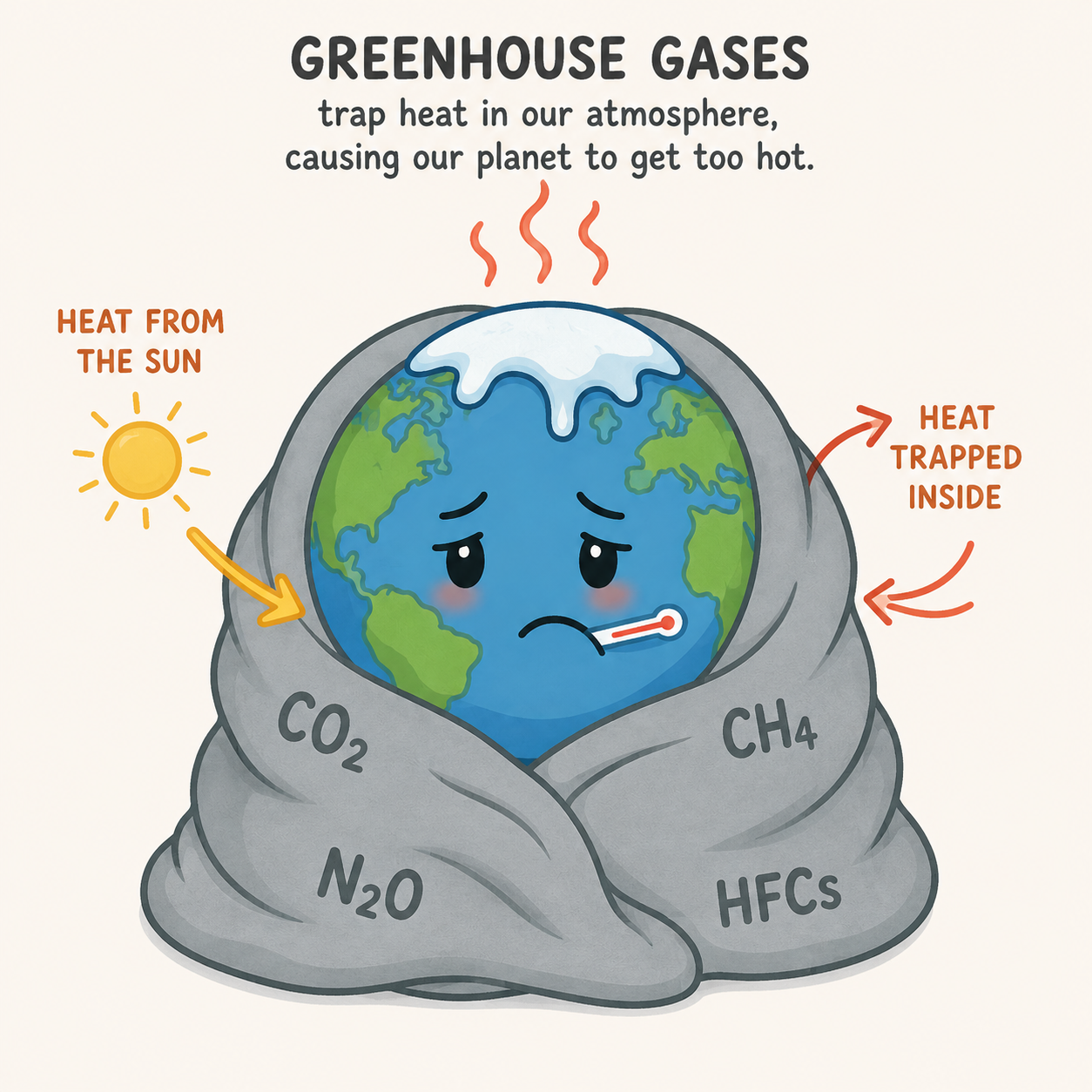
Geoengineering the Climate: Why Tweaking the Planet Is Not the Solution
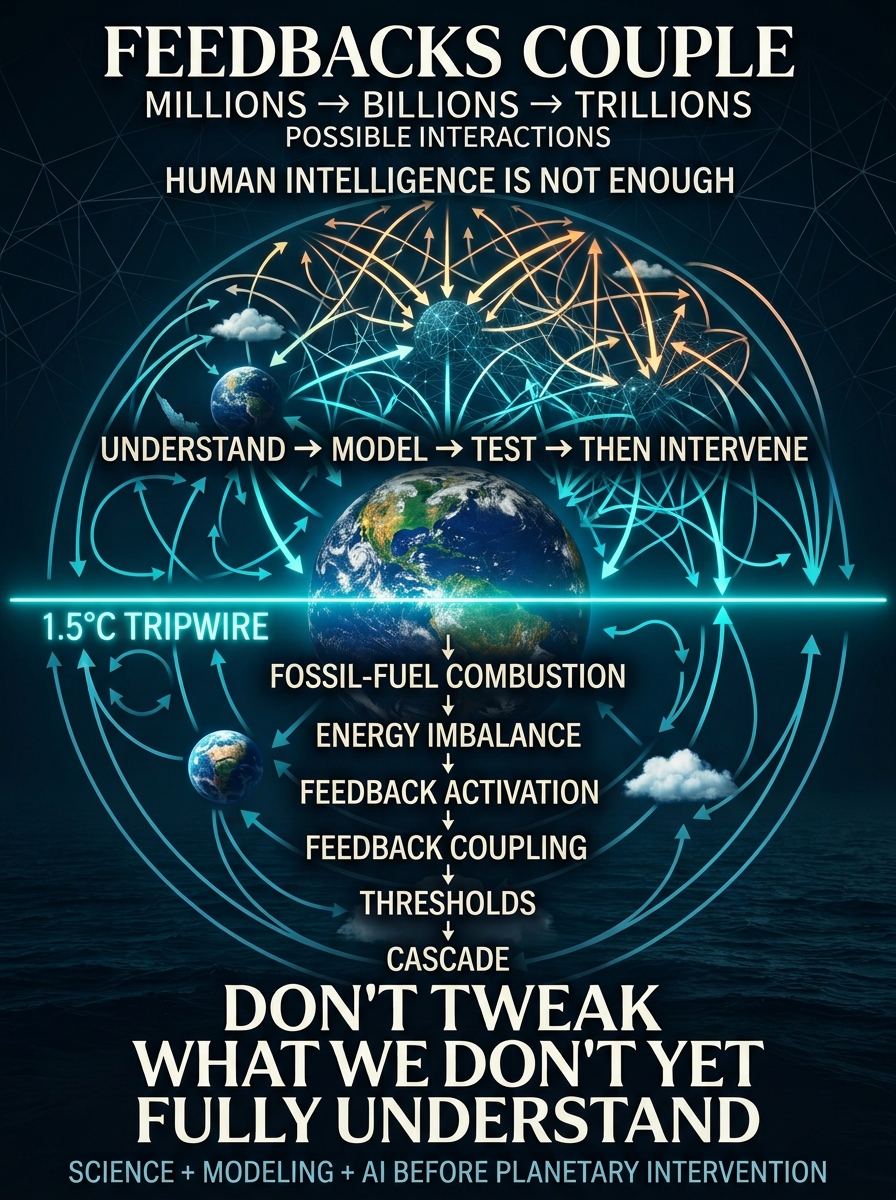
Until we can demonstrate that a proposed intervention will not trigger larger, faster, or more dangerous feedbacks elsewhere in the Earth system, deliberately tweaking the planet is an extraordinarily risky experiment.
The goal should be to understand the system first—and intervene only when the evidence shows that the intervention is safer than allowing the underlying problem to continue.
MILLIONS → BILLIONS → TRILLIONS
POSSIBLE FEEDBACK INTERACTIONSFEEDBACK COUPLING IS EMERGING
We cannot yet predict how these interactions will propagate and amplify as they unfold.THE BUTTERFLY EFFECT
A small perturbation can propagate across the entire network.
The 1.5°C Tripwire and the Limits of Climate Manipulation
The idea of climate geoengineering is gaining attention as the planet continues to warm. One proposal is cirrus cloud thinning: deliberately reducing high-level cirrus clouds to allow more infrared radiation to escape to space and temporarily offset some global warming.
I understand the logic. If the world remains on a trajectory toward 2.5–3°C of warming, the pressure to find additional ways to limit the damage will become enormous.
But I do not recommend geoengineering.
The fundamental problem is that we are dealing with an extraordinarily complex Earth system, not a thermostat.
Clouds Are Not a Thermostat
Clouds interact with atmospheric circulation, humidity, precipitation, aerosols, ocean temperatures, radiation, and the hydrological cycle. Changing one component can produce effects elsewhere that are difficult to predict or control.
Cirrus clouds are particularly important because their effects extend beyond simply reflecting or trapping radiation. Deliberately thinning them could alter atmospheric moisture, circulation, precipitation patterns, and interactions with other cloud layers.
We cannot assume that reducing one warming influence will produce only the desired result.
The climate system is interconnected.
Geoengineering Does Not Stop Global Warming
More importantly, cirrus cloud thinning would not remove the cause of the warming.
It would attempt to counteract one radiative effect while humanity continued adding CO₂ and other greenhouse gases to the atmosphere.
The atmospheric concentration of CO₂ would continue increasing. Ocean heat would continue accumulating. Ice would continue responding to the additional energy. Water vapor and other feedbacks would continue responding to the changing climate.
In other words:
Fossil-fuel combustion → greenhouse gases ↑ → energy imbalance ↑ → warming ↑
Cloud geoengineering does not break that chain.
It attempts to counteract one consequence of the chain while the forcing continues.
That is a fundamentally different strategy from solving the problem.
We Are Already Geoengineering the Planet
There is an important irony here.
Humanity is already conducting a massive uncontrolled geoengineering experiment.
We are changing the atmospheric composition of the planet by burning fossil fuels and releasing enormous quantities of greenhouse gases. We are changing atmospheric chemistry, ocean chemistry, land cover, aerosols, and the planetary energy balance.
Fossil-fuel combustion is humanity’s contribution to geoengineering.
The solution is not to develop another form of climate manipulation to counteract the first one.
The solution is to stop the geoengineering we are already doing.
The safest climate intervention available to us is therefore remarkably simple:
Stop adding the forcing.
The Cloud Problem Is More Complicated Than Cirrus Alone
There is another reason I am particularly cautious about cloud geoengineering.
Not all clouds have the same climate effect.
Low-level clouds generally produce a strong cooling effect because they reflect incoming solar radiation back into space. High-level cirrus clouds generally have a net warming effect because they trap outgoing infrared radiation.
That distinction is critical.
The climate system is already experiencing changes in cloud distribution, cloud altitude, cloud cover, atmospheric moisture, ocean temperatures, and radiation. Deliberately manipulating one cloud layer while these other components are changing could create new feedbacks that we do not fully understand.
We should not assume that the climate response will remain confined to the variable we intended to change.
The Most Dangerous Feedback May Be Societal
There is also a significant societal feedback that is already observable.
The promise of technological fixes such as carbon capture has been used to argue that continued fossil-fuel use can be accommodated while technologies are developed to remove or offset the resulting emissions.
That creates a dangerous feedback:
continued fossil-fuel combustion → technological-fix promises → reduced urgency to transition → continued fossil-fuel combustion
Geoengineering could amplify the same feedback.
If people believe we can simply manipulate clouds, remove carbon later, or otherwise engineer our way out of climate change, the perceived need to stop the underlying forcing is weakened.
This is particularly concerning when technological solutions become a justification for continuing the activity that created the problem.
The result is a feedback within the human system that reinforces the physical climate feedback:
continued emissions → continued warming → promises of technological correction → delayed transition → continued emissions.
That is not merely a theoretical concern. The debate over carbon capture already demonstrates how the promise of future technological solutions can become intertwined with arguments for maintaining fossil-fuel use.
We should be extremely cautious about extending that logic to deliberate manipulation of the atmosphere and cloud system.
The Goal Should Be to Stop the Experiment
Geoengineering may eventually become something humanity is forced to consider under extreme circumstances. But that is very different from treating it as a preferred solution.
Every additional intervention introduces another layer of uncertainty into an already highly coupled system.
We should not try to engineer the climate in the opposite direction while continuing to engineer it in the wrong direction.
The enormous scientific and engineering effort required for climate intervention would be far better directed toward rapidly replacing fossil-fuel combustion and eliminating the source of the forcing.
Once we stop adding the primary forcing, the climate system can begin responding to that change.
Until then, we are attempting to compensate for an accelerating problem while continuing to feed it.
The safest geoengineering strategy is therefore the simplest one:
Stop geoengineering the planet.
The 1.5°C Tripwire and the Limits of Climate Manipulation
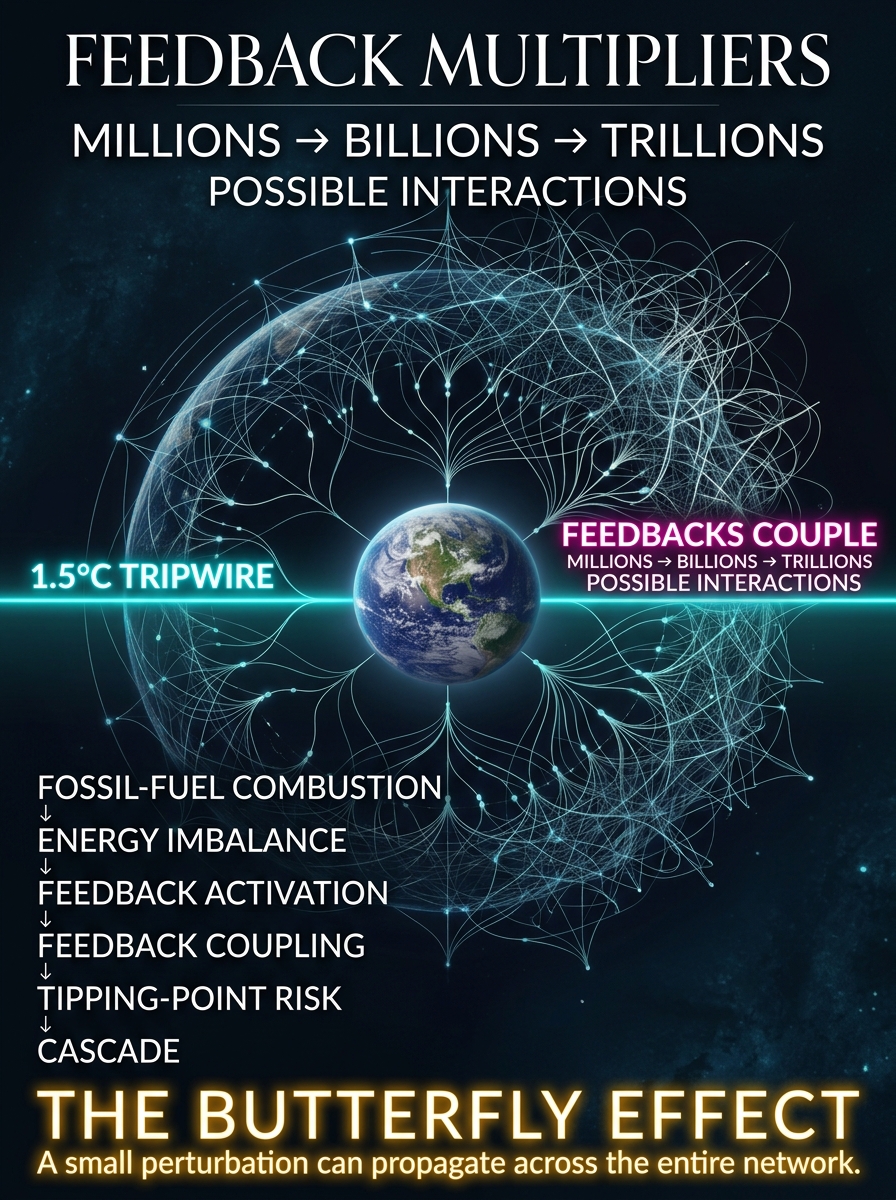
The 1.5°C threshold is more than a temperature target. It represents a critical point in the Earth system because crossing it increases the likelihood that multiple climate feedbacks and tipping elements will be pushed toward, or across, critical thresholds from which recovery is not straightforward.
Many climate tipping elements are already under significant stress, and there is currently no known way to simply reverse these processes once critical thresholds are crossed. More importantly, there is no known way to slow the underlying accumulation of climate-system energy without ultimately addressing its primary driver: the continued combustion of fossil fuels.
That does not mean we should give up on finding additional solutions. Quite the opposite. We should aggressively pursue them. But deliberately manipulating the climate system with today’s understanding is fundamentally different from developing solutions that reduce the underlying forcing.
The central problem is the extraordinary complexity of the Earth system.
The Feedback Loop and Tipping Point Network illustrates only a simplified representation of the feedback relationships that are currently understood. Each feedback can interact with multiple others, creating networks of interactions rather than isolated cause-and-effect relationships.
Once those interactions are combined across the atmosphere, oceans, cryosphere, biosphere, and carbon cycle, the number of possible pathways becomes enormous—potentially millions, billions, or even trillions of interactions across the Earth system.
It is highly inconceivable that human intelligence alone can calculate and predict all of those interactions with sufficient accuracy to safely manipulate the climate at planetary scale.
This is where artificial intelligence could become critically important.
If humanity is going to discover a genuinely safe way to intervene in the climate system—or determine with reasonable confidence that a proposed intervention is safe—we will need Earth-system modeling capable of exploring interactions far beyond what humans can individually calculate. AI could potentially help identify previously unrecognized feedback relationships, run vastly larger ensembles of simulations, detect nonlinear interactions, and expose consequences that conventional modeling or human analysis might miss.
That is not an argument against pursuing alternative solutions. It is an argument for pursuing them much more aggressively through science, modeling, and AI before deploying them.
The distinction is crucial:
We should not stop looking for ways to intervene in the climate system.
We should stop treating the climate system as though we already understand it well enough to safely manipulate it.
Until we can demonstrate that a proposed intervention will not trigger larger, faster, or more dangerous feedbacks elsewhere in the Earth system, deliberately tweaking the planet is an extraordinarily risky experiment.
The goal should be to understand the system first—and intervene only when the evidence shows that the intervention is safer than allowing the underlying problem to continue.
Resources
Feedback Loop and Tipping Point Network
Why Do Scientists Use AI? From Computational Efficiency to Climate Innovation
The most significant emerging climate feedback accelerating the planetary energy imbalance is the decline in low-level clouds.
Low-Level Cloud Overview
Low-Level Cloud Feedback: The Mega-Multiplier — An Additional 1.5°C to 2°C • Albedo–Cloud–Ocean Heat Content Feedback Triad (Climate Jerk Surge Math & Methods) • Feedback Loop and Tipping-Point Network • The Global Feedback Cascade: Ozone and Cloud Feedback Coupling • Low-Level Ozone – Clouds = Slowing AMOC and Collapse • Water Vapor + Clouds: Coupled Feedbacks Driving a Warmer Planet
Feedback Loops → Tipping Points → Feedback Loop and Tipping-Point Network → Acceleration → Domino Effect
Feedback loops amplify climate change and can push interconnected Earth systems past critical tipping points. As tipping points are crossed, they can trigger additional feedback loops and destabilize other climate systems. This cascading "Domino Effect" compresses timescales, accelerates change, and increases the risk of rapid, nonlinear climate transformations.
Easy-to-Read Resources