How Is the Climate Energy Hitting You?
California and the Sierras
The Sierra Nevada has long served as California’s natural water tower. Climate change is increasingly turning that water tower into a system of rapid loading and rapid discharge—delivering too much water too quickly, followed by too little stored water when the summer demand arrives.
Sierra Nevada: Hydroclimatic Whiplash, Atmospheric Rivers, Rain-on-Snow, Droughts, Landslides, Wildfires
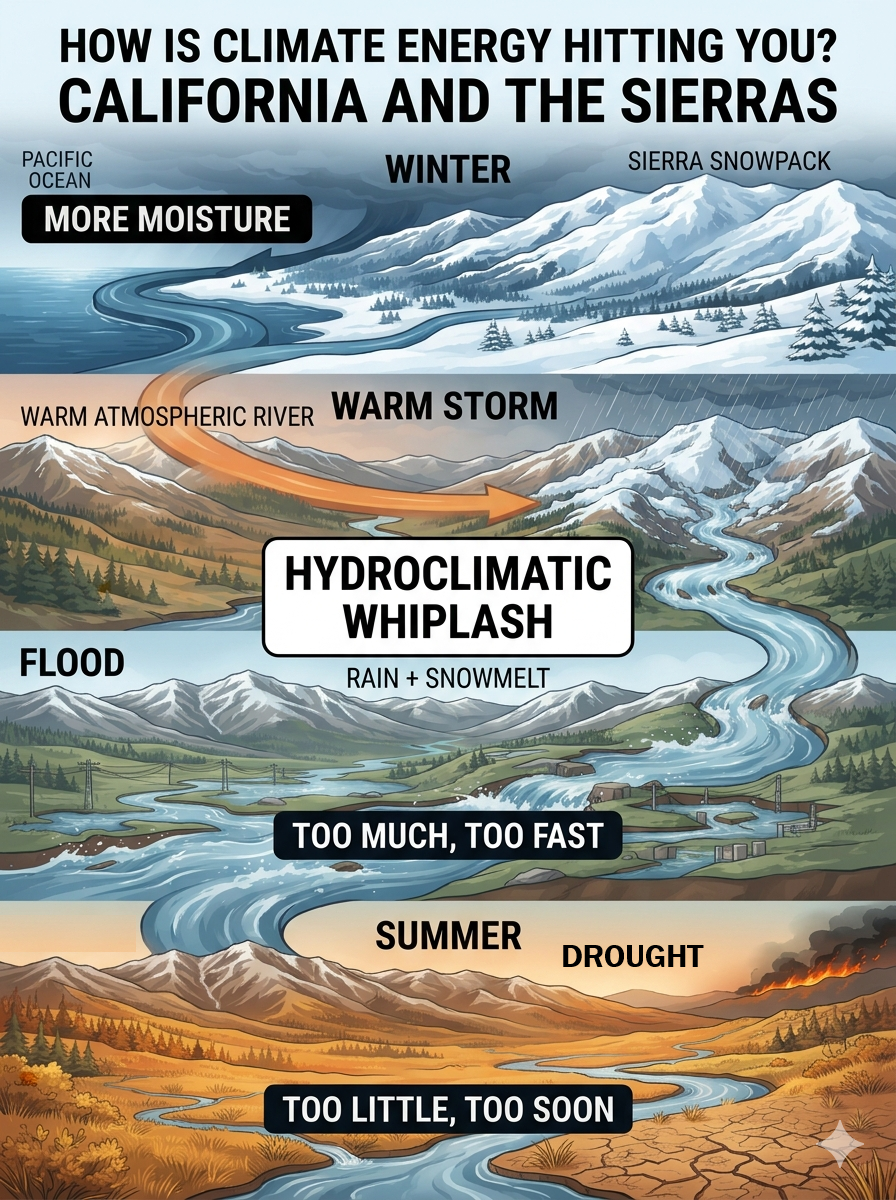
The Sierra Nevada is becoming a powerful example of hydroclimatic whiplash—where climate energy intensifies both extremes, shifting California’s water cycle from a relatively predictable seasonal rhythm toward rapid swings between atmospheric-river flooding, premature snowmelt, and summer drought.
Excessive winter moisture associated with El Niño can produce enormous snowfall in the Sierra Nevada. But when warmer temperatures accompany subsequent atmospheric rivers—the so-called Pineapple Express—that snowpack can melt rapidly and weeks or months ahead of schedule.
The result is a dangerous paradox: more winter water can mean less water available when California needs it most.
1. The Rain-on-Snow Flooding Trap
When a warm atmospheric river collides with an existing mountain snowpack, it can produce a rain-on-snow event.
Instead of adding to California’s frozen natural reservoir, warm tropical moisture accelerates snowmelt. Rain also adds its own runoff to the water released from the snowpack, producing a sudden surge of water flowing into rivers and valleys.
The result can be catastrophic flooding, landslides, erosion, and infrastructure damage.
This also shifts flood risk earlier in the year. A water system historically organized around gradual spring and early-summer snowmelt can instead experience major runoff events in the middle of winter.
2. The High-Altitude “Snow Eaters”
A warmer atmosphere can hold roughly 7% more water vapor for every 1°C of warming. When that additional moisture is delivered by powerful atmospheric rivers, storms can become extraordinarily wet.
But temperature determines whether that moisture falls as snow or rain.
As the baseline climate warms, the snowline rises. Elevations that once reliably accumulated snow are increasingly likely to receive rain during warm storms. Water that would have been stored for months as snow instead becomes immediate runoff.
The mountains are therefore losing part of their ability to function as California’s natural reservoir.
3. The Aquifer and Reservoir Disconnect
California’s water infrastructure was largely designed around a seasonal rhythm in which Sierra snowpack acts as a natural storage system.
Snow accumulates during winter and gradually melts during spring and early summer, releasing water over an extended period. That slow release helps sustain rivers, reservoirs, ecosystems, agriculture, and groundwater recharge.
Accelerated snowmelt disrupts that timing.
When enormous volumes of water arrive rapidly, reservoirs can fill much earlier than planned. Water managers may then have to release water to maintain flood-control capacity, even while California faces water shortages later in the year.
And rapid surface runoff is not equivalent to slow, sustained groundwater recharge. When water races through rivers and across saturated landscapes, much of it can move downstream before it has an opportunity to infiltrate deeply into aquifers.
The paradox is profound:
A landscape can experience flooding and groundwater stress within the same water year.
4. The Summer Hangover
The consequences don’t end when the floodwaters recede.
If Sierra snowpack disappears weeks or months earlier than it once did, the mountains enter summer with less stored water. Soils dry earlier. Streams decline sooner. Vegetation loses access to moisture during the hottest part of the year.
That creates a dangerous feedback:
More winter heat → more rain instead of snow → faster snowmelt → greater runoff → less summer snowpack → earlier drying → greater wildfire risk.
The same climate energy that produces extreme winter precipitation can therefore help create extreme summer dryness.
The New Sierra Water Cycle
This is the essence of hydroclimatic whiplash.
California is not simply becoming “wetter” or “drier.” The timing, intensity, and physical form of water are changing.
More atmospheric moisture can arrive in fewer, more intense storms. More precipitation can fall as rain rather than snow. Snowpack can melt earlier. Flooding can occur during winter while groundwater and surface-water supplies become increasingly stressed later in the year.
The Sierra Nevada has long served as California’s natural water tower.
Climate change is increasingly turning that water tower into a system of rapid loading and rapid discharge—delivering too much water too quickly, followed by too little stored water when the summer demand arrives.
The problem isn’t simply how much water California receives. It is when that water arrives, where it goes, and how long the landscape can hold onto it.
Taking the Temperature of Climate Change: How Is Climate Energy Hitting You?
Easy-to-Read Resources