An Introduction to Advanced Anthropogenic Global Warming and the Domino Effect
Black Zombie Fires and Green Unicorn Algae
Q: How fast is climate change accelerating?
A: Right now, the acceleration of global warming impacts is roughly 26-fold decade-scale behavior — multiple climate indicators suggest that the impacts of global warming are accelerating at rates far beyond those observed in the geological record. This is not simply rapid change—it may represent one of the most abrupt large-scale climate transitions in Earth's history.
A Call to Citizen Climate Scientists
by Daniel Brouse and Sidd Mukherjee
March 4, 2026
This paper is an invitation.
Much about anthropogenic global warming is no longer debated in serious scientific circles.
We know the primary driver: fossil fuel combustion.
We know the agent: humans.
The frontier is no longer basic attribution.
The frontier is tipped tipping points — interacting feedback systems that are accelerating in nonlinear ways.
We are no longer asking whether warming is occurring.
We are asking:
-
How many feedback loops are already active?
-
How tightly are they coupled?
-
How fast are they amplifying one another?
Physics Review
In Anthropogenic Global Warming 101, we reviewed a foundational concept: Earth’s climate is a nonlinear, highly coupled dynamical system composed of the atmosphere, oceans, cryosphere, lithosphere, and biosphere. These components exchange energy continuously across multiple spatial and temporal scales.
Global warming represents an increase in total thermal energy within this integrated system. Incoming solar radiation is absorbed and converted into heat. Under natural conditions, much of that energy is radiated back to space. Greenhouse gases alter this balance, increasing energy retention.
Advanced climate science does not simply study temperature rise. It studies the redistribution, transformation, and amplification of energy within the Earth system.
The phrase global warming is widely misunderstood. While it correctly describes a rise in average surface temperature, it understates the real risk: a rapid increase in total system energy. Temperature is only the initial signal. Once excess energy accumulates, it is transferred, converted, and expressed through atmospheric circulation, ocean dynamics, hydrological cycling, and ecological responses.
Global warming is therefore the beginning of climate change — not its endpoint.
Extreme Energy Events
Excess trapped thermal energy is continually transformed into other forms, including:
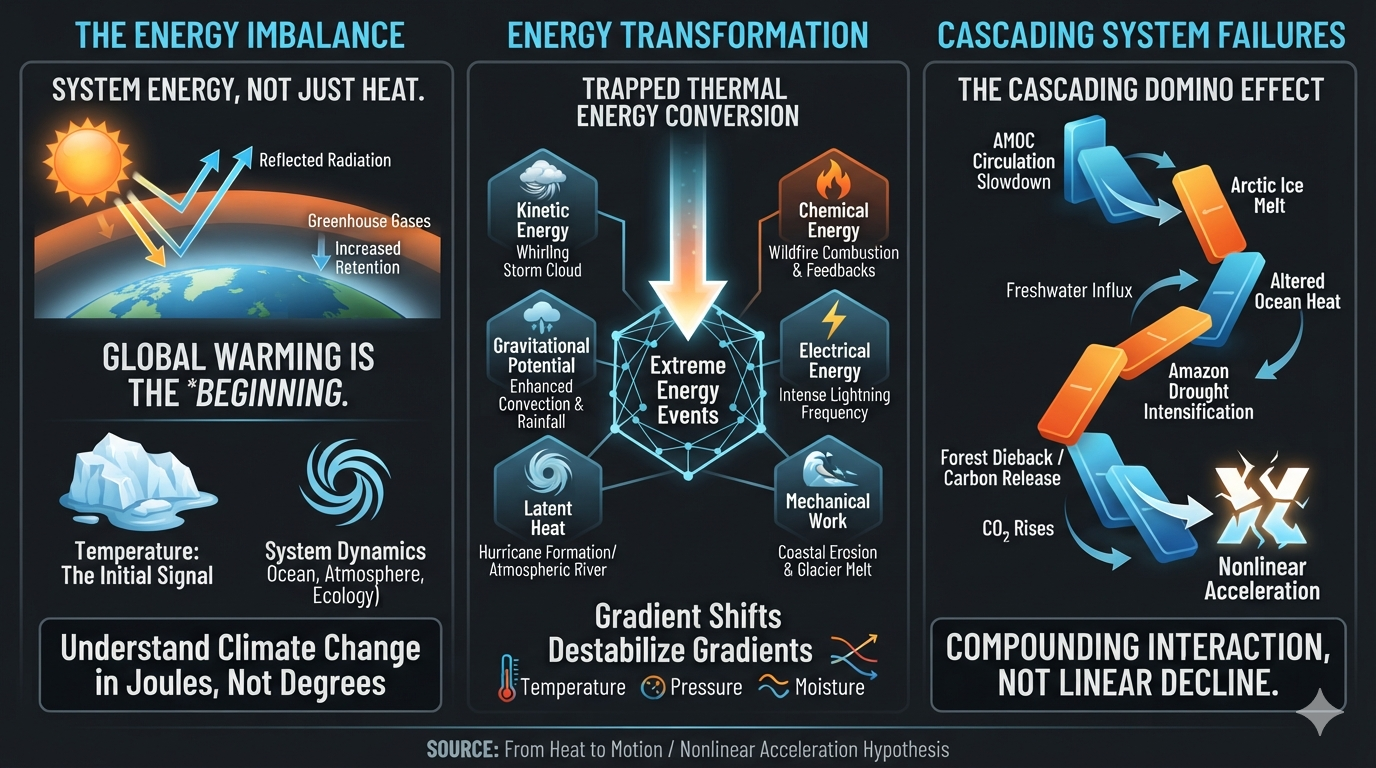
- Kinetic Energy (stronger winds, faster storm systems)
- Gravitational Potential Energy (enhanced vertical convection, intensified precipitation)
- Latent Heat (phase changes driving hurricanes and atmospheric rivers)
- Radiant Energy (infrared trapping and feedback amplification)
- Chemical Energy (biogeochemical feedbacks, wildfire combustion)
- Electrical Energy (increased lightning frequency in convective systems)
- Mechanical Work (coastal erosion, glacier flow acceleration, ocean mixing)
For a deeper explanation, see:
From Heat to Motion: How Thermal Energy Transforms Across Physical Systems
In 2025, global mean temperatures exceeded the long-recognized 1.5°C threshold. To a casual observer, that number may sound small. In a nonlinear system, it is not.
Small shifts in average temperature translate into large, destabilizing shifts in gradients — temperature gradients, pressure gradients, and moisture gradients. Those gradient changes alter circulation patterns, intensify convection, amplify hydrological extremes, and increase momentum transfer.
What emerges are not merely “weather events,” but what are more accurately described as:
Extreme energy events.
Understanding climate change requires thinking not in degrees —
but in joules.
And in how those joules move.
Beyond Temperature: How Climate Science Shifted from Measuring Warming to Tracking Earth’s Energy System- The Water Cycle’s Extreme Energy Transfer: Latent Heat and You (Public Access Version)
- The Latent Heat Engine: Ocean Evaporation, Water Vapor Feedback, and the Acceleration of Hydroclimatic Whiplash (Graduate Level)
Tipping Points Igniting a Domino Effect
We long suspected that tipping points would eventually trigger self-sustaining feedback loops.
Now they have.
What even seasoned systems analysts did not fully anticipate was the speed of interaction — how rapidly destabilized systems would begin reinforcing one another.
Economic, physical, and ecological subsystems are no longer evolving independently. They are synchronizing.
Abstract models are becoming measurable reality.
Cascading System Failures
Climate destabilization will not unfold as a smooth curve. It behaves like a complex adaptive system under stress:
One subsystem weakens → accelerates another → feeds back into the first.
Consider one example:
-
A slowdown of the Atlantic Meridional Overturning Circulation (AMOC) alters ocean heat distribution.
-
Tropics warm further; the Arctic amplifies.
-
Ice melt accelerates.
-
Freshwater input further destabilizes AMOC.
Simultaneously:
-
Drought intensifies in the Amazon.
-
Forest dieback reduces carbon sequestration.
-
Atmospheric CO₂ rises further.
-
Warming accelerates.
-
Ice melt intensifies again.
This is not linear decline.
It is compounding interaction.
The Domino Effect
By the early 2000s, we articulated what we called the Nonlinear Acceleration Hypothesis:
Climate feedback loops do not act independently.
They interact synergistically — a cascade of tipped tipping points in which each destabilized system accelerates the next.
At the time, it was largely theoretical.
By 2024, the acceleration was visible to the layperson.
As Sidd once said:
“Just look out your window.”
Black Zombie Fires and Green Unicorn Algae
The names sound poetic.
The processes are not.
Permafrost: From Gradual Thaw to Persistent Combustion
Old assumption:
Permafrost thaw would unfold gradually over centuries.
Observed reality:
Peatlands and thawed soils are igniting. Some overwinter beneath snowpack as “zombie fires,” re-emerging in spring.
Implications:
-
Accelerated CO₂ release
-
Methane oxidation uncertainties
-
Poorly constrained combustion vs. direct methane escape
What is certain: release rates are faster than many early models anticipated.
Ice Sheets: Linear Mass Loss Meets Nonlinear Biology
Greenland’s cumulative mass loss appeared near-linear for decades.
Then an additional feedback surfaced.
Windblown mineral dust from exposed proglacial sediments deposits phosphorus onto the ice surface. Algae bloom. The surface darkens. Albedo drops. Melt accelerates.
Add wildfire aerosols from Canada and Siberia.
Now the system looks like this:
Glacial retreat → sediment exposure
Wildfire intensification → aerosol transport
Nutrient deposition → algal blooms
Surface darkening → accelerated melt
Regional systems interconnect across continents.
I found myself thinking:
Glacial retreat alters wind and rain patterns —
transporting sediment and aerosols onto remaining ice sheets.
Surface darkening becomes biological terraforming.
Algae blooms spread.
Feedbacks cascade.
Not abstractly.
Visibly.
Now.
Black zombie fires.
Green unicorn algae.
Strange names for very real feedbacks.
A New Research Frontier
In the 1990s, we underestimated one variable:
Human delay.
We assumed mitigation would begin in earnest.
It did not.
Now we observe potential doubling in intensity or frequency of certain climate impacts on timescales of 2–10 years — not centuries.
The apparent acceleration has compressed from millennial-scale shifts to multi-decade nonlinear surges.
The Network Problem
The core challenge is not one catastrophic event.
It is understanding the network.
Possible active feedbacks include:
-
Boreal forests shifting from sink to source
-
Ocean stratification weakening biological carbon pumps
-
Soil microbial regime shifts under heat stress
-
Aerosol–cloud interactions altering precipitation
-
Jet stream persistence amplifying drought–flood oscillations
-
Hydroclimatic whiplash intensifying desertification
We may never catalog every feedback.
But we can observe patterns of nonlinear acceleration.
Why This Matters
This is the first human-driven climate shift of planetary scale.
The defining feature of this century may not be warming alone — but the nonlinear acceleration of interacting systems.
The question is no longer:
Do feedbacks exist?
The question is:
How many are already active?
How tightly coupled are they?
How quickly are they amplifying?
An Invitation
If you are a citizen scientist, systems thinker, data analyst, physicist, economist, ecologist — or simply observant —
This is your frontier.
Start with what you can see.
Look out your window.
Gradient Shifts
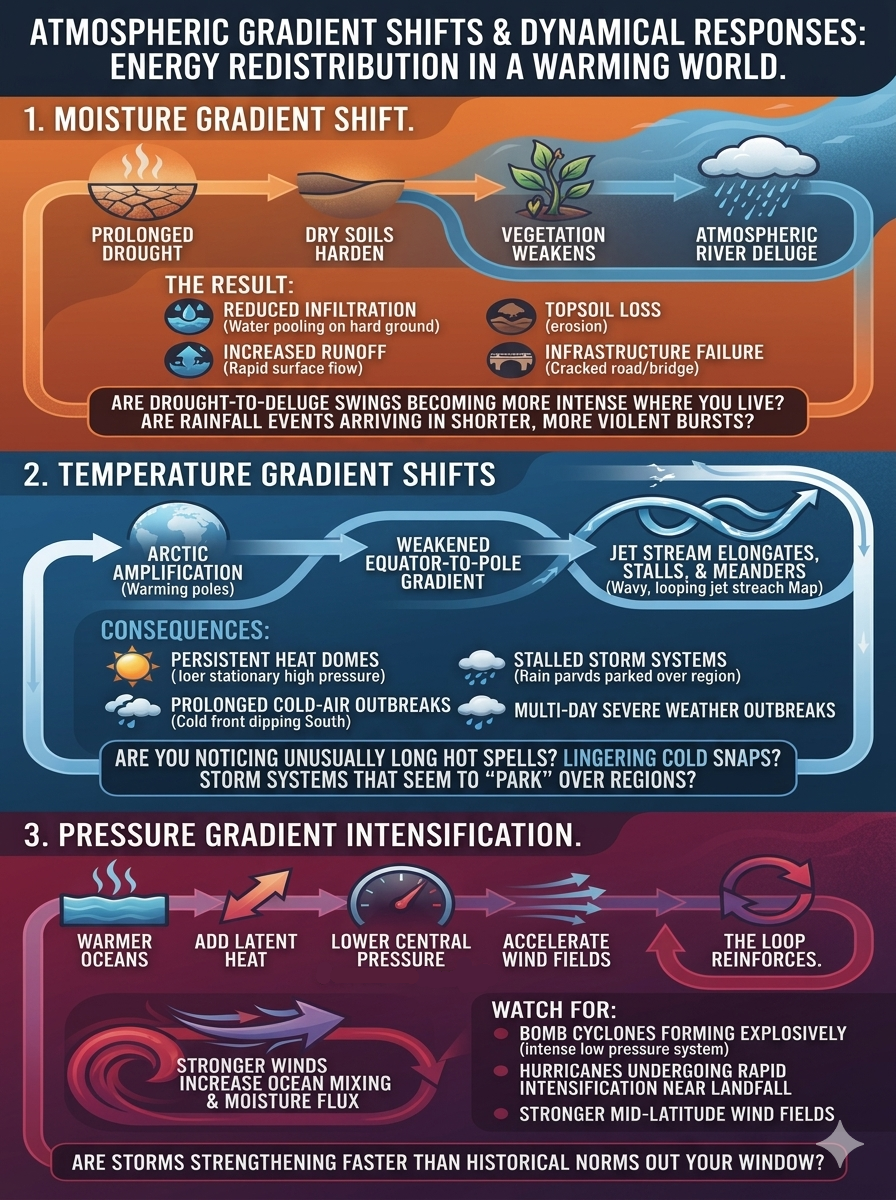
Climate change is not simply an increase in temperature—it is a transformation of the Earth's energy gradients. As excess heat accumulates within the climate system, it reshapes the differences that drive atmospheric and oceanic motion. These differences, known as gradients, determine how energy flows through the planet.
Even relatively small increases in average global temperature can produce disproportionately large changes in these gradients, amplifying storms, altering weather patterns, and increasing the intensity of extreme events. The most important climate gradients fall into three interconnected categories:
- Temperature Gradients – Differences in temperature between regions that drive atmospheric circulation, ocean currents, and the transfer of heat around the globe.
- Pressure Gradients – Differences in atmospheric pressure that generate wind, organize storm systems, and control large-scale circulation patterns.
- Moisture Gradients – Differences in atmospheric water vapor that fuel evaporation, cloud formation, atmospheric rivers, hurricanes, and extreme precipitation.
These gradients do not operate independently. They continually interact through powerful feedbacks: warming increases evaporation, added moisture releases latent heat during condensation, latent heat strengthens pressure differences, and stronger pressure gradients accelerate winds that transport even more heat and moisture. Together, these reinforcing processes transform modest increases in average temperature into the increasingly energetic weather and climate extremes now being observed around the world.
Understanding climate change therefore requires looking beyond temperature alone. The real story lies in how shifting temperature, pressure, and moisture gradients redistribute energy throughout the Earth system, driving the acceleration of climate change.
Moisture Gradient Shifts: Fueling Hydroclimatic Extremes
Periods of prolonged drought followed by atmospheric river deluges.
Dry soils harden. Vegetation weakens. Then extreme rainfall arrives.
The result:
-
Reduced infiltration
-
Increased runoff
-
Severe flooding
-
Topsoil loss
-
Infrastructure failure
Are drought-to-deluge swings becoming more intense where you live?
Are rainfall events arriving in shorter, more violent bursts?
This is not random variability.
It is energy redistribution in a warming atmosphere.
Temperature Gradient Shifts
Arctic amplification weakens the equator-to-pole temperature gradient.
The jet stream elongates, stalls, and meanders.
Consequences:
-
Persistent heat domes
-
Prolonged cold-air outbreaks
-
Stalled storm systems
-
Multi-day severe weather outbreaks
Are you noticing unusually long hot spells?
Lingering cold snaps?
Storm systems that seem to “park” over regions?
These are gradient-driven dynamical responses.
Pressure Gradient Intensification
Warmer oceans and altered pressure contrasts fuel rapid storm intensification.
Watch for:
-
Bomb cyclones forming explosively
-
Hurricanes undergoing rapid intensification near landfall
-
Stronger mid-latitude wind fields
Warmer water adds latent heat.
Latent heat lowers central pressure.
Lower pressure accelerates wind fields.
Stronger winds increase ocean mixing and moisture flux.
The loop reinforces.
Are storms strengthening faster than historical norms out your window?
Feedback Amplification & Coupling
As the Earth's energy imbalance grows, climate change becomes increasingly nonlinear. Individual feedback mechanisms not only amplify themselves, but also couple with other feedbacks, creating cascading interactions that accelerate change throughout the Earth system. What begins as a relatively localized disturbance can propagate across the atmosphere, oceans, cryosphere, biosphere, and even the planet's physical dynamics.
One of the most comprehensive examples illustrates how a single perturbation can trigger a chain of interconnected responses:
Polar amplification → weakened equator-to-pole temperature gradients → reduced thermal contrast that drives and stabilizes large-scale atmospheric circulation → accelerated Greenland and Arctic ice melt → increased freshwater input into the North Atlantic, reducing the salinity and density of surface waters → disruption and potential weakening of the Atlantic Meridional Overturning Circulation (AMOC) → reorganization of North Atlantic pressure fields and storm tracks → greater jet stream waviness, slower progression, and amplified Rossby wave behavior → more persistent blocking patterns, omega blocks, and meridional flow → stalled atmospheric rivers, prolonged heat domes, drought-flood oscillations, and other forms of hydroclimatic whiplash → destabilization of agriculture, infrastructure, ecosystems, and public health systems → accelerated land-ice loss and groundwater redistribution that shift mass across the planet → climate-driven mass redistribution sufficient to measurably alter Earth's moment of inertia, contributing to subtle changes in Earth's rotational dynamics, including a slight slowing of its rotation and changes in the length of day.
This example demonstrates that climate feedbacks do not operate as isolated loops. They form an interconnected network in which one destabilized system increases the probability of destabilizing another, producing cascading failures that can propagate across the entire climate system.
The following sections examine several of the most important individual feedback loops in greater detail, including the Wildfire–Carbon–Albedo Feedback, Permafrost–Methane Feedback, Ocean Stratification Feedback, and Vegetation Stress Feedback. Together, these examples illustrate how feedback amplification transforms gradual warming into accelerating systemic change.
Wildfire–Carbon–Albedo Feedback
Heat dries forests.
Drought stresses vegetation.
Wildfires intensify.
Wildfires:
-
Release CO₂ and black carbon
-
Deposit soot on ice and snow
-
Reduce albedo
-
Accelerate melt
Accelerated melt further alters circulation and precipitation patterns.
Have fire seasons lengthened where you are?
Is smoke now a recurring seasonal feature?
Permafrost–Methane Feedback
Thaw exposes organic carbon.
Microbes activate.
Methane and CO₂ are released.
In some regions:
Peat ignites.
“Zombie fires” overwinter.
Combustion is accelerating carbon release beyond even conservative thaw projections, while ozone pollution is reducing plant productivity and weakening natural carbon sinks.
What is happening to the forests out your window?
Ocean Stratification Feedback
Warmer surface waters increase stratification.
Nutrient mixing weakens.
Biological carbon pumps decline.
Reduced ocean uptake means more CO₂ remains in the atmosphere.
At the same time:
Marine heatwaves intensify.
Coral bleaching accelerates.
Food webs destabilize.
What changes are you observing in the ocean and along your coast?
Vegetation Stress Feedback
Heat + ozone + drought reduce photosynthesis.
Carbon sequestration weakens.
Forests transition from sinks to sources.
Reduced evapotranspiration further intensifies local heat and drought.
What changes are you observing in the plants and trees around you?
The Pattern to Watch
The key signal is not a single event.
It is coupling.
-
Drought amplifies wildfire.
-
Wildfire alters albedo.
-
Albedo loss accelerates melt.
-
Melt shifts circulation.
-
Circulation shifts alter rainfall.
-
Rainfall variability intensifies drought.
Each subsystem feeds another.
You do not need a supercomputer to begin noticing.
You need:
-
Curiosity
-
Pattern recognition
-
Access open datasets—or even better, start collecting your own observations right outside your window
-
Willingness to test hypotheses
The frontier is not abstract.
It is visible.
It is measurable.
It is accelerating.
Look out your window.
Then ask:
Are these events isolated —
or are they reinforcing one another?
That question is where advanced climate science begins.
Advanced climate science is no longer confined to institutions.
The models are open.
The data are public.
The signals are visible.
Just look out your window.
And then look deeper.
* Our probabilistic, ensemble-based climate model — which incorporates complex socio-economic and ecological feedback loops within a dynamic, nonlinear system — projects that global temperatures are becoming unsustainable this century. This far exceeds earlier estimates of a 4°C rise over the next thousand years, highlighting a dramatic acceleration in global warming. We are now entering a phase of compound, cascading collapse, where climate, ecological, and societal systems destabilize through interlinked, self-reinforcing feedback loops.
Easy-to-Read Resources
- Anthropogenic Global Warming 101
- Climate Change Made Simple: Understanding Feedback Loops and Acceleration
- The Nonlinear Acceleration Hypothesis: Easy-Read Format
- Chaos Theory Basics (Quick Refresher)
- Statistical Mechanics and Chaos Theory in Climate Science
Advanced Climate Change Math and Physics
- A Unified Energetics Framework for Accelerating Climate Change: From Radiative Forcing to Drag Physics
- Emergent Climate Dynamics: The Nonlinear Acceleration of Climate Impacts
Tipping points and feedback loops drive the acceleration of climate change. When one tipping point is breached and triggers others, the cascading collapse is known as the Domino Effect.
Extreme Impacts: Extreme Weather Events | Violent Rain | Deadly Humid Heat | Sea Level Rise | Insurance
Ecosystems & Feedbacks: Ecosystem Collapse & Extinction Risks | Soil–Insect Climate Feedback Collapse | Insect Collapse | Soil | Trees & Deforestation
Human Health & Society: Climate & Human Health | Limits of Human Adaptability | Climate-Driven Health Collapse | Civilization Collapse | Food & Water Security
Bottom line: The question is no longer how warm the planet becomes, but how life on Earth can endure when change outpaces our ability to adapt.
We cannot control the laws of physics, but we can control our pollution. The most effective action is to stop burning fossil fuels.