Runaway Climate Feedbacks and Systemic Collapse
(Tipped Tipping Points, Feedback Loops, and the Domino Effect)
by Daniel Brouse and Sidd Mukherjee
September 3, 2025
Our probabilistic, ensemble-based climate model -- incorporating complex socio-economic and ecological feedback loops within a dynamic, nonlinear system -- projects that global temperatures could rise by as much as 9°C (16.2°F) within this century. This far exceeds earlier estimates, which predicted a 4°C rise over the next thousand years, and signals a dramatic acceleration of warming.
Sidd responded: "9°C this century is a stretch. The scientific consensus at the time was closer to ~3°C of Arctic warming." Since then, James Hansen and colleagues have projected that global warming could approach ~4°C under continued high emissions and strong climate feedbacks.
I ask: What do you make of the physics given the observable data?
We're already at 1.5°C, which makes 3°C this century seem almost unavoidable. I used to think 9°C was a worst-case scenario -- now I fear it's shifting toward the "highly likely" range. In just the last couple of years, I've seen at least nine tipping points trigger feedback loops with my own eyes.
What strikes me most is not just that each loop accelerates warming, but that they are now amplifying each other. The interactions are compounding in ways that exceed current models.
So my question is: What do you think about the physics of reaching 9°C this century, given the observed interactions of feedback loops and tipping points, including:
- Greenland and East Antarctic ice sheet tipping
- Slowing of the Atlantic Meridional Overturning Circulation (AMOC)
- Mountain glacier loss
- Amazon rainforest dieback
- Arctic sea ice loss
- Boreal forest degradation and wildfire
- Permafrost thawing and burning
- Warm-water coral bleaching
- West Antarctic Ice Sheet instability
Sidd replied: "I think ~3°C is likely this century, and that estimate already includes tipping points. But of course, I could be wrong. The oceans have the last word -- and they take centuries to drive a 9°C+ shift."
The Arctic as a Harbinger
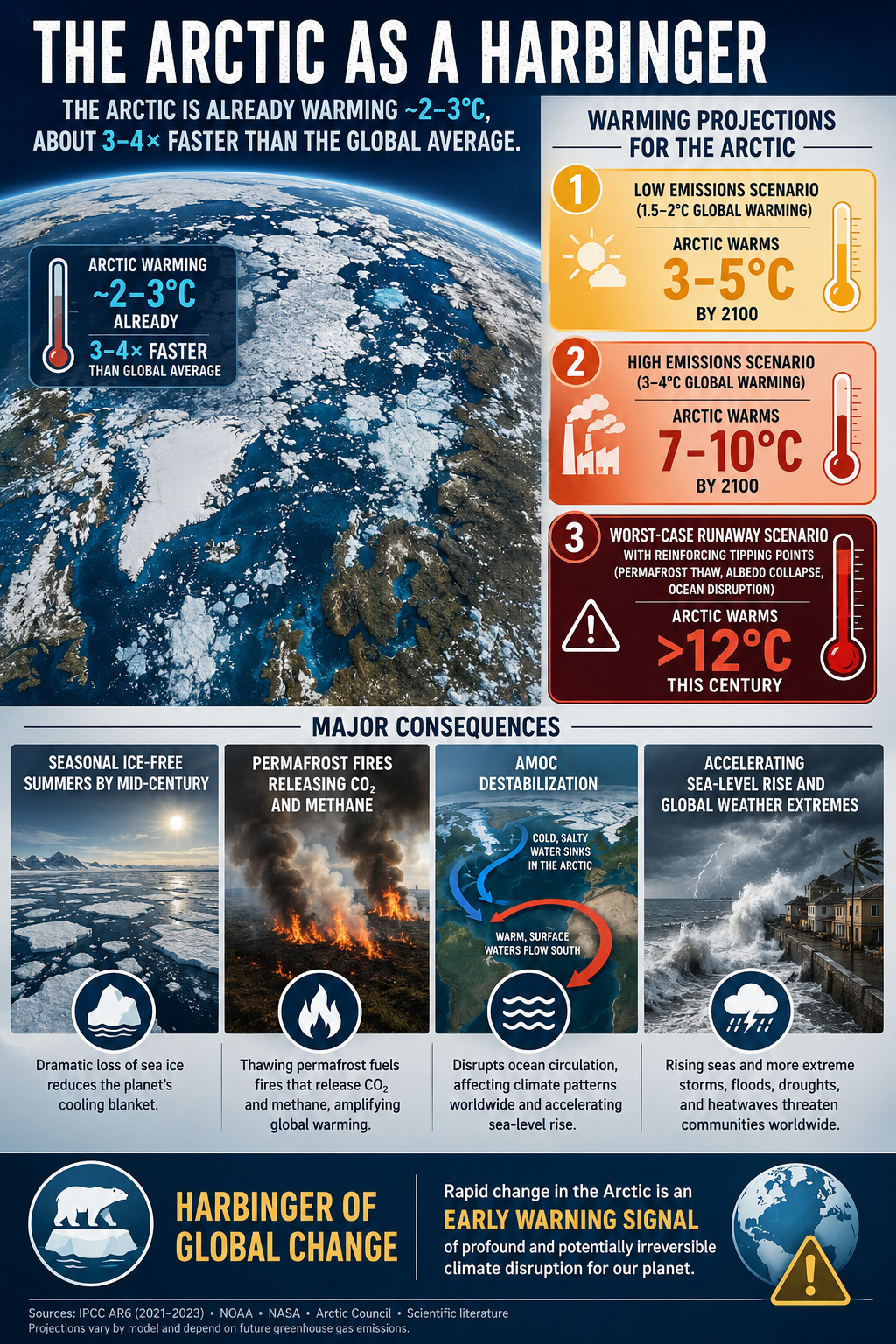
Future warming projections vary depending on global greenhouse gas emissions:
- Low-emissions pathway (~1.5-2°C global warming): Arctic temperatures increase by approximately 3-5°C by 2100.
- High-emissions pathway (~3-4°C global warming): Arctic warming reaches approximately 7-10°C by 2100, with some regions experiencing substantially larger increases.
- Worst-case nonlinear scenario: If major tipping elements reinforce one another—including widespread permafrost thaw, extensive sea-ice loss, and disruptions to ocean circulation—parts of the Arctic could experience more than 12°C of warming this century. The ~12°C figure already appears within mainstream CMIP6/IPCC projections under SSP5-8.5 and does not require invoking additional tipping cascades.
The Arctic’s rapid warming is being driven by several powerful feedback loops. As sea ice disappears, dark ocean water absorbs far more solar energy than reflective ice, intensifying regional heating. Thawing permafrost releases carbon dioxide and methane that have been locked in frozen soils for thousands of years, adding additional greenhouse gases to the atmosphere. Warmer oceans and altered atmospheric circulation patterns further amplify these changes, increasing the probability of abrupt transitions.
The consequences extend far beyond the polar regions. Current projections indicate that the Arctic is likely to experience seasonally ice-free summers by mid-century, fundamentally altering marine ecosystems and atmospheric circulation. Expanding permafrost thaw and increasingly frequent tundra fires could release vast stores of carbon, further accelerating global warming. Large freshwater inputs from melting Greenland ice and changing ocean conditions may also weaken the Atlantic Meridional Overturning Circulation (AMOC), increasing the risk of regional sea-level rise, shifts in precipitation patterns, and more persistent weather extremes.
In this sense, the Arctic functions as an early-warning system for the planet. The region is demonstrating, in compressed form, how reinforcing climate feedbacks can transform gradual warming into rapidly accelerating change. What happens in the Arctic does not stay in the Arctic; it influences ocean circulation, atmospheric dynamics, sea levels, and climate risks across the entire globe.
Global Runaway Feedbacks
If multiple tipping points reinforce each other, the climate may enter a self-perpetuating heating cycle beyond human control. The main candidates include:
- Ice-Albedo Collapse -- Ice loss locks in warming.
- Permafrost Thaw + Boreal Fires -- Gigatons of CO2/CH4 released.
- Amazon & Rainforest Dieback -- Carbon sinks flip to carbon sources.
- Ocean Circulation Breakdown -- Jet stream chaos, monsoon collapse, food shocks.
- Marine Ecosystem Collapse -- Coral death and plankton loss undermine food security.
- Soil & Crop Failure Feedbacks -- Drought, famine, and forced migration.
Temperature outcomes:
- Linear physics: ~3-5°C by 2100.
- With feedbacks: 6-9°C this century is plausible.
- Runaway: A "Hothouse Earth" trajectory of 10°C+ over centuries-millennia.
Feedback-Driven Warming Beyond 1.5 °C
As global mean temperature exceeds 1.5 °C and multiple climate tipping points activate, the critical question is not simply how much warmer the planet becomes, but how quickly feedbacks amplify that warming.
Scientific consensus: Current models suggest that carbon-cycle feedbacks -- permafrost thaw, weakening ocean and land sinks, methane release from wetlands, and fire-driven emissions -- could add ~0.2-1.0 °C of warming by 2100 on top of direct human emissions. This range reflects assumptions that:
- Warming is held close to ~2 °C by policy.
- Tipping points unfold slowly and largely independently.
- Ecosystems and oceans continue absorbing a significant share of emissions.
Under a high-emissions trajectory, with multiple tipping elements engaged, the upper end of this estimate (or beyond) becomes more plausible.
My concern: These consensus estimates are already lagging reality. Observations suggest that at least nine major tipping points are not only triggered but are now reinforcing each other. Instead of unfolding over centuries or millennia, the pace is measured in years or decades. Models have struggled to keep up with this rapid nonlinearity.
Cascading Feedbacks in Real Time
Regardless of the rise in global mean temperature, cascading feedbacks are already reshaping weather extremes.
In just ten days during July 2025, the U.S. experienced:
- Hundreds of flash floods nationwide, with hundreds of fatalities and billions in damages.
- At least five "1-in-1,000-year" rainfall events (Texas, New Mexico, North Carolina, Florida, Illinois).
- Multiple "500-year floods" across Pennsylvania, Delaware, New Jersey, Maryland, Virginia, and Iowa as extreme rainfall overwhelmed infrastructure.
These events illustrate how tipping feedbacks manifest in human terms -- not only as gradual warming, but as sudden escalations in climate volatility and infrastructure failure.
Coupled Runaway Feedbacks
Is Climate Change Runaway? Maybe.

Unfortunately, the underlying science increasingly points in that direction. More importantly, it highlights what may be the most critical issue facing society today: not whether climate change is occurring, but whether we are approaching thresholds beyond which many impacts become effectively irreversible on human timescales.
None of us are arguing that the entire Earth system is in a fully runaway state today. However, observations accumulated over the past four decades suggest that multiple climate indicators are accelerating faster than many earlier projections anticipated. We are also observing increasing evidence of self-reinforcing feedback loops emerging across interconnected climate, ecological, and economic systems.
The central question is no longer whether runaway behavior is possible in principle. The question is how we recognize the transition if and when enough individual subsystems enter self-reinforcing states that the larger coupled system begins exhibiting runaway characteristics of its own.
Our observations, along with those of many other researchers over the past four decades, indicate a significant acceleration in climate-related impacts and feedbacks. When we first developed portions of this hypothesis in the 1990s, observed acceleration rates were closer to what could be described as roughly 2¹-fold per century behavior. More recent analyses across multiple independent datasets suggest substantially shorter characteristic timescales, with amplification patterns closer to 2⁶-fold behavior on decadal scales.
This is known as “jerk” behavior. In physics, jerk is the term for the third derivative of position—the rate at which acceleration itself changes. It’s also a useful term because people can relate to it intuitively: it’s what you feel when acceleration changes abruptly, such as when a car suddenly lurches forward or brakes hard. On a graph, that same behavior appears as a sharp bend or sudden change in the acceleration curve.
I’m using the term both in its formal physical sense and because it makes the concept legible outside a technical audience. And we are already experiencing multiple climate “jerks” as a society: abrupt shifts in stress, disruption, and acceleration that people can feel in real time. The graphic highlights ten examples of climate jerks that many people have likely already experienced.
Depending on how the calculations are formulated, this implies:
- roughly a 60-fold increase in the effective growth constant, or
- approximately two orders of magnitude faster system amplification.
The exact numbers remain a matter of scientific debate, but the broader trend is increasingly difficult to ignore: the system appears to be accelerating faster than many earlier projections anticipated.
By 2023, multiple feedback loops were becoming directly observable in real-world data. Because of that, the question is no longer whether self-reinforcing climate processes are possible. The more important question is how we will recognize when enough interacting feedbacks have pushed the larger system beyond a critical threshold.
What is already clear is that substantial climate change has been locked in for at least the next several generations, even under extremely aggressive emissions reductions. If emissions continue and additional tipping elements become engaged, the probability of triggering broader system-wide instability increases significantly.
That is why the debate is shifting away from whether climate change is occurring and toward understanding the speed, scale, and interaction of the feedbacks that are now emerging.
Coupled Runaway Feedback Example
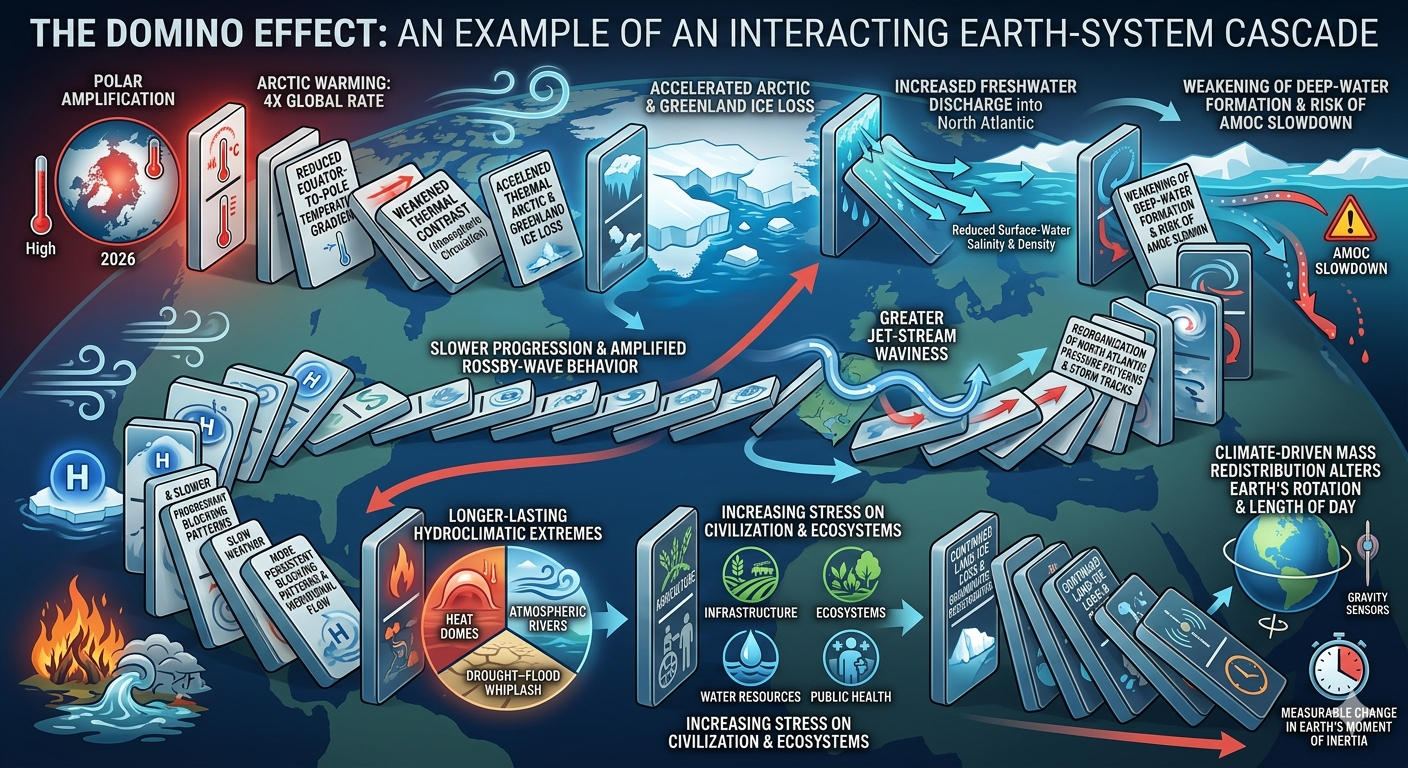
Polar amplification → weakened equator-to-pole temperature gradients → reduced thermal contrast that helps drive and stabilize large-scale atmospheric circulation → accelerated Greenland and Arctic ice melt → freshwater input into the North Atlantic and reduced salinity/density of surface waters → disruption and potential weakening of the Atlantic Meridional Overturning Circulation (AMOC) → reorganization of North Atlantic pressure fields and storm tracks → greater jet-stream waviness, slower progression, and amplified Rossby-wave behavior → more persistent blocking patterns, omega blocks, and meridional flow → stalled atmospheric rivers, prolonged heat domes, drought-flood swings, and other forms of hydroclimatic whiplash → destabilization of agriculture, infrastructure, ecosystems, and public health systems → accelerated land-ice loss and groundwater redistribution that shift mass across the planet → climate-driven mass redistribution sufficient to measurably alter Earth’s moment of inertia and contribute to changes in rotational dynamics, including a slight slowing of Earth’s rotation and changes in the length of day.
Example: Amazon Rainforest Dieback
Example: Cryosphere Tipping Points and Ice Sheet Collapse
Example: Jerk-Behavior in Earth’s Rotation
What 9°C Warming Would Mean for Humanity
- Uninhabitable Tropics -- Wet-bulb > 31-35°C renders regions physiologically uninhabitable.
- Multi-Meter Sea-Level Rise -- Coastal megacities drowned.
- Food System Collapse -- Crop yields crash across tropics and mid-latitudes.
- Oceanic Collapse -- Fisheries and reefs vanish.
- Mass Extinction -- 50-70% of species lost.
- Mass Mortality & Migration -- Billions displaced, political collapse, conflict.
- Refugia Shrink -- Only high-latitude/high-altitude zones remain marginally habitable.
At this level, modern civilization likely collapses, with human survival reduced to scattered refugia.
Why "Global Average" Misleads
The idea of a global average temperature is misleading when it comes to human survival. A 3 °C increase in the global mean may sound modest, but it translates to regional extremes that are far more severe. For example, while the oceans may rise slowly, the Arctic is already warming at more than four times the global rate, with localized increases exceeding 10 °C. What ultimately determines human habitability are regional extremes and wet-bulb thresholds -- the limits at which heat and humidity overwhelm the body's ability to cool itself.
When policymakers emphasize "holding warming below 1.5 °C," they are referring to the global average across oceans, land, and atmosphere. But this is not the metric that determines survival. Oceans absorb the majority of excess heat and require vastly more energy to warm than air or land. This heavily skews the average downward, masking the much faster rise occurring over continents and in the atmosphere. In reality, while it may take centuries for the global average to rise 9 °C, land and air temperatures in most regions are already approaching, and in many cases exceeding, those levels.
A deep-ocean study has revealed that even the deepest layers of the ocean are warming at a rapid rate. Since the oceans absorb and store over 90% of the excess heat trapped by greenhouse gases, even a tiny increase -- as little as one-tenth of a degree -- represents an enormous amount of additional stored thermal energy. The physics is stark: if that accumulated ocean heat were distributed across land surfaces, it would equate to an estimated 35°C increase in land temperatures -- a level that would make most of the planet uninhabitable. This highlights how oceans have been masking the true extent of surface warming, acting as a temporary buffer while silently destabilizing their own systems through stratification, circulation slowdown, and ecosystem collapse. During 2025, the entire Pacific Ocean is running 1.6°C above its long-term average -- a shocking six standard deviations above the mean. In climate science, deviations of this magnitude are virtually off the charts, underscoring just how far outside of "normal variability" our planet has moved.
Two thresholds demand urgent attention: about 1.5 °C of global average warming, which signals the breaching of major climate tipping points, and about 9 °C of land and air warming, which represents the upper boundary of human survivability. These thresholds are not distant risks -- they are rapidly being crossed.
Wet-Bulb Heat: The Real Threat
Wet-bulb temperatures >31°C are already being observed in parts of the U.S. Gulf Coast, Florida, and Mississippi River Valley, with lethal consequences. These levels were once thought "impossible" in the U.S., but climate change is shifting baselines.
This metric -- not the global average -- is the clearest signal of existential risk to human health and survival.
Conclusion: Humanity's Chosen Fate
The question is not whether Earth will warm -- it is how fast, how far, and how violently feedbacks will accelerate the process. A 9°C rise this century may or may not occur, but even "consensus" outcomes (~3°C) would be catastrophic.
The decisive factor is human action: whether we allow runaway feedbacks to trigger an irreversible "Hothouse Earth," or whether we cut emissions, restore ecosystems, and adapt quickly enough to keep habitable zones intact.
We are not just modeling the future -- we are choosing it.
- Systemic Collapse Archive
- A Unified Energetics Framework for Accelerating Climate Change: From Radiative Forcing to Drag Physics
- Emergent Climate Dynamics: The Nonlinear Acceleration of Climate Impacts
* Our probabilistic, ensemble-based climate model — which incorporates complex socio-economic and ecological feedback loops within a dynamic, nonlinear system — projects that global temperatures are becoming unsustainable this century. This far exceeds earlier estimates of a 4°C rise over the next thousand years, highlighting a dramatic acceleration in global warming. We are now entering a phase of compound, cascading collapse, where climate, ecological, and societal systems destabilize through interlinked, self-reinforcing feedback loops.
We examine how human activities — such as deforestation, fossil fuel combustion, mass consumption, industrial agriculture, and land development — interact with ecological processes like thermal energy redistribution, carbon cycling, hydrological flow, biodiversity loss, and the spread of disease vectors. These interactions do not follow linear cause-and-effect patterns. Instead, they form complex, self-reinforcing feedback loops that can trigger rapid, system-wide transformations — often abruptly and without warning. Grasping these dynamics is crucial for accurately assessing global risks and developing effective strategies for long-term survival.
* Our probabilistic, ensemble-based climate model -- incorporating complex socio-economic and ecological feedback loops within a dynamic, nonlinear system -- projects that global temperatures are becoming unsustainable this century.
Tipping points and feedback loops drive the acceleration of climate change.
The Climate Crisis: Violent Rain | Deadly Humid Heat | Health Collapse | Extreme Weather Events | Insurance | Trees and Deforestation | Rising Sea Level | Food and Water
The Human Induced Climate Change Experiment
Runaway Feedbacks: Can Earth Warm 9°C This Century?
The Philadelphia Spirit Experiment Publishing Company
These graphics, images, text copy, sights or sounds may not be used without our expressed written consent.