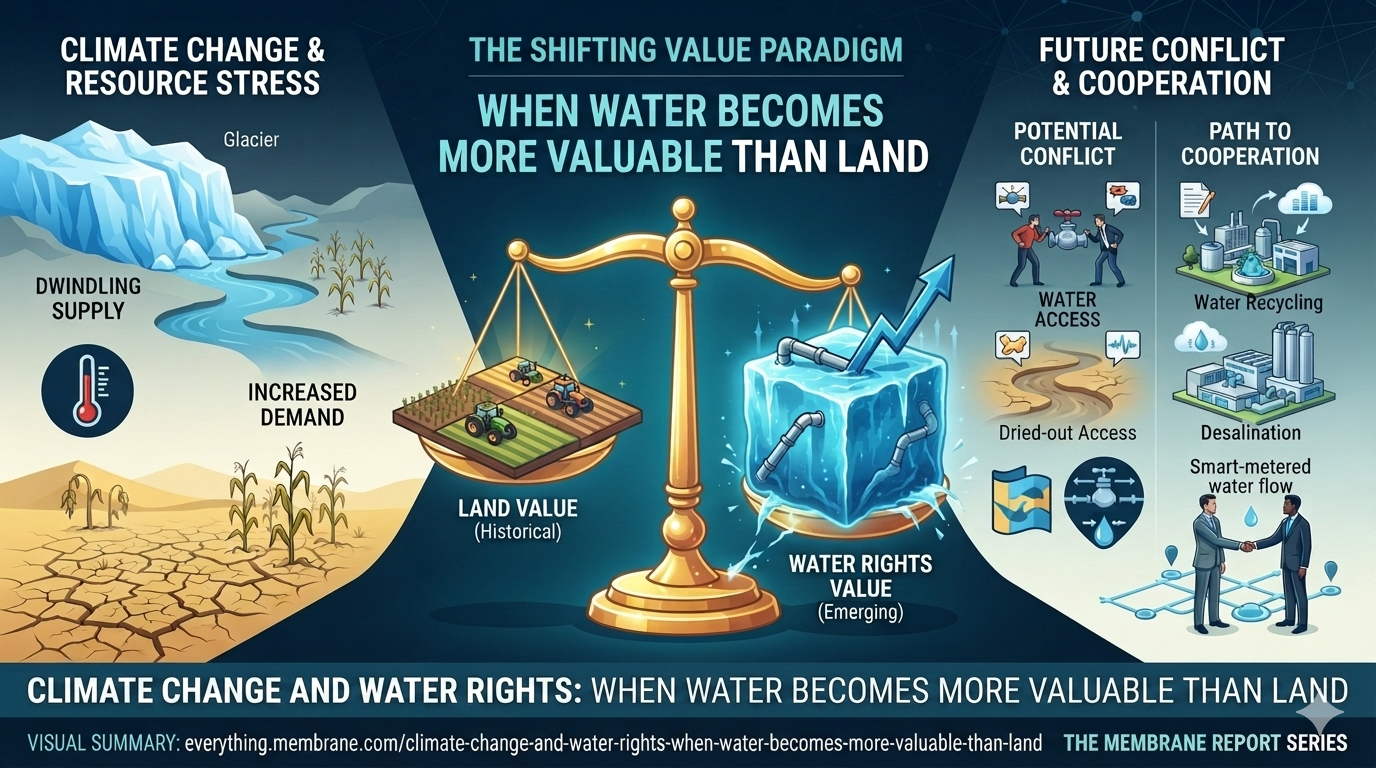
Climate change is making water security impossible to ignore. You don’t need a scientific report to see it—just look out your window. Floods, droughts, shrinking reservoirs, and increasing competition for freshwater are becoming part of everyday life.
Back in the 1990s, we warned that one day there would be “water wars.” We jokingly wrote headlines like, “Water Wars: Coming to a Town Near You.” Unfortunately, what once seemed like dark humor is steadily becoming reality.
The underlying problem is the same everywhere: climate change is disrupting the availability of freshwater. However, the resulting socio-economic and ecological feedbacks vary dramatically depending on geography, politics, and legal systems. In some regions, conflicts arise between nations, such as India and Pakistan over shared river systems. In others, disputes occur between neighboring communities, businesses, or even individual property owners.
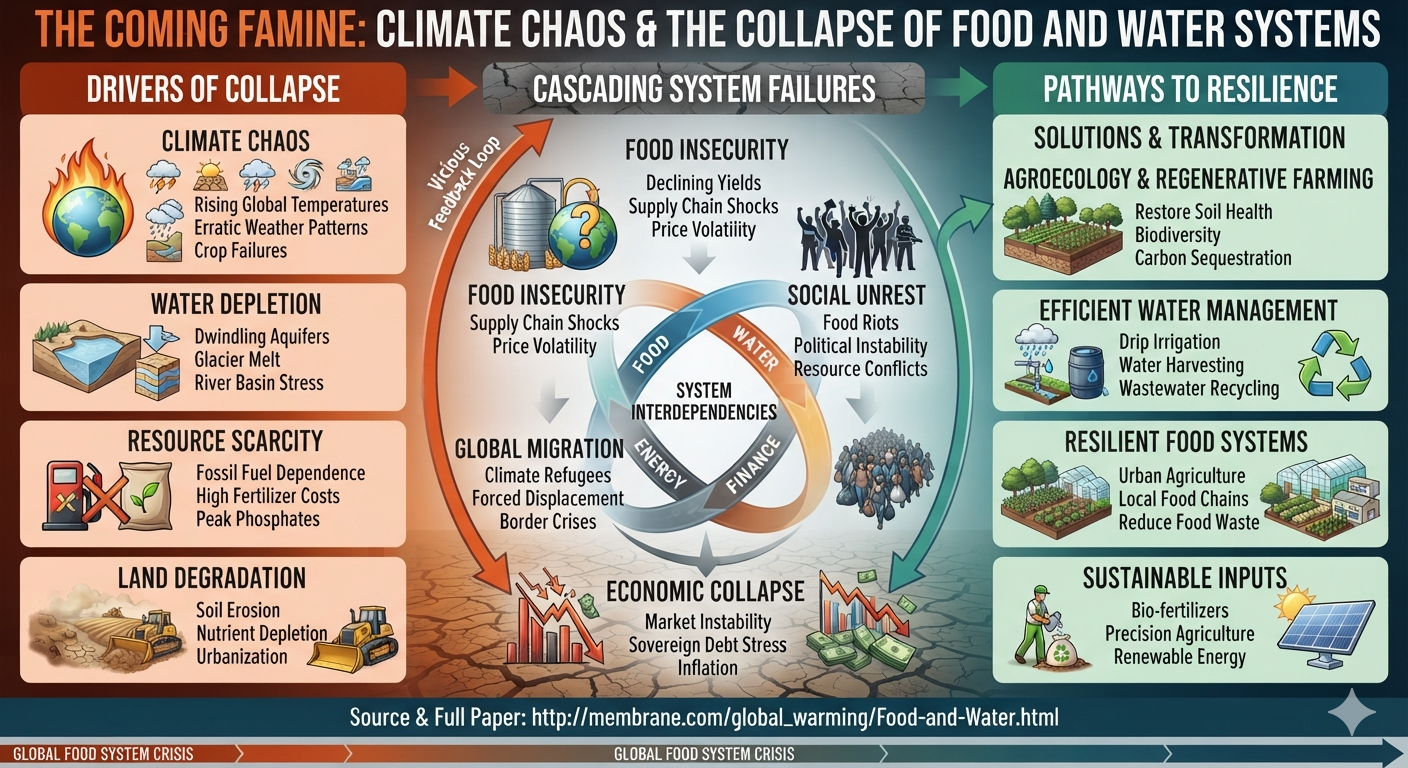
One of the most urgent consequences of climate change is the destabilization of the global food and water systems that support human civilization. What was once viewed as a distant possibility has become an emerging planetary crisis—already contributing to rising food prices, economic disruption, hunger, migration, and social instability.
The threat is no longer defined by isolated disasters. The modern climate crisis is increasingly characterized by compound shocks—multiple climate disruptions occurring simultaneously or sequentially, overwhelming agricultural, economic, and governmental systems.
Extreme heat reduces crop productivity. Drought limits water availability. Floods destroy farmland and infrastructure. Warmer temperatures expand the range of agricultural pests and diseases. Ocean warming disrupts fisheries. These impacts are no longer independent events; they are interacting forces that amplify one another.
The result is a growing systemic vulnerability: the breakdown of the predictable environmental conditions upon which agriculture, water management, and human settlement have depended for thousands of years.
For thousands of years, agriculture developed around relatively stable seasonal patterns. Farmers relied on predictable transitions between winter and spring, wet and dry seasons, planting and harvest periods.
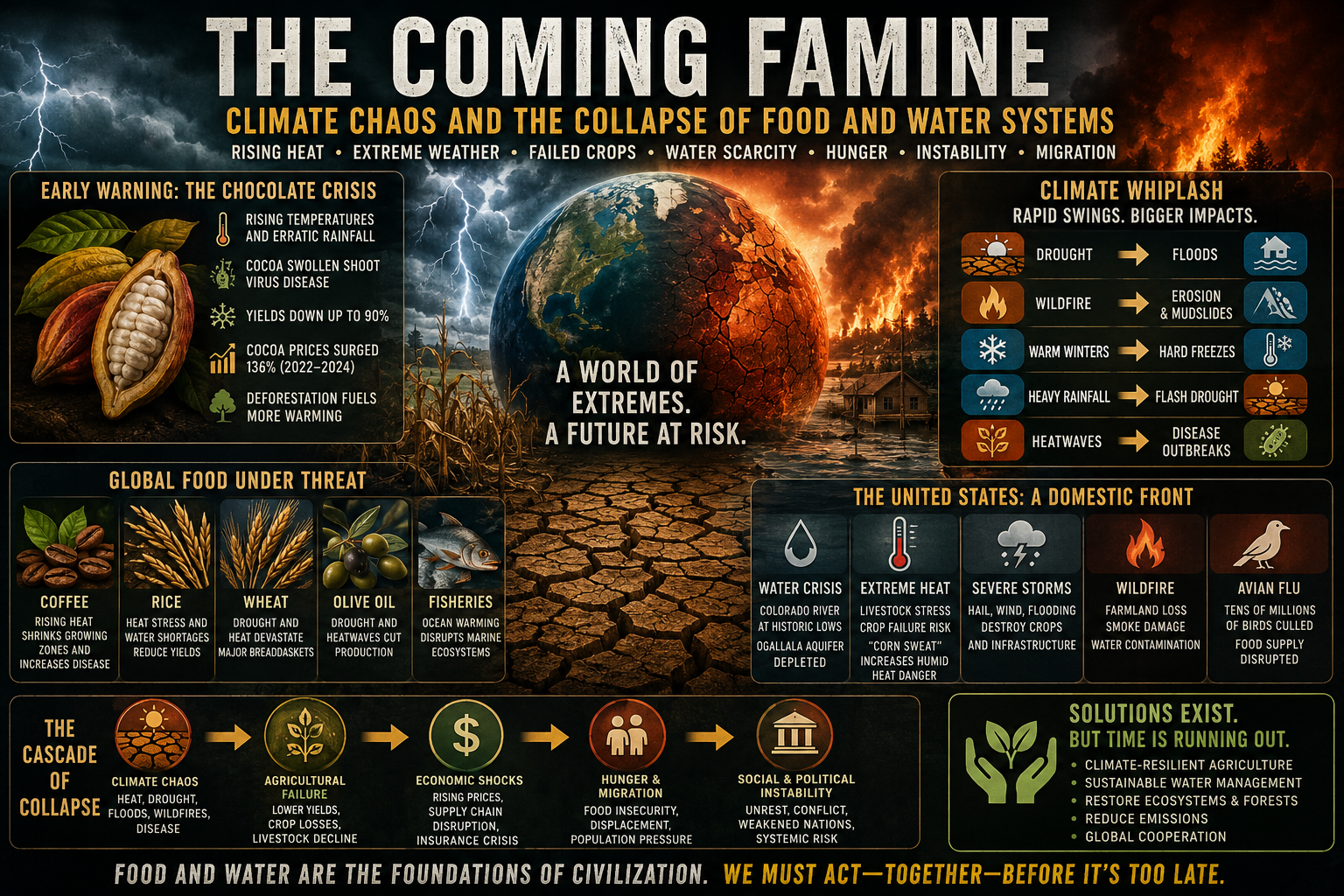
Climate change is disrupting these patterns through what scientists increasingly describe as climate whiplash—rapid transitions between opposing extremes.
These rapid shifts make adaptation increasingly difficult because agricultural systems are designed around averages, while climate change is increasingly producing extremes.
The same interconnected climate pressures destabilizing global agriculture are accelerating across the United States. The nation’s food system—one of the most productive in human history—is increasingly vulnerable to extreme heat, drought, flooding, wildfire, disease outbreaks, and declining water availability.
The emerging threat is not a single agricultural failure, but a convergence of multiple climate stresses occurring across different regions at the same time.
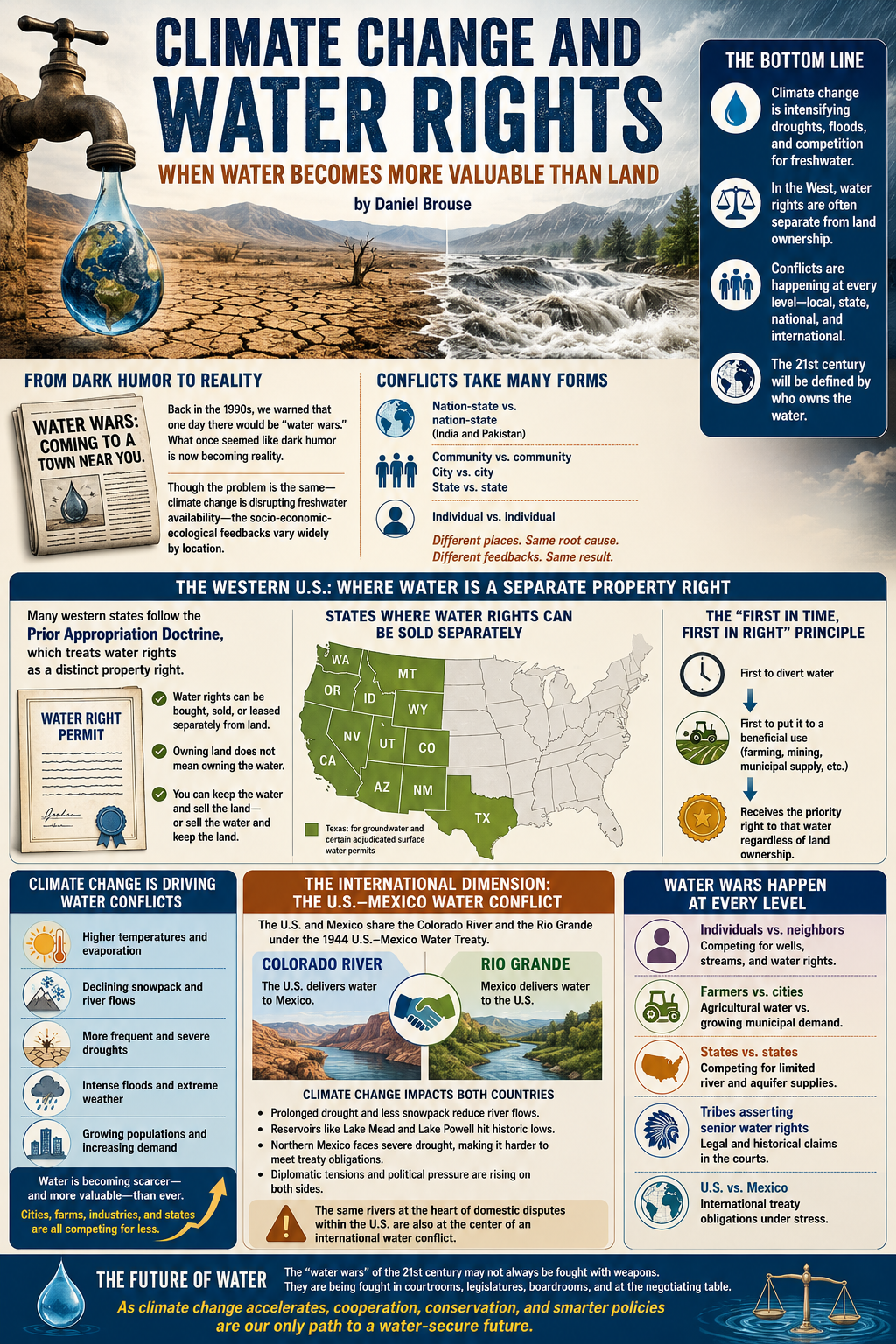
Across the American West, prolonged drought, declining snowpack, rising temperatures, and groundwater depletion are transforming the agricultural landscape.
The Colorado River Basin, which supplies water to approximately 40 million people and supports some of the nation’s most productive agricultural regions, continues to experience unprecedented stress. Reduced mountain snowpack, higher evaporation rates, and decades of over-allocation have pushed major reservoirs toward historically low levels.
Lake Mead and Lake Powell have experienced dramatic declines, forcing emergency negotiations, mandatory conservation measures, and difficult choices between urban, agricultural, and ecological needs.
In California, one of the world’s largest agricultural producers, climate-driven drought and declining groundwater reserves are threatening crops including almonds, grapes, tomatoes, and other high-value commodities. Farmers are increasingly forced to abandon fields, reduce planting, or rely on increasingly expensive water supplies.
The crisis extends underground. The Ogallala Aquifer, one of the largest groundwater systems in the world, supports agriculture across the Great Plains but is being depleted faster than natural recharge can replace it in many areas.
Livestock production is also increasingly vulnerable to climate extremes. Rising temperatures reduce animal productivity, increase water demand, and create dangerous heat stress conditions.
In Texas and other drought-stricken regions, ranchers have reduced herd sizes as pasture conditions deteriorate and water supplies become unreliable. Extreme heat increases mortality risk while raising the cost of feed, transportation, and veterinary care.
These pressures eventually reach consumers through higher meat prices, supply volatility, and increased economic stress on rural communities.
Across the Midwest, agriculture is facing a new era of climate volatility. Increasingly intense storms, hail events, flooding, and wind damage can destroy entire fields within minutes.
Unlike gradual climate shifts, these extreme events create sudden economic shocks. A single severe storm during a critical growing period can eliminate months of agricultural investment.
Flooding creates additional long-term damage by eroding topsoil, delaying planting, damaging infrastructure, and reducing the ability of farmers to recover between disasters.
Wildfires are expanding agricultural risks throughout the West. Smoke, extreme heat, drought, and direct fire damage are affecting farms, orchards, vineyards, and livestock operations.
At the same time, climate conditions are altering the behavior and spread of agricultural diseases and pests. Warmer winters allow some insects and pathogens to survive farther north and remain active for longer periods.
Climate-linked avian influenza outbreaks have resulted in the loss of tens of millions of poultry birds, demonstrating how rapidly biological threats can disrupt food supplies.
The Midwest provides another example of how climate change is altering the relationship between agriculture and weather.
During hot summer conditions, large cornfields release enormous quantities of water vapor through evapotranspiration—a process sometimes called "corn sweat." A mature cornfield can release thousands of gallons of water per acre per day under favorable growing conditions.
This additional atmospheric moisture can contribute to higher humidity levels during already dangerous heat events. Because warmer air can hold more moisture, climate change is increasing the potential for extreme humid heat conditions.
The result is a dangerous combination: higher temperatures, higher humidity, and reduced human ability to cool through evaporation. These conditions increase risks for outdoor workers, farmers, and vulnerable populations.
However, corn sweat also signals agricultural stress. High evapotranspiration rates increase soil moisture loss, accelerate irrigation demands, and can worsen drought conditions when rainfall fails to compensate.
Agriculture is therefore becoming both a victim of climate change and an active participant in increasingly unstable regional water cycles.
Climate-driven food and water disruptions are increasingly producing economic consequences beyond farms and rural communities.
Food price increases are amplified by transportation costs, energy prices, insurance losses, and supply-chain disruptions. Water shortages affect agriculture, industry, and urban growth simultaneously.
Insurance markets are also becoming increasingly stressed as climate disasters become more frequent and expensive. Rising insurance costs or declining availability create additional pressure on farmers, homeowners, and businesses.
The emerging pattern is systemic: climate disasters that once appeared temporary are becoming recurring economic forces.
Around the world, the same destabilizing forces are creating a cascading global crisis.
In India and Southeast Asia, extreme heat is threatening agricultural productivity and making outdoor labor increasingly dangerous. Heat stress is reducing crop yields while placing additional pressure on urban water supplies.
In Central and South America, droughts are damaging coffee, maize, and other essential crops, while extreme rainfall events destroy infrastructure and wash away agricultural land.
In Africa, prolonged drought, flooding, and changing rainfall patterns are increasing food insecurity and accelerating migration pressures.
Across Europe, heatwaves, drought, and flooding are affecting vineyards, wheat production, and water availability. In China, agricultural regions are increasingly experiencing both drought and flooding in the same year—a contradiction made possible by a destabilizing climate system.
The climate crisis is breaking the environmental rhythms on which agriculture depends. The issue is no longer simply warmer temperatures; it is a fundamental disruption of the systems that regulate water, seasons, and food production.
Food and water are no longer guaranteed foundations of human stability. Climate change is transforming them from predictable resources into increasingly volatile risks.
The decline of agricultural reliability and freshwater security is already contributing to inflation, economic disruption, hunger, migration, and social instability. The systems that support civilization—farming, transportation, energy, water management, and community resilience—are becoming increasingly vulnerable to compound climate shocks.
The greatest danger is not any single drought, flood, wildfire, or heatwave. The danger is the interaction among them. A failed harvest in one region affects global markets. Water shortages increase food prices. Economic stress accelerates migration. Migration pressures intensify political instability.
Humanity must rapidly invest in climate-resilient agriculture, sustainable water management, ecosystem restoration, improved agricultural technology, and emissions reduction. International cooperation will be essential—not only to share resources, but to stabilize the interconnected systems upon which all societies depend.
The coming decades will determine whether humanity adapts successfully or allows cascading climate disruptions to overwhelm the systems that sustain modern civilization.
Otherwise, the world will continue to burn to stay cool—until there is nothing left to burn.
Our climate model — incorporating complex social-ecological feedback loops within a dynamic, nonlinear system — projects that global temperatures could rise by up to 9°C (16.2°F). This far exceeds earlier projections, which estimated a 4°C rise over the next thousand years, and signals a dramatic acceleration of planetary warming. We are entering a phase of compound, cascading collapse.
At this level of heating, many regions will become uninhabitable due to heat stress, sea-level rise, food system failure, and forced migration. Wet-bulb temperatures in the U.S. are already nearing 31°C (87.8°F) -- a physiological limit beyond which human life cannot be sustained outdoors for long, even with water and shade.
This is not hypothetical. The climate system is tipping now.
Also see: Climate Shock to the Food System
Bottom line: The question is no longer how warm the planet becomes, but how life on Earth can endure when change outpaces our ability to adapt.
We cannot control the laws of physics, but we can control our pollution. The most effective action is to stop burning fossil fuels.