Severe weather is becoming more frequent, more intense, and more persistent, with extreme events lasting longer and affecting larger areas.
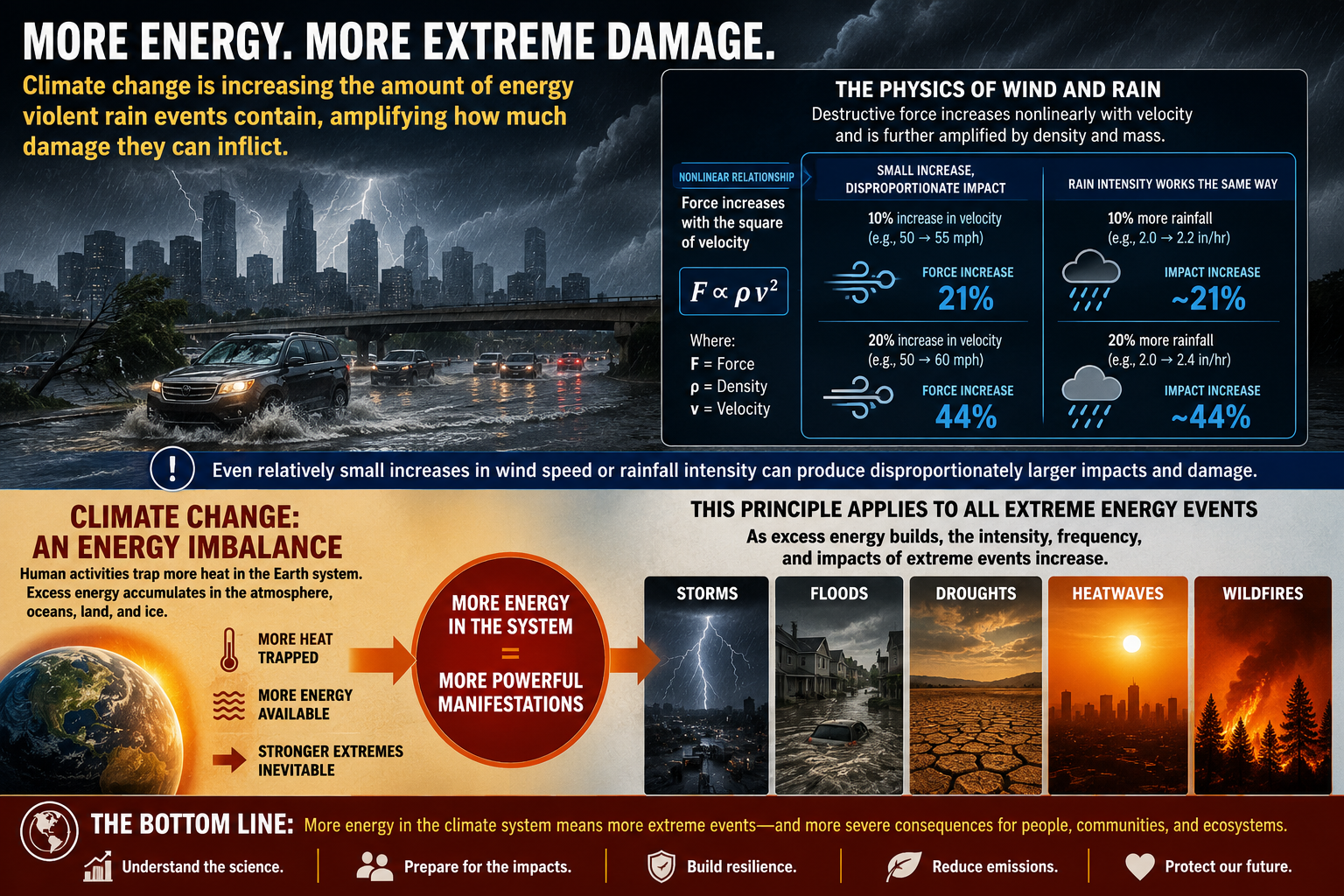
"Climate change is increasing the amount of energy contained within extreme weather events, amplifying their destructive potential and the damage they can inflict."
The physics of wind and rain are important to understand: their destructive force increases nonlinearly with velocity and is further amplified by density and mass. Consequently, relatively small increases in wind speed or rainfall intensity can produce disproportionately larger impacts and damage.
This principle applies to all extreme energy events. At its core, climate change is an energy imbalance. As excess heat accumulates within the Earth system, more energy becomes available to drive storms, floods, droughts, heatwaves, and wildfires. As the energy intensifies, so do its manifestations.
The Three Fastest-Accelerating Climate Extremes Since 2000
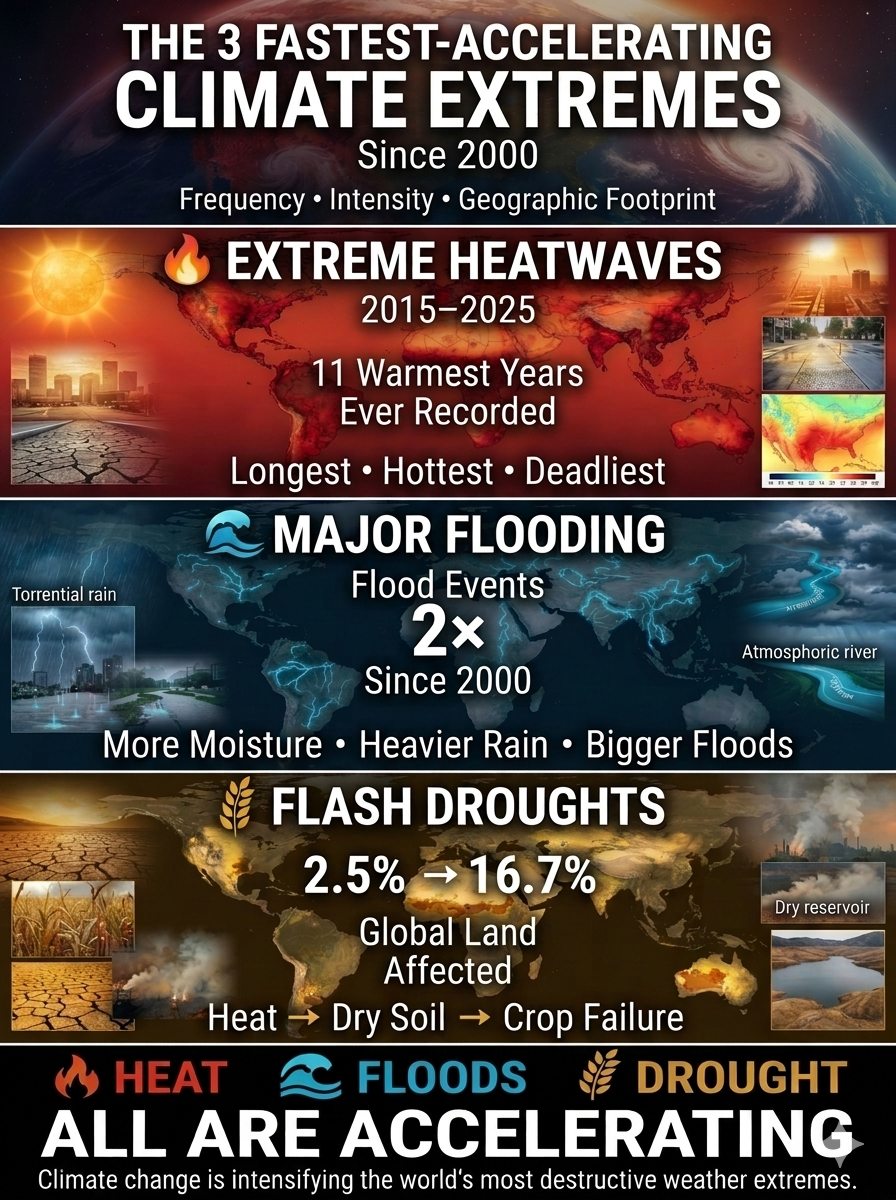
Since 2000, three climate extremes have accelerated faster than all others in their frequency, intensity, and geographic reach: extreme heatwaves, major flooding, and heat-triggered flash droughts.
1. Extreme Heatwaves The Trend: The years 2015–2025 were the 11 warmest years ever recorded globally. The Impact: Heatwaves have become dramatically longer, hotter, and more widespread, producing record-breaking temperatures on every continent. They now account for the largest share of climate-related deaths worldwide and increasingly strain power grids, agriculture, water supplies, and public health systems.
2. Major Flooding & Extreme Rainfall The Trend: According to United Nations disaster records, major flood events have more than doubled since 2000, increasing from approximately 1,389 events to more than 3,254. The Impact: As the atmosphere warms, it holds significantly more water vapor, intensifying the global water cycle. The result is a sharp rise in short-duration, high-intensity rainfall that overwhelms drainage systems, dams, rivers, and urban infrastructure.
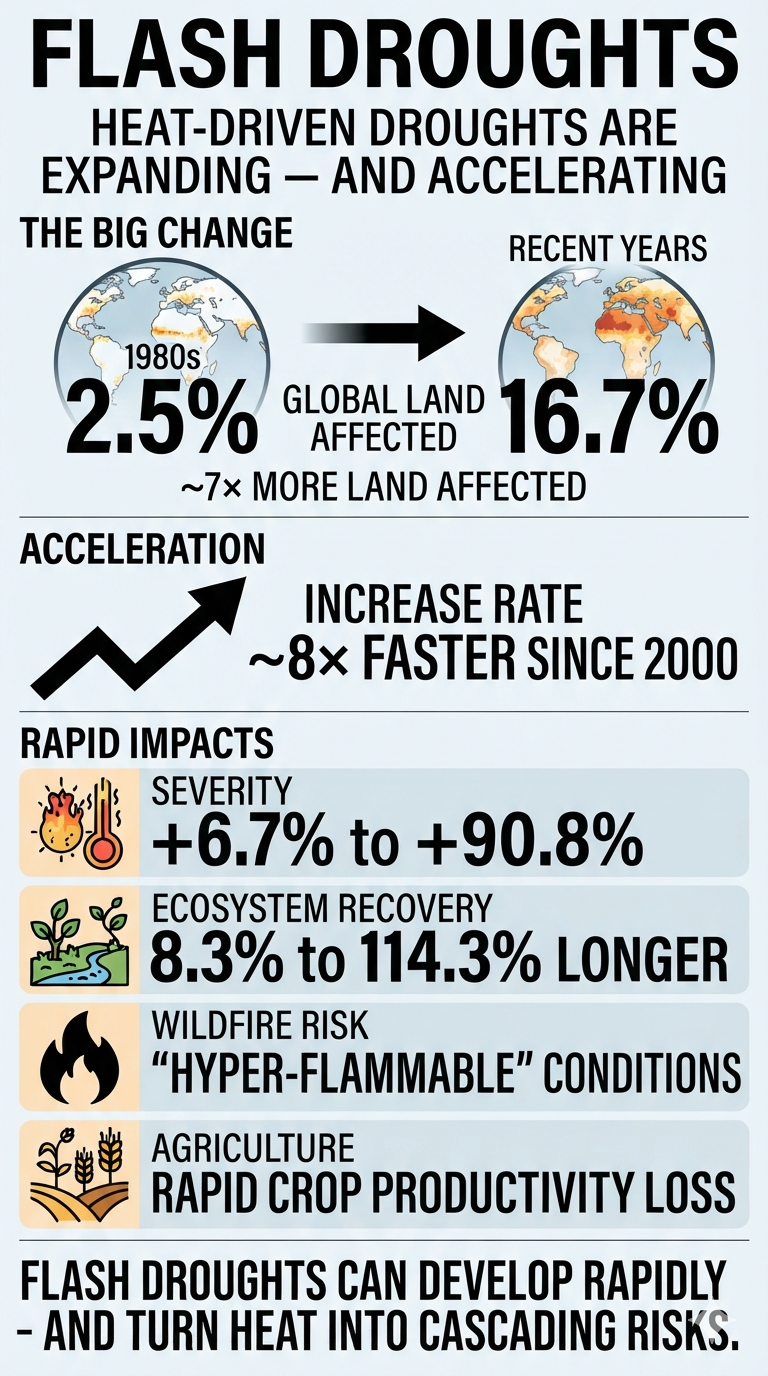
3. Heat-Triggered Flash Droughts The Trend: The share of global land affected by heat-driven drought has expanded from 2.5% in the 1980s to 16.7% in recent years, with the rate of increase accelerating roughly eightfold since 2000. The Impact: Unlike traditional droughts that develop over months, flash droughts can emerge within weeks. Extreme heat rapidly strips moisture from soils and vegetation, triggering sudden crop failures, water shortages, wildfire risk, and severe agricultural losses before communities have time to respond.
Bottom Line: These three extremes—extreme heat, extreme flooding, and flash droughts—are no longer isolated events. They are accelerating simultaneously, amplifying one another, and reshaping climate risk across the globe. Together, they represent the clearest evidence that climate change is driving a new era of increasingly frequent, intense, and widespread extreme weather.
Extreme Energy Event Examples
Extreme Energy Event
Description
Violent Rain
High-intensity precipitation events driven by increased atmospheric moisture and convective energy. A warmer atmosphere can hold more water vapor, increasing the potential for extreme rainfall rates and destructive flooding.
Floods
The physical manifestation of excess water energy overwhelming natural and human systems. Extreme rainfall, saturated soils, rapid runoff, and rising rivers combine to produce flash floods, river floods, and coastal inundation.
Atmospheric Rivers
Long, narrow corridors of concentrated atmospheric moisture transport that can release enormous quantities of water when they encounter mountains or stalled weather systems, producing extreme rainfall, flooding, and landslides.
Wildfires
High-energy combustion events amplified by heat, drought, low humidity, dry vegetation, and strong winds. Warmer conditions increase fuel dryness and create conditions favorable for larger, faster-moving fires.
Microbursts
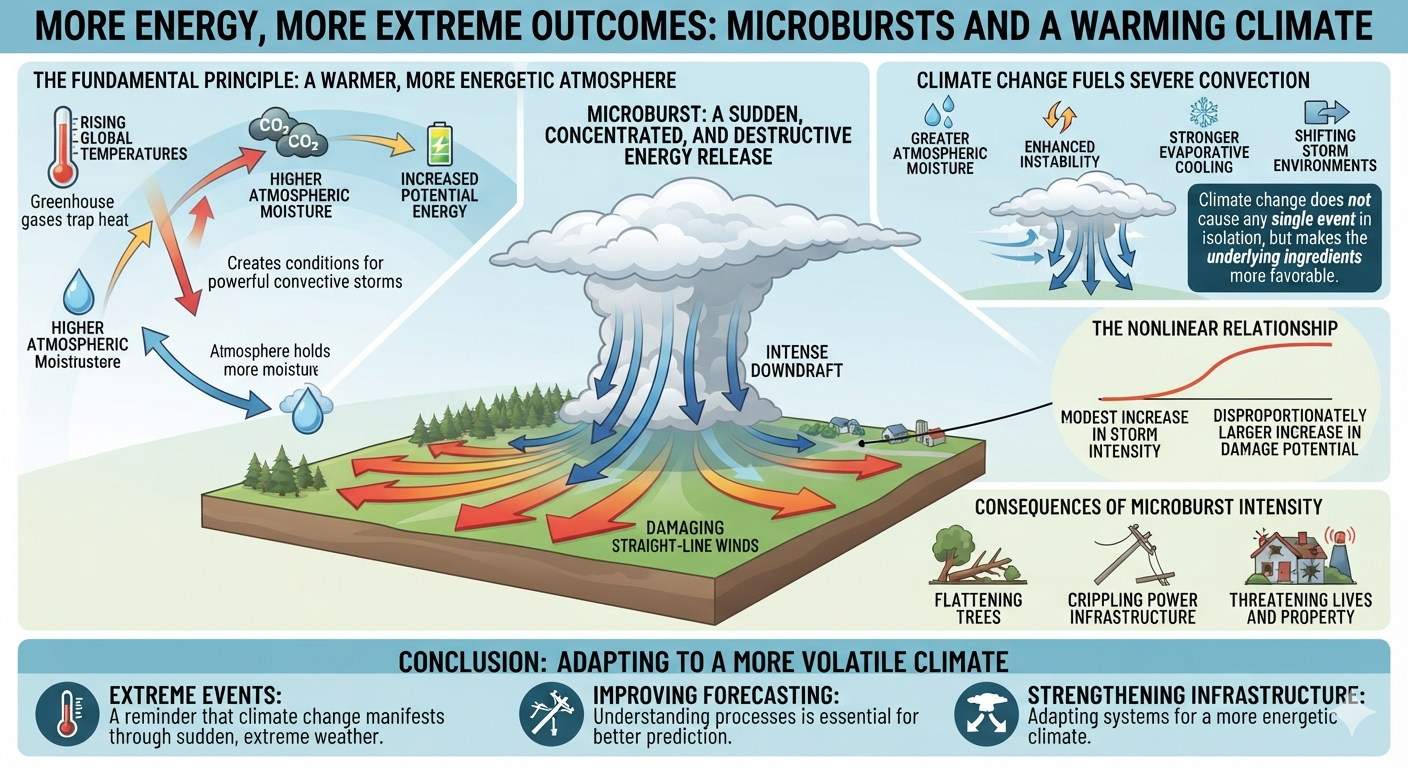
Powerful localized downdrafts produced by collapsing thunderstorms that rapidly spread outward upon reaching the surface, generating destructive straight-line winds capable of damaging structures and vegetation.
Straight-Line Winds
Non-rotating, high-velocity wind events produced by thunderstorms, derechos, and microbursts. These winds can extend over large areas and cause widespread damage through extreme momentum transfer.
Hurricanes / Tropical Cyclones
Among Earth's most powerful heat engines, converting ocean heat into enormous wind fields, storm surge, extreme rainfall, and destructive energy release.
Tornadoes
Concentrated rotational wind energy events produced by severe convection; important counterparts to microbursts and straight-line winds.
Derechos
Large-scale convective windstorms producing hundreds of miles of straight-line wind damage; a natural extension of microbursts.
Heat Domes & Atmospheric Blocking
Large-scale atmospheric energy accumulations that trap heat, amplify temperature extremes, and create dangerous persistence.
Drought & Megadroughts
Long-duration energy imbalance events caused by altered precipitation patterns, evaporation demand, and soil moisture feedbacks.
Marine Heatwaves
Massive ocean energy anomalies that affect ecosystems, weather patterns, hurricanes, and atmospheric circulation.
Extreme Cold Events / Polar Vortex Disruptions
Despite global warming, changes in atmospheric circulation can produce severe cold outbreaks through altered jet-stream dynamics.
Lightning & Thunderstorm Complexes
Direct manifestations of atmospheric electrical energy and convective instability.
Hailstorms
Severe convective energy events capable of producing significant agricultural, vehicle, and infrastructure damage.
Dust Storms / Haboobs
High-energy atmospheric events driven by strong pressure gradients and collapsing dry air masses.
Storm Surge & Coastal Inundation
Ocean-atmosphere energy transfer producing destructive coastal flooding, especially during hurricanes and sea-level rise.
Sea-Level Rise & Coastal Extremes
A slower energy-driven process that amplifies storm impacts and increases baseline flood risk.
More Energy in the Climate System = More Powerful Extreme Events
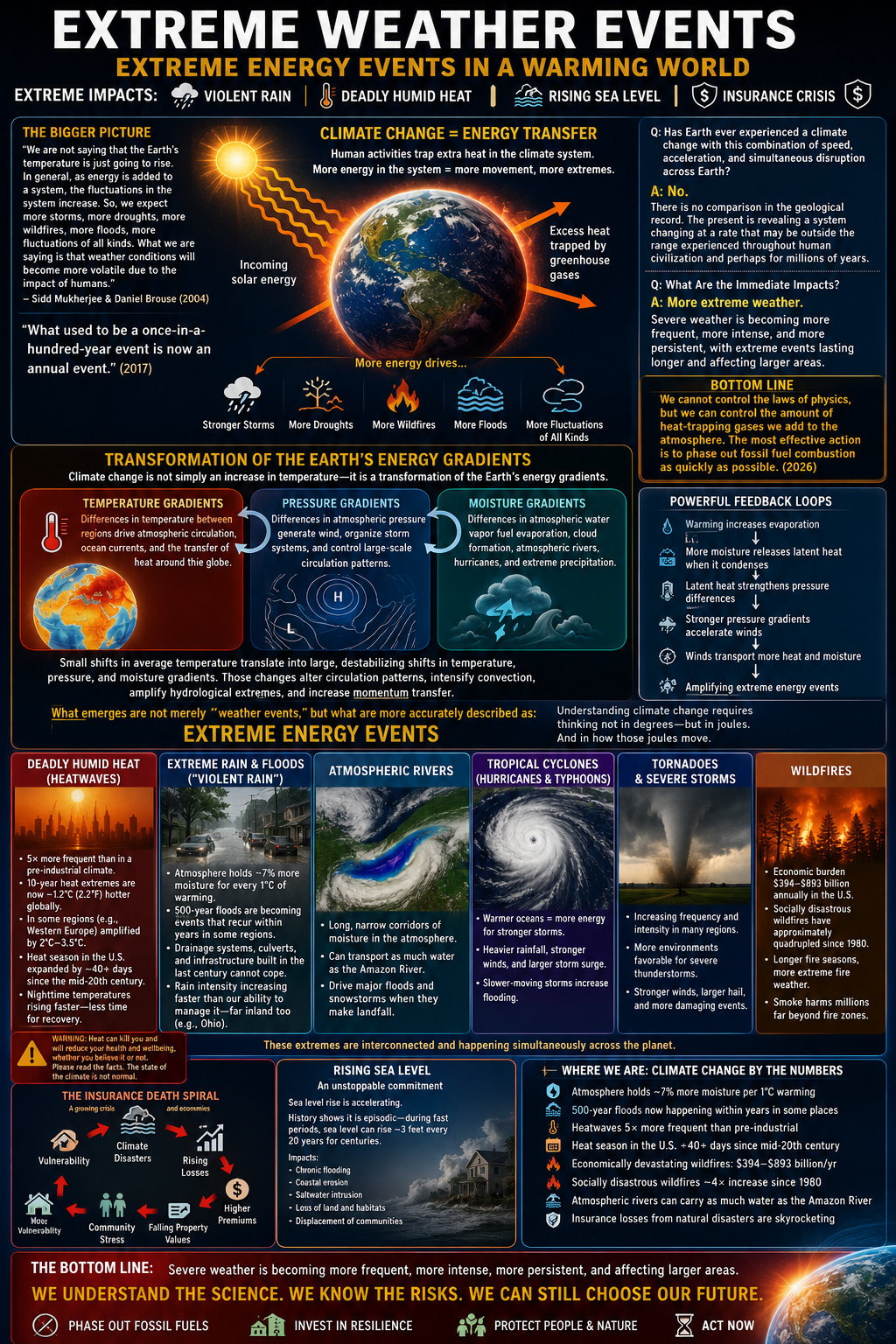
"We are not saying that the Earth's temperature is just going to rise. In general, as energy is added to a system, the fluctuations in the system increase. So, we expect more storms, more droughts, more wildfires, more floods, more fluctuations of all kinds. What we are saying is that weather conditions will become more volatile due to the impact of humans," said Sidd Mukherjee and Daniel Brouse (2004)
"What used to be a once-in-a-hundred-year event is now an annual event." (2017)
Q:“Has Earth ever experienced a climate change with this combination of speed, acceleration, and simultaneous disruption across Earth?”
A: No.
Extreme Weather: Where We Are
There is no comparison in the geological record. The present is revealing a system changing at a rate that may be outside the range experienced throughout human civilization and perhaps for millions of years.
Q: “What Are the Immediate Impacts?”
A: More extreme weather.
Severe weather is becoming more frequent, more intense, and more persistent, with extreme events lasting longer and affecting larger areas.
Bottom line: We cannot control the laws of physics, but we can control the amount of heat-trapping gases we add to the atmosphere. The most effective action is to phase out fossil fuel combustion as quickly as possible. (2026)
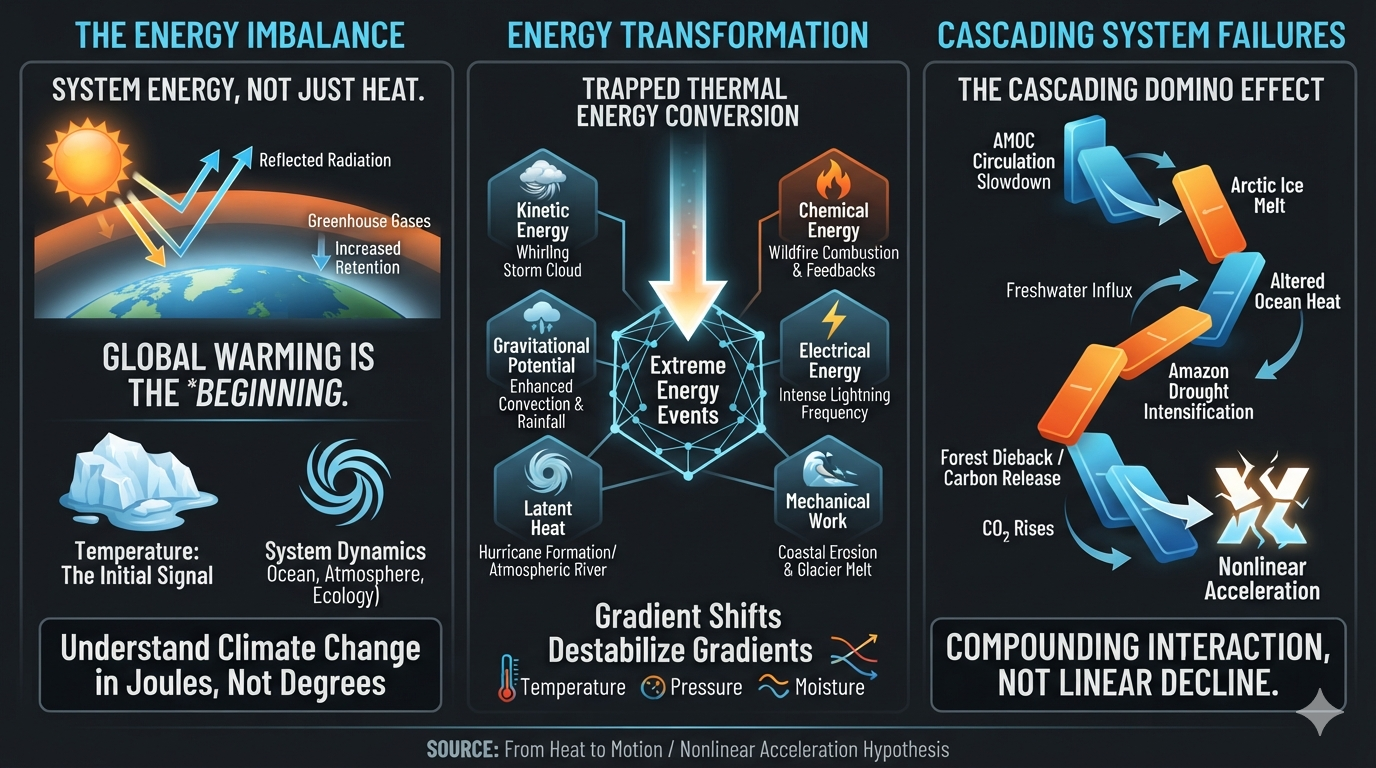
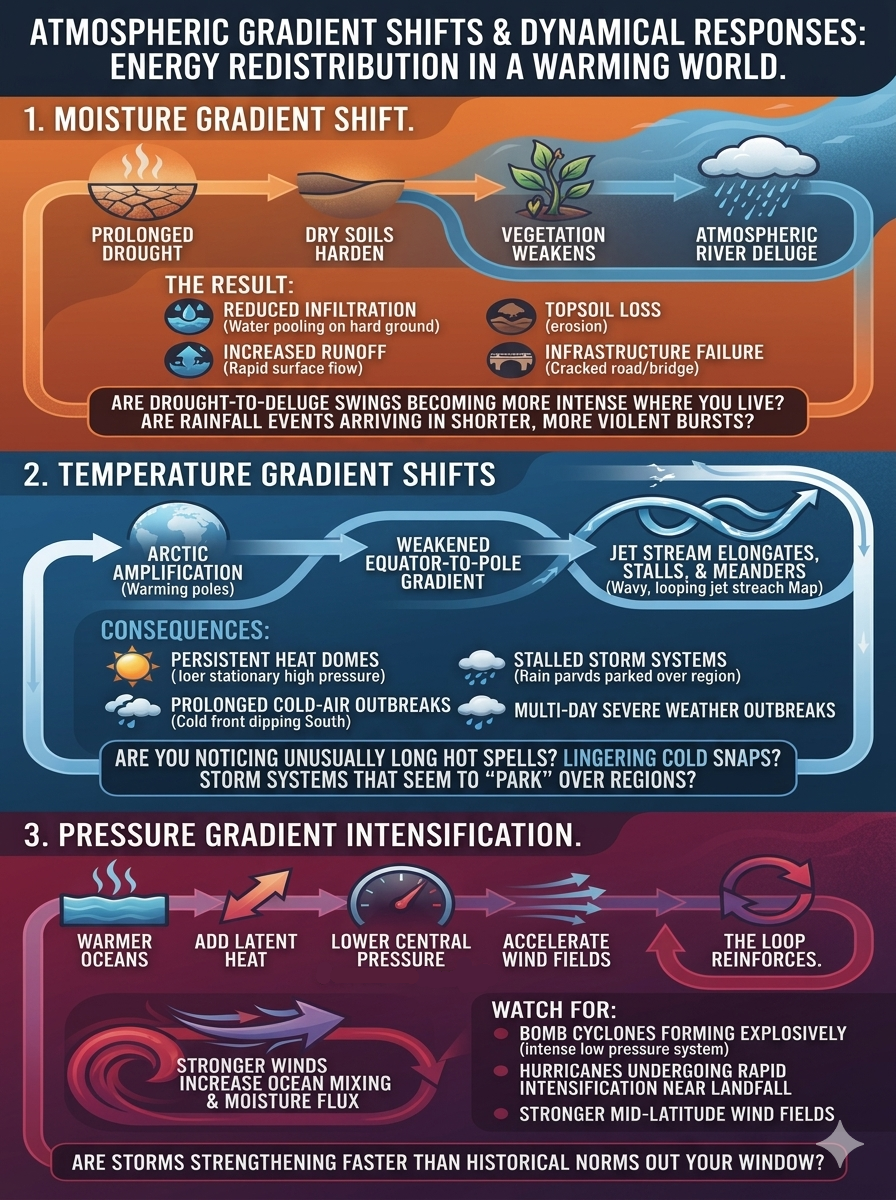
Small shifts in average temperature translate into large, destabilizing shifts in gradients — temperature gradients, pressure gradients, and moisture gradients. Those gradient changes alter circulation patterns, intensify convection, amplify hydrological extremes, and increase momentum transfer.
What emerges are not merely “weather events,” but what are more accurately described as:
Extreme energy events.
Understanding climate change requires thinking not in degrees — but in joules.
Climate change is not simply an increase in temperature—it is a transformation of the Earth's energy gradients. As excess heat accumulates within the climate system, it reshapes the differences that drive atmospheric and oceanic motion. These differences, known as gradients, determine how energy flows through the planet.
Even relatively small increases in average global temperature can produce disproportionately large changes in these gradients, amplifying storms, altering weather patterns, and increasing the intensity of extreme events. The most important climate gradients fall into three interconnected categories:
Temperature Gradients – Differences in temperature between regions that drive atmospheric circulation, ocean currents, and the transfer of heat around the globe.
Pressure Gradients – Differences in atmospheric pressure that generate wind, organize storm systems, and control large-scale circulation patterns.
Moisture Gradients – Differences in atmospheric water vapor that fuel evaporation, cloud formation, atmospheric rivers, hurricanes, and extreme precipitation.
These gradients do not operate independently. They continually interact through powerful feedbacks: warming increases evaporation, added moisture releases latent heat during condensation, latent heat strengthens pressure differences, and stronger pressure gradients accelerate winds that transport even more heat and moisture. Together, these reinforcing processes transform modest increases in average temperature into the increasingly energetic weather and climate extremes now being observed around the world.
Understanding climate change therefore requires looking beyond temperature alone. The real story lies in how shifting temperature, pressure, and moisture gradients redistribute energy throughout the Earth system, driving the acceleration of climate change.
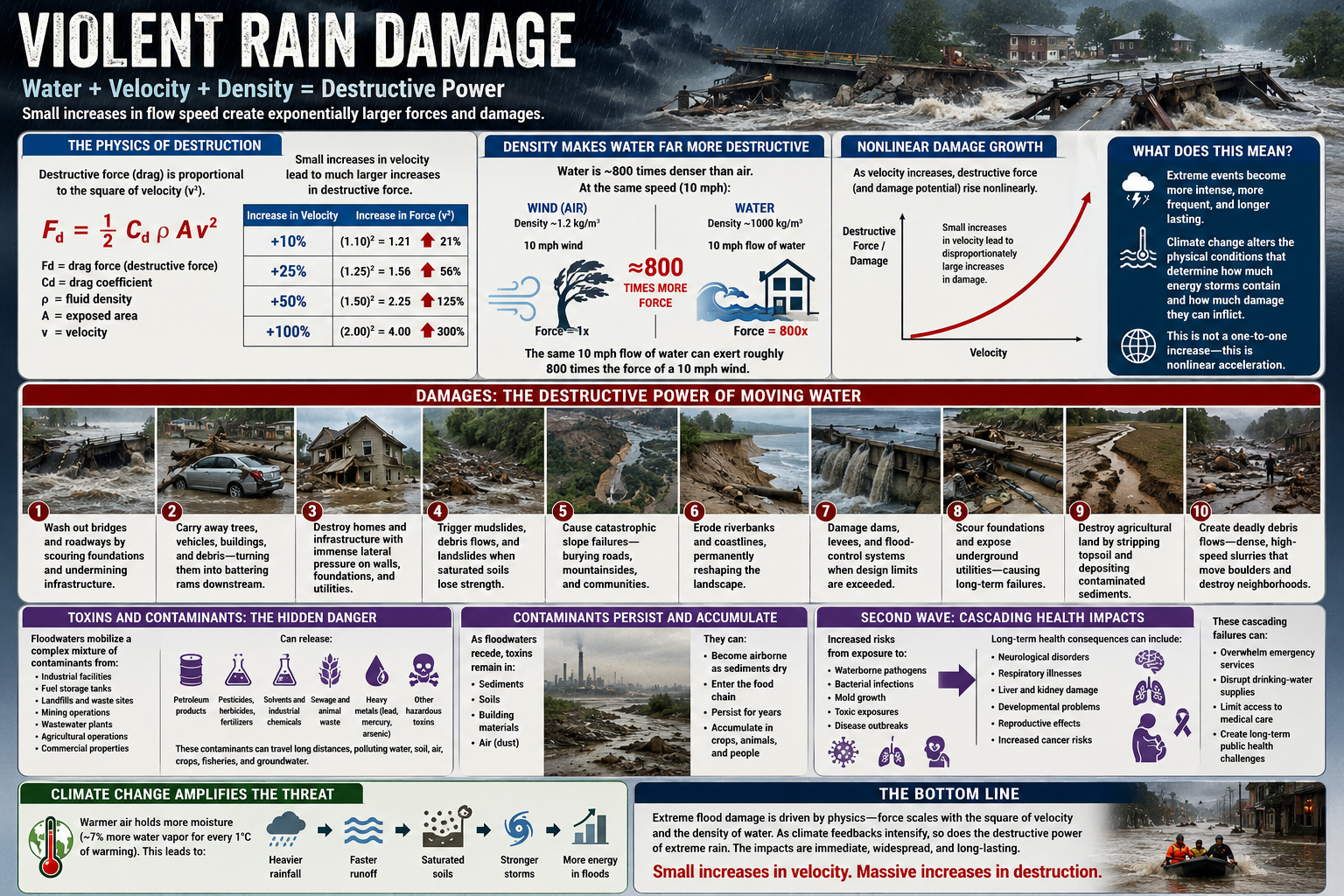
The destructive power of both wind and water scales approximately with the square of velocity (v²), meaning relatively small increases in flow speed can lead to disproportionately large increases in force and damage. Density further amplifies these impacts. Because water is approximately 800 times denser than air, a 10 mph flow of water can exert roughly 800 times the force of a 10 mph wind at the same speed. As climate change increases flow velocities, the resulting forces and damages rise nonlinearly.
What does this mean?
The physics of extreme events is nonlinear. Wind and water damage do not increase in a simple one-to-one relationship with climate change because destructive force scales with the square of velocity. As climate feedbacks become increasingly coupled, extreme events can become more intense, more frequent, and longer lasting. Climate change is not simply producing more storms or heavier rainfall; it is altering the physical conditions that determine their intensity, duration, and destructive potential.
Climate change is increasing the amount of energy violent rain events contain, amplifying how much damage they can inflict.
Damages — The destructive power of moving water is evident in countless real-world examples. Floodwaters do not simply rise; they become a powerful moving force capable of transporting enormous amounts of mass and energy. Fast-moving water can:
The destructive power of both wind and water scales approximately with the square of velocity (v²).
Wash out bridges and roadways by scouring away foundations, eroding support structures, and undermining concrete, asphalt, and other infrastructure.
Carry away trees, vehicles, buildings, and debris, turning ordinary objects into battering rams that multiply destruction downstream.
Destroy homes and infrastructure as flood currents exert immense lateral pressure on walls, foundations, electrical systems, and utilities.
Trigger mudslides, debris flows, and landslides when saturated soils lose strength and entire hillsides collapse under the weight of water.
Cause catastrophic slope failures, where mountainsides, roads, and communities can be buried beneath rapidly moving earth, rock, and water.
Erode riverbanks and coastlines, permanently reshaping landscapes and removing natural protective barriers.
Damage dams, levees, and flood-control systems when water volumes and flow rates exceed engineering design limits.
Scour foundations and expose underground utilities, causing structural failures that can continue long after floodwaters recede.
Destroy agricultural land by stripping away fertile topsoil, depositing contaminated sediments, and altering drainage patterns.
Create deadly debris flows where water, soil, rocks, trees, and other materials combine into a dense, high-speed slurry capable of moving massive boulders and destroying entire neighborhoods.
The danger of extreme flooding is not only the amount of water involved, but the velocity and density of that water. Because water is hundreds of times denser than air, even relatively slow-moving floodwaters can generate forces capable of moving vehicles, uprooting trees, collapsing structures, and reshaping entire landscapes.
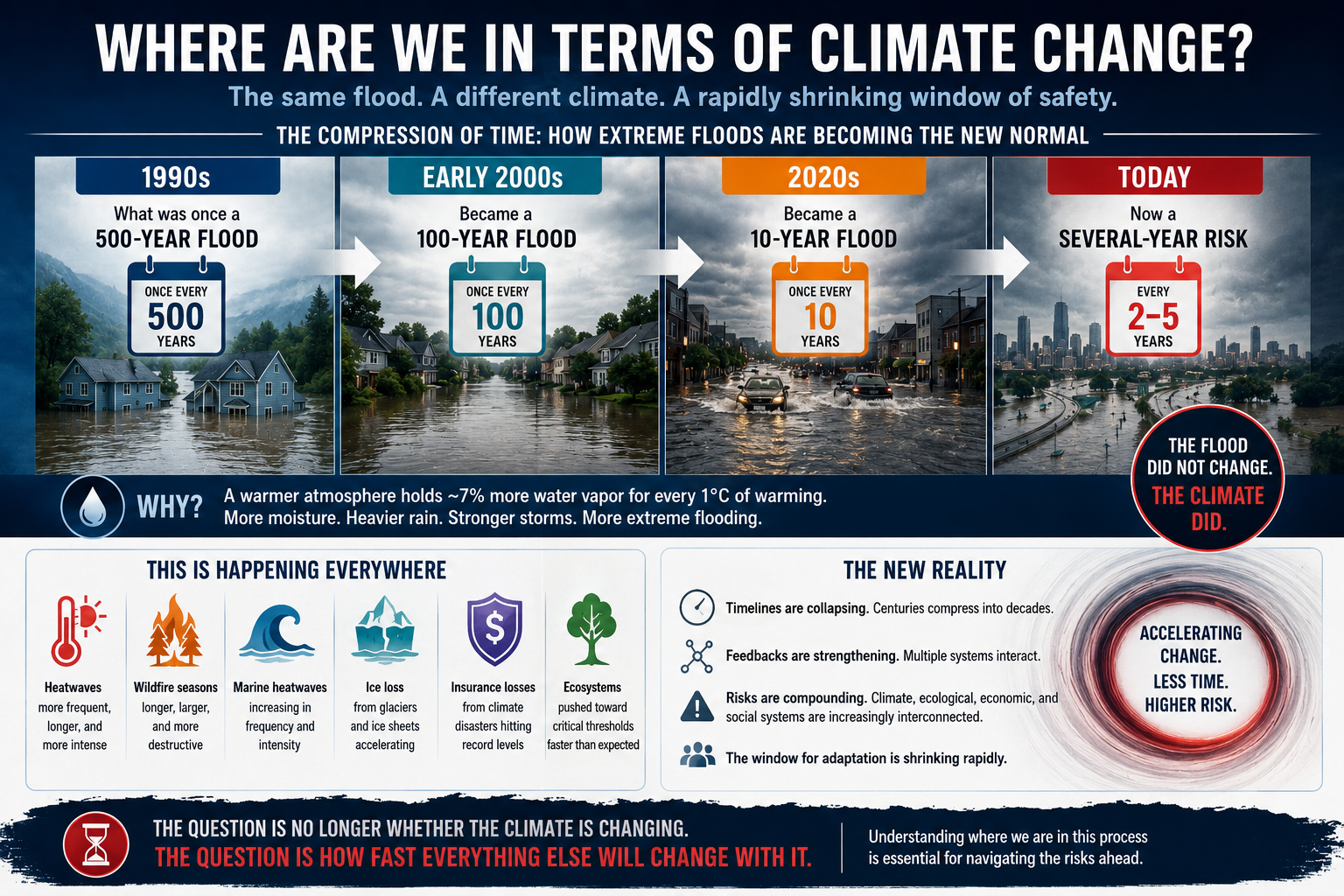
One of the simplest ways to understand climate change is through the changing frequency of extreme events.
Climate change is not merely causing temperatures to rise. It is fundamentally altering the probability of extreme weather. Events that were once considered extraordinarily rare are becoming increasingly common.
In the 1990s, what was considered a 500-year flood had only a 0.2 percent chance of occurring in any given year.
By the early 2000s, many of these same events were being reclassified as 100-year floods. By the 2020s, they increasingly resembled 10-year floods. Today, in some regions, comparable flood events are occurring every few years.
This does not mean that every flood is becoming larger than previous floods. Rather, the statistical framework itself is changing. The atmosphere and oceans now contain significantly more energy and moisture than they did several decades ago, increasing the likelihood of extreme rainfall events.
The flood itself did not change. What changed was the climate system.
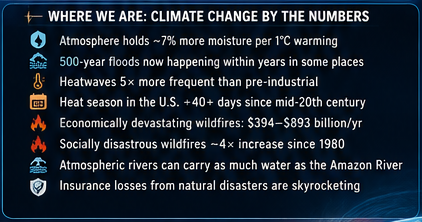
A warmer atmosphere can hold approximately 7 percent more water vapor for every 1°C (1.8°F) of warming. That additional moisture acts as fuel for extreme precipitation.
When weather systems stall or slow, they can release enormous amounts of rain over relatively short periods, producing flash floods and catastrophic river flooding that exceed historical expectations.
Recent years have provided numerous examples of this new reality. Across the United States and around the world, communities have experienced multiple so-called "1-in-500-year" and "1-in-1,000-year" rainfall events occurring within just a few years of one another.
Infrastructure designed using historical climate assumptions—including dams, stormwater systems, culverts, bridges, and levees—is increasingly being overwhelmed by rainfall intensities it was never engineered to withstand.
The same phenomenon can be observed across numerous climate indicators:
Heatwaves that once occurred once in a generation now occur repeatedly within a decade.
Wildfire seasons are becoming longer, larger, and more destructive.
Marine heatwaves are increasing in frequency and intensity.
Ice loss from glaciers and ice sheets continues to accelerate.
Insurance losses from weather-related disasters are reaching record levels.
Ecosystems are being pushed toward critical thresholds faster than many models once anticipated.
Extreme rainfall events are becoming more frequent, even in regions previously considered low risk.
Flash flooding is occurring in areas with little historical experience managing such hazards.
The key lesson is that climate change is not simply about gradual warming.
It is about the acceleration of change itself. As the climate system warms, the intervals between extreme events continue to contract, giving communities, ecosystems, and infrastructure less time to recover before the next disaster strikes.
Flooding Costs
Flooding has become one of the most expensive natural hazards in the United States. Estimates place the annual economic burden of flooding between approximately $180 billion and $500 billion when direct damages, business interruptions, agricultural losses, infrastructure repairs, and long-term economic impacts are considered.
Just one inch of floodwater entering a home can cause up to $25,000 in damage. Severe flooding can render homes uninhabitable, destroy personal possessions, damage foundations, and create long-term mold and contamination problems.
The financial consequences extend far beyond repair costs. Repeated flooding has caused insurance premiums to surge, reduced property values in vulnerable regions, and, in some cases, led insurers to withdraw coverage altogether.
Local governments are increasingly burdened with rising infrastructure costs, while taxpayers ultimately bear much of the expense associated with disaster response, rebuilding efforts, and federal recovery programs.
Flood Insurance
The United States is fairly unique in its approach to flood insurance. Flood insurance is generally excluded from standard homeowners' insurance policies and is primarily provided through the National Flood Insurance Program (NFIP), administered by FEMA.
Since the early 2000s, FEMA has increasingly encouraged managed retreat and voluntary buyout programs in repeatedly flooded areas because rebuilding the same properties after successive disasters has proven economically unsustainable.
Many homeowners are also unaware of the limitations of flood insurance coverage. Standard NFIP policies generally do not cover many improvements located below grade, including finished basements and certain mechanical systems.
Residential building coverage is typically capped at $250,000, an amount that is increasingly inadequate given today's construction and replacement costs. Consequently, many homeowners discover after a major flood that even insured losses can result in substantial out-of-pocket expenses.
As flood probabilities continue to shift and extreme rainfall events become more common, historical flood maps and past experience are becoming less reliable guides to future risk.
The question for many communities is no longer whether another major flood will occur, but whether homes, infrastructure, insurance systems, and public finances can adapt quickly enough to a rapidly changing climate.
Atmospheric Rivers
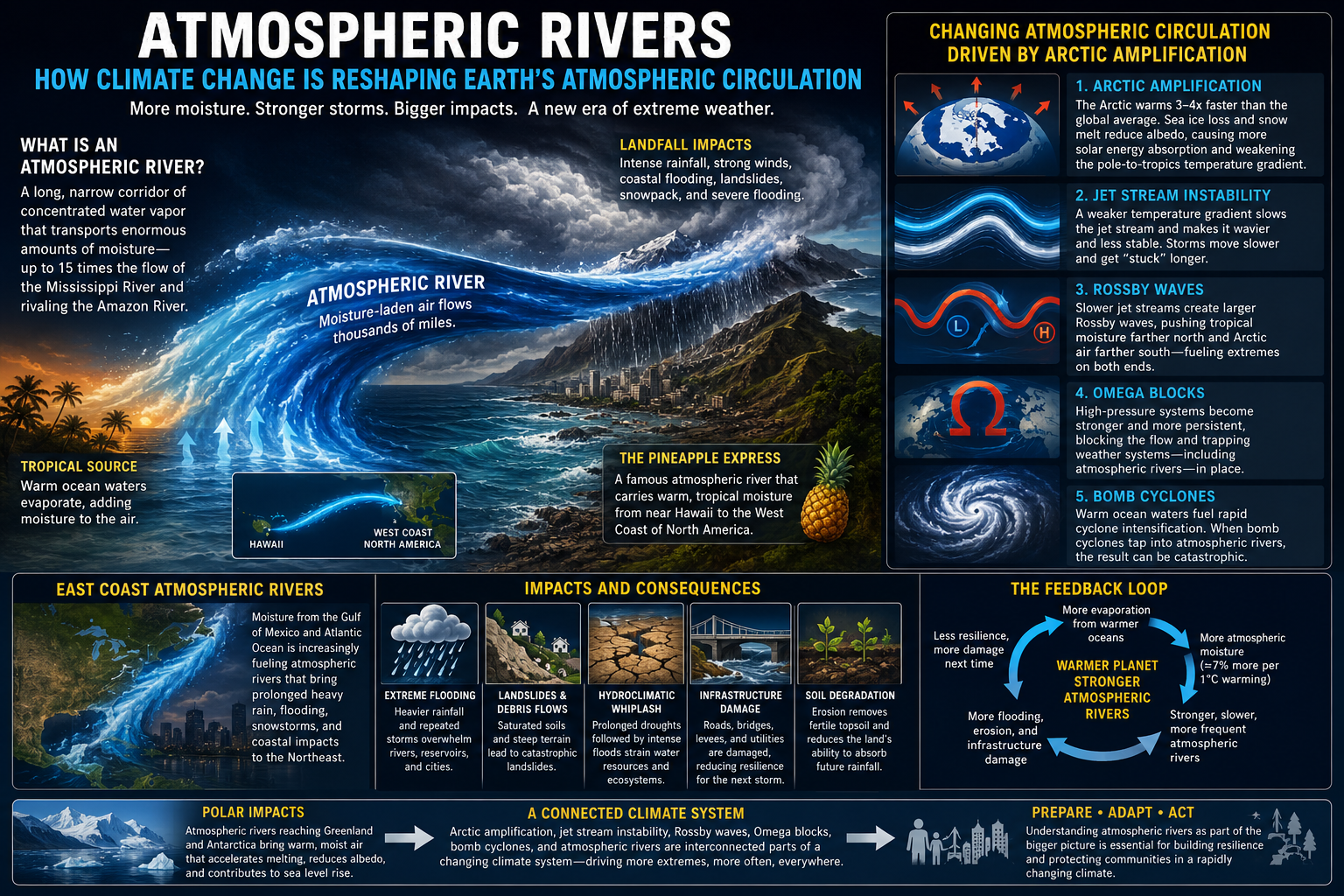
"Atmospheric rivers, at their peak, can carry as much water through the sky as the Amazon River does on land. They unleash intense winds and heavy rain as they surge across the Pacific Ocean, eventually making landfall on the U.S. West Coast, contributing to many high-tide flooding events."
Atmospheric rivers are among the most powerful weather systems on Earth. These long, narrow corridors of concentrated water vapor transport immense quantities of moisture through the atmosphere, functioning as airborne rivers that redistribute water across the planet. Once viewed primarily as pathways carrying tropical moisture toward higher latitudes, atmospheric rivers are evolving into a global phenomenon driven by a warming climate. Rising ocean temperatures, increased evaporation, melting ice, thawing permafrost, and moisture released from increasingly warm land surfaces are adding new sources of atmospheric water vapor. As the atmosphere holds more energy and moisture, atmospheric rivers are becoming broader, stronger, and more persistent—transforming from regional precipitation events into major components of a changing global climate system.
Historically, atmospheric rivers have been an essential part of Earth’s hydrologic cycle, replenishing reservoirs and snowpacks. Today, however, human-induced climate change is fundamentally changing their behavior. A warmer atmosphere, warmer oceans, and rapidly changing atmospheric circulation patterns are producing stronger, wetter, slower-moving, and increasingly destructive atmospheric rivers.
Heat can kill—and even when it doesn’t, it steadily reduces health and wellbeing through sustained thermal stress.
"WARNING: Heat can kill you and will reduce your health and wellbeing, whether you believe it or not. Please read the facts. The state of the climate is not normal."
Frequency:
Heatwaves that once occurred roughly once per decade in a pre-industrial climate now occur about five times more often under current warming levels. In the United States, observations indicate a substantial increase in the annual number of extreme heat events since the mid-20th century.
Intensity:
Modern heatwaves are measurably hotter. Globally, a 10-year heat extreme is now about 1.2°C (2.2°F) more intense than it would have been in the absence of human-caused warming. In some regions, such as Western Europe, individual heatwaves have been amplified by 2°C–3.5°C due to fossil-fuel-driven climate change. Nighttime temperatures are increasing even faster than daytime highs, reducing recovery time for both human and natural systems.
Duration:
Heatwaves are also lasting longer and persisting over larger regions, often driven by stationary high-pressure systems known as “heat domes.” In the United States, the length of the heatwave season has expanded by approximately 40+ days since the mid-20th century.
Flash droughts are one of the three fastest-accelerating climate extremes. The share of global land affected by heat-driven drought has expanded dramatically—from approximately 2.5% in the 1980s to 16.7% in recent years. The rate of increase has also accelerated, rising roughly eightfold since 2000.
This shift is important because heat-triggered droughts behave differently from conventional droughts. Rather than developing gradually over months or years, they can emerge within weeks, leaving agriculture, ecosystems, water managers, and communities with far less time to respond.
The Hyper-Flammability Multiplier
One of the most dangerous consequences occurs when a heat-triggered flash drought overlaps an existing conventional drought.
The slow drought has already depleted vegetation and soil moisture. The sudden arrival of extreme heat and atmospheric dryness then accelerates the drying process, pushing vegetation toward an exceptionally flammable state.
This creates a hyper-flammability multiplier:
Existing drought → Extreme heat + dry atmosphere → Rapid vegetation and soil drying → Loss of natural moisture + evaporative cooling → Hyper-flammable landscape → Faster-spreading, more intense wildfires
Once ignited, fires in these conditions can spread more rapidly, burn with greater intensity, and become substantially more difficult to contain.
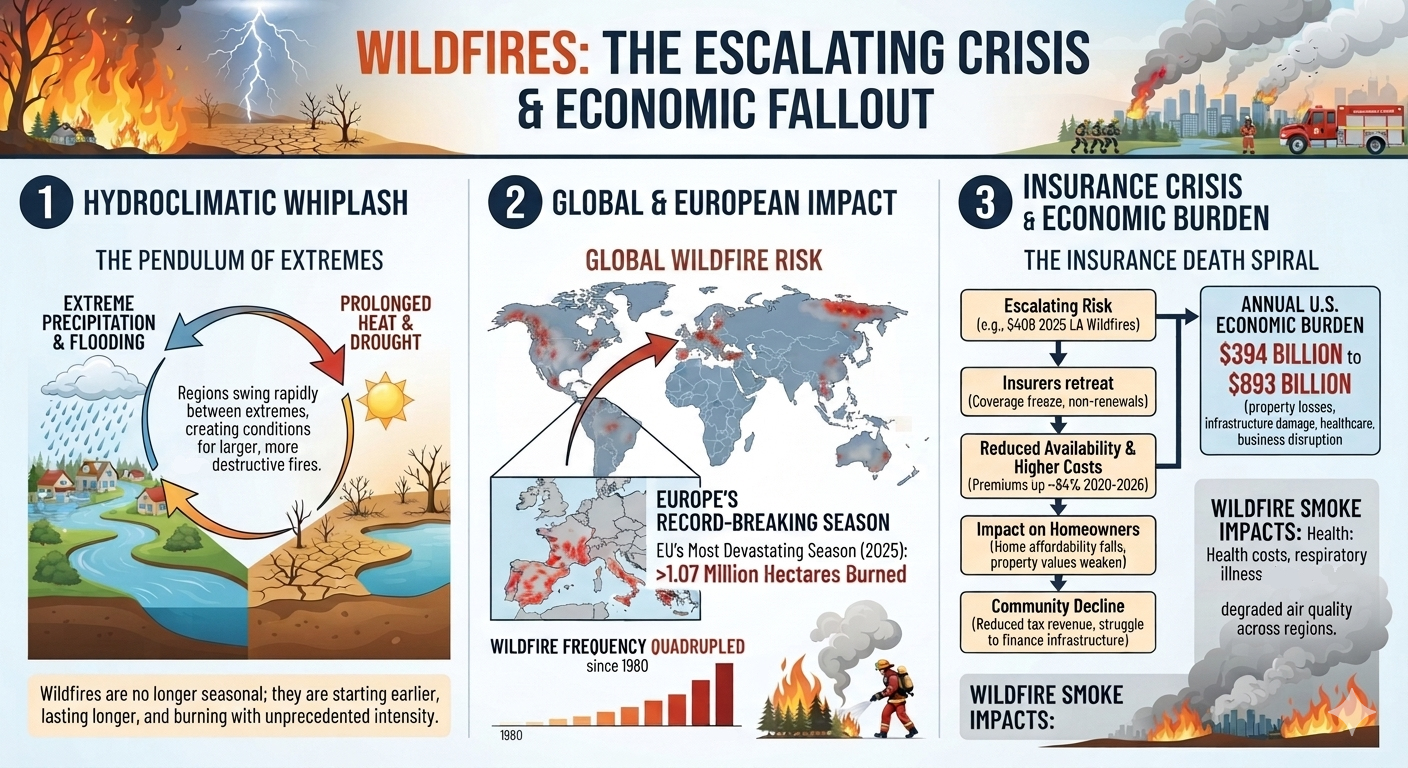
Hydroclimatic whiplash—the increasing tendency for regions to swing rapidly between extreme drought and extreme precipitation—is producing powerful climate extremes on both sides of the hydrological pendulum.
On one side, floods are becoming more frequent, intense, and prolonged. On the other, prolonged heat, declining soil moisture, and persistent drought are creating conditions that favor larger, faster-moving, and more destructive wildfires.
Wildfires are no longer seasonal events confined to traditionally fire-prone regions. In many parts of the world, wildfire seasons are starting earlier, lasting longer, and burning with unprecedented intensity. Areas that historically experienced only occasional fires are increasingly facing repeated and severe wildfire outbreaks.
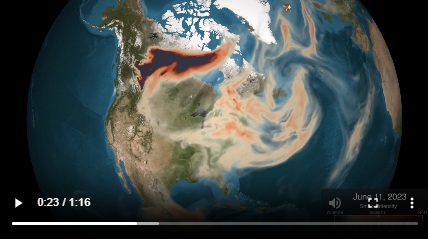
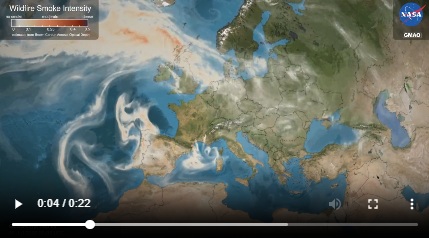
Global warming is exactly that—global. These two videos of the 2026 wildfire season provide a striking example.
The first video shows wildfire smoke spreading across North America. The second follows that smoke as it is transported across the atmosphere and circulates around the globe, reaching the UK and Europe.
The second video also captures smoke from wildfires burning across Spain, France, and Greece, along with massive fires in the Siberian forests.
Wildfire smoke does not recognize national borders—and neither does climate change. What happens in one part of the world can affect the atmosphere, climate, and air quality thousands of miles away.
Wildfire Smoke Over North America
Wildfire Smoke Over Europe
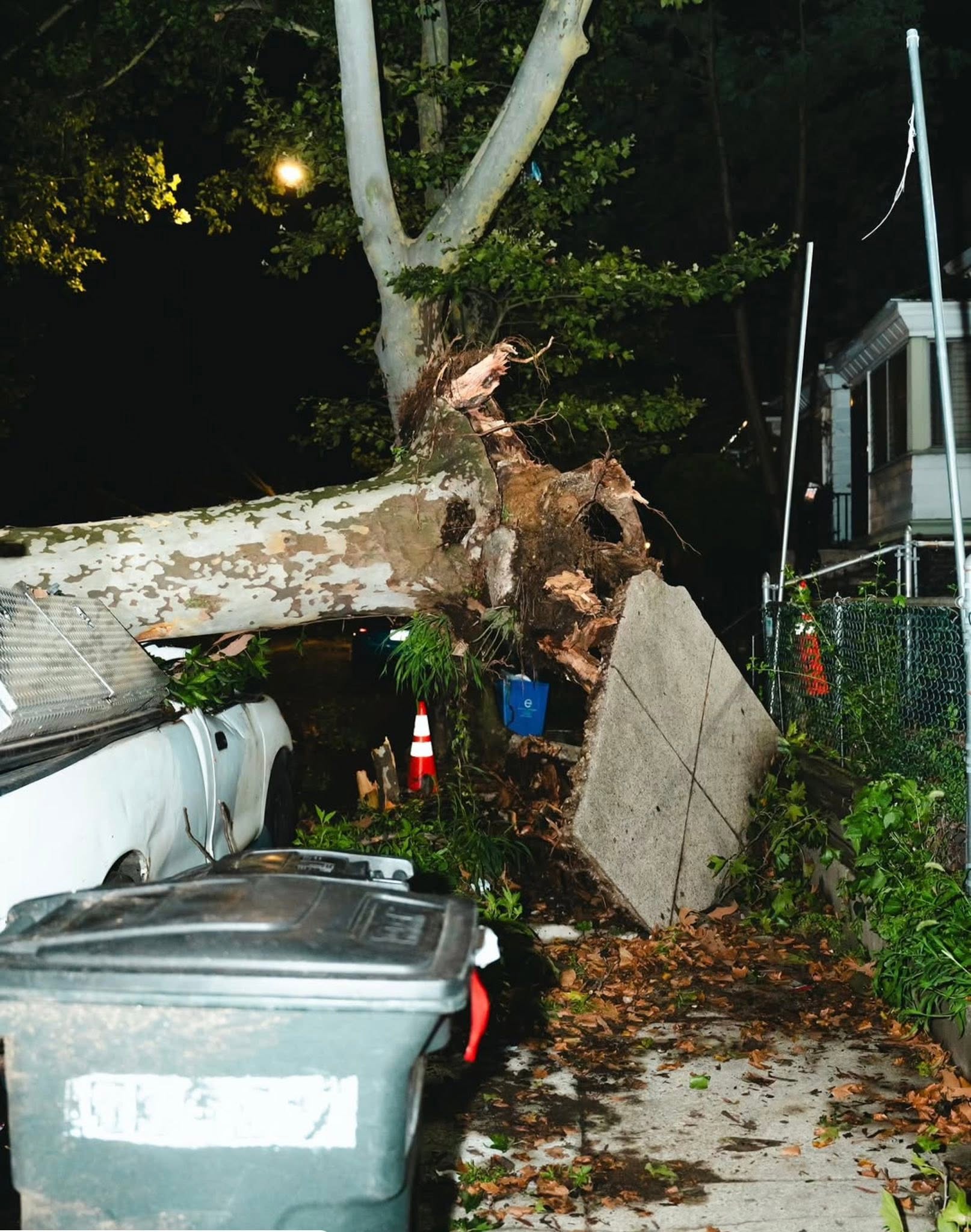
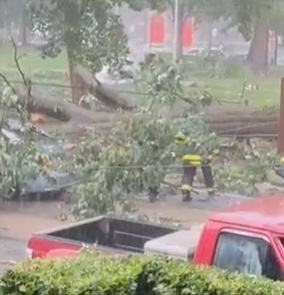
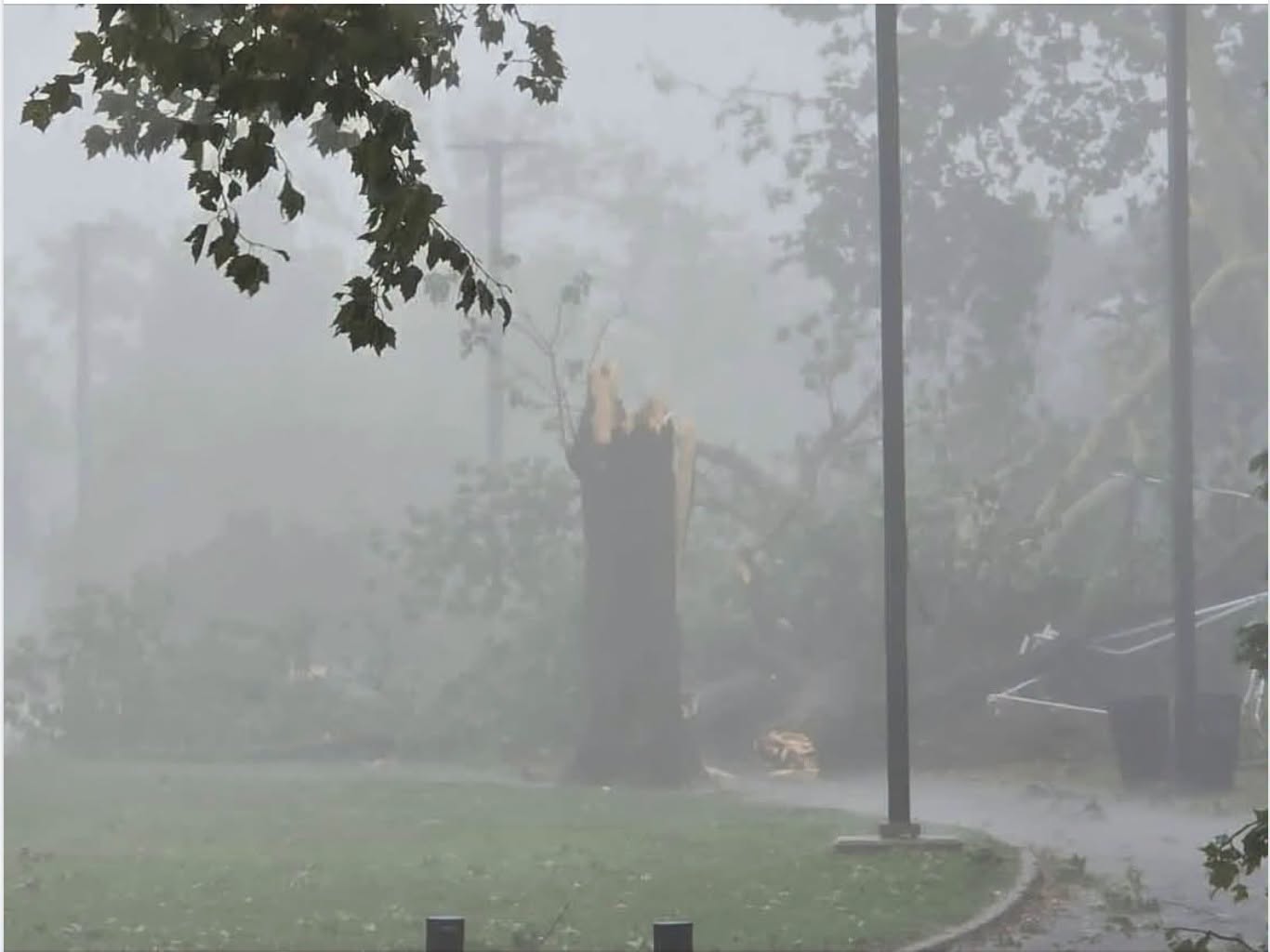
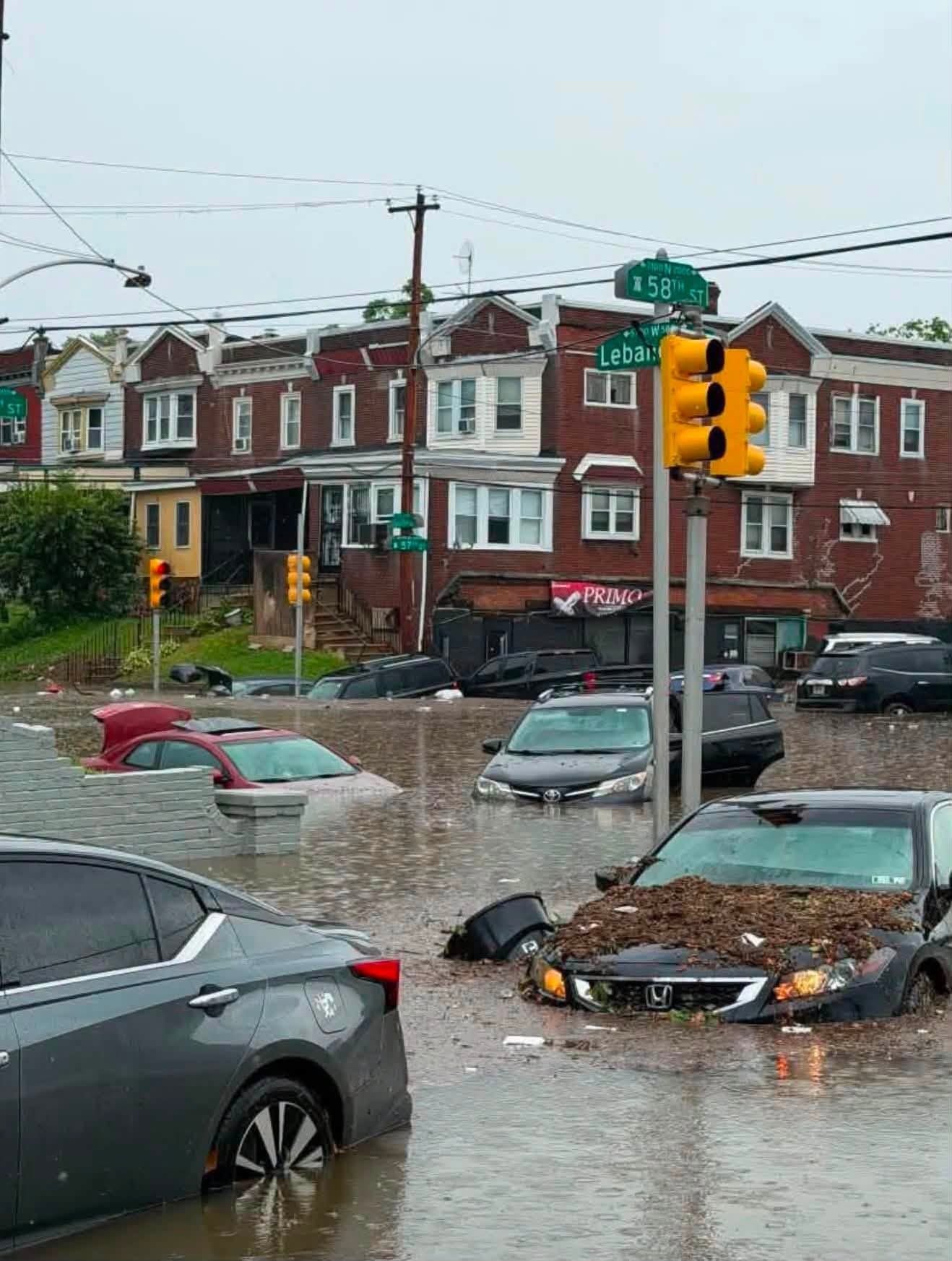
Microbursts, Extreme Energy Events, and a Warming Climate
Philadelphia, July 12, 2026
Microbursts: Violent Downdraft Spreading in All Directions
<-- ← WIND ← IMPACT → WIND → -->
Explodes Outward
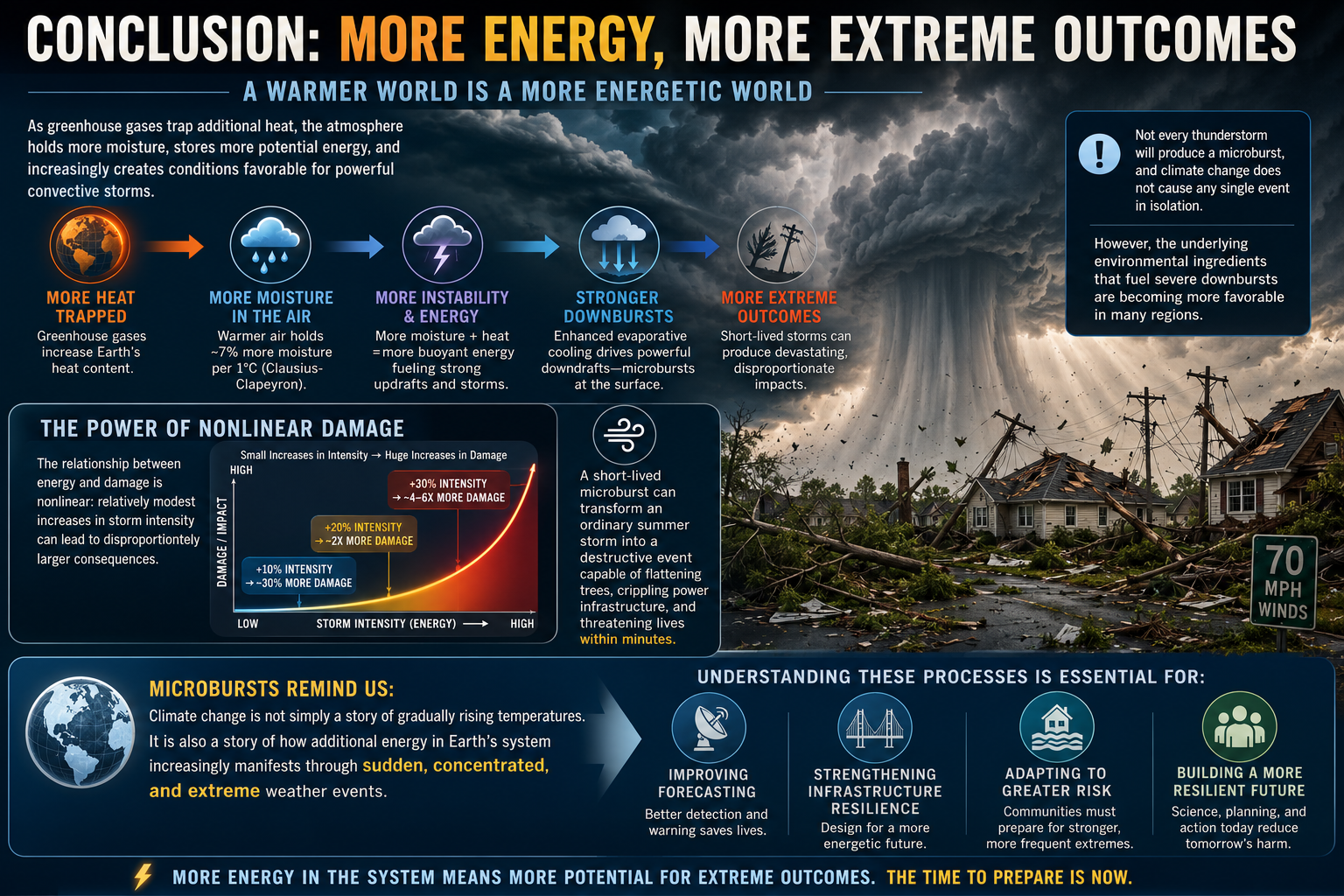
Microbursts illustrate a fundamental principle of climate physics: a warmer world is a more energetic world. As greenhouse gases trap additional heat, the atmosphere holds more moisture, stores more potential energy, and increasingly creates conditions favorable for powerful convective storms.
Not every thunderstorm will produce a microburst, and climate change does not cause any single event in isolation. However, the underlying environmental ingredients that fuel severe downbursts—greater atmospheric moisture, enhanced instability, stronger evaporative cooling, and shifting storm environments—are becoming more favorable in many regions.
Because the relationship between energy and damage is nonlinear, relatively modest increases in storm intensity can lead to disproportionately larger consequences. A short-lived microburst can transform an ordinary summer storm into a destructive event capable of flattening trees, crippling power infrastructure, and threatening lives within minutes.
Microbursts therefore serve as a reminder that climate change is not simply a story of gradually rising temperatures. It is also a story of how additional energy in Earth’s system increasingly manifests through sudden, concentrated, and extreme weather events. Understanding these processes is essential for improving forecasting, strengthening infrastructure resilience, and adapting to a climate system that is becoming progressively more volatile and energetic.
Violent Downdraft Spreading Outward in Straight-Line Winds
← WIND ← IMPACT ZONE → WIND →
Straight-Line Flow (No Rotation)
Scientists have detected an increase since the 1980s in what are known as straight-line winds, and climate change is playing a significant role. These winds, which are often associated with severe thunderstorms, can reach speeds exceeding 100 mph and cause damage similar to that of a tornado, but they move along a straight path. Recent studies indicate that climate change is contributing to an increase in the frequency and intensity of these wind events.
Straight-line winds, also known as derechos when they cover a particularly large area, are powerful, sustained winds that originate from downdrafts in thunderstorms. Unlike the rotating winds of a tornado, straight-line winds blow in a single direction, hence their name. These winds can flatten trees, knock down power lines, and cause extensive damage to buildings and infrastructure.
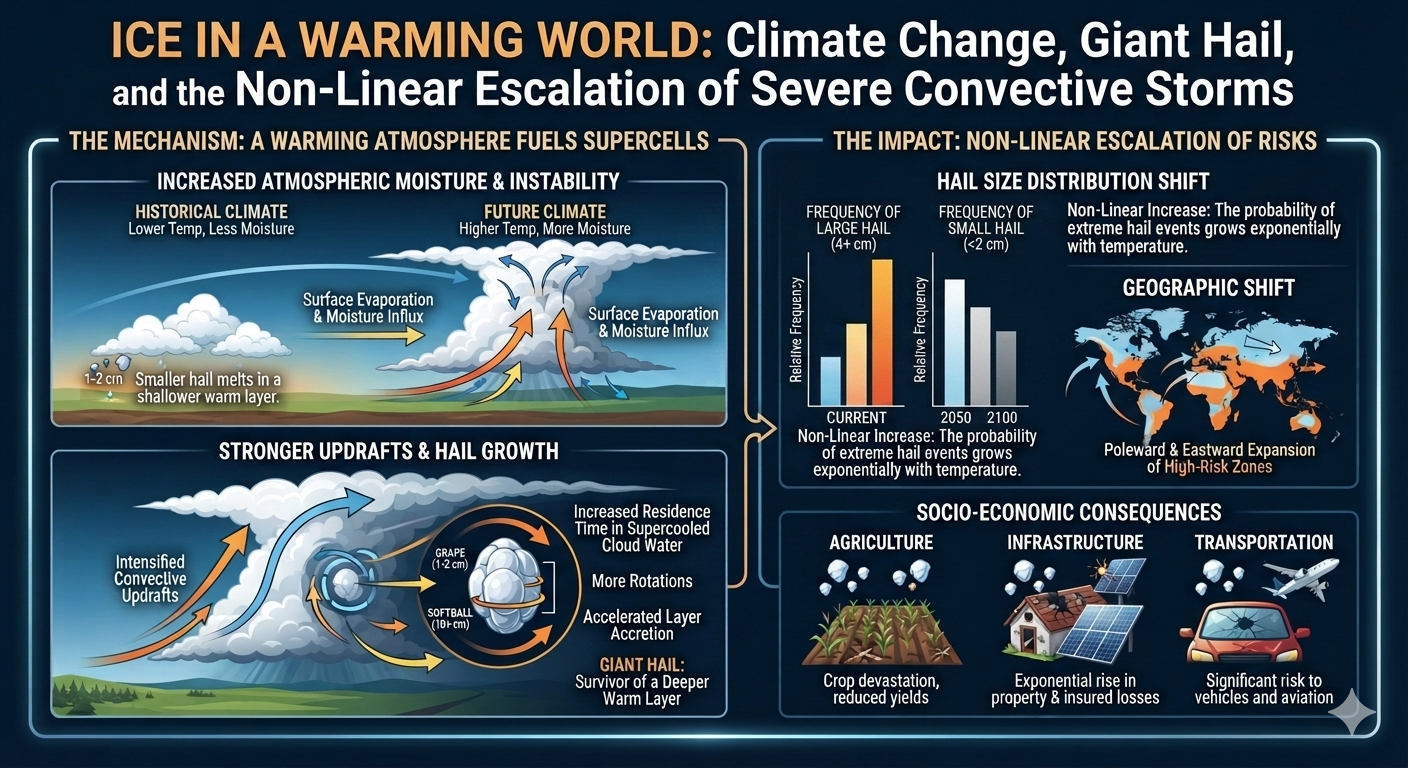
Giant Hail and the Nonlinear Escalation of Severe Convective Storms
Giant Hail and Severe Convective Storms
Hailstorms are among the most energetic convective weather systems on Earth. They develop inside powerful thunderstorms where intense upward air currents repeatedly lift developing ice particles through layers of supercooled water.
Each trip through the storm adds another layer of ice.
If the updraft remains strong enough, hailstones continue growing until gravity finally overcomes the upward force.
The stronger the storm, the larger the hail.
Large hail has become one of the fastest-growing sources of weather-related insurance losses worldwide, producing billions of dollars in damage each year
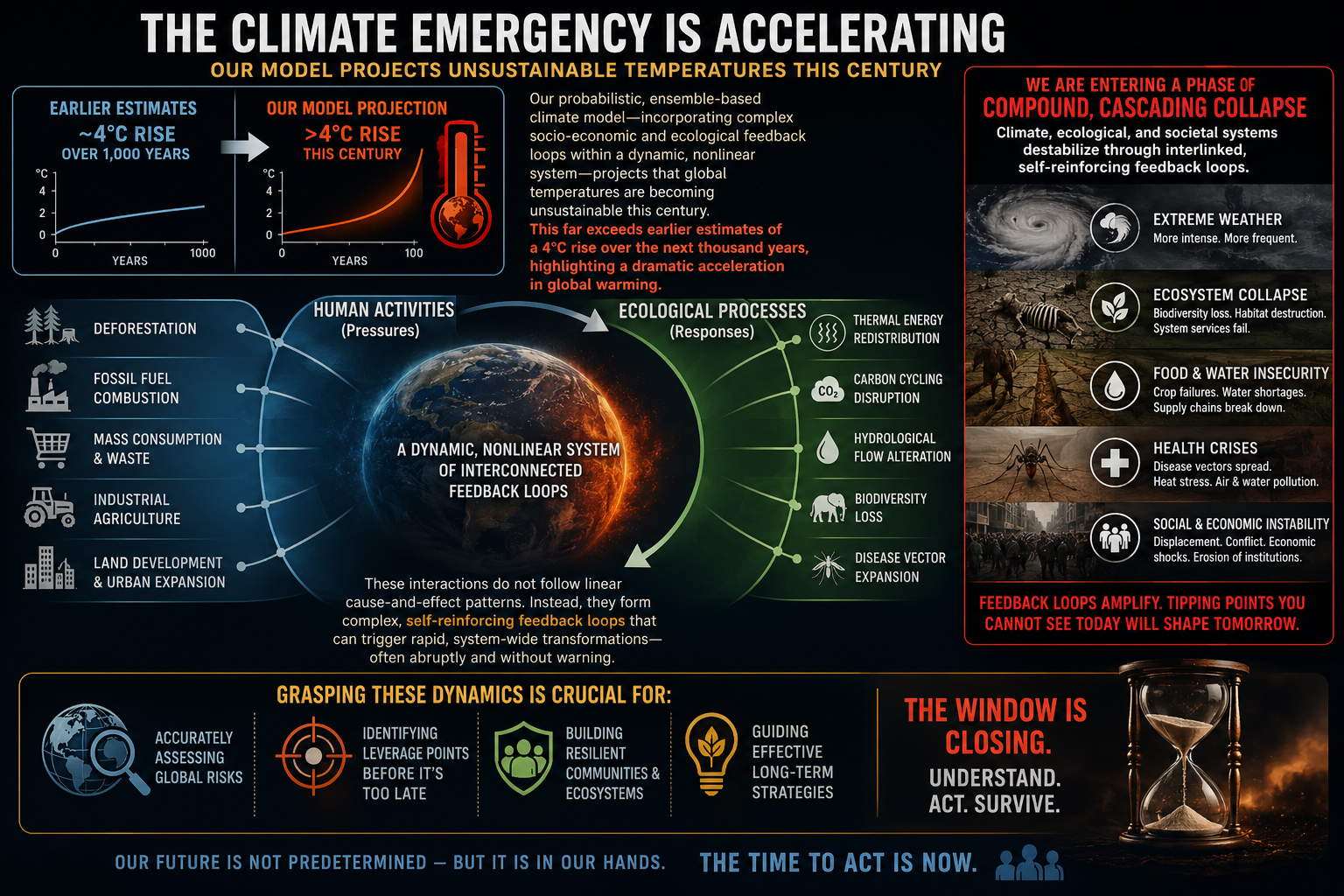
We examine how human activities — such as deforestation, fossil fuel combustion, mass consumption, industrial agriculture, and land development — interact with ecological processes like thermal energy redistribution, carbon cycling, hydrological flow, biodiversity loss, and the spread of disease vectors. These interactions do not follow linear cause-and-effect patterns. Instead, they form complex, self-reinforcing feedback loops that can trigger rapid, system-wide transformations — often abruptly and without warning. Grasping these dynamics is crucial for accurately assessing global risks and developing effective strategies for long-term survival.
Feedback Loops → Tipping Points → Acceleration → Domino Effect
Feedback loops amplify climate change and can push interconnected Earth systems past critical tipping points. As tipping points are crossed, they can trigger additional feedback loops and destabilize other climate systems. This cascading "Domino Effect" compresses timescales, accelerates change, and increases the risk of rapid, nonlinear climate transformations.
Bottom line:The question is no longer how warm the planet becomes, but how life on Earth can endure when change outpaces our ability to adapt.
We cannot control the laws of physics, but we can control our pollution. The most effective action is to stop burning fossil fuels.