Wildfires: The Rapid Intensification of Heat, Drought, Hydroclimatic Whiplash, and Wildfire Risk
Wildfires
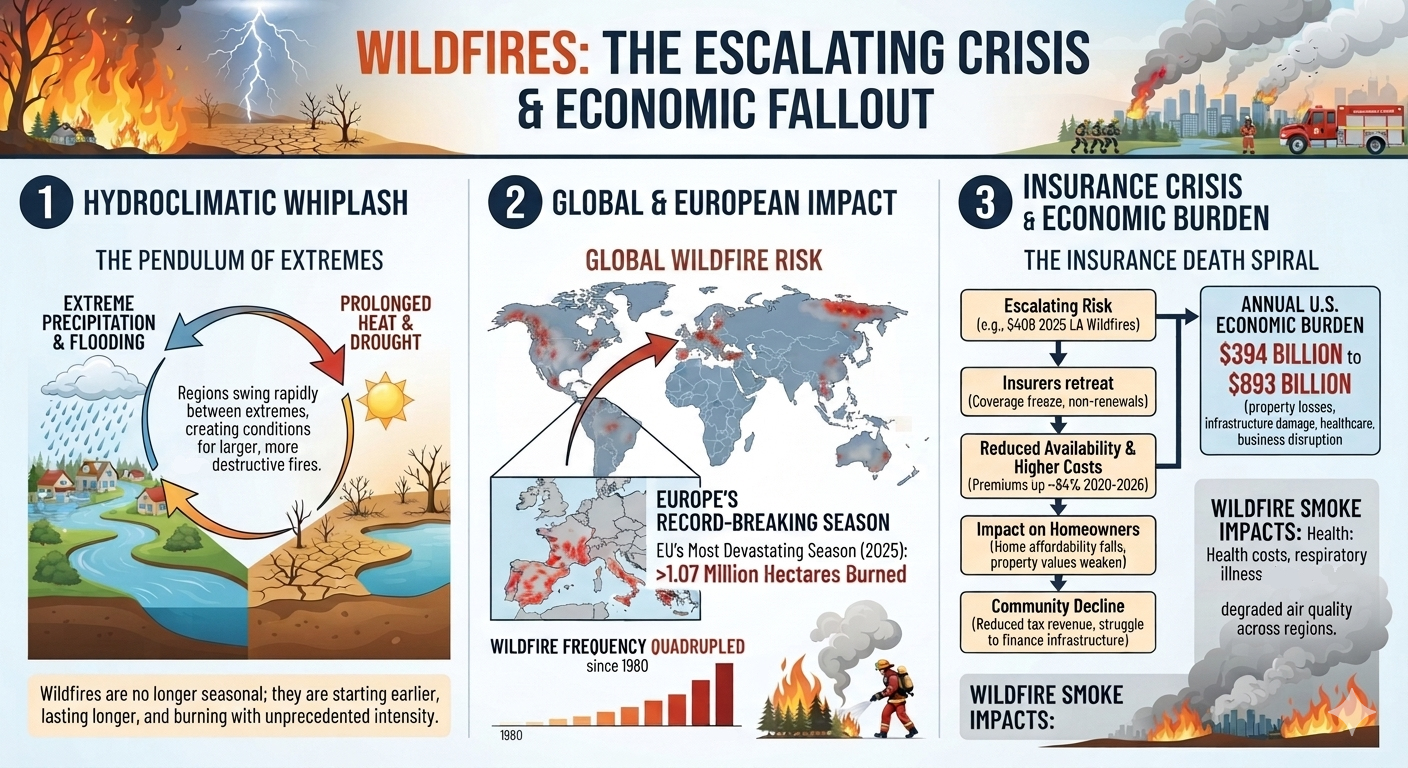
Hydroclimatic whiplash—the increasing tendency for regions to swing rapidly between extreme drought and extreme precipitation—is producing powerful climate extremes on both sides of the hydrological pendulum.
On one side, floods are becoming more frequent, intense, and prolonged. On the other, prolonged heat, declining soil moisture, and persistent drought are creating conditions that favor larger, faster-moving, and more destructive wildfires.
Wildfires are no longer seasonal events confined to traditionally fire-prone regions. In many parts of the world, wildfire seasons are starting earlier, lasting longer, and burning with unprecedented intensity. Areas that historically experienced only occasional fires are increasingly facing repeated and severe wildfire outbreaks.
The total economic burden of wildfires in the United States is estimated to range between approximately $394 billion and $893 billion annually. These costs include property losses, infrastructure damage, healthcare expenses from smoke exposure, business interruptions, ecosystem degradation, and long-term economic impacts. Collectively, these losses consume the equivalent of roughly 2 to 4 percent of the nation's gross domestic product.
Flash Droughts
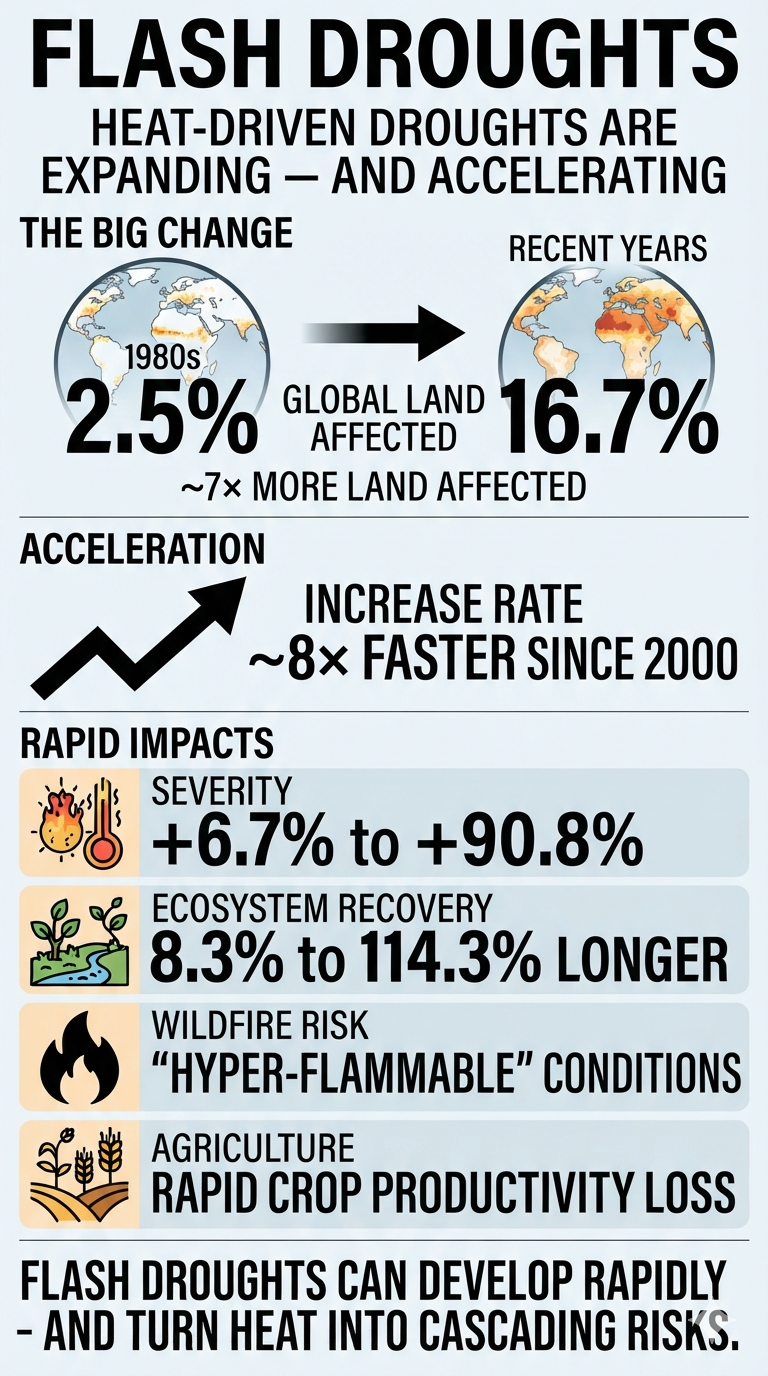
Flash droughts are one of the three fastest-accelerating climate extremes. The share of global land affected by heat-driven drought has expanded dramatically—from approximately 2.5% in the 1980s to 16.7% in recent years. The rate of increase has also accelerated, rising roughly eightfold since 2000.
This shift is important because heat-triggered droughts behave differently from conventional droughts. Rather than developing gradually over months or years, they can emerge within weeks, leaving agriculture, ecosystems, water managers, and communities with far less time to respond.
The Hyper-Flammability Multiplier
One of the most dangerous consequences occurs when a heat-triggered flash drought overlaps an existing conventional drought.
The slow drought has already depleted vegetation and soil moisture. The sudden arrival of extreme heat and atmospheric dryness then accelerates the drying process, pushing vegetation toward an exceptionally flammable state.
This creates a hyper-flammability multiplier:
Existing drought → Extreme heat + dry atmosphere → Rapid vegetation and soil drying → Loss of natural moisture + evaporative cooling → Hyper-flammable landscape → Faster-spreading, more intense wildfires
Once ignited, fires in these conditions can spread more rapidly, burn with greater intensity, and become substantially more difficult to contain.
Global Impact
Catastrophic climate shifts have dramatically increased wildfire risk worldwide. Since 1980, the frequency of socially disastrous wildfires has approximately quadrupled globally. Rising temperatures, prolonged droughts, declining snowpack, and increasingly erratic precipitation patterns are creating landscapes that are hotter, drier, and more combustible than at any time in modern history.
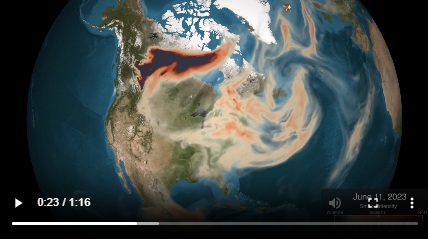
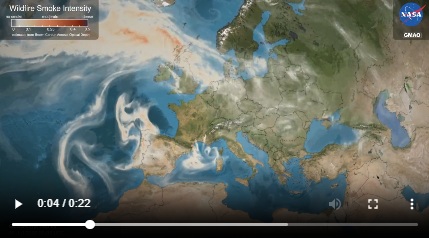
Global warming is exactly that—global. These two videos of the 2026 wildfire season provide a striking example.
The first video shows wildfire smoke spreading across North America. The second follows that smoke as it is transported across the atmosphere and circulates around the globe, reaching the UK and Europe.
The second video also captures smoke from wildfires burning across Spain, France, and Greece, along with massive fires in the Siberian forests.
Wildfire smoke does not recognize national borders—and neither does climate change. What happens in one part of the world can affect the atmosphere, climate, and air quality thousands of miles away.
Escalating Boreal Wildfires and Climate Feedbacks
Satellite observations indicate that extreme wildfires in Canada and Siberia have approximately doubled in both frequency and intensity over the past two decades. Driven by rising temperatures, changing precipitation patterns, and thawing permafrost, these regions are experiencing unprecedented increases in burn severity.
Global Impacts of Boreal Wildfires
- Air Quality and Health: Smoke from major boreal fires travels across international boundaries, routinely degrading air quality for millions of people throughout North America and Eurasia.
- Carbon Emissions: Massive releases of greenhouse gases from burning peatlands and forests can temporarily transform northern ecosystems from carbon sinks into net carbon sources.
- Climate Feedbacks: While wildfire smoke can temporarily cool the Arctic by blocking incoming sunlight, it also deposits soot on snow and ice, accelerating melting and reinforcing long-term warming.
Interconnected Climate Feedback Loops
The intensification of wildfires in Siberia and Canada initiates a series of interconnected feedback mechanisms that amplify both regional destruction and global climate change.
The Permafrost Thaw Loop
Northern permafrost contains nearly twice as much carbon as is currently present in Earth's atmosphere. Wildfires act as a powerful accelerant for its destabilization.
- Insulation Loss: Fires destroy the moss and peat layers that insulate permafrost from summer heat.
- Rapid Thawing: Exposed ground absorbs more solar energy, accelerating permafrost thaw.
- Thermokarst Formation: Thawing ground collapses, creating meltwater lakes and unstable landscapes.
- Methane Release: Microbial decomposition of newly thawed organic matter releases methane, a potent greenhouse gas.
The Mechanics of "Zombie Fires"
Also known as overwintering fires, zombie fires link consecutive fire seasons and eliminate the traditional winter reset for fire management.
- Peat Smoldering: Fires burn underground within carbon-rich peat deposits.
- Subsurface Survival: Deep snow insulates the smoldering fire throughout winter.
- Spring Reignition: The fire resurfaces when snow melts and vegetation dries.
- Longer Fire Seasons: Recurring ignitions extend fire seasons and increase cumulative burn area.
Loss of Carbon Sinks
Boreal forests have historically functioned as major global carbon sinks. Increasingly severe fire seasons threaten this critical climate service.
- Sink to Source: Extreme fire seasons can cause forests to release more carbon than they absorb.
- Soil Burn Severity: Deep fires consume centuries of accumulated organic soils in addition to living vegetation.
- Regeneration Failure: Extreme heat can destroy seed banks and hinder forest recovery.
- Ecosystem Shifts: High-severity burn areas may transition into grasslands or shrublands that store substantially less carbon.
Albedo and Aerosol Feedback Loops
Wildfires influence the climate through more than carbon emissions alone. Smoke aerosols and black carbon alter Earth's energy balance in ways that reinforce Arctic warming and accelerate ice loss.
- Black Carbon Deposition: Soot particles settle on snow, glaciers, and sea ice, darkening normally reflective surfaces.
- Albedo Reduction: Darkened snow and ice absorb more incoming solar radiation, increasing melt rates and exposing even darker land or ocean surfaces that absorb additional heat.
- Pyrocumulonimbus (PyroCb) Clouds: Intense wildfires can generate powerful thunderstorm clouds that inject smoke, ash, and black carbon high into the upper troposphere and lower stratosphere, allowing aerosols to spread across continents and persist for weeks or months.
- Regional Heat Trapping: Elevated smoke layers absorb and re-emit longwave (infrared) radiation, reducing nighttime heat loss and creating localized warming, particularly over high-latitude regions where cooling is already diminishing.
Wildfire Smoke: An Atmospheric Blanket That Raises Nighttime Temperatures
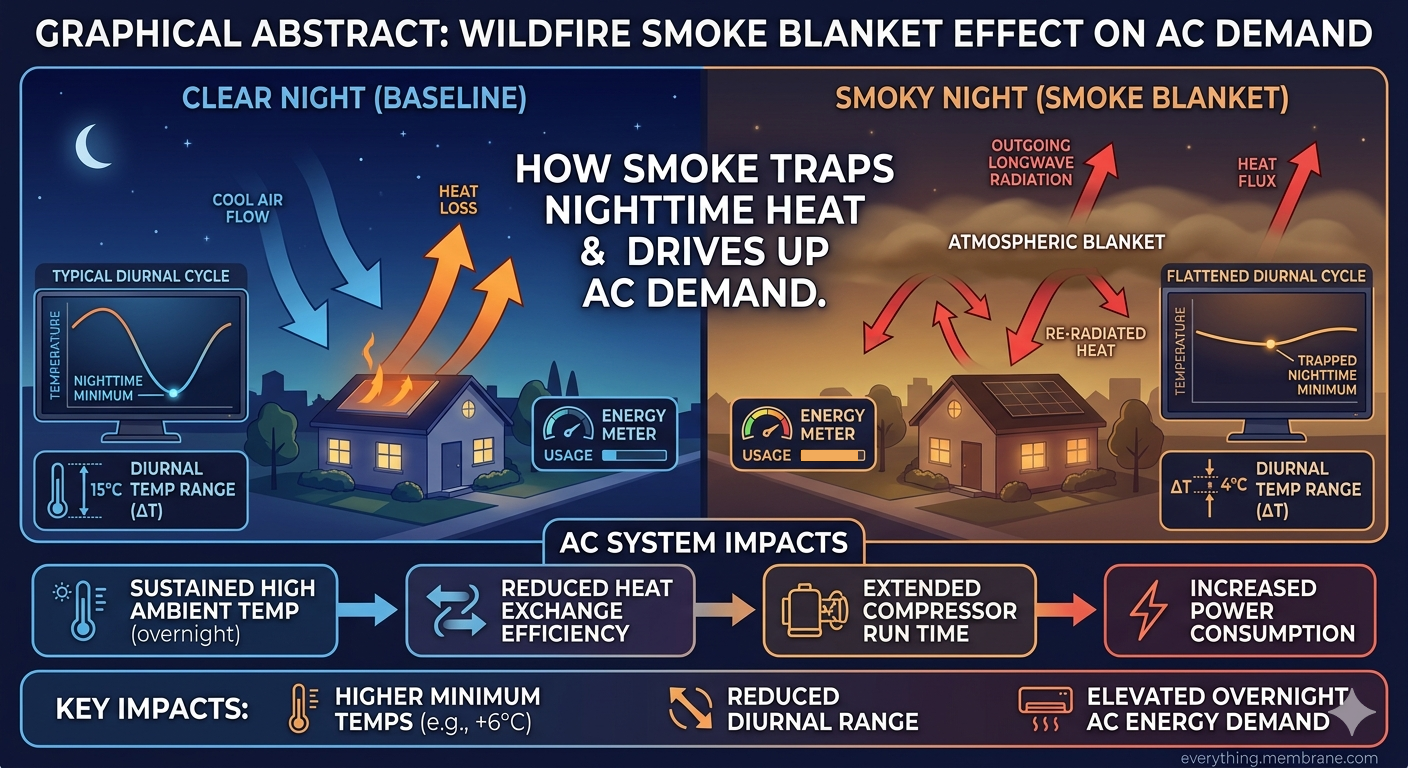
Wildfire smoke acts much like a temporary atmospheric blanket. While dense smoke often cools the surface during the day by reflecting and scattering incoming sunlight, it can produce the opposite effect after sunset by slowing the escape of heat from Earth's surface.
- Less outgoing infrared radiation escapes into space.
- More heat is retained within the lower atmosphere.
- Nighttime temperatures remain warmer than normal.
- The normal day-night temperature cycle becomes compressed, with cooler days but increasingly warm nights.
This loss of nighttime cooling is especially important because ecosystems, buildings, and people rely on cooler overnight temperatures to recover from daytime heat. As smoke becomes more persistent during wildfire seasons, these overnight warming effects can substantially increase cumulative heat stress.
How Wildfire Smoke Increases Air Conditioning Demand
The nighttime warming caused by wildfire smoke can significantly increase electricity demand for cooling. Buildings typically release accumulated heat overnight, allowing air conditioning systems to cycle less frequently before the next day's heating begins. When smoke prevents that overnight cooling, homes, offices, and commercial buildings begin each morning at a higher indoor temperature.
- Buildings retain more heat overnight.
- Air conditioners operate for longer periods and start earlier in the day.
- Peak electricity demand increases, placing additional stress on power grids during heat waves.
- Higher electricity consumption can increase greenhouse gas emissions in regions still dependent on fossil-fuel generation, creating another climate feedback loop.
This creates a compounding cycle: climate change increases wildfire frequency and intensity; wildfire smoke traps additional nighttime heat; warmer nights increase cooling demand; and increased energy use can contribute to additional greenhouse gas emissions where electricity is not fully decarbonized.
Climate Change → More Frequent and Intense Wildfires → More Smoke, Black Carbon, and Aerosols → Nighttime Heat Trapping + Black Carbon Deposition on Snow and Ice → Warmer Nights + Reduced Surface Albedo → Accelerated Regional Warming → Higher Air Conditioning Demand + Faster Arctic Ice Melt → Greater Greenhouse Gas Emissions (where grids are fossil-fuel powered) + Increased Solar Heat Absorption → Additional Global Warming → More Frequent and Intense Wildfires
Europe
Europe has emerged as a striking example of this new reality. The European Union experienced its most devastating wildfire season on record in 2025, with more than 1.07 million hectares of land burned—an area roughly equivalent to the size of Cyprus.
As the world's fastest-warming continent, Europe experienced thousands of wildfires across 25 nations during the 2025 season. The trend accelerated further in 2026, when a record-breaking June heatwave triggered unusually early and severe wildfires across France, Spain, Portugal, and Greece.
The impacts of wildfires extend far beyond the immediate burn zones. Smoke from major wildfires can travel hundreds or even thousands of miles, degrading air quality across entire regions. Exposure to wildfire smoke has been linked to respiratory illnesses, cardiovascular disease, increased hospitalizations, and premature mortality, imposing substantial public health and economic costs.
Escalating wildfire risks have also plunged the global property insurance industry into a structural crisis, causing a significant contraction in coverage availability and historic increases in homeowner insurance costs.
Climate-driven property losses—including the devastating 2025 Los Angeles wildfires, which alone generated approximately $40 billion in insured losses—have fundamentally altered how insurers assess and price risk. Wildfires now account for roughly 7 percent of global insured natural hazard losses, compared with approximately 1 percent just a decade ago.
According to a landmark Stanford University study, average homeowners' insurance premiums in fire-vulnerable areas increased by approximately 84 percent between late 2020 and mid-2026. During the same period, average deductibles rose from approximately $1,813 to $2,553, shifting an increasing share of disaster costs directly onto homeowners.
The Insurance Death Spiral
In many high-risk regions, insurers have begun freezing or abandoning entire geographic areas by restricting coverage based on broad ZIP code risk assessments. Major carriers have reduced their exposure by declining to renew policies, limiting new business, or withdrawing from particularly vulnerable markets altogether.
This insurance retreat creates a destructive feedback loop. As coverage becomes scarce and premiums rise, home affordability declines, property values weaken, and local tax revenues deteriorate. Communities increasingly struggle to finance infrastructure improvements and disaster resilience measures precisely when they need them most.
The Coverage Freeze
Insurance companies frequently impose immediate moratoriums on issuing new policies in areas threatened by active wildfires. During these periods, newly constructed homes and recently purchased properties may become temporarily uninsurable.
Because mortgage lenders generally require homeowners' insurance, the inability to obtain coverage can delay real estate transactions, reduce market liquidity, and in some cases make financing impossible. As wildfire risk continues to escalate, insurance availability itself is becoming one of the most significant economic consequences of climate change.
Fire Without Precedent: The Wildfire Escalation Reshaping the Pacific Northwest and Alaska
Foundational Wildfire Research
Extreme Weather Events
Extreme Impacts: Extreme Weather Events | Violent Rain | Deadly Humid Heat | Sea Level Rise | Insurance
Ecosystems & Feedbacks: Ecosystem Collapse & Extinction Risks | Soil–Insect Climate Feedback Collapse | Insect Collapse | Soil | Trees & Deforestation
Human Health & Society: Climate Change Business & Economics | DIY Climate Control | Climate & Human Health | Climate Tax | Limits of Human Adaptability | Climate-Driven Health Collapse | Food & Water Security | Civilization Collapse