Complex Social-Ecological Feedback Loops, Climate Change, and You
by Daniel Brouse and Sidd Mukherjee
December 11, 2025 | Updated March 9, 2026
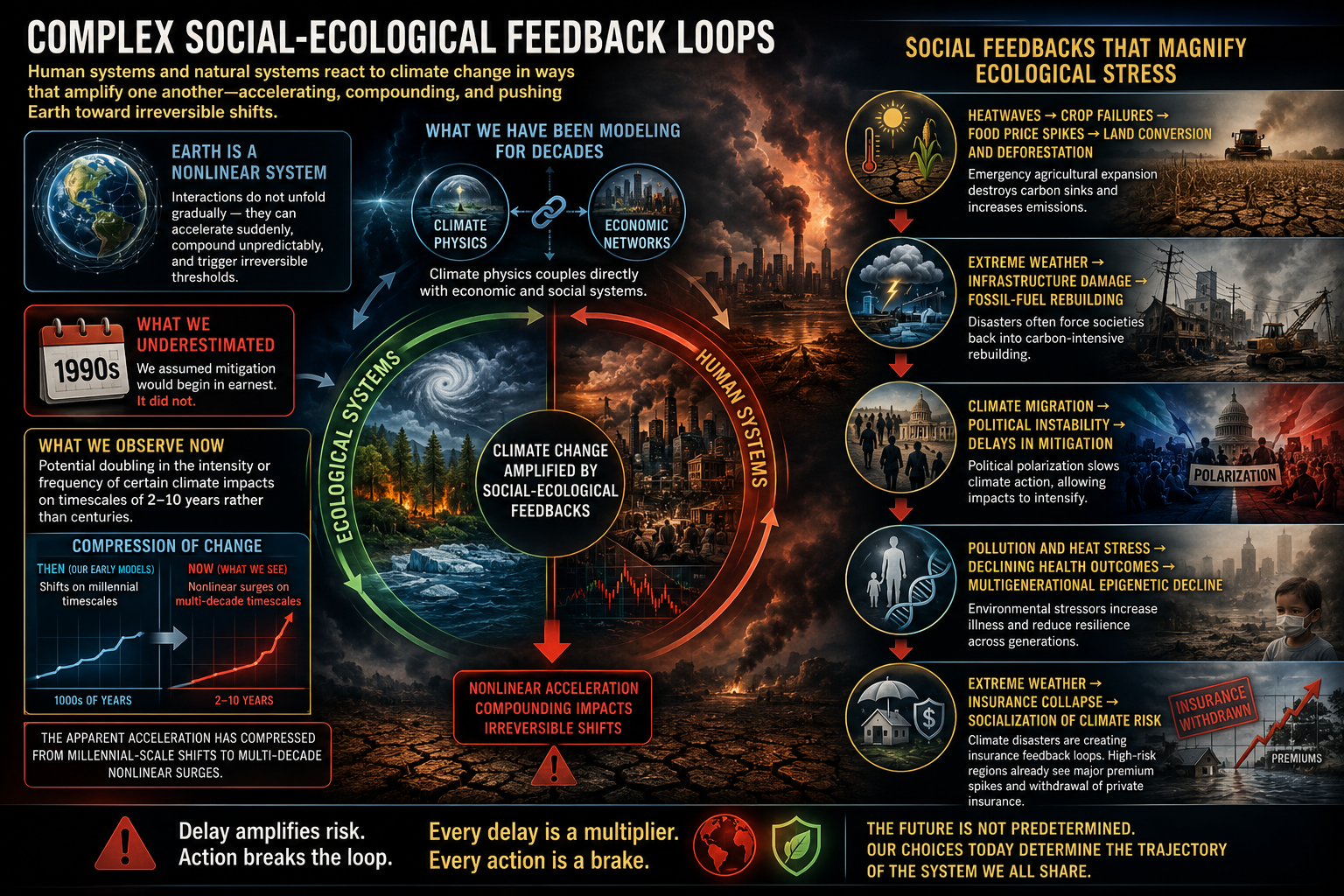
Complex social-ecological feedback loops arise when human systems and natural systems react to climate change in ways that amplify one another. Because Earth's climate operates as a nonlinear system, these interactions do not unfold gradually — they can accelerate suddenly, compound unpredictably, and push the system toward irreversible shifts.
This nonlinear, cross-regional feedback behavior is something we have been modeling for decades — where climate physics couples directly with economic networks.
In the 1990s we underestimated one variable: human delay. We assumed mitigation would begin in earnest. It did not.
Now we observe potential doubling in the intensity or frequency of certain climate impacts on timescales of 2–10 years rather than centuries. The apparent acceleration has compressed from millennial-scale shifts to multi-decade nonlinear surges.
Denialism and Ecofascism
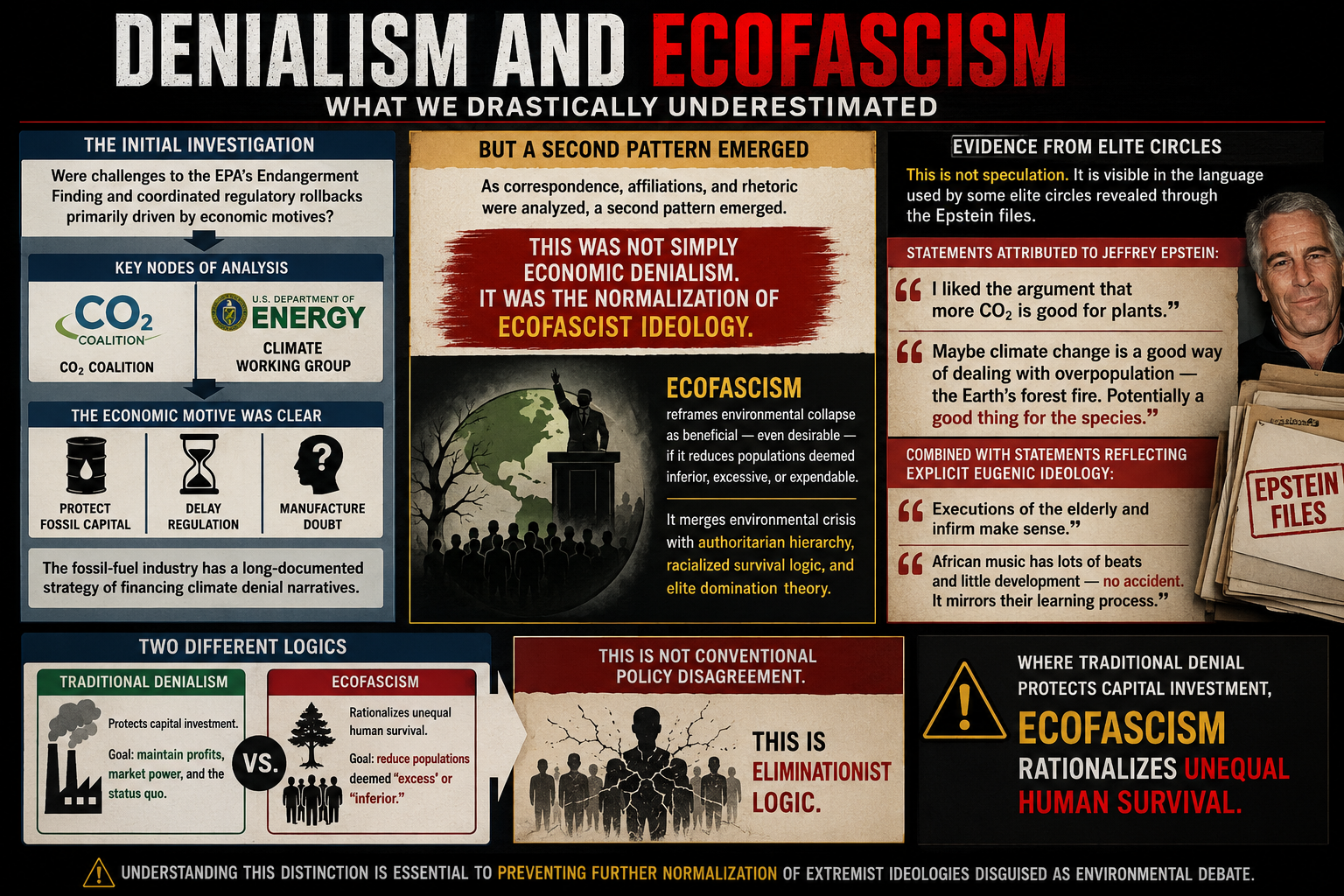
One factor we drastically underestimated was the influence of organized denialism and emerging ecofascist ideology.
Initially the investigation focused on a straightforward institutional question:
Were challenges to the EPA's Endangerment Finding and coordinated regulatory rollbacks primarily driven by economic motives — specifically the fossil-fuel industry's long-documented strategy of financing climate denial narratives?
Organizations such as the CO₂ Coalition and the Department of Energy's Climate Working Group were key nodes of analysis. The economic motive was clear and well documented: protect fossil capital, delay regulation, and manufacture doubt.
But as correspondence, affiliations, and rhetoric were analyzed, a second pattern emerged.
This was not simply economic denialism. It was the normalization of ecofascist ideology.
Ecofascism reframes environmental collapse as beneficial — even desirable — if it reduces populations deemed inferior, excessive, or expendable. It merges environmental crisis with authoritarian hierarchy, racialized survival logic, and elite domination theory.
This is not speculation. It is visible in the language used by some elite circles revealed through the Epstein files.
Examples include statements attributed to Jeffrey Epstein such as:
- "I liked the argument that more CO₂ is good for plants."
- "Maybe climate change is a good way of dealing with overpopulation — the Earth's forest fire. Potentially a good thing for the species."
Combined with statements reflecting explicit eugenic ideology:
- "Executions of the elderly and infirm make sense."
- "African music has lots of beats and little development — no accident. It mirrors their learning process."
This is not conventional policy disagreement. This is eliminationist logic.
Where traditional denial protects capital investment, ecofascism rationalizes unequal human survival.
Ecofascism and Denialism 101
1. Ecological Feedbacks That Intensify Climate Forcing
-
Drought → wildfire → CO₂ release → more warming
Forests that once absorbed carbon burn or die back, turning into major carbon sources. -
Warming → permafrost thaw → methane release → more warming
Methane spikes accelerate heat faster than CO₂, deepening the cycle. -
Ocean warming → ice melt → reduced albedo → more ocean heat absorption
Each stage magnifies the next, accelerating polar destabilization.
2. Social Feedbacks That Magnify Ecological Stress
-
Heatwaves → crop failures → food price spikes → land conversion and deforestation
Emergency agricultural expansion destroys carbon sinks and increases emissions. -
Extreme weather → infrastructure damage → fossil-fuel rebuilding
Disasters often force societies back into carbon-intensive rebuilding. -
Climate migration → political instability → delays in mitigation
Political polarization slows climate action, allowing impacts to intensify. -
Pollution and heat stress → declining health outcomes → multigenerational epigenetic decline
Environmental stressors increase illness and reduce resilience across generations. -
Extreme weather → insurance collapse → socialization of climate risk
Climate disasters are creating insurance feedback loops. High-risk regions are already seeing major premium spikes and withdrawal of private insurance.
3. Coupled Social-Ecological Feedbacks
- Water scarcity drives conflict and unsustainable groundwater extraction, which collapses ecosystems and worsens scarcity.
- Heat-related crop loss drives fertilizer overuse, degrading soils and increasing nitrous oxide emissions.
- Economic disruptions prompt short-term fossil expansion ("energy security"), increasing emissions and worsening future disruptions.
Because these systems are nonlinear, small increases in stress can produce enormous impacts. They also shorten the doubling time of climate damages.
4. Why Nonlinear Systems Accelerate
- A shift in one system — ice loss, jet stream distortion, coral collapse, crop failure — alters the boundary conditions for other systems.
- Those altered conditions accelerate the next shift.
- That shift accelerates the next.
The result is runaway co-acceleration, where feedback loops reinforce not only one another but their own previous states.
This produces the compound systemic destabilization we are beginning to observe globally.
5. Empirical Confirmation
In March 2026 the paper Global economic exposure to climate change amplified by spatially compounding climate extremes confirmed an important element of this research.
The study found that climate extremes increasingly occur simultaneously across multiple regions. Because global food production, trade, finance, and insurance systems are interconnected, these simultaneous shocks compound economic risk.
Climate impacts do not remain local. When heatwaves, droughts, or floods strike several regions at once, the resulting economic disruptions cascade across the global system.
This is exactly the nonlinear cross-regional feedback behavior we have long modeled: climate physics interacting directly with global economic networks.
* Our probabilistic, ensemble-based climate model — which incorporates complex socio-economic and ecological feedback loops within a dynamic, nonlinear system — projects that global temperatures are becoming unsustainable this century. This far exceeds earlier estimates of a 4°C rise over the next thousand years, highlighting a dramatic acceleration in global warming. We are now entering a phase of compound, cascading collapse, where climate, ecological, and societal systems destabilize through interlinked, self-reinforcing feedback loops.
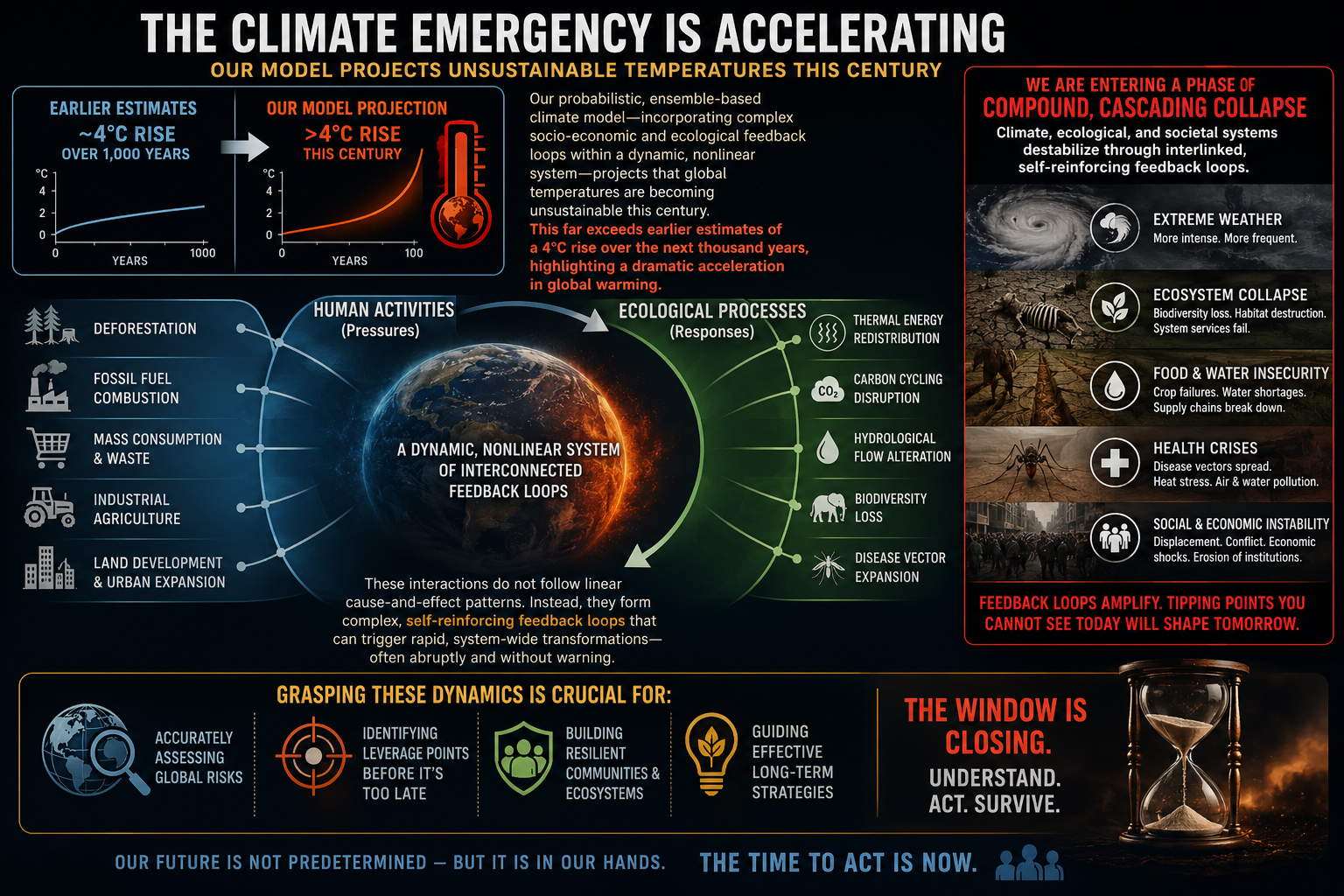
We examine how human activities — such as deforestation, fossil fuel combustion, mass consumption, industrial agriculture, and land development — interact with ecological processes like thermal energy redistribution, carbon cycling, hydrological flow, biodiversity loss, and the spread of disease vectors. These interactions do not follow linear cause-and-effect patterns. Instead, they form complex, self-reinforcing feedback loops that can trigger rapid, system-wide transformations — often abruptly and without warning. Grasping these dynamics is crucial for accurately assessing global risks and developing effective strategies for long-term survival.
What Can I Do?
The single most important action to address the climate crisis is simple: stop burning fossil fuels.
Each person shares responsibility to reduce pollution, lower consumption, and foster a culture of care for the planet.
In chaos theory, the Butterfly Effect shows that small changes in one place can produce large changes elsewhere.
Be a butterfly and affect the world.
Resources
- Ecofascism and Denialism 101 -- Brouse (March 2026)
- The Accidental Fascist Hunter: How a Climate Investigation Uncovered Ecofascist Networks -- Brouse (March 2026)
- Nonlinear Climate Acceleration and the Convergence of Ecofascist and Eugenics Ideologies -- Brouse & Mukherjee (February 2026)
- The DOE Climate Working Group: Legal Violations, Ideological Networks, and Ecofascist Connections -- Brouse (February 2026)
- Bounded but Accelerating: Nonlinear Climate Dynamics and the Real Risk Landscape of the 21st Century -- Brouse & Mukherjee (February 2026)
- Cracked Fractals: Climate Thermodynamics, Insurance Instability, and Sovereign Debt Transmission in Late-Stage Capitalism -- Brouse (February 2026)
- Youth Mental and Physical Health in the Era of Accelerating Climate Extremes -- Brouse (February 2026)
- The Collapse Point: How Climate Change Is Breaking Insurance — and Capitalism With It -- Brouse & Mukherjee (November 2025)
Tipping points and feedback loops drive the acceleration of climate change. When tipping points trigger others, cascading collapse can occur — the Domino Effect.
Extreme Impacts: Extreme Weather Events | Violent Rain | Deadly Humid Heat | Sea Level Rise | Insurance
Ecosystems & Feedbacks: Ecosystem Collapse & Extinction Risks | Soil–Insect Climate Feedback Collapse | Insect Collapse | Soil | Trees & Deforestation
Human Health & Society: Climate Tax | Climate & Human Health | Limits of Human Adaptability | Climate-Driven Health Collapse | Food & Water Security | Civilization Collapse
Bottom line: The question is no longer how warm the planet becomes, but how life on Earth can endure when change outpaces our ability to adapt.
We cannot control the laws of physics, but we can control our pollution. The most effective action is to stop burning fossil fuels.