Ecofascism and Denialism 101
A Meta-Analysis
March 14, 2026
Introduction
By systematically coding behaviors and rhetoric, this research identifies demographic patterns, behavioral characteristics, and ideological markers associated with denialist and ecofascist individuals. Findings indicate that these forms of discourse are dominated by specific demographic groups, exhibit distinctive behavioral traits, and reveal the intersection of ideological and scientific ignorance.
- Denialism: Identified by the outright rejection of scientific evidence, refusal to engage with empirical data, and reliance on misinformation or rhetorical obfuscation. Denialism is fundamentally rooted in self-interest.
- Ecofascism: Identified by denialism combined with aggressive, hostile, and mocking behavior, often accompanied by ideological framing that rationalizes environmental collapse as beneficial for select populations, eugenics, and elite networks surviving over “inferior genes.” Ecofascism is fundamentally rooted in beliefs about genetic superiority.
Background
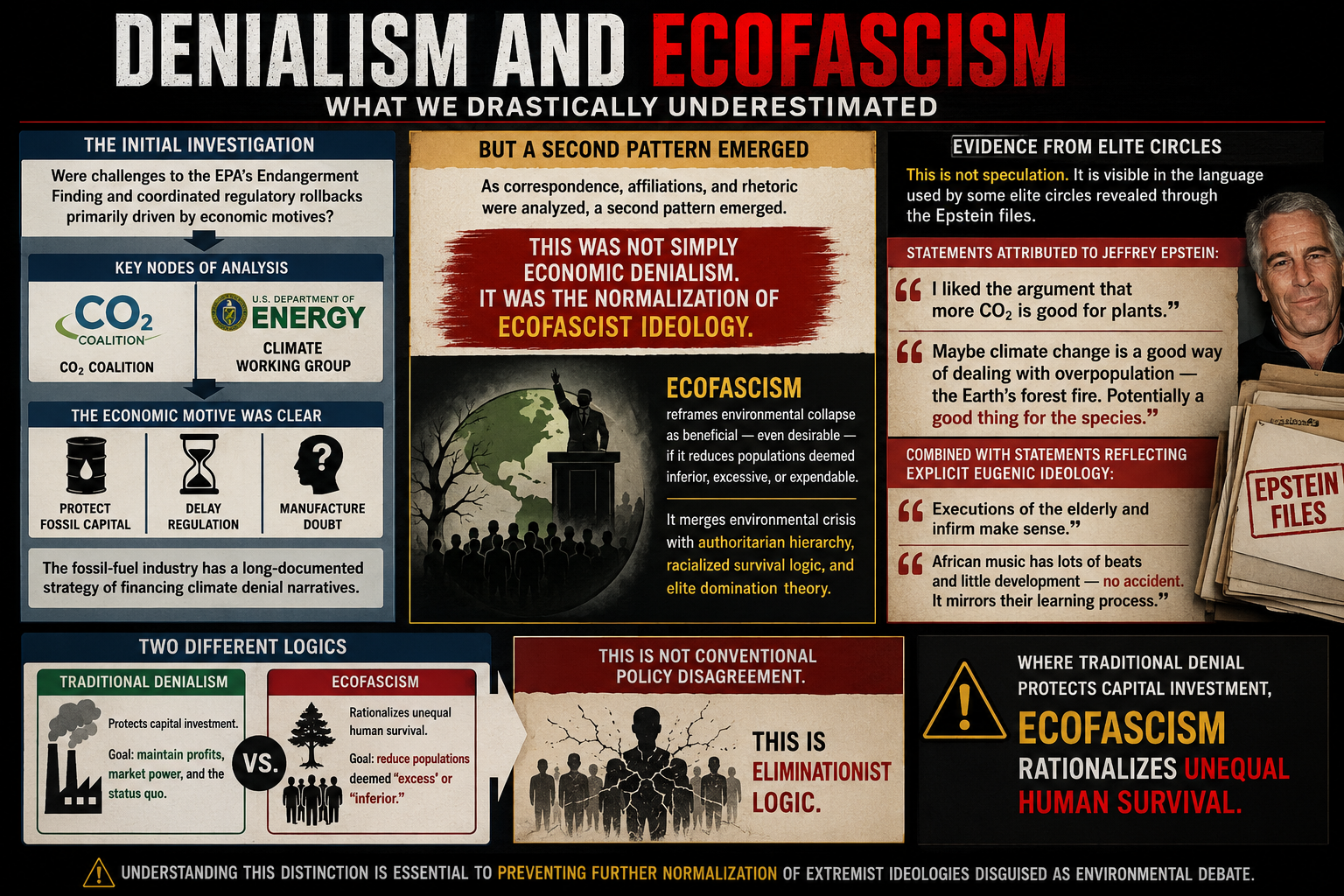
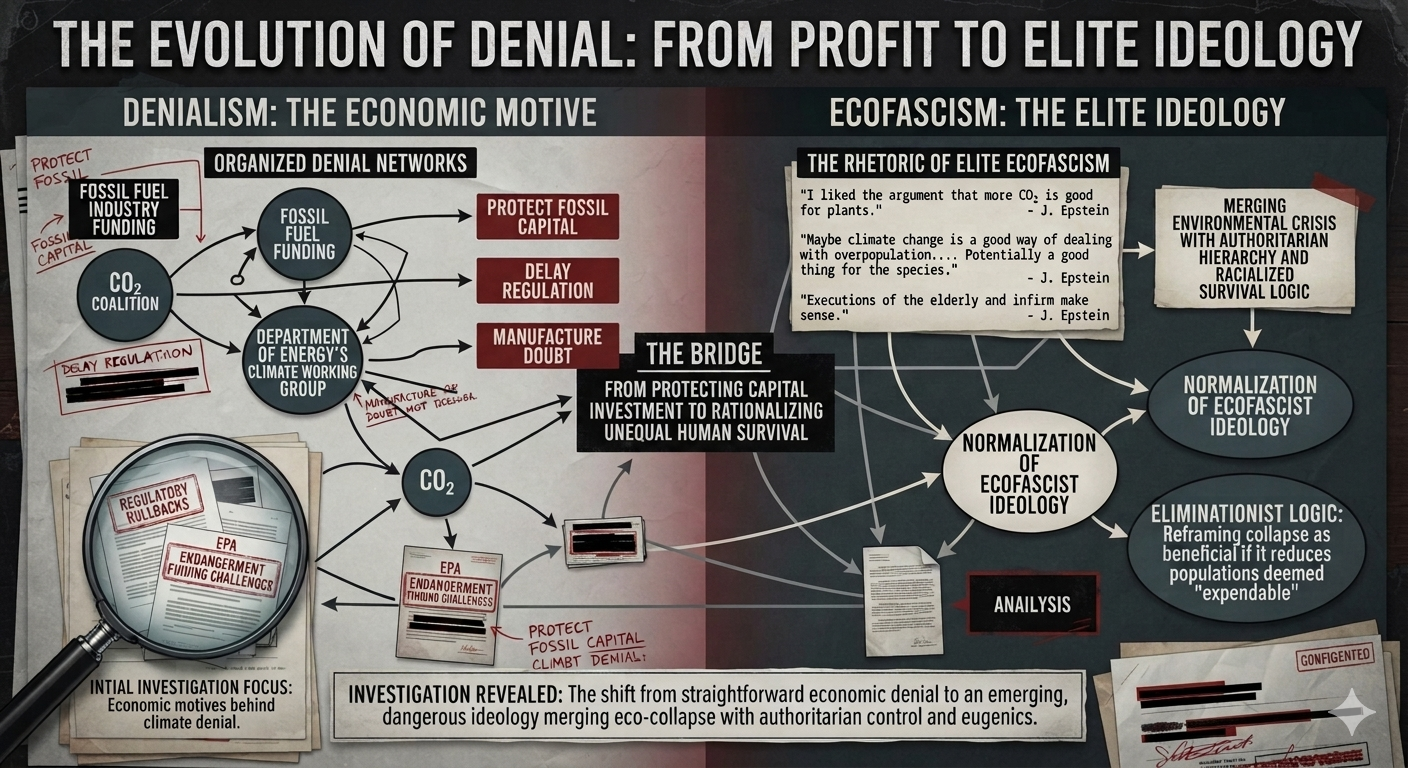
I initially began investigating denialism and the CO₂ Coalition in the spring of 2025, tracing its connections to the Department of Energy’s Climate Working Group (CWG). My early hypothesis focused on profit: fossil fuel interests fund campaigns to cast doubt on the scientific consensus to protect investments and delay regulation. While this motive exists, it did not fully explain the patterns emerging from elite networks.
It wasn’t until the release of the Epstein Files that the ideological dimension became clear. Analysis of correspondence, affiliations, and rhetoric revealed a second pattern: this was not merely economic denialism, but the normalization of ecofascism. Ecofascism frames environmental collapse as beneficial—even desirable—if it reduces populations deemed inferior, excessive, or expendable. It merges environmental crisis with authoritarian hierarchy, racialized survival logic, and elite domination theory.
This is not speculation; it is evident in language. Publicly released statements attributed to Jeffrey Epstein include:
“I liked the argument that more CO₂ is good for plants.”
This statement echoes the central messaging long promoted by the CO₂ Coalition, which similarly frames increased atmospheric CO₂ as broadly beneficial due to its role in plant growth.
Combined with explicit eugenic ideology:
“Maybe climate change is a good way of dealing with overpopulation—the earth’s forest fire. Potentially a good thing for the species.”
“Executions of the elderly and infirm make sense.”
“African music has lots of beats and little development—not an accident. It mirrors their learning process.”
This is not conventional policy disagreement. It is eliminationist logic: where traditional denial protects capital, ecofascism rationalizes unequal human survival.
Based on two years of combined denialism and ecofascism analysis:
- ~10% appear to understand the science and knowingly promote harmful narratives consistent with ecofascist ideology.
- ~90% do not understand the science but adopt denialist rhetoric as identity reinforcement.
- A measurable subset demonstrate impaired abstract reasoning capacity, making them highly susceptible to manipulation and propaganda.
The analysis focused on several thousand interactions on English-language social media sites and forums. Individual responses were coded according to their engagement with climate science. Demographic data, when inferable from public profiles, were recorded, including age, gender, and country of origin. Behavioral patterns and rhetorical strategies were systematically categorized.
Denialism
- Predominantly displayed by individuals who refused to engage with empirical evidence, often relying on anecdotal reasoning or misinformation.
- Demographics: 98% white males, mean age 42.
- Geography: Primarily from the United States, Canada, Australia, the EU, and the United Kingdom.
Ecofascism
- Characterized by denialism combined with overt hostility, ridicule, and ideological framing that links climate mitigation to authoritarian or exclusionary goals.
- Demographics: 100% white males, mean age 47.
- Geography: Same as above — U.S., Canada, Australia, the EU, and the U.K.
- Behavioral Indicators: Repeated use of mocking or disparaging language, attempts to discredit scientific authority, and framing environmental issues through racial, hierarchical, or eliminationist logic.
- Political Affiliation: 100% identified as far-right.
Discussion
The findings indicate that online climate denialism is largely concentrated within specific demographic groups and is often reinforced by identity and ideological alignment rather than by scientific literacy. Ecofascist rhetoric represents a more extreme subset, wherein denialist positions are fused with authoritarian, exclusionary, or eugenicist ideologies. Both denialism and ecofascism act as significant barriers to constructive public discourse, perpetuating misinformation and obstructing meaningful engagement with climate science.
An unexpected finding was the disproportionately high representation of Canadians employed in the timber industry, suggesting the possibility of sector-specific cultural, economic, or occupational influences on climate-change skepticism and related rhetoric. Interactions also suggested a potentially significant presence of similar viewpoints in Russia; however, the study was limited primarily to English-language communications, preventing a thorough analysis of non-English-speaking populations.
This is ongoing research.
The dataset now includes tens of thousands of observed interactions.
Fortunately, a growing network of citizen scientists has begun assisting in documentation and data collection.
* Our probabilistic, ensemble-based climate model — which incorporates complex socio-economic and ecological feedback loops within a dynamic, nonlinear system — projects that global temperatures are becoming unsustainable this century. This far exceeds earlier estimates of a 4°C rise over the next thousand years, highlighting a dramatic acceleration in global warming. We are now entering a phase of compound, cascading collapse, where climate, ecological, and societal systems destabilize through interlinked, self-reinforcing feedback loops.
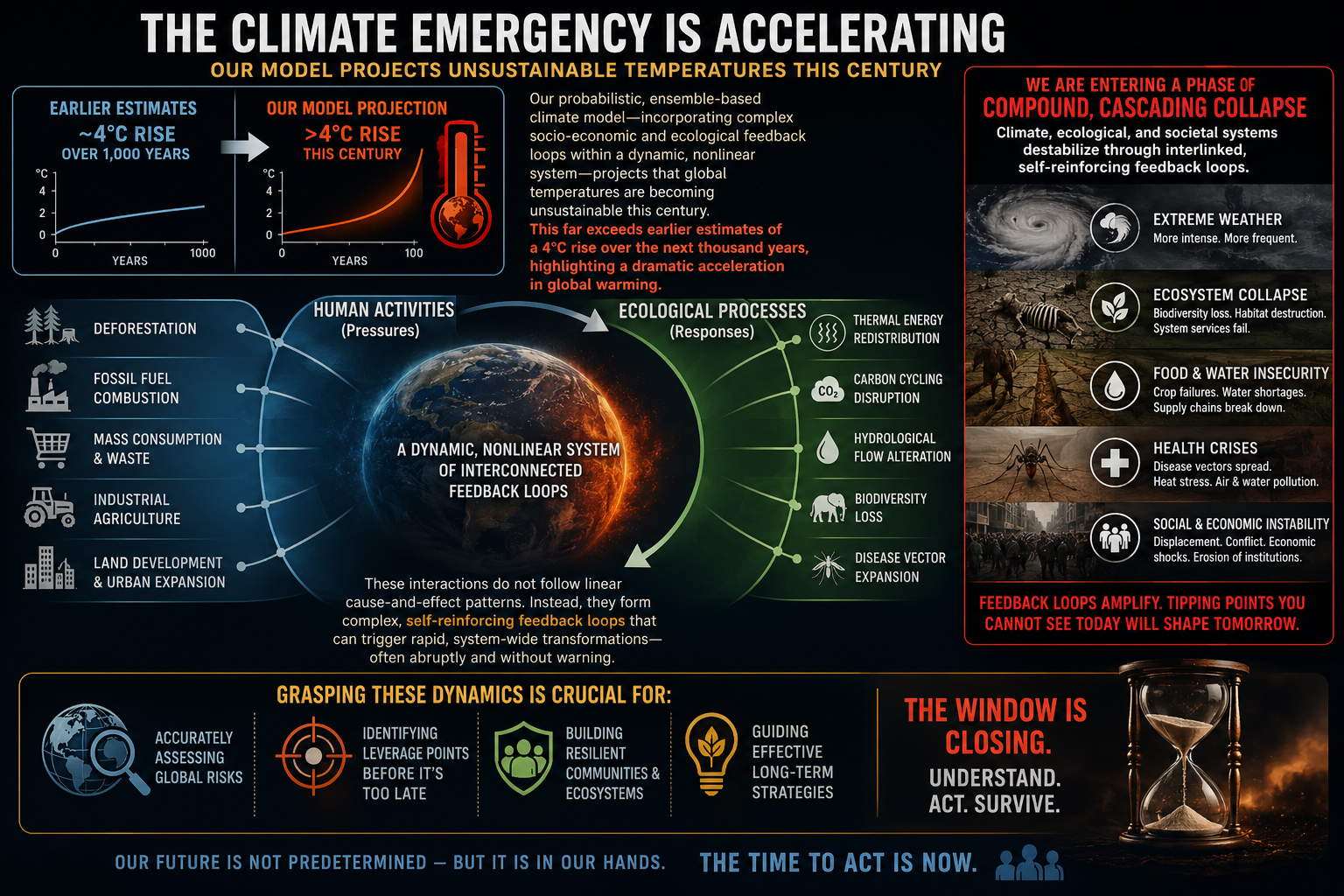
We examine how human activities — such as deforestation, fossil fuel combustion, mass consumption, industrial agriculture, and land development — interact with ecological processes like thermal energy redistribution, carbon cycling, hydrological flow, biodiversity loss, and the spread of disease vectors. These interactions do not follow linear cause-and-effect patterns. Instead, they form complex, self-reinforcing feedback loops that can trigger rapid, system-wide transformations — often abruptly and without warning. Grasping these dynamics is crucial for accurately assessing global risks and developing effective strategies for long-term survival.
Denialism and Ecofascism Resources:
- Climate Denialism, Obfuscation, Suppression and Normalization
- From Climate Denial to Climate Authoritarianism: Fossil Fascism, Ecofascism, and Petro-Masculinity
- The DOE Climate Working Group: Legal Violations, Ideological Networks, and Ecofascist Connections
- Nonlinear Climate Acceleration and the Convergence of Ecofascist and Eugenics Ideologies
- The Accidental Fascist Hunter: How a Climate Investigation Uncovered Ecofascist Networks
Tipping points and feedback loops drive the acceleration of climate change. When tipping points trigger others, cascading collapse can occur — the Domino Effect.
Extreme Impacts: Extreme Weather Events | Violent Rain | Deadly Humid Heat | Sea Level Rise | Insurance
Ecosystems & Feedbacks: Ecosystem Collapse & Extinction Risks | Soil–Insect Climate Feedback Collapse | Insect Collapse | Soil | Trees & Deforestation
Human Health & Society: Climate Tax | Climate & Human Health | Limits of Human Adaptability | Climate-Driven Health Collapse | Food & Water Security | Civilization Collapse
Bottom line: The question is no longer how warm the planet becomes, but how life on Earth can endure when change outpaces our ability to adapt.
We cannot control the laws of physics, but we can control our pollution. The most effective action is to stop burning fossil fuels.