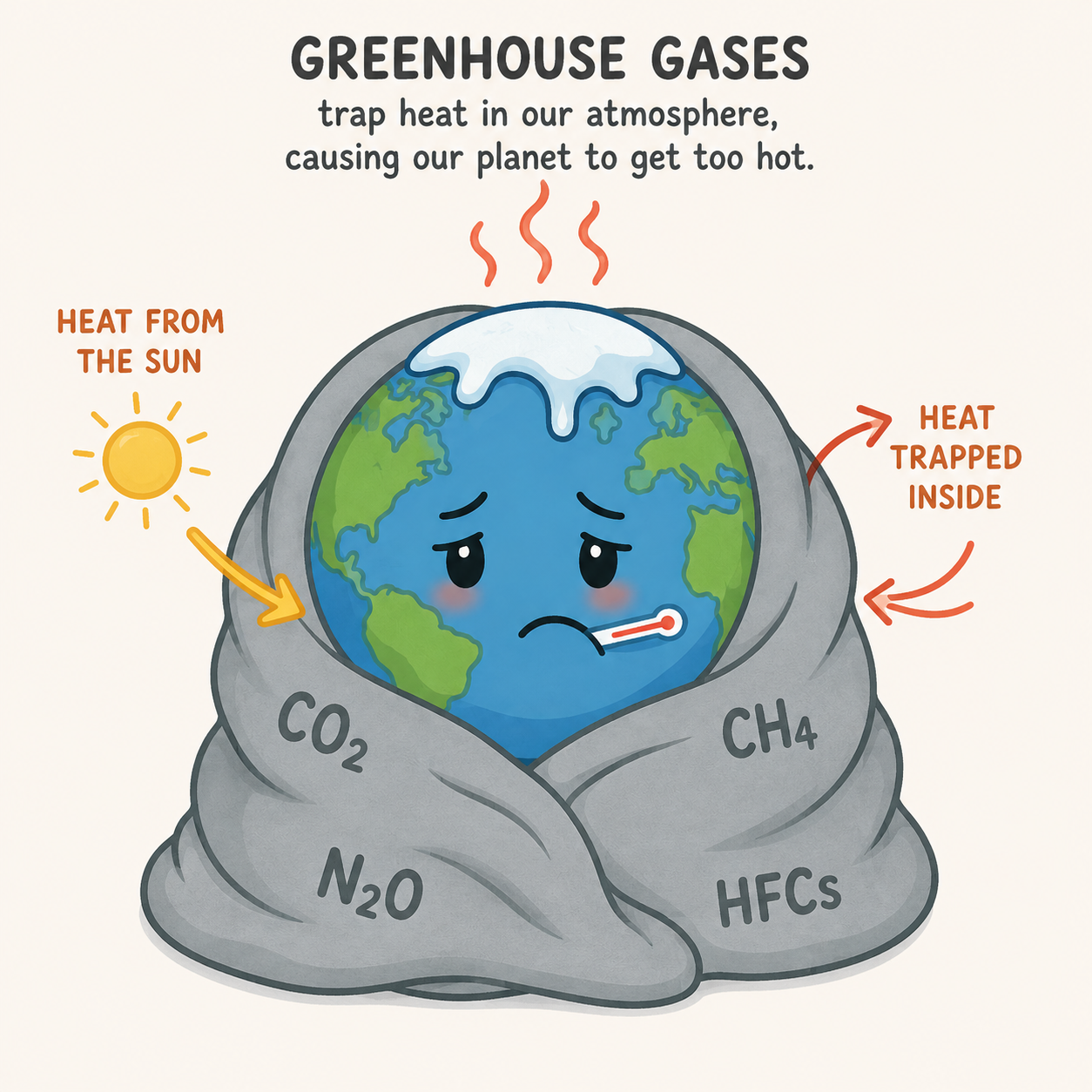
How Is the Climate Energy Hitting You?
The Mountains Crumble to the Sea
Sometimes, it comes downhill.
A massive rock-and-ice avalanche, involving approximately 25 million cubic meters of material, plunged into Dickson Fjord. The impact generated an initial tsunami with a runup of approximately 200 meters—about 650 feet. The confined fjord then acted like a gigantic bathtub, allowing the water to oscillate back and forth as a seiche.
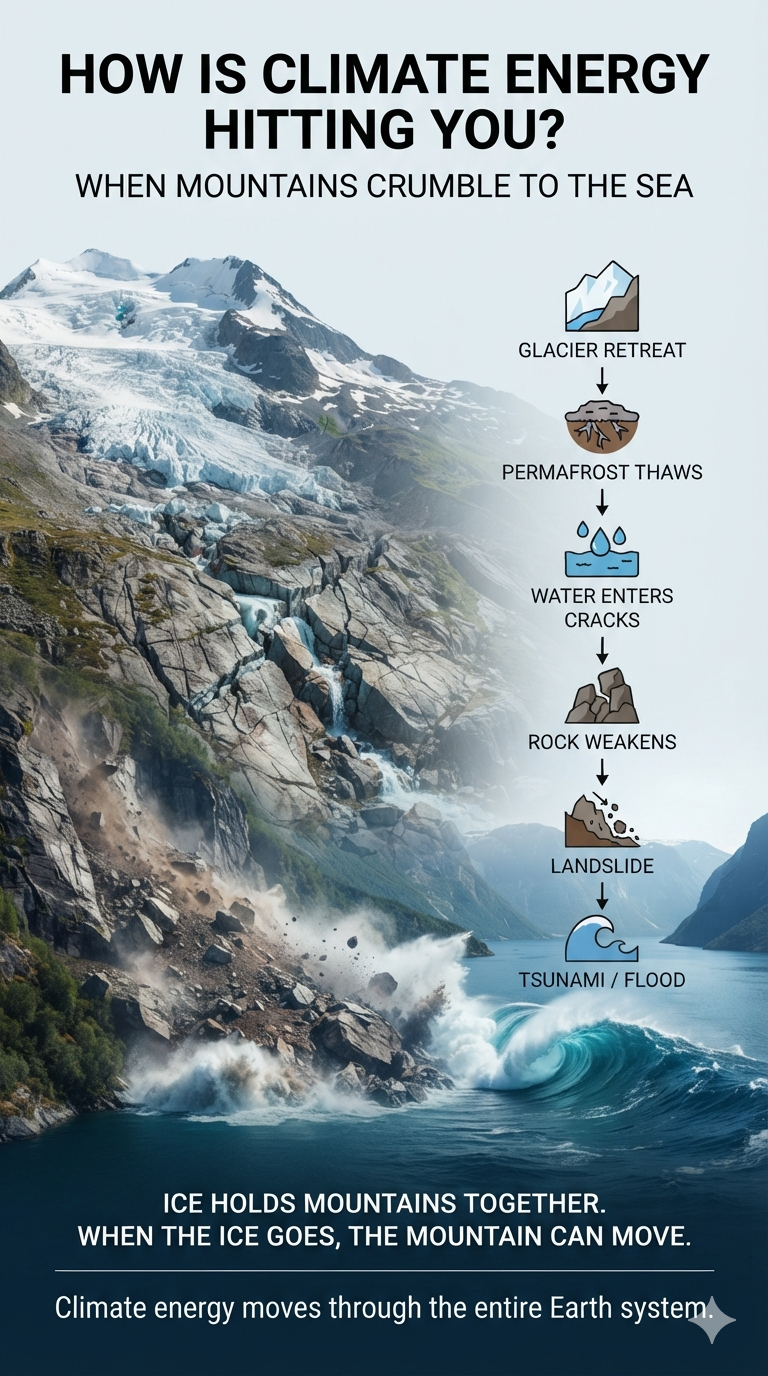
When Mountains Crumble to the Sea: Glacial Retreat, Permafrost Thaw, Hydrostatic Pressure, and Landslides
Mountains may look permanent. They are not.
Across Alaska, Greenland, Norway, Chile, New Zealand, and the European Alps, glaciers are retreating, permafrost is thawing, and mountain slopes that were stabilized by ice for centuries or millennia are becoming increasingly unstable.
The result is a dangerous transformation of the high mountains: rockfalls, landslides, glacier collapses, debris flows, and landslide-generated tsunamis.
These are not simply isolated geological curiosities. They are examples of a larger climate-driven interaction among the cryosphere—the frozen part of the Earth system—the hydrosphere, and the lithosphere. As ice disappears, water enters places where it previously could not. As frozen ground thaws, fractures that were once reinforced by ice can weaken. As glaciers retreat, steep slopes can lose part of the support and confinement that helped stabilize them.
The mountains can begin to crumble.
And when they do, enormous amounts of stored gravitational energy can suddenly become kinetic energy.
A Mountain Can Become a Climate Hazard
One of the clearest examples occurred in East Greenland in September 2023.
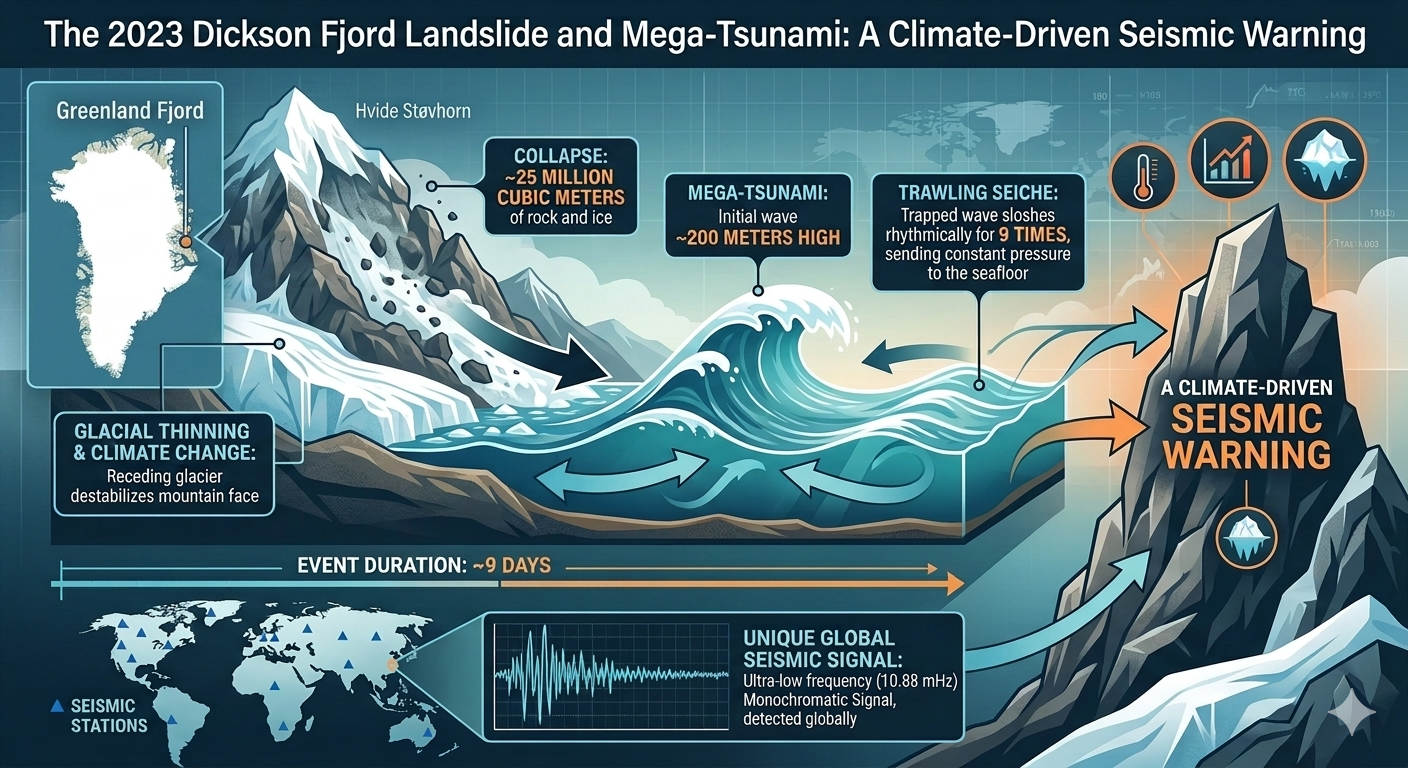
A massive rock-and-ice avalanche, involving approximately 25 million cubic meters of material, plunged into Dickson Fjord. The impact generated an initial tsunami with a runup of approximately 200 meters—about 650 feet. The confined fjord then acted like a gigantic bathtub, allowing the water to oscillate back and forth as a seiche.
That oscillation continued for nine days.
The movement was powerful enough to generate seismic waves detectable around the world. Scientists eventually determined that the mysterious nine-day signal recorded by seismometers globally was produced by the fjord’s oscillating water.
In other words, a climate-related change in a glacierized mountain landscape produced a chain reaction:
Glacial thinning → slope destabilization → rock-and-ice avalanche → tsunami → seiche → global seismic signal
This is what a climate cascade looks like.
The Mechanics of Destabilization
1. Loss of Glacial Support
Glaciers are not merely passive sheets of ice sitting on mountains. They interact mechanically with the surrounding landscape.
When glaciers occupy steep valleys, their mass and geometry influence the stresses acting on adjacent slopes. When glaciers thin and retreat, formerly ice-confined slopes can become exposed and mechanically reorganized.
Retreat can therefore contribute to slope destabilization, particularly where steep, fractured rock has been exposed or where the glacier previously helped buttress or constrain unstable terrain.
The process does not mean that every retreating glacier automatically causes a landslide. Rather, glacier retreat can remove one of several stabilizing factors from a mountain system already close to failure.
2. Permafrost Degradation
At high elevations, permafrost can exist not only in soil but within fractured bedrock.
Ice occupying those fractures can function as a natural cement, binding blocks of rock together and increasing the strength of the mountain mass.
When temperatures rise sufficiently for that ice to thaw, the mechanical properties of the rock mass can change.
The mountain has not suddenly become a pile of loose rocks. Instead, a complex system of fractures, joints, ice, water, and rock begins to respond differently to gravity.
That difference can be critical.
3. Meltwater and Hydrostatic Pressure
When ice melts, water has to go somewhere.
Meltwater can infiltrate fractures and joints in rock. Once inside a confined fracture, water can exert pressure on the surrounding rock surfaces. This is known as hydrostatic or pore-water pressure, depending on the physical setting.
Increasing water pressure can reduce the effective forces holding fractured rock surfaces together. In simplified terms, water can help pry apart a structure that was already mechanically compromised.
This is especially important when meltwater penetrates deeply into a mountain containing extensive fracture networks.
4. Freeze-Thaw Fracturing
Water entering fractures can also amplify mechanical damage through freeze-thaw processes.
When water freezes, it expands. Repeated freezing and thawing can progressively widen existing fractures and create new pathways through the rock.
At elevations where temperatures repeatedly cross the freezing point, this process can become an important agent of mechanical weathering.
The result is not necessarily one dramatic failure.
It can be thousands of small failures accumulating until the mountain reaches a critical state.
Then the failure can become very large.
From Rockfall to Megatsunami
Once a large mountain mass begins moving, the consequences can extend far beyond the slope itself.
A collapsing mountain can:
- bury communities;
- destroy roads and bridges;
- dam rivers;
- create unstable lakes;
- generate debris flows;
- trigger secondary landslides;
- produce glacial-lake outburst flood hazards;
- and, when the collapse enters a fjord or lake, generate a tsunami.
The last mechanism is particularly important because a landslide-generated tsunami does not require an earthquake.
A sufficiently large mass entering confined water can displace enormous quantities of water almost instantaneously.
Recent Examples
Greenland — 2023
A rock-and-ice avalanche entered Dickson Fjord and generated an approximately 200-meter-high tsunami. The resulting seiche continued oscillating for nine days and produced a globally detected seismic signal. Scientists concluded that climate-change-driven glacial thinning preconditioned the slope for failure.
Alaska — 2025
On August 10, 2025, a more than 64-million-cubic-meter landslide struck Tracy Arm near the terminus of South Sawyer Glacier. The event generated a tsunami with a measured maximum runup of approximately 481 meters (1,578 feet)—the second-highest landslide-tsunami runup ever documented, behind the 1958 Lituya Bay event.
The landslide was preconditioned by glacial retreat associated with climate change. The resulting tsunami generated a global seismic signal, while a landslide-induced seiche persisted for as long as 36 hours.
The danger was particularly significant because Tracy Arm is frequented by cruise ships and other vessels. More than 20 vessels, including large cruise ships, can travel through Tracy and Endicott arms during the summer. Fortunately, no large vessel was in the upper fjord when the landslide occurred.
Switzerland — 2025
On May 28, 2025, part of the Birch Glacier and the unstable slope of the Kleine Nesthorn above it collapsed in the Lötschental Valley.
The resulting rock-and-ice avalanche buried approximately 90 percent of the village of Blatten. Scientific estimates put the total volume of the moving rock and ice at roughly 20 million tonnes, with approximately 6.4 million cubic meters of rock and 2.9 million cubic meters of glacier ice involved in the main event.
The village had been evacuated nine days earlier because deformation and other warning signs had been detected. That evacuation almost certainly prevented a far greater loss of life. The debris also blocked the Lonza River, creating a temporary lake and producing a secondary flooding hazard.
Blatten demonstrates another important feature of climate-driven hazards:
The first disaster may not be the last disaster.
A landslide can dam a river.
The dam can create a lake.
The lake can flood surviving structures.
Additional slope failures can destabilize the new landscape.
One failure can therefore create the conditions for another.
The Spitze Stei Crisis: Kandersteg, Switzerland
One of the most closely watched unstable mountain formations in Switzerland is Spitze Stei, above the Alpine village of Kandersteg in the Bernese Oberland.
Scientists estimate that approximately 15–20 million cubic meters of unstable rock could potentially move. The mountain’s instability is associated with the degradation of permafrost and the progressive weakening of the fractured rock mass.
Mountain failures are often progressive. A slope can shed smaller pieces while simultaneously becoming more unstable. Alternatively, smaller failures can reduce the amount of material available for a larger collapse.
The challenge is determining which trajectory the mountain will follow.
That is why Kandersteg is under continuous monitoring, with radar and other systems providing information about movement and deformation. Evacuation plans are part of the community’s preparedness.
The mountain is effectively being watched in real time.
The Emerging Pattern
Blatten and Kandersteg are not identical geological situations. Nor is every landslide in a warming mountain environment caused exclusively by climate change.
Mountains fail for many reasons.
Earthquakes, rainfall, erosion, geological structure, gravity, and natural weathering have always produced landslides.
The climate connection is different.
Warming can alter the background conditions under which these geological processes operate.
A retreating glacier can expose a previously confined slope.
Thawing permafrost can weaken fractured bedrock.
Increasing meltwater can infiltrate fractures.
More intense rainfall can increase pore-water pressure.
Freeze-thaw cycles can enlarge cracks.
And a warming atmosphere can alter the timing, duration, and intensity of snowmelt and precipitation.
These processes can interact.
That interaction is what makes the problem particularly difficult.
Hydroclimatic Whiplash in the Mountains
The larger story is therefore not simply “global warming causes landslides.”
The more scientifically useful description is:
Climate warming changes the physical conditions that govern mountain stability.
Those changes can interact with water, ice, rock, gravity, and topography to produce cascading hazards.
A mountain slope does not care whether the energy destabilizing it came from a warming atmosphere, melting glacier, rainfall event, or gravitational unloading.
It responds to the physical forces acting upon it.
That is the essence of climate energy.
The energy added to the climate system does not remain confined to the atmosphere.
It moves through the Earth system.
It melts ice.
It thaws frozen ground.
It changes water.
It alters pressure.
It weakens structures.
And sometimes, it converts a mountain into a landslide.
Atmospheric Rivers: More Water, Less Snow, Faster Runoff
The mountains are being reshaped not only by warming temperatures, but by a changing water cycle.
As the atmosphere warms, it can hold more water vapor. This increases the potential for powerful atmospheric rivers—long, narrow corridors of concentrated moisture that transport enormous quantities of water vapor from the oceans toward land.
The important change is not simply that atmospheric rivers may become stronger. The form in which their moisture reaches the mountains is changing.
Warmer air means more precipitation falls as rain rather than snow, particularly at elevations near the freezing level. Snowpack that once stored winter precipitation for months can instead become immediate runoff.
That changes the mountain’s hydrology.
From Snow Reservoir to Water Pulse
Historically, mountain snowpack has acted as a natural reservoir:
Atmospheric moisture → snow → gradual melt → streams → rivers
A warmer climate increasingly shifts that sequence toward:
Atmospheric river → rain → rapid runoff → flooding → erosion → landslides
The distinction is enormous.
Snow stores water.
Rain releases it.
When a warm atmospheric river arrives on top of an existing snowpack, the consequences can become even more dramatic. Rain adds water directly to the landscape while warmer conditions accelerate snowmelt. The result can be a rain-on-snow event—a rapid release of water from both precipitation and the mountain’s frozen reservoir.
Changing Moisture Gradients
There is another piece of the puzzle: moisture gradients.
A warming atmosphere does not simply add moisture uniformly everywhere. The capacity of air to hold water increases with temperature, while ocean temperatures, atmospheric circulation, mountain barriers, and regional drying patterns redistribute that moisture.
This can sharpen contrasts between very dry and very wet conditions.
One region may experience prolonged atmospheric drying and declining snowpack while, nearby or later in the season, a moisture-rich atmospheric river delivers an extraordinary pulse of precipitation.
That is hydroclimatic whiplash:
Dry → wet → dry → extreme precipitation
The problem for mountain systems is that they must absorb these rapidly changing conditions while their physical structure is already being altered by warming.
The Mountain Feedback
This creates another cascading pathway:
Warming → more atmospheric moisture → stronger atmospheric-river potential
↓
More rain, less snow
↓
Reduced snow storage
↓
Rapid runoff and rain-on-snow events
↓
Higher pore-water pressure and erosion
↓
Greater landslide and debris-flow potential
↓
More sediment, flooding, and infrastructure damage
At the same time, warming and permafrost thaw can weaken the rock and sediment structures through which that water moves.
The result is a mountain system being hit from several directions at once:
Less frozen storage.
More liquid water.
Faster runoff.
Greater precipitation extremes.
Weaker slopes.
The atmosphere is changing the mountain’s plumbing while warming is changing the mountain itself.
That is hydroclimatic whiplash in the mountains.
And when an atmospheric river arrives at a mountain that has less snow, more meltwater, thawing permafrost, and increasingly unstable slopes, the question is no longer simply how much rain will fall?
It becomes:
What will the mountain do with it?
So, How Is Climate Energy Hitting You?
You do not have to live beneath a glacier to experience this process.
A landslide can block a highway.
A debris flow can destroy a bridge.
A mountain collapse can dam a river.
A landslide-generated tsunami can threaten vessels in a fjord.
A new glacial lake can become a flood hazard.
And a community that has existed for centuries can suddenly find itself living beneath an unstable mountain.
The most important lesson from Greenland, Alaska, and the Swiss Alps is not that every mountain is about to collapse.
It is that the frozen components that helped stabilize many high-mountain environments are changing rapidly.
The mountains are responding.
And sometimes the response is spectacular.
The ice retreats.
The permafrost thaws.
Water enters the fractures.
Hydrostatic pressure rises.
Rock begins to move.
Gravity takes over.
Then the mountain crumbles toward the sea.
How is the climate energy hitting you?
Sometimes, it comes downhill.
Taking the Temperature of Climate Change: How Is Climate Energy Hitting You?
Easy-to-Read Resources