How Is the Climate Energy Hitting You?
North Texas
In North Texas, it is hitting as drought, wildfire, evacuation, water scarcity, livestock liquidation, crop failure, and rising agricultural costs.
North Texas: Drought, Wildfire, Evacuation, Water Scarcity, Livestock Liquidation, Crop Failure
The Ross Fire: Climate Energy on the Ground
The Ross Fire has exploded across more than 50,000 acres of North Texas, triggering mandatory evacuations, school closures, and a major emergency response. Driven by triple-digit heat, exceptionally low humidity, strong winds, and severe drought, the fire is exhibiting extreme behavior and was only about 5% contained as of August 25.
The fire began in Palo Pinto County near Highway 180 and Ross Watson Road and has pushed rapidly northeast toward southern Jack County. Firefighters have reported flames reaching as high as 100 feet, making direct attacks extremely dangerous. Crews have therefore relied heavily on bulldozers and aerial support.
Evacuations and Community Disruption
Mandatory evacuations have been ordered for portions of southern Jack County, including areas near and east of Bartons Chapel and along County Road 2210 toward Highway 281.
An evacuation center has been established at the Twin Lakes Recreation Center on Highway 59 in Jacksboro.
The fire is also disrupting education. On August 25, Perrin CISD canceled all classes, while Jacksboro ISD delayed the beginning of the school day by two hours.
This is more than a wildfire. It is a demonstration of how climate energy moves through a coupled human-environment system: heat dries vegetation, drought removes water from the landscape, wind accelerates fire spread, and communities are forced to evacuate.
Texas Is Drying Out
The Ross Fire is occurring within a much larger regional drought emergency. Drought conditions across Texas have deteriorated rapidly, with approximately 77% of the state experiencing drought. Nearly 200 counties across Texas and Oklahoma have implemented active outdoor burn bans because of elevated fire danger.
A second significant brush fire has also been reported farther south in Hamilton County near Evant, forcing localized evacuations north of Highway 84.
The important point is that wildfire is not an isolated event. Fire is the visible expression of an increasingly dry and heat-loaded landscape.
When extreme heat, low humidity, depleted soil moisture, dry vegetation, and high winds occur simultaneously, their effects are not merely additive. They reinforce one another.
Climate Energy Is Reshaping Texas Agriculture
The same climate pressures driving wildfire are disrupting Texas agriculture and the cattle industry.
Texas agriculture is confronting a convergence of prolonged drought, historic heat, declining water availability, and increasingly volatile precipitation. Together, these stresses are changing the economics of farming and ranching.
The result is not simply a bad growing season.
It is structural disruption.
The Cattle Industry Under Pressure
Shrinking Herds
Depleted water supplies and increasingly parched rangelands have contributed to a major contraction in Texas cattle operations. The Texas cattle herd has fallen from approximately 13.1 million head to about 12 million.
The national beef-cow inventory has also fallen to its lowest level in decades.
Forced Liquidation
When stock ponds empty and forage disappears, ranchers face an increasingly difficult choice: purchase expensive supplemental feed or sell their cattle.
For operations already under financial pressure, purchasing enough hay to maintain a breeding herd may be impossible. Cattle are therefore being sent to auction and slaughter earlier than planned.
That creates a feedback loop.
Drought reduces forage.
Reduced forage forces liquidation.
Liquidation reduces future breeding capacity.
Reduced cattle inventories constrain beef supplies.
Constrained supplies increase prices.
Higher prices do not restore the lost water or forage.
The economic consequences therefore continue long after the drought itself begins to ease.
Beef Supply Chains Under Stress
With fewer cattle available, livestock prices are rising sharply. The contraction in cattle inventories is also putting pressure on meat processors.
When there are not enough animals moving through the system, processing facilities can become economically unsustainable. Plant closures then reduce processing capacity and increase the vulnerability of the remaining supply chain.
Climate energy is therefore moving from the atmosphere to the pasture, from the pasture to the rancher’s balance sheet, and from the rancher’s balance sheet to the consumer’s grocery bill.
Crop Agriculture Under Extreme Heat and Drought
Texas is also confronting severe challenges to crop production.
Cotton Crop Failures
Texas is the nation’s leading cotton-producing state, but extreme heat and drought have caused widespread crop stress, crop failures, and abandoned fields.
Sustained triple-digit temperatures can interfere with flowering and reproductive development, reducing yields even when plants survive.
Heat Stress and Water Scarcity
As temperatures rise, crops lose water more rapidly through evapotranspiration.
At the same time, declining soil moisture and groundwater availability make irrigation increasingly difficult and expensive.
This creates another feedback:
Higher temperatures → greater atmospheric demand for water → faster soil drying → greater irrigation demand → declining water availability → higher agricultural costs.
The atmosphere is effectively pulling water out of the agricultural system faster.
Pests and Disease
Climate disruption is also changing the biological environment in which crops are grown.
Changes in temperature and seasonal conditions can allow pests and diseases to expand their ranges, survive through seasons in which they previously could not, or reproduce more rapidly.
Threats including cotton jassid, rice delphacid, and pasture mealybug illustrate how agricultural climate risk extends beyond drought and heat.
Farmers are increasingly confronting a moving target: the climate conditions under which today’s agricultural systems evolved are changing faster than the systems themselves can adapt.
Adaptation: Fighting Back Against Climate Energy
Texas farmers and ranchers are not simply waiting for conditions to improve. Many are experimenting with strategies designed to make agricultural systems more resilient.
Regenerative Ranching
Some ranching operations are adopting rotational and multi-paddock grazing systems designed to improve soil structure, maintain living root systems, and increase water infiltration.
Healthy soils can store substantially more water than degraded soils. Improving soil organic matter and root systems can therefore provide a buffer against drought by allowing more rainfall to infiltrate and remain available to plants.
Adaptation cannot stop the atmosphere from warming.
But it can increase the amount of climate stress an agricultural system can absorb before it fails.
Carbon Farming
Managed grasslands can also store carbon in soils while improving soil health and water retention.
Carbon farming therefore has the potential to provide multiple benefits: improved pasture productivity, greater drought resilience, healthier soils, and additional revenue through carbon markets where those markets are viable.
Statewide Disaster Planning
Texas is also attempting to improve its institutional response to increasingly complex agricultural hazards.
The Texas Department of Agriculture has established the Texas Agriculture Disaster Task Force to coordinate responses to threats including wildfire, freezes, drought, and biosecurity emergencies.
That kind of planning recognizes an increasingly important reality:
Climate disasters do not occur one at a time.
A drought can increase wildfire risk.
A wildfire can destroy forage.
Heat can intensify drought.
Drought can reduce crop yields.
Crop failures can increase food prices.
Water shortages can force livestock liquidation.
And all of these pressures can occur simultaneously.
The Bigger Picture: Climate Energy Is Cascading Through the System
The Ross Fire is therefore more than 50,000 acres of burning vegetation.
It is one visible manifestation of a larger climate-energy cascade.
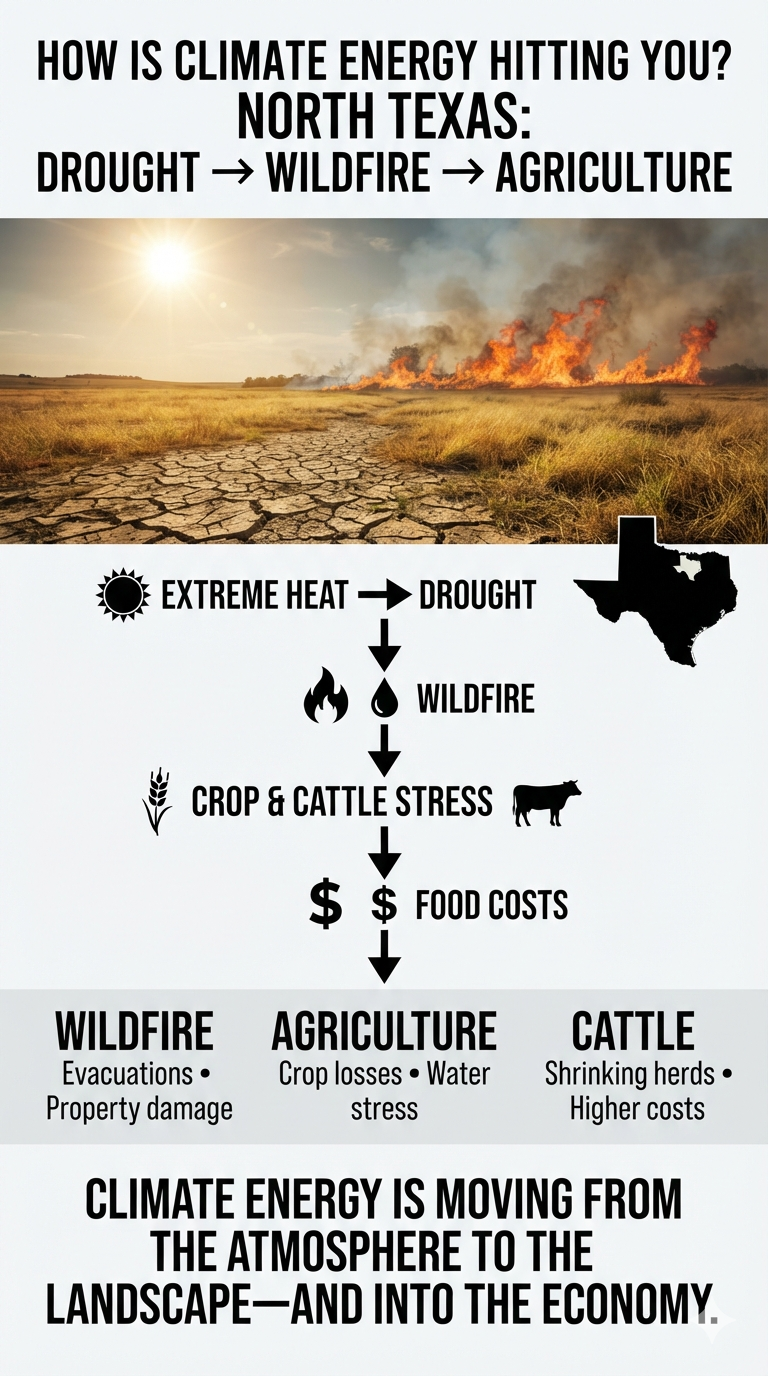
Heat → drought → dry vegetation → wildfire → evacuations → infrastructure disruption
At the same time:
Heat → evapotranspiration → soil-moisture loss → crop stress → lower yields → higher food costs
And:
Drought → depleted forage and water → cattle liquidation → smaller herds → constrained beef supplies → higher prices
These are not independent problems.
They are connected expressions of the same physical system.
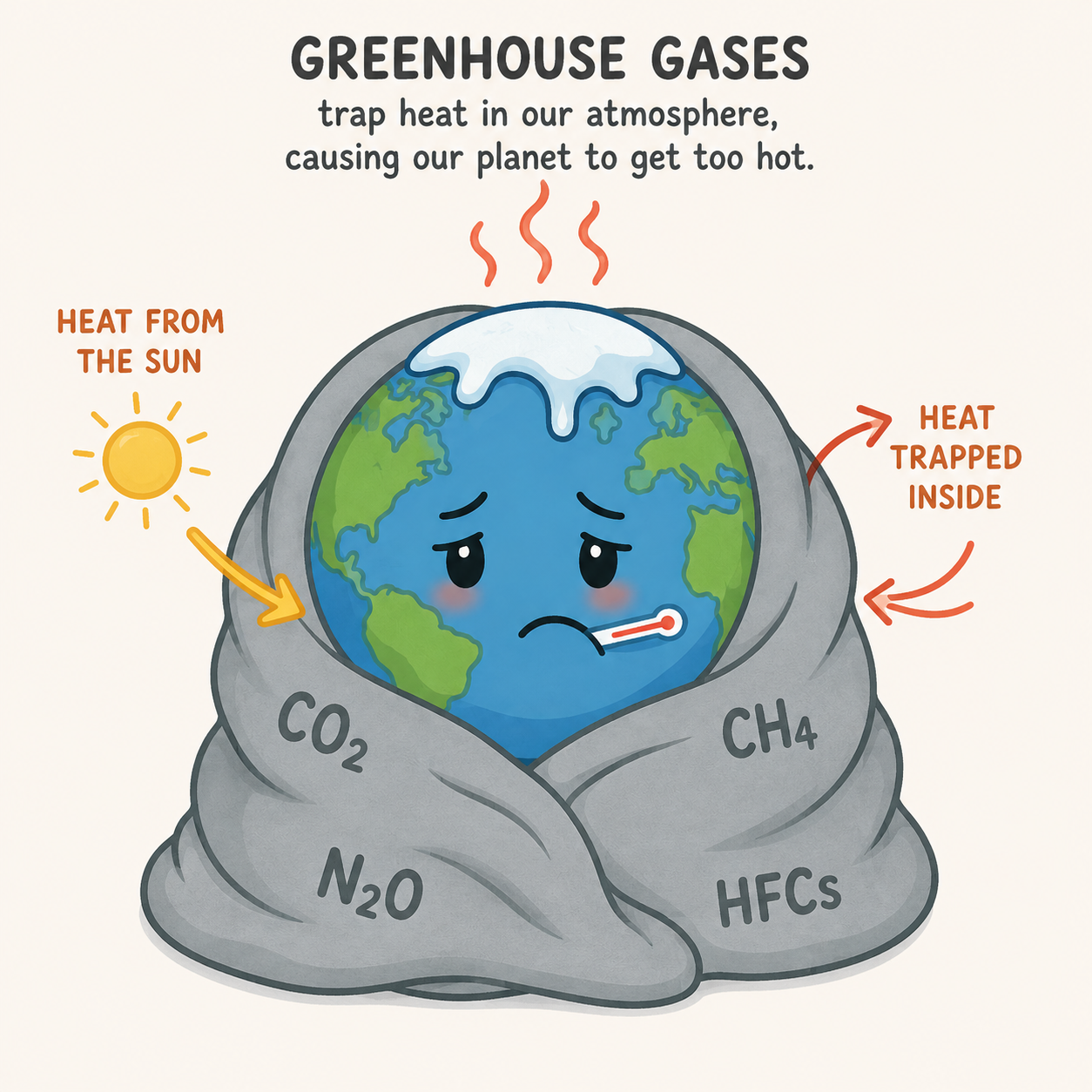
Climate change adds energy to the atmosphere. That additional energy intensifies the hydrologic cycle, increases atmospheric demand for water, amplifies heat extremes, and changes the timing and intensity of precipitation.
The result is increasing volatility: longer dry periods interrupted by more intense rainfall, greater heat stress, rapidly drying landscapes, and wildfire conditions that can emerge with extraordinary speed.
How Is the Climate Energy Hitting You?
In North Texas, it is hitting as drought, wildfire, evacuation, water scarcity, livestock liquidation, crop failure, and rising agricultural costs.
The Ross Fire makes the process impossible to ignore.
The fire is burning on the landscape.
The drought is draining the landscape.
And the climate energy driving both is increasingly reaching the farm, the ranch, the grocery store, and the household.
Climate change is not merely changing the weather.
It is changing the systems that depend upon the weather.
Taking the Temperature of Climate Change: How Is Climate Energy Hitting You?
Easy-to-Read Resources