Observable Climate Feedback Coupling: Identifying the Most Active Indicators in an Increasingly Interconnected Earth System
The most important development in contemporary climate feedback analysis is the increasing need to examine interactions among previously separated climate processes. Ocean heat content, surface albedo, low-level clouds, atmospheric water vapor, and soil moisture provide particularly important observational indicators of these interactions.
Daniel Brouse¹, Sidd Mukherjee²
¹ Climatologist, Economist
² Physicist
November 2026
A Comparative Assessment of Ocean Heat Content, Albedo, Clouds, Atmospheric Water Vapor, Soil Moisture, and Emerging Carbon-Release Feedback Networks
Simplified Overview
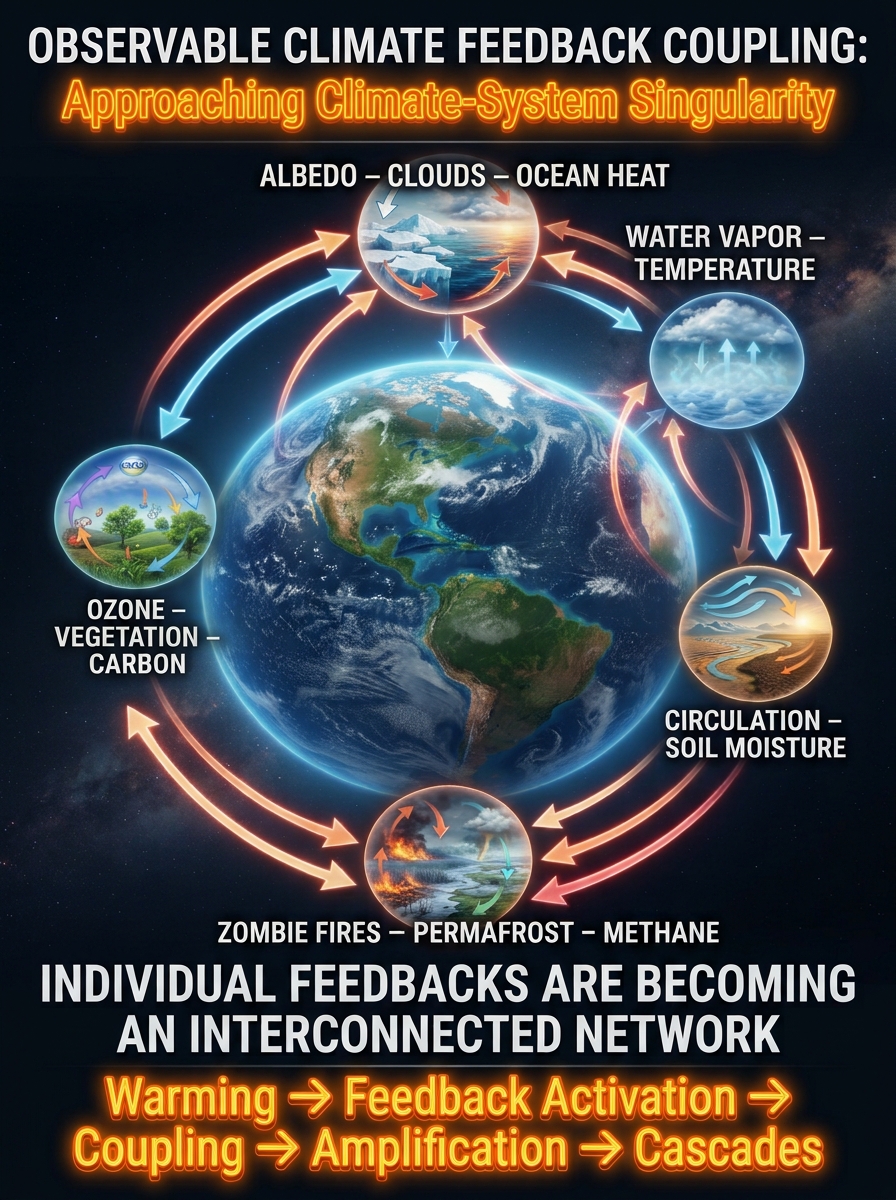
🌎 Observable Climate Feedback Coupling — The Emergence of an Interconnected Earth-System Network
Climate change is no longer adequately described by examining individual feedback loops in isolation. The increasingly interconnected behavior of Earth’s climate systems demands a broader perspective.
This paper examines five major feedback networks showing observable interactions:
🔹 Albedo–Cloud–Ocean Heat: Reduced reflectivity, changing cloud behavior, and increasing ocean heat accumulation.
🔹 Water Vapor–Temperature: Increasing atmospheric moisture reinforcing greenhouse warming.
🔹 Circulation–Soil Moisture: Reduced evaporative cooling amplifying heat and drought.
🔹 Ozone–Vegetation–Carbon: Vegetation damage weakening natural carbon uptake.
🔹 Zombie Fires–Permafrost–Methane: Underground combustion, thawing permafrost, and additional greenhouse-gas release.
The central finding is that these processes cannot be understood independently. Their interactions connect atmospheric, oceanic, terrestrial, and cryospheric systems into increasingly complex feedback networks.
Three areas deserve particularly close attention: the Albedo–Cloud–Ocean Heat triad, Water Vapor–Temperature coupling, and Circulation–Soil Moisture–Temperature interactions.
The critical question is no longer simply whether individual feedbacks are occurring. It is whether their interactions are becoming increasingly interconnected, persistent, synchronized, and mutually reinforcing.
Warming → Feedback Activation → Coupling → Amplification → Cascades
Understanding this transition is essential to evaluating the evolving dynamics of Earth’s climate system.
📖 Read the paper and explore the interconnected feedback network:
#ClimateScience #ClimateFeedbacks #FeedbackCoupling #OceanHeat #Albedo #WaterVapor #ClimateTippingPoints #EarthSystemScience #NonlinearClimateDynamics
Abstract
Climate change is increasingly characterized by interactions among multiple physical, chemical, biological, and atmospheric processes. Individual climate indicators are no longer sufficient to describe the evolving behavior of the Earth system. The increasingly interconnected relationships among ocean heat content, surface albedo, low-level cloud cover, atmospheric water vapor, soil moisture, atmospheric circulation, vegetation, permafrost, and greenhouse-gas emissions provide observable evidence of expanding feedback coupling.
This paper examines the principal climate indicators demonstrating observable feedback interactions and evaluates their significance according to three criteria: the magnitude and persistence of observed changes, the number of interconnected climate processes, and the degree to which those interactions reinforce additional warming.
Five major feedback domains receive particular attention:
- Albedo–Cloud–Ocean Heat Content coupling.
- Ocean Heat–Cryosphere–Sea-Level coupling.
- Water Vapor–Temperature–Radiative coupling.
- Atmospheric Circulation–Soil Moisture–Temperature coupling.
- Wildfire–Permafrost–Carbon–Methane coupling.
The analysis identifies ocean heat content, surface albedo, low-level cloud behavior, atmospheric water vapor, and soil moisture as particularly important observational indicators. It also identifies the growing interaction among terrestrial carbon release, permafrost degradation, wildfire activity, and atmospheric greenhouse-gas accumulation as an important emerging feedback network.
The central conclusion is that climate feedback research must move beyond isolated indicators and individual feedback loops. The increasing interaction, synchronization, and reinforcement of multiple climate processes require a network-based approach to monitoring Earth-system behavior.
1. Introduction: From Individual Feedbacks to Network Coupling
Traditional climate analysis frequently examines individual feedback mechanisms independently. Examples include the water vapor feedback, ice-albedo feedback, cloud feedback, and terrestrial carbon feedback.
Although these mechanisms remain scientifically important, examining them independently does not adequately characterize the increasingly interconnected behavior of the climate system.
Climate feedback coupling occurs when changes in one physical process influence another process, which subsequently reinforces or modifies the original disturbance. As these relationships become interconnected, individual feedback mechanisms form larger networks capable of amplifying changes across multiple Earth-system domains.
The relevant progression is:
Initial warming → Feedback activation → Coupling → Amplification → Threshold → Cascade
This framework emphasizes that the significance of climate change is not determined solely by the magnitude of an individual indicator. The interaction among indicators determines how disturbances propagate and influence other components of the Earth system.
A comprehensive observational framework must therefore evaluate:
- The magnitude and direction of individual indicator changes.
- The strength and persistence of relationships between indicators.
- The directionality of physical interactions.
- The emergence of reinforcing feedback pathways.
- The development of increasingly interconnected feedback networks.
The objective is to identify which climate indicators currently provide the clearest observable evidence of this evolving behavior.
2. Criteria for Evaluating Observable Feedback Coupling
The indicators examined in this paper are evaluated using three principal criteria.
2.1 Magnitude and Persistence of Observed Change
The first criterion examines whether an indicator demonstrates measurable, persistent changes over time.
Examples include:
- Increasing ocean heat content.
- Declining Arctic sea-ice extent.
- Changes in surface reflectivity.
- Increasing atmospheric water vapor.
- Declining soil moisture in vulnerable regions.
- Increasing greenhouse-gas concentrations.
Persistent changes provide the observational foundation for identifying evolving climate feedback relationships.
2.2 Network Connectivity
The second criterion evaluates how many other climate processes interact with a particular indicator.
Ocean heat content, for example, connects atmospheric energy imbalance, sea-surface temperature, ocean stratification, sea-ice loss, ice-sheet melting, and ocean circulation.
Atmospheric water vapor connects temperature, evaporation, precipitation, cloud formation, and atmospheric radiation.
Indicators with numerous physical connections are especially important when evaluating the development of interconnected feedback networks.
2.3 Reinforcement and Amplification
The third criterion examines whether interactions reinforce the original disturbance.
A reinforcing feedback occurs when an initial change produces additional changes that strengthen the original effect.
For example:
Temperature increase → Increased atmospheric water vapor → Increased absorption of outgoing infrared radiation → Additional warming.
The distinction between simple correlation and actual feedback amplification is essential. Observing two indicators changing simultaneously does not independently establish a causal feedback relationship.
3. Principal Climate Indicators Demonstrating Observable Coupling
The following ranking reflects observational importance and network connectivity. It is not a quantitative ranking of total global radiative forcing or a statistically established ranking of feedback strength.
3.1 Ocean Heat Content: The Central Energy Redistribution Indicator
Ocean heat content (OHC) is one of the most important indicators of the changing Earth-system energy balance.
More than 90% of the excess energy accumulating in the Earth system is absorbed by the oceans. Consequently, ocean heat content provides a particularly important measure of continuing planetary energy accumulation.
Its principal connections include:
- Atmospheric energy imbalance.
- Sea-surface temperature.
- Ocean stratification.
- Marine heatwaves.
- Sea-ice loss.
- Ice-sheet and glacier melting.
- Ocean circulation.
- Atmospheric moisture and evaporation.
Increasing ocean heat content influences both atmospheric and cryospheric processes. It also contributes to the redistribution of energy through ocean circulation and changes in the vertical structure of the ocean.
OHC is therefore not simply another warming indicator. It is a central connecting variable in the broader climate feedback network.
3.2 Surface Albedo: The Ice-Loss Amplification Mechanism
Surface albedo measures the proportion of incoming solar radiation reflected by the Earth’s surface.
Snow and ice have relatively high reflectivity. When they disappear, darker ocean and land surfaces become exposed, increasing the absorption of incoming solar energy.
The principal reinforcing pathway is:
Warming → Snow and Ice Loss → Reduced Surface Albedo → Increased Solar Absorption → Additional Warming
This mechanism connects:
- Arctic sea-ice retreat.
- Antarctic sea-ice variability.
- Greenland ice-sheet melting.
- Mountain glacier retreat.
- Snow-cover changes.
- Surface temperature.
- Ocean heat accumulation.
Albedo is especially important because it provides a direct physical connection between cryospheric changes and the planetary energy balance.
Its interactions with cloud cover and ocean heat content make it a particularly important indicator in higher-order feedback analysis.
3.3 Low-Level Clouds: An Important and Evolving Climate Feedback
Low-level clouds influence the Earth’s energy balance through their reflection of incoming solar radiation and their absorption and emission of infrared radiation.
Their net climate effect depends on cloud altitude, thickness, optical properties, geographical distribution, and atmospheric conditions.
Changes in low-level cloud cover can alter the amount of solar energy absorbed by the ocean and land.
The principal interactions include:
- Cloud cover and surface albedo.
- Cloud cover and ocean heat content.
- Cloud cover and atmospheric water vapor.
- Cloud cover and atmospheric circulation.
- Cloud cover and surface temperature.
Declining low-cloud cover in some regions increases incoming solar energy at the surface. However, observed cloud trends are geographically and temporally variable, and increases in cloud cover can produce different radiative effects depending on cloud properties.
Consequently, low-level clouds should be treated as a major emerging feedback indicator, with regional and seasonal behavior evaluated separately.
The distinction between shortwave and longwave cloud-radiative effects is particularly important.
3.4 Atmospheric Water Vapor: A Fundamental Atmospheric Amplifier
Water vapor is the most abundant greenhouse gas and one of the most important climate feedback mechanisms.
As atmospheric temperatures increase, the atmosphere can contain more water vapor. Increased atmospheric moisture strengthens the absorption of outgoing infrared radiation, reinforcing warming.
The principal feedback sequence is:
Temperature Increase → Increased Atmospheric Water Vapor → Increased Infrared Absorption → Additional Warming
Water vapor also connects several other climate processes:
- Ocean evaporation.
- Land-surface evaporation.
- Atmospheric rivers.
- Cloud formation.
- Precipitation extremes.
- Atmospheric circulation.
- Ice-sheet surface melting.
Its importance extends beyond its direct greenhouse effect. Water vapor is a major connecting mechanism between the atmosphere, oceans, hydrological cycle, and cryosphere.
Monitoring atmospheric moisture alongside temperature, outgoing longwave radiation, cloud properties, and precipitation provides a more complete assessment of atmospheric feedback coupling.
3.5 Soil Moisture and Evapotranspiration: Land–Atmosphere Feedback Coupling
Soil moisture regulates the partitioning of available surface energy between latent and sensible heat.
When sufficient soil moisture is available, evaporation and plant transpiration provide evaporative cooling.
When soil moisture declines, evaporative cooling becomes restricted and a greater proportion of available energy contributes to sensible heating.
The resulting feedback pathway is:
Atmospheric Circulation Changes → Reduced Soil Moisture → Reduced Evapotranspiration → Increased Sensible Heating → Temperature Amplification → Atmospheric Circulation Changes
This interaction connects:
- Drought.
- Heatwaves.
- Atmospheric blocking.
- Cloud formation.
- Vegetation stress.
- Precipitation.
- Regional atmospheric circulation.
The significance of this feedback is particularly evident during persistent heat and drought conditions.
Soil moisture is therefore an essential indicator for evaluating regional feedback amplification and the interaction between atmospheric circulation and land-surface energy redistribution.
3.6 Vegetation and Terrestrial Carbon Uptake
Vegetation provides a major natural mechanism for removing carbon dioxide from the atmosphere.
However, increasing heat stress, drought, wildfire, and ozone exposure damage vegetation and interfere with photosynthesis, stomatal function, and carbon uptake.
The principal interaction is:
Ozone and Heat Stress → Vegetation Damage → Reduced Carbon Uptake → Increased Atmospheric Carbon Accumulation → Additional Warming
Additional pathways involve:
- Reduced evapotranspiration.
- Changes in regional precipitation.
- Increased vegetation mortality.
- Greater wildfire susceptibility.
- Reduced ecosystem resilience.
- Changes in terrestrial carbon storage.
This feedback domain is particularly important because atmospheric chemistry, biological processes, hydrology, and climate dynamics interact directly.
Vegetation condition and carbon uptake should therefore be monitored alongside atmospheric CO₂, ozone concentrations, soil moisture, and temperature.
3.7 Permafrost, Wildfire, and Methane: Emerging Carbon-Release Coupling
Permafrost contains substantial quantities of previously frozen organic carbon.
As permafrost thaws, microbial decomposition releases greenhouse gases, including carbon dioxide and methane.
Wildfire activity introduces additional pathways by consuming insulating vegetation and organic soil layers, exposing previously protected carbon, and increasing the vulnerability of underlying permafrost.
The principal feedback network is:
Warming → Permafrost Thaw and Wildfire → Organic Carbon Release → CO₂ and CH₄ Accumulation → Additional Warming
Additional interactions include:
- Peat combustion.
- Persistent underground fires.
- Vegetation loss.
- Black-carbon deposition.
- Snow and ice albedo reduction.
- Deeper seasonal thaw.
- Changes in soil hydrology.
The emerging zombie-fire feedback network is particularly important because it connects terrestrial combustion, atmospheric greenhouse-gas accumulation, permafrost degradation, and cryospheric changes.
This is an example of how previously distinct climate feedback domains become interconnected through shared physical mechanisms.
4. The Five Most Important Observable Feedback Networks
Individual indicators become more meaningful when examined through their physical relationships.
Five networks deserve particular attention.
4.1 Albedo–Cloud–Ocean Heat Content
This network connects three important components of the planetary energy balance.
Reduced surface albedo increases solar absorption. Changes in low-level cloud cover alter the amount of incoming solar radiation reflected back into space. Increased ocean heat content records the resulting accumulation of energy, together with the contributions of other energy-imbalance processes.
The three principal pairwise relationships are:
- Albedo × Ocean Heat Content.
- Cloud Cover × Ocean Heat Content.
- Albedo × Cloud Cover.
Together, these relationships form a higher-order feedback network.
In the previously developed Coupled Climate Feedback Index, the analytical weighting assigned to these relationships was:
| Relationship | Analytical weight |
|---|---|
| Albedo × OHC | 14.3% |
| Cloud × OHC | 13.2% |
| Albedo × Cloud | 12.1% |
| Combined triad | 39.6% |
These figures represent weights within that analytical framework, not independently measured percentages of global climate forcing or proof of causal contribution.
The triad nevertheless provides a useful starting point for investigating interactions among surface reflectivity, atmospheric radiation, and planetary energy accumulation.
4.2 Ocean Heat–Cryosphere–Sea-Level Coupling
Ocean heat accumulation contributes to changes in marine and cryospheric conditions.
Increasing subsurface ocean temperatures expose vulnerable ice shelves and glacier systems to additional heat, contributing to basal melting and changes in ice discharge.
The resulting network includes:
Ocean Heat Accumulation → Ice-Shelf Basal Melting → Glacier Discharge → Sea-Level Rise
Freshwater input also changes ocean stratification and circulation, potentially altering the distribution of heat within the ocean.
This network is particularly important because it connects a relatively well-observed global indicator, ocean heat content, with major changes in the cryosphere.
4.3 Atmospheric Circulation–Soil Moisture–Temperature
This network connects atmospheric dynamics with land-surface energy redistribution.
Persistent atmospheric circulation patterns can suppress precipitation and promote cloud-free conditions. Declining soil moisture reduces evaporative cooling, increasing sensible heating and reinforcing temperature extremes.
The resulting interaction can influence atmospheric circulation and prolong regional heat and drought conditions.
Atmospheric Circulation → Soil Moisture Depletion → Reduced Evaporative Cooling → Temperature Amplification → Atmospheric Circulation Intensification
This is an important example of coupled feedback behavior involving the atmosphere and terrestrial environment.
4.4 Ozone–Vegetation–Carbon Sink
Tropospheric ozone damages vegetation and interferes with photosynthesis and plant physiological processes.
Vegetation damage reduces carbon uptake and can also diminish transpiration and regional moisture recycling.
The resulting feedback network connects atmospheric chemistry, terrestrial carbon storage, hydrology, and temperature.
Ozone Exposure → Vegetation Damage → Reduced Carbon Uptake → Increased Atmospheric CO₂ → Additional Warming
This relationship deserves greater attention in climate feedback monitoring because greenhouse-gas concentrations alone do not reveal changes in the effectiveness of natural carbon sinks.
4.5 Zombie Fires–Permafrost–Carbon–Methane
Persistent peat and underground fires connect wildfire activity with permafrost degradation and greenhouse-gas release.
Combustion releases stored carbon, removes insulating vegetation and organic material, and increases exposure of underlying soils to warming.
Permafrost thaw subsequently exposes additional organic carbon to decomposition.
The resulting network connects:
- Wildfire and peat combustion.
- Permafrost thaw.
- CO₂ emissions.
- Methane emissions.
- Black-carbon deposition.
- Reduced surface albedo.
- Additional atmospheric warming.
This network illustrates how terrestrial feedback processes can interact with atmospheric and cryospheric feedbacks.
5. A Proposed Observational Monitoring Framework
A more comprehensive approach to climate feedback research should distinguish three levels of observation and analysis.
Level 1: Directly Observable Climate Indicators
The first level measures the physical variables themselves.
| Indicator | Principal measurements |
|---|---|
| Ocean heat content | Integrated ocean heat accumulation |
| Surface albedo | Surface reflectivity and absorbed solar radiation |
| Low-level clouds | Cloud fraction, optical depth, and radiative effects |
| Atmospheric water vapor | Specific humidity and column-integrated water vapor |
| Soil moisture | Surface and subsurface moisture |
| Evapotranspiration | Latent heat flux and vegetation transpiration |
| Atmospheric circulation | Winds, pressure patterns, and circulation indices |
| Vegetation | Productivity, photosynthesis, and carbon uptake |
| Permafrost | Ground temperature, active-layer depth, and thaw |
| Greenhouse gases | Atmospheric CO₂ and CH₄ concentrations |
Earth Energy Imbalance should be included as an overarching measurement of whether the planet is accumulating or losing energy.
Level 2: Pairwise Feedback Coupling
The second level evaluates relationships between individual indicators.
Priority relationships include:
- Albedo × Ocean Heat Content.
- Cloud Cover × Ocean Heat Content.
- Albedo × Cloud Cover.
- Water Vapor × Temperature.
- Soil Moisture × Temperature.
- Evapotranspiration × Atmospheric Circulation.
- Ozone × Vegetation Productivity.
- Permafrost Thaw × Methane.
- Wildfire × Carbon Release.
- Sea-Ice Loss × Ocean Heat.
These relationships should be evaluated using consistent observational periods, appropriate regional and seasonal controls, lagged relationships, and physically meaningful directional tests.
Level 3: Higher-Order Feedback Networks
The third level evaluates interactions among three or more indicators.
The priority networks are:
- Albedo–Cloud–Ocean Heat Content.
- Ocean Heat–Cryosphere–Sea-Level.
- Circulation–Soil Moisture–Temperature.
- Ozone–Vegetation–Carbon Sink.
- Zombie Fire–Permafrost–Carbon–Methane.
- Atmospheric River–Foehn Wind–Ice-Shelf and Ice-Sheet Loss.
The objective is to determine whether individual feedback processes are becoming increasingly interconnected, persistent, and mutually reinforcing.
6. Methodological Requirements: Distinguishing Correlation from Feedback
A central requirement of this framework is distinguishing observable association from demonstrated physical feedback.
Correlation between two climate indicators does not independently establish causation, directionality, or amplification.
A rigorous assessment should therefore incorporate:
Temporal analysis: Determine whether changes occur simultaneously or whether one indicator consistently precedes another.
Directional analysis: Evaluate whether changes in one variable physically influence the subsequent behavior of another.
Physical mechanisms: Establish whether the observed relationship is consistent with known energy, mass, chemical, and biological processes.
Regional differentiation: Preserve geographical and seasonal differences rather than relying exclusively on global averages.
Lagged relationships: Evaluate whether feedback interactions develop over different timescales.
Independent validation: Compare results across observational datasets and independent analytical approaches.
Network amplification: Determine whether interactions among multiple indicators produce measurable reinforcement beyond the behavior of individual processes.
These requirements are especially important for cloud feedbacks, where the net effect depends on cloud altitude, optical properties, geographical distribution, and shortwave versus longwave radiation.
They also apply to ocean–atmosphere and land–atmosphere interactions, where internal variability and external forcing can produce correlated changes without necessarily demonstrating a reinforcing feedback.
7. Implications for the Coupled Climate Feedback Index
The Coupled Climate Feedback Index should evolve beyond measuring individual pairwise relationships.
A more comprehensive framework should incorporate:
- Indicator trends and rates of change.
- Pairwise coupling strength.
- Directional relationships and temporal lags.
- Higher-order interactions.
- Persistence of reinforcing pathways.
- Changes in network connectivity.
- Acceleration in the development of interconnected feedbacks.
The existing Albedo–Cloud–OHC triad provides a useful foundation.
However, atmospheric water vapor, soil moisture, atmospheric circulation, vegetation condition, and carbon-release processes should also be incorporated.
A particularly useful distinction is between the magnitude of an individual indicator and its network importance.
For example, ocean heat content may demonstrate a large and persistent physical change, while atmospheric water vapor may have particularly extensive connections to other climate processes.
Similarly, soil moisture can become a dominant regional amplifier during persistent drought and heat events without necessarily representing the largest global climate forcing.
A multidimensional index should preserve these distinctions rather than collapsing all indicators into one undifferentiated score.
8. Conclusions: The Emergence of an Interconnected Climate Feedback Network
The most important development in contemporary climate feedback analysis is the increasing need to examine interactions among previously separated climate processes.
Ocean heat content, surface albedo, low-level clouds, atmospheric water vapor, and soil moisture provide particularly important observational indicators of these interactions.
Three networks deserve immediate priority:
First: Albedo–Cloud–Ocean Heat Content.
This network connects surface reflectivity, atmospheric radiation, and planetary energy accumulation. Its three-way interaction provides an important framework for examining changes in the Earth’s energy balance.
Second: Water Vapor–Temperature–Radiation.
This fundamental atmospheric feedback connects warming with increasing atmospheric moisture and enhanced absorption of outgoing infrared radiation. It also links atmospheric warming to evaporation, precipitation, clouds, and the cryosphere.
Third: Atmospheric Circulation–Soil Moisture–Temperature.
This network demonstrates how atmospheric dynamics and land-surface energy redistribution interact to reinforce heat and drought extremes.
The emerging Zombie Fire–Permafrost–Carbon–Methane network represents another important development because it connects terrestrial combustion, greenhouse-gas emissions, and cryospheric degradation.
These processes should not be understood as isolated feedback loops. They are components of a larger Earth-system network in which energy redistribution, atmospheric composition, surface conditions, and biological processes increasingly influence one another.
The central research question is therefore no longer simply whether individual climate feedbacks are occurring.
It is whether their interactions are becoming increasingly interconnected, persistent, synchronized, and mutually reinforcing.
Understanding this transition from individual feedback activation to interconnected network amplification is essential to evaluating the evolving dynamics of the Earth’s climate system.
Singularity
As individual feedbacks emerge, couple, and organize into self-reinforcing feedback networks, these networks will increasingly interact and converge into a unified, interconnected system approaching climate-system singularity.
Feedback Loops → Tipping Points → Feedback Loop and Tipping-Point Network → Acceleration → Domino Effect
Feedback loops amplify climate change and can push interconnected Earth systems past critical tipping points. As tipping points are crossed, they can trigger additional feedback loops and destabilize other climate systems. This cascading "Domino Effect" compresses timescales, accelerates change, and increases the risk of rapid, nonlinear climate transformations.
Current Status: Climate Tipping Point Crisis
Easy-to-Read Resources