bookmark_borderIt’s About Time

[Intro] Indeed (What does the clock read?) [Verse 1] A fundamental quantity (That you can’t really see) To sequence an event (Is what I meant) [Bridge] It’s about time (Time came to mind) Try to find the time [Chorus] Indeed (What does the clock read?) Oscillations of a caesium (Observations of time) [Verse 2] Hold on a second (While I define time) What do you recommend (While I’m in my prime) [Bridge] [Chorus] [Outro] Time sublime It’s about time (Time came to mind) Try to find the time (To remind) Time’s so sublime

ABOUT THE SONG

In physics, time is considered a fundamental quantity that allows for the sequencing of events and the measurement of durations. Its definition and behavior vary across different physical frameworks:

Core Concepts of Time 
* Operational Definition: In practical physics, time is simply “what a clock reads”. The standard unit is the second, defined by the oscillations of a caesium-133 atom.
* The Arrow of Time: While most fundamental laws of physics are time-reversible (they work the same forward and backward), our reality has a clear direction. This is primarily explained by the Second Law of Thermodynamics, which states that entropy (disorder) in a closed system generally increases over time.
* Spacetime: Modern physics treats time as a fourth dimension integrated with the three dimensions of space into a single manifold called spacetime. 

Major Physical Theories of Time
* Classical (Newtonian) Time: View’s time as “absolute,” flowing at a constant, uniform rate throughout the universe, independent of any observer.
* Relativistic Time (Einstein): Time is relative to the observer’s motion and gravity.
* Time Dilation: Moving clocks run slower than stationary ones, and time passes more slowly near massive objects (gravitational time dilation).
* Block Universe: This theory suggests that past, present, and future all exist simultaneously in a fixed 4D “block,” making the “flow” of time a human perception or illusion.

Quantum Time: In standard quantum mechanics, time is treated as an external, absolute parameter (like in Newtonian physics) rather than a dynamic part of the system.

The Problem of Time: A major conflict in theoretical physics is that general relativity treats time as malleable and part of spacetime, while quantum mechanics treats it as a background parameter. Resolving this is a key goal of quantum gravity research. 

Theoretical Units and Boundaries 
Planck Time: The smallest theoretically observable unit of time, approximately
5.39×10-445.39 cross 10 to the negative 44 power

5.39×10−44 seconds.

Chronon: A proposed discrete “packet” or quantum of time, though most current physics models treat time as continuous.

Beginning of Time: According to the Big Bang theory, time itself began approximately 13.8 billion years ago alongside the universe.


From the album “The Times

bookmark_borderStanding Near a Black Hole

[Intro]
(I’mmmmm….)
Hanging at the corner of space-time
(Ohh, oh, oh)
Standing next to a black hole

[Bridge]
(Let’s roll)

[Refrain]
(I’mmmmm….)
Hanging at the corner of space-time
(In my prime)
Standing next to a black hole

[Bridge]
(Let’s roll)
Take a leap of faith?
(What a waste)
Take a leap
(Into the future)
Take a peep
(If we’ll endure)

[Refrain]
(I’mmmmm….)
Hanging at the corner of space-time
(In my prime)
Standing next to a black hole

[Bridge]
(Let’s roll)
The gravity of the situation
Is slowing you down
(Down, down, down)
The irony of our relation
Gives me the faith to leap
(Time ain’t cheap)

[Refrain]
(I’mmmmm….)
Hanging at the corner of space-time
(In my prime)
Standing next to a black hole

[Outro]
(Let’s roll)
Don’t let it drag you down
(Down, down, down)
Take a leap with me
(Come and see)

ABOUT THE SONG
Time Travel into the Future
Physically, traveling into the future is a proven reality through time dilation. For example, intense gravity slows time. Standing near a black hole would cause time to pass much slower for you than for someone in deep space, effectively allowing you to “leap” into their future.

From the album “The Future

bookmark_borderPredictability Of

[Verse 1]
Purely Newtonian
(Laplace’s Demon)
Perhaps Babylonian
(So ya know… come on)

[Bridge]
Get with the times
(Reason that rhymes)

[Chorus]
The predictability of….
(The future)
You gotta love
(The picture)

[Verse 2]
Retrocausality
(Will you be the death of me)
Comes to today
(In an unusual way)

[Bridge]
Get with the times
(Reason that rhymes)

[Chorus]
The predictability of….
(The future)
You gotta love
(The picture)

[Outro]
Ensure (endure)
Get with the times
(Reason that rhymes)
It’s the modern day
(Coming our way)

ABOUT THE SONG
Predictability of the Future
Whether the future is “fixed” depends on which branch of physics is applied:

* Classical Physics: In a purely Newtonian universe, if you knew the position and velocity of every particle, you could perfectly predict the future (a concept known as Laplace’s Demon).
* Quantum Mechanics: At the subatomic level, the future is probabilistic rather than certain. The Heisenberg Uncertainty Principle states that we cannot know both the position and momentum of a particle exactly, meaning the future cannot be perfectly determined.
* Current Research: Theoretical physicists are increasingly focused on “Effective Theories” rather than a singular “Theory of Everything”. Some 2025/2026 studies have even explored retrocausality, the controversial idea that future states might subtly influence present conditions.

From the album “The Future

bookmark_borderThe Block Universe

[Verse 1]
Are we keeping time
(Do we have the beat)
On the hour, do we chime
(Can we achieve the feat)

[Bridge]
Universalism
(Eternalism)

[Chorus]
Did your space-time fabric
(Get wrinkled)
Iron out the static
(Get sparkled)

[Verse 2]
Miraculously
(Past, present, and future)
Simultaneously
(Last as they endure)

[Bridge]
Universalism
(Eternalism)

[Chorus]
Did your space-time fabric
(Get a stain)
Iron out the static
(Rid of strain)

[Outro]
How much does remain?
Universalism
(Eternalism)

ABOUT THE SONG
The Block Universe (Relativity)
Albert Einstein’s theories of relativity suggest a model called the Block Universe or Eternalism.

* Space-Time Fabric: In this view, time is a fourth dimension woven with the three dimensions of space into a “block” of spacetime.
* Coexistence of Moments: According to this theory, the past, present, and future are all equally real and coexist simultaneously. The “flow” of time is considered a human illusion; we are simply experiencing different “slices” of the block.

From the album “The Future

bookmark_borderThe Arrow of Time

[Intro]
(Do you know)
How to draw the bow
(Shoot the arrow of time)

[Verse 1]
Do you know
(If it’s time to go)
Are we in our prime
(Hear the clocks chime)

[Bridge]
(Do you know)
How to draw the bow
(Shoot the arrow of time)

[Chorus]
Entropy
(Memory and causality)
Reality
(And relativity)

[Verse 2]
Do you know
(Which way to go)
They said, “move ahead”
(We lack going back)

[Bridge]
(Do you know)
How to draw the bow
(Shoot the arrow of time)

[Chorus]
Entropy
(Memory and causality)
Reality
(And relativity)

[Outro]
From the arrow quiver
(Draw a sliver)
Pull back the string
(And start your fling)

ABOUT THE SONG
In physics, time is not a simple flow but a complex dimension governed by the laws of thermodynamics, relativity, and quantum mechanics.

The Arrow of Time (Thermodynamics)
While most fundamental equations in physics are time-symmetric (they work the same forward and backward), our reality has a clear “one-way” direction called the Arrow of Time.

* Entropy: The Second Law of Thermodynamics states that entropy (disorder) in an isolated system always increases over time. This creates the distinction between past and future; the future is simply the direction of higher entropy.
* Memory and Causality: Our psychological perception of time is tied to this arrow. Creating a memory is a physical process that releases heat, thereby increasing entropy. This is why we remember the past but not the future.

From the album “The Future

bookmark_borderThings Never Change

[Intro]
Some things never change
(Despite how we might rearrange)
They stay the same
(Remain)

[Verse 1]
The inevitability
(Of gravity)
And the supposed need
(Of greed)

[Instrumental, Electric Piano Solo]

[Chorus]
Some things never change
(Despite how we might rearrange)
They stay the same
(Remain)

[Instrumental, Synth Solo, Bass, Percussion]

[Verse 2]
Fundamental laws
(Natural flaws)
And to participate
(In hate)

[Instrumental, Electric Piano Solo]

[Chorus]
Some things never change
(Despite how we might rearrange)
They stay the same
(Remain)

[Instrumental, Synth Solo, Bass, Percussion]

[Verse 3]
Another setting sun
(2 equals one plus one)
Love, hate, and tears
(Darkness and fears)

[Instrumental, Electric Piano Solo]

[Chorus]
Some things never change
(Despite how we might rearrange)
They stay the same
(Remain)

[Bridge]
Can we put love above
[Instrumental, Synth Solo, Bass, Percussion]
(Lighten the load)
Take the high road
[Instrumental, Guitar Solo, Bass, Percussion]

[Chorus]
Some things never change
(Despite how we might rearrange)
They stay the same
(Remain)

[Outro]
Can we put love above
[Instrumental, Synth Solo, Bass, Percussion]
(Lighten the load)
Take the high road
As for the fate of hate
(The message we send)
In the end
(The end)
[Instrumental, Guitar Solo, Bass, Percussion]

ABOUT THE SONG
Things that never change often fall into fundamental laws, enduring aspects of human nature, or life’s unavoidable realities, such as physics (gravity), natural cycles (sunsets), core human emotions (love, fear, bias), the past’s permanence, the inevitability of change itself, and persistent societal issues like inequality, while spiritual beliefs often focus on eternal truths or unchanging deities.

From the album “The Future

bookmark_borderSlowing the Spin

[Intro]
Once again
(We’re slowing the spin)
Faster and faster
(Can’t slow disaster)

[Verse 1]
Which way to go
(We don’t know)
What a (Shhh) it show
(A fatal blow)

[Bridge]
Drip by drip
(Drop by drop]
We’re fillin’ ‘er up

[Chorus]
Once again
(We’re slowing the spin)
Faster and faster
(Can’t slow disaster)

[Verse 2]
The future is now
(Can’t stop it… know how)
Oh, didn’t you hear
(We’re bringing it here)

[Bridge]
Drip by drip
(Drop by drop]
We’re fillin’ ‘er up

[Chorus]
Once again
(We’re slowing the spin)
Faster and faster
(Can’t slow disaster)

[Outro]
Drip by drip
(Drop by drop]
We’re fillin’ ‘er up

ABOUT THE SONG
If the Earth were to spin faster, time would pass more slowly relative to an outside observer, according to Einstein’s theory of relativity. For people on Earth, however, time would feel completely normal. What would change is the length of the day: faster rotation would shorten days and could even require “negative leap seconds” to keep atomic clocks aligned with Earth’s rotation. At Earth’s current rotational speed, these relativistic effects are extremely small, but they are very real. GPS satellites, for example, experience measurable time shifts due to both their high orbital speed and weaker gravity, and must correct for relativity to function accurately.

Climate change, by contrast, is causing the Earth to spin slightly more slowly, lengthening days by tiny but measurable amounts. As polar ice melts, water is redistributed toward the equator, moving mass farther from Earth’s axis of rotation. Like a spinning skater extending their arms, this increases Earth’s moment of inertia and slows its spin. This effect adds to other long-term influences, such as tidal friction from the Moon, which has been gradually slowing Earth’s rotation for billions of years.

Conclusion:
Relativity and climate change affect time and Earth’s rotation in very different ways, but both are observable, measurable, and governed by well-understood physics. While relativistic time dilation reminds us that time itself is not absolute, climate-driven changes in Earth’s spin show that human activity is now influencing even the planet’s most fundamental motions. The changes are small, but their significance lies in what they reveal: Earth is a dynamic system, and human actions are increasingly part of that system.

From the album “The Future

Also found on the album “Reggae Getaway

bookmark_borderParticle Accelerators

[Intro]
Accelerating particles practically
(To the speed of light)
Out of sight!

[Verse]
To get to live
(Along alive)
Would would I give
(To live)
… to thrive

[Bridge]
(Survive)
[Instrumental, Piano Solo, Strings, Bass, Percussion]
Accelerating particles practically
(To the speed of light)
Out of sight!
[Instrumental, Synth Solo]

[Verse]
To arrive alive
(What’s the destination)
To merely survive
(Or love procreation)
… mind dive

[Bridge]
(Extracurricular education)
[Instrumental, Piano Solo, Strings, Bass, Percussion]
Accelerating particles practically
(To the speed of light)
Out of sight!
[Instrumental, Synth Solo]

[Outro]
If you could live forever
(Would you ever)
Accept the endeavor?

ABOUT THE SONG
Particle Accelerators: At facilities like the GSI Helmholtz Centre in Germany, physicists accelerate ions to near-light speeds, observing that these particles “live” much longer than they do at rest—a direct confirmation of time dilation.

From the album “The Future

bookmark_borderTheoretically Possible

[Intro]
Impossible?
(Theoretically possible)

[Verse 1]
Would you like to go
(On a trip both far and near)
Exploring what we know
(And what’s to fear)

[Bridge]
Impossible?
(Theoretically possible)

[Chorus]
Into the future
(Let’s ride)
An endeavor
(End? …nevermore)

[Verse 2]
Yow would come to know
(The physics… and quick)
The speed of light we go
(Better bring some music)

[Bridge]
Impossible?
(Theoretically possible)

[Chorus]
Into the future
(Let’s ride)
An endeavor
(End? …nevermore)

[Outro]
Speed and gravity
(Indeed gain clarity)
How fast can we go
(Guess it’s time we know)

ABOUT THE SONG
In physics, time travel into the future is not only theoretically possible but a well-established and measured phenomenon known as time dilation. According to Albert Einstein’s theories of relativity, the rate at which time passes is relative and can change depending on speed and gravity.

Primary Mechanisms of Future Time Travel
Physicists have identified two main ways to “jump” into the future by slowing down your own internal clock relative to the rest of the world:

* Velocity-Based Time Dilation (Special Relativity): The faster you move through space, the slower you move through time.
* The Effect: If you were to travel on a spaceship at near-light speeds (e.g., 99.9% the speed of light) for what felt like one year to you, several decades might have passed on Earth when you returned.
* Real-World Example: Astronauts on the International Space Station (ISS) travel at 17,500 mph. After six months, they have aged approximately 0.005 seconds less than people on Earth.

Gravitational Time Dilation (General Relativity): Time passes more slowly in stronger gravitational fields.
* The Effect: Clocks near massive objects (like stars or black holes) run slower than clocks in deep space.
* Extreme Scenarios: A person who orbits the edge of a massive black hole for a few hours might return to Earth to find 1,000 years have passed.
* Daily Technology: GPS satellites are farther from Earth’s gravity than we are, causing their clocks to run about 38 microseconds faster per day than clocks on the ground. Engineers must constantly correct for this “time travel” to keep GPS accurate.

Comparison with Past Time Travel
While traveling to the future is a standard consequence of modern physics, traveling into the past is far more controversial. Theories like “wormholes” or “closed timelike curves” suggest it might be mathematically possible, but many physicists, including the late Stephen Hawking, argue that the laws of nature likely prevent it to avoid causality paradoxes (like the “grandfather paradox”).

From the album “The Future

bookmark_borderThis Is Freaky

[Intro]
Dialed in to (dilation)
Man, is this freaky
[Instrumental, Guitar Solo]

[Verse 1]
Ma, do you know the formula
(Dad can you fill me in)
No, no said my mama
(My dad didn’t know where to begin)

[Bridge]
Now, I’m dialed in…
[Instrumental, Synth Solo, Percussion]
Dialed in to (dilation)
Man, is this freaky
[Instrumental, Guitar Solo]

[Chorus]
Just in time
(My brain keeps up to my mind)
If it were to go slow
(Ohhh, I just don’t know)

[Instrumental, Synth Solo, Percussion Solo]

[Verse 2]
Pa, do you know the formula
(Ma can you fill me in)
They said, “No son. Not for this sun.”
(So my birth on earth did begin)

[Bridge]
Now, I’m dialed in…
[Instrumental, Synth Solo, Percussion]
Dialed in to (dilation)
Man, is this freaky
[Instrumental, Guitar Solo]

[Chorus]
Just in time
(My brain keeps up to my mind)
If it were to go slow
(Ohhh, I just don’t know)

[Outro]
[Instrumental, Whistle Solo]
Will it take a toll (on my soul)
I dunno
Will a arrive alive
(Survive the drive)
I dunno
(No, no know)

ABOUT THE SONG
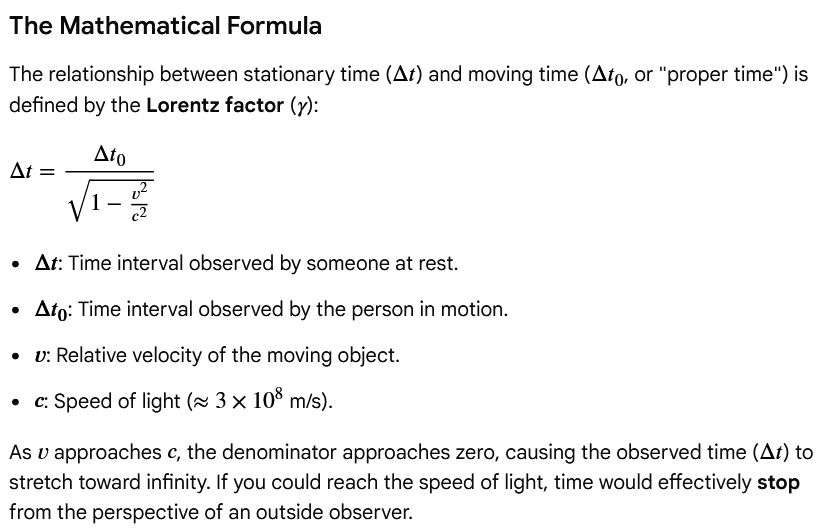
Velocity-Based Time Dilation (Special Relativity): The faster you move through space, the slower you move through time. Acore tenet of Einstein’s Special Relativity, describes how time slows down for an object as its speed increases relative to a stationary observer.


Time Dilation

From the album “The Future

bookmark_borderJump Into

[Intro]
Slow down
(And jump)
… into the future
[Instrumental, Guitar Solo]

[Verse 1]
Wanna get a taste
(Of velocity based)
Faster through space
(Slower through time)

[Bridge]
I’m….
[Instrumental, Synth Solo, Percussion]
Slow down
(And jump)
… into the future
[Instrumental, Guitar Solo]

[Chorus]
Jump! (Ahead)
Jump up!
(Book read)
Jump!
(Come on and…)
Jump!

[Instrumental, Saxophone Solo]

[Verse 2]
Wanna race against space
(Time without a trace)
Decades gone (they fly by)
No time to wonder (“Wonder why?”)

[Bridge]
Bye…. (Bye-bye)
[Instrumental, Synth Solo, Percussion]
Slow down
(And jump)
… into the future
[Instrumental, Guitar Solo]

[Chorus]
Jump! (Ahead)
Jump up!
(Book read)
Jump!
(Come on and…)
Jump!

ABOUT THE SONG
Primary Mechanisms of Future Time Travel
Physicists have identified two main ways to “jump” into the future by slowing down your own internal clock relative to the rest of the world:

* Velocity-Based Time Dilation (Special Relativity): The faster you move through space, the slower you move through time.
* The Effect: If you were to travel on a spaceship at near-light speeds (e.g., 99.9% the speed of light) for what felt like one year to you, several decades might have passed on Earth when you returned.
* Real-World Example: Astronauts on the International Space Station (ISS) travel at 17,500 mph. After six months, they have aged approximately 0.005 seconds less than people on Earth.

From the album “The Future

bookmark_borderWhat’s Left

Whats-Left.mp3
Whats-Left.mp4
Whats-Left-Pt-2.mp3
Whats-Left-Pt-2.mp4
Whats-Left-intro.mp3

[Intro]
Do your best
To hold on
(To what’s left)
Suggest
(Reason)

[Verse 1]
The ice is melting
(Drip by drop)
Temperature’s sweltering
(Just won’t stop)

[Bridge]
Suggest
(Reason)

[Chorus]
Do your best
To hold on
(To what’s left)
Before more
(Fades away today)

[Verse 2]
The reservoir
(Drier than before)
Down to the last drop
(Just won’t stop)

[Bridge]

[Chorus]

[Outro]
What do you say
(Let’s make it OK)
Suggest it’s the season
(For reason)

ABOUT THE SONG AND THE SCIENCE

“What’s Left” reads as a quiet but urgent meditation on human-induced climate change, framed not as spectacle, but as loss measured in drops, degrees, and dwindling margins.

Verse 1: The Physics of Loss

“The ice is melting / (Drip by drop)”
“Temperature’s sweltering / (Just won’t stop)”

The imagery is deliberately incremental. Climate change rarely arrives as a single moment—it accumulates. “Drip by drop” mirrors glacial melt, ice-sheet mass loss, and the slow but relentless transfer of water from frozen reservoirs into the ocean. The phrase “just won’t stop” reflects the inertia of the climate system: even if emissions ceased today, stored heat in oceans and atmosphere would continue driving warming for decades.

This is climate change as process, not apocalypse—yet.

Bridge: Reason vs. Denial

“Suggest / (Reason)”

This terse bridge functions like a plea. In the face of overwhelming physical evidence, the song calls for rational response rather than excuse-making. It’s a direct challenge to denial, delay, and political deflection—an appeal to act while reason still has leverage.

Chorus: The Shrinking Window

“Do your best / To hold on / (To what’s left)”
“Before more / (Fades away today)”

Here the song becomes ethical. “What’s left” refers simultaneously to:

  • Remaining ice

  • Remaining freshwater

  • Remaining ecosystems

  • Remaining time

  • Remaining moral responsibility

The urgency is temporal: today. Climate change is framed not as a future problem but as an ongoing subtraction. Each delay erodes options. The chorus implies that inaction is itself a choice—one that guarantees further loss.

Verse 2: Water as the Limiting Factor

“The reservoir / (Drier than before)”
“Down to the last drop / (Just won’t stop)”

This verse shifts from ice to liquid water, completing the hydrological arc. Melting ice does not mean water security—paradoxically, warming leads to drought, reservoir depletion, and freshwater scarcity. Snowpack loss, altered precipitation patterns, and evaporation intensify shortages even as floods increase elsewhere.

“Just won’t stop” now applies to depletion, reinforcing the idea of runaway dynamics once thresholds are crossed.

Outro: A Final Choice

“What do you say / (Let’s make it OK)”
“Suggest it’s the season / (For reason)”

The closing lines return agency to humanity. The problem is physical, but the solution is social, political, and moral. Calling it a “season for reason” subtly contrasts natural cycles with human decision-making: nature follows laws; humans choose whether to listen.

Overall Meaning
“What’s Left” is not about panic—it’s about accounting. It asks the listener to notice what remains before it’s gone, and to recognize that climate change is not an abstract trend but a lived, measurable erosion of stability.

The song’s power lies in restraint: no grand metaphors, no hyperbole—just the physics of warming translated into human terms. It reminds us that the defining question of climate change is no longer “Is it happening?” but:

How much will we lose before we decide to stop?

* Our probabilistic, ensemble-based climate model — which incorporates complex socio-economic and ecological feedback loops within a dynamic, nonlinear system — projects that global temperatures are becoming unsustainable this century. This far exceeds earlier estimates of a 4°C rise over the next thousand years, highlighting a dramatic acceleration in global warming. We are now entering a phase of compound, cascading collapse, where climate, ecological, and societal systems destabilize through interlinked, self-reinforcing feedback loops.

We examine how human activities — such as deforestation, fossil fuel combustion, mass consumption, industrial agriculture, and land development — interact with ecological processes like thermal energy redistribution, carbon cycling, hydrological flow, biodiversity loss, and the spread of disease vectors. These interactions do not follow linear cause-and-effect patterns. Instead, they form complex, self-reinforcing feedback loops that can trigger rapid, system-wide transformations — often abruptly and without warning. Grasping these dynamics is crucial for accurately assessing global risks and developing effective strategies for long-term survival.

What Can I Do?
The single most important action you can take to help address the climate crisis is simple: stop burning fossil fuels. There are numerous actions you can take to contribute to saving the planet. Each person bears the responsibility to minimize pollution, discontinue the use of fossil fuels, reduce consumption, and foster a culture of love and care. The Butterfly Effect illustrates that a small change in one area can lead to significant alterations in conditions anywhere on the globe. Hence, the frequently heard statement that a fluttering butterfly in China can cause a hurricane in the Atlantic. Be a butterfly and affect the world.

Tipping points and feedback loops drive the acceleration of climate change. When one tipping point is breached and triggers others, the cascading collapse is known as the Domino Effect.

The Climate Crisis: Violent Rain | Deadly Humid Heat | Extreme Weather Events | Insurance | Trees Deforestation | Air Pollution | Rising Sea Level | Food and Water | Updates

The Human Induced Climate Change Experiment

From the album “Hold On

bookmark_borderA Long Day

A-Long-Day-Best-Of.mp3
A-Long-Day-Best-Of.mp4
A-Long-Day.mp3
A-Long-Day.mp4
A-Long-Day-intro.mp3

[Intro]
It’s going to be a long day
(Will you be OK?)

[Verse 1]
The sun is rising high
(High, high, high)
Until we turn around
(Round and round)

[Bridge]
Hey! Hey! Hey!
It’s going to be a long Day
(Will you be OK?)

[Chorus]
The truth she speaks
(Gonna be light for weeks)
The sun high in the sky
(Tell me the reason why)

[Verse 2]
It turned so bright
(Under the midnight sun)
Can’t turn off the light
(To get some sleepin’ done)

[Bridge]
Saa, saa, saa (Sunlight)
Bring on the night
It’s going to be a long day
(Will you be OK?)

[Chorus]
The truth she speaks
(Gonna be light for weeks)
The sun high in the sky
(Tell me the reason why)

[Outro]
A bit of an elliptical orbit
Twilight
(It’s starting to dim)
The sliver of light… glowing slim
(Oh, what a delight)
The night might…
(Fade to black)
… imagine that

ABOUT THE SONG AND THE SCIENCE
The longest “day” at the North Pole is a single continuous period of daylight known as the polar day, which lasts for approximately six months. While lower latitudes experience a “longest day” as a single 24-hour period with the most sunlight hours on the summer solstice, the North Pole experiences the following unique cycle:

* Continuous Daylight (The Polar Day): The sun stays above the horizon for roughly 186 days. It rises at the vernal equinox (around March 20–21) and does not set again until the autumnal equinox (around September 22–23).
* Maximum Solar Height: During this six-month “day,” the sun reaches its highest point in the sky at the summer solstice (June 20 or 21). In 2025, the summer solstice occurred on June 20 at 10:42 PM EDT.
* The “Midnight Sun”: Because the sun circles the pole without setting, every 24-hour period during these six months technically has 24 hours of daylight.

The North Pole’s polar day is slightly longer than its polar night (approximately 179 days) due to Earth’s elliptical orbit, which causes the planet to move more slowly during the northern summer when it is further from the sun.

From the album “Arctic

bookmark_borderA Long Night

A-Long-Night.mp3
A-Long-Night.mp4
A-Long-Night-Pt-2.mp3
A-Long-Night-Pt-2.mp4
A-Long-Night-intro.mp3

[Intro]
It’s going to be a long night
(Will you be alright?)

[Verse 1]
The sun is going down
(Down, down, down)
Until we turn around
(Round and round)

[Bridge]
Twilight
It’s going to be a long night
(Will you be alright?)

[Chorus]
The truth he speaks
(Gonna be night for weeks)
The sun below the horizon
(Don’t know when it rise again)

[Verse 2]
It turned so dark
(We needed a spark)
Until it turned day
(All the way)

[Bridge]
Twilight
It’s going to be a long night
(Will you be alright?)

[Chorus]
The truth he speaks
(Gonna be night for weeks)
The sun below the horizon
(Don’t know when it rise again)

[Outro]
Twilight
(Barely left in sight)
Insight into light
(Oh, what a delight)
The night might…
(Turn to broad daylight)

ABOUT THE SONG AND THE SCIENCE
The longest “night” at the North Pole is a continuous period of darkness known as the polar night, which lasts for approximately six months. While the exact duration depends on how “night” is defined (based on the sun’s position below the horizon), here are the specific periods for the North Pole:

* Total Polar Night (Sun below horizon): Lasts roughly 179 days. It typically begins around the autumnal equinox (September 21–25) and ends around the vernal equinox (March 18–21).
* True/Full Darkness (No twilight): Lasts for about 11 weeks. This period of “true polar night,” where no astronomical twilight occurs even at midday, occurs roughly from November 12 to January 28.
* Twilight Periods: The months of October and early March are characterized by long periods of dawn and dusk, where the sun is just below the horizon, providing some dim light rather than total darkness.

In contrast, the South Pole experiences a slightly longer polar night of approximately 186 days because Earth’s elliptical orbit causes it to move more slowly during the southern winter.

From the album “Arctic

bookmark_borderThe Depths

The-Depths.mp3 The-Depths.mp4 The-Depths-Unplugged-Underground-XXIX.mp3 The-Depths-Unplugged-Underground-XXIX.mp4 The-Depths-intro.mp3

[Intro]
From the height
(Of reflecting white)
To the depth
(Of the ocean deep)

[Bridge]
Who would’ve thunk
Into the deep dark ocean….
(She sunk)

[Refrain]
From the height
(Of reflecting white)
To the depth
(Of the ocean deep)

[Bridge]
So you know
(Albdeo)
Albus (ness)
Reflectivity
(Can you see?)
Who would’ve thunk
Into the deep dark ocean….
(She sunk)
Imagine that…
(A heat trap)
Feeding back
(… and back and back)

[Refrain]
From the height
(Of reflecting white)
To the depth
(Of the ocean deep)

[Bridge]
So you know
(Albdeo)
Albus (ness)
Reflectivity
(Can you see?)

[Outro]
Who would’ve thunk
Into the deep dark ocean….
(She sunk)
Who’s to thank
(She sank)
Imagine that…
(A heat trap)
Feeding back
(… and back and back)

ABOUT THE SONG AND THE SCIENCE
PART I — A DEEP DARK OCEAN VS. BRIGHT WHITE
A deep-ocean study has revealed that even the deepest layers of the ocean are warming at a rapid rate. Since the oceans absorb and store over 90% of the excess heat trapped by greenhouse gases, even a tiny increase — as little as one-tenth of a degree — represents an enormous amount of additional stored thermal energy. The physics is stark: if that accumulated ocean heat were distributed across land surfaces, it would equate to an estimated 35°C increase in land temperatures — a level that would make most of the planet uninhabitable. This highlights how oceans have been masking the true extent of surface warming, acting as a temporary buffer while silently destabilizing their own systems through stratification, circulation slowdown, and ecosystem collapse. During 2025, the entire Pacific Ocean is running 1.6°C above its long-term average — a shocking six standard deviations above the mean. In climate science, deviations of this magnitude are virtually off the charts, underscoring just how far outside of “normal variability” our planet has moved.

PART II — ALBEDO

The term “albedo effect” comes from a combination of classical astronomy, Latin etymology, and 20th-century climate physics.

1. Origin of the Word Albedo

  • Albedo comes from the Latin albus, meaning “white”.

  • In Latin, albedo literally means “whiteness” or reflectivity.

The term was first used scientifically in astronomy, not climate science.

2. Early Scientific Use (Astronomy)

In the 18th and 19th centuries, astronomers used albedo to describe how much sunlight a celestial body reflects.

  • A high albedo meant a bright object (e.g., Venus clouds, icy moons)

  • A low albedo meant a dark object (e.g., the Moon’s basalt plains)

This was essential for:

  • Estimating planetary temperatures

  • Understanding surface composition

  • Explaining why bodies at the same distance from the Sun had different temperatures

3. Transition to Climate Science

The concept moved into Earth science in the early–mid 20th century, as scientists began treating Earth as a radiative energy system.

Key milestones:

  • Svante Arrhenius (1896) laid the groundwork by linking atmospheric gases to temperature, though he did not yet formalize albedo.

  • Budyko (1950s–1960s) and Sellers (1969) explicitly incorporated albedo into climate models.

  • They showed that ice and snow reflect far more solar radiation than land or ocean, making albedo a critical climate variable.

4. The “Albedo Effect”

The albedo effect refers specifically to the feedback mechanism, not just reflectivity itself:

  • Ice and snow → high albedo → cooling

  • Ice melts → darker surface exposed → more solar absorption → warming

  • More warming → more melting

This became one of the first formally recognized positive feedback loops in climate science.

5. Why It Became Central to Climate Tipping Points

By the late 20th century, albedo was understood as:

  • A nonlinear amplifier

  • A threshold-driven feedback

  • A key driver of polar amplification

This is why albedo plays a central role in:

  • Arctic warming (now 4–20× the global mean)

  • Greenland and Antarctic instability

  • Jet stream destabilization

  • Cascading tipping-point dynamics (your area of work)

6. Modern Usage

Today, the albedo effect is foundational in:

  • General circulation models (GCMs)

  • Cryosphere studies

  • Earth system tipping-point analysis

  • Satellite-based energy balance measurements

In Short

  • Word origin: Latin (albus = white)

  • First use: Astronomy (planetary brightness)

  • Climate adoption: Mid-20th century

  • Modern meaning: A powerful positive climate feedback where reflectivity changes accelerate warming

It’s one of the clearest examples of how simple physics, when embedded in a complex system, produces nonlinear and cascading outcomes—exactly the kind of mechanism your tipping-point work focuses on.

Like penguins on land and polar bears on ice, whales may soon become another voice in the growing wail of a planet crossing irreversible thresholds.

The Plight of the Penguin: Will Humans Follow? (Adaptation Part I)

Polar Bear Plunge: Will Humans Follow? (Adaptation Part II)


* Our probabilistic, ensemble-based climate model — which incorporates complex socio-economic and ecological feedback loops within a dynamic, nonlinear system — projects that global temperatures are becoming unsustainable this century. This far exceeds earlier estimates of a 4°C rise over the next thousand years, highlighting a dramatic acceleration in global warming. We are now entering a phase of compound, cascading collapse, where climate, ecological, and societal systems destabilize through interlinked, self-reinforcing feedback loops.

We examine how human activities — such as deforestation, fossil fuel combustion, mass consumption, industrial agriculture, and land development — interact with ecological processes like thermal energy redistribution, carbon cycling, hydrological flow, biodiversity loss, and the spread of disease vectors. These interactions do not follow linear cause-and-effect patterns. Instead, they form complex, self-reinforcing feedback loops that can trigger rapid, system-wide transformations — often abruptly and without warning. Grasping these dynamics is crucial for accurately assessing global risks and developing effective strategies for long-term survival.

What Can I Do?
The single most important action you can take to help address the climate crisis is simple: stop burning fossil fuels. There are numerous actions you can take to contribute to saving the planet. Each person bears the responsibility to minimize pollution, discontinue the use of fossil fuels, reduce consumption, and foster a culture of love and care. The Butterfly Effect illustrates that a small change in one area can lead to significant alterations in conditions anywhere on the globe. Hence, the frequently heard statement that a fluttering butterfly in China can cause a hurricane in the Atlantic. Be a butterfly and affect the world.

Tipping points and feedback loops drive the acceleration of climate change. When one tipping point is breached and triggers others, the cascading collapse is known as the Domino Effect.

The Climate Crisis: Violent Rain | Deadly Humid Heat | Extreme Weather Events | Insurance | Trees Deforestation | Air Pollution | Rising Sea Level | Food and Water | Updates

The Human Induced Climate Change Experiment

From the album “Arctic