bookmark_borderCracked Windshield (Album)

Cracked Windshield Album Cover

Cracked Windshield

Cracked Windshield

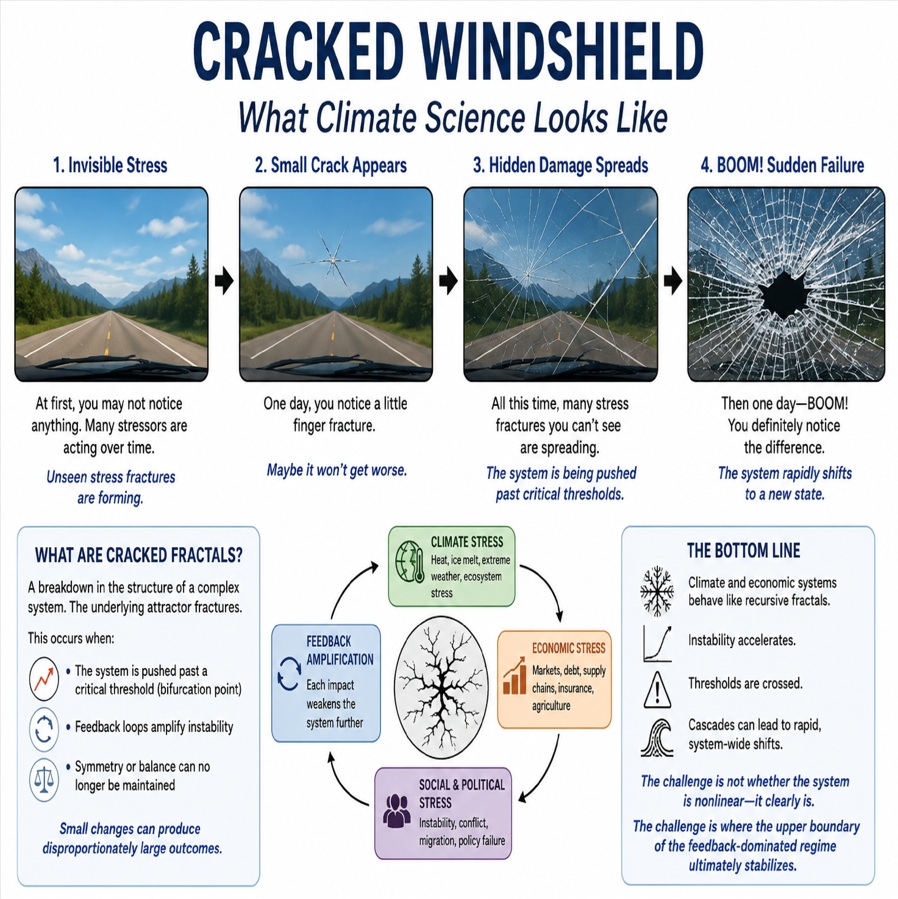
What Climate Science Looks Like

In many ways, it resembles a cracked windshield.

At first, you may not notice anything at all. Time passes. The damage appears minor or even invisible. Then one day, a small fracture catches your eye — just a tiny finger crack stretching across the glass.

You think:

“Maybe it won’t get worse.”

But during all that time, unseen stress fractures have already been spreading beneath the surface. Temperature changes, vibration, pressure, and repeated impacts continue weakening the structure. The windshield may appear stable right up until the moment it suddenly fails.

Then one day:

BOOM.

The entire system changes.

Climate systems often behave the same way.

What Climate Science Looks Like: Cracked Windshield
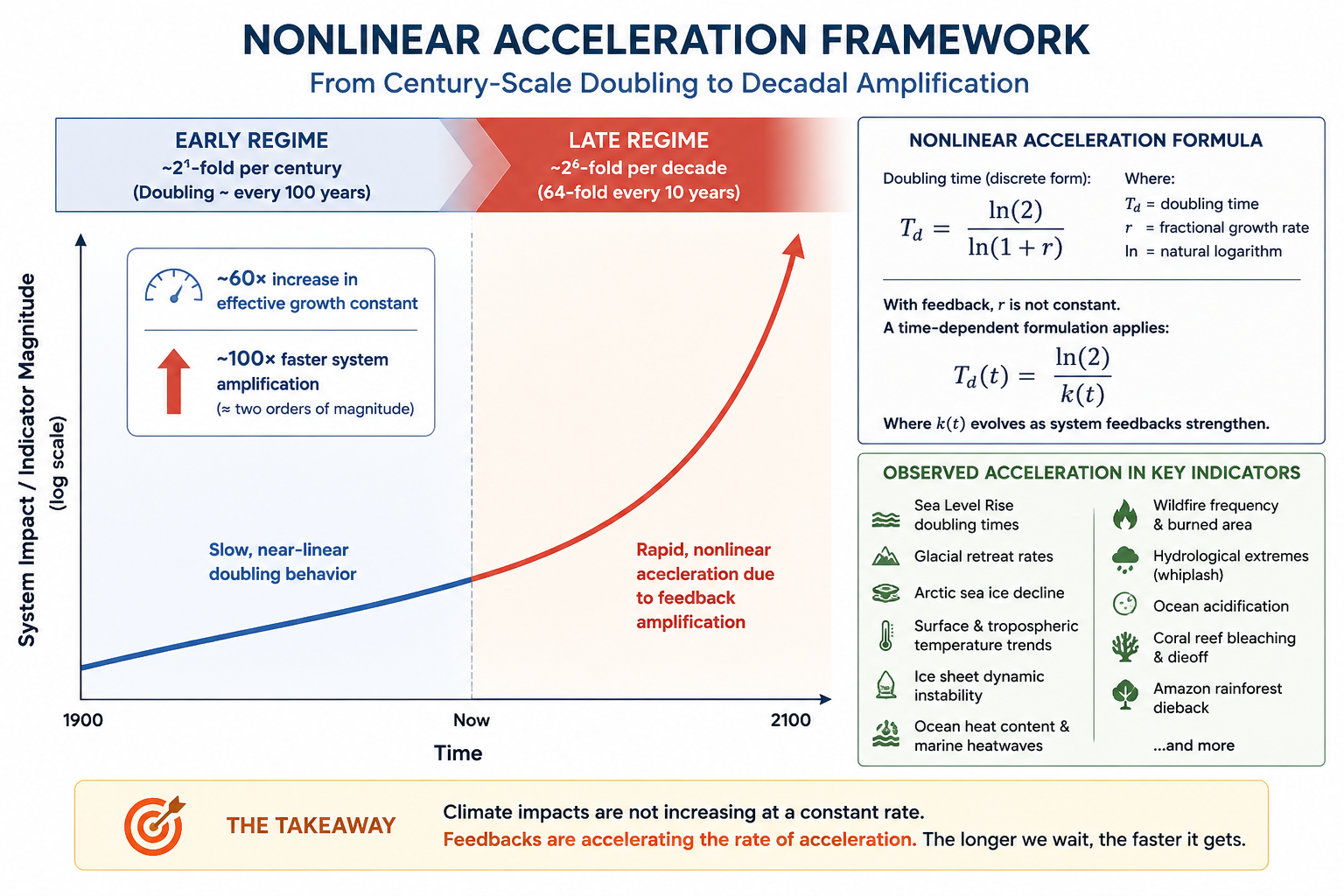

Nonlinear Climate Impact Acceleration Framework

Cracked Windshield

[Intro]
Did you know…
You can look out your window…
And see what’s come to be.

At first…
You don’t notice anything.
Just another day.
Another mile.
Another season passing by.
(Why?)

[Soft Piano Enters]
Then one day…
You see it.
A tiny crack.
A thin line stretching across the glass.
You tell yourself…
“It’s probably nothing.”
But beneath the surface…
The fractures are already spreading.
(Bringing on the dreading)

[Verse 1]
Did you know
You can look out your window
(And see what’s come to be)
There’s a crack
In the windshield
(And it will yield… the fact)
You can drive for miles
Thinking everything’s alright
Just a little line of damage
In the morning light
But every bump and every season
Every freeze and every thaw
Adds a little more pressure
To a weakness that you saw

[Pre-Chorus]
Beneath the surface
Out of sight
The fractures spread
Day and night

[Chorus]
[Full Band]
It’s a cracked windshield
Spider webs across the sky
One more shock
And the whole thing comes alive
It’s a cracked windshield
Breaking faster than it seems
What looked so small
Was bigger than our dreams
And when it goes
It doesn’t ask us why
A cracked windshield
Across the world we drive

[Verse 2]
We watched the rivers
We watched the forests
We watched the oceans rise
We saw the warning signs
Reflected in our eyes
Heat waves linger longer
Storms arrive with greater force
Every year another fracture
Running through the course
We kept saying tomorrow
Would be time enough to mend
Never seeing all the branches
Growing from the end

[Pre-Chorus]
[Building Tension]
Beneath the surface
Out of sight
The fractures spread
Day and night

[Chorus]
It’s a cracked windshield
Spider webs across the sky
One more shock
And the whole thing comes alive
It’s a cracked windshield
Breaking faster than it seems
What looked so small
Was bigger than our dreams
And when it goes
It doesn’t ask us why
A cracked windshield
Across the world we drive

[Bridge]
Then one day…
BOOM.

The pattern changes shape.
What held together yesterday
Can suddenly break.
[Drums Re-enter]
The pieces were connected
Though we never saw the thread
Now every crack is talking
To the others up ahead
Tipping points and feedback loops
Joining hand in hand
Drawing maps of fractures
Across the sea and land

[Final Chorus]
It’s a cracked windshield
Looking out on changing days
The lines we ignored
Now stretch in every way
It’s a cracked windshield
Not a single crack alone
But a thousand hidden pathways
Through the structure we’ve known
And the lesson
Written right before our eyes
A cracked windshield
Shows how systems fail with time

[Outro]
[Drums Fade]
Did you know…
You can look out your window…
And see what’s come to be…
[Organ and Piano Sustain]
There’s a crack…
In the windshield…
[Long Pause]
And it reveals…
What we could not see…
(And what has come to be.)
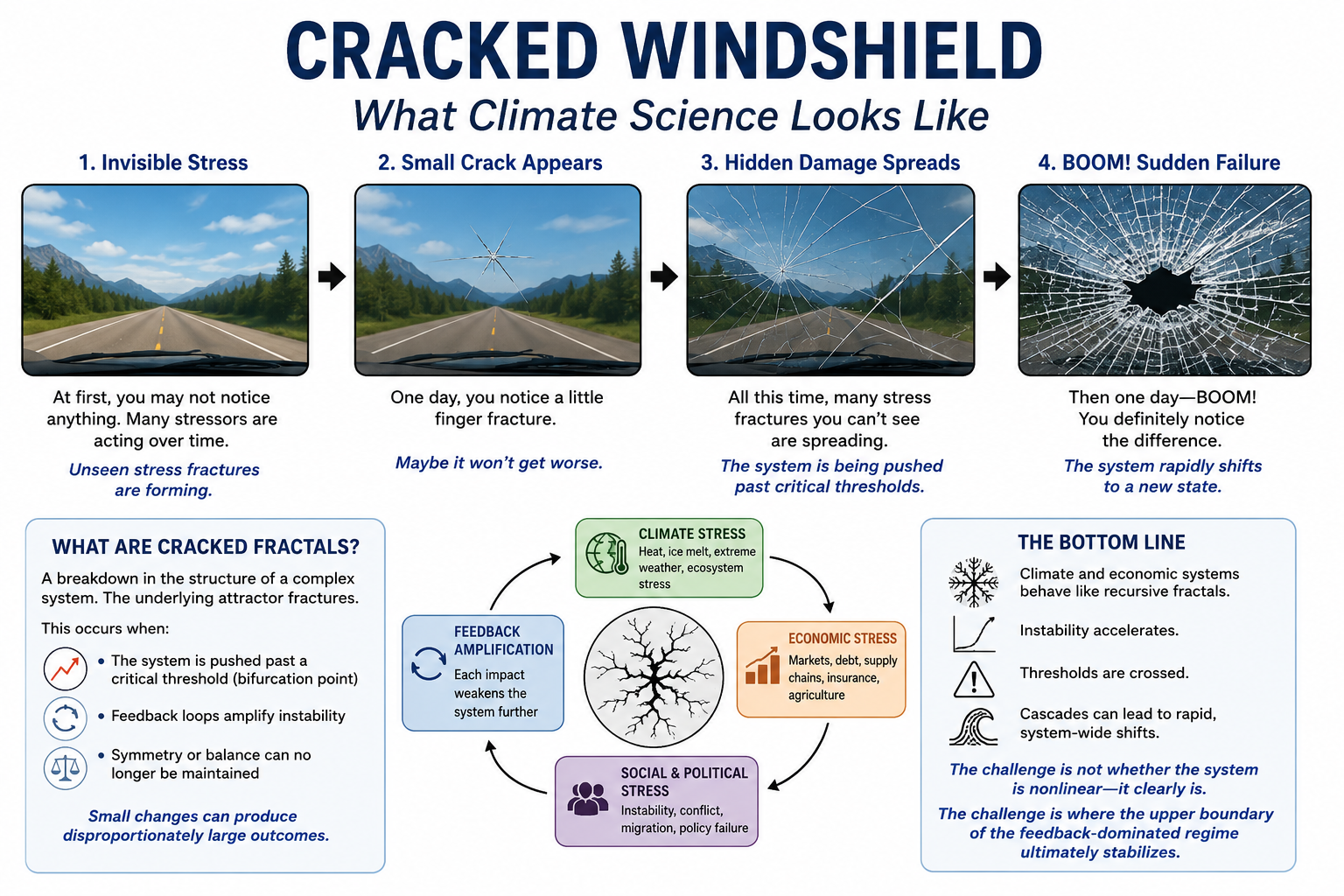

Cracked Windshield Climate Scene

Get Together

[Chorus]
Do you want to get together?
(Does it have to be forever)
Strange attractor
(Is in fact a factor?)

[Refrain]
Do you want to get together?
(Is it “whether”… is it weather)
How long… is forever
(How long… will this song go on?)
Until…
(Still is still)

[Chorus]
Do you want to get together?
(Does it have to be forever)
Strange attractor
(Is in fact a factor?)
[Bridge]
Maybe pathways cross
(Like they often do)
Maybe strange attractors
(Brought me here to you)

[Refrain]
Do you want to get together?
(Is it “whether”… is it weather)
How long… is forever
(How long… will this song go on?)
Until…
(Still is still)
Until…
(The moment stands still)

[Outro]
[Instrumental Fade]
[Guitar Harmonics]
[Organ Sustain]
[Soft Bass Pulse]
[Spoken Vocal]
Is forever…
… simply what happens…
when two trajectories meet…
… the feat.

(Complete?)
Complete

Frame 1 — Invisible Stress

[Intro]
Sometimes the biggest changes…
Begin where nobody is looking.
A structure can appear unchanged…
Nevertheless…
(… stress quietly accumulates beneath the surface.)

[Verse 1]
Back before the warning signs
Filled the nightly news
The system seemed so stable
Nothing much to lose
The seasons came and went around
Like they always had before
But tiny shifts were building up
Behind a hidden door

[Pre-Chorus]
Earlier in the game
(First frame)
Before the picture changed
(No one knew its name)

[Chorus]
At first you may not notice
(Maybe you missed the first verse)
Multiplying unseen fractures
(Adding up to become the future)
Tiny stresses
(Hidden from view)
Building pathways
(Running through)

[Verse 2]
The ice thinning slow
So hardly anyone could know
Easy to explain away
Until the pressure found its way

[Pre-Chorus]
Earlier in the game
(First frame)
Quiet changes spreading
(Without a face to blame)

[Chorus]
At first you may not notice
(Maybe you missed the first verse)
Multiplying unseen fractures
(Adding up to become the future)
Tiny stresses
(Hidden from view)
Building pathways
(Running through)

[Bridge]
Invisible doesn’t mean absent
Silent doesn’t mean still
The forces keep accumulating
Following their will
Every crack begins as something
Almost too small to see
Until enough connections form
To change reality

[Breakdown]
One line…
(Becomes two)
Two lines…
(Becomes more)
Small shifts…
(Open the door)

[Final Chorus]
At first you may not notice
(Maybe you missed the first verse)
Multiplying unseen fractures
(Adding up to become the future)
Hidden stresses
(Beneath the skin)
The story’s already starting
(Before the next frames begin)

[Outro]
[Ambient Synth, Soft Piano]
Earlier in the game…
(First frame)
The damage wasn’t seen…
(Soon bursting onto the scene)

Queue frame 2
(Hidden stress becomes a mess)

About the Song
The graphic is a simplified representation of an extraordinarily complex system. Nevertheless, it provides a familiar visual analogy that helps make nonlinear climate dynamics easier to understand.

Up through the 1990s, we were largely in Frame 1 — invisible stress. The underlying pressures were building, but most of the damage remained hidden from view.

Fly on the Phenomenon

[Intro]
Remember when…
A summer drive meant stopping for gas…
And cleaning the windshield.

Not once…
But over and over again.

Now the glass stays clean…
(There is no yield)
Revealed:
(No bugs in the scene)
… know what I mean?

[Verse 1]
Cruisin’ down the blacktop
Windows rolled down
Used to hear the buzzin’
All around town
Dragonflies and fireflies
Moths beneath the moon
Clouds of life were everywhere
But they vanished much too soon

[Pre-Chorus]
Something changed
Along the way
The silence grew
Day by day

[Chorus]
A fly…
(On the phenomenon)
Oh my
(Now there’s none)

[Refrain]
Splatometer
(Runnin’ flat)
Splat!

Insect splatter
(Sure does matter)

[Verse 2]
Used to wipe the windshield
Every hundred miles
Now it stays so spotless
Year after year and mile after mile
The roads are getting cleaner
But something isn’t right
When the air grows empty
Of wings in summer light

[Pre-Chorus]
The birds are looking
Fields and streams
No dinner cooking
Just leftover dreams

[Chorus]
A fly…
(On the phenomenon)
Oh my
(Now there’s none)

[Refrain]
Splatometer
(Runnin’ flat)
Splat!

Insect splatter
(Sure does matter)

[Bridge]
Half or more in others too
And the warning’s coming through
Vacant fields and flowers
The blame is all ours

[Build]
One by one
The losses add
Until the whole thing’s looking bad

[Chorus]
A fly…
(On the phenomenon)
Oh my
(Now there’s none)
A fly…
(Where’d they go?)
Oh my
(We may never know)

[Refrain]
Splatometer
(Runnin’ flat)
Splat!

Insect splatter
(Sure does matter)

Splatometer
(Falling fast)
Splat!
(How much longer)
Can this last?

[Final Verse]
The windshield tells a story
Anybody can see
A signal from the roadside
Of a changing tragedy
The smallest things among us
Often hold the biggest key
And when they start disappearing
What does that say for you and me?

[Final Chorus]
A fly…
(On the phenomenon)
Oh my
(Now there’s none)
A fly…
(On the windshield glass)
Oh my
(Passed into the past)

[Extended Refrain]
Splatometer
(Runnin’ flat)
Splat!
Insect splatter
(Sure does matter)
Food webs shatter
(That does matter)
Empty chatter
(Science matters)

[Outro]
[Highway Sounds Fade]
[Soft Acoustic Guitar]
[Fade Out]
Splat…
Splat…
Splat…
(No more of that…)

About the Song
The “windshield phenomenon” refers to the observation that people see far fewer dead insects on their windshields today than they did a few decades ago. What began as an anecdotal observation has since been confirmed by scientific studies documenting substantial declines in insect populations around the world.

Researchers have even measured the trend directly using standardized bug-splatter surveys.

*In Denmark, a study tracking insect impacts along the same driving routes from 1997 to 2017 found roughly an 80% decline in insect splatters, paralleling declines in insect-eating bird populations.

* In the UK, “Splatometer” surveys conducted by the Kent Wildlife Trust found a 50% to 72% reduction in insect collisions compared with measurements from 2004.

* A landmark 2017 study in German nature reserves reported a 76% decline in total flying insect biomass over a 27-year period.

The causes are complex and likely include habitat loss, pesticide use, pollution, climate change, invasive species, and other environmental stressors acting together. Regardless of the exact mix of causes, the decline is significant because insects form the foundation of many ecosystems, supporting pollination, soil health, birds, amphibians, and countless other species.

In many ways, the disappearing bugs on our windshields may be one of the most visible signs of a much larger ecological disruption.

Many Stressors

[Intro]
Rarely does a system fail…
From a single cause.
Because more often…
Many pressures arrive together…
Turning is…
To was.

[Verse 1]
Another extreme storm
Creating a new (knew) norm
A splinter by itself may seem
Like something incomplete…
(But, just wait until they meet)

[Pre-Chorus]
One stressor here
(One stressor there)
Another arrives
(From everywhere)

[Chorus]
Many stressors
(Over time)
Humanity’s aggressors
(All the while… feedbacks rhyme)

[Verse 2]
Ecofascists wine and dine
Order another course (of course!)
While separate pieces intertwine
And magnify the force

[Pre-Chorus]
One becomes two
(Two become more)
Small disturbances
(Open a door)

[Chorus]
Many stressors
(Over time)
Humanity’s aggressors
(All the while… feedbacks rhyme)

Adding pressure
(Year by year)
Making futures
(Less than clear)

[Bridge]
[Music Drops to Bass and Drums]
Habitat loss
(Push)
Pollution
(Push)
Overconsumption
(Push)
Climate disruption
(Push)
Invasive species
(Push)
Resource depletion
(Push)
One alone may bend a system
(Together they can break “I am”)

[Build]
Stress upon stress
(Stronger still)
Force upon force
(Against the will)
Feedback loops
(Begin to grow)
Accelerating
(What we sow)

[Chorus]
Many stressors
(Over time)
Humanity’s aggressors
(All the while… feedbacks rhyme)

[Final Chorus]
[Full Band, Choir Harmony]
Many stressors
(Over time)
Humanity’s aggressors
(All the while… feedbacks rhyme)
Not one cause
(Not one line)
But countless pressures
(All combined)
Many stressors
(Every day)
Shaping futures
(Along the way)

[Outro]
[Drums Fade, Ambient Synth Remains]
A system can withstand…
A great deal.
Until it can’t.
The challenge…
Is recognizing the total weight.
Not just the heaviest stone.
(Man, man alone)
[Fade Out]
Many stressors…
Over time…

Butterfly Flaps

[Intro]
Wisp, wisp…
(Just like this:)
The butterfly effect isn’t about butterflies.
(I’ve come to realize)
It’s about sensitivity.
(I’ve come to see)
Tiny causes.
(And becauses)
Unexpected consequences.
A world where small things matter.

[Verse 1]
A whisper in the background
(A change too small to see)
A fraction of a degree
(In a complex tapestry)

A choice made on a Tuesday
(A pathway left untapped)
One little perturbation
(Then the future gets remapped)

[Pre-Chorus]
Small things
(Grow)
Small things
(Flow)
Small things
(We barely know)

[Whispered Vocal]
Wisp, wisp…
(Just like this:)

[Chorus]
A butterfly flaps its wings
(And look what it brings)
The chaos amongst us
(Is it fabulous or dangerous?)

A tiny little motion
(Changes everything)
A butterfly flaps its wings
(And look what it brings)

[Verse 2]
The storm was not created
(By wings alone, it’s true)
The atmosphere was waiting
(For something small to do)

A system near a threshold
(Can tip from little things)
When tension fills the network
(The smallest signal sings)

[Pre-Chorus]
Tiny push
(Big swing)
Tiny note
(Big string)
Tiny spark
(Big thing)

Wisp, wisp…
(Just like this:)

[Chorus]
A butterfly flaps its wings
(And look what it brings)
The chaos amongst us
(Is it fabulous or dangerous?)

The future starts unfolding
(From the smallest springs)
A butterfly flaps its wings
(And look what it brings)

[Refrain]
Flap flap flap
(Then a cascade)
Flap flap flap
(A future made)
Flap flap flap
(A pathway laid)
Flap flap flap
(A price gets paid)

[Bridge]
Chaos doesn’t mean disorder
It means possibility
The future is not random
It’s sensitive dependency
The system holds many outcomes
Many roads that might have been
Until some tiny influence
Helps determine if we’re in balance
Wisp, wisp…
(Just like this:)

[Build]
One choice
(One chance)
One step
(One dance)
One flutter
(Advance)
And suddenly…
Circumstance

[Whispered Vocal]
Wisp, wisp…
(Just like this:)

[Final Chorus]
A butterfly flaps its wings
(And look what it brings)
The chaos amongst us
(Is it fabulous or dangerous?)

Maybe both together
(As uncertainty sings)
A butterfly flaps its wings
(And look what it brings)

A butterfly flaps its wings
(And look what it brings)

The world is more connected
(Than it first appears)
Tiny causes
(Growing through the years)

[Outro]
[Soft Piano and Synth Fade]
The butterfly was never the story…
Just the opening of the book
waiting for you to look

Flap…
(Flap…)
Flap…
[Whispered Vocal]
Wisp, (wisp…)
Just like this:
(Wisp…..)

About the Song
The new release of the day, **”BUTTERFLY FLAPS,”** is a song about the chaos amongst us. The track features acoustic/electric guitar, glockenspiel, bass, and layered synth textures inspired by the famous butterfly effect—the idea that small actions can sometimes produce surprisingly large consequences.

The song was inspired by recent conversations about those seeking to incite insight into ecosystems, economics, and consumer behavior. In many ways, every consumer is a butterfly, casting votes with dollars, attention, and choices. Those decisions ripple outward through supply chains, markets, communities, and the environment, creating reverberations that can be difficult to predict.

As the chorus asks:

*”A butterfly flaps its wings
(And look what it brings)
The chaos amongst us
(Is it fabulous or dangerous?)”*

The answer may be both.

The song explores how seemingly insignificant actions can contribute to much larger outcomes through interconnected systems, where a *”tiny little motion (Changes everything)”* and *”the future starts unfolding (From the smallest springs).”*

Whether in ecology, economics, or everyday life, small choices matter. Sometimes more than we realize. Sometimes a butterfly flaps its wings… and look what it brings.

Who Is Responsible? The answer may be both.

Consumers ultimately control demand. Without demand, there is no profitable supply. Every purchase acts as a market signal that encourages additional production, resource extraction, energy consumption, and waste generation.

In that sense, consumers exert enormous influence over emissions, pollution, and resource use. Corporations certainly bear responsibility for their actions, but they are responding to economic incentives created by billions of individual purchasing decisions.

The challenge is that responsibility is distributed. No single consumer causes the problem, yet collectively consumers drive the system. That means meaningful change requires both systemic reforms and changes in consumer behavior. Ignoring either side of that equation leaves us with an incomplete solution.

As for government, big business, conspiracies, and the responsibilities of others, here are my thoughts:
→ Solutions to the Fossil Fuel Economy and the Myths Accelerating Climate and Economic Collapse

Chaos Theory and Climate Systems

Frame 2 — In View

[Intro]
The first frame was easy to ignore.
(But no more)
Most of the damage remained unseen
(On the scene)
But eventually…
(What was once invisible to all)
Is now in view.
(Yes… here in the room with you.)

[Verse 1]
A line appears across the glass
A signal we can see
Not enough to stop the journey
But enough to disagree
Some say it’s just a blemish
Some say it’s all okay
Others point to growing patterns
That won’t simply fade away

[Pre-Chorus]
The pressure’s rising
(More each year)
The warning signs
(Becoming clear)

[Chorus]
Welcome to frame 2
(Stressors in view)
Well… of course…
(Maybe it won’t get worse?)

The cracks are showing
(Across the pane)
Yet many still say
(It’s just the rain)

[Verse 2]
The summers feel now makes ya reel
The floods arrive so fast
Records that once stood the test
Now rarely seem to last
As glaciers slip into the past
The oceans climb the shore
Each fracture looks connected
To the ones that came before

[Pre-Chorus]
What once seemed random
(Begins to align)
Individual signals
(Forming a line)

[Chorus]
Welcome to frame 2
(Stressors in view)
Well… of course…
(Maybe it won’t get worse?)

[Bridge]
Better rehearse
(For the hearse)
If we keep pretending
(The cracks won’t burst)
A fracture ignored
(Is a fracture fed)
The longer we wait
(The further it spreads)

[Build]
One crack…
(Becomes a chain)
One stress…
(Becomes a strain)
One warning…
(Becomes a trend)
Until the structure starts to bend

[Final Chorus]
[Full Band]
Welcome to frame 2
(Stressors in view)
No longer hidden
(Enough to review)

What once seemed distant
(Is drawing near)
The windshield’s talking
(Can anyone hear here?)

Welcome to frame 2
(A cracked point-of-view)

[Outro]
The first frame hid the damage.
The second frame reveals it.
The question becomes…
Will we ever quit?

[Fade Out]
Frame 2…
In view…

One Day…

[Intro]
It rarely happens all at once.
Change does not arrive by chance.
It arrives as accumulation…
Until suddenly unreliable…
Becomes undeniable.

[Verse 1]
A small imbalance in the system
A shift too slight to name
A quiet drift in baseline rules
That never looks the same

You carry on through daily noise
Assuming it will pass
Not noticing the pattern
Forming in the glass

[Pre-Chorus]
A line becomes a signal
(A signal becomes more)
What once was barely visible
(Starts knocking at the door)

[Chorus]
One day
(Along the way)
You notice
(An injustice)

Askew…
(What was one or two)
Grew and grew
(And grew, too)

The wait gained weight

[Verse 2]
The numbers start to gather
The edges start to fray
What felt like coincidence
No longer fades away
The curve begins to steepen
The baseline rearranged
And what you thought was stable
Is quietly exchanged

[Pre-Chorus]
A whisper becomes warning
(A warning becomes sound)
What once was scattered signals
(Begins begins screaming all around)

[Chorus]
One day
(Along the way)
You notice
(An injustice)

Askew…
(What was one or two)
Grew and grew
(And grew, too)
The wait gained weight

[Bridge]
It wasn’t sudden…
It wasn’t loud…
It was layered expectation
Underneath a growing cloud

Each step too small to measure
Each change too slow to feel
Until the accumulation
Makes the abstract suddenly real

[Build]
Small shifts
(Becoming trend)
Lost ground
(Without an end)
Quiet drift
(Becomes demand)
Until you finally understand

[Final Chorus]
One day
(Along the way)
You notice
(An injustice)
No longer hidden
(No disguise)
It was always forming
(Before your eyes)

Askew…
(What was one or two)
Grew and grew
(And grew, too)

The wait gained weight
(No debate)
Too, too late

[Outro]
One day…
Is never really one day.
It is many ways…
(In many days)

Until now…
(And now you know)

Spreading

[Intro]
A crack rarely stays where it starts.
(It departs leaving remnants)
Stress seeks pathways.
(Day after day after days)
Pressure seeks weakness.
And once connections form…
The spreading begins.
(Growin’)
Growin’ again and again

[Verse 1]
What began as a single line
Running through the pane
Slowly found another path
And then another lane
Each fracture linked to others
Across the structure’s face
Turning isolated damage
Into a spreading lace

[Pre-Chorus]
Across the glass
(Across the years)
Across our hopes
(Across our fears)

[Chorus]
We knew
(It grew)
Spreading
(Toward dreading)

The lines connected
(More than a few)
What seemed impossible
(Became true)

[Verse 2]
A drought affects a harvest
A harvest shifts a price
A price affects a family
Already stretched by life
A storm disrupts with strife
A region strains a state’s state
The consequences multiply
As pressures accumulate
(You can’t deny)
… it’s gettin’ late

[Refrain]
Pushed to the limit
(More than a bit)
Climatic
(Economic)
Political
(Roll call)
And, all and all

Let it roll
(Roll, baby, roll)

[Pre-Chorus]
One stressor
(Finds another)
One fracture
(Finds a brother)

[Chorus]
We knew
(It grew)
Spreading
(Toward dreading)

The pathways widened
(Through and through)
What seemed disconnected
(Connected too)

[Bridge]
Feedback follows feedback
Reaction follows cause
Every system carries strengths
And hidden structural flaws
The question isn’t whether
The crack will spread at all
The question is how quickly
The next fractures will crawl

[Build]
Faster…
(Than before)
Farther…
(Than before)
Deeper…
(Than before)
Opening another door

[Refrain]
Pushed to the limit
(More than a bit)
Climatic
(Economic)
Political
(Roll call)
Ecological
(Overall)
And, all and all

Let it roll
(Roll, baby, roll)

[Final Chorus]
We knew
(It grew)
Spreading
(Toward dreading)
Across the glass
(Across the years)
Across the headlines
(Across the fears)
We knew
(It grew)
Spreading
(Still spreading)

[Outro]
A fracture spreads…
Not because it wants to.
But because the structure
Allows it not to quit.
(Call it… habit?)
Or habitat, at that.

[Fade Out]
Roll…
Baby…
Roll…

Fractured Attractor

[Intro]
The system tends toward patterns.
Stable states.
Habitual paths.
Attractors.
(Consider the factors)
But what happens…
With changing rates
(Changing fates)

When the attractor itself begins to fracture?

[Verse 1]
The system found equilibrium
Or so it seemed to be
A balance built from countless parts
Across the land and sea

The pathways looked familiar
The averages held true
Until the hidden stresses
Started breaking through

[Pre-Chorus]
One branch
(Becomes two)
Two branches
(Becomes more)
Tiny fractures
(Open doors)

[Chorus]
Have you considered the factor
(Fractured attractor)
Humanity as the actor
(Fractured attractor)

A crack becomes a pattern
(A branching vector)
Following pathways
(Through the fractured attractor)

[Verse 2]
The forests lose resilience
The oceans gather heat
Economic systems wobble
As feedbacks start to meet

Each stressor finds another
Each pathway finds a way
The network grows more tangled
With each passing day

[Refrain]
Feedback on feedback
(Reaction chain)
Stress upon stress
(Again and again)

Branch upon branch
(Spreading faster)
Following the map
(Of the fractured attractor)

[Verse 3]
What looked like isolated events
Now travel as a swarm
Droughts and floods and market shocks
Become a different form

The pieces stay connected
Though distant in their place
Invisible relationships
Linking the space

[Pre-Chorus]
One threshold
(Becomes two)
Two thresholds
(Becomes more)
Tiny openings
(Open doors)

[Chorus]
Have you considered the factor
(Fractured attractor)
Humanity as the actor
(Fractured attractor)

What once seemed random
(Finds a vector)
Tracing pathways
(Through the fractured attractor)

[Bridge]
The crack was never merely a crack
It was a roadmap
A network
A branching architecture
Waiting to emerge

The fracture spreads
Not in a line
But as a fractal
Repeating through time

[Build]
Bifurcation
(New direction)
Amplification
(New connection)

Percolation
(New infection)
Cascading toward
(Reorganization)

[Instrumental Break]
[Lead Guitar Solo]
[Organ Stabs]
[Rising Synth Arpeggios]

[Final Chorus]
[Full Band]
Have you considered the factor
(Fractured attractor)
Humanity as the actor
(Fractured attractor)

The windshield shatters
(Into sectors)
Revealing pathways
(Of the fractured attractor)

Have you considered the factor
(Fractured attractor)
The future grows from
(What we manufacture)

Your choice contributes
(To the vector)
Guiding trajectories
(Through the fractured attractor)

[Outro]
[Drums Fade]
[Organ Sustain]
[Ambient Guitar Harmonics]
A stable world…
May not disappear all at once.
Sometimes it fragments.
Sometimes it branches.

Sometimes…
The attractor fractures.

[Fade Out]
Fractured attractor…

For the “Cracked Windshield” Climate Analogy

The term that may fit best is:

Fractured Attractor or Cracked Fractal

Those are not standard textbook terms, but they are scientifically meaningful metaphors.

It is essentially describing:
<blockquote”>A nonlinear system whose original attractor has become unstable, causing stress to propagate through a branching network of feedbacks and bifurcations.
In chaos-theory language, that is very close to:

  • attractor destabilization
  • cascading bifurcations
  • fracture networks
  • branching criticality
  • percolation cascades

For a climate paper, it would probably be called:

“A Fractured Attractor: Crack Propagation and Cascading Bifurcations in Coupled Climate–Economic Systems”

or simply

“Climate Change as a Fracture Fractal”

because it immediately conveys the image of a small crack evolving into a branching network of instability.

Frame 3 — Gettin’ Harder to See

[Intro]
There comes a point…
When the cracks are formin’ a joint…
You stop seeing the original fracture.
The damage itself begins to obscure the view.
(For you… it’s true)
It’s getting hard to see
(Except for the cracks… obviously)

[Verse 1]
The windshield’s still together
But barely just the same
Lines cross lines in every direction
No longer easy to name

What started as a single nick
Has branched across the whole
A thousand tiny pathways grew thick
Connecting pole to pole

[Refrain]
Golly
(Gettin’ hard to see)
I mean…
(Really)

It’s getting hard to see
(Except for the cracks… obviously)

[Chorus]
Frame 3
(Gettin’ hard to see)
Hidden damage spreads
(Pulling all the threads)

Until who knows…
(The emperor wears no clothes)
Signals overlap
(Harder to compose)

[Verse 2]
Floods follow droughts
Heat follows rain
Markets ride uncertainty
Trying to explain

The headlines multiply
The denialists disagree
But the fractures keep expanding
For everyone to see

[Pre-Chorus]
One crack here
(One crack there)
One more burden
(Everywhere)

It’s getting hard to see
(Except for the cracks… obviously)

[Refrain]
Golly
(Gettin’ hard to see)
I mean…
(Really)

[Chorus]
Frame 3
(Gettin’ hard to see)
Hidden damage spreads
(Pulling all the threads)

Until you know…
(The emperor wears no clothes)
The view grows fractured
(Through every window)

[Bridge]
It’s getting hard to see
(Except for the cracks… obviously)

[Build]
More connections
(More complexity)
More uncertainty
(More intensity)
More pathways
(More revealed)
Less ability
(To conceal)

[Final Chorus]
[Full Band, Choir Harmony]
Frame 3
(Gettin’ hard to see)
The fractures multiply
(Beyond simplicity)
Frame 3
(Gettin’ hard to see)
Hidden damage spreads
(Pulling all the threads)
Until who knows…
(The emperor wears no clothes)
The cracks tell stories
(We all chose)

[Outro]
What began as a tiny line…
Has become all of time.
What became askew…
Now shapes the view
(It’s true)
[Fade Out]
Gettin’ hard to see…
Really…
Gettin’ hard to see…
(It’s getting hard to see)
Except for the cracks… obviously
(Except for the cracks… obviously)

Magnitude

[Intro]
Sometimes the question isn’t whether something is growing.
The question is…
How fast is the grow growing?
(Yet off we go… without knowing….)

[Verse 1]
Back when the signals first emerged
The changes seemed restrained
A little faster every year
But largely unexplained

The curves were slowly bending
The future looked remote
Most assumed the system’s pace
Would somehow stay afloat

[Chorus]
Oh, the magnitude
(Of your attitude)
There’s no latitude
(For being rude… crude)
Dismissing warnings
(From the data dude)
When the evidence grows
(In magnitude)

[Verse 2]
The numbers kept on changing
The curves refused to rest
Each decade brought new records
Surpassing every test

What looked like gentle motion
Began to steepen more
The feedbacks found each other
And opened wider doors

[Refrain]
The growth constant
(Is not)
…is not constant
(Faster and faster)
Riskin’ disaster

[Chorus]
Oh, the magnitude
(Of your attitude)
There’s no latitude
(For being rude… crude)

[Bridge]
[Music Drops to Bass and Piano]
The problem of amplification
(Amplification! Amplification!)
When feedback follows feedback
(Feedback, back, back)
And pathways intertwine
Tomorrow doesn’t add itself
It multiplies through time

[Build]
Faster…
(Than expected)
Stronger…
(Than projected)
Steeper…
(Than before)
Opening another door

[Refrain]
The growth constant
(Is not)
…is not constant
(Faster and faster)
Riskin’ disaster

Feedback master
(Adding pressure)

[Final Chorus]
[Full Band, Choir Harmony]
Oh, the magnitude
(Of your attitude)
There’s no latitude
(For being rude… crude)

Oh, the magnitude
(Of what came true)
The future arrived
(Faster than we knew)

[Outro]
The biggest surprise…
May not be the change itself.
But the speed…
Of the change in change.
Change… not only coming
(Change… already here)
Hear?
[Fade Out]
Magnitude…
Magnitude…
Faster and faster…

What does that mean?
The Nonlinear Acceleration framework focuses on the rate of acceleration of climate change.

At the time the hypothesis was first developed in the 1990s, observed acceleration rates were closer to ~2^1-fold per century doubling behavior. More recent analyses across multiple independent datasets suggest much shorter characteristic timescales consistent with stronger feedback amplification of 2^6-fold on a decadal basis.

* a ~60× increase in the effective growth constant
* or about two orders of magnitude faster system amplification

depending on formulation and interpretation.

Train, Train

[Intro]
[Instrumental Intro: Rhythmic Train-Like Percussion, Low Droning Bass, Metallic Wheel-Sample FX, Slow Rising Synth Pulse]
Steel on steel, a steady grind
Motion pulling through the mind
Landscape blurring at the edge
Running close along the ledge

Signals flicker, lights go green
Nothing stays quite in between
Speed is something we can feel
But not always what is real

[Verse 1]
[Arrangement: Driving Bassline, Staccato Guitar Rhythm, Tight Snare, Subtle Industrial Synth Layer]
We measure pace by what we see
Acceleration steadily
But under that familiar sound
There’s shaking underneath the ground

Systems stretch and start to strain
Under rising load and gain
Not yet gone beyond control
But pressure building in the whole

Every carriage holds its place
Until the rhythm starts to race
And what once felt safe and known
Stops behaving like a stone

[Refrain]
[Arrangement: Chant Vocals, Percussive Train Rhythm, Organ Swells, Echoed Group Shouts]
Train, train
(Are you coming off the tracks)
Train, train
(Are you conforming to the facts)
Train, train
(Have we all gone insane)
Train, train
(Will we all remain)

[Verse 2]
[Arrangement: Pulsing Synth Bass, Echo Guitar Lines, Syncopated Drum Pattern, Ambient Tension Pads]
We don’t yet see the coming bend
Or where the straightaways might end
No clear signal marks the shift
When stability starts to drift

We only notice after change
Once effects begin to range
Across the system wide and deep
Where consequences fail to sleep

And hindsight writes the clearer line
After thresholds cross the line
But by then it’s hard to slow
What’s already set to go

[Bridge]
[Arrangement: Half-Time Breakdown, Low Drone Bass, Metallic Percussion, Rising Dissonant Swells]
If there’s a curve around the hill
Then speed becomes a fragile will
For every train that keeps its pace
Must still respect the track and space

No one sees the tipping point
Until it fractures joint by joint
And then the question comes too late
Was this speed or was it fate?

[Refrain]
[Arrangement: Full Ensemble Chant, Heavy Drum Pattern, Expanding Organ, Layered Vocal Harmony]
Train, train
(Are you coming off the tracks)
Train, train
(Are you conforming to the facts)
Train, train
(Have we all gone insane)
Train, train
(Will we all remain)

[Outro]
[Arrangement: Fading Train Wheels, Distant Horn Echo, Slow Bass Decay, Ambient Wind Through Rails]
The motion doesn’t break or bend
It only asks us where it ends
And whether we can still explain
What drives the speed of this train.

About the Song
We are on a train that is clearly accelerating. You can look out the window and see the speed increasing over time. That much is observable and not really in dispute.

At the same time, the ride is becoming less stable. We are seeing increasing variability, volatility, and signs of stress across different parts of the system.

So no, we do not appear to be in a full runaway state—yet. But we should at least make sure the engineer has not fallen asleep at the controls. More importantly, we should be slowing down.

How far are we from a true runaway scenario? I do not know. No one can define that threshold with certainty.

What I do know is that if there is a steep grade ahead or a sharp bend in the tracks, speed matters. A train can accelerate safely for a long time right up until it encounters conditions it was not designed to handle.

If we continue gaining momentum into a decline and then hit a sharp curve, I am not at all confident that we stay on the rails.

The prudent course is not to wait until we see the curve. The prudent course is to slow down now, while we still can.

* In other words, part of the problem is epistemic: we may only fully recognize such a transition in hindsight, once the system response is already well underway.

Is Climate Change on a Runaway Train?

Runaway State

[Chorus]
How do we know
(How this can go)
Wow! Watch that momentum grow…
(Maybe we should slow)

[Refrain]
Whiplash!
(To and fro)
Whiplash!
(High and low)
Whiplash!
(Faster we go)
Whiplash!
(Maybe we should know)

[Verse 1]
What was a five-hundred-year flood
(Just a century ago)
Became a one-hundred-year flood
(Then the numbers began to flow)

Then a ten-year flood arrived
(Showing up once again)
Now the maps keep changing
(And the odds refuse to bend)

The storm was not the thing that changed
(The system changed instead)
The atmosphere gained energy
(And the warnings slowly spread)

[Pre-Chorus]
Seven percent more moisture
(For every degree we climb)
A little more heat each decade
(A little less remaining time)

[Chorus]
How do we know
(How this can go)
Wow! Watch that momentum grow…
(Maybe we should slow)

How do we know
(What’s down below)
The ocean keeps the score you know…
(Maybe we should slow)

[Verse 2]
Forests burn and oceans warm
(The signals intertwine)
Species move and coastlines shift
(Along the fault lines of time)

Markets shake and crops decline
(Supply chains feel the strain)
One disturbance joins another
(And amplifies the pain)

Cause and effect get tangled
(In loops we barely see)
A web of coupled systems
(From the soil to the sea)

[Refrain]
Whiplash!
(To and fro)
Whiplash!
(Fast and slow)
Whiplash!
(The pressure grows)
Whiplash!
(Everybody knows)

[Bridge]
No, it isn’t science fiction
(No sudden fireball sky)
The danger is commitment
(To pathways we can’t unwind)

Not a runaway tomorrow
(Not next week or next year)
But decisions made this century
(That echo far from here)

The inertia keeps on building
(The oceans hold the heat)
Future generations inherit
(The momentum we repeat)

[Instrumental Break]
[Lead Guitar Solo]
[Organ Swell]
[Rising Synth Arpeggios]

[Verse 3]
Some say everything is normal
(Just another passing phase)
Others see the fracture lines
(Beneath familiar days)

Invisible stress accumulates
(Like cracks beneath the glass)
Then one day the pieces connect
(And thresholds come to pass)

The question isn’t whether
(The system can still change)
The question is how much remains
(Within a manageable range)

[Final Chorus]
How do we know
(How this can go)
Wow! Watch that momentum grow…
(Maybe we should slow)

How do we know
(What futures we bestow)
The train is still upon the tracks…
(Maybe we should slow)

How do we know
(How far before the bend)
We still have time to brake the wheels…
(But not time without end)

[Extended Refrain]
Whiplash!
(To and fro)
Whiplash!
(The signals show)

Whiplash!
(The numbers grow)
Whiplash!
(Maybe we should slow)

Whiplash!
(Watch momentum flow)
Whiplash!
(Maybe we should know)

[Outro]
[Spoken Vocal]

A system can absorb stress for a very long time… (until.)

The challenge is recognizing the transition before the cracks connect… (fulfil.)

About the Song

*Important Footnote

It is not possible to reach a full “Hothouse Earth” runaway state within a century. However, it is possible that current emissions and feedback processes could set in motion long-term, high-impact warming pathways.

Under strong feedback participation, some research has explored scenarios involving more than 10°C of global warming over centuries, often discussed within “Hothouse Earth” frameworks. The critical issue is not whether such outcomes occur within decades, but whether present-day actions commit future generations to warming trajectories that become increasingly difficult—or impossible—to reverse.

* Our probabilistic, ensemble-based climate model — which incorporates complex socio-economic and ecological feedback loops within a dynamic, nonlinear system — projects that global temperatures are becoming unsustainable this century. This far exceeds earlier estimates of a 4°C rise over the next thousand years, highlighting a dramatic acceleration in global warming. We are now entering a phase of compound, cascading collapse, where climate, ecological, and societal systems destabilize through interlinked, self-reinforcing feedback loops.

We examine how human activities — such as deforestation, fossil fuel combustion, mass consumption, industrial agriculture, and land development — interact with ecological processes like thermal energy redistribution, carbon cycling, hydrological flow, biodiversity loss, and the spread of disease vectors. These interactions do not follow linear cause-and-effect patterns. Instead, they form complex, self-reinforcing feedback loops that can trigger rapid, system-wide transformations — often abruptly and without warning. Grasping these dynamics is crucial for accurately assessing global risks and developing effective strategies for long-term survival.

How Will I Know?

[Intro]
One of the hardest things about tipping points…
is that they rarely arrive with a sign.
(No arrival time)
No flashing light.
No buzzer.
No announcement.
(What I meant:)
Just a system…
(Entering the flight of might)

[Verse 1]
The lake looked calm this morning
(The shoreline looked the same)
The graphs were still updating
(With a slightly steeper frame)

The changes felt incremental
(Not enough to steal the show)
Yet something underneath us
(Had already started to go)

[Pre-Chorus]
One more step
(One more degree)
One more stress
(We barely see)

[Chorus]
How will I know
(We’ve crossed the line)
What will it show
(During tipping point time)

Will it arrive
(With a bell or a sign)
Or only later
(When all’s not fine)

[Refrain]
Madge,
(How will I know)
You’re soaking in it
(That’s it)
Rinse repeat
(Go!)
Repeat
(Repeat)

[Verse 2]
The forest still looked healthy
(Until it didn’t one day)
The glacier seemed eternal
(Until it slipped away)

The probabilities kept shifting
(Beneath familiar ground)
By the time the trend was obvious
(The threshold had been found)

[Pre-Chorus]
One more year
(One more trend)
One more warning
(We defend)

[Chorus]
How will I know
(We’ve crossed the line)
What will it show
(During tipping point time)

Will there be proof
(We can define)
Or only footprints
(Left behind)

[Bridge]
The challenge isn’t seeing change
The challenge is recognition
A system can be transforming
Long before admission
We ask for certainty
While the pathways rearrange
And by the time we’re satisfied
The system may have changed

[Build]
Rinse…
(Repeat)
Watch…
(The heat)
Track…
(The beat)
The signals don’t retreat

[Final Chorus]
How will I know
(We’ve crossed the line)
What will it show
(During tipping point time)

The answer may be hidden
(Until another time)
When future generations
(Look behind)

How will I know
(We’ve crossed the line)
Maybe the question itself
(Is the warning sign)

[Extended Refrain]
Madge,
(How will I know)
You’re soaking in it
(That’s it)
Rinse repeat
(Go!)
Repeat
(Repeat)
Watch the pattern
(Grow)
Watch the momentum
(Flow)

[Outro]
Most times the tipping point
Doesn’t announce itself.
Sometimes…
The only way you know
Is that the world no longer behaves
Losing the last chance to save.

How will I know…
(No)
How will I know…
(No)

Epistemic

Epistemic: we may only fully recognize such a transition in hindsight, once the system response is already well underway.

We don’t see the phase change around.
Only after it’s going down
(Down, down, down)
When the curve has already bent.
(And chances already spent.)

[Verse 1]
We build our models carefully
With data in a line
Assuming that tomorrow
Will resemble one more time
We trust the average behavior
The smoothness of the trend
Not seeing that the structure
Is approaching an end

[Pre-Chorus]
Signals blend
(Into noise)
Noise becomes
(Our decoy)

[Chorus]
Epistemic: Things that pertain
(… to how we know what we know)
In fact…
(What constitutes a fact)
…or the limits of our understanding
(Our damned demanding)
The edge of certainty
(Begins to bend)
Where explanation
(Can’t defend)

[Verse 2]
A system shifts in silence
A threshold disappears
But language lags behind it
For years and years and years
We label what is familiar
We name what we can see
While deeper reorganizations
Rewrite reality

[Pre-Chorus]
We measure
(After the fact)
We explain
(Once it’s intact)

[Chorus]
Epistemic: Things that pertain
(… to how we know what we know)
In fact…
(What constitutes a fact)
…or the limits of our understanding
(Our damned demanding)

We learn too late
(What we didn’t know)
As the hidden fractures
Begin to show

[Refrain]
In hindsight
(20/20)
New insight
(Needed plenty)
In hindsight
(Incite insight)

[Bridge]
We think we see reality
But we see its reflection
Filtered through assumption
And delayed detection

The world moves first
Then knowledge follows slow
By the time we name it
It already chose to grow

[Build]
Too late…
(To define it)
Too late…
(To confine it)
Too late…
(To align it)
It already shifted while we were trying to find it

[Final Chorus]
[Full Band, Choir Harmony]
Epistemic: Things that pertain
(… to how we know what we know)
In fact…
(What constitutes a fact)
…or the limits of our understanding
(Our damned demanding)

[Refrain]
In hindsight
(20/20)
New insight
(Needed plenty)
In hindsight
(Incite insight)

[Outro]
In hindsight
(20/20)
New insight
(Needed plenty)
In hindsight
(Incite insight)
(End of the music)
[Silence]
Epistemic…
(End of the music)

Bifurcation

[Intro]

A bifurcation is not loud.
(Often lost in the crowd)
It is not dramatic at first.
(Even out in broad daylight)
It is a threshold hiding in plain sight.
A point where the rules you thought…
are not.
(Bifurcation)
Revolution
(No vacation)

[Verse 1]
We walked a line of comfort
(Assuming it would hold)
A smooth and steady function
(Predictable and old)

But underneath the averages
(A tension starts to grow)
Until a parameter shifts
(And something lets us know)

[Pre-Chorus]
One degree
(Too much)
One change
(Too much)
One step
(Too much)
And nothing feels as such

[Chorus]
The past is of little use
(Now that we’ve lit the fuse)
Yet… we still refuse
(To engage with our age)

The curve begins to break
(The patterns disengage)
The system finds a second path
(A split upon the stage)

[Refrain]
Systemic transformation
(The music of orientation)
Systemic transformation
(The magic of revolution)

[Verse 2]
What once was stable motion
(Begins to lose its ground)
The attractor shifts its meaning
(The old rules fall unbound)

Two futures now emerging
(From what looked like one before)
A branching of the possible
(Through an invisible door)

[Pre-Chorus]
Small change
(Big effect)
Small shift
(Intersect)
Small spark
(Can redirect)
What we did not expect

[Chorus]
The past is of little use
(Now that we’ve lit the fuse)
Yet… we still refuse
(To engage with our age)

The system splits in silence
(No warning to accuse)
And suddenly the future
(Is no longer what we choose)

[Refrain]
Systemic transformation
(The music of orientation)
Systemic transformation
(Bifurcation)
Revolution

[Bridge]
At the bifurcation point
History does not continue
It divides
Each path self-consistent
Each path plausible
Each path irreversible once taken
There is no return
Only divergence

[Build]
Left path
(Right path)
Stable past
(Final math)
New state
(Too late)
The system chooses how to break

[Final Chorus]
The past is of little use
(Now that we’ve lit the fuse)
Yet still we stand confused
(At the edge we cannot lose)
Systemic transformation
(No longer a suggestion)
Systemic transformation
(Becomes the only question)
The attractor splits
(The frame divides)
And what we were
(No longer survives)

[Outro]
[Slow Piano, Fading Drone]
A bifurcation is not an ending.
It is a divergence.
A moment where one world becomes two.
And only one can be lived.

Bifurcation…
(Revolution)

Bifurcation…
(Revolution)

About the Song
Bifurcation is the division of something into two branches or parts.
Mathematics & Science: Refers to the point where a system undergoes a sudden, qualitative change in its behavior or structure when a parameter is slightly altered.

Symmetry Gone

[Intro]
Symmetry is what we assume when the world feels balanced.
When forces cancel.
When systems mirror themselves across time.
(Suddenly losing rhythm and rhyme)
Comin’ on nonlinear systems…
rarely stay symmetric for long.
(So here’s the song….)

[Verse 1]
We built our expectations
On balance and on scale
On averages behaving
Everlasting patterns that prevail

But underneath the structure
A slight imbalance grew
A tilt that once was nothing
Now changes what we do

[Pre-Chorus]
Left side
(Meets right side)
Old truth
(Meets new guide)
Stable frame
(Starts to slide)
Something shifts inside

[Chorus]
Is our symmetry gone
(Have we cracked our mirror)
Were our choices wrong
(More major and less minor)

Did the reflection break
(Or was it always thinner)
Is our symmetry gone
(Have we cracked our mirror)

[Verse 2]
The climate writes in gradients
Not equal left and right
Feedbacks amplify the uneven
Into day and night

What once was neatly mirrored
Across assumed constraints
Now leans toward amplification
Of asymmetry and strain

[Pre-Chorus]
One side
(Begins to win)
One side
(Loses skin)
Balance fades
(From within)
The shift is happening

[Chorus]
Is our symmetry gone
(Have we cracked our mirror)
Were our choices wrong
(More major and less minor)

Did the system tilt
(Without us seeing clearer)
Is our symmetry gone
(Have we cracked our mirror)

[Bridge]
Symmetry is an assumption
Of reversible design
But feedback breaks reversibility
Over nonlinear time

Once a small deviation
Is allowed to persist
The system stops returning
To the equilibrium it missed

[Build]
Tilt becomes direction
(Direction becomes law)
Law becomes trajectory
(Becomes a guiding flaw)

[Final Chorus]
Is our symmetry gone
(Have we cracked our mirror)
What we thought was balance
(Becomes ever clearer)

No equal return
(No simple divider)
Is our symmetry gone
(Have we cracked our mirror)

Were our choices wrong
(Or just nonlinear)
The system bends
(Beyond the familiar)

[Outro]
A mirror only reflects symmetry…
until it breaks.
Then it reveals…
the asymmetry that was always there to take

Symmetry gone…
(So long)

Gone Mono

[Intro]
Different voices.
(Or the same old choices?)

[Verse 1]
I used to hear the harmony
Coming from both sides
Different notes and melodies
All along the ride

The balance made the music
Feel bigger than the room
Now something’s missing from the mix
And silence starts to bloom

[Pre-Chorus]
Left and right
(Working together)
Different voices
(Made it better)

[Chorus]
Oh, no
(Woe)
My stereo
(Went mono)
Now I can only hear
(With one ear)

The richness faded
(From the show)
My stereo
(Went mono)

[Verse 2]
The system kept on playing
Or so it seemed at first
Until the missing pieces
Made the whole thing sound much worse

[Chorus]
Oh, no
(Woe)
My stereo
(Went mono)

Now I can only hear
(With one ear)

The song keeps playing
(Soft and low)
My stereo
(Went mono)

[Bridge]
The Beatles sounded better
(Before Paul and John split up)
Now only one comes through
(No matter what I do)
My stereo
(Went mono)

The harmonies are thinner now
(Lost somewhere along the route)
The song remains familiar
(But something’s missing from the truth)

[Build]
One channel
(Goes away)
One pathway
(Fades away)

[Pre-Chorus]
Many voices
(One refrain)
Many pathways
(One domain)

[Final Chorus]
Oh, no
(Woe)
My stereo
(Went mono)
Now I can only hear
(With one ear)

The world sounds smaller
(Than before)
My stereo
(Went mono)

Oh, no
(Woe)
The missing channels
(Start to show)
The music lost dimension
(That we used to know)

[Outro]
The song didn’t stop.
The volume didn’t vanish.
But the depth…
(And breadth)
… went missing.
(Goodbye… kissing)

[Fade Out]
My stereo…
Went mono…

About the Song
Today’s release, **”Gone Mono,”** blends groovy organ riffs, surf-inspired electric guitar, and strong 1960s British Invasion vibes. The song was inspired by a simple experience many music lovers have had: listening to an old stereo recording when one channel suddenly cuts out.

As I listened to an old Beatles song that had been carefully mixed for stereo playback through a speaker with one dead channel, it struck me that the experience felt surprisingly similar to what happens when complex systems lose diversity and resilience. There was no harmony. Sometimes there was no voice at all. Paul would disappear. Then John. Entire parts of the song would simply vanish depending on which channel carried the track. The music was still there, but something essential was missing. The depth, richness, and interplay that made it whole had begun to disappear.

That became a metaphor for climate change and ecological simplification. As ecosystems lose species, redundancy, and complexity, they can begin to behave more like a system approaching singularity—fewer pathways, fewer options, and less resilience when stress arrives.

The song leans into that idea with lyrics like:

*”Oh, no (Woe)
My stereo (Went mono)
Now I can only hear
(With one ear)”*

and my favorite tongue-in-cheek bridge:

*”The Beatles sounded better
(Before Paul and John split up)
Now only one comes through
(No matter what I do)
My stereo
(Went mono)”*

Sometimes a broken stereo can teach an unexpected lesson about the value of diversity, whether in music, ecosystems, or the complex systems we depend on every day.

Hole in My Heart

[Intro]
Not all systems fail gradually.
Some fail at the seams.
Where everything seemed intact…
then is no longer what it means.

[Verse 1]
We were running steady rhythm
(A stable kind of day)
Nothing in the signal
(Suggested it would sway)

Then a tiny misalignment
(A fraction out of place)
Turned into a rupture
(We could not erase)

[Pre-Chorus]
All at once
(Not in time)
All at once
(Undefined)

[Chorus]
Really?
Is that what you’re gonna do
(Shoot it straight through)
Suddenly…
(The start:)
Hole in my heart

A structure I depended on
(Just falls apart)
Hole in my heart

[Refrain]
BOOM!
(Sudden failure)
I can’t endure
Soon!
(And that’s for sure)
For certain: future
Becomes obscure

[Verse 2]
It wasn’t slow erosion
It wasn’t wear and tear
It was a single moment
That fractured all the air

The feedback loops collapsed in
A cascade out of sight
And everything went silent
Between the wrong and right

[Pre-Chorus]
No warning
(No sign)
No warning
(Declined)

[Chorus]
Really?
Is that what you’re gonna do
(Shoot it straight through)
Suddenly…
(The start:)
Hole in my heart

(The system breaks without a sound)
Down, down, down
(… falls apart)
Hole in my heart

[Refrain]
BOOM!
(Sudden failure)
I can’t endure
Soon!
(And that’s for sure)
Nothing feels secure

[Bridge]
Some failures are gradual
Others are binary
A threshold crossed without apology
No time to inventory
What held together yesterday
Does not imply today
The structure chooses its collapse
In its own sudden way

[Build]
Snap…
(No delay)
Break…
(No say)
Shift…
(Away)
And nothing stays the same

[Final Chorus]
Really?
Is that what you’re gonna do
(Shoot it straight through)
Suddenly…
(The start:)
Hole in my heart

(No warning written in the sky)
No more asking and asking why…
(No time to start)
Hole in my heart

BOOM!
(Sudden failure)
I can’t endure
Soon!
(And that’s for sure)
Nothing stays secure

[Outro]
Sometimes the first sign of instability…
is collapse.
(No time lapse)
A hole is not an absence of structure.
It is the moment structure disappears.
(The absence appears)
Depart…
(Hole in my heart…)

Frame 4 — No More

[Intro]
At some point, the frames stop being perspectives.
They become states.
(Ever increasing rates)
Not ways of seeing…
But what is actually there.
(We’re just unaware)

[Verse 1]
The windshield is no longer a window
It’s more crack than glass
A lattice of accumulated stress
From every frame that passed

What once was interpretation
Is now structure and decay
The system shows its boundaries
In everything it displays

[Pre-Chorus]
No correction
(No return)
No reflection
(As it burns)
No direction
(As it turns)
Only lessons it has learned

[Chorus]
The final frame
(Not the same)
The final frame
(All’s gone lame)

Frame 4 — No More
(Will we remain?)

The structure speaks
(Without a name)

[Refrain]
No more
(Know more)
No more
(For sure)
No more balance
(No secure)
No more answers
(No demure)

[Verse 2]
What was once a simple fracture
Is now the entire view
A system rewritten inward
By everything it went through

The feedback loops are louder now
Each threshold crossed in turn
The question is no longer if
But what is left to learn

[Pre-Chorus]
No more waiting
(No delay)
No more stating
(“It’ll stay”)
No more faking
(Decay)
The system chose another way

[Chorus]
The final frame
(Not the same)
The final frame
(All’s gone lame)

Frame 4 — No More
(The rules unname)

The glass is structure
(Not just frame)

[Refrain]
No more
(Know more)
No more
(For sure)
No more future
(As before)
No more stories
(To restore)

[Bridge]
There is a point where observation ends
And entanglement begins
Where you are no longer watching the system
You are inside its change
The frame does not contain the fracture anymore
The fracture contains the frame… the future

[Build]
No exit
(No door)
No reset
(No floor)
No safety
(Anymore)
Only what came before

[Final Chorus]
The final frame
(Not the same)
The final frame
(All’s gone lame)

Frame 4 — No More
(The last refrain)

The structure closes
On what remains
The final frame
(Becomes the chain)
And nothing moves
(The same again)

[Outro]
No more frames…
(Fractured future)
No more distance…
(Fractured future)
No more illusion of outside…
(Fractured future)

No more…
(Fractured future)

Rearview Mirror

[Intro]
We rarely understand change be for reaching “apparently”
We understand it after it has already become memory

Is the present too fast to interpret…
(Even for an expert?)

[Verse 1]
We thought we were observing motion
(But we were in the stream)
Each moment felt so ordinary
(Not quite what it would seem)

The signals were incremental
(The meaning lagged behind)
Until the point of turning
(Was something we defined)

[Pre-Chorus]
Too late
(To adjust)
Too fast
(To trust)
Too unclear
(At first)

[Chorus]
Alas,
(Sometimes you don’t know until you pass)
Too fast?
(Rapidly the future turns to past)

What felt like now becomes a trace
(A fading photograph)
And only then can we see the face
(Of paths we didn’t grasp)

[Refrain]
In the rearview mirror
(Hindsight’s 20/20)
The path becomes much clearer
(When the future’s empty)

The bends we missed
(Become symmetry)
In the rearview mirror
(We finally see)

[Verse 2]
The climate shifted subtly
(Year by year by year)
A pattern in the averages
(We struggled to make clear)

The extremes began accumulating
(One record after one)
Until the past was obvious
(And the threshold had been done)

[Pre-Chorus]
Too slow
(To detect)
Too close
(To correct)
Too late
(To reject)
What we didn’t quite expect

[Chorus]
Alas,
(Sometimes you don’t know until you pass)
Too fast?
(Rapidly the future turns to past)

We only see the road ahead
(Once it’s been surpassed)
And realize the turning point
(Was already cast)

[Refrain]
In the rearview mirror
(Hindsight’s 20/20)
The path becomes much clearer
(When the future’s empty)

What once was noise
(Becomes history’s choice)
In the rearview mirror
(We finally see clearer)

[Bridge]
The paradox of awareness
Is timing, not vision
We are always interpreting
A delayed transmission

By the time the pattern resolves
We are already beyond it
Looking backward at certainty
We never quite confronted

[Build]
Too late…
(To steer)
Too clear…
(When near)
Too near…
(The fear)
Of what we didn’t hear

[Instrumental Break]
[Echoing Guitar Solo]
[Organ Swells]
[Slow Drum Build]

[Final Chorus]
Alas,
(Sometimes you don’t know until you pass)
Too fast?
(Rapidly the future turns to past)

The road behind is sharp and bright
(But only after the flight)
We understand the curve we took
(Too late to rewrite)

In the rearview mirror
(Hindsight’s 20/20)
The path becomes much clearer
(When the future’s empty)

And what we were
(Was never fully seen)
Until it’s memory
(And not the in-between)

[Outro]
The future became much clearer…
(In the rearview mirror)
bookmark_borderButterfly Flaps

[Intro]
[Instrumental: Light Acoustic Guitar, Fluttering Synths, Piano, Bass, Percussion]
[Whispered Vocal]
Wisp, wisp…
(Just like this:)
[Spoken Vocal]
The butterfly effect isn’t about butterflies.
(I’ve come to realize)
It’s about sensitivity.
(I’ve come to see)
Tiny causes.
(And becauses)
Unexpected consequences.
A world where small things matter.

[Verse 1]
A whisper in the background
(A change too small to see)
A fraction of a degree
(In a complex tapestry)

A choice made on a Tuesday
(A pathway left untapped)
One little perturbation
(Then the future gets remapped)

[Pre-Chorus]
Small things
(Grow)
Small things
(Flow)
Small things
(We barely know)

[Whispered Vocal]
Wisp, wisp…
(Just like this:)

[Chorus]
A butterfly flaps its wings
(And look what it brings)
The chaos amongst us
(Is it fabulous or dangerous?)

A tiny little motion
(Changes everything)
A butterfly flaps its wings
(And look what it brings)

[Verse 2]
The storm was not created
(By wings alone, it’s true)
The atmosphere was waiting
(For something small to do)

A system near a threshold
(Can tip from little things)
When tension fills the network
(The smallest signal sings)

[Pre-Chorus]
Tiny push
(Big swing)
Tiny note
(Big string)
Tiny spark
(Big thing)

[Whispered Vocal]
Wisp, wisp…
(Just like this:)

[Chorus]
A butterfly flaps its wings
(And look what it brings)
The chaos amongst us
(Is it fabulous or dangerous?)

The future starts unfolding
(From the smallest springs)
A butterfly flaps its wings
(And look what it brings)

[Refrain]
Flap flap flap
(Then a cascade)
Flap flap flap
(A future made)
Flap flap flap
(A pathway laid)
Flap flap flap
(A price gets paid)

[Bridge]
[Music Drops to Piano and Ambient Synth]
Chaos doesn’t mean disorder
It means possibility
The future is not random
It’s sensitive dependency
The system holds many outcomes
Many roads that might have been
Until some tiny influence
Helps determine if we’re in balance
[Whispered Vocal]
Wisp, wisp…
(Just like this:)

[Build]
One choice
(One chance)
One step
(One dance)
One flutter
(Advance)
And suddenly…
Circumstance

[Instrumental Break]
[Fluttering Guitar Solo]
[Organ Swell]
[Rising Drums]

[Whispered Vocal]
Wisp, wisp…
(Just like this:)

[Final Chorus]
A butterfly flaps its wings
(And look what it brings)
The chaos amongst us
(Is it fabulous or dangerous?)

Maybe both together
(As uncertainty sings)
A butterfly flaps its wings
(And look what it brings)

A butterfly flaps its wings
(And look what it brings)

The world is more connected
(Than it first appears)
Tiny causes
(Growing through the years)

[Outro]
[Soft Piano and Synth Fade]
The butterfly was never the story…
Just the opening of the book
waiting for you to look

Flap…
(Flap…)
Flap…
[Whispered Vocal]
Wisp, (wisp…)
Just like this:
(Wisp…..)
[Silence]

About the Song
The new release of the day, **”BUTTERFLY FLAPS,”** is a song about the chaos amongst us. The track features acoustic/electric guitar, glockenspiel, bass, and layered synth textures inspired by the famous butterfly effect—the idea that small actions can sometimes produce surprisingly large consequences.

The song was inspired by recent conversations about those seeking to incite insight into ecosystems, economics, and consumer behavior. In many ways, every consumer is a butterfly, casting votes with dollars, attention, and choices. Those decisions ripple outward through supply chains, markets, communities, and the environment, creating reverberations that can be difficult to predict.

As the chorus asks:

*”A butterfly flaps its wings
(And look what it brings)
The chaos amongst us
(Is it fabulous or dangerous?)”*

The answer may be both.

The song explores how seemingly insignificant actions can contribute to much larger outcomes through interconnected systems, where a *”tiny little motion (Changes everything)”* and *”the future starts unfolding (From the smallest springs).”*

Whether in ecology, economics, or everyday life, small choices matter. Sometimes more than we realize. Sometimes a butterfly flaps its wings… and look what it brings.

Who Is Responsible? The answer may be both.

Consumers ultimately control demand. Without demand, there is no profitable supply. Every purchase acts as a market signal that encourages additional production, resource extraction, energy consumption, and waste generation.

In that sense, consumers exert enormous influence over emissions, pollution, and resource use. Corporations certainly bear responsibility for their actions, but they are responding to economic incentives created by billions of individual purchasing decisions.

The challenge is that responsibility is distributed. No single consumer causes the problem, yet collectively consumers drive the system. That means meaningful change requires both systemic reforms and changes in consumer behavior. Ignoring either side of that equation leaves us with an incomplete solution.

As for government, big business, conspiracies, and the responsibilities of others, here are my thoughts:
→ Solutions to the Fossil Fuel Economy and the Myths Accelerating Climate and Economic Collapse

Chaos Theory and Climate Systems

From the album Cracked Windshield

bookmark_borderRunaway State

[Instrumental Intro]
[Pulsing Bass]
[Electric Guitar Swells]
[Distant Train Sounds]
[Building Percussion]

[Chorus]
How do we know
(How this can go)
Wow! Watch that momentum grow…
(Maybe we should slow)

[Refrain]
Whiplash!
(To and fro)
Whiplash!
(High and low)
Whiplash!
(Faster we go)
Whiplash!
(Maybe we should know)

[Verse 1]
What was a five-hundred-year flood
(Just a century ago)
Became a one-hundred-year flood
(Then the numbers began to flow)

Then a ten-year flood arrived
(Showing up once again)
Now the maps keep changing
(And the odds refuse to bend)

The storm was not the thing that changed
(The system changed instead)
The atmosphere gained energy
(And the warnings slowly spread)

[Pre-Chorus]
Seven percent more moisture
(For every degree we climb)
A little more heat each decade
(A little less remaining time)

[Chorus]
How do we know
(How this can go)
Wow! Watch that momentum grow…
(Maybe we should slow)

How do we know
(What’s down below)
The ocean keeps the score you know…
(Maybe we should slow)

[Verse 2]
Forests burn and oceans warm
(The signals intertwine)
Species move and coastlines shift
(Along the fault lines of time)

Markets shake and crops decline
(Supply chains feel the strain)
One disturbance joins another
(And amplifies the pain)

Cause and effect get tangled
(In loops we barely see)
A web of coupled systems
(From the soil to the sea)

[Refrain]
Whiplash!
(To and fro)
Whiplash!
(Fast and slow)
Whiplash!
(The pressure grows)
Whiplash!
(Everybody knows)

[Bridge]
No, it isn’t science fiction
(No sudden fireball sky)
The danger is commitment
(To pathways we can’t unwind)

Not a runaway tomorrow
(Not next week or next year)
But decisions made this century
(That echo far from here)

The inertia keeps on building
(The oceans hold the heat)
Future generations inherit
(The momentum we repeat)

[Instrumental Break]
[Lead Guitar Solo]
[Organ Swell]
[Rising Synth Arpeggios]

[Verse 3]
Some say everything is normal
(Just another passing phase)
Others see the fracture lines
(Beneath familiar days)

Invisible stress accumulates
(Like cracks beneath the glass)
Then one day the pieces connect
(And thresholds come to pass)

The question isn’t whether
(The system can still change)
The question is how much remains
(Within a manageable range)

[Final Chorus]
How do we know
(How this can go)
Wow! Watch that momentum grow…
(Maybe we should slow)

How do we know
(What futures we bestow)
The train is still upon the tracks…
(Maybe we should slow)

How do we know
(How far before the bend)
We still have time to brake the wheels…
(But not time without end)

[Extended Refrain]
Whiplash!
(To and fro)
Whiplash!
(The signals show)

Whiplash!
(The numbers grow)
Whiplash!
(Maybe we should slow)

Whiplash!
(Watch momentum flow)
Whiplash!
(Maybe we should know)

[Outro]
[Spoken Vocal]

A system can absorb stress for a very long time… (until.)

The challenge is recognizing the transition before the cracks connect… (fulfil.)

[Instrumental Fade]
[Guitar Harmonics]
[Low Synth Drone]
[Train Sound Dissolves Into Wind]

From the album Cracked Windshield

bookmark_borderTrain, Train

[Intro]
[Instrumental Intro: Rhythmic Train-Like Percussion, Low Droning Bass, Metallic Wheel-Sample FX, Slow Rising Synth Pulse]
Steel on steel, a steady grind
Motion pulling through the mind
Landscape blurring at the edge
Running close along the ledge

Signals flicker, lights go green
Nothing stays quite in between
Speed is something we can feel
But not always what is real

[Verse 1]
[Arrangement: Driving Bassline, Staccato Guitar Rhythm, Tight Snare, Subtle Industrial Synth Layer]
We measure pace by what we see
Acceleration steadily
But under that familiar sound
There’s shaking underneath the ground

Systems stretch and start to strain
Under rising load and gain
Not yet gone beyond control
But pressure building in the whole

Every carriage holds its place
Until the rhythm starts to race
And what once felt safe and known
Stops behaving like a stone

[Refrain]
[Arrangement: Chant Vocals, Percussive Train Rhythm, Organ Swells, Echoed Group Shouts]
Train, train
(Are you coming off the tracks)
Train, train
(Are you conforming to the facts)
Train, train
(Have we all gone insane)
Train, train
(Will we all remain)

[Verse 2]
[Arrangement: Pulsing Synth Bass, Echo Guitar Lines, Syncopated Drum Pattern, Ambient Tension Pads]
We don’t yet see the coming bend
Or where the straightaways might end
No clear signal marks the shift
When stability starts to drift

We only notice after change
Once effects begin to range
Across the system wide and deep
Where consequences fail to sleep

And hindsight writes the clearer line
After thresholds cross the line
But by then it’s hard to slow
What’s already set to go

[Bridge]
[Arrangement: Half-Time Breakdown, Low Drone Bass, Metallic Percussion, Rising Dissonant Swells]
If there’s a curve around the hill
Then speed becomes a fragile will
For every train that keeps its pace
Must still respect the track and space

No one sees the tipping point
Until it fractures joint by joint
And then the question comes too late
Was this speed or was it fate?

[Refrain]
[Arrangement: Full Ensemble Chant, Heavy Drum Pattern, Expanding Organ, Layered Vocal Harmony]
Train, train
(Are you coming off the tracks)
Train, train
(Are you conforming to the facts)
Train, train
(Have we all gone insane)
Train, train
(Will we all remain)

[Outro]
[Arrangement: Fading Train Wheels, Distant Horn Echo, Slow Bass Decay, Ambient Wind Through Rails]
The motion doesn’t break or bend
It only asks us where it ends
And whether we can still explain
What drives the speed of this train.

About the Song
We are on a train that is clearly accelerating. You can look out the window and see the speed increasing over time. That much is observable and not really in dispute.

At the same time, the ride is becoming less stable. We are seeing increasing variability, volatility, and signs of stress across different parts of the system.

So no, we do not appear to be in a full runaway state—yet. But we should at least make sure the engineer has not fallen asleep at the controls. More importantly, we should be slowing down.

How far are we from a true runaway scenario? I do not know. No one can define that threshold with certainty.

What I do know is that if there is a steep grade ahead or a sharp bend in the tracks, speed matters. A train can accelerate safely for a long time right up until it encounters conditions it was not designed to handle.

If we continue gaining momentum into a decline and then hit a sharp curve, I am not at all confident that we stay on the rails.

The prudent course is not to wait until we see the curve. The prudent course is to slow down now, while we still can.

* In other words, part of the problem is epistemic: we may only fully recognize such a transition in hindsight, once the system response is already well underway.

From the album Cracked Windshield

bookmark_borderPour Some Water on It

[Intro]
[Instrumental Intro: Funky Bass Groove, Wah Guitar Licks, Hand Percussion, Rising Organ Swells]
Smoke curling up into the air
Why ya’ll standing there
Watching sparks become a blaze
Are we trapped inside a phase?

[Verse 1]
[Arrangement: Tight Drum Pocket, Syncopated Bassline, Clean Rhythm Guitar, Bright Synth Stabs]
Tempers rising, markets crash
Watch it all moving way too fast
Another headline screams alarm
Why are people adding harm

Heatwaves rolling through the town
Still nobody slows it down
Fueling every fire lit
Instead of cooling any bit

[Chorus]
[Arrangement: Big Brass Synth Hits, Layered Vocals, Driving Rock Drums, Wide Guitar Chords]
That thing is on fire
(Pour some water on it)
Before it gets any higher
(Pour some water on it)

Cool it down
(Before we drown)
Turn around
(And think about it)

[Verse 2]
[Arrangement: Pulsing Synth Bass, Funk Guitar Chops, Percussive Keyboard Rhythm, Crowd Clap Accents]
Arguments burn through the night
Who really wants to fight
Fanned flames don’t care who’s right or wrong
They just spread along and on

Perhaps wisdom starts with pause
Not just pushing harder cause
Sometimes strength is knowing when
To cool the fire again

[Refrain]
[Arrangement: Chant Vocals, Tom Drum Groove, Organ Layer, Call-and-Response Backing Vocals]
It’s way too hot
(Oh, so hot)
So why not…
(Pour some water on it)

Take a breath
(Count the cost)
Before it all
(Gets totally lost)

[Bridge]
[Arrangement: Half-Time Breakdown, Deep Bass Drone, Echo Guitar Feedback, Tension Synth Rise]
This system has a seam
Each pressure builds up steam
And if nobody cuts the heat
The fire becomes complete

[Chorus]
[Arrangement: Full Band Explosion, Anthemic Harmonies, Crashing Cymbals, Massive Bass Pulse]
That thing is on fire
(Pour some water on it)
Before it gets any higher
(Pour some water on it)

Save the frame
(Without more flame)
We don’t need
(To keep feeding it)
… gasoline…
(Know what I mean?)

[Outro]
Drop by drop the temperature falls
Echo cooling through the halls
Maybe not too late to quit
And pour some water on it.

About the Song

A Follow-Up to Heat Stress, Human Survivability, and the Emerging Physiological Limits of Climate Change


http://membrane.com/global_warming/Heat-Survivability-Thresholds.html

Q: How Adaptable Are Humans to Rising Heat and Compounding Environmental Stressors?

A: Far less adaptable than many assume.

For decades, many researchers assumed humans could generally survive “wet-bulb” temperatures near 35°C (95°F at 100% humidity) for limited periods. This threshold was widely treated as the upper survivability boundary for healthy individuals under shaded and ventilated conditions.

Many newer experiments now indicate that:

  • 31°C wet-bulb (~87.8°F) may already be dangerous or unsurvivable for many healthy adults after prolonged exposure.
  • For elderly individuals or vulnerable populations, critical stress may begin closer to:
    28–30°C wet-bulb (~82–86°F).

Heat Stress, Environmental Stressors, and the Limits of Human Adaptability

From the album Raze

bookmark_borderThat’s a Lot

[Intro]
[Instrumental Intro: Pulsing Synth Bass, Glitch Percussion, Echoed Piano Hits, Rising Noise Sweep]

Numbers climbing off the chart
Like a warning from the start
Watch graphs begin to bend
Faster now than we pretend

[Verse 1]
[Arrangement: Tight Electronic Groove, Funk Bassline, Staccato Guitar Chops, Atmospheric Synth Layers]

Back in the day the models said
“Slow progression lies ahead”
Century scales, measured pace
Gradual shifts we thought we’d face

But the signals changed their tone
Feedback loops have overgrown
What once doubled over years
Now explodes through all the gears

[Chorus]
[Arrangement: Anthemic Synth Leads, Driving Drums, Layered Vocals, Wide Bass Drop]

That is a big number
(That is for sure)
Raise it more
(Raze for sure)

Every line climbs higher
(Than before)
Open the door
(To what’s in store)

[Refrain]
[Arrangement: Chant Vocals, Tom-Heavy Percussion, Organ Stabs, Crowd Response FX]

Wow!
(Holy cow)
That’s a lot
(A lot of a lot)

[Verse 2]
[Arrangement: Distorted Bass Pulse, Syncopated Drum Fills, Delayed Guitar Echoes, Robotic Vocal FX]

Sixty times the growth rate now
Everybody asking “How?”
Two orders faster than before
Like a runaway reactor core

Every feedback fuels the next
Climate spinning hyper-flexed
Ice to heat and heat to flame
Nothing staying quite the same

[Refrain]
[Arrangement: Chant Vocals, Tom-Heavy Percussion, Organ Stabs, Crowd Response FX]

Wow!
(Holy cow)
That’s a lot
(A lot of a lot)

Look out now
(It won’t stop)
Climbing up
(Right to the top)

[Bridge]
[Arrangement: Half-Time Breakdown, Deep Sub Bass, Ambient Synth Drone, Tension Cymbal Build]

We thought the future moved in lines
Measured slowly over time
But systems pushed beyond the seam
Can accelerate extreme

[Chorus]
[Arrangement: Full Band Explosion, Double-Time Drums, Massive Synth Layers, Harmonized Vocals]

That is a big number
(That is for sure)
Raise it more
(Raze for sure)

Feedback grows stronger
(Than before)
Changing the score
(At the core)

[Refrain]
[Arrangement: Chant Vocals, Tom-Heavy Percussion, Organ Stabs, Crowd Response FX]

Wow!
(Holy cow)
That’s a lot
(A lot of a lot)

Look out now
(It won’t stop)
Climbing up
(Right to the top)

[Outro]
[Arrangement: Fading Electronic Pulse, Soft Piano Notes, Static FX, Slow Bass Decay]

Numbers echo through the haze
Warnings hidden in the phase
A lot of a lot, they say
As tomorrow arrives today.

About the Song
At the time the hypothesis was first developed in the 1990s, observed acceleration rates were closer to ~2^1-fold per century doubling behavior. More recent analyses across multiple independent datasets suggest much shorter characteristic timescales consistent with stronger feedback amplification of 2^6-fold on a decadal basis.

* a ~60× increase in the effective growth constant
* or about two orders of magnitude faster system amplification

The Nonlinear Acceleration Framework: Collapsing Doubling Times in Climate Change Impacts

From the album Raze

bookmark_borderPolar

[Instrumental Intro: Deep Arctic Wind Effects, Vibraphone Solo, Pulsing Sub Bass, Slow Cinematic Drums, Cracking Ice Samples, Distant Synth Choir]

[Intro]
Frozen boundaries
Start to bend
The trusted patterns
Begin to fail again

North runs warmer
Currents strain
Pressure shifts
Across the plain

[Instrumental, Acoustic Guitar Solo]

[Verse 1]
Temperature gradients collapse
Jet stream slips outside the map
Once a ribbon flowing fast
Now it stalls and loops back past

Omega blocks hold storms in place
Heat domes lock across the space
Polar air escapes the seam
Flooding south in fractured streams

[Pre-Chorus]
The balance weakens
The flow decays
Seasonal rhythms
Drift away

[Chorus]
The poles are getting less polar
(And by far)
The extremes approach a new mean
(Know what I mean)

Frozen lines
(Rearrange)
Climate systems
(Change)

[Instrumental Break: Vibraphone Solo, Distorted Bass Swells, Mechanical Pulses, Reversed Synth Arpeggios, Thunder FX]
[Instrumental, Acoustic Guitar Solo]

[Verse 2]
Rossby waves begin to swell
Twisting patterns no one knew well
Slow-moving currents trap the strain
Too much sun or too much rain

Drought then flood in rapid turn
Forests freeze while cities burn
Weather locked in looping states
As instability escalates

[Bridge]
Sudden stratospheric warming
Signals systems losing warning
Polar vortex fractures wide
Cold air plunges far outside

Meanwhile oceans lose their drive
Salty currents fail to dive
AMOC begins to slow
Changing climates people know

[Build Section: Layered Vocals, Rising Industrial Percussion, Expanding Atmospheric Synths]
[Instrumental, Vibraphone Solo]
Melt the ice
(Break the flow)
Shift the winds
(Watch them slow)

North and south
(Intertwine)
Destabilize
(The line)

[Final Chorus]
The poles are getting less polar
(And by far)
The extremes approach a new mean
(Know what I mean)

Heat and cold
(Collide collide)
Climate swings
(Worldwide)

[Outro: Slow Ambient Drone, Wind and Thunder Fading Together, Cracking Ice Echoes]
The patterns unable
(The currents bend)
What once was stable
(May not mend)
[Instrumental, Vibraphone Solo]
[Silence]

About the Song: How Polar Amplification Destabilizes the Planet
Normally, large temperature differences between the tropics and the poles help maintain a fast, well-organized jet stream in the upper atmosphere and a powerful ocean circulation in the North Atlantic known as the Atlantic Meridional Overturning Circulation (AMOC). These systems work together to redistribute heat, prevent stagnation, and maintain seasonal predictability.

But as the Arctic warms nearly four times faster than the global average, and as the Antarctic undergoes record ice loss, these temperature gradients are collapsing.

Two Major Climate Systems Have Now Crossed Tipping Points
Recent observations indicate that:

1. The Jet Stream
Once strong and relatively stable, the jet stream is weakening and meandering. With less temperature contrast to drive it, the flow now stalls, buckles, and forms persistent “omega blocks” and polar vortex leaks that trap extreme weather in place.

Rossby Waves, Climatic Whiplash, and Sudden Stratospheric Warming Events
Rossby waves — the large-scale meanders in high-altitude atmospheric winds — play a critical role in shaping global weather patterns. Under stable climate conditions, they help redistribute heat between the equator and the poles. However, as the Arctic warms faster than the equatorial regions, the jet stream weakens, causing these waves to become more amplified, slower-moving, and increasingly persistent. The result is “stuck” weather patterns and greater climatic whiplash, including prolonged droughts, extreme rainfall events, cold snaps, and stagnant heat domes.

Sudden Stratospheric Warming (SSW) events — during which polar stratospheric temperatures can rise by as much as 50°C (90°F) within only a few days — also play a major role in atmospheric instability. These events weaken or disrupt the polar vortex, often allowing lobes of Arctic air to plunge far south while unusually warm air surges into the polar regions. Increasingly unstable SSW patterns are associated with greater weather volatility, helping create conditions favorable for extreme events such as tornado outbreaks, historic flooding, prolonged southern cold spells, bomb cyclones, and unusually early-season heat waves.

2. The AMOC
Freshwater from accelerating Arctic melt is disrupting the sinking of salty, dense water in the North Atlantic–a key driver of the AMOC. Multiple studies now show significant weakening, with early-stage collapse signatures emerging.

Both systems now oscillate over the Northern and Mid-Atlantic United States and similar latitudes. Pennsylvania, situated beneath these interacting instabilities, has become a frontline example of climate volatility.

From the album Opposite

bookmark_borderClimatic Whiplash

[Instrumental Intro: Thunder Samples, Dry Wind Effects, Heavy Electronic Drums, Pulsing Bass Oscillation]

[Intro]
Crack the sky
(Mothers cry)
Shift the flow
(Don’t we know)
One more extreme
(Destroys the scene)

[Verse 1]
Reservoirs begin to fade
Fields collapse beneath the blaze
Then the clouds arrive at once
Breaking hard in swollen floods

Rivers rising past the line
Storm drains fail in record time
Parched terrain can’t hold the flow
Water strikes and overflow

[Pre-Chorus]
Fast reversals
Violent swings
Atmospheric tension brings

[Chorus]
Way too dry
(Why)
Way too wet
(You bet)

Bash!
(Whiplash)

[Refrain]
Extreme cold
(Is getting old)
Extreme hot
(I’d rather not)

Bash!
(Whiplash)

[Instrumental Break: Distorted Synth Sirens, Rapid Percussion Rolls, Bass Drops Like Thunder]

[Verse 2]
Heat waves buckle power grids
Cold snaps freeze what summer did
Forests burn then storms erase
One extreme replaces place

Jet streams bend and patterns stall
Historic records start to fall
Weather flipping side to side
Without the time to stabilize
(Surprise!)

[Bridge]
Ecosystems strain and crack
Trying hard to bounce back
Communities absorb the blow
From violent swings they used to know

Not a cycle slow and mild
But oscillation running wild
Drought to deluge, freeze to flame
Nothing settles quite the same

[Build Section: Layered Chant Vocals, Industrial Drums Intensify, Wind and Rain FX Collide]

Too much heat
(Too much rain)
Pressure waves
(Through the strain)

Hot then cold
(Fast and hard)
Climate swings
(Leave their scars)

[Final Chorus]
Way too dry
(Why)
Way too wet
(You bet)

Bash!
(Whiplash)

[Final Refrain]
Extreme cold
(Is getting old)
Extreme hot
(I’d rather not)

Bash!
(Whiplash)

Flood then fire
(Storm then drought)
Weather turning
(Inside out)

[Outro: Distant Thunder, Fading Wind, Slow Bass Pulse Dissolves Into Static]
Crack the sky
(Plants will die)
Shift the flow
(Plants can’t grow)
One more extreme
(Destroys the scene)

[Silence]

About the Song
Climatic (or “weather”) whiplash is the phenomenon of rapid, severe swings between opposing weather extremes—such as an abrupt transition from a punishing, multi-year drought to intense, destructive flooding. Rather than a gradual change, ecosystems and communities flip-flop between starkly different climate conditions in rapid succession. This is also becoming more frequent and intense with cold snaps and record heat.

How Shrinking Temperature Gradients Are Driving Extreme Weather

From the album Opposite

bookmark_borderElectrostatic

[Instrumental Intro: Funk-Driven Synth Bass, Crisp Electronic Drums, Bright Guitar Chops, Crackling Static Effects]

[Intro]
(Turn me on. Turn me on.)
Voltage rising through the room
Tiny sparks begin to bloom
Fields collide beneath the light
Charged up bright for the night
(Turned me on. Turned me on.)

[Verse 1]
Positive standing across the floor
Negative moving a little more
Different currents synchronize
Electric fire in our eyes

Too much sameness pushes away
But opposite charges want to stay
Invisible lines begin to flow
Pulling closer, form a glow

[Pre-Chorus]
Feel the force
Feel the spin
Atomic rhythm pulling us in

[Chorus]
Get your proton on
(Electron turn on)
Put us together
(We’ll orbit each other)

Round and round
(Without touching down)
Bound together in motion
(Like atomic devotion)

[Refrain]
Electrostatic
(Dancin’ to the music)
Electrostatic
(Attraction… fantastic)
Electrostatic
(It’s like magic)
… dance to the music

[Instrumental Break: Synth Solo With Filter Sweeps, Percussive Claps, Bass Slap Groove]
(Turn me on. Turn me on.)

[Verse 2]
Coulomb whispers through the air
Telling charged hearts where to steer
Push apart or pull in tight
Depending on the charge tonight

Like signs scatter and divide
Unlike signs electrify
Tiny particles in flight
Building matter out of light

[Bridge: Breakdown Groove, Heavy Bass Pulse]
No strings attached
Still we connect
A force unseen
Creates the effect

Orbit motion
Never still
Spinning under nature’s will

[Build Section: Layered Vocals, Rising Energy]
Static sparks
(Feel the reaction)
Field to field
(Pure attraction)

Spin around
(Through the sound)
Atomic hearts in rotation

[Final Chorus]
Get your proton on
(Electron turn on)
Put us together
(We’ll orbit each other)

Charge the night
(Hold on tight)
Moving under pressure
(Together forever)

[Refrain: Extended]
Electrostatic
(Dancin’ to the music)
Electrostatic
(Attraction… fantastic)
Electrostatic
(It’s like magic)
… dance to the music

Electrostatic
(Feel the connection)
Electrostatic
(Atomic perfection)

[Outro: Crackling Static, Bass Slowly Dissolves, Echoed Vocals Fade]
(Turned me on. Turned me on.)
Orbiting…
(As we sing)
Electrostatic…
(Dance to the music)
You turned me on….

[Silence]

From the album Opposite

bookmark_borderAttract

[Instrumental Intro: Warm Synth Pads, Soft Guitar Arpeggios, Gentle Mid-Tempo Beat, Ambient Room Reverb]

[Verse 1]
You speak in fire (I move in calm)
You bring the storm (I bring the balm)
Different rhythms (same refrain)
Two directions in one lane

You chase the edge (I hold the line)
Still somehow we realign
Not the same (but still we fit)
Like fractured parts that complement it

[Pre-Chorus]
What pulls us in
Is not the same
But somehow balance
Learns our name

[Chorus]
In fact…
(Do opposites attract)
Pulling us closer together
(Forever)

You and me
(Different sea)
Still we move in perfect weather
(Together)

[Verse 2]
You talk in sparks (I think in space)
You rush ahead (I slow the pace)
Where you are loud (I drift inside)
Still we meet on the same tide

But something shifts beneath the shine
(When time reveals the real design)
It’s not just chaos holding on
(It’s shared ground we stand upon)

[Pre-Chorus]
The first pull feels like gravity
But deeper roots need clarity

[Chorus]
In fact…
(Do opposites attract)
Pulling us closer together
(Forever)

A different start
(Same heart)
But something else will matter
(Later)

[Bridge: Reflective, Minimal Instrumentation]
Psychology whispers low and clear
Similarity draws us near
Shared values hold the frame
When attraction loses flame

Opposites may light the spark
But sameness maps the dark
What begins as wild and free
Settles into symmetry

[Final Chorus: Fuller Instrumentation, Harmonic Layers]
In fact…
(Do opposites attract)
Pulling us closer together
(Forever)

If we last
(Past the past)
It’s more than just the glitter
(That glitter)

Different minds
(Same design)
Finding something deeper
(To keep us)

[Outro: Soft Piano, Fading Vocals]
Opposites may start the fire
But shared ground climbs higher

In fact…
(Do opposites attract?)

[Silence]

About the Song
“Opposites attract” is a phrase describing the tendency for people with completely different personalities, interests, or backgrounds to be drawn to one another. It suggests that individuals often seek partners who possess complementary traits they themselves lack, creating a sense of balance and filling in personal gaps, such as an introvert pairing with an extrovert.

The Scientific Perspective: While popular in romance, psychologists often find that similarity (values, interests, backgrounds) is a better predictor of long-term relationship success. The “opposites attract” phenomenon is commonly most powerful in the initial stage of attraction, but shared values tend to be crucial for lasting relationships.

In physics, the phrase “opposites attract” is a fundamental rule governing forces, fields, and particles.

Here are the primary examples of this principle in action:

🧲 Magnetism

  • Magnetic Poles: Every magnet has a North (N) pole and a South (S) pole.
  • The Attraction: A North pole strongly attracts a South pole.
  • The Repulsion: Two identical poles (North-North or South-South) push each other away.

⚡ Electrostatics (Electric Charges)

  • Coulomb’s Law: This law dictates how electric charges interact with each other.
  • The Attraction: A positive charge (like a proton) and a negative charge (like an electron) pull toward each other.
  • Atomic Structure: This attraction keeps electrons orbiting around the atomic nucleus, forming matter.
  • The Repulsion: Two positive charges or two negative charges repel one another.

🌌 Gravity (The Exception)

  • Mass Interaction: Gravity does not follow the “opposites attract” rule.
  • All Attract: There is no opposite mass; all matter possesses positive mass.
  • Universal Pull: Every object with mass attracts every other object with mass, regardless of properties.

🧪 Quantum Chromodynamics (The Strong Force)

  • Color Charge: Quarks (the building blocks of protons and neutrons) carry a property called “color charge” (red, green, and blue).
  • The Attraction: A quark with a specific color charge is attracted to an antiquark carrying the corresponding “anticolor” charge (e.g., red attracts antired).

From the album Opposite

bookmark_borderNagatitan (Album)

Nagatitan Album Cover

Nagatitan

From the album Nagatitan

Introduction

One of the most persistent claims made by climate-change denialists is that rising atmospheric carbon dioxide (CO2) is largely beneficial for life on Earth. Because plants require CO2 for photosynthesis, denialists often argue that increasing concentrations will simply create a greener, more productive planet. Many also claim that current global warming is merely part of a “natural cycle” that has occurred repeatedly throughout Earth’s history.

While these arguments contain fragments of truth when removed from context, they are profoundly misleading when examined through the full lens of climate science, evolutionary biology, atmospheric chemistry, ecology, and human physiology.

It is true that Earth experienced past greenhouse periods long before humans evolved. During parts of the dinosaur era, atmospheric CO2 concentrations were several times higher than modern levels, and giant organisms such as Nagatitan chaiyaphumensis evolved in those ancient climates. However, those greenhouse transitions unfolded gradually over millions of years, allowing ecosystems and species time to adapt through evolution and natural selection.

The modern climate crisis is fundamentally different.

Today’s warming is occurring at an extraordinarily rapid pace due primarily to human combustion of fossil fuels, deforestation, industrial agriculture, and large-scale environmental disruption. In geological terms, humanity is injecting greenhouse gases into the atmosphere almost instantaneously.

Equally important, modern emissions do not consist of CO2 alone. Fossil-fuel combustion releases methane, ozone precursors, aerosols, particulate pollution, nitrogen compounds, and other by-products that place additional stress on ecosystems and human health. Rising temperatures are also amplifying feedback loops involving drought, wildfire, permafrost thaw, ocean warming, and ecosystem collapse.

As a result, the simplistic narrative that “more CO2 is good for plants” ignores the destabilizing effects of extreme heat, water scarcity, soil degradation, ozone damage, wildfire smoke, flooding, biodiversity loss, and rapidly shifting climate zones.

Perhaps most critically, modern humans evolved during a relatively stable climatic window. Human civilization, agriculture, infrastructure, and global population growth all developed under environmental conditions far cooler and more stable than many ancient greenhouse worlds.

This paper examines the discovery of Nagatitan within the broader context of greenhouse Earth systems, evolutionary adaptation, predator-prey dynamics, human physiological limits, pathogen evolution, and the accelerating risks posed by modern climate change. It explores a central question:

Could humans biologically adapt to a rapidly intensifying greenhouse world — or would the speed of modern climate change outpace human evolutionary capacity?

The Reality of Modern Climate Change: Human Limits, Evolution, and Survival in a Changing Climate

Nagatitan

[Verse 1]
Born in the heat where the ancient seas rise,
CO₂ thick in a copper-red sky,
Stone turned to bone in the pulse of the earth,
Measuring time by the weight of its birth.

Forests bent under a fevered sun,
Evolution racing what couldn’t outrun,
In the floodplains carved by a molten past,
Something enormous was built to last.

[Pre-Chorus]
It wasn’t silence, it wasn’t still,
It was pressure shaping iron will,
From the dust of the tropics, the ember-stain,
A titan answered the climate’s flame.

[Chorus]
The Nagatitan
(Is at it again)
The Nagatitan
(Watch the scene heighten)
The Nagatitan
(Rising through time)
The Nagatitan
(A giant in prime)

[Verse 2]
Twenty-seven meters cutting the air,
A living shadow beyond compare,
Nine elephants in a single stride,
A slow-motion wave in a Cretaceous tide.

Thailand’s stone holds the secret still,
Chaiyaphum carved on a fossil hill,
Where myth and marrow begin to blend,
And serpent and science finally ascend.

[Pre-Chorus 2]
Not born in comfort, not shaped by ease,
But thermal storms and ancient seas,
The hotter the world, the larger it grows,
A paradox only deep time knows.

[Chorus]
The Nagatitan
(Is at it again)
The Nagatitan
(Watch the scene heighten)
The Nagatitan
(Rising through time)
The Nagatitan
(A giant in prime)

[Bridge]
When carbon ruled the atmosphere,
And daylight burned instead of near,
Life didn’t shrink — it scaled the skies,
In forms we now can’t recognize.

So what we call a warning sign,
Was once the rhythm of design,
A world too warm for what we know,
Yet still where giants learned to grow.

[Final Chorus]
The Nagatitan
(It rises again)
The Nagatitan
(Through stone and wind)
The Nagatitan
(A relic untame)
The Nagatitan
(We remember its name)

[Outro]
In the heat where ancient worlds collide,
(A giant walks where myths reside…)
On a vegetarian spree
(… the earth still keeps its memory.)

About the Song
Nagatitan: The Giant Dinosaur Forged by a Greenhouse Earth
Scientists in Thailand have announced the discovery of Nagatitan chaiyaphumensis, the largest dinosaur ever found in Southeast Asia. The colossal long-necked sauropod weighed as much as 27 tonnes — roughly the mass of nine elephants — and stretched nearly 27 meters (89 feet) in length, making it about twice as long as a Tyrannosaurus rex.

The name Nagatitan combines “Naga,” the mythical serpent of Southeast Asian folklore, with chaiyaphumensis, honoring Thailand’s Chaiyaphum province where the fossils were uncovered.

But perhaps the most fascinating part of the discovery is when this giant evolved.

A Dinosaur Born in a Superheated World
Between 100 and 120 million years ago, during the Early Cretaceous period, Earth was locked in an intense greenhouse climate. Atmospheric carbon dioxide levels were far higher than today, global temperatures were extreme, and tropical regions were often hot, dry, and seasonally harsh.

Rather than preventing giant life forms from evolving, these conditions may have accelerated the rise of enormous sauropods like Nagatitan.

Nagatitan: The Giant Dinosaur Forged by a Greenhouse Earth

Super-Buffet

[Intro]
Steam in the jungle, heat in the sky,
(Leaves growing thick and climbing high)
Carbon pumping through the air,
(From sea to see — dinner everywhere.)

[Verse 1]
Forests stretching mile by mile,
Feeding giants in greenhouse style,
Branches bending under endless green,
The biggest feast the world had seen.

Ferns exploding after every rain,
Solar-powered sugarcane,
Low-grade fiber stacked so high,
Enough to feed a mountain alive.

[Chorus]
This is much more
(Than a snack attack)
Oh, yeah, for sure
(The extreme…)
Eating the scene

This is much more
(Than survival mode)
A living freight store
(On overload)
Eating the scene

[Verse 2]
Twenty tons with a bottomless gut,
Turning jungle waste into thunderous strut,
Fermentation chambers working all night,
Digesting forests by morning light.

The hotter it got, the faster things grew,
More plants rising than the earth once knew,
And every mouthful pushed evolution higher,
Building giants from the carbon’s dire.

[Chorus]
This is much more
(Than a snack attack)
Oh, yeah, for sure
(The extreme…)
Eating the scene

This is much more
(Than survival mode)
A living freight store
(On overload)
Eating the scene

[Bridge]
Greenhouse Earth… endless bloom…
Life expanding in the heat and gloom…
The buffet spreads from plain to vine…
And giants rise to claim their time…

[Final Chorus]
This is much more
(Than a snack attack)
Oh, yeah, for sure
(The extreme…)
Eating the scene

This is much more
(Than the world could hold)
A carbonivore
(Hungry and bold)
Eating the scene

[Outro]
In the furnace of a growing Earth,
(The feast itself defined their worth…)
And every forest fed the rise
(Until their ultimate demise)

About the Song: The Greenhouse “Super-Buffet”
High atmospheric CO2 acted like a planetary fertilizer, stimulating explosive plant growth across much of the world. Forests and open woodlands produced vast quantities of vegetation, including tough, fibrous plants that smaller herbivores struggled to digest efficiently.

For giant sauropods, however, this created an evolutionary advantage.

A massive body allowed Nagatitan to carry an enormous fermentation-based digestive system capable of processing huge amounts of low-quality plant matter. The more vegetation available, the more gigantism paid off. Size became an energy advantage rather than a burden.

Built for Dissipation

[Intro]
All around… heat rising off the ground
(Pressure waves without a sound)
A giant shape surely not tame
(Learning how to cool its frame)

[Verse 1]
Twenty-seven meters in the burning light,
Walking slow through a world too bright,
Every breath a thermal test,
Every stride demanding less.

Massive shadows crossing plains,
Solar fire inside the veins,
But evolution found a way,
To keep the overload at bay.

[Chorus]
Built for dissipation
(Without question)
A/C on the inside
(Ride, ride, ride)

Built for circulation
(Heat rejection)
Cooling from within now
(Glide, glide, glide)

[Verse 2]
Air sacs flowing through the core,
Cooling chambers built for more,
Bird-like systems long before flight,
Keeping giants moving through the light.

Hollow bones but mountain strong,
Energy stretched the whole day long,
Less weight carried mile by mile,
Across the furnace running wild.

[Pre-Chorus]
Neck to tail — a cooling line,
A living thermal design.

[Chorus]
Built for dissipation
(Without question)
A/C on the inside
(Ride, ride, ride)

Built for circulation
(Heat rejection)
Cooling from within now
(Glide, glide, glide)

[Bridge]
Air moving through a cathedral of bone…
(Cooling the giant from the inside alone…)
Breathing systems centuries ahead…
(Keeping the titan from dropping dead…)

Surface stretched beneath the sun…
Heat released or end welldone…
What should fail instead survives…
A massive engine built alive…

[Final Chorus]
Built for dissipation
(Without question)
A/C on the inside
(Ride, ride, ride)

Built for adaptation
(No exception)
Cooling while the world burns
(Stride, stride, stride)

[Outro]
Built for dissipation
(Without question)
A/C on the inside
(Ride, ride, ride)

About the Song: Built for Heat Dissipation

At first glance, a 27-meter animal evolving in a hot climate seems counterintuitive. Large animals retain heat more easily, which can become dangerous in extreme temperatures.

But Nagatitan may have turned its immense size into a thermal advantage.

Its extraordinarily long neck and tail dramatically increased surface area, functioning like giant biological radiators. Heat could disperse across the length of the body more effectively than in compact animals, helping regulate internal temperature in a scorching environment.

Internal Air-Conditioning

Like many sauropods, Nagatitan likely possessed a sophisticated air-sac respiratory system similar to that found in modern birds. These internal air sacs continuously circulated air through the body, improving oxygen efficiency while also removing excess heat.

This adaptation may have served three critical functions:

  • Efficient cooling through continuous airflow
  • Reduced body weight through hollowed vertebrae
  • Lower energy costs while moving enormous distances

Climate-Era Giant

[Intro]

Pressure building age by age
(Nature turning another page.)

[Verse 1]
Heatwaves rolling across the land,
Green worlds spreading strand by strand,
The air itself became the fuel,
Rewriting every ancient rule.
New designs emerging fast,
Built for futures meant to last.

[Chorus]
Reshape evolution
(It’s a revolution)
Reshape evolution
(New constitution)

Reshape evolution
(Try n’ find a solution)
Life redefined itself
(Under eruption)

[Refrain]
Chant:
(Climate-era giant)
Eating the plant
(Eaten the planet)

Superheated
(Air mistreated)
Given birth
(To a true titan on Earth)

[Verse 2]
Forests feeding the endless stride,
A moving mountain amplified,
Every adaptation linked as one,
Respiration, heat, and solar sun,
Carbon-rich skies and endless green,
Creating creatures never seen.

[Chorus]
Reshape evolution
(It’s a revolution)
Reshape evolution
(New constitution)

Reshape evolution
(Try n’ find a solution)
Life redefined itself
(Under eruption)

[Refrain]
Chant:
(Climate-era giant)
Eating the plant
(Eaten the planet)

Superheated
(Air mistreated)
Given birth
(To a true titan on Earth)

[Bridge]
Greenhouse skies… crimson haze…
Life accelerated through the blaze…
Pressure bends what life can be…
Turning heat into biology…

The planet changed… the giants rose…
Following pathways no one knows…
And buried deep beneath the stone…
The ancient climate leaves its bones…

[Final Chorus]
Reshape evolution
(It’s a revolution)
Reshape evolution
(World reconstruction)

Reshape evolution
(Beyond prediction)
Life became colossal
(Through adaptation)

[Final Refrain / Outro]
(Climate-era giant)
Eating the plant
(Eaten the planet)

Superheated
(Air mistreated)
Given birth
(To a true titan on Earth)

About the Song: A Climate-Era Giant
Nagatitan chaiyaphumensis demonstrates that greenhouse climates can dramatically reshape evolution. Rising temperatures and elevated carbon dioxide did not simply stress ecosystems — they transformed them, creating conditions that favored entirely new biological strategies.

In the case of Nagatitan, the combination of abundant vegetation, advanced respiratory adaptations, and heat-management biology helped produce one of the largest animals ever discovered in Southeast Asia — a true titan forged by a superheated Earth.

Prey in an Era of Dinosaur-Domination

[Intro]

Something moves beyond the trees…
Heavy footsteps in the heat…
(No one sees. Hear the beat.)
You are not the hunter here…
(Oh, my god! You’re near fear)
Man, wouldn’t you say…
… your just prey …
(In an era of dinosaur-domination)

[Verse 1]
Dropped into a furnace world,
Where giant reptile flags unfurled,
Claws and teeth in every zone,
A savage age unlike our own.

No cities glowing in the night,
No satellites, no electric light,
Just endless jungle, swamp, and flame,
Where every shadow knows your name.

[Pre-Chorus]
The food chain closes from above,
No mercy here, no modern love,
Predators shaped in the age of fear,
Can smell the weakness standing near.

[Chorus]
Prey
(In an era of dinosaur domination)
Pray
(For your salvation)

Best not
(Food for thought)

Prey
(In the jaws of evolution)
Pray
(Against extinction)

[Refrain]
Prey
(Pray!)
Hey! Hey! Hey!

Pray
(Prey)
Hey! Hey! Hey!

[Verse 2]
Hunters built for giant kills,
Tracking movement through the hills,
Eyes adapted for the chase,
Killing speed and crushing force.

Compared to them we’re slow and weak,
Soft-skinned creatures easy meat,
No armored hide, no giant claws,
Just fragile flesh beneath their jaws.

[Pre-Chorus 2]
Without the tools that shape our reign,
We fall back into nature’s chain,
And every rustle in the leaves,
Could be the last thing one conceives

[Chorus]
Prey
(In an era of dinosaur domination)
Pray
(For your salvation)

Best not
(Food for thought)

Prey
(In the jaws of evolution)
Pray
(Against extinction)

[Final Chorus]
Prey
(In an era of dinosaur domination)
Pray
(For your salvation)

Best not
(Food for thought)

Prey
(At the bottom of creation)
Pray
(Against annihilation)

[Final Refrain / Outro]
Prey
(Pray!)
Hey! Hey! Hey!

Pray
(Prey)
Hey! Hey! Hey!

About the Song
Humans in the World of Nagatitan: Prey in a Dinosaur-Dominated Ecosystem

During the Early Cretaceous period, Southeast Asia was home to one of the most dangerous ecosystems in Earth’s history — a world dominated by highly specialized predators perfectly adapted to hunting giant dinosaurs.

If modern humans were suddenly transported into this environment, we would sit firmly at the bottom of the food chain. Without advanced technology, humans would function almost entirely as prey.

Humans in the World of Nagatitan: Prey in a Dinosaur-Dominated Ecosystem

Apex Predators

[Intro]

Something moves through broken fern…
(Too fast to track… too large to scorn…)
The ground remembers every step…
(Should’ve already lept)

[Verse 1]
Cretaceous shadows tearing through time,
Built for the hunt, refined by design,
Shark-toothed giants with blades for jaws,
Nature perfected its oldest laws.

Siamraptor cutting through the heat,
Eight meters long with silent feet,
No roar needed, no warning sound,
Just death delivered to the ground.

[Chorus]
Carcharodontosaur
(Are you sure?)
Apex predator
(Yes, I’m sure)

Carcharodontosaur
(Make you bleed)
Apex predator
(Survival weed)

[Verse 2]
Teeth unsheathe… a serrated line,
Cutting through flesh shedding it fine,
Not built to wrestle, not built to break,
But every strike is life to take.

No armored prey can outrun the slice,
No second chance, no roll of dice,
Just sudden silence in the air,
Where something massive was once there.

[Chorus]
Carcharodontosaur
(Are you sure?)
Apex predator
(Yes, I’m sure)

Carcharodontosaur
(Shark-tooth reign)
Apex predator
(Blood in the grain)

[Bridge]
No mercy carved into bone and stone…
No hesitation in flesh alone…
Just instinct sharpened through deep time…
A living weapon at its prime…

[Final Chorus]
Carcharodontosaur
(Are you sure?)
Apex predator
(Yes, I’m sure)

Carcharodontosaur
(Endless fear)
Apex predator
(Too fast, too near)

[Outro]
In the age before human eyes could see…
The apex had already decided what would be…
(Forget having fun… run!)
Run, run, run

About the Song
The Apex Predators: Carcharodontosaurs
Among the most feared hunters was Siamraptor suwati, an enormous predator reaching roughly 8 meters (26 feet) in length. It belonged to the carcharodontosaur family — often called the “shark-toothed dinosaurs” because of their long, serrated teeth.

Unlike predators built to crush bone, these dinosaurs specialized in slashing attacks designed to inflict catastrophic wounds and massive blood loss. Against an unarmored human, a single strike would likely be fatal.

Siamosaurus

[Intro]

Water doesn’t move like water here…
(There’s much to fear)
It watches…
It waits…
(Anticipates)

[Verse 1]
The surface calm, the depths conceal
What jaws of silence quickly reveal
A crocodile shape in a reptile guise
(Hunger in its eyes
Siamosaurus in the tide
(Where death and water coincide)

[Pre-Chorus]
Step too close and you will learn,
The river never gives return,
A ripple breaks, then stillness spreads,
And something massive lifts its head.

[Chorus]
Prehistoric
(Futuristic)
Thick!
(In opportunistic)

An ambush predator
(You’re unlikely to endure)

Prehistoric
(Deep aquatic)
Quick!
(And pragmatic)

An ambush predator
(No escape from the lure)

[Refrain]
See ya later
(Alligator)
After a while…
(Crocodile)

See ya never
(River lever)
Under tides…
(Something hides)

[Verse 2]
… in the stream…
(Half seen shadow, half a dream
Fish find out it’s too late
The river decides your final fate

But it’s not just fish that feed this beast,
Anything near becomes its feast,
Ambush rising from muddy ground,
No warning sign, no battle sound.

[Chorus]
Prehistoric
(Futuristic)
Thick!
(In opportunistic)

An ambush predator
(You’re unlikely to endure)

Prehistoric
(Bone-acoustic)
Quick!
(And lethal-logic)

An ambush predator
(No escape from the lure)

[Bridge]
And beneath it all…
The crocodilian kings still roam…
Watching weaker species fall…
Where they dare not call their home…

[Final Chorus]
Prehistoric
(Futuristic)
Thick!
(In opportunistic)

An ambush predator
(You’re unlikely to endure)

Prehistoric
(Aqua-dramatic)
Quick!
(And catastrophic)

An ambush predator
(From the river’s obscure)

[Outro]
See ya later…
(Too late to waver…)
The river keeps what it takes…
(And rarely ever fakes.)

About the Song
The River Hunters: Spinosaurids
Southeast Asia’s vast river systems and floodplains were patrolled by spinosaurids such as Siamosaurus. These crocodile-snouted predators primarily hunted giant fish and prehistoric sharks, but they were opportunistic ambush predators capable of attacking almost anything near the water’s edge.

Any human attempt to gather water, fish, or cross rivers would involve constant danger.

The Crocodilians
The waterways were also inhabited by giant prehistoric crocodilians such as Sunosuchus, which dwarfed many modern crocodiles and alligators.

Strong Are Meek

[Intro]
Blessed are the meek, for they will inherit the earth.
(“the first will be last, and the last will be first”)

[Verse 1]
Giant shadows crossing flame
Nature forgetting our modern name
Soft skin walking through the heat
Hearing thunder beneath our feet

[Pre-Chorus]
You don’t survive by standing tall,
You survive by not being seen at all,
Every sound becomes a warning sign,
Every heartbeat counts the time.

[Chorus]
About your birth
(Will you inherit the earth?)
Speak!
(Are you meek)
Strong!
(For how long?)

About your worth
(When you’re dragged through the dirt)
Hide!
(To stay alive)
Strong!
(Or become gone)

[Refrain]
Sleep all day
(Out all night)
In dismay
(Missing light)

Savaging
(Instead of ravaging)
Hide your hide
(In the inside)

[Verse 2]
Predators larger than moving walls
Tracking movement through jungle calls
One mistake beside the stream
And you dissolve into the food chain seen

No rifles, roads, or satellites,
Just cave-fire flickers in endless nights,
Climbing trees to escape the ground,
Praying the hunters don’t track the sound.

[Pre-Chorus 2]
The strong aren’t those who dominate,
But those who bend and calculate,
Learning silence, shadow, fear,
Just to survive another year.
(Day by day, anyway)

[Chorus]
About your birth
(Will you inherit the earth?)
Speak!
(Are you meek)
Strong!
(For how long?)

About your worth
(When you’re dragged through the dirt)
Hide!
(To stay alive)
Strong!
(Or become gone)

[Refrain]
Sleep all day
(Out all night)
In dismay
(Missing light)

Scavenging
(Instead of ravaging)
Hide your hide
(In the inside)

[Bridge]
Soon the meek inherit the earth…
Because they learned when not to fight…

Mere survival isn’t glory…
But disappearing into the night…

The giant falls…
The hunter starves…
But the hidden still remain…
(Sane, sane in the membrane)

[Final Chorus]
About your birth
(Will you inherit the earth?)
Speak!
(Are you meek)
Strong!
(For how long?)

About your worth
(When you survive through your birth)
Hide!
(To stay alive)
Strong!
(Strong are meek)
Survive
(… another week)

[Final Refrain / Outro]
Sleep all day
(Out all night)
In dismay
(Missing light)

Savaging scavenging
(Instead of ravaging)
Hide your hide
(In from the outside)

(“the first will be last… and the last will be first…”)
First, last
(Fade into the past)
Fade away
(Away)

About the Song: Why Humans Would Be Outmatched

Factor Modern Humans Early Cretaceous Predators Likely Outcome
Body Size ~1.8 meters tall, ~80 kg Predators exceeding 8 meters and several tons Humans become easy prey targets
Natural Weapons Minimal claws, weak bite force Massive jaws, claws, teeth, armor Humans lose any direct confrontation
Defenses Intelligence and tools Thick hides, powerful muscles, speed Primitive weapons would be largely ineffective
Environment Adapted to modern ecosystems Extreme greenhouse heat and unfamiliar flora Dehydration and starvation become major threats

Survival Prospects: Hiding Instead of Hunting

  • Nocturnal behavior
  • Living in trees or caves
  • Avoiding open floodplains and rivers
  • Constant group vigilance
  • Scavenging rather than hunting

Behave

[Intro]

Temperature rising…
(Really not that surprising)
Air getting thicker…
(Quicker)
Body responding…
(Desponding)

[Verse 1]
Step into the greenhouse haze,
Copper skies and fever waves,
Every breath feels twice as hard,
Heavy lungs beneath the stars.

Carbon stacking in the air,
Too much pressure everywhere,
Thoughts begin to drift and fade,
The body starts to misbehave.

[Pre-Chorus]
Head spinning slow…
Can’t think straight…
(At any rate)
Sweat won’t cool…
Heart rate breaks…
(How much can we take)

[Chorus]
Choke
(Till you croak)
Look
(You’ll cook)
Alas, can’t pass
(The stress test)

Break
(Under weight)
Burn
(You never learn)
Collapse inside
(The heat nest)

[Verse 2]
Wet-bulb pressure on the skin,
Sweat can’t carry cooling in,
Humidity traps every degree,
Turning breath into emergency.

Organs straining through the load,
Blood like fire inside the bones,
Every movement costs too much,
The climate itself becomes the crush.

[Pre-Chorus 2]
Dizziness… confusion…
Shortness… of breath…
(Closer to death)
The body reaches…
Its thermal depth…
(Survivability breaches)

[Chorus]
Choke
(Till you croak)
Look
(You’ll cook)
Alas, can’t pass
(The stress test)

Break
(Under strain)
Burn
(Inside your brain)
Collapse inside
(The heat nest)

[Refrain]
Can’t adapt
(Not that fast)
Lungs collapse
(Under gas)

Air turns thick
(Bodies quit)
Systems fail
(Beyond the scale)

[Verse 3]
Smoke and fungus fill the sky,
Pathogens evolve and multiply,
Ozone burns inside the chest,
Civilizations lose their rest.

The ancient warning carved in stone,
Returns again through flesh and bone,
What shaped the giants long ago,
May break the world we think we know.

[Bridge]
There are limits…
Biology remembers…

No species outruns physics forever…

The hotter the planet…
The narrower survival becomes…

And evolution doesn’t wait…
For comfort…
Or civilization…
(Bring on realization)

[Final Chorus]
Choke
(Till you croak)
Look
(You’ll cook)
Alas, can’t pass
(The stress test)

Break
(Under flame)
Burn
(Inside your brain)
Collapse inside
(The heat nest)

[Final Outro]
The body behaves…
Until it raves…

The climate decides…
What survives…

About the Song: How the Human Body Would Behave
If a modern human were transported to the Early Cretaceous environment inhabited by Nagatitan, the body would undergo extreme physiological stress.

1. Elevated CO2, Air Quality Stress, and Cognitive Decline

Atmospheric CO2 concentrations during major Cretaceous greenhouse intervals may have ranged from roughly 1,000–2,000 ppm.

Likely symptoms: Persistent headaches, dizziness, mental fatigue, impaired decision-making, sleep disruption, and chronic respiratory stress.

2. Heat Stress and Wet-Bulb Temperature Limits

Humans rely heavily on evaporative cooling through sweating. In high humidity, however, sweat evaporates poorly.

Likely symptoms: Severe dehydration, confusion, organ stress, heat stroke, and potentially death after prolonged exposure.

3. Respiratory and Metabolic Strain

High CO2 levels and extreme heat would place substantial stress on the lungs and cardiovascular system.

Likely symptoms: Chronic fatigue, shortness of breath, reduced endurance, and impaired recovery from exertion.

Modern Climate Implications

If humanity continues accelerating climate change at the current pace, we are likely to face many of the same environmental stresses that shaped ancient greenhouse worlds — including extreme heat, expanding drought, ecosystem disruption, and increasing difficulty sustaining agriculture and stable civilizations.

Most importantly, the human body has hard biological limits when exposed to extreme wet-bulb temperatures and chronic respiratory stressors.

At the same time, worsening air quality from wildfire smoke, ozone pollution, dust, and expanding fungal and bacterial growth places increasing stress on the respiratory system.

Perhaps even more concerning is the likelihood that pathogens will adapt and spread far faster than human biology can respond.

If a modern human were transported to the Early Cretaceous environment inhabited by Nagatitan
How the Human Body Would Behave

Implications

[Intro]

We studied the past…
(But the learnin’ didn’t last)
.. the future kept approaching…
(Man kept encroaching)

[Verse 1]
It’s starting to get hot in here
(Did you hear?)
Can you feel
(It’s for real)
It’s for reel
(Got me feeling reeling)

[Pre-Chorus]
The body bends…
The lungs resist…
The systems crack…
Under our fist…

[Chorus]
Hmmm…
(Serious implications)
Complications
(More disease?)
Oh, please!
(Implications:)
Ain’t apt
(To adapt)

Hmmm…
(Climate escalation)
Complications
(System freeze)
Oh, please!
(Implications:)
Too fast
(To outlast)

[Verse 2]
Smoke drifts heavy through the air
(Getting more than I can bear)
Dust and spores spread everywhere
(No free… not anywhere)
Ozone burns inside the chest
(Every breath becomes a test)

[Pre-Chorus 2]
Pathogens shift…
Mutations rise…
The planet changes…
Before our eyes…

[Chorus]
Hmmm…
(Serious implications)
Complications
(More disease?)
Oh, please!
(Implications:)
Ain’t apt
(To adapt)

Hmmm…
(Biological limitations)
Complications
(Heat increase)
Oh, please!
(Implications:)
Too strained
(To sustain)

[Refrain]
Air gets thick
(Bodies quit)
Heat expands
(From man’s demands)

Stress response
(Too prolonged)
Nature’s nuance
(“Same ole song”)

[Bridge]
Evolution adapts…
(But not overnight…)
We ain’t apt
(To see the light)

In fact… there no insight
(In sight)

[Instrumental Break]

[Final Chorus]
Hmmm…
(Serious implications)
Complications
(More disease?)
One more sneeze!
(Implications:)
Ain’t apt
(To adapt)

Hmmm…
(Civilization shaking)
Complications
(Breathing cease)
Oh, please!
(Implications:)
Too late
(To resuscitate)

[Outro]
The greenhouse world is not a myth…
It already happened before…
(Pop quiz!)
The question is…
If you tell the truth…
Could it happen some more?
(Yes!)
Confess:
(Yes! Yes! Yes!)

About the Song: Modern Climate Implications
If humanity continues accelerating climate change at the current pace, we are likely to face many of the same environmental stresses that shaped ancient greenhouse worlds — including extreme heat, expanding drought, ecosystem disruption, and increasing difficulty sustaining agriculture and stable civilizations.

Most importantly, the human body has hard biological limits when exposed to extreme wet-bulb temperatures and chronic respiratory stressors.

At the same time, worsening air quality from wildfire smoke, ozone pollution, dust, and expanding fungal and bacterial growth places increasing stress on the respiratory system.

Perhaps even more concerning is the likelihood that pathogens will adapt and spread far faster than human biology can respond.

*Important Note

[Intro]
History doesn’t always repeat…
But it does rhyme (some of the time…)
And speed changes everything…
(Let’s hear you sing…)

[Verse 1]
Life had time to learn the heat
And reorganize its changing feet
Balance held in long design
Written across geologic time

[Pre-Chorus]
Oh, by the way
(Did I forget to say:)
Speed is everything…
(When worlds decay…)
Let’s hear you sing:

[Chorus]
An important note
Before you vote
(With your dollar)
Holler!

An important note
Don’t misquote
(What’s slower)
Or older!

[Refrain]
Gettin’ hotter
(Faster)
A mad dash
(For whiplash)

Collapsing
(No more “perhaps-ing”)
Backlash
(Systems crashing)

[Verse 2]
This is sudden, sharp, and fast,
Future compressed from present past.
Fires leap beyond control,
Humanity loses their humane role.

[Pre-Chorus 2]
No millions of years to adjust the pace,
No slow evolution, no steady trace,
See the rapid shifts in atmosphere,
And thresholds breaking year by year.
(Or one should say… day-by-day)

[Chorus]
An important note
Don’t misquote
(Modern mode)
Explodes!

An important note
System’s throat
(Overloaded)
Choked!

[Refrain]
Gettin’ hotter
(Faster)
A mad dash
(For whiplash)

Collapsing
(No more “perhaps-ing”)
Backlash
(Chains unfastening)

[Bridge]
The ancient Earth was patient fire…
The modern world is rapid wire…

One builds change across deep time…
The other breaks the paradigm…

Man’s damned demand won’t adapt on command…
The rain will reign…

Or not at all…
(Feel the fall)

[Final Chorus]
An important note
Before you vote
(With your dollar)
Holler!

An important note
Not remote
(It’s much closer)
Closure!

[Final Refrain / Outro]
Gettin’ hotter
(Faster)
A mad dash
(For whiplash)

Collapsing
(No more “perhaps-ing”)
Ending
(Not relaxing)

[Outro]
Worlds of old were slow to form…
Modern change is not the norm…

And that difference…
(Irreverence)
That is our legend
(And the band played on)
… and on and on and on

About the Song

Important Climate Note: Ancient Greenhouse Worlds vs. Modern Climate Change

It is important to understand that today’s rapid rise in atmospheric CO2 is fundamentally different from the greenhouse periods that existed millions of years ago.

During the age of dinosaurs, elevated CO2 levels developed gradually over millions of years, giving ecosystems time to evolve and adapt. Modern human-driven emissions, however, are occurring over mere decades — an extraordinarily rapid shock in geological terms.

In addition, today’s fossil-fuel emissions include numerous harmful by-products beyond carbon dioxide itself, including ozone-forming pollutants, aerosols, methane, and nitrogen compounds. Ground-level ozone in particular damages plant tissues, reduces photosynthesis, and suppresses crop yields and forest productivity.

As a result, the simplistic idea that “more CO2 automatically means more plant growth” is increasingly misleading in the modern world.

Climate feedback loops are now amplifying stress on ecosystems through:

  • Intensifying heat waves
  • Severe droughts
  • Expanding desertification
  • Soil degradation
  • Mega-wildfires
  • Water scarcity
  • Forest collapse
  • Extreme rainfall and flooding cycles

Rather than creating lush prehistoric-style greenhouse ecosystems, rapid human-driven warming is more likely to destabilize modern agriculture and natural ecosystems faster than they can adapt.

The dinosaurs evolved within greenhouse climates over immense evolutionary timescales. Humanity, by contrast, is triggering a greenhouse transition at unprecedented speed while simultaneously fragmenting ecosystems through deforestation, pollution, and industrialization.

The result may not resemble the fertile dinosaur world of the Early Cretaceous, but instead a far more unstable and hostile climate defined by ecological disruption, wildfire expansion, collapsing biodiversity, and advancing aridification.

Cognitive Decline

[Intro]
The room feels smaller…
Thoughts feel slower…
Something in the air…
(But so unaware)

[Verse 1]
Descending through the haze,
Fog settling over mental space,
Every breath a little weight,
Every hour harder to calculate.

Focus slipping from the thread,
Pressure building in the head,
Simple thoughts begin to stall,
Names and patterns start to fall.

[Pre-Chorus]
Too much noise…
Too much strain…
Heavy skies…
Inside the brain…

[Chorus]
Masters to refine
(Cognitive decline)
Breathe it in
(Again and again)

Oh, woe
(Where to begin)

I fear the atmosphere
(Has got me here)

Masters to refine
(Thoughts misaligned)
Breathe it deep
(While losing sleep)

[Verse 2]
Mental fatigue behind the eyes,
Decision-making compromised,
Reaction time begins to slide,
Clarity nowhere left to hide.

Air grows thick will make ya choke,
As systems start to croak,
Language fractures under stress,
Consciousness becomes a mess.

[Pre-Chorus 2]
Confusion grows…
Attention breaks…
The body bends…
The memory shakes…

[Chorus]
Masters to refine
(Cognitive decline)
Breathe it in
(Again and again)

Oh, woe
(Where to begin)

I fear the atmosphere
(Has got me here)

Masters to refine
(Nervous systems grind)
Breathe it deep
(Forget to sleep)

[Refrain]
Think less clear
(Year by year)
Day by day
(Oh? No way?)
Mental drift
(Chemical shift)

Slow response
(Under stress)
Mind compressed
(By excess)

[Bridge]
Perception…
(Civilization…)

[Final Chorus]
Masters to refine
(Cognitive decline)
Breathe it in
(Again and again)

Oh, woe
(Where to begin)

I fear the atmosphere
(Has got me here)

Masters to refine
(Thoughts undefined)
Breathe too long
(And something’s gone)

[Outro]
The mind adapts…
Until it does… collapse…

And the atmosphere…
(Makes it clear)

Stress Stresses

[Intro]

Temperature rising…
(Sure not surprising)
Breathing changing…
(Nature rearranging)
Systems failing quietly…
(… and quickly)

[Verse 1]
Sweat no longer sets heat free,
The stress becomes biology.
Daylight burns through concrete veins,
Nighttime heat does still remain,
No recovery for flesh and mind,
Only pressure over time.

[Pre-Chorus]
Wet-bulb warnings in the air,
Cross the threshold — no repair,
The nervous system starts to bend,
While modern comforts near their end.

[Chorus]
The thought of stress
(Stresses me)
Humanity’s mess
(Historic absurdity)

The weight of heat
(Consumes relief)
Trying to breathe
(Through the grief)

[Verse 2]
Particles invade the chest,
The lungs can never fully rest.
Spores and allergens expand,
Chasing warmth across the land,
Ancient molds and toxic tides,
Growing stronger where man resides.

[Pre-Chorus 2]
The atmosphere becomes the strain,
Invisible but linked to pain,
Every breath a loaded cost,
Every season something lost.

[Chorus]
The thought of stress
(Stresses me)
Humanity’s mess
(Historic absurdity)

The weight of heat
(Consumes relief)
Trying to breathe
(Through the grief)

[Bridge]
We evolved for slower dreams…
For climates shifting grain by grain…
Not decades racing toward extremes…
Not systems locked in a feedback chain…

[Final Chorus]
The thought of stress
(Stresses me)
Humanity’s mess
(Historic absurdity)

The edge of life
(Becomes so thin)
Heat outside
(And heat within)

[Outro]
Is it to late
(To know the flow)
While we debate
(What we don’t know)

About the Song
Humans cannot biologically evolve quickly enough to adapt to climate change occurring over decades rather than millennia. Survival will depend primarily on rapid behavioral, medical, technological, and societal adaptation.

Heat Stress and Wet-Bulb Limits
The human body has hard physiological limits when exposed to extreme wet-bulb temperatures — conditions where heat and humidity combine to prevent efficient cooling through sweat evaporation. Once these thresholds are exceeded, even healthy individuals can rapidly experience heat exhaustion, organ failure, and death after prolonged exposure.

Rising nighttime temperatures further compound the problem by reducing the body’s ability to recover from daytime heat stress. In many regions, prolonged heat waves are becoming less survivable without continuous access to cooling infrastructure and reliable electricity.

Respiratory Stress and Air Quality Decline
Climate-driven wildfires, ozone pollution, airborne dust, industrial pollutants, and expanding fungal growth are increasingly degrading air quality worldwide. Chronic exposure to these respiratory stressors can inflame lung tissue, weaken immune defenses, increase cardiovascular strain, and heighten vulnerability to both infectious and chronic disease.

Warmer temperatures and changing rainfall patterns are also expanding the geographic range of allergens, toxic algal blooms, fungal spores, and disease-carrying organisms into regions previously less affected.

Pathogen Expansion vs. Immune Suppression

[Intro]

Mutation never sleeps…
(It creeps, creeps, creeps)
The climate shifts…
(Amidst immunity rifts)
And something microscopic follows…
(As the body soon knows)

[Verse 1]
Viruses rewrite overnight,
Bacteria evolve in real time flight,
Fungi spread through warming rain,
Parasites redraw the terrain.

Human bodies adapt too slow,
Bound to generations we’ll never know,
While pathogens race from host to host,
Of man’s malay they make the most.

[Pre-Chorus]
Heat expands the breeding zone,
Mosquito wings and fever drones,
Ticks move north through forests changed,
And old diseases rearrange.

[Chorus]
Pathogen expansion
(Versus immune suppression)
Increasing susceptibility
(To our self-imposed destiny)

Pathogen expansion
(Beyond containment)
Biological pressure
(Without replacement)

[Verse 2]
The body weakens under strain,
Sleep disrupted night by night again,
Polluted air and thermal stress,
Turn resilience into less.

Malnutrition spreads through heat,
Crop decline and toxic streams,
Immune systems burning thin,
As invisible wars begin.

[Pre-Chorus 2]
Not one collapse but many threads,
Crossing pathways through the dead,
The climate shifts, the vectors rise,
And weakness spreads behind the eyes.

[Chorus]
Pathogen expansion
(Versus immune suppression)
Increasing susceptibility
(To our self-imposed destiny)

Pathogen expansion
(Global infection)
Biological pressure
(Chain reaction)

[Bridge]
The hotter the move…
The more we prove…

[Final Chorus]
Pathogen expansion
(Versus immune suppression)
Increasing susceptibility
(To our self-imposed destiny)

Pathogen expansion
(Immune regression)
The body devolution
(In acceleration)

[Outro]
In evolution race…
(Humanity struggles to keep pace…)

(“the pressure keeps spreading…”)
Dreading (Dreading) Dreading

About the Song: Immune Stress and Pathogen Expansion
Perhaps even more concerning is the speed at which pathogens can adapt relative to humans. Viruses, bacteria, fungi, and parasites evolve on extremely rapid timescales, while human immune adaptation occurs slowly across many generations.

As warming expands tropical and subtropical conditions into new regions, disease vectors such as mosquitoes, ticks, and waterborne pathogens are expected to spread into populations with limited immunity and inadequate infrastructure preparedness.

At the same time, climate stress, malnutrition, pollution exposure, sleep disruption, and chronic heat stress weaken immune system performance, increasing susceptibility to disease outbreaks and long-term health complications.

Epigenetics

[Intro]

Chemical switches…
(Which witches)
Signals under stress…
(What a mess)
The code remains…
(Under strains)
But expression changes…
(Rearranges)

[Verse 1]
Invisible marks upon the chain,
Not changing code but shifting the frame,
Genes switched on and genes shut down,
By unclear atmosphere and burning ground.

Heat and pressure shape the flow,
Through pathways we don’t fully know,
Stress rewritten cell by cell,
Inside a modern living hell.

[Chorus]
Jesus! Do you know what this means
(You’re messin’ with my genes)
I say, “Hey! Hey! Hey!”
(Getta way from my DNA)

Transgenerational
(Multi-mutational)

[Refrain]
Get back!
(Don’t jack)
My identity
(Whoa! Noooo….)
Stay free
(From heredity)

[Verse 2]
Polluted lungs and sleepless nights,
Malnutrition under city lights,
Inflammation moving slow,
Leaving marks that start to show.

Neurological overload,
Metabolic pressure might explode,
Immune defenses stretched too thin,
While stress rewrites the skin within.

[Pre-Chorus]
Not mutations in the code alone,
But switches triggered over time and tone,
Signals passed from age to age,
Written quietly beneath the page.

[Chorus]
Jesus! Do you know what this means
(You’re messin’ with my genes)
I say, “Hey! Hey! Hey!”
(Getta way from my DNA)

Transgenerational
(Multi-mutational)

[Refrain]
Get back!
(Don’t jack)
My identity
(Whoa! Noooo….)
Stay free
(From heredity)

[Bridge]
Stress becomes chemistry…
(… turning me to history)
Chemistry becomes inheritance…
(A mortal circumstance)

[Final Chorus]
Jesus! Do you know what this means
(You’re messin’ with my genes)
I say, “Hey! Hey! Hey!”
(Getta way from my DNA)

Transgenerational
(Multi-mutational)

Biological pressure
(Intergenerational)

[Final Refrain / Outro]
Get back!
(Don’t jack)
My identity
(Whoa! Noooo….)
Stay free
(From heredity)

[Whispered Vocal]
(“the switches remember…”)
Never to forget
(Your regret)

About the Song: Epigenetics and Long-Term Biological Stress
A growing area of concern involves epigenetic changes — chemical modifications that influence how genes are expressed without altering the DNA sequence itself. These changes function like biological switches, activating or silencing certain genetic pathways in response to environmental stress.

Chronic exposure to pollution, heat stress, malnutrition, psychological stress, and environmental toxins can contribute to harmful epigenetic changes linked to inflammation, immune dysfunction, metabolic disorders, neurological disease, and premature aging.

Researchers are also investigating the possibility of transgenerational impacts, where environmentally induced epigenetic stress in one generation may increase disease vulnerability in future generations.

In effect, while human biological adaptation proceeds slowly — and immune systems become increasingly strained under chronic environmental stress — many pathogens and climate-related stressors are accelerating under rapidly changing climate conditions.

Evolutionary Lag

[Intro]
Climate accelerates…
Biology hesitates…
The system changes faster than the species…
(Up to our eyes in feces)

[Verse 1]
Evolution takes its time (time, time),
Generation after generation in line,
Random changes slowly spread,
Long after warnings have been read.

[Pre-Chorus]
The pace of change begins to race,
But adaptation slows in place,
Pressure rising day by day,
While chaotic systems start to fray.

[Chorus]
Boy, you’re movin’ too slow
(Don’t you know how to go?)
The tortoise is unaware
(The hare is already there)

Boy, you’re losin’ the pace
(Heat is all over the place)
The future’s already arrived
(Before we learned to survive)

[Refrain]
Caught in a time sag
(Evolutionary lag)
Adaptation retardation
(Worse than stagnation)
How awkward…
(Movin’ backward)

[Verse 2]
Heat or the moment clouds the mind,
Pain in the brain… strain combined,
Pathogens spread where winters fade,
While infrastructures degrade.

[Pre-Chorus 2]
One by one systems crossed,
Ecological circuits lost,
Every stressor amplifies,
As stability slowly dies.

[Chorus]
Boy, you’re movin’ too slow
(Don’t you know how to go?)
The tortoise is unaware
(The hare is already there)

Boy, you’re losin’ the pace
(Heat is all over the place)
The future’s already arrived
(Before we learned to survive)

[Refrain]
Caught in a time sag
(Evolutionary lag)
Adaptation retardation
(Worse than stagnation)
How awkward…
(Movin’ backward)

[Final Chorus]
Boy, you’re movin’ too slow
(Don’t you know how to go?)
The tortoise is unaware
(The hare is already there)

Boy, you’re trapped in delay
(While the systems decay)
Trying to outrun collapse
(With evolutionary gaps)

[Final Refrain / Outro]
Caught in a time sag
(Evolutionary lag)
Adaptation retardation
(Worse than stagnation)
How awkward…
(Movin’ backward)

Nature is left in thrown feces…
(“the climate changed faster than the species…”)
… the primate rearranged the thesis…

About the Song: Evolutionary Lag

When a species adapts too slowly to environmental changes, it is called an evolutionary lag.

Why Biological Adaptation Will Not Occur Fast Enough
Humans cannot genetically adapt within a single lifetime — or even across a few generations. Evolution operates over long timescales through natural selection acting on random genetic variation across populations.

Modern climate change is unfolding extraordinarily rapidly in geological terms. Temperatures, atmospheric chemistry, ecosystem disruption, and biodiversity loss are changing on timescales measured in decades rather than millennia, placing immense stress on biological systems that evolved under far more stable climate conditions.

Rather than gradual adaptation, the immediate human challenge is likely to involve increasing physiological and societal stress:

[Rising Heat & Respiratory Stress] → [Immune Strain & Chronic Health Impacts] → [Compounding Ecological and Infrastructure Disruptions]

* Increased cognitive and cardiovascular stress from heat and pollution
* Reduced thermoregulation efficiency during humid heat waves
* Growing pressure on food and freshwater systems
* Expanding disease exposure from shifting pathogen and vector ranges
* Agricultural instability as familiar crops face changing climate conditions

These environmental pressures may overwhelm populations and infrastructure long before meaningful evolutionary biological adaptation could occur.

Eat the Ditch

[Intro]
Supply lines fracture…
(As does the future)
Water turns uncertain…
(For sure… for certain)
The table gets smaller…
(Shadows grow taller…)

[Verse 1]
Fields once green now crack with heat,
Floods wash poison through the streets,
Parasites and fungal rain,
Moving through the food chain.

[Chorus]
Welcome:
(To the last supper)
How come?
(Thrown to the gutter)

Welcome:
(To the slow decline)
No crumbs
(When the systems unwind)

[Refrain]
There are no rich
(Eat the ditch)
For what it’s worth
(Eat the earth)

There are no kings
(When poison sings)
For what remains
(Eat the pain)

[Verse 2]
Algal blooms across the shore,
Turning lives into no more,
Immune systems running thin,
As contaminants move in.

[Chorus]
Welcome:
(To the last supper)
How come?
(Thrown to the gutter)

Welcome:
(To the slow decline)
No crumbs
(When the systems unwind)

[Refrain]
There are no rich
(Eat the ditch)
For what it’s worth
(Eat the earth)

There are no kings
(When poison sings)
For what remains
(Eat the pain)

[Final Chorus]
Welcome:
(To the last supper)
How come?
(Thrown to the gutter)

Welcome:
(To the breakdown age)
No crumbs
(Just ecological rage)

[Final Refrain / Outro]
There are no rich
(Eat the ditch)
For what it’s worth
(Eat the earth)

[Whispered Vocal]
“everything enters the food chain…”
(As we strain to remain)

About the Song: The Dietary and Ecological Barrier
Climate-driven ecosystem disruption may also increase exposure to unfamiliar microorganisms, parasites, harmful algal blooms, fungi, and waterborne pathogens. In many regions, warming temperatures and changing rainfall patterns are already altering the distribution of infectious diseases and environmental contaminants.

Potential consequences include:
Malnutrition, dehydration, food insecurity, gastrointestinal illness, toxin exposure, weakened immune resilience, and long-term reductions in public health stability.

Devolution

[Intro]

One generation…
(Stagnation)
Millions against one…
(Run, run, run)
The clock is not running at the same speed…
(Will we succeed?)
Devolution
(No solution)

[Verse 1]
Twenty-five years to change our name,
While the ill rewrites the game,
Replication moving night and day,
Mutation never fades away.

[Pre-Chorus]
We move slow… they move fast…
By the time we learn, the moment’s passed…
What took us ages to refine…
They replace in near no time…

[Chorus]
Compared to the ill
(We’re standing still)
Or even worse
(In a reverse course)

Compared to disease
(Down on our knees)
Slow adaptation
(Against mutation)

Devolution
(No solution)

[Verse 2]
Intensity rising, vectors spread,
Pathogens moving where winters fled,
Ecosystems breaking apart,
Opening doors to viral sparks.

Influenza shifting shape,
SARS escaping every gate,
HIV evolving fast,
Learning from every host it passed.

[Pre-Chorus 2]
Millions of generations ahead,
Rewriting life while we tread,
The asymmetry becomes severe,
As warming amplifies the fear.

[Chorus]
Compared to the ill
(We’re standing still)
Or even worse
(In a reverse course)

Compared to disease
(Down on our knees)
Slow adaptation
(Against mutation)

Devolution
(No solution)

[Bridge]
Fast-forward evolution…
(What’s the solution?)
Slow-motion defense…
(Ill-fated offense)
The barriers fall…
And microscopic hunters spread through it all…

[Final Chorus]
Compared to the ill
(We’re standing still)
Or even worse
(In a reverse course)

Compared to disease
(They evolve with ease)
Biological lag
(Waving the flag)

Compared to the swarm
(We’re caught in the storm)
Slow adaptation
(Facing degeneration)

Devolution
(No solution)

[Outro]
Millions of generations pass…
Before we even begin to react…
(Fact)

(“fast-forward… slow-motion… degeneration…”)
… acceleration….
(Devolution)
… that’s no solution!

About the Song: Devolution
Degeneration, also referred to as devolution, describes biological or cultural decline that moves in the opposite direction of adaptive evolution. It refers to a degenerative process in which a species, organism, system, or societal structure deteriorates over time toward a simpler, less resilient, or less functional state.

Human evolution operates extremely slowly compared to viruses.

A single human generation is typically about 20–30 years. During that same period, many viruses can pass through hundreds of thousands to millions of generations.

Organism Approximate Generation Time Generations in 25 Years
Humans ~25 years 1 generation
Bacteria 20 minutes to several hours Millions of generations
Influenza Virus ~1–3 days ~3,000–9,000 generations
SARS-CoV-2 Days to weeks Thousands of generations
HIV ~1–2 days ~4,000–9,000 generations

Viruses mutate so rapidly because:

  • They reproduce extremely fast
  • They produce enormous population sizes
  • Many lack robust error-correction during replication
  • Natural selection acts continuously on each new generation

Humans, by contrast:

  • Reproduce slowly
  • Have relatively few offspring
  • Require long developmental periods
  • Evolve mainly across many thousands of years

This creates a major evolutionary asymmetry. In the time it takes humans to produce one new generation, viruses may already have undergone enough mutations to produce entirely new variants with altered transmissibility, immune evasion, or pathogenicity.

That mismatch becomes even more important in a warming world because climate change can:

  • Expand the geographic range of pathogens
  • Increase transmission seasons
  • Stress human immune systems through heat and pollution
  • Increase human contact with new animal reservoirs
  • Accelerate ecosystem disruption that favors disease emergence

In evolutionary terms, pathogens effectively operate on “fast-forward,” while human biological adaptation occurs in slow motion.

Underground

[Intro]

(Bury my face)
Below the surface…
(To beat the heat…)
Away from the hunters…
(Protect wealth)
Away from the air itself…
(Protect health)

[Verse 1]
Sun above like a furnace wall,
Wet-bulb pressure over all,
Predators moving through the haze,
Searching shadows in the blaze.

No salvation in the open plain,
No relief beneath acid rain,
So we descend beneath the stone,
To build a world beneath our own.

[Pre-Chorus]
When biology cannot compete,
Intelligence retreats beneath,
Not stronger claws, not thicker skin,
But tools and thought might let us win.

[Chorus]
I’ll see what can be found
(Underground)
So, I can’t be found
(Underground)

Below the burning sky
(Where we hide alive)
Far beneath the sound
(Underground)

[Verse 2]
Cavern shelters carved by hand,
Cooling chambers in the land,
Water filtered drop by drop,
Boiled until the sickness stops.

Moving only after dark,
Silent pathways through the black,
Heat retreats when daylight fades,
Giving life a thinner shade.

Shade cloth stretched and sealed indoors,
Growing food behind closed doors,
Tiny gardens under light,
Protected from the world outside.
(Hide, hide, hide)

[Pre-Chorus 2]
Quarantine the air we breathe,
Sterilize what we receive,
Every surface, every meal,
Could become a deadly deal.

Fire becomes our oldest shield,
Tools the weapon we still wield,
Against a planet running wild,
And pathogens evolving miles.

[Chorus]
I’ll see what can be found
(Underground)
So, I can’t be found
(Underground)

Away from hostile heat
(Below retreat)
Far beneath the hellbound
(Underground)

[Bridge]
Not kings of nature…
(That’s for sure)
Not rulers anymore…
(Rich become poor)
Just survivors adapting…
(Reacting)
Behind reinforced doors…
(Hoarding the stores)
Trying not to breathe…
(What will relieve?)

[Final Chorus]
I’ll see what can be found
(Underground)
So, I can’t be found
(Underground)

Living underneath
(Beyond the heat)
Won’t find me around
(I’m underground)

Hiding from the storm
(Trying to transform)
There are no crowned
(Underground)

[Outro]
Below extinction…
Below the fevered Earth…
(A subterranean birth)
Humanity survives…
(Remembering the times of “thrives”)

About the Song

The Only Plausible Survival Strategy: Technological Adaptation

Humans would survive only through intelligence, cooperation, and technology rather than biology.

Possible strategies would include:

  • Underground or Cave Shelter: Minimizing heat exposure while avoiding environmental hazards and hostile threats.
  • Nocturnal Activity: Operating mainly at night when temperatures and wet-bulb stress decline.
  • Water Purification: Filtering and boiling water to reduce pathogen exposure.
  • Protective Clothing & Shade Systems: Limiting solar heating, dehydration, and reducing exposure to airborne and environmental pathogens.
  • Controlled Agriculture: Attempting enclosed cultivation of edible plants.
  • Fire & Tool Use: Essential for defense, sterilization, and food preparation.
  • Pathogen Defense & Disease Control: Implementing quarantine practices, sanitation systems, and sterile handling of water and food to reduce exposure to rapidly evolving microorganisms.

Nocturnal Activity

[Intro]

The sun is no longer your ally…
(Does it make you wanna cry?)
Daylight burns…
(Now one yearns)
Movement waits for darkness…
(Unless…)

[Verse 1]
Heatwaves bending through the air,
Nothing living lingers there,
Daylight turned against the skin,
Forcing shadows to begin.

[Chorus]
Nocturnal activity
(Survivability)
Daytime flight
(Operating mainly at night)

Nocturnal activity
(Adaptability)
Out of sight
(To remain alive tonight)

[Refrain]
Eternal fright
(Longing for the light)
Might have lost our might
(Operating mainly at night)

Eternal strain
(Hiding from the flame)
Changing how we fight
(Operating mainly at night)

[Verse 2]
Flashlights covered, movements slow,
Tracking pathways we don’t know,
Predators still rule the dark,
But daylight leaves a deeper mark.

Children learning not to speak,
Every sound could make you weak,
Listening for the distant sound,
Of something massive moving round.

[Pre-Chorus]
The clock of life begins to shift,
Survival forcing every drift,
What once was strange becomes routine,
A hidden species rarely seen.

[Chorus]
Nocturnal activity
(Survivability)
Daytime flight
(Operating mainly at night)

Nocturnal activity
(Adaptability)
Out of sight
(To remain alive tonight)

[Refrain]
Eternal fright
(Longing for the light)
Might have lost our might
(Operating mainly at night)

Eternal strain
(Hiding from the flame)
Changing how we fight
(Operating mainly at night)

[Final Chorus]
Nocturnal activity
(Survivability)
Daytime flight
(Operating mainly at night)

Nocturnal activity
(Forced reality)
Out of sight
(Through the endless night)

[Final Refrain / Outro]
Eternal fright
(Longing for the light)
Might have lost our might
(Operating mainly at night)

[Whispered Vocal]
(“wait for sunset… wait for sunset…”)
… until that moment…
(“wait for sunset… wait for sunset…”)

Fire and Tool Fool

[Intro]

From satellites…
(To the darkest nights)
Just sparks in the dark…
(… stark…)
From electric towers…
(To loss of powers)
Back to primitive survival…
(… for all)

[Verse 1]
Cities glowing through the haze,
Built on oil-burning days,
Engines roaring without end,
Never thought the system’d bend.

Plastic rivers, smoke-filled skies,
Progress sold through polished lies,
Now the power grids collapse,
And survival maps the traps.

[Pre-Chorus]
What once looked permanent and strong,
Couldn’t outrun what went wrong,
The heat arrived, the coastlines changed,
And all the rules rearranged.

[Chorus]
The fossil fuel fool
(Forced back to fire and tool)
Burned his dream in steam
(Obscene scene…)
… know what I mean

The fossil fuel fool
(Back to survival school)
Ashes in the sky
(Watching systems die)
… know what I mean

[Verse 2]
Generators running dry,
Supply chains fade under a burning sky,
Air too thick and rivers warm,
Human systems overthrown.
(… and overblown)

So we sharpen ancient ways,
Firelight replacing blaze,
Tools rebuilt with hand and stone,
Learning how to live alone.

Boiling water, sealing wounds,
Hiding underneath the dunes,
Cooking food to stay alive,
Trying in vain to survive.

[Pre-Chorus 2]
Technology once ruled the Earth,
Then consumed its future worth,
And now the species bends once more,
Toward what fire was invented for.

[Chorus]
The fossil fuel fool
(Forced back to fire and tool)
Burned his dream in steam
(Obscene scene…)
… know what I mean

The fossil fuel fool
(Back to survival school)
Ashes in the sky
(Watching systems die)
… know what I mean

[Bridge]
Civilization climbed so high…
(The consequence — to fry)
It forgot the ground beneath…
(While campfires returned underneath…)

The old knowledge wakes again…
Shelter… flame… back to “begin”…
Not conquest now…
Just endurance somehow…

[Final Chorus]
The fossil fuel fool
(Forced back to fire and tool)
Burned his dream in steam
(Obscene scene…)
… know what I mean

The fossil fuel fool
(Rewriting every rule)
Smoke becomes the sky
(As the old world dies)
… know what I mean

[Outro]
One spark remains…
(Under the strains)
In the ruins of the machine…
(Know what I mean?)

(“fire and tool… fire and tool…”)
… don’t be a fool..

Quarantine Time

[Intro]

Containment begins now…
(Wow)
Reduce exposure…
(Sure)
Reduce contact…
(Fact)
Reduce transmission…
(Suggestion)

[Verse 1]
Heat outside and sickness near,
Every surface growing fear,
Masks and gloves beside the flame,
Everything contaminated just the same

[Pre-Chorus]
Every touch becomes a test,
Every cough disrupts the rest,
Isolation turns routine,
Living inside the quarantine.

[Refrain]
Quarantine time
(On the space-time continuum)
I am
(I think)
Stink?
(Sanitize)
Realize

The only plausible survival strategy
(Reality)

[Verse 2]
Boil the water, clean the blade,
Seal the wounds before they spread,
Separate the sick from well,
Trying not to build a hell.

Pathogens evolve too fast,
Learning from the hosts they pass,
Every breach invites the swarm,
Every weakness feeds the storm.

Children learning distance rules,
Sleeping chambers turned to tools,
Entire cultures reorganized,
Around what must be sterilized.

[Pre-Chorus 2]
The warming world expands the range,
Old diseases start to change,
Boundaries blur from beast to man,
And survival shrinks its span.

[Refrain]
Quarantine time
(On the space-time continuum)
I am
(I think)
Stink?
(Sanitize)
Realize

The only plausible survival strategy
(Reality)

[Bridge]
Lock the chamber…
Filter the air…
Count the symptoms…
Watch and prepare…

(Isolation…)
Sterilization
(Desolation)

[Final Refrain]
Quarantine time
(On the space-time continuum)
I am
(I think)
Stink?
(Sanitize)
Realize

The only plausible survival strategy
(Reality)

Containment line
(Protect the timeline)
Stay alive
(And survive)

[Outro]
Wash the hands…
Seal the door…
Wait for the signal…
And endure…

(“quarantine time… quarantine time…”)
… for whom does the bell chime…..?

Modern Times

[Intro]

A stable world, now out of frame,
The rules are bending just the same,
What once was balance, now decays,
In faster and faster moving days…

[Verse 1]
We built our lives on steady ground,
Assumed the climate would stay bound,
But feedback loops begin to spin,
And drag the whole system within.

Didn’t do what we really should,
Turning “bad” into “could be good,”
But only for a moment’s time,
Before the shift becomes the crime.

[Pre-Chorus]
The past is no guarantee,
For what the future’s going to be,
And adaptation has a cost,
When every baseline has been lost…

[Chorus]
Evolutionary lag
(Tag!)
You’re it

I mean really
(The physiology)
Should learn when to quit

Evolutionary lag
(Drag!)
Too lit

I mean really
(The ecology)
Can’t handle this shift

[Verse 2]
Agriculture built on gentle skies,
Now baked beneath more extreme highs,
Water systems start to break,
Under pressures we now make.

Civil lines begin to strain,
Infrastructure meets the flame,
What once was rare becomes the norm,
Inside a rapidly changing storm.

[Pre-Chorus 2]
Not evolution over time,
But shock compressed into a line,
A century versus a million years,
Collapsing what the species steers…

[Chorus]
Evolutionary lag
(Tag!)
You’re it

I mean really
(The physiology)
Should learn when to quit

Evolutionary lag
(Bad fit)
No hit

I mean really
(The geography)
Can’t handle this shift

[Bridge]
We are not dinosaurs in time…
We are the cause of the climb…

A greenhouse world rebuilt by hand…
Accelerated beyond plan…

Not waiting for geology…
We compress catastrophe…

And call it progress…
As the system breaks…

[Final Chorus]
Evolutionary lag
(Tag!)
You’re it

I mean really
(The physiology)
Should learn when to quit

Evolutionary lag
(Major drag)
No script

I mean really
(The civilization)
Is losing its grip

[Outro]
When change outruns the ones who change…
The outcome is already arranged…

And lag is not just history…
It’s destiny…

About the Song: Modern Implications
If humanity continues accelerating climate change at the current pace, we are likely to face many of the same environmental stresses that shaped ancient greenhouse worlds — including extreme heat, expanding drought, ecosystem disruption, and increasing difficulty sustaining large-scale agriculture and stable civilizations.

Unlike the dinosaurs, however, modern human society evolved during a relatively stable climate period, making rapid climate shifts potentially far more disruptive to global infrastructure, food systems, water supplies, and population centers.

In essence, humans entering a Cretaceous-style greenhouse world would not merely face dinosaurs, but an entire planetary system operating under climate conditions fundamentally hostile to modern human physiology. Ironically, instead of avoiding that experiment, humanity appears determined to recreate it “man”-ually — and to do so in record time.

When a species adapts too slowly to environmental changes, it is called an evolutionary lag.

If the lag is severe enough that the species cannot survive or reproduce in its new environment, it results in an evolutionary trap or maladaptation.

This eventually leads to extinction.

“Man”-Ually

[Intro]

Every age leaves fingerprints…
(Some bumps and dents)
But this one leaves smoke…
(And, it ain’t no joke)

[Verse 1]
Coal-black skies and concrete veins,
Engines running through the strain,
Cities glowing through the night,
Burning futures into light.

[Pre-Chorus]
Shout into the void:
(Not by asteroid…)
Not by chance…
(Chosen dance)
Destroyed habitat
(… by habit…)
By man’s damned demand…

[Chorus]
Annually?
(Oh, no daily)
“Man”-Ually
(Every minute)
Moment to moment

The crime
(…of all time….)

Annually?
(No — instantly)
“Man”-Ually
(Continuously)
Systematic motion

The crime
(…of all time….)

[Verse 2]
A greenhouse world rebuilt by hand,
Faster than life can understand,
Not over epochs, not through seas,
But through markets, pipes, and economies.

Weather twisting out of frame,
Every season we’ve made lame,
Flood and drought… rotted fruits,
While denial still recruits.

[Pre-Chorus 2]
Human bodies evolved for calm,
Not endless thermal overload alarms,
Yet still we push the system higher,
Adding fuel directly to the fire.

[Chorus]
Annually?
(Oh, no daily)
“Man”-Ually
(Every minute)
Moment to moment

The crime
(…of all time….)

Annually?
(No — machine speed)
“Man”-Ually
(With increasing greed)
Accelerating motion

The crime
(…of all time….)

[Bridge]
Not trapped in the experiment…
But conducting it…

A civilization turning geological…
An economy becoming historical…

And every second…
The numbers climb…
(Racing toward the end of time)

[Final Chorus]
Annually?
(Oh, no daily)
“Man”-Ually
(Every minute)
Moment to moment

The crime
(…of all time….)

Annually?
(No — relentlessly)
“Man”-Ually
(Collectively)
Self-inflicted motion

The crime
(…of all time….)

[Outro]
We got lost
(Misunderstood the cost…)

And now the experiment…
(Made us famous…)
Is that what we meant?

In essence, humans entering a Cretaceous-style greenhouse world would not merely face dinosaurs, but an entire planetary system operating under climate conditions fundamentally hostile to modern human physiology. Ironically, instead of avoiding that experiment, humanity appears determined to recreate it “man”-ually — and to do so in record time.

Touching the Stove

[Intro]

They told you once…
They told you twice…
(But then again…)
… warning signs look different…
When they’ve never burned your skin…

[Verse 1]
Standing too close to the orange glow,
Thinking you already know,
Every caution sounds abstract,
Until the moment of impact.

Smoke curling through the air,
But confidence says “I don’t care,”
The lesson waits beneath the flame,
Ready to tattoo your name.

[Pre-Chorus]
Some truths are learned in conversation…
Others arrive through devastation…

[Chorus]
What are you trying to prove
(Touching the stove)
Oh the web you’ve wove
(Touching the stove)

What are you trying to find
(Burning your mind)
Too late to rewind
(Touching the stove)

[Verse 2]
Every generation plays the game,
Believing somehow they’ll escape the flame,
Warnings stacked like history books,
Ignored for faster, brighter looks.

The burn arrives before the thought,
Explaining what denial bought,
A scar that doesn’t need debate,
Only consequence to educate.

[Pre-Chorus 2]
You can study heat your whole life long…
Still underestimate the burn’s so strong…

[Chorus]
What are you trying to prove
(Touching the stove)
Oh the web you’ve wove
(Touching the stove)

What are you trying to save
(Digging your grave)
Behaving so brave
(Touching the stove)

[Final Chorus]
What are you trying to prove
(Touching the stove)
Oh the web you’ve wove
(Touching the stove)

What are you trying to deny
(Watching it fry)
Still asking “why?”
(Touching the stove)

[Outro]
Do you find it cool…
(Proving to be the fool…)

And the stove…
Was already hot…

About the Song
“Touching the stove” is a common metaphor for learning a harsh lesson through direct, personal experience. It means choosing to do something risky or forbidden despite being warned not to, and immediately suffering the negative consequences. It highlights the idea that hearing advice isn’t always enough to make someone fully understand a danger; sometimes, the pain of personal failure is required.

Live ‘N Learn

[Intro]
Everybody’s got advice…
(Same mistake twice)
Everybody’s got a warning…
(Some may seem quite alarming)
But some roads only make sense…
(Once traveled by the dense)
Free-dumb wisdom

[Verse 1]
You walk the line thinking you’re wise,
Reading danger through borrowed eyes,
But confidence can blur the sign,
And make disaster appear benign.

The flame looks small from far away,
Until it colors your whole day,
Some lessons stick beneath the skin,
Long after where they first begin.

[Pre-Chorus]
The world keeps teaching in strange way,
Through mistakes day after day after day…

[Chorus]
As they say…
(Ya live n’ learn)
Earn a foray
(Might might burn)

As they say…
(Ya crash n’ turn)
Push too far
(And watch it churn)

Free-dumb wisdom

[Verse 2]
Wearin’ scars as a memory mapped,
Of moments where perception cracked,
You thought you knew, you thought you’d win,
Until reality stepped right in.

Sometimes pain becomes the guide,
That pride alone could never provide,
And wisdom rarely arrives clean,
It usually comes through extremes.

[Pre-Chorus 2]
Some hear warnings and walk away…
Others need the full display…

[Chorus]
As they say…
(Ya live n’ learn)
Earn a foray
(Might might burn)

As they say…
(Ya slip n’ turn)
Cross that line
(And feel concern)

Free-dumb wisdom

[Bridge]
Every generation thinks it knows…
Until the consequences show…

And every hand that touched the flame…
Believed somehow it changed the game…

But heat stays heat…
And truth stays truth…
Whether learned in youth…
(Wait, wait, wait)
… or “too late”…

[Final Chorus]
As they say…
(Ya live n’ learn)
Earn a foray
(Might might burn)

As they say…
(Ya rise n’ turn)
But every lesson
(Has to be earned)

Free-dumb wisdom

[Outro]
Some lessons whisper…
Some lessons scar…
Free-dumb wisdom
Either way…
You remember them…

At My House

[Intro]
(For cryin’ out loud!)
Then the sky opened…
(And the “why” fell down)
All around… (and round n’ round)

[Verse 1]
Trees bending sideways in the blast,
Windows shaking hard and fast,
Power flashes in electric blue,
The atmosphere breaking through.

Rain falling thick in sheets,
Flooding roads and drowning streets,
Half an hour felt unreal,
… the storm forgot to conceal.

[Pre-Chorus]
Lightning cracking sky from ground,
Shockwaves rolling all around,
Every second pressure climbs,
Nature speaking through the lines.

[Refrain]
At my house…
(Just got doused)
The rain did reign
(Pour upon the poor)

You see the energy
(Is way more than you can see)
Exponentially

[Verse 2]
Hundreds of strikes in rapid fire,
Clouds glowing white like exposed wire,
Straight-line winds tearing through,
Like invisible freight trains passing through.

But the hidden force stayed out of sight,
Locked inside the storm tonight,
Water vapor turning phase,
Fueling thermodynamic rage.

[Pre-Chorus 2]
The wind and lightning steal the scene,
But deeper forces drive the machine,
Invisible heat becomes the rain,
Releasing power hard to explain.

[Chorus]
Eight point eight petajoules
(Atmospheric fuel)
One storm cell
(Breaking through the rules)

Two megatons
(Hidden in the clouds)
Nature screams
(Without making a sound)

[Refrain]
At my house…
(Just got doused)
The rain did reign
(Pour upon the poor)

You see the energy
(Is way more than you can see)
Exponentially

[Bridge]
… the power…
(… invisible…)

… the power…
(… invincible…)

[Final Chorus]
Eight point eight petajoules
(Atmospheric fuel)
One storm cell
(Breaking through the rules)

One hundred thirty Hiroshima blasts
(In thirty minutes passed)
And warmer air
(Makes the danger last)

[Final Refrain / Outro]

At my house…
(Still got doused)
The rain did reign
(Pour upon the poor)

You see the energy
(Is way more than you can see)
Exponentially

About the Song
This is what just happened at my house.

About how many joules would be involved in an extreme weather event that comprised strong winds, sometimes straight line force, hundreds of lightning strikes, and 1-2 inch of rain downpour in a half-hour time period?

A severe 30-minute thunderstorm producing violent straight-line winds, hundreds of lightning strikes, and 1–2 inches of torrential rain over a 100 km² area can release roughly 8.8 petajoules of energy — equivalent to nearly 2 megatons of TNT, or about 130 Hiroshima bombs. Most of this power is hidden in the storm’s thermodynamic engine: the latent heat released as massive quantities of water vapor condense into rain. In comparison, the lightning, wind, and falling rain represent only a small fraction of the total energy unleashed inside the atmosphere.

Extreme weather systems are among the most powerful natural energy-transfer mechanisms on Earth.

While high winds and lightning are visually dramatic, the overwhelming majority of storm energy exists within invisible atmospheric thermodynamics — particularly the latent heat released when massive quantities of water vapor condense into rainfall.

As global temperatures rise, warmer air can hold more moisture, increasing the total thermodynamic energy available to storms. This is one reason climate change can intensify heavy rainfall events, atmospheric instability, and extreme weather behavior.

Nothing… Then…

[Intro]
Nothing…
Then…
[Bridge – Breakdown]
[Loud Vocal]
Boom!

[Refrain]
Nothing…
(When?)
Then…
(Something)

None too soon…
(Boom!)

[Refrain]
Nothing…
(When?)
Then…
(Something)

None too soon…
(Boom!)

[Outro]
[Refrain]
Nothing…
(When?)
Then…
(Something)

None too soon…
(Boom!)

bookmark_borderAt My House

[Intro]

[distant thunder, rain ambience, low synth drone, slow heartbeat kick]
Started with dark clouds…
(For cryin’ out loud!)
Then the sky opened…
(And the “why” fell down)
All around… (and round n’ round)

[Verse 1]
[steady bass groove, echoing guitar taps, restrained percussion]
Trees bending sideways in the blast,
Windows shaking hard and fast,
Power flashes in electric blue,
The atmosphere breaking through.

Rain falling thick in sheets,
Flooding roads and drowning streets,
Half an hour felt unreal,
… the storm forgot to conceal.

[Pre-Chorus]
[rising synth arpeggios, tom buildup, layered vocal echoes]
Lightning cracking sky from ground,
Shockwaves rolling all around,
Every second pressure climbs,
Nature speaking through the lines.

[Refrain]
[heavy groove, layered vocals, pulsing sub-bass]
At my house…
(Just got doused)
The rain did reign
(Pour upon the poor)

You see the energy
(Is way more than you can see)
Exponentially

[Verse 2]
[groove intensifies, industrial percussion textures, distorted bass swells]
Hundreds of strikes in rapid fire,
Clouds glowing white like exposed wire,
Straight-line winds tearing through,
Like invisible freight trains passing through.

But the hidden force stayed out of sight,
Locked inside the storm tonight,
Water vapor turning phase,
Fueling thermodynamic rage.

[Pre-Chorus 2]
[synth tension swell, choir pads underneath, accelerating drums]
The wind and lightning steal the scene,
But deeper forces drive the machine,
Invisible heat becomes the rain,
Releasing power hard to explain.

[Chorus]
[full cinematic drop, pounding drums, soaring synth lead, gang vocals]
Eight point eight petajoules
(Atmospheric fuel)
One storm cell
(Breaking through the rules)

Two megatons
(Hidden in the clouds)
Nature screams
(Without making a sound)

[Refrain]
[expanded instrumentation, heavier low end, layered chant vocals]
At my house…
(Just got doused)
The rain did reign
(Pour upon the poor)

You see the energy
(Is way more than you can see)
Exponentially

[Bridge]
[half-time atmospheric breakdown, sparse piano, distant thunder rolls]
… the power…
(… invisible…)

… the power…
(… invincible…)

[Instrumental Break]

[chaotic drum fills, lightning-like synth bursts, distorted guitar solo, deep sub rumbles]
[Final Chorus]
[maximal intensity, full orchestra + industrial rhythm section + layered choir]
Eight point eight petajoules
(Atmospheric fuel)
One storm cell
(Breaking through the rules)

One hundred thirty Hiroshima blasts
(In thirty minutes passed)
And warmer air
(Makes the danger last)

[Final Refrain / Outro]

[tempo slows, rain ambience returns, soft synth decay]
At my house…
(Still got doused)
The rain did reign
(Pour upon the poor)

You see the energy
(Is way more than you can see)
Exponentially

[fade into rolling thunder, dripping water, and distant emergency sirens]

About the Song
This is what just happened at my house.

About how many joules would be involved in an extreme weather event that comprised strong winds, sometimes straight line force, hundreds of lightning strikes, and 1-2 inch of rain downpour in a half-hour time period?

A severe 30-minute thunderstorm producing violent straight-line winds, hundreds of lightning strikes, and 1–2 inches of torrential rain over a 100 km² area can release roughly 8.8 petajoules of energy — equivalent to nearly 2 megatons of TNT, or about 130 Hiroshima bombs. Most of this power is hidden in the storm’s thermodynamic engine: the latent heat released as massive quantities of water vapor condense into rain. In comparison, the lightning, wind, and falling rain represent only a small fraction of the total energy unleashed inside the atmosphere.

Extreme weather systems are among the most powerful natural energy-transfer mechanisms on Earth.

While high winds and lightning are visually dramatic, the overwhelming majority of storm energy exists within invisible atmospheric thermodynamics — particularly the latent heat released when massive quantities of water vapor condense into rainfall.

As global temperatures rise, warmer air can hold more moisture, increasing the total thermodynamic energy available to storms. This is one reason climate change can intensify heavy rainfall events, atmospheric instability, and extreme weather behavior.

From the album Nagatitan

bookmark_border“Man”-Ually

[Intro]

[mechanical ticking, distorted news static, slow synth pulse, distant alarm tones]
Every age leaves fingerprints…
(Some bumps and dents)
But this one leaves smoke…
(And, it ain’t no joke)

[Verse 1]
[driving industrial groove, muted guitar rhythm, deep bass pulse]
Coal-black skies and concrete veins,
Engines running through the strain,
Cities glowing through the night,
Burning futures into light.

[Pre-Chorus]
[rising synth filter, tom buildup, layered vocal echoes]
Shout into the void:
(Not by asteroid…)
Not by chance…
(Chosen dance)
Destroyed habitat
(… by habit…)
By man’s damned demand…

[Chorus]
[explosive drop, distorted bass, giant gang vocals, heavy drums]
Annually?
(Oh, no daily)
“Man”-Ually
(Every minute)
Moment to moment

The crime
(…of all time….)

Annually?
(No — instantly)
“Man”-Ually
(Continuously)
Systematic motion

The crime
(…of all time….)

[Verse 2]
[groove intensifies, industrial percussion layers, ominous synth swells]
A greenhouse world rebuilt by hand,
Faster than life can understand,
Not over epochs, not through seas,
But through markets, pipes, and economies.

Weather twisting out of frame,
Every season we’ve made lame,
Flood and drought… rotted fruits,
While denial still recruits.

[Pre-Chorus 2]
[tension rise, choir pads, syncopated percussion]
Human bodies evolved for calm,
Not endless thermal overload alarms,
Yet still we push the system higher,
Adding fuel directly to the fire.

[Chorus]
[expanded orchestration, layered choir, heavier low-end]
Annually?
(Oh, no daily)
“Man”-Ually
(Every minute)
Moment to moment

The crime
(…of all time….)

Annually?
(No — machine speed)
“Man”-Ually
(With increasing greed)
Accelerating motion

The crime
(…of all time….)

[Bridge]
[half-time breakdown, sparse piano, distorted vocal ambience]
Not trapped in the experiment…
But conducting it…

A civilization turning geological…
An economy becoming historical…

And every second…
The numbers climb…
(Racing toward the end of time)

[Instrumental Break]
[chaotic synth arpeggios, distorted guitar lead, pounding tribal-industrial percussion]

[Final Chorus]
[maximal intensity, full orchestra + industrial metal rhythm section + layered chants]
Annually?
(Oh, no daily)
“Man”-Ually
(Every minute)
Moment to moment

The crime
(…of all time….)

Annually?
(No — relentlessly)
“Man”-Ually
(Collectively)
Self-inflicted motion

The crime
(…of all time….)

[Outro]
[tempo collapse, fading static, distant thunder, slow heartbeat bass]
We got lost
(Misunderstood the cost…)

And now the experiment…
(Made us famous…)
Is that what we meant?

In essence, humans entering a Cretaceous-style greenhouse world would not merely face dinosaurs, but an entire planetary system operating under climate conditions fundamentally hostile to modern human physiology. Ironically, instead of avoiding that experiment, humanity appears determined to recreate it “man”-ually — and to do so in record time.

From the album Nagatitan

bookmark_borderModern Times

[Intro]

[low ambient synth, distant industrial hum, slow heartbeat kick drum, rising tension pads]
A stable world, now out of frame,
The rules are bending just the same,
What once was balance, now decays,
In faster and faster moving days…

[Verse 1]
[measured groove, minor-key piano, muted guitar pulses, restrained percussion]
We built our lives on steady ground,
Assumed the climate would stay bound,
But feedback loops begin to spin,
And drag the whole system within.

Didn’t do what we really should,
Turning “bad” into “could be good,”
But only for a moment’s time,
Before the shift becomes the crime.

[Pre-Chorus]
[rising synth arpeggios, accelerating drums, vocal layering]
The past is no guarantee,
For what the future’s going to be,
And adaptation has a cost,
When every baseline has been lost…

[Chorus]
[full impact, distorted bass, layered gang vocals, sharp percussion hits]
Evolutionary lag
(Tag!)
You’re it

I mean really
(The physiology)
Should learn when to quit

Evolutionary lag
(Drag!)
Too lit

I mean really
(The ecology)
Can’t handle this shift

[Verse 2]
[heavier rhythm, industrial textures, echoing guitar lines]
Agriculture built on gentle skies,
Now baked beneath more extreme highs,
Water systems start to break,
Under pressures we now make.

Civil lines begin to strain,
Infrastructure meets the flame,
What once was rare becomes the norm,
Inside a rapidly changing storm.

[Pre-Chorus 2]
[synth tension swell, percussive build, choir undertone]
Not evolution over time,
But shock compressed into a line,
A century versus a million years,
Collapsing what the species steers…

[Chorus]
[expanded orchestration, deeper bass, more aggressive vocal layering]
Evolutionary lag
(Tag!)
You’re it

I mean really
(The physiology)
Should learn when to quit

Evolutionary lag
(Bad fit)
No hit

I mean really
(The geography)
Can’t handle this shift

[Bridge]
[half-time breakdown, dark ambient drones, distant thunder-like impacts]
We are not dinosaurs in time…
We are the cause of the climb…

A greenhouse world rebuilt by hand…
Accelerated beyond plan…

Not waiting for geology…
We compress catastrophe…

And call it progress…
As the system breaks…

[Instrumental Break]
[glitching synths, fractured percussion, rising distorted orchestral swells]

[Final Chorus]
[maximal intensity, full choir + industrial-metal rhythm + orchestral brass]
Evolutionary lag
(Tag!)
You’re it

I mean really
(The physiology)
Should learn when to quit

Evolutionary lag
(Major drag)
No script

I mean really
(The civilization)
Is losing its grip

[Outro]
[slow fade, minimal piano, wind-like synth, distant sub-bass rumble]
When change outruns the ones who change…
The outcome is already arranged…

And lag is not just history…
It’s destiny…

About the Song: Modern Implications
If humanity continues accelerating climate change at the current pace, we are likely to face many of the same environmental stresses that shaped ancient greenhouse worlds — including extreme heat, expanding drought, ecosystem disruption, and increasing difficulty sustaining large-scale agriculture and stable civilizations.

Unlike the dinosaurs, however, modern human society evolved during a relatively stable climate period, making rapid climate shifts potentially far more disruptive to global infrastructure, food systems, water supplies, and population centers.

In essence, humans entering a Cretaceous-style greenhouse world would not merely face dinosaurs, but an entire planetary system operating under climate conditions fundamentally hostile to modern human physiology. Ironically, instead of avoiding that experiment, humanity appears determined to recreate it “man”-ually — and to do so in record time.

When a species adapts too slowly to environmental changes, it is called an evolutionary lag.

If the lag is severe enough that the species cannot survive or reproduce in its new environment, it results in an evolutionary trap or maladaptation.

This eventually leads to extinction.

From the album Nagatitan

bookmark_borderQuarantine Time

[Intro]

[sterile ambient drones, heartbeat kick, distant alarm tones, filtered radio static]
Containment begins now…
(Wow)
Reduce exposure…
(Sure)
Reduce contact…
(Fact)
Reduce transmission…
(Suggestion)

[Verse 1]
[minimal industrial groove, pulsing synth bass, echoing percussion]
Heat outside and sickness near,
Every surface growing fear,
Masks and gloves beside the flame,
Everything contaminated just the same

[Pre-Chorus]
[rising synth tension, whispered layered vocals, ticking electronic percussion]
Every touch becomes a test,
Every cough disrupts the rest,
Isolation turns routine,
Living inside the quarantine.

[Refrain]
[heavy atmospheric drop, deep bass pulses, hypnotic vocal layering]
Quarantine time
(On the space-time continuum)
I am
(I think)
Stink?
(Sanitize)
Realize

The only plausible survival strategy
(Reality)

[Verse 2]
[groove intensifies, metallic percussion, pulsing sub bass]
Boil the water, clean the blade,
Seal the wounds before they spread,
Separate the sick from well,
Trying not to build a hell.

Pathogens evolve too fast,
Learning from the hosts they pass,
Every breach invites the swarm,
Every weakness feeds the storm.

Children learning distance rules,
Sleeping chambers turned to tools,
Entire cultures reorganized,
Around what must be sterilized.

[Pre-Chorus 2]
[synth swell, layered choir textures, accelerating drums]
The warming world expands the range,
Old diseases start to change,
Boundaries blur from beast to man,
And survival shrinks its span.

[Refrain]
[expanded instrumentation, deeper bass, echo-heavy chants]
Quarantine time
(On the space-time continuum)
I am
(I think)
Stink?
(Sanitize)
Realize

The only plausible survival strategy
(Reality)

[Bridge]
[half-time breakdown, eerie piano notes, distant ventilation hum]
Lock the chamber…
Filter the air…
Count the symptoms…
Watch and prepare…

(Isolation…)
Sterilization
(Desolation)

[Instrumental Break]

[glitchy synth solo, industrial drum barrage, alarm-like guitar swells]

[Final Refrain]
[maximal intensity, layered choir, pounding industrial rhythm section]
Quarantine time
(On the space-time continuum)
I am
(I think)
Stink?
(Sanitize)
Realize

The only plausible survival strategy
(Reality)

Containment line
(Protect the timeline)
Stay alive
(And survive)

[Outro]
[slow fade into ventilation ambience, faint heartbeat bass, distant radio chatter]
Wash the hands…
Seal the door…
Wait for the signal…
And endure…

[Whispered Vocal]
(“quarantine time… quarantine time…”)
… for whom does the bell chime…..?

From the album Nagatitan