bookmark_borderEnergization

Energization-Best-Of.mp3
Energization-Best-Of.mp4
Energization.mp3
Energization.mp4
Energization-intro.mp3

[Intro]
Can you bring wind…
(For under my wings)

[Verse 1]
I need friction
(For wheels to move me)
Energization
(Vigorous to us)
… obviously

[Chorus]
Can you bring wind…
(For under my wings)
Fill our sail
(And soar some more)

[Bridge]
Up, up and away
(A harmonious way)
[Instrumental, Saxophone Solo]

[Verse 2]
Surface tension
(We’ll walk on water)
Did I mention….
(Energization)
Vigorous to us
… sons and daughters

[Chorus]

[Outro]
[Instrumental, Guitar Solo]
Up, up and away
(A harmonious way)
Above the foray
(Beyond dismay)

A SCIENCE NOTE

The song Energization weaves core physics concepts into musical imagery about movement, flight, and vitality.

In Verse 1, the line “I need friction (For wheels to move me)” reflects the fundamental role of friction in mechanics. Friction is the resistive force that allows wheels to grip the ground—without it, a wheel would simply spin in place. Cars, bicycles, and even walking all rely on friction to translate force into forward motion. The call for “wind under my wings” in the Chorus invokes aerodynamics: lift is generated when moving air creates pressure differences across a wing’s surface, allowing flight. Similarly, “Fill our sail” references wind energy harnessed through momentum transfer, which propels sailing vessels.

Verse 2 brings in “Surface tension (We’ll walk on water).” Surface tension arises from cohesive forces between water molecules, which are held together by hydrogen bonding. At the surface, water molecules are pulled inward, forming a kind of elastic film. This is why water beads up into droplets, insects like water striders can walk across ponds, and why tiny objects can float despite being denser than water.

The theme of energization ties all of this together: energy transfer is what makes systems move, fly, float, or resonate. Friction converts chemical energy into motion, wind transfers kinetic energy into lift or thrust, and surface tension redistributes molecular energy into stability at interfaces.

Finally, the repeated line “Up, up and away (A harmonious way)” suggests the unifying principle of physics: diverse forces and energies can interact harmoniously, creating balance and motion across scales—from the wheels on the ground, to the wind in the sails, to the molecules at the surface of water.

From the album “Aardvark

bookmark_borderPenguin

Penguin-Best-Of.mp3
Penguin-Best-Of.mp4
Penguin.mp3
Penguin.mp4
Penguin-intro.mp3

[Verse 1]
Penguin…
Are you comin’
(Or are you goin’)
Either way… (today)
It’s a no-win

[Chorus]
No good advice
(On melting ice)
It’s wearing thin
(Good you know how to swim)

[Bridge]
Penguin…
You’re gonna fall in

[Verse 2]
Penguin…
Where ya goin’?
(Society’s)
Lack of responsibility
… killin’ you (and killin’ me)

[Chorus]

[Bridge]

[Outro]
Penguin…
You’re gonna fall in
(Man’s sin is killin’)
Makes me wanna cry
(Knowing you’ll die)

ABOUT THE SONG: Antarctica and the Cascading Impacts of Climate Change

Today’s new release, Penguin, blends my favorite electric guitar through a Boss distortion pedal with a touch of digital delay for a rich stereo texture. Three keyboards, MIDI-chained and controlled with a sustain pedal, allowed me to layer sounds and play everything simultaneously, creating the song’s immersive atmosphere.

The inspiration came from my latest paper, Antarctica, Inevitable Sea-Level Rise, and the Cascading Impacts of Climate Change. Writing about extinction is the hardest part of my work. When I reach the sections where humanity’s actions are driving other species to the brink, I try to hold back tears. The emperor penguin—majestic, iconic, and entirely dependent on sea ice—is likely to go extinct as their habitat vanishes.

In my research, I try to keep the language clinical: “Wildlife Collapse: Emperor penguins and other species face extinction as their habitats vanish.” But in music, I let myself feel it. Penguin is my therapy, a way to pour my soul into sound, hoping that it stirs even one listener to action. Please—before it’s too late—stop climate change now.

The penguin most at risk of extinction from Antarctic ice melt is the emperor penguin.

They depend almost entirely on stable sea ice for breeding, feeding, and molting. As Antarctic sea ice extent has reached record lows in recent years, entire emperor penguin colonies have suffered breeding failures, with chicks drowning or freezing when the ice breaks up too early. The U.S. Fish and Wildlife Service listed the emperor penguin as a threatened species in 2022 under the Endangered Species Act, citing climate change as the primary threat.

Other penguins, like the Adélie penguin, are also vulnerable, particularly in the Antarctic Peninsula where warming has already reduced their populations. But the emperor penguin is considered the species most at risk of outright extinction if ice loss continues.

The Antarctic “Regime Shift”

Recent research published in Nature confirms that Antarctica is already undergoing abrupt and potentially irreversible changes:

  • Regime Shift: The continent is moving into a new climate state, characterized by drastically reduced sea ice.

  • Accelerated Melting: Glacial outflow from Thwaites and others has doubled since the 1990s.

  • Tipping Point: The West Antarctic Ice Sheet may soon pass the point of no return for unstoppable collapse.

  • Ocean Circulation Slowdown: The Antarctic Overturning Circulation–which regulates heat transport and CO2 absorption–is weakening, undermining a key planetary stabilizer.

  • Wildlife Collapse: Emperor penguins and other species face extinction as their habitats vanish.

Planetary Consequences

  • Amplified Warming: With less ice, the Antarctic reflects less sunlight, accelerating global warming.

  • Rapid Sea-Level Rise: Even temporary pulses of 20-40 feet this century will devastate coasts. The long-term inevitability is hundreds of feet.

  • Ecosystem Disruption: Warming and acidifying Southern Ocean waters threaten krill, penguins, whales, and entire food webs.

The Driving Force

At the heart of all this is human-caused climate change. Fossil fuel emissions continue to trap heat, warming both atmosphere and ocean. Unlike the Arctic, the Antarctic is responding with alarming speed, its feedback loops less understood and far harder to predict.

The Bottom Line

The Earth has crossed tipping points that make extreme sea-level rise both inevitable and irreversible within our lifetimes. The exact timing and scale will vary by location due to gravity, isostatic rebound, and thermal expansion. But the direction is clear:

  • Coastal communities must plan for retreat.

  • Governments must end fossil fuel dependency immediately.

  • Planners must recognize that rebuilding low-lying infrastructure is wasted effort.

The world is entering a new geological epoch shaped by rising seas. The only question left is whether we plan for it–or drown in denial.

Tipping points and feedback loops drive the acceleration of climate change. When one tipping point is toppled and triggers others, the cascading collapse is known as the Domino Effect.

The Human Induced Climate Change Experiment

From the album “Aardvark

bookmark_borderOld as Dirt

Old-as-Dirt.mp3
Old-as-Dirt.mp4
Old-as-Dirt-Unplugged-Underground-XXV.mp3
Old-as-Dirt-Unplugged-Underground-XXV.mp4
Old-as-Dirt-intro.mp3

[Intro]
How old’s the Earth?
(For what it’s worth)
Old as dirt

[Verse 1]
How we got to this page…
Scientists arrived at the age
By dating rock
(Did you say rock?)
Rock!

[Bridge]
How old’s the Earth?
(For what it’s worth)
Old as dirt

[Chorus]
(I’ve been told…)
We’re talking old (old, old, old)
Much older than you
(And, probably me)

[Verse 2]
Now we’ve set the stage
The arrived at age
4.54 billion years old
Based on rock n’ roll

[Bridge]
That’s right…
(We saw the light)
… by dating rock
(Did you say rock?)
Rock!
How old’s the Earth?
(For what it’s worth)
Old as dirt

[Chorus]
(I’ve been told…)
We’re talking old (old, old, old)
Much older than you
(And, probably me)

[Bridge]
That’s right…
(We saw the light)
… by dating rock
(Did you say rock?)
Rock!
How old’s the Earth?
(For what it’s worth)
Old as dirt

[Outro]
You know… rock
(Did you say rock?)
Rock!
(Rock?)
Rock!

A SCIENCE NOTE
The Earth is approximately 4.54 billion years old. Scientists arrived at this age by using radiometric dating of ancient rocks and meteorites, which fall to Earth and offer glimpses into the early solar system. The age is consistent with the formation of the solar system, which began about 4.6 billion years ago.

From the album “Aardvark

bookmark_borderWhat Does It Mean?

What-Does-It-Mean-Best-Of.mp3
What-Does-It-Mean-Best-Of.mp4
What-Does-It-Mean.mp3
What-Does-It-Mean.mp4
What-Does-It-Mean-intro.mp3

[Intro]
New to the scene
(What does it mean?)

[Verse 1]
Probably probabilistic
(Ensemble-based)
Profoundly bombastic
(Makin’ haste to waste)

[Bridge]
New to the scene
(What does it mean?)

[Chorus]
Do you find the change strange
(In the chaos among us)
All our lives… rearrange
(Time we found higher ground)

[Verse 2]
Complex feedback loops
(Within a dynamic, nonlinear system)
Perplex with a giant “whoops”
(Representing the hairless ape, I am)

[Bridge]
[Chorus]

[Bridge 2]
I’ve seen your scene — obscene
(Know what I mean?)
All of you humans
(Left it in ruins)
This ain’t no dream
(It’s an obscene scene)

[Outro]
What does it mean?
… It means humanity
is on a fast track
to self-destruction
if we don’t act decisively
to change course now.
(Right right now.)
Right. Right now.

A SCIENCE NOTE
Our probabilistic, ensemble-based climate model — which incorporates complex socio-economic and ecological feedback loops within a dynamic, nonlinear system — projects that global temperatures could rise by up to 9°C (16.2°F) within this century. This far exceeds earlier estimates of a 4°C rise over the next thousand years, highlighting a dramatic acceleration in global warming. We are now entering a phase of compound, cascading collapse, where climate, ecological, and societal systems destabilize through interlinked, self-reinforcing feedback loops.

We examine how human activities — such as deforestation, fossil fuel combustion, mass consumption, industrial agriculture, and land development — interact with ecological processes like thermal energy redistribution, carbon cycling, hydrological flow, biodiversity loss, and the spread of disease vectors. These interactions do not follow linear cause-and-effect patterns. Instead, they form complex, self-reinforcing feedback loops that can trigger rapid, system-wide transformations — often abruptly and without warning. Grasping these dynamics is crucial for accurately assessing global risks and developing effective strategies for long-term survival.

What does it mean? It means humanity is on a fast track to self-destruction if we don’t act decisively to change course now.

Explore the fundamentals of chaos theory in Edge of Chaos — where order meets unpredictability.

Understand the fundamentals of Statistical Mechanics and Chaos Theory in Climate Science.

The Human Induced Climate Change Experiment

From the album “Zph

bookmark_borderRapid Intensification

Rapid-Intensification.mp3
Rapid-Intensification.mp4
Rapid-Intensification-Unplugged-Underground-XXIV.mp3
Rapid-Intensification-Unplugged-Underground-XXIV.mp4
Rapid-Intensification-intro.mp3

[Intro]
(Clearly…)
In the event of an emergency
Tune your radio
(You know!)

[Verse 1]
Millibar and jaw dropping
The atmosphere is all a smear
(Sh, sh, sh) shocking!
Out of nowhere…
(See the eye appear)

[Chorus]
Rapid intensification
(Extreme! Know what I mean)
Rapid intensification
(Obscene what we’ve done to this scene)

[Bridge]
All took part
(Blew it apart)

[Verse 2]
Formation acceleration
(Eye opening)
Hurricane gone insane
(Changing fate at a rapid rate)

[Chorus]
Rapid intensification
(Extreme! Know what I mean)
Rapid intensification
(Obscene what we’ve done to this scene)

[Bridge]
All took part
(Blew it apart)
Too late for fate
(Can’t go back to “start”)

[Chorus]
Rapid intensification
(Extreme! Know what I mean)
Rapid intensification
(Obscene what we’ve done to this scene)

[Outro]
(Clearly…)
In the event of an emergency
Tune your radio
(You know!)
To hear fear drawing near
So you can say
(You got out of harm’s way)
Out of harm’s way
(Lived to see another day)

A SCIENCE NOTE
August 16, 2025 — In the last 24 hours, Hurricane Erin exploded from a newly named storm into a powerful Category 5 hurricane — one of the most rapid cases of “extreme rapid intensification” ever recorded. This phenomenon is becoming more frequent as climate change warms ocean waters, which act as the fuel source for hurricanes. Warmer seas provide more latent heat energy, while higher atmospheric moisture levels supercharge storm systems. At the same time, reduced wind shear in certain regions allows storms to build vertically without disruption. The result is hurricanes that intensify at unprecedented speeds, giving coastal communities less time to prepare and dramatically increasing the risk of catastrophic damage.

Learn more about Lightning, Extreme Weather, and the Climate Change Connection.

Tipping points and feedback loops drive the acceleration of climate change. When one tipping point is toppled and triggers others, the cascading collapse is known as the Domino Effect.

The Human Induced Climate Change Experiment

From the album “Real Eyes

bookmark_borderCloudburst

Cloudburst.mp3
Cloudburst.mp4
Cloudburst-Pt-2.mp3
Cloudburst-Pt-2.mp4
Cloudburst-intro.mp3

[Verse 1]
For crying out loud
Did you see that cloud
Busted… broke…
It ain’t a joke

[Chorus]
Cloudburst
(Raining down on me)
Cloudburst
(Reigning… obviously)

[Bridge]
Pouring on the poor
(Inundated… once more)

[Verse 2]
The cloud burst open wide
With nowhere to run… nowhere to hide
Intensity of the monsoon
Falling on me way to soon

[Chorus]
Cloudburst
(Raining down on me)
Cloudburst
(Reigning… obviously)

[Bridge]
Pouring on the poor
(Inundated… once more)

[Chorus]
Cloudburst
(Raining down on me)
Cloudburst
(Reigning… obviously)

[Outro]
Pouring on the poor
(Inundated… once more)
Pour, pour, pour
(Pour some more)
How much more…
(Can we endure)

A SCIENCE NOTE
A cloudburst is defined as more than 100 mm (about 4 inches) of rainfall in just one hour over a small area.

Heavy rains and cloudbursts have caused severe flooding and landslides in Pakistan’s Khyber Pakhtunkhwa province during the 2025 monsoon season. As of August 16, 2025, over 300 people have been confirmed dead, with many more missing. The Provincial Disaster Management Authority has reported 307 confirmed deaths in the Khyber Pakhtunkhwa region alone.

“Heavy rainfall, landslides in several areas and washed-out roads are causing significant challenges in delivering aid, particularly in transporting heavy machinery and ambulances,” Bilal Ahmed Faizi, a spokesman for Khyber Pakhtunkhwa’s rescue agency, said. “Due to road closures in most areas, rescue workers are traveling on foot to conduct operations in remote regions. “They are trying to evacuate survivors, but very few people are relocating due to the deaths of their relatives or loved ones being trapped in the debris.”

Violent Rain
If you’re wondering why rain-related severe weather events are becoming more frequent and intense, it’s due to climate change. Rising temperatures increase the amount of humidity in the atmosphere, as warmer air holds more moisture. The Clausius-Clapeyron equation shows that for every 1°C (1.8°F) increase in temperature, the air can hold about 7% more water vapor. This not only raises relative humidity, posing health risks, but it also amplifies the intensity of extreme weather events like storms, floods, and hurricanes.

Many areas in the U.S. are experiencing average temperature increases of up to 10°C, extending over more weeks during both spring and fall. This increase allows the atmosphere to hold about 70% more water vapor, leading to significantly more rainfall. Additionally, raindrops are becoming larger and falling faster, which increases their momentum. Using the formula p=mv (momentum = mass x velocity), larger and faster raindrops carry more energy.

Moreover, the number of raindrops is also increasing. A higher concentration of raindrops in a given time and area further boosts momentum. For example, if N raindrops, each with mass m and velocity v, hit a surface area A per second, the total momentum impacting the surface is Nmv per second. This contributes to increased force and damage during rainstorms.

The end result is an increase not only in the frequency and intensity of storms but also in the momentum of falling rain, which intensifies their impact.

What turns these severe weather events into ‘violent rain events’ is the application of the drag equation and flow dynamics.

Mass and velocity are just part of the equation; density also plays a key role. The combination of these variables increases the intensity of flow forces. Wind and water forces scale with the square of velocity, meaning that as flow speeds increase — due to more intense heating or heavier rainfall — the damage scales accordingly. According to drag physics, force is proportional to density times the square of velocity.

For example, a 20-mile-an-hour wind exerts four times the force of a 10-mile-an-hour wind, while a 40-mile-an-hour wind exerts 16 times the force of a 10-mile-an-hour wind. At 50 miles an hour, the force is 25 times greater, and at 60 miles an hour, it’s 36 times greater than at 10 miles an hour. Now, add the density factor: water is about 800 times denser than air, so a 10-mile-an-hour water flow exerts 800 times the force of a 10-mile-an-hour wind.

As flow velocities increase due to climate change, the forces — and thus the damage — scale with the square of the velocities. While we may not know precisely how much velocities will rise with climate change, we’re already seeing the effects: overwhelmed flood and sewage systems, collapsing hillsides, and more.

Tipping points and feedback loops drive the acceleration of climate change. When one tipping point is toppled and triggers others, the cascading collapse is known as the Domino Effect.

The Human Induced Climate Change Experiment

From the album “Real Eyes

bookmark_borderOutburst

Outburst-Best-Of.mp3
Outburst-Best-Of.mp4
Outburst.mp3
Outburst.mp4
Outburst-intro.mp3

[Verse 1]
All pent up… gonna let it out
(There’s no doubt)
It’s not a matter of if,
It’s a matter of when.
(Then….)

[Bridge]
Outburst

{Chorus]
Pouring up and out
(In urgency)
Shout!
(A Glacial Flood Emergency)
New urgency (see?)

[Bridge]
(Don’t know… how the flow… is gonna go)

[Verse 2]
Did you try sticking
… your finger… (in the dike)
… praying… wishing…
(Despite the trite)

[Bridge]
Outburst
(Hate to bust your bubble)
Outburst
(Left it all as rubble)

{Chorus]
Pouring up and out
(In urgency)
Shout!
(A Glacial Flood Emergency)
New urgency (see?)

[Bridge]
(Don’t know… how the flow… is gonna go)
Outburst
(Hate to bust your bubble)
Outburst
(Left us all in rubble)

[Outro]
Outburst
(Case: the worst)
Under the flow
(Of getting to know)

A SCIENCE NOTE: Sudden Sea Level Pulses, Glacial Floods, and “Cork Release” Events
If you’ve been following the giant feedback loop example involving Sudden Sea Level Pulses and Cork Release events, there’s a paper documenting one in action — an outburst of 23 billion gallons of water in just ten days. That’s the equivalent of nine Niagara Falls roaring beneath the ice, warping and fracturing the once-pristine sheet into a chaotic mess.

The Earth’s climate system is a tightly woven network of interdependent processes. Disturb one, and you risk setting off a cascade of reinforcing feedback loops. Consider just one example: the potential collapse of the Atlantic Meridional Overturning Circulation (AMOC).

When the AMOC slows, tropical waters grow hotter while the Arctic warms even faster. This accelerates polar ice melt, raising global sea levels more quickly and injecting vast amounts of freshwater into the North Atlantic. The added freshwater disrupts ocean salinity and density, further weakening the AMOC in a dangerous feedback cycle.

Meanwhile, elsewhere in the system, Amazon droughts intensify under the altered climate, pushing the rainforest toward dieback and eventual desertification. This reduces the Amazon’s ability to recycle rainfall and sequester carbon, further amplifying global warming–and thus accelerating ice melt, sea level rise, and AMOC destabilization.

The Albedo Effect and Ice Melt
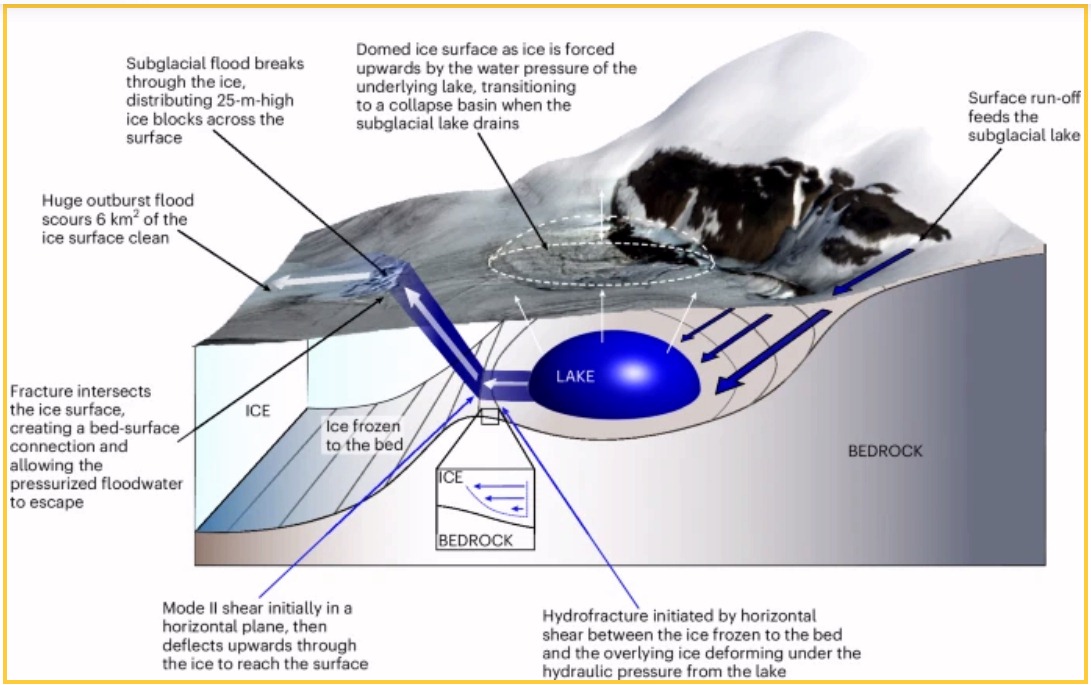
Sudden Sea Level Rise / Cork Release

One of the most powerful feedbacks in the polar regions is the albedo effect. As bright, reflective ice melts, it reveals darker land or ocean surfaces that absorb far more solar energy. This speeds up further melting. While melting sea ice mainly changes heat balance without directly raising sea levels, the melting of land-based ice–especially from Greenland and Antarctica–not only raises global seas but also changes ocean salinity and temperature, further destabilizing circulation systems like the AMOC.

These ice sheets hold vast “corks” of land ice restraining enormous reservoirs of meltwater. When these corks break, sudden sea level rise pulses–sometimes 1-3 feet per year for multiple consecutive years–could occur. The impacts on coastlines, global weather, and ocean currents would be both severe and unpredictable.

The Greenland Ice Sheet Outburst Flood

Recent research has identified a startling example of this process. In the paper Outburst of a subglacial flood from the surface of the Greenland Ice Sheet (2025), scientists documented a 90-million-cubic-meter flood that forced its way upward through the ice sheet, bursting out at the surface. This was caused by the rapid drainage of a subglacial lake in a region where the bed was thought to be frozen solid–an event that current ice sheet models do not account for.

The flood’s upward path fractured the ice sheet, disrupting the downstream marine-terminating glacier and altering its flow. This bi-directional coupling between surface and basal hydrology highlights just how complex–and poorly understood–ice sheet dynamics truly are.

Over the last three decades, Greenland has lost roughly 169 billion tons of ice per year on average, contributing about 14 mm to global sea level rise. Roughly half of this loss comes from surface melting and runoff, which are projected to increase sharply as Arctic warming intensifies.

Alaska’s Mendenhall Glacier Outburst: A Glacial Flood Emergency

A massive upstream basin of rainwater and snowmelt, dammed by Alaska’s Mendenhall Glacier, began releasing in August of 2025, prompting officials to urge residents in parts of Juneau to evacuate ahead of a potentially dangerous surge of floodwater.

A glacial outburst flood occurs when meltwater or rainwater accumulates behind a natural ice dam, creating a substantial reservoir of water under pressure. In the case of the Mendenhall Glacier, snowmelt and rainfall from the upstream basin — ironically named Suicide Basin — accumulate behind the glacier, which acts as a solid barrier, trapping the water in depressions known as proglacial lakes or subglacial reservoirs. As the water volume increases, hydrostatic pressure builds against the ice dam. Ice behaves like a viscoelastic material–it can deform slowly under pressure but can fracture if stress exceeds its strength. The weight of the water eventually exceeds the ice’s ability to hold it, particularly if crevasses or melt channels weaken the glacier structure. Once the pressure exceeds the strength of the ice or underlying bedrock, cracks propagate rapidly, and water can exploit subglacial channels, forcing its way beneath or through the ice, a process known as hydraulic fracturing. When the dam fails, the water stored in the basin rushes downstream in a high-energy flood, converting potential energy into kinetic energy, generating destructive flow speeds and forces that can erode soil, uproot trees, damage infrastructure, and rapidly raise river levels. Warming temperatures increase surface melt and rainfall, filling these basins faster, while ice thinning and increased meltwater lubricate the glacier bed, reducing friction and making outbursts more likely. In essence, a glacial outburst results from the buildup of pressure from trapped water, ice weakening or cracking, and the sudden release of gravitational energy, producing a high-speed, destructive flood downstream.

Why This Matters

If hydrofracture events like this outburst become more frequent, the world could face abrupt, multi-foot-per-year sea level jumps–not the gradual rise most models currently project. This would leave little time for adaptation in coastal cities and could unleash profound economic, humanitarian, and ecological consequences.

Current ice sheet models typically treat meltwater movement as predictable and gradual. The Greenland event shows that under certain conditions, trapped subglacial water can build enough pressure to fracture ice and erupt at the surface–what could be called a “cork release” event. These sudden failures are not fully understood, but they could represent one of the most dangerous tipping points in the cryosphere.

Understanding and integrating these processes into predictive models is urgent. The more we learn, the more it becomes clear that the climate system is capable of abrupt, nonlinear shifts–far faster than human infrastructure, economies, or governance can adapt.

* Our climate model — which incorporates complex social-ecological feedback loops within a dynamic, non-linear system — projects that global temperatures could rise by up to 9°C (16.2°F) within this century. This far exceeds earlier estimates of a 4°C rise over the next thousand years, signaling a dramatic acceleration of warming.

Ignite a Domino Effect: Albedo, Brown Carbon, AMOC, Permafrost, Amazon Rainforest Dieback, Outbursts and Sea Level Rise Pulses, Hydroclimate Whiplash, and Arctic Sea Ice Brouse and Mukherjee (2025)

Tipping points and feedback loops drive the acceleration of climate change. When one tipping point is toppled and triggers others, the cascading collapse is known as the Domino Effect.

The Human Induced Climate Change Experiment

From the album “Real Eyes

bookmark_borderSurmise

Surmise.mp3 Surmise.mp4 Surmise-Unplugged-Underground-XXIV.mp3 Surmise-Unplugged-Underground-XXIV.mp4 Surmise-intro.mp3

[Verse 1]
Do you see the cracks
(Appearing)
The air… it smacks
(Of sheering)

[Bridge]
For god’s sake
(Is the damn about to break?)

[Chorus]
What should I surmise
Should I realize
Before the surprise?
Should I wait and negate…
(F science in defiance!)

[Verse 2]
The cork looks like it’s gonna
(Pop!)
She’ll start going and flowing
(Too fast to stop)

[Bridge]
For god’s sake
(Is the damn about to break?)

[Chorus]
What should I surmise
Should I realize
Before the surprise?
Should I wait and negate…
(F science in defiance!)

[Outro]
For god’s sake
(Our damn damned)
Broke the bank
(No one but ourselves to thank)

A SCIENCE NOTE

Alaska’s Mendenhall Glacier Outburst: A Glacial Flood Emergency

A massive upstream basin of rainwater and snowmelt, dammed by Alaska’s Mendenhall Glacier, began releasing yesterday, prompting officials to urge residents in parts of Juneau to evacuate ahead of a potentially dangerous surge of floodwater.

A glacial outburst flood occurs when meltwater or rainwater accumulates behind a natural ice dam, creating a substantial reservoir of water under pressure. In the case of the Mendenhall Glacier, snowmelt and rainfall from the upstream basin — ironically named Suicide Basin — accumulate behind the glacier, which acts as a solid barrier, trapping the water in depressions known as proglacial lakes or subglacial reservoirs. As the water volume increases, hydrostatic pressure builds against the ice dam. Ice behaves like a viscoelastic material–it can deform slowly under pressure but can fracture if stress exceeds its strength. The weight of the water eventually exceeds the ice’s ability to hold it, particularly if crevasses or melt channels weaken the glacier structure. Once the pressure exceeds the strength of the ice or underlying bedrock, cracks propagate rapidly, and water can exploit subglacial channels, forcing its way beneath or through the ice, a process known as hydraulic fracturing. When the dam fails, the water stored in the basin rushes downstream in a high-energy flood, converting potential energy into kinetic energy, generating destructive flow speeds and forces that can erode soil, uproot trees, damage infrastructure, and rapidly raise river levels. Warming temperatures increase surface melt and rainfall, filling these basins faster, while ice thinning and increased meltwater lubricate the glacier bed, reducing friction and making outbursts more likely. In essence, a glacial outburst results from the buildup of pressure from trapped water, ice weakening or cracking, and the sudden release of gravitational energy, producing a high-speed, destructive flood downstream.

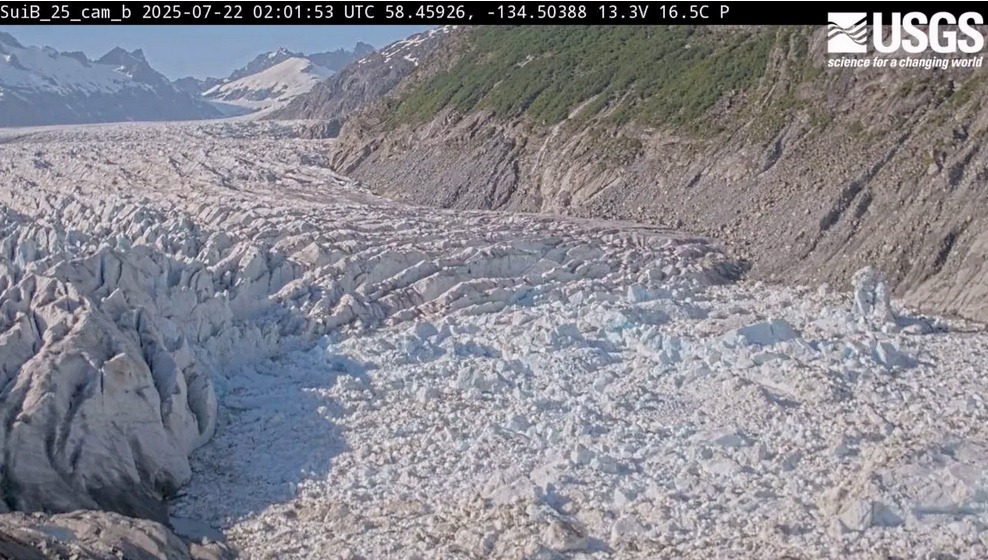
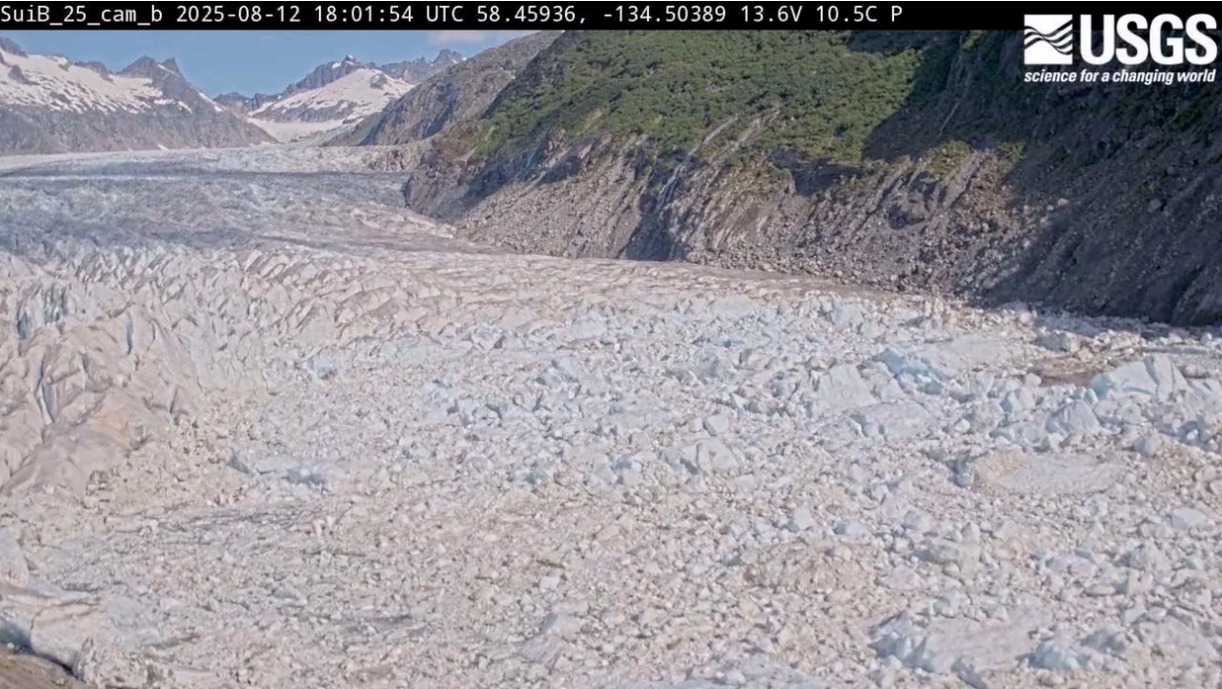
Before-and-after shots of Suicide Basin “popping its cork.” In the first, a small, fractured section of glacier holds back millions of gallons of water, both behind and beneath it. In the next, it’s gone.

Suicide Basin Ice Damn BeforeSuicide Basin After Outburst

The National Weather Service (NWS) Juneau office issued a flood warning for areas along the Mendenhall River near Auke Bay. The released water from this glacial outburst is flowing downstream, putting riverside homes and properties at immediate risk. As of Tuesday afternoon local time, river levels were measured at 9.85 feet, with major flooding classified at 14 feet. Officials expect the river to crest Wednesday afternoon at near-record levels of 16.3 to 16.8 feet, setting a new historic high. NWS meteorologist Nicole Ferrin stated, “This will be a new record, based on all of the information that we have.” The City and Borough of Juneau issued a public advisory confirming that the glacial outburst originated from Suicide Basin. Flooding is expected to continue along Mendenhall Lake and River from late Tuesday through Wednesday. Residents in areas at risk are strongly encouraged to evacuate immediately. A Red Cross shelter is open at Floyd Dryden Gymnasium (3800 Mendenhall Loop Road). Important notices for pet owners: The Red Cross shelter cannot accommodate pets. Evacuated animals should be taken to Juneau Animal Rescue at (907) 789-6997. Safety warning: Do not approach the river. Floodwaters are extremely dangerous, and entering the area endangers both residents and first responders. Stay away from the river to allow safe evacuations and emergency response efforts.

The Mendenhall River crested today at a record-setting 16.65 feet deep as of 7:15 a.m. Alaska time (12:15 Eastern).

Ignite a Domino Effect: Albedo, Brown Carbon, AMOC, Permafrost, Amazon Rainforest Dieback, Outbursts and Sea Level Rise Pulses, Hydroclimate Whiplash, and Arctic Sea Ice Brouse and Mukherjee (2025)
Tipping points and feedback loops drive the acceleration of climate change. When one tipping point is toppled and triggers others, the cascading collapse is known as the Domino Effect.

The Human Induced Climate Change Experiment

From the album “Real Eyes

bookmark_borderCirculation

Circulation-Best-Of.mp3
Circulation-Best-Of.mp4
Circulation.mp3
Circulation.mp4
Circulation-intro.mp3

[Intro]
(Anticipation)
Depending on the circulation
Caught up in a dream
(Ridin’ the jet stream)

[Verse 1]
Down in the doldrums
Trade winds come undone
The attitude
Of horse latitudes

[Bridge]
(Dream of the scene)

[Chorus]
(Anticipation)
Depending on the circulation
Caught up in a dream
(Ridin’ the jet stream)

[Verse 2]
Currently caught in the current
(Can’t hide from the waves or tide)
Aspire to the gyre (riding higher)
Hey! Thermohaline time (devine)

[Bridge]
(Dream of the scene)

[Chorus]
(Anticipation)
Depending on the circulation
Caught up in a dream
(Ridin’ the jet stream)

[Bridge]
(Dream of the scene)

[Chorus]
(Anticipation)
Depending on the circulation
Caught up in a dream
(Ridin’ the jet stream)

[Outro]
Know what I mean
(Dream of the scene)
Get around
(And get down)
Get down

A SCIENCE NOTE
Chaos theory underscores the intricate, nonlinear, and interconnected nature of the relationships between soil, atmosphere, and oceans in the context of thermal energy and carbon storage. These interactions contribute to the Earth’s climate system’s complexity, and understanding these dynamics is crucial for accurately modeling and predicting climate changes. In addition, thermal energy and carbon are redistributed throughout the world.

Circulation systems of air and/or water include:
* doldrums, trade winds, horse latitudes, prevailing westerlies, polar front zone, and polar easterlies
* each hemisphere has three cells — Hadley cell, Ferrel cell and Polar cell in which air circulates through the entire depth of the troposphere
* usually each hemispheres has two jet streams — a subtropical jet stream and a polar-front jet stream
* waves, tides, currents, downwelling, upwelling move water
* there are over 24 currents — Benguela Current, California Current, Falkland Current, Labrador Current, Brazil Current, Florida Current, Gulf Stream, West Australian Current, Canary Current, Kuroshio Current, North Pacific Current, Somali Current, Antarctic Circumpolar Current, Antarctica Current, Antilles Current, Mozambique Current, North Atlantic Drift, Norwegian Current, Oyashio Current, West Wind Drift, Agulhas Current, South Equatorial Current, Humboldt or Peruvian Current, Monsoon Current
* five major ocean-wide gyres — the North Atlantic, South Atlantic, North Pacific, South Pacific, and Indian Ocean
* thermohaline (temperature and salinity) circulation systems — Gulf Stream, Atlantic Meridional Overturning circulation (AMOC), Pacific Meridional Overturning Circulation (PMOC)
* ocean-atmosphere oscillations — La Nina / El Nino-Southern Oscillation (ENSO), Antarctic Oscillation (AAO), Arctic Oscillation (AO), Atlantic Multidecadal Oscillation (AMO),
Indian Ocean Dipole (IOD), Madden-Julian Oscillation (MJO), North Atlantic Oscillation (NAO), North Pacific Gyre Oscillation (NPGO), North Pacific Oscillation (NPO), Pacific Decadal Oscillation (PDO), Pacific-North American (PNA) Pattern

* Our probabilistic, ensemble-based climate model — which incorporates complex socio-economic and ecological feedback loops within a dynamic, nonlinear system — projects that global temperatures could rise by up to 9°C (16.2°F) within this century. This far exceeds earlier estimates of a 4°C rise over the next thousand years, highlighting a dramatic acceleration in global warming. We are now entering a phase of compound, cascading collapse, where climate, ecological, and societal systems destabilize through interlinked, self-reinforcing feedback loops.

We examine how human activities — such as deforestation, fossil fuel combustion, mass consumption, industrial agriculture, and land development — interact with ecological processes like thermal energy redistribution, carbon cycling, hydrological flow, biodiversity loss, and the spread of disease vectors. These interactions do not follow linear cause-and-effect patterns. Instead, they form complex, self-reinforcing feedback loops that can trigger rapid, system-wide transformations — often abruptly and without warning. Grasping these dynamics is crucial for accurately assessing global risks and developing effective strategies for long-term survival.

Tipping points and feedback loops drive the acceleration of climate change. When one tipping point is toppled and triggers others, the cascading collapse is known as the Domino Effect.

Explore the fundamentals of chaos theory in Edge of Chaos — where order meets unpredictability.

Understand the fundamentals of Statistical Mechanics and Chaos Theory in Climate Science.


From the album “Lofty

bookmark_borderUpper Atmosphere

Upper-Atmosphere.mp3
Upper-Atmosphere.mp4
Upper-Atmosphere-Unplugged-Underground-XXIV.mp3
Upper-Atmosphere-Unplugged-Underground-XXIV.mp4
Upper-Atmosphere-intro.mp3

[Verse 1]
Decided to rise to the top
Gonna fly high
(Never gonna stop)
Come, see what’s in store
Spread our wings (and soar)

[Bridge]
(I’m outta here)

[Chorus]
Rising through the atmosphere
(Mesosphere and thermosphere)
Up the upper atmosphere
(To clear the exosphere)

[Verse 2]
Give a smile and laugh
As we catch an updraft
(Try to fly high)
Welcome to see some more
Spread our wings (and soar)

[Bridge]
(We’re outta here)

[Chorus]
Rising through the atmosphere
(Mesosphere and thermosphere)
Up the upper atmosphere
(To clear the exosphere)

[Bridge]
As the rooftops clear
(Sayin’ outta here)

[Chorus]
Rising through the atmosphere
(Mesosphere and thermosphere)
Up the upper atmosphere
(To clear the exosphere)

[Outro]
Come, see what’s in store
Spread our wings (and soar)

A SCIENCE NOTE
The upper atmosphere is the region of Earth’s atmosphere above the troposphere, extending into space. It encompasses several layers, including the mesosphere, thermosphere, and exosphere, and is characterized by decreasing air density and increasing temperatures (except in the mesosphere) as altitude increases. The upper atmosphere also includes the ionosphere, a layer of charged particles created by solar radiation.

Atmospheric circulation together with ocean circulation is how thermal energy is redistributed throughout the world. Chaos theory offers insights into the complex, nonlinear dynamics of climate systems role in the redistribution of thermal energy. The Earth’s climate is a highly complex and dynamic system, influenced by various factors such as ocean currents, atmospheric circulation, and feedback loops.

General Circulation Models (GCMs) of Earth’s climate are nonlinear and highly teleconnected. That means a small change in temperature or pressure or humidity in one small area on the globe can cause _large_ changes in conditions _anywhere_ on the globe. This phenomenon is often referred to as the Butterfly Effect — the idea that a butterfly flapping its wings in China could ultimately contribute to a hurricane forming in the Atlantic. The complexity of these models can lead to chaotic behavior. Climate science must grapple with these models and extract results in spite of the mathematical difficulties, and there have been remarkable successes in some cases and sad failures in others. Nevertheless we must proceed.

* Our probabilistic, ensemble-based climate model — which incorporates complex socio-economic and ecological feedback loops within a dynamic, nonlinear system — projects that global temperatures could rise by up to 9°C (16.2°F) within this century. This far exceeds earlier estimates of a 4°C rise over the next thousand years, highlighting a dramatic acceleration in global warming. We are now entering a phase of compound, cascading collapse, where climate, ecological, and societal systems destabilize through interlinked, self-reinforcing feedback loops.

We examine how human activities — such as deforestation, fossil fuel combustion, mass consumption, industrial agriculture, and land development — interact with ecological processes like thermal energy redistribution, carbon cycling, hydrological flow, biodiversity loss, and the spread of disease vectors. These interactions do not follow linear cause-and-effect patterns. Instead, they form complex, self-reinforcing feedback loops that can trigger rapid, system-wide transformations — often abruptly and without warning. Grasping these dynamics is crucial for accurately assessing global risks and developing effective strategies for long-term survival.

Explore the fundamentals of chaos theory in Edge of Chaos — where order meets unpredictability.

Understand the fundamentals of Statistical Mechanics and Chaos Theory in Climate Science.

Tipping points and feedback loops drive the acceleration of climate change. When one tipping point is toppled and triggers others, the cascading collapse is known as the Domino Effect.

From the album “Lofty

bookmark_borderEvaporation

Evaporation-Best-Of.mp3
Evaporation-Best-Of.mp4
Evaporation.mp3
Evaporation.mp4
Evaporation-intro.mp3

[Verse 1]
When the air’s so thick
You’re dripping in it
(Your pores can pour no more)
[Instrumental, Synth Solo, Bass]
As thick as a brick
Can’t shake a stick
(Check your core temperature)

[Bridge]
Can you endure
(No more)

[Chorus]
Nevermore
No, no never again
(Can’t get in)
There’s no room for you
Nevermore
Not night or day
No, not the way
Things are going
(The obvious is showing)

[Refrain]
Are you thirstier
(I’m not sure)
Sure, the temperature
(What’s your moisture?)

[Verse 2]
Madge, you’re soaking in it
You’re drippin’… (within without)
No doubt… (that’s not workin’ out)
Thick air on skin
No body (nobody) will win
(The land cannot withstand man)

[Bridge]
Can you endure
(No more)

[Chorus]
Nevermore
No, no never again
(Can’t get in)
There’s no room for you
Nevermore
Not night or day
No, not the way
Things are going
(The obvious is showing)

[Outro]
Are you thirstier
(I’m not sure)
Sure, the temperature
(What’s your moisture?)

A SCIENCE NOTE: Evaporation. Does what evaporate faster when it is less humid?
Yes — when the air is less humid, evaporation happens faster. Evaporation is the process of molecules at the surface of a liquid escaping into the air as vapor. The rate of evaporation depends partly on how much water vapor is already in the air. Relative humidity measures how close the air is to being saturated (100% humidity = no more room for water vapor).

When humidity is low, the air is “thirstier” for water vapor, so more liquid molecules can escape into it before equilibrium is reached. When humidity is high, the air is already holding a lot of water vapor, so the difference between the liquid’s vapor pressure and the air’s vapor content is small, slowing evaporation.

From the album “More On

bookmark_borderAmplitude

Amplitude-Best-Of.mp3
Amplitude-Best-Of.mp4
Amplitude.mp3
Amplitude.mp4
Amplitude-intro.mp3

[Verse 1]
(Wave) Hello!
Ya know…
The right attitude
Combined with fortitude

[Bridge]
What is our amplitude?

[Chorus]
The maximum displacement
(From our movement)
What is our strength and size
(When we come to realize….)

[Verse 2]
(Wave) Goodbye
(Don’t cry)
Adjust our attitude
With a bit more gratitude

[Bridge]
Turn up our amplitude

[Chorus]
The maximum displacement
(From our movement)
What is our strength and size
(When we come to realize….)

[Bridge]
Concede the need
To turn up our amplitude
(Turn it up, up, up)

[Chorus]
The maximum displacement
(From our movement)
What is our strength and size
(When we come to realize….)

[Outro]
Forego the bleed… concede
(To turn up our amplitude)
Turn it up (Turn it up)
Turn up our amplitude
(Up, up, up, up, up)

A SCIENCE NOTE
In physics, amplitude refers to the maximum displacement of a wave from its equilibrium position. It essentially measures the “size” or “strength” of a wave. For a transverse wave, like a wave on a string, the amplitude is the height of a crest or the depth of a trough. For a longitudinal wave, like a sound wave, the amplitude is the maximum compression or rarefaction of the medium.

Visualizing Amplitude:
Imagine a rope tied to a wall. If you shake the rope up and down, you create a wave. The amplitude is the distance the rope moves vertically from its resting position (the straight line) to its highest point (crest) or lowest point (trough). 
  • Energy and Amplitude:
    Amplitude is directly related to the energy of a wave. A wave with a larger amplitude carries more energy. For instance, a sound wave with a greater amplitude will be perceived as louder, and a water wave with a larger amplitude will have a more forceful impact. 

  • Types of Waves:
  • Transverse Waves: The displacement of the medium (like the rope) is perpendicular to the direction the wave travels. Examples include light waves and waves on a string. 
  • Longitudinal Waves: The displacement of the medium is parallel to the direction the wave travels. Sound waves are a prime example. 
  • Mathematical Representation:
    The amplitude (A) can be represented in equations for wave motion. For example, in a simple harmonic motion equation: x = A sin(ωt + φ), where x is the displacement, t is time, ω is angular frequency, and φ is the phase shift. 

In summary, the amplitude of a wave is a fundamental property that describes its size and is directly linked to the amount of energy the wave carries

From the album “More On

bookmark_borderPhoKnow

PhoKnow-Best-Of.mp4

PhoKnow.mp4

PhoKnow-Best-Of.mp3
PhoKnow.mp3
PhoKnow-intro.mp3

[Verse 1]
A little pho
(You know)
Not too slow
Thank you
(That’ll do)

[Chorus]
Getting to know
(Our phono)
Inside and out
(Shout! PhoKnow!)
Getting to know
(Our phono)
Without a doubt
(Shout! PhoKnow!)

[Bridge]
Know, know, know, know
(Here we go)
Getting to know
(Our phono)
Without a doubt
(Shout! PhoKnow!)

[Verse 2]
Friend or pho
(You know)
1, 2, 3, 4
(Let’s hear some more)

[Chorus]
[Bridge]

[Verse 3]
Fee, fi, pho
(Humm)
Come on give me some
(Turn up the pho)

[Chorus]

[Outro]
Getting to know
(Our phono)
Inside and out
(Shout!)
Out (out) out

A SCIENCE NOTE

The prefix “phono-” (derived from the Greek word

phōnē), means sound or voice. This is why words like phonograph, which literally means “instrument for recording sound,” use this prefix. 

Here are some other words that use this prefix:
  • Phonetics: the study of speech sounds.
  • Phonology: the study of the organization of sounds in languages.
  • Cacophony: a harsh or discordant sound.
  • Symphony: a harmonious arrangement of sounds. 

From the album “Phoron

bookmark_borderCatching Rays

Catching-Rays.mp3
Catching-Rays.mp4
Catching-Rays-Unplugged-Underground-XXIV.mp3
Catching-Rays-Unplugged-Underground-XXIV.mp4
Catching-Rays-intro.mp3

[Verse 1]
Consider the exposure
(All who’ll come to see)
To be at your leisure
(Under the sun, happily)

[Bridge]
Imagine your future
In the spotlight (UV)
… you… and me

[Chorus]
Catching rays
(Catching ra, ra, radiation)
More n’ more these days
(We’re catching rays)
Ra, Ra, radiation

[Verse 2]
Don’t wear your welcome thin
Letting the sun under your skin
In the Age of Damage
You’ll have no next of kin

[Bridge]
Imagine your future
In the spotlight (UV)
… you… and me

[Chorus]
Catching rays
(Catching ra, ra, radiation)
More n’ more these days
(We’re catching rays)
Ra, Ra, radiation

[Bridge]
Immune system suppression
(Physical regression)
Premature aging
(Skin is sagging)
Fade to the shade
(Fa, fa, fa fade)
To the shade

[Chorus]
Catching rays
(Catching ra, ra, radiation)
More n’ more these days
(We’re catching rays)
Ra, Ra, radiation

[Outro]
Didn’t mean to be catching rays
(These days)
Fade to the shade
(Fa, fa, fa fade)
Fade to the shade
(Fa, fa, fa fade)
To the shade
(Fade)

A SCIENCE NOTE

Climate feedbacks are causing increased UV alerts because warming temperatures and changing atmospheric chemistry reduce the protective ozone layer in some regions and alter cloud cover. Less ozone and fewer clouds allow more ultraviolet (UV) radiation to reach the surface. Additionally, higher levels of ground-level pollutants like nitrogen oxides (from fossil fuel combustion) can interact with warming to worsen stratospheric ozone depletion, especially during heatwaves.

Photon radiation refers to energy carried by photons, the fundamental particles of light. UV photons have high energy and short wavelengths. When they penetrate the skin, they can damage DNA, leading to:

  • Skin cancer (e.g., melanoma)

  • Premature aging

  • Eye damage (like cataracts)

  • Immune system suppression

UV alerts are a public warning that dangerous levels of solar radiation are reaching the ground—often amplified by climate-related feedbacks.

Tipping points and feedback loops drive the acceleration of climate change. When one tipping point is toppled and triggers others, the cascading collapse is known as the Domino Effect.

From the album “Phoron

bookmark_borderPhoton On

Photon-On-Best-Of.mp4

Photon-On.mp4

Photon-On-Best-Of.mp3
Photon-On.mp3
Photon-On-intro.mp3

[Verse 1]
Turn on
Another photon
I mean…
We need a stream

[Bridge]
A quantum in a vacuum
Traveling at the speed of light
(Is that right?)

[Chorus]
Sending radio waves
(And a lightshow to go)
Bending cosmic raves
(Massless and gasless)

[Bridged]
Traveling to the masses
(Turn your photon on)

[Verse 2]
Turned on photon
Warping of spacetime
Rock on photon
Carrying rhythm and rhyme
(You know… turn up the radio!)

[Bridge]
A quantum in a vacuum
Traveling at the speed of light
(Is that right?)

[Chorus]
Sending radio waves
(And a lightshow to go)
Bending cosmic raves
(Massless and gasless)

[Bridged]
Traveling to the masses
(Turn your photon on)

[Outro]
Traveling to the masses
(Turn your photon on)
Traveling fast past the past
(How long will I last?)

A SCIENCE NOTE
A photon is an elementary particle that is a quantum of the electromagnetic field, encompassing radiation like light and radio waves. It also acts as the force carrier for the electromagnetic force. Photons are massless and travel at the speed of light in a vacuum.

Photons, despite lacking mass, do bend around massive objects due to gravity. This phenomenon is explained by the warping of spacetime caused by energy and momentum, which includes the energy carried by photons. While photons travel in straight lines in a flat spacetime, the presence of massive objects causes the spacetime itself to curve, making the photon’s path appear bent.

From the album “Phoron