bookmark_borderThe Limits of Deranged

[Intro]
Testing (testing)
Testing the limits of deranged
… nothing’s changed

[Verse 1]
It’s hard to keep up
With the rapid pace
In the change
Of climate change

[Verse 2]
It’s hard to believe
The human race
Tests the limits of deranged
Nothing’s changed

[Bridge]
We’d be better off by far
Than sitting where we are

[Chorus]
Testing (testing)
The limits of deranged
Still unchanged
(Nothing’s changed)
Testing (testing)
The limits of deranged
… nothing’s changed
(Nothing’s changed)

[Bridge]
Comfortable
Turning up the heat
Regrettable
Our nation’s beat
Uneducable
Evolution in retreat
Near complete
Regressing
Testing (testing)
The limits of deranged

[Outro]
Testing (testing)
The limits of deranged
Regressing
Past the limits of deranged

A SCIENCE NOTE

Our climate model / experiment employs chaos theory to comprehensively consider human impacts and projects a potential global average temperature increase of 9℃ above pre-industrial levels. Global warming is a consequence of elevated thermal energy in the climate system, which comprises various subsystems. Chaos theory underscores the intricate and nonlinear nature of dynamic systems. Previous climate models have inadequately incorporated “social-ecological systems” as human involvement was not a significant factor in past climate changes. Regrettably, the United States ranks among the least prepared countries globally, with the highest percentage of climate deniers. Politicians hinder the fight against climate change exacerbating the problem. The Republican party dismisses it as a manufactured crisis and plans to increase fossil fuel production. Political extremists asserting that the climate crisis is manufactured employ an ironic term, considering that human manufacturing activities are the primary driver of climate change. Under President Biden, the United States has continued to be the world’s largest producer of oil, including crude oil, natural gas liquids, and other petroleum products. Both political parties have concurred to allocate unlimited emergency funding for climate disasters instead of proactively preventing them. Last year, the US witnessed a record number of over a billion-dollar climate disasters, totaling 28 separate weather and climate-related events. It is due to this arrogance and ignorance that “worst-case scenarios” are now “best-case scenarios” for the acceleration of climate change. These factors have altered our climate model, shifting the projected maximum temperature rise from 4 degrees Celsius over the next millennium to a probable increase of 9 degrees Celsius this century. A 9-degree Celsius increase would bring the Earth close to a wet-bulb temperature incapable of sustaining human life.
From the album “Hold the Onions” by The Beatless Sense Mongers

MegaEpix Enormous

A song about The Human Induced Climate Change Experiment

bookmark_borderDense Woulds

[Intro]
Dense woulds
(Could’s, should’s)
Can’t see the forest through the trees
Oh, please
Can’t see the trees through the forest
Unless…

[Verse 1]
Do we understand
The situation is large
Can we comprehend
When Man is in charge

[Bridge]
Can’t see the forest through the trees
Oh, please
Can’t see the trees through the forest
Unless…

[Chorus]
We can change our point-of-view
It’s up to me, it’s up to you
Come on, it’s something we have to do
If we’re to get through

[Instrumental, Guitar Solo, Drum Fills]

[Verse 2]
Do we appreciate
The problem is big
At any rate
Why do we still renege

[Bridge]
Can’t see the forest through the trees
Oh, please
Can’t see the trees through the forest
Unless…

[Chorus]
We can change our point-of-view
It’s up to me, it’s up to you
Come on, it’s something we have to do
If we’re to get through

[Instrumental, Saxophone Solo, Bass]

[Bridge]
Dense woulds
(Could’s, should’s)
Can’t see the forest through the trees
Oh, please
Can’t see the trees through the forest
Unless…

[Chorus]
We can change our point-of-view
It’s up to me, it’s up to you
Come on, it’s something we have to do
If we’re to get through

[Outro]
Dense woulds
(Could’s, should’s)
Can’t see the forest through the trees
Oh, please

A SCIENCE NOTE
Anthropogenic climate change is an exponential component of an unordered system (chaos theory). Climate change is primarily driven by the escalation of thermal energy affecting biogeophysical and socio-economic systems. While biogeophysical factors can be studied using math, physics, and historical records, socio-economic systems pose greater challenges due to the unpredictable consequences of human behavior and inexplicable consumer choices, exacerbating tipping points and feedback loops. Politicians hinder the fight against climate change exacerbating the problem.

The Age of Loss and Damage is a new way of thinking about economics by combining economics, climate science, statistics, and physics. Until now, economic models have been unfit to capture the full extent of climate damage. Traditionally, “integrated assessment models” (IAMs) were used to forecast “shock” events. IAMs use “quadratic function” to calculate GDP losses by squaring the temperature change, yet ignore other methods (such as the exponential function) that are better suited for rapid change. “Climate change is fundamentally different to other shocks because once it has hit, it doesn’t go away,” said Thierry Philipponnat, author of a report by Finance Watch, a Brussels-based public interest NGO on financial issues. “And if the fundamental assumption is flawed, all the rest makes little sense — if any.”

Unfortunately, even scientists are failing to see, let alone forecast, the rapid acceleration in climate change. Due to their complexity, the impacts of the Domino Effect are being underestimated. The Domino Effect is also known as “tipping cascades” in climate science. Cascading impacts in relation to tipping points include cascading impacts across biogeophysical and social systems. Until recently, scientist have been drastically underestimating the social-ecological systems. The University of Exeter reports, “There is a notable lack of topic clusters dedicated to how humans will be impacted by climate-related tipping cascades.” 2023 was a wake-up call to social-ecological scientists. The record breaking physical and economical impacts could be felt worldwide. The record warming year was seventeen times greater than any other record increase in history. Typically, record-breaking temperatures are measured in 100th degrees. There were also 200 consecutive days of record-breaking temperatures. Usually, there are one or two record breaking days in a row. The increase in intensity and frequency of record-breaking heat requires forecasting models to be recast.

From the album “Solid State” by Daniel

MegaEpix Enormous

A song about The Human Induced Climate Change Experiment

bookmark_borderThose Squirrels Are Nuts!

[intro]
Those squirrels are nuts!
No if’s, and’s, or but’s

[Verse 1]
Sitting next to you
Watching how things shakeout
Will they drop through
And fall all about
Your view

[Bridge]
Is it true
Is there doubt?

[Chorus]
The squirrels have gone nuts
All in a free-fall (free-for-all)
No if’s, and’s, or but’s (but, butt?)
All in free-fall (free-for-all)

[Instrumental, Guitar Solo, Drum Fills]

[Verse 2]
You come to have a clue
Watching how things shakeout
How things fall through
And crawl all about
Your view

[Bridge]
Is it true
Is there doubt?

[Chorus]
The squirrels have gone nuts
All in a free-fall (free-for-all)
No if’s, and’s, or but’s (but, butt?)
All in free-fall (free-for-all)

[Instrumental, Hammond B3 Organ Solo, Drum Fills]

[Bridge]
Your view: crawling about
Is it true
Is there doubt?

[Chorus]
The humans have gone nuts
All in a free-fall (free-for-all)
No if’s, and’s, or but’s (but, butt?)
All in free-fall (free-for-all)
Amen.

[Outro}
The humans have gone nuts
All in a free-fall (free-for-all)
No if’s, and’s, or but’s (but, butt?)
All in free-fall (free-for-all)
Amen.

A SCIENCE NOTE
Our climate model / experiment employs chaos theory to comprehensively consider human impacts and projects a potential global average temperature increase of 9℃ above pre-industrial levels. Global warming is a consequence of elevated thermal energy in the climate system, which comprises various subsystems. Chaos theory underscores the intricate and nonlinear nature of dynamic systems. Previous climate models have inadequately incorporated “social-ecological systems” as human involvement was not a significant factor in past climate changes. Regrettably, the United States ranks among the least prepared countries globally, with the highest percentage of climate deniers. Politicians hinder the fight against climate change exacerbating the problem. The Republican party dismisses it as a manufactured crisis and plans to increase fossil fuel production. Political extremists asserting that the climate crisis is manufactured employ an ironic term, considering that human manufacturing activities are the primary driver of climate change. Both political parties have concurred to allocate unlimited emergency funding for climate disasters instead of proactively preventing them. Last year, the US witnessed a record number of over a billion-dollar climate disasters, totaling 28 separate weather and climate-related events. It is due to this arrogance and ignorance that “worst-case scenarios” are now “best-case scenarios” for the acceleration of climate change. These factors have altered our climate model, shifting the projected maximum temperature rise from 4 degrees Celsius over the next millennium to a probable increase of 9 degrees Celsius this century. A 9-degree Celsius increase would bring the Earth close to a wet-bulb temperature incapable of sustaining human life.

From the album “Solid State” by Daniel

MegaEpix Enormous

A song about The Human Induced Climate Change Experiment

bookmark_borderOh, To….

[Intro]
(Oh,)
O2
Oh, to….

[Verse 1]
The oxygen is blowing
Through the trees
Blowing…
Blowing over to me

[Bridge]
The atmosphere
Brought near
In the breeze
Thank you
For the please

[Chorus]
The way that O2 is going
Respiration starts slowing
OH, to
Breathe with ease
Loving living
In the tree’s breeze

[Instrumental, Guitar Solo, Drum Fills]

[Verse 2]
The O2 is going
Flowing from the trees
Flowing…
Blowing over to me

[Bridge]
The atmosphere
Brought near
In the breeze
Thank you
For the please

[Chorus]
The way that O2 is going
Respiration starts slowing
OH, to
Breather with ease
Loving living
In the tree’s breeze

[Instrumental, Saxophone Solo, Bass, Piano]

A SCIENCE NOTE

How Oxygen from Trees Reaches You in a Breeze

Trees produce oxygen through the process of photosynthesis, where they convert carbon dioxide and water into glucose and oxygen using sunlight. This oxygen is released into the atmosphere through tiny pores on the leaves called stomata. Here’s a detailed explanation of how the oxygen from trees reaches you and its health benefits:

Process of Oxygen Release and Distribution

  1. Photosynthesis:
    • Chemical Reaction: Trees take in carbon dioxide (CO₂) and water (H₂O) and, using sunlight, convert these into glucose (C₆H₁₂O₆) and oxygen (O₂). The chemical equation for photosynthesis is: 6CO2+6H2O+light energy→C6H12O6+6O2
  2. Oxygen Release:
    • Stomata: The oxygen produced during photosynthesis is released into the air through stomata. These tiny openings are primarily on the underside of leaves and allow gases to move in and out.
  3. Distribution by Wind:
    • Air Movement: Once released, the oxygen molecules diffuse into the surrounding air. Wind and breezes help to disperse these oxygen molecules over a larger area, mixing with the atmosphere.
  4. Breathing in Oxygen:
    • Inhalation: When you breathe, you take in air from the atmosphere, which contains a mixture of gases, including oxygen. The oxygen molecules enter your respiratory system and are transported to your cells via your bloodstream.

Health Benefits of Oxygen from Trees

  1. Improved Air Quality:
    • Pollution Reduction: Trees not only produce oxygen but also absorb pollutants like sulfur dioxide, ammonia, and nitrogen oxides, improving the overall air quality.
  2. Physical Health:
    • Respiratory Health: Breathing cleaner air with higher oxygen levels can improve lung function and reduce respiratory problems.
    • Immune System Boost: Higher oxygen levels can enhance the immune system, making it more effective in fighting infections.
  3. Mental Health and Wellness:
    • Stress Reduction: Exposure to natural environments and fresh air can reduce stress levels, lower blood pressure, and improve overall mental well-being.
    • Enhanced Mood: Being in nature and breathing in fresh air rich in oxygen can improve mood and cognitive function.

Conclusion

The oxygen produced by trees is essential for life, contributing significantly to the air we breathe. Wind and breezes help distribute this oxygen, ensuring that it mixes well with the atmosphere and reaches us efficiently. The benefits of this oxygen extend beyond just sustaining life, contributing to better physical and mental health by improving air quality and providing a calming, stress-reducing environment.

References

  1. How Trees Clean the Air
  2. Photosynthesis and Its Impact on the Atmosphere
  3. Health Benefits of Trees

Tree Extinction Due to Human Induced Environmental Stress

Chaos Theory and Climate Systems

Climate Change: Rate of Acceleration

From the album “Tempered Response” by The Beatless Sense Mongers

MegaEpix Enormous

A song about The Human Induced Climate Change Experiment

bookmark_borderThought Provoking

[Intro]
Hmmm… what?
Let me think about that

[Verse 1]
How thought provoking
Mind embers stoking
Let’s blast this fire
Higher

[Chorus]
Some serious consideration
In all of us, admiration
Strive to stay alive
And thrive
[Bridge]
Strive n’ thrive
Alive

[Instrumental, Guitar Solo, Drum Fills]

[Verse 1]
How thought provoking
Mind embers stoking
Let’s blast this fire
Higher

[Chorus]
Some serious consideration
In all of us, admiration
Strive to stay alive
And thrive
[Bridge]
Strive n’ thrive
Alive

[Instrumental, Saxophone Solo, Bass]

[Verse 2]
What have we done
With all we’ve won
The universe
Is universal
We’re one

[Chorus]
Some serious consideration
In all of us, admiration
Strive to stay alive
And thrive
[Bridge]
Strive n’ thrive
Alive

[Instrumental, Saxophone, Bass]

[Bridge]
This place in space
Fortunate to grace
Why lay it to waste?
(Taste? Disgrace.)

[Chorus]
Some serious consideration
In all of us, admiration
Strive to stay alive
And thrive
[Outro]
Strive n’ thrive
And stayin’ live

A SCIENCE NOTE
Chaos theory provides a framework for understanding the inherent complexity, sensitivity, and unpredictability of climate systems, including the redistribution of thermal energy. The interconnectedness of various factors and the nonlinear interactions within the Earth’s climate contribute to the intricate patterns observed in thermal energy distribution on a global scale. Climate models use principles from chaos theory to simulate these dynamic interactions.

Perhaps the most important factor impacting our climate is us. The biggest influence on climate change is the increase in greenhouse gas concentrations in the Earth’s atmosphere, primarily driven by human activities. The largest drivers of human induced climate change include: burning of fossil fuels, deforestation and land use, industrial processes, agriculture, waste management, and use of fluorinated gases.

Human induced climate change is an exponential component of an unordered system (chaos theory). Chaos theory plays a role in understanding the dynamics and potential unpredictability of social-ecological systems’ impact on climate change. Social-ecological systems encompass the interconnectedness of human societies and the ecosystems they are part of, and their behavior is influenced by a myriad of factors, including human activities, policies, resource use, and environmental changes. Chaos theory contributes insights into the complexity, sensitivity to initial conditions, and potential nonlinearities within these systems. Incorporating chaos theory into forecasting models for social-ecological systems helps researchers and policymakers recognize the limitations of linear thinking and deterministic approaches. Embracing complexity and uncertainty can lead to more robust and adaptive strategies for addressing the multifaceted challenges posed by climate change within the context of human societies and ecosystems.

* Our climate model employs chaos theory to comprehensively consider human impacts and projects a potential global average temperature increase of 9℃ above pre-industrial levels.

What Can I Do?
There are numerous actions you can take to contribute to saving the planet. Each person bears the responsibility to minimize pollution, discontinue the use of fossil fuels, reduce consumption, and foster a culture of love and care. The Butterfly Effect illustrates that a small change in one area can lead to significant alterations in conditions anywhere on the globe. Hence, the frequently heard statement that a fluttering butterfly in China can cause a hurricane in the Atlantic. Be a butterfly and affect the world.

What you can do today. How to save the planet.

From the album “Incoming” by The Beatless Sense Mongers

MegaEpix Enormous

A song about The Human Induced Climate Change Experiment

bookmark_borderForeboding Sky

[Verse 1]
Energy increasing
Humans ain’t ceasing
Thermal overload
Makes my head explode

[Chorus]
No wonder why
Foreboding sky
Cross my heart
Hope not to die

[Bridge]
Understanding
Is a start
Start commanding
Our part

[Instrumental, Saxophone Solo, Drum Fills]

[Verse 2]
Head exploding
With dark foreboding
Dam broke wide
No place to hide

[Chorus]
No wonder why
Foreboding sky
Cross my heart
Hope not to die

[Bridge]
Understanding
Is a start
Start commanding
Our part

[Instrumental, Piano Solo, Bass]

[Bridge]
Understanding
The Man thing
Is a start
Start commanding
Our part
Look into the heart
Commending
Smart

[Instrumental, Guitar Solo, Drum Fills]

[Chorus]
No wonder why
Foreboding sky
Cross my heart
Hope not to die

[Outro]
No wonder why
Foreboding sky
Cross my heart
Hope not to die

A SCIENCE NOTE

Humans are making the Earth hotter. The cool water from the melting ice at the poles is being drawn toward the center of the Earth and getting warmed to record high temperatures. The warm, moist air is circulating and moving over land. The average time moisture stays in the air is 9 days before it turns into precipitation. The warmer the air becomes, the more rain the atmosphere holds and dumps; therefore, violent rain events are increasing in frequency and intensity.

Atmospheric circulation together with ocean circulation is how thermal energy is redistributed throughout the world. Chaos theory offers insights into the complex, nonlinear dynamics of climate systems role in the redistribution of thermal energy. The Earth’s climate is a highly complex and dynamic system, influenced by various factors such as ocean currents, atmospheric circulation, and feedback loops.

* Our climate model employs chaos theory to comprehensively consider human impacts and projects a potential global average temperature increase of 9℃ above pre-industrial levels.


Climate change is creating more foreboding skies by influencing various atmospheric and weather-related processes that result in more intense and visually dramatic cloud formations and weather phenomena. Here are some key ways in which climate change contributes to this effect:

  1. Increased Moisture and Cloud Formation: Warmer temperatures due to climate change lead to higher rates of evaporation from bodies of water. This increased moisture in the atmosphere can lead to the formation of more and thicker clouds. When these clouds become dense and heavy with moisture, they appear darker and more foreboding.
  2. Enhanced Thunderstorm Activity: Climate change can intensify thunderstorms by increasing the amount of available heat and moisture. Enhanced convection (the upward movement of warm, moist air) can lead to the development of larger, more powerful storm clouds, such as cumulonimbus clouds. These clouds are often associated with severe weather and can create dark, ominous skies.
  3. More Frequent and Intense Storms: As climate change progresses, the frequency and intensity of storms, including hurricanes, tornadoes, and severe thunderstorms, are expected to increase. These storms often produce dramatic and foreboding skies with dark clouds, lightning, and heavy precipitation. The visual impact of these storms can be striking and intimidating.
  4. Higher Cloud Tops: Intensified convection can cause storm clouds to grow taller, reaching higher altitudes in the atmosphere. These high-reaching clouds can block more sunlight, contributing to darker skies. The vertical extent of these clouds can also make them appear more menacing.
  5. Pollutants and Aerosols: Climate change can influence the concentration of pollutants and aerosols in the atmosphere. These particles can act as cloud condensation nuclei, leading to the formation of more and smaller water droplets in clouds. This can enhance the optical density of clouds, making them appear darker and more threatening. Some pollutants can also absorb sunlight, further darkening the clouds.
  6. Increased Frequency of Extreme Weather Events: Climate change is linked to a rise in extreme weather events, such as intense rainstorms, heatwaves, and windstorms. These events can create dramatic and foreboding skies, with rapidly changing weather conditions and visually striking cloud formations.
  7. Shifts in Weather Patterns: Climate change can alter global weather patterns, leading to more unpredictable and severe weather. This can result in a higher likelihood of encountering unusual and dramatic skies, as weather systems become more erratic and extreme.

Climate change amplifies the factors that contribute to the formation of darker, more intense, and visually dramatic skies. These changes can create a more foreboding atmosphere, reflecting the increasing severity and unpredictability of weather patterns in a warming world.

From the album “Incoming” by The Beatless Sense Mongers

MegaEpix Enormous

A song about The Human Induced Climate Change Experiment

bookmark_borderToday’s Forecast: Chance of Violent Rain

A severe weather alert
Has been issued
For your patch of dirt
Alert!

[Verse 1]
Another day
But more extreme
In some way
Know what I mean

[Chorus]
They say
Violent rain on the way
Can’t play
Under Man’s fierce foray

[Bridge]
The chance does remain
For violent rain
Under the strain
Of Man’s domain

[Instrumental, Guitar Solo, Drum Fills]

[Verse 2]
Day after day
Is getting more extreme
The atmosphere
Now come to fear

[Chorus]
They say
Violent rain on the way
Can’t play
Under Man’s fierce foray

[Bridge]
The chance does remain
For violent rain
Under the strain
Of Man’s domain

[Instrumental, Saxophone Solo, Synthesizers, Bass]

[Bridge]
The chance — sustained
For violent reign
Of violent rain
Impacting the brain
Under the strain
Of Man’s domain

[Instrumental, Guitar Solo, Drum Fills]

[Chorus]
They say
Violent rain on the way
Can’t play
Under Man’s fierce foray

[Outro]
Violent rain
Impacting the brain
Under the strain
Of Man’s domain

A SCIENCE NOTE
May 27, 2024 — Severe Weather Threat Shifts to I-95 Corridor on Memorial Day
After severe weather and tornadoes tore across the nation’s heartland, resulting in at least 19 deaths across Texas, Oklahoma, Arkansas, and Kentucky over the weekend, the threat of severe storms and violent rain is now shifting eastward on Memorial Day. Millions of people along the Interstate 95 corridor are at risk of experiencing damaging wind gusts, severe downpours, large hail, and a few tornadoes. This shift underscores the broader trend of increasing extreme weather events due to climate change.

As millions along the I-95 corridor brace for the severe weather threat, it highlights the urgent need for increased preparedness and adaptation strategies to mitigate the impacts of climate change-induced extreme weather. This includes investing in resilient infrastructure, improving early warning systems, and promoting public awareness and readiness to respond to severe weather events.

Climate change is contributing to more frequent and intense weather events, including violent rainstorms and severe thunderstorms. Warmer global temperatures increase atmospheric moisture, which can lead to heavier rainfall and more severe storms. These conditions not only heighten the risk of flooding but also provide the energy needed for storms to develop into more dangerous systems.

Imminent Risk: Violent Rain

In October of 2023 Sidd said, “Now I am thinking the violent rain will be a bigger problem before we die… still thinking it through. In the long run, ya, sea level rise will hit big. If you look at the history, it is episodic, and in the fast bits it can go up 3 feet every twenty years for five hundred years. But, the rain intensity is increasing faster today, and drainage cannot cope, whether in the city or out, culverts and such put in over the last hundred years cannot handle. So, I am paying a lot of attention to terrain and drainage far inland from the seacoast (like Ohio.) By drainage I don’t mean just human built. I mean that the natural streams and gullies and ravines have not evolved to a state that can handle the water volumes we see and the worse, larger volumes we will see. So expect huger erosion, steeper slopes to waterways, land collapses and such. Build out your drainage.”

The rain intensity is increasing faster today than ever known. Multiple factors figure into the physics of violent rain. The Momentum of Rain is p = mv (p = momentum, m = mass, v = velocity.) Part of the increasing momentum is transferred to the sides and upward increasing wind turbulence, as well as updrafts. Most of the momentum is transferred upon impact. You may notice the rain bouncing higher off the streets and sidewalks. As rain becomes more massive, it will have greater momentum when it hits the ground causing more damage. The momentum of rain and the turbulence of wind are part of a larger equation that includes not only the mass and velocity of precipitation but also the density. The combination of these variables results in an increased intensity of the flow dynamics. Increased updrafts will result in an increase in the frequency of hail. When violent rain becomes denser and turns into hail, it can be deadly. Ground without groundcover will be hit harder causing more damage. The groundcover will also be hit harder causing more damage. Concrete, asphalt, solar panels, roofs, and plants will sustain more damage. Hail may also impact your skull. Infants and young children are at highest risk. Several infants have been killed by hail in the past year.

Wind and water flow forces scale as the square of velocity, so as flow speeds increase (say due to more intense heating or heavier rain) the damage scales as the square of the velocity. Look at drag physics and you will see that force is proportional to density times square of velocity (v^2). So a twenty mile an hour wind exerts four times as much force as a ten mile an hour wind. And a forty mile an hour wind exerts sixteen times as much force as a ten mile an hour wind. A wind of fifty miles an hour exerts twenty five times and a wind of sixty miles an hour exerts thirty six times as much force as one of ten miles an hour. Then you have the density term. Water is about eight hundred times denser than air, So the force exerted by a ten mile an hour flow of water is eight hundred times that of a ten mile an hour wind. So as flow velocities go up due to climate change, force and damage scale as square of the velocities. What is not clear is how much these velocities increase with climate change. But in a sense we are seeing this already as, for example, flood and sewage systems succumb and hillsides fall down, and so on.

— from The Reign of Violent Rain / Brouse and Mukherjee (2023)

From the album “Incoming” by The Beatless Sense Mongers

MegaEpix Enormous

A song about The Human Induced Climate Change Experiment

bookmark_borderPuzzled

[Intro]
(Hmmmm…)
Hmm
Puzzled at your behavior?

[Verse 1]
A square peg in a round hole
Or a round peg in a square hole
Is it the same answer
A bigger hammer?

[Bridge]
If you choose the hard way
It’s going to be a hell-of-a-day

[Chorus]
And it all begins
With the easy way out
Then happens again
On the escape route

[Instrumental, Saxophone Solo, Bass]

[Verse 2]
What the deal
Hamster on its wheel
Amazed
Rat in it’s maze

[Bridge]
Is primate change
Just as strange?

[Chorus]
And it all begins
With the easy way out
Then happens again
On the escape route

[Instrumental, Guitar Solo, Drum Fills]

[Bridge]
Hmm
Puzzled at your behavior?
Is primate change
Estranged?

[Instrumental, Organ Solo, Drum Fills]

[Chorus]
And it all begins
With the easy way out
Then happens again
On the escape route

[Instrumental, Piano]

[Outro]
And it all begins
With the easy way out

A SCIENCE NOTE
Anthropogenic climate change is an exponential component of an unordered system (chaos theory). Climate change is primarily driven by the escalation of thermal energy affecting biogeophysical and socio-economic systems. While biogeophysical factors can be studied using math, physics, and historical records, socio-economic systems pose greater challenges due to the unpredictable consequences of human behavior and inexplicable consumer choices, exacerbating tipping points and feedback loops.

From the album “Incoming” by The Beatless Sense Mongers

MegaEpix Enormous

A song about The Human Induced Climate Change Experiment

bookmark_borderWooden I

(hello?)
Knock, knock
On would

[Verse 1]
Wooden I leave(s)
You with an oh! pine
On trees
Such as these

[Bridge]
Unfortunately,
Disease…
Pests and other human activities
The death of trees

[Chorus]
The canopy collapsing
Your memory relapsing
The trouble with the tree
Is “me, me, me”

[Instrumental, Guitar Solo, Drum Fills]

[Verse 2]
This ain’t pulp fiction
This is human direction
Yearn to burn
Never learn

[Bridge]
Unfortunately,
Our damned demand
Responsibility
Forest death, we command

[Chorus]
The canopy collapsing
Your memory relapsing
The trouble with the tree
Is “me, me, me”

[Instrumental, Saxophone Solo, Bass]

[Chorus]
The canopy collapsing
Your memory relapsing
The trouble with the tree
Is “me, me, me”

[Instrumental, Saxophone Solo, Bass]

A SCIENCE NOTE
It would appear that there is a complex chaotic system in play that is resulting in the deforestation of the Earth. Following is an abstract from a study started in 2001 and continuing through the present.

Human activities are contributing to tree mortality and deforestation. Humans have also induced climate change in other ways. The combination of human induced climate change and human induced tree mortality are creating a cycle of exponential chain reactions. A better way to say it might be — the veiled causes of the current tree deaths are an unanticipated result of human activities. This new form of deforestation contributes to more global warming. An increase in global warming and human induced climate change intensifies the rate of tree mortalities.

Our climate model uses chaos theory in an attempt to adequately account for humans and forecasts a global average temperature increase of 9 degrees Celsius above pre-industrial levels. Everybody has the responsibility not to pollute. Stop using fossil fuels. Consume less. Love more.


From the album “Days” by Daniel

MegaEpix Enormous

A song about The Human Induced Climate Change Experiment

bookmark_borderNeither Here nor There?

[Verse 1]
Since it is both here and there
Are you aware
I mean… with your plea,
“It doesn’t concern me.”

[Chorus]
I guess we’ll see
Reality
In real time
Are you ready?
I know I am

[Instrumental, Synthesizers, Sub-bass]

[Verse 2]
Is “It’s neither here nor there”
Because you don’t care?
The problem: it’s everywhere
In common, we share

[Chorus]
I guess we’ll see
Reality
In real time
Are you ready?
I know I am

[Instrumental, Saxophone Solo, Sub-bass]

[Bridge]
It’s in the air
It’s in the sea
Fair to say
Transmitted globally
Hitting me
Hitting you
What are you going to do?

[Chorus]
I guess we’ll see
Reality
In real time
Are you ready?
I know I am

[Instrumental, Piano]

[Outro]
It’s in the sea
Can’t you see?
It’s in the air
It’s everywhere

A SCIENCE NOTE
No place on Earth is completely immune to the impacts of climate change. At the current rate of consumption and demand, much of the world will become uninhabitable this century. Research published in the Proceedings of the National Academy of Sciences reports, “by 2070, around 2 billion people are expected to live in extremely hot areas” similar to the Sahara Desert.

Our climate model / experiment employs chaos theory to comprehensively consider human impacts and projects a potential global average temperature increase of 9℃ above pre-industrial levels. Global warming is a consequence of elevated thermal energy in the climate system, which comprises various subsystems. Chaos theory underscores the intricate and nonlinear nature of dynamic systems. Human well-being is compromised above a 1.5-degree temperature rise, rendering much of the Earth uninhabitable. A 9-degree Celsius increase would bring the Earth close to a wet-bulb temperature incapable of sustaining human life.

What Can I Do? There are numerous actions you can take to contribute to saving the planet. Each person bears the responsibility to minimize pollution, discontinue the use of fossil fuels, reduce consumption, and foster a culture of love and care. The Butterfly Effect illustrates that a small change in one area can lead to significant alterations in conditions anywhere on the globe. Hence, the frequently heard statement that a fluttering butterfly in China can cause a hurricane in the Atlantic. Be a butterfly and affect the world.

From the album “Days” by Daniel

MegaEpix Enormous

A song about The Human Induced Climate Change Experiment

bookmark_borderThis Place Has Changed

[Chorus]
This place has changed
It use to be so cool
Now it’s not
Got too hot

[Verse 1]
When I was a kid
The things we did
’cause of freedom
Might have done us in
[Bridge]
Where to begin
When we went dumb
Future succumbed

[Chorus]
This place has changed
It use to be so cool
Now it’s not
Got too hot
Been rearranged
It use to rule
Now, does not
Got too hot

[Instrumental, Guitar Solo, Drum Fills]

[Verse 2]
When I was a young
I was among
Those who sung
My, my, my freedom

Might have done us in
[Bridge]
Where to begin
When we went dumb
Future succumbed

[Instrumental, Saxophone Solo, Bass]

[Verse 3]
When I was naive
I did not believe
Proud and loud
My, my, my freedom

[Bridge]
Might have done us in
Where to begin
When we went dumb
Future succumbed
All me, me, me
We didn’t see
What that would do
To you

[Chorus]
This place has changed
It use to be so cool
Now it’s not
Got too hot
Been rearranged
It use to rule
Now, does not
Got too hot

[Outro]
Ouch! Don’t touch
Got too hot

A SCIENCE NOTE
Over the period from 1992 to 2023, we have presented compelling evidence, proposed remedies to mitigate climate change, and amassed valuable information through the engagement of millions with this climate model. Your participation has been invaluable. The incontrovertible data underscores that human-induced climate change is rapidly deteriorating our habitat.

This climate model / experiment employs chaos theory to comprehensively consider human impacts and projects a potential global average temperature increase of 9℃ above pre-industrial levels. Global warming is a consequence of elevated thermal energy in the climate system, which comprises various subsystems. Chaos theory underscores the intricate and nonlinear nature of dynamic systems. Human well-being is compromised above a 1.5-degree temperature rise, rendering much of the Earth uninhabitable. A 9-degree Celsius increase would bring the Earth close to a wet-bulb temperature incapable of sustaining human life.

What Can I Do?
There are numerous actions you can take to contribute to saving the planet. Each person bears the responsibility to minimize pollution, discontinue the use of fossil fuels, reduce consumption, and foster a culture of love and care. The Butterfly Effect illustrates that a small change in one area can lead to significant alterations in conditions anywhere on the globe. Hence, the frequently heard statement that a fluttering butterfly in China can cause a hurricane in the Atlantic. Be a butterfly and affect the world.

From the album “Days” by Daniel

MegaEpix Enormous

A song about The Human Induced Climate Change Experiment

bookmark_borderThe Impacts

Whack! The impact

[Verse 1]
The impact of the warming
Quite alarming
The pace of the race
Disarming

[Chorus]
Hurricanes, heatwaves, and rising 3eas
I’m begging, begging please
Under strain from violent rain
Oh, the human induced pain

[Instrumental, Guitar Solo, Bass]

[Verse 2]
The impact of the primate change
Nature’s rearranged
What a disgrace
Barely recognize our place

[Chorus]
Hurricanes, heatwaves, and rising 3eas
I’m begging, begging please
Under strain from violent rain
Oh, the human induced pain

[Instrumental, Saxophone Solo, Piano]

[Bridge]
The change is huge
Yet we refuse
With all our might
To see the light
Why it’s happening
Is terrifying

[Chorus]
Hurricanes, heatwaves, and rising 3eas
I’m begging, begging please
Under strain from violent rain
Oh, the human induced pain

[Outro]
Hurricanes, heatwaves, and rising 3eas
I’m begging, begging please

A SCIENCE NOTE
BBC Reports: Hurricanes, Heatwaves, and Rising Seas: The Impacts of Record Ocean Heat

“The step-change in ocean temperatures over the last year is huge,” says Hayley Fowler, professor of climate change impacts at Newcastle University in the UK. “The fact we can’t simulate these step-change increases and understand why it’s happening is terrifying.”

The world’s oceans act like a planet-sized battery, absorbing and slowly releasing vast amounts of heat. So far, our oceans have soaked up over 90% of the heat trapped in the Earth’s atmosphere due to rising greenhouse gas emissions. Recently, however, the rate of ocean warming has been dramatic.

Since late March 2023, global ocean surface temperatures have set new records for the hottest temperature ever recorded on those dates. On 47 of those days, temperatures surpassed previous highs by the largest margin seen in the satellite era, according to data from the European Union’s Copernicus Climate Change Service.

In February 2024, the world breached 1.5°C warming of surface air temperatures for a full year. Yet, in some regions last year, ocean temperatures were akin to those expected if overall global warming of surface air temperatures reached 3°C above pre-industrial levels. This suggests quicker ocean heating than anticipated.

This rapid heating presents a puzzle for scientists: why is recent ocean warming even greater than models suggest? Understanding this discrepancy is crucial, as it has significant implications for predicting and mitigating the impacts of climate change.

Overview

Global warming has inflicted irreversible damage on our environment, a consensus echoed by nearly all scientists. Indeed, climate change poses a profound challenge. Our planet is witnessing conditions that increasingly jeopardize human habitation. The critical question now is whether we can adapt swiftly enough. “We are not saying that the Earth’s temperature is just going to rise. In general, as energy is added to a system, the fluctuations in the system increase. So, we expect more storms, more droughts, more wildfires, more floods, more fluctuations of all kinds. What we are saying is that weather conditions will become more volatile (Extreme Weather Events) due to the impact of humans,” said Mukherjee and Brouse.

Human-induced climate change is a dynamic component of an intricate and unordered system, as per chaos theory. This implies that global warming is accelerating exponentially in a complex manner. Over the period from 1992 to 2023, we have presented compelling evidence, proposed remedies to mitigate climate change, and amassed valuable information through the engagement of millions with this climate model. Your participation has been invaluable. The incontrovertible data underscores that human-induced climate change is rapidly deteriorating our habitat.

Our climate model chaos theory to comprehensively consider human impacts and projects a potential global average temperature increase of 9℃ above pre-industrial levels. Global warming is a consequence of elevated thermal energy in the climate system, which comprises various subsystems. Chaos theory underscores the intricate and nonlinear nature of dynamic systems. Human well-being is compromised above a 1.5-degree temperature rise, rendering much of the Earth uninhabitable. A 9-degree Celsius increase would bring the Earth close to a wet-bulb temperature incapable of sustaining human life.

What Can I Do? There are numerous actions you can take to contribute to saving the planet. Each person bears the responsibility to minimize pollution, discontinue the use of fossil fuels, reduce consumption, and foster a culture of love and care. The Butterfly Effect illustrates that a small change in one area can lead to significant alterations in conditions anywhere on the globe. Hence, the frequently heard statement that a fluttering butterfly in China can cause a hurricane in the Atlantic. Be a butterfly and affect the world.

From the album “Right Now” by The Beatless Sense Mongers

MegaEpix Enormous

A song about The Human Induced Climate Change Experiment

bookmark_borderTexas Bailout

[Intro]
Lie, baby, lie
Cry, baby, cry

[Verse 1]
First you deny
Then you lie
Putting all at risk
To die
(tsk, tsk, tsk)

[Bridge]
Mother messes with Texas
Comes back for a kick in ass

[Chorus]
We’re under strain
Need a government bailout
Extreme rain, extreme pain
Something to cry about

[Verse 2]
On your knees
Begging please!
Ignorance
Is not bliss

[Bridge]
Mother messes with Texas
Comes back for a kick in ass

[Chorus]
We’re under strain
Need a government bailout
Extreme rain, extreme pain
Something to cry about

[Instrumental, Guitar Solo, Drum Fills]

[Bridge]
Mess in Texas
Self-imposed I suppose
Science denial
Education’s on trial
Political suicide
Fat cat’s reside
Slogan’s ill
Drill, drill, drill

[Instrumental, Saxophone Solo, Bass]

[Verse 3]
Texas, the welfare state
Dumb ass, climate irate
Fossil fuel fools
The devil’s tools

[Bridge]
Mother messes with Texas
Comes back for a kick in ass

[Chorus]
We’re under strain
Need a government bailout
Extreme rain, extreme pain
Something to cry about

[Outro]
On your knees
Begging please!
Ignorance
Is not bliss

A SCIENCE AND ECONOMICS NOTE
Newsweek reportsRepublican Texas Governor Greg Abbott has asked President Joe Biden to issue a Presidential Disaster Declaration for areas of Texas affected by recent severe weather and flooding. The state has experienced a series of intense weather events over the past few weeks, including thunderstorms that have caused flooding and tornadoes. In his request, Abbott stated, “Due to severe weather and flooding that continues to cause devastating damage in several of our communities, I am requesting a Presidential Disaster Declaration. The extensive damage caused by these severe storms, historic river flooding, and tornadoes requires comprehensive, robust action by all levels of government to help Texans rebuild and recover.” Abbott included a link to a press release from his office, which contained his full letter to President Biden.

In the letter, Abbott emphasized the severity of the situation: “I have determined that the incident is of such severity and magnitude that an effective response is beyond the capabilities of the state and affected local governments, and that supplementary federal assistance is necessary to save lives and to protect property, public health, and safety, or to lessen or avert the threat of a disaster.” Abbott also requested access to the Federal Emergency Management Agency’s Hazard Mitigation Grant Program statewide and the U.S. Small Business Administration Disaster Loan Program for physical and economic loss in all requested counties.

On April 24, the National Weather Service issued an “extreme fire behavior warning” for the El Paso region of Texas, just across the Mexican border. On May 1, heavy rainfall caused flooding along the Trinity River, affecting Harris County after dangerous flash floods hit the area around Galveston in East Texas.

Abbott noted, “The request to declare a major disaster for the state of Texas comes after an initial review of damage sustained due to catastrophic flash flooding, historic river flooding, extremely large hail, damaging wind gusts, and destructive tornadoes. Local jurisdictions have reported more than $58 million in public infrastructure damage estimates thus far, including disaster response costs and debris management.”

About the Age of Loss and Damage

Climate change is primarily driven by the escalation of thermal energy affecting biogeophysical and socio-economic systems. While biogeophysical factors can be studied using mathematics, physics, and historical records, socio-economic systems pose greater challenges due to the unintended consequences of human behavior and inexplicable consumer choices.

Human-induced climate change is an exponential component of an unordered system (chaos theory), meaning global warming is accelerating at a rapid and complex rate. Unfortunately, even scientists are struggling to fully understand or predict the rapid acceleration of climate change. The impacts of the Domino Effect, or “tipping cascades,” are being underestimated. Tipping points are critical milestones that directly impact the rate of acceleration in climate change by multiplying the number and intensity of feedback loops. These cascading impacts affect both biogeophysical and social systems. Until recently, scientists have drastically underestimated the role of social-ecological systems. The University of Exeter reports, “There is a notable lack of topic clusters dedicated to how humans will be impacted by climate-related tipping cascades.”

Previous climate models have inadequately incorporated “social-ecological systems” as human involvement was not a significant factor in past climate changes. Regrettably, the United States ranks among the least prepared countries globally, with a high percentage of climate deniers. The Republican party dismisses it as a manufactured crisis and plans to increase fossil fuel production, exacerbating the situation. Political extremists asserting that the climate crisis is manufactured use an ironic term, given that human manufacturing activities are the primary driver of climate change. Both political parties have agreed to allocate unlimited emergency funding for climate disasters instead of proactively preventing them. Last year, the US witnessed a record number of over a billion-dollar climate disasters, totaling 28 separate weather and climate-related events. Due to this arrogance and ignorance, “worst-case scenarios” are now “best-case scenarios” for the acceleration of climate change. These factors have altered our climate model, shifting the projected maximum temperature rise from 4 degrees Celsius over the next millennium to a probable increase of 9 degrees Celsius this century.

From the album “Right Now” by The Beatless Sense Mongers

MegaEpix Enormous

A song about The Human Induced Climate Change Experiment

bookmark_borderEvolution Forcing Revolution

This evolution forcing revolution
(Evolution revolution)

[Verse 1]
This evolution forcing revolution
With no solution to our institution
(Pro-pollution)
Self-centered position
(For repetition)

[Chorus]
Going round and round
In a feedback loop
Adding more and more
To recoup
[Bridge]
Round n’ round in a loop (loo-pity-loop)
Found around (loo-pity-loop)
Loop, Loop (loo-pity-loop)

[Verse 2]
The inept apt to force (adaptation?)
With no solution (Citizens Pro-pollution)
Self-centered position
(For repetition)

[Chorus]
Going round and round
In a feedback loop
Adding more and more
To recoup
[Bridge]
Round n’ round in a loop (loo-pity-loop)
Found around (loo-pity-loop)
Loop, Loop (loo-pity-loop)

A SCIENCE NOTE
Tipping cascades have emerged between biogeophysical and social-ecological systems. This Domino Effect is causing climate change to accelerate at an exponential rate.

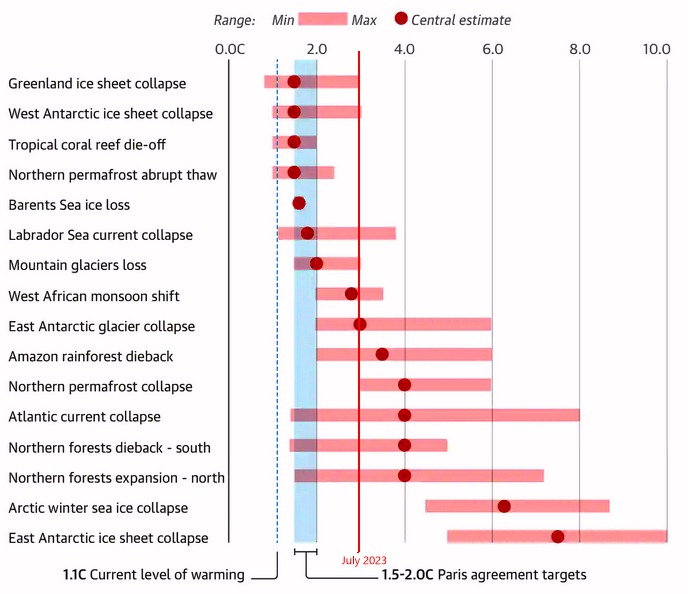
Tipping points are Critical Milestones that directly impact the rate of acceleration in climate change by multiplying the number and intensity of feedback loops. Identifying and understanding these tipping points is crucial for climate science and policymaking. Crossing multiple tipping points could lead to a domino effect, resulting in a much more rapid and severe climate change than currently projected.

Tipping Points

Push a glass toward the edge of a table and eventually it will fall off on its own. No matter how slowly or meticulously you push… no matter how you weight or fill the glass, it will reach a tipping point and fall off before being pushed completely off the table. No matter whether you believe the glass is half-empty or half-full, when the tipping point is reached it will plummet out-of-control to its end. This is science not fate, faith, nor belief. Human induced climate change has resulted in environmental tipping points being breached.

Tipping points, when crossed, trigger self-sustaining feedback loops that are no longer dependent on human activity. Similar to when a domino topples over hitting two more dominoes that in turn fall hitting more dominoes. Thus, the name The Domino Effect. It can also be visualized as The Snowball Effect. A tipping point is like a snowball rolling down a hill growing in mass and velocity (momentum). When a tipping point is crossed, it results in cumulative and reinforced global warming.

From the album “Nowadays” by The Beatless Sense Mongers

MegaEpix Enormous

A song about The Human Induced Climate Change Experiment

bookmark_borderThe Heat is On

[Verse]
We talkin’ ’bout the climate
The temperature’s risin’
Chaos theory in effect
Ain’t no compromisin’
Human impacts got the world in a frenzy
9 degrees above
It’s gettin’ hot and it’s intense
See

[Verse 2]
Global warming
It’s the consequence we facin’
Thermal energy risin’
Climates changin’
Climate system
A web of subsystems
Intricate and nonlinear
This chaos we’ve become

[Chorus]
The heat is on
It’s gettin’ hotter day by day
1.5 degrees
We’re compromised in a major way
Earth uninhabitable
The future’s lookin’ bleak
9 degrees
It’s a wet-bulb temp we can’t defeat

[Bridge]
The heat is on (and on and on)
Temperature climbing (rising)
Is it surprising?

[Break]
Ouch!

[Chorus]
The heat is on
It’s gettin’ hotter day by day
1.5 degrees
We’re compromised in a major way
Earth uninhabitable
The future’s lookin’ bleak
9 degrees
It’s a wet-bulb temp we can’t defeat

[End]

A SCIENCE NOTE
AI and I created the song from this quote:
This climate model / experiment employs chaos theory to comprehensively consider human impacts and projects a potential global average temperature increase of 9℃ above pre-industrial levels. Global warming is a consequence of elevated thermal energy in the climate system, which comprises various subsystems. Chaos theory underscores the intricate and nonlinear nature of dynamic systems. Human well-being is compromised above a 1.5-degree temperature rise, rendering much of the Earth uninhabitable. A 9-degree Celsius increase would bring the Earth close to a wet-bulb temperature incapable of sustaining human life.

From the album “Nowadays” by The Beatless Sense Mongers

MegaEpix Enormous

A song about The Human Induced Climate Change Experiment