bookmark_borderReelize

Reelize-Best-Of.mp3
Reelize-Best-Of.mp4
Reelize.mp3
Reelize.mp4
Reelize-intro.mp3

[Intro]
Do you feel
(That you’ll reel?)

[Verse 1]
I’m reeling in reality
Dropped my jaw sight-seeing
Trying to understand
Man’s demand

[Bridge]
Do you feel
(That you’ll reel?)

[Chorus]
Did you, too…
lose your balance
… stagger and lurch
(Violently!)
Realize… (I reel!)

[Verse 2]
Are we reeling in the years
All our pet peeves… (and fears)
Lost are health and wealth
(Trying to find ourself)

[Bridge]
Do you feel
(That you’ll reel?)

[Chorus]
Did you, too…
lose your balance
… stagger and lurch
(Violently!)
Realize… (I reel!)

[Bridge]
Do you feel
(That you’ll reel?)

[Outro]
Having lost our balance
(There is no justice in our stance)
We choose ignorance and arrogance
(Over romance and dance)

From the album “Real Eyes

bookmark_borderOutburst

Outburst-Best-Of.mp3
Outburst-Best-Of.mp4
Outburst.mp3
Outburst.mp4
Outburst-intro.mp3

[Verse 1]
All pent up… gonna let it out
(There’s no doubt)
It’s not a matter of if,
It’s a matter of when.
(Then….)

[Bridge]
Outburst

{Chorus]
Pouring up and out
(In urgency)
Shout!
(A Glacial Flood Emergency)
New urgency (see?)

[Bridge]
(Don’t know… how the flow… is gonna go)

[Verse 2]
Did you try sticking
… your finger… (in the dike)
… praying… wishing…
(Despite the trite)

[Bridge]
Outburst
(Hate to bust your bubble)
Outburst
(Left it all as rubble)

{Chorus]
Pouring up and out
(In urgency)
Shout!
(A Glacial Flood Emergency)
New urgency (see?)

[Bridge]
(Don’t know… how the flow… is gonna go)
Outburst
(Hate to bust your bubble)
Outburst
(Left us all in rubble)

[Outro]
Outburst
(Case: the worst)
Under the flow
(Of getting to know)

A SCIENCE NOTE: Sudden Sea Level Pulses, Glacial Floods, and “Cork Release” Events
If you’ve been following the giant feedback loop example involving Sudden Sea Level Pulses and Cork Release events, there’s a paper documenting one in action — an outburst of 23 billion gallons of water in just ten days. That’s the equivalent of nine Niagara Falls roaring beneath the ice, warping and fracturing the once-pristine sheet into a chaotic mess.

The Earth’s climate system is a tightly woven network of interdependent processes. Disturb one, and you risk setting off a cascade of reinforcing feedback loops. Consider just one example: the potential collapse of the Atlantic Meridional Overturning Circulation (AMOC).

When the AMOC slows, tropical waters grow hotter while the Arctic warms even faster. This accelerates polar ice melt, raising global sea levels more quickly and injecting vast amounts of freshwater into the North Atlantic. The added freshwater disrupts ocean salinity and density, further weakening the AMOC in a dangerous feedback cycle.

Meanwhile, elsewhere in the system, Amazon droughts intensify under the altered climate, pushing the rainforest toward dieback and eventual desertification. This reduces the Amazon’s ability to recycle rainfall and sequester carbon, further amplifying global warming–and thus accelerating ice melt, sea level rise, and AMOC destabilization.

The Albedo Effect and Ice Melt

Sudden Sea Level Rise / Cork Release

One of the most powerful feedbacks in the polar regions is the albedo effect. As bright, reflective ice melts, it reveals darker land or ocean surfaces that absorb far more solar energy. This speeds up further melting. While melting sea ice mainly changes heat balance without directly raising sea levels, the melting of land-based ice–especially from Greenland and Antarctica–not only raises global seas but also changes ocean salinity and temperature, further destabilizing circulation systems like the AMOC.

These ice sheets hold vast “corks” of land ice restraining enormous reservoirs of meltwater. When these corks break, sudden sea level rise pulses–sometimes 1-3 feet per year for multiple consecutive years–could occur. The impacts on coastlines, global weather, and ocean currents would be both severe and unpredictable.

The Greenland Ice Sheet Outburst Flood

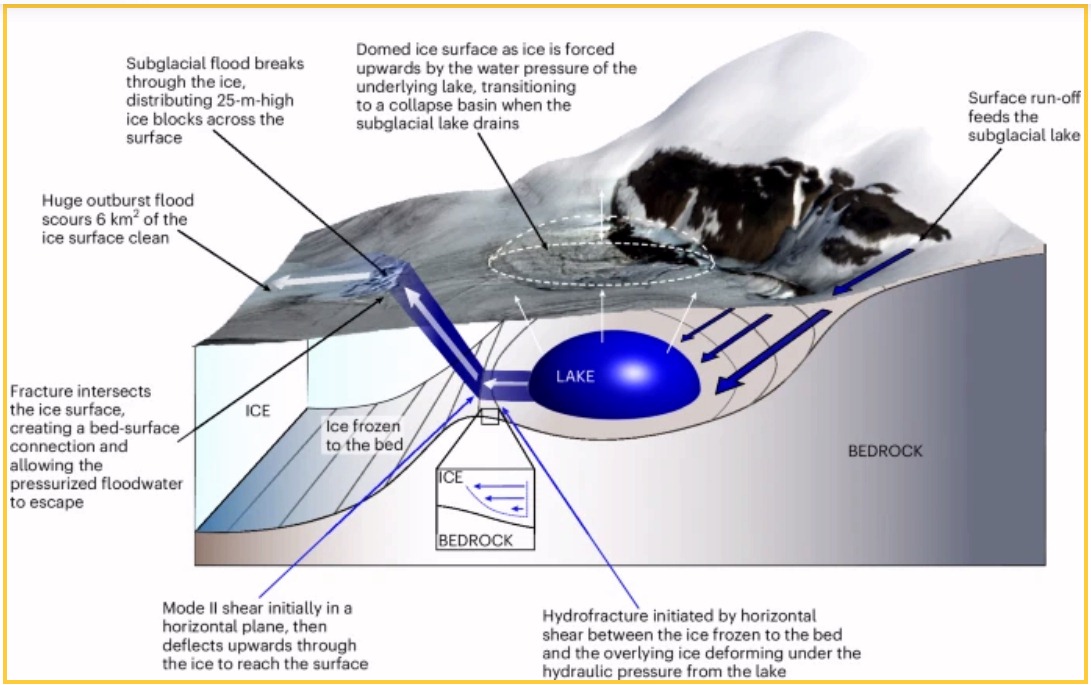
Recent research has identified a startling example of this process. In the paper Outburst of a subglacial flood from the surface of the Greenland Ice Sheet (2025), scientists documented a 90-million-cubic-meter flood that forced its way upward through the ice sheet, bursting out at the surface. This was caused by the rapid drainage of a subglacial lake in a region where the bed was thought to be frozen solid–an event that current ice sheet models do not account for.

The flood’s upward path fractured the ice sheet, disrupting the downstream marine-terminating glacier and altering its flow. This bi-directional coupling between surface and basal hydrology highlights just how complex–and poorly understood–ice sheet dynamics truly are.

Over the last three decades, Greenland has lost roughly 169 billion tons of ice per year on average, contributing about 14 mm to global sea level rise. Roughly half of this loss comes from surface melting and runoff, which are projected to increase sharply as Arctic warming intensifies.

Alaska’s Mendenhall Glacier Outburst: A Glacial Flood Emergency

A massive upstream basin of rainwater and snowmelt, dammed by Alaska’s Mendenhall Glacier, began releasing in August of 2025, prompting officials to urge residents in parts of Juneau to evacuate ahead of a potentially dangerous surge of floodwater.

A glacial outburst flood occurs when meltwater or rainwater accumulates behind a natural ice dam, creating a substantial reservoir of water under pressure. In the case of the Mendenhall Glacier, snowmelt and rainfall from the upstream basin — ironically named Suicide Basin — accumulate behind the glacier, which acts as a solid barrier, trapping the water in depressions known as proglacial lakes or subglacial reservoirs. As the water volume increases, hydrostatic pressure builds against the ice dam. Ice behaves like a viscoelastic material–it can deform slowly under pressure but can fracture if stress exceeds its strength. The weight of the water eventually exceeds the ice’s ability to hold it, particularly if crevasses or melt channels weaken the glacier structure. Once the pressure exceeds the strength of the ice or underlying bedrock, cracks propagate rapidly, and water can exploit subglacial channels, forcing its way beneath or through the ice, a process known as hydraulic fracturing. When the dam fails, the water stored in the basin rushes downstream in a high-energy flood, converting potential energy into kinetic energy, generating destructive flow speeds and forces that can erode soil, uproot trees, damage infrastructure, and rapidly raise river levels. Warming temperatures increase surface melt and rainfall, filling these basins faster, while ice thinning and increased meltwater lubricate the glacier bed, reducing friction and making outbursts more likely. In essence, a glacial outburst results from the buildup of pressure from trapped water, ice weakening or cracking, and the sudden release of gravitational energy, producing a high-speed, destructive flood downstream.

Why This Matters

If hydrofracture events like this outburst become more frequent, the world could face abrupt, multi-foot-per-year sea level jumps–not the gradual rise most models currently project. This would leave little time for adaptation in coastal cities and could unleash profound economic, humanitarian, and ecological consequences.

Current ice sheet models typically treat meltwater movement as predictable and gradual. The Greenland event shows that under certain conditions, trapped subglacial water can build enough pressure to fracture ice and erupt at the surface–what could be called a “cork release” event. These sudden failures are not fully understood, but they could represent one of the most dangerous tipping points in the cryosphere.

Understanding and integrating these processes into predictive models is urgent. The more we learn, the more it becomes clear that the climate system is capable of abrupt, nonlinear shifts–far faster than human infrastructure, economies, or governance can adapt.

* Our climate model — which incorporates complex social-ecological feedback loops within a dynamic, non-linear system — projects that global temperatures could rise by up to 9°C (16.2°F) within this century. This far exceeds earlier estimates of a 4°C rise over the next thousand years, signaling a dramatic acceleration of warming.

Ignite a Domino Effect: Albedo, Brown Carbon, AMOC, Permafrost, Amazon Rainforest Dieback, Outbursts and Sea Level Rise Pulses, Hydroclimate Whiplash, and Arctic Sea Ice Brouse and Mukherjee (2025)

Tipping points and feedback loops drive the acceleration of climate change. When one tipping point is toppled and triggers others, the cascading collapse is known as the Domino Effect.

The Human Induced Climate Change Experiment

From the album “Real Eyes

bookmark_borderSurmise

Surmise.mp3 Surmise.mp4 Surmise-Unplugged-Underground-XXIV.mp3 Surmise-Unplugged-Underground-XXIV.mp4 Surmise-intro.mp3

[Verse 1]
Do you see the cracks
(Appearing)
The air… it smacks
(Of sheering)

[Bridge]
For god’s sake
(Is the damn about to break?)

[Chorus]
What should I surmise
Should I realize
Before the surprise?
Should I wait and negate…
(F science in defiance!)

[Verse 2]
The cork looks like it’s gonna
(Pop!)
She’ll start going and flowing
(Too fast to stop)

[Bridge]
For god’s sake
(Is the damn about to break?)

[Chorus]
What should I surmise
Should I realize
Before the surprise?
Should I wait and negate…
(F science in defiance!)

[Outro]
For god’s sake
(Our damn damned)
Broke the bank
(No one but ourselves to thank)

A SCIENCE NOTE

Alaska’s Mendenhall Glacier Outburst: A Glacial Flood Emergency

A massive upstream basin of rainwater and snowmelt, dammed by Alaska’s Mendenhall Glacier, began releasing yesterday, prompting officials to urge residents in parts of Juneau to evacuate ahead of a potentially dangerous surge of floodwater.

A glacial outburst flood occurs when meltwater or rainwater accumulates behind a natural ice dam, creating a substantial reservoir of water under pressure. In the case of the Mendenhall Glacier, snowmelt and rainfall from the upstream basin — ironically named Suicide Basin — accumulate behind the glacier, which acts as a solid barrier, trapping the water in depressions known as proglacial lakes or subglacial reservoirs. As the water volume increases, hydrostatic pressure builds against the ice dam. Ice behaves like a viscoelastic material–it can deform slowly under pressure but can fracture if stress exceeds its strength. The weight of the water eventually exceeds the ice’s ability to hold it, particularly if crevasses or melt channels weaken the glacier structure. Once the pressure exceeds the strength of the ice or underlying bedrock, cracks propagate rapidly, and water can exploit subglacial channels, forcing its way beneath or through the ice, a process known as hydraulic fracturing. When the dam fails, the water stored in the basin rushes downstream in a high-energy flood, converting potential energy into kinetic energy, generating destructive flow speeds and forces that can erode soil, uproot trees, damage infrastructure, and rapidly raise river levels. Warming temperatures increase surface melt and rainfall, filling these basins faster, while ice thinning and increased meltwater lubricate the glacier bed, reducing friction and making outbursts more likely. In essence, a glacial outburst results from the buildup of pressure from trapped water, ice weakening or cracking, and the sudden release of gravitational energy, producing a high-speed, destructive flood downstream.

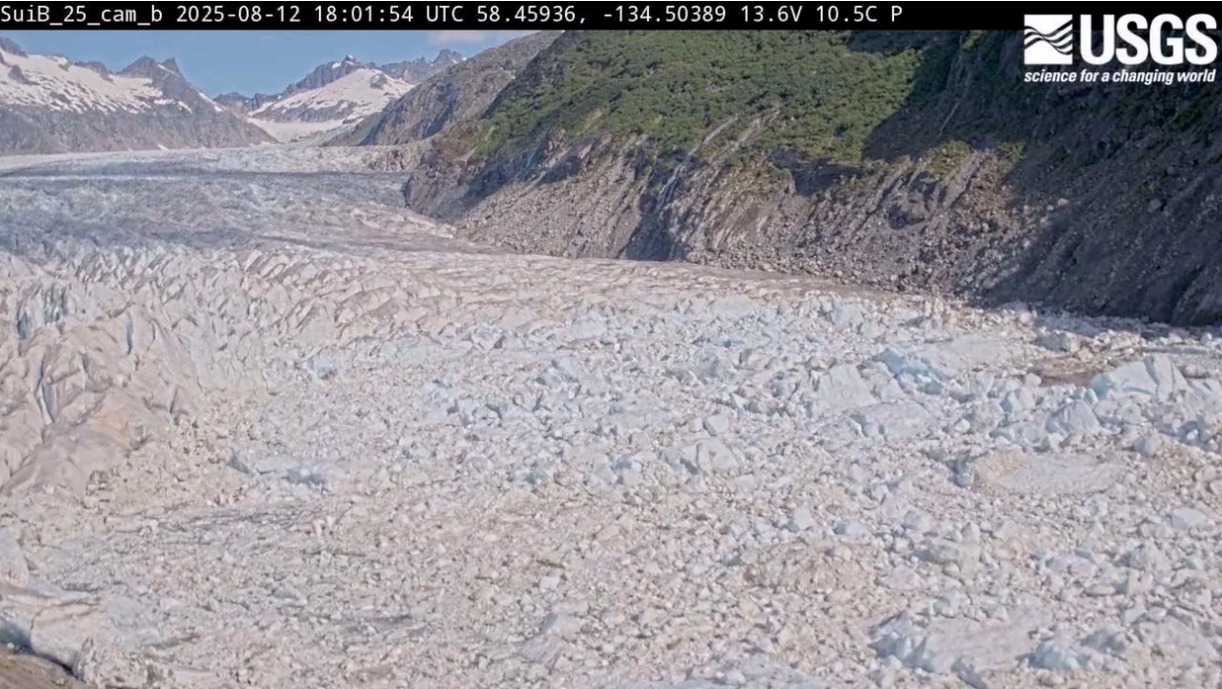
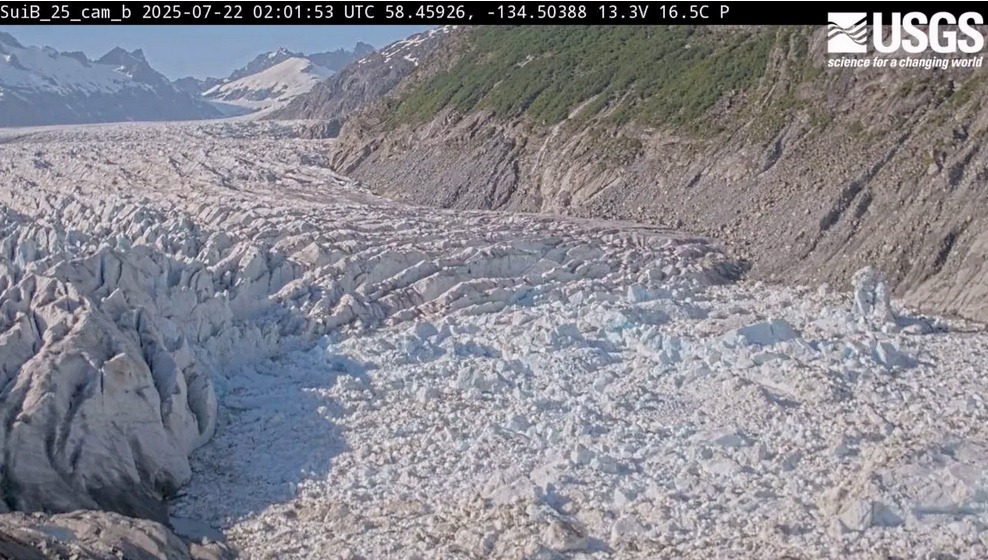
Before-and-after shots of Suicide Basin “popping its cork.” In the first, a small, fractured section of glacier holds back millions of gallons of water, both behind and beneath it. In the next, it’s gone.

Suicide Basin Ice Damn BeforeSuicide Basin After Outburst

The National Weather Service (NWS) Juneau office issued a flood warning for areas along the Mendenhall River near Auke Bay. The released water from this glacial outburst is flowing downstream, putting riverside homes and properties at immediate risk. As of Tuesday afternoon local time, river levels were measured at 9.85 feet, with major flooding classified at 14 feet. Officials expect the river to crest Wednesday afternoon at near-record levels of 16.3 to 16.8 feet, setting a new historic high. NWS meteorologist Nicole Ferrin stated, “This will be a new record, based on all of the information that we have.” The City and Borough of Juneau issued a public advisory confirming that the glacial outburst originated from Suicide Basin. Flooding is expected to continue along Mendenhall Lake and River from late Tuesday through Wednesday. Residents in areas at risk are strongly encouraged to evacuate immediately. A Red Cross shelter is open at Floyd Dryden Gymnasium (3800 Mendenhall Loop Road). Important notices for pet owners: The Red Cross shelter cannot accommodate pets. Evacuated animals should be taken to Juneau Animal Rescue at (907) 789-6997. Safety warning: Do not approach the river. Floodwaters are extremely dangerous, and entering the area endangers both residents and first responders. Stay away from the river to allow safe evacuations and emergency response efforts.

The Mendenhall River crested today at a record-setting 16.65 feet deep as of 7:15 a.m. Alaska time (12:15 Eastern).

Ignite a Domino Effect: Albedo, Brown Carbon, AMOC, Permafrost, Amazon Rainforest Dieback, Outbursts and Sea Level Rise Pulses, Hydroclimate Whiplash, and Arctic Sea Ice Brouse and Mukherjee (2025)

Tipping points and feedback loops drive the acceleration of climate change. When one tipping point is toppled and triggers others, the cascading collapse is known as the Domino Effect.

The Human Induced Climate Change Experiment

From the album “Real Eyes

bookmark_borderAccumulate

Accumulate.mp3
Accumulate.mp4
Accumulate-Unplugged-Underground-XXIV.mp3
Accumulate-Unplugged-Underground-XXIV.mp4
Accumulate-intro.mp3

[Verse 1]
Stacking the tax
Gonna break my back
The reasoning lacks
Of a tariff stack

[Chorus]
At what rate
Do we accumulate
Stack on stack
(I want my money back)

[Bridge]
This tax is taxing

[Verse 2]
Put some more on the top
Stack, stack never stop
The common sense that lacks
… more than made up for in tax

[Chorus]
At what rate
Do we accumulate
Stack on stack
(I want my money back)

[Bridge]
This tax is taxing

[Chorus]
At what rate
Do we accumulate
Stack on stack
(I want my money back)

[Outro]
This tax is taxing
Gonna break my back
(Get your hands off my stack)

ABOUT THE SONG

Tariffs don’t stand alone; they stack—and that stacking results in taxes on top of taxes, with compounding effects when combined with sales tax.  Your effective tax burden on Chinese EVs or appliances isn’t just one tariff—it’s six or more tariff layers, plus state sales tax. It’s not a single “25% tariff”—it’s closer to doubling or tripling the cost, plus another layer of tax. That burden is borne entirely by American consumers and businesses, driving up prices and shrinking competitiveness.

From the album “Real Eyes

bookmark_borderA Trillion

A-Trillion-Pt-2B-Best-Of.mp3
A-Trillion-Pt-2B-Best-Of.mp4
A-Trillion-Pt-2.mp3
A-Trillion-Pt-2.mp4
A-Trillion-Pt-2B-B.mp3
A-Trillion-Pt-2B-B.mp4
A-Trillion-Pt-2B.mp3
A-Trillion-Pt-2B.mp4
A-Trillion-intro.mp3
A-Trillion.mp3
A-Trillion.mp4

[Intro]
1, 2, 3
(Let’s see….)

[Verse 1]
Spending faster than we can count
(Totally a staggering amount)
Circling the earth again and again
(How to count… where to begin?)

[Bridge]
A trillion mistakes
(Our race at stake)

[Chorus]
Why don’t you count the amount
For the next million years
Cause the end of what you spend
Alleviate our fears

[Verse 2]
Spending hand over fist
(With a fatal twist)
Pile high to the sky
(Try to count it… try, try, try)

[Chorus]
Why don’t you count the amount
For the next million years
Cause the end of what you spend
Alleviate our fears

[Outro]
A trillion mistakes
(Our race at stake)
Take, take, take
(More than we make)

——— Part 2 B—————

[Verse 1]
Spending faster on our disaster
(A staggering amount… can you count?)
Circling the earth ’round n’ ’round
(Is our accounting sound?)

[Bridge]
A trillion mistakes
(Our race at stake)

(Count out loud!)
1, 2, 3
(Count with me)
… 6, 7, 8
(Too late to debate)

[Chorus]
Why don’t you count the amount
For the next million years
Cause the end of what you spend
Alleviate our fears

[Verse 2]
Spending well beyond our means
(Scenes of obscene)
The height of the bills
(Higher than the hills)

[Outro]
A trillion mistakes
(Our race at stake)
Take, take, take
(More than we make)

ABOUT THE SONG
At seventeen, I was a freshman studying economics at West Chester University. At the time, the national debt of the United States was $827 billion. In a course on fiscal spending and debt, we discussed how short-term political interests are difficult to account for in economics. I suggested that anyone authorizing government spending should be required to physically count each dollar before it could be spent. This would ensure that a politician would spend the rest of their life counting the money—long before they could ever spend it. (If you counted eight hours a day, seven days a week, it would take roughly 190 years to reach 1 billion.)

In August of 2025, the US federal debt is 37 trillion dollars. In January 2020, the Congressional Budget Office (CBO) estimated that gross federal debt would not surpass $37 trillion until after fiscal year 2030.

1. Weight of $37 trillion in $1 bills

  • A single U.S. $1 bill weighs about 1 gram.

  • There are 1,000,000,000,000,000 / 1 = 37,000,000,000,000 bills. Wait—we should calculate carefully:

Step 1: Number of $1 bills in $37 trillion:

37 trillion dollars=37×1012 dollars37\,\text{trillion dollars} = 37 \times 10^{12} \text{ dollars}

So there are 37 trillion $1 bills.

Step 2: Total weight:

37,000,000,000,000 bills×1 gram per bill=37,000,000,000,000 grams37,000,000,000,000\text{ bills} \times 1\text{ gram per bill} = 37,000,000,000,000\text{ grams}

Convert grams to metric tons:

37,000,000,000,000 g÷1,000,000 g/ton=37,000,000 tons37,000,000,000,000 \text{ g} \div 1,000,000 \text{ g/ton} = 37,000,000 \text{ tons}

That’s 37 million metric tons—roughly the weight of all the cars in the U.S. several times over, or about 8 times the Great Pyramid of Giza in weight.

2. How far $37 trillion in $1 bills would circle the Earth

  • A U.S. $1 bill is about 0.156 meters long.

  • Total length:

37,000,000,000,000 bills×0.156 m=5,772,000,000,000 m37,000,000,000,000 \text{ bills} \times 0.156\text{ m} = 5,772,000,000,000\text{ m}

Convert to kilometers:

5,772,000,000,000 m÷1,000=5,772,000 km5,772,000,000,000 \text{ m} \div 1,000 = 5,772,000 \text{ km}

  • Circumference of the Earth ≈ 40,075 km.

5,772,000 km÷40,075≈144 times around the Earth!5,772,000 \text{ km} \div 40,075 \approx 144 \text{ times around the Earth!}

Stacking $37 trillion in $1 bills end to end would circle the Earth 144 times.

3. Time to count $37 trillion in $1 bills

  • Assume a person counts 1 bill per second continuously.

  • Seconds in a year ≈ 31,536,000.

Step 1: Number of seconds needed:

37,000,000,000,000 bills÷1 bill/sec=37,000,000,000,000 sec37,000,000,000,000 \text{ bills} \div 1 \text{ bill/sec} = 37,000,000,000,000 \text{ sec}

Step 2: Convert to years:

37,000,000,000,000÷31,536,000≈1,173,000 years37,000,000,000,000 \div 31,536,000 \approx 1,173,000 \text{ years}

At 1 bill per second, it would take over 1.17 million years to count $37 trillion!

4. Height of $37 Trillion in $1 Bills

  • Thickness of a U.S. $1 bill ≈ 0.11 mm (0.00011 meters).

  • Total height if stacked:

37,000,000,000,000 bills×0.00011 m/bill=4,070,000,000 meters37,000,000,000,000 \text{ bills} \times 0.00011 \text{ m/bill} = 4,070,000,000 \text{ meters}

  • Convert to kilometers:

4,070,000,000 m÷1,000=4,070 km4,070,000,000 \text{ m} \div 1,000 = 4,070 \text{ km}

That’s over 4,000 km tall, which is more than five times the cruising altitude of a commercial airplane (about 10 km), and ten times the height of Mount Everest (8.85 km).

  • Another way to visualize it: a stack this high would extend from the Earth’s surface through the stratosphere, mesosphere, thermosphere, and into low Earth orbit, almost reaching satellites in orbit!
Trumpenomics: The Decline of the US

From the album “Real Eyes

bookmark_borderRealize

Realize-Best-Of.mp3
Realize-Best-Of.mp4
Realize.mp3
Realize.mp4
Realize-intro.mp3

[Intro]
How do I recognize the prize?
(Real eyes realize real I’s)

[Verse 1]
Sleepwalking
(Eyes closed tight into the night)
… but, it’s a bright, beautiful day
(Have we lost our way?)

[Bridge]
How do I recognize the prize?

[Chorus]
Realize (recognize the prize)
A day above ground
(Look around)
We did (arrive alive)
We will (fulfill the thrill)

[Bridge]
(How do I recognize the prize?)
Open your eyes

[Verse 2]
Daydreaming
(Fell asleep at the wheel)
… no big deal?
(No… I have to say)
Wake up for today
(Have we lost our way?)

[Bridge]
How do I recognize the prize?

[Chorus]
Realize (recognize the prize)
A day above ground
(Look around)
We did (arrive alive)
We will (fulfill the thrill)

[Bridge]
(How do I recognize the prize?)
Open your eyes

[Chorus]
Realize (recognize the prize)
A day above ground
(Look around)
We did (arrive alive)
We will (fulfill the thrill)

[Outro]
(How do we recognize the prize?)
Open our eyes — realize
(Real eyes realize real I’s)

From the album “Real Eyes

bookmark_borderReal I’s

Real-I-s.mp3
Real-I-s.mp4
Real-I-s-Pt-2.mp3
Real-I-s-Pt-2.mp4
Real-I-s-intro.mp3

[Verse 1]
What’s the deal
(Are you for real)
What is the purpose
(Of us?)

[Chorus]
Look around
(What can be found)
Find surprise
(In real I’s)

[Bridge]
Some of you
(I know are true)
Your heart is good
(Share souls… we should)

[Verse 2]
Why are you here
(What do you fear)
What is the meaning
(Of being?)

[Chorus]
Look around
(What can be found)
Find surprise
(In real I’s)

[Bridge]
Some of you
(I know are true)
Your heart is good
(Share souls… we should)

[Chorus]
Look around
(What can be found)
Find surprise
(In real I’s)

[Outro]
Some of us
(Seek tolerance)
Hearts of empathy
(Share souls… in synergy)

From the album “Real Eyes

bookmark_borderReal Eyes

Real-Eyes.mp3
Real-Eyes.mp4
Real-Eyes-Pt-2.mp3
Real-Eyes-Pt-2.mp4
Real-Eyes-intro.mp3

[Verse 1]
What is your reality
Is it different for you
Than it is for me
The fact, actually
What is true for me
Is true for you, too

[Chorus]
1 plus 1 equals 2
(The facts hold true)
It’s time to realize
(See things with real eyes)

[Bridge]
You can’t make water freeze
(At a hundred degrees)

[Verse 2]
Opinion is a personal belief
What you think is true
Feelings like joy and grief
Are internal to you
Facts can be tested
Opinions rested

[Chorus]
1 plus 1 equals 2
(The facts hold true)
It’s time to realize
(See things with real eyes)

[Bridge]
No matter how you toil
(… can’t make ice boil)

[Chorus]
1 plus 1 equals 2
(The facts hold true)
It’s time to realize
(See things with real eyes)

[Outro]
You can’t make water freeze
(At a hundred degrees)
No matter how you toil
(… can’t make ice boil)

From the album “Real Eyes

bookmark_borderCirculation

Circulation-Best-Of.mp3
Circulation-Best-Of.mp4
Circulation.mp3
Circulation.mp4
Circulation-intro.mp3

[Intro]
(Anticipation)
Depending on the circulation
Caught up in a dream
(Ridin’ the jet stream)

[Verse 1]
Down in the doldrums
Trade winds come undone
The attitude
Of horse latitudes

[Bridge]
(Dream of the scene)

[Chorus]
(Anticipation)
Depending on the circulation
Caught up in a dream
(Ridin’ the jet stream)

[Verse 2]
Currently caught in the current
(Can’t hide from the waves or tide)
Aspire to the gyre (riding higher)
Hey! Thermohaline time (devine)

[Bridge]
(Dream of the scene)

[Chorus]
(Anticipation)
Depending on the circulation
Caught up in a dream
(Ridin’ the jet stream)

[Bridge]
(Dream of the scene)

[Chorus]
(Anticipation)
Depending on the circulation
Caught up in a dream
(Ridin’ the jet stream)

[Outro]
Know what I mean
(Dream of the scene)
Get around
(And get down)
Get down

A SCIENCE NOTE
Chaos theory underscores the intricate, nonlinear, and interconnected nature of the relationships between soil, atmosphere, and oceans in the context of thermal energy and carbon storage. These interactions contribute to the Earth’s climate system’s complexity, and understanding these dynamics is crucial for accurately modeling and predicting climate changes. In addition, thermal energy and carbon are redistributed throughout the world.

Circulation systems of air and/or water include:
* doldrums, trade winds, horse latitudes, prevailing westerlies, polar front zone, and polar easterlies
* each hemisphere has three cells — Hadley cell, Ferrel cell and Polar cell in which air circulates through the entire depth of the troposphere
* usually each hemispheres has two jet streams — a subtropical jet stream and a polar-front jet stream
* waves, tides, currents, downwelling, upwelling move water
* there are over 24 currents — Benguela Current, California Current, Falkland Current, Labrador Current, Brazil Current, Florida Current, Gulf Stream, West Australian Current, Canary Current, Kuroshio Current, North Pacific Current, Somali Current, Antarctic Circumpolar Current, Antarctica Current, Antilles Current, Mozambique Current, North Atlantic Drift, Norwegian Current, Oyashio Current, West Wind Drift, Agulhas Current, South Equatorial Current, Humboldt or Peruvian Current, Monsoon Current
* five major ocean-wide gyres — the North Atlantic, South Atlantic, North Pacific, South Pacific, and Indian Ocean
* thermohaline (temperature and salinity) circulation systems — Gulf Stream, Atlantic Meridional Overturning circulation (AMOC), Pacific Meridional Overturning Circulation (PMOC)
* ocean-atmosphere oscillations — La Nina / El Nino-Southern Oscillation (ENSO), Antarctic Oscillation (AAO), Arctic Oscillation (AO), Atlantic Multidecadal Oscillation (AMO),
Indian Ocean Dipole (IOD), Madden-Julian Oscillation (MJO), North Atlantic Oscillation (NAO), North Pacific Gyre Oscillation (NPGO), North Pacific Oscillation (NPO), Pacific Decadal Oscillation (PDO), Pacific-North American (PNA) Pattern

* Our probabilistic, ensemble-based climate model — which incorporates complex socio-economic and ecological feedback loops within a dynamic, nonlinear system — projects that global temperatures could rise by up to 9°C (16.2°F) within this century. This far exceeds earlier estimates of a 4°C rise over the next thousand years, highlighting a dramatic acceleration in global warming. We are now entering a phase of compound, cascading collapse, where climate, ecological, and societal systems destabilize through interlinked, self-reinforcing feedback loops.

We examine how human activities — such as deforestation, fossil fuel combustion, mass consumption, industrial agriculture, and land development — interact with ecological processes like thermal energy redistribution, carbon cycling, hydrological flow, biodiversity loss, and the spread of disease vectors. These interactions do not follow linear cause-and-effect patterns. Instead, they form complex, self-reinforcing feedback loops that can trigger rapid, system-wide transformations — often abruptly and without warning. Grasping these dynamics is crucial for accurately assessing global risks and developing effective strategies for long-term survival.

Tipping points and feedback loops drive the acceleration of climate change. When one tipping point is toppled and triggers others, the cascading collapse is known as the Domino Effect.

Explore the fundamentals of chaos theory in Edge of Chaos — where order meets unpredictability.

Understand the fundamentals of Statistical Mechanics and Chaos Theory in Climate Science.


From the album “Lofty

bookmark_borderUpper Atmosphere

Upper-Atmosphere.mp3
Upper-Atmosphere.mp4
Upper-Atmosphere-Unplugged-Underground-XXIV.mp3
Upper-Atmosphere-Unplugged-Underground-XXIV.mp4
Upper-Atmosphere-intro.mp3

[Verse 1]
Decided to rise to the top
Gonna fly high
(Never gonna stop)
Come, see what’s in store
Spread our wings (and soar)

[Bridge]
(I’m outta here)

[Chorus]
Rising through the atmosphere
(Mesosphere and thermosphere)
Up the upper atmosphere
(To clear the exosphere)

[Verse 2]
Give a smile and laugh
As we catch an updraft
(Try to fly high)
Welcome to see some more
Spread our wings (and soar)

[Bridge]
(We’re outta here)

[Chorus]
Rising through the atmosphere
(Mesosphere and thermosphere)
Up the upper atmosphere
(To clear the exosphere)

[Bridge]
As the rooftops clear
(Sayin’ outta here)

[Chorus]
Rising through the atmosphere
(Mesosphere and thermosphere)
Up the upper atmosphere
(To clear the exosphere)

[Outro]
Come, see what’s in store
Spread our wings (and soar)

A SCIENCE NOTE
The upper atmosphere is the region of Earth’s atmosphere above the troposphere, extending into space. It encompasses several layers, including the mesosphere, thermosphere, and exosphere, and is characterized by decreasing air density and increasing temperatures (except in the mesosphere) as altitude increases. The upper atmosphere also includes the ionosphere, a layer of charged particles created by solar radiation.

Atmospheric circulation together with ocean circulation is how thermal energy is redistributed throughout the world. Chaos theory offers insights into the complex, nonlinear dynamics of climate systems role in the redistribution of thermal energy. The Earth’s climate is a highly complex and dynamic system, influenced by various factors such as ocean currents, atmospheric circulation, and feedback loops.

General Circulation Models (GCMs) of Earth’s climate are nonlinear and highly teleconnected. That means a small change in temperature or pressure or humidity in one small area on the globe can cause _large_ changes in conditions _anywhere_ on the globe. This phenomenon is often referred to as the Butterfly Effect — the idea that a butterfly flapping its wings in China could ultimately contribute to a hurricane forming in the Atlantic. The complexity of these models can lead to chaotic behavior. Climate science must grapple with these models and extract results in spite of the mathematical difficulties, and there have been remarkable successes in some cases and sad failures in others. Nevertheless we must proceed.

* Our probabilistic, ensemble-based climate model — which incorporates complex socio-economic and ecological feedback loops within a dynamic, nonlinear system — projects that global temperatures could rise by up to 9°C (16.2°F) within this century. This far exceeds earlier estimates of a 4°C rise over the next thousand years, highlighting a dramatic acceleration in global warming. We are now entering a phase of compound, cascading collapse, where climate, ecological, and societal systems destabilize through interlinked, self-reinforcing feedback loops.

We examine how human activities — such as deforestation, fossil fuel combustion, mass consumption, industrial agriculture, and land development — interact with ecological processes like thermal energy redistribution, carbon cycling, hydrological flow, biodiversity loss, and the spread of disease vectors. These interactions do not follow linear cause-and-effect patterns. Instead, they form complex, self-reinforcing feedback loops that can trigger rapid, system-wide transformations — often abruptly and without warning. Grasping these dynamics is crucial for accurately assessing global risks and developing effective strategies for long-term survival.

Explore the fundamentals of chaos theory in Edge of Chaos — where order meets unpredictability.

Understand the fundamentals of Statistical Mechanics and Chaos Theory in Climate Science.

Tipping points and feedback loops drive the acceleration of climate change. When one tipping point is toppled and triggers others, the cascading collapse is known as the Domino Effect.

From the album “Lofty

bookmark_borderLooking Down

Looking-Down.mp3
Looking-Down.mp4
Looking-Down-Reggae.mp3
Looking-Down-Reggae.mp4
Looking-Down-intro.mp3

[Verse 1]
Do you care to share
Your point-of-view
Is there love out there
(I wish someone knew)

[Bridge]
Does anyone care
(Out there)

[Chorus]
Looking down from above
(Do you see the love?)
Looking up from below
(Will love come to know….)

[Verse 2]
Do we make or take
Do we live to give
Is anyone out there aware
(Do you care to share)

[Bridge]
Does anyone care
(Out there)

[Chorus]
Looking down from above
(Do you see the love?)
Looking up from below
(Will love come to know….)

[Bridge]
If you care
(Please share)

[Chorus]
Looking down from above
(Do you see the love?)
Looking up from below
(Will love come to know….)

[Outro]
Looking down from above
(I see the love)
Showering down below
(Let everyone know)

From the album “Lofty

Also found on the album “Reggae Segue

bookmark_borderHead in the Clouds

Head-in-the-Clouds-Best-Of.mp3
Head-in-the-Clouds-Best-Of.mp4
Head-in-the-Clouds.mp3
Head-in-the-Clouds.mp4
Head-in-the-Clouds-intro.mp3

[Verse 1]
Seeming…
To be daydreaming
Aloof in the thought
Of all I’ve got

[Bridge]
(Ahh, ahh, ahh)

[Chorus]
My head’s in the clouds
(Heart’s screaming out loud)
In a fantasy of what could be
(When reality comes to me)

[Bridge]
We’re in this together
(Let’s make the best)
Weather the weather
(Put to the test)

[Verse 2]
In a serene scene
We dance in romance
The justice that love rules
The passion that love fuels

[Bridge]
(Ahh, ahh, ahh)

[Chorus]
My head’s in the clouds
(Heart’s screaming out loud)
In a fantasy of what could be
(When reality comes to me)

[Bridge]
We’re in this together
(Let’s make the best)
Weather the weather
(Put to the test)

[Chorus]
My head’s in the clouds
(Heart’s screaming out loud)
In a fantasy of what could be
(When reality comes to me)

[Outro]
We’re in this together
(We’ll make the best)
Whatever the whether
(Letting love suggest)
Ahh, ahh, ahh
(Ahh, ahh, ahh)

From the album “Lofty

bookmark_borderNeed a Raise

Need-a-Raise.mp3
Need-a-Raise.mp4
Need-a-Raise-Unplugged-Underground-XXIV.mp3
Need-a-Raise-Unplugged-Underground-XXIV.mp4
Need-a-Raise-intro.mp3

[Verse 1]
Are you making do
Play it day-by-day
Tryin’ to make it through
In spite of the pay

[Bridge]
Livin’ in a hard way
(Hard work… hard play)

[Chorus]
Do you need a raise
Are you in the days
Troubling getting by
There’s no reason why

[Verse 2]
No, don’t need a whole lot
Playin’ it day-by-day
Happy with what you got
Not a whole lot to say

[Bridge]
Livin’ in a hard way
(Hard work… hard play)

[Chorus]
Do you need a raise
Are you in the days
Troubling getting by
There’s no reason why

[Bridge]
Livin’ in a hard way
(Hard work… hard play)

[Chorus]
Do you need a raise
Are you in the days
Troubling getting by
There’s no reason why

[Outro]
Livin’ in a hard way
(Hard work… hard play)

From the album “Lofty

bookmark_borderGoals

Goals.mp3
Goals.mp4
Goals-Pt-2.mp3
Goals-Pt-2.mp4
Goals-intro.mp3

[Verse 1]
What want is important to you
Is it all about me (me, me)
Is envy all consuming you, too?
Nothing is satisfactory

[Chorus}
Do you have lofty goals
(Dreams beyond your means)
Taking a toll on the sole
(Trying to acquire your desire)

[Bridge]
Jonesing (on the Jones)

[Verse 2]
Do you forego all you know
All to free me (me, me)
Can’t escape the rat in the cage stage
Question your own sanity

[Chorus}
Do you have lofty goals
(Dreams beyond your means)
Taking a toll on the sole
(Trying to acquire your desire)

[Bridge]
Jonesing (on the Jones)

[Chorus}
Do you have lofty goals
(Dreams beyond your means)
Taking a toll on the sole
(Trying to acquire your desire)

[Outro]
Jonesing (on the Jones)
Can’t see through the jealousy
(Cast your own destiny)
To the fate of cries and moans

From the album “Lofty

bookmark_borderOut Rage Us

Out-Rage-Us-Best-Of.mp3
Out-Rage-Us-Best-Of.mp4
Out-Rage-Us.mp3
Out-Rage-Us.mp4
Out-Rage-Us-Pt-2.mp3
Out-Rage-Us-Pt-2.mp4
Out-Rage-Us-Reggae.mp3
Out-Rage-Us-Reggae.mp4
Out-Rage-Us-intro.mp3

[Verse 1]
Stomp your feet
Wouldn’t be complete
If you fail to whine and wail

[Chorus]
Gotta out rage us
With your disastrous
(Disaster ass)
Gotta up stage us
With arrogance
(And ignorance)

[Bridge]
To be fair
(You don’t compare)

[Verse 2]
Cry, freak out!
Yell and jump about
… and never fail to whine and wail

[Chorus]
Gotta out rage us
With your disastrous
(Disaster ass)
Gotta up stage us
With arrogance
(And ignorance)

[Bridge]
To be fair
(You don’t compare)

[Verse 3]
Agin’ science, rail!
Let me guess… did your ship already sail
… can’t fail to whine and wail

[Chorus]
Gotta out rage us
With your disastrous
(Disaster ass)
Gotta up stage us
With arrogance
(And ignorance)

[Bridge]
To be fair
(You don’t compare)
You’re disastrous
(Disaster ass)

[Break]
Are you serious?
(Gotta out rage us)
Plain delirious
(Gotta out rage us)

[Chorus]
Gotta out rage us
With your disastrous
(Disaster ass)
Gotta up stage us
With arrogance
(And ignorance)

[Outro]
To be fair
(You don’t compare)
Saddest part… you don’t care
You’re disastrous
(A disaster ass)

From the album “Lofty

Also found on the album “Reggae Segue