bookmark_borderStang

Stang-Best-Of.mp3
Stang-Best-Of.mp4
Stang.mp3
Stang.mp4
Stang-intro.mp3

[Intro]
Dang!
(No more stang?)

[Verse 1]
For goodness sake
Have you gone archaic
What the elders bake
The kids gotta take

[Chorus]
Dang!
(That sure did stang)
The sting stung
(All’s come undone)

[Bridge]
Sting, stang, stung
(You call this fun)
Sting, stang, stung
(Hands are wrung)

[Verse 2]
Here’s the thing
About you sting
It’s left lingering
(Pain drives us insane)

[Chorus]
Dang!
(That sure did stang)
The sting stung
(All’s come undone)

[Bridge]
Sting, stang, stung
(You call this fun)
Sting, stang, stung
(Hands are wrung)

[Chorus]
Dang!
(That sure did stang)
The sting stung
(All’s come undone)

[Outro]
Sting, stang, stung
(Better watch your tongue)
Sting, stang, stung
(Left in our own dung)

ABOUT THE SONG
“Sting,” “stang,” and “stung” are verb forms related to the irregular verb “to sting,” which describes causing pain with a sharp point or a stinging sensation. “Sting” is the base form, “stung” is the correct past tense and past participle for the action (e.g., “The bee stung me,” “My eyes stung”), and “stang” is an archaic or rare past tense form that is largely considered obsolete in modern English.

The song is about how older generations have stung younger generations with their poisonous greenhouse gas venom.

Our updated climate model, now integrating complex social-ecological factors, shows that global temperatures could rise by up to 9°C within this century — far beyond previous predictions of a 4°C rise over the next thousand years. This kind of warming could bring us dangerously close to the “wet-bulb” threshold, where heat and humidity exceed the human body’s ability to cool itself, leading to fatal consequences.

Tipping points and feedback loops drive the acceleration of climate change. When one tipping point is toppled and triggers others, the cascading collapse is known as the Domino Effect.

The Human Induced Climate Change Experiment

From the album “Sting

bookmark_borderJudas

Judas.mp3
Judas.mp4
Judas-Reggae.mp3
Judas-Reggae.mp4
Judas-intro.mp3

[Intro]
Judas: the denier
(Pathological liar)

[Verse 1]
Do you razz what’s right
Out of stupidity
(Not too bright)
No integrity

[Bridge]
(Under scrutiny)
Under the light
Judas: the denier
(Pathological liar)

[Chorus]
Driven by malice
(Hatred and fear)
All you see is jealousy
(Screaming me, me, me)

[Bridge]
No manger
(For anger)
Endanger
(All other)

[Verse 2]
Do you razz insight
Out of ignorance
A victim of plight
(Self-blight arrogance)

[Bridge]
(Under scrutiny)
Under the light
Judas: the denier
(Pathological liar)

[Chorus]
Driven by malice
(Hatred and fear)
All you see is jealousy
(Screaming me, me, me)

[Outro]
No manger
(For anger)
Endanger
(All other)
Casting your fear
(Upon your peer)
Having to shout
(All that you doubt)
You’re the Judas
(Amongst us)

ABOUT THE SONG
Many people ask, “Why does a scientist engage with climate deniers?”

As an educator, I see these interactions as an opportunity to reach a wider audience. Engaging with climate skeptics — what some might call ‘climate dummies’ — gives me the chance to correct misinformation in real time and provide fact-based explanations to others who may be quietly observing the conversation.

By addressing these false claims head-on, I can offer a legitimate, scientifically backed source of information to those seeking clarity in a sea of misinformation. This outreach is critical, especially when so many people are exposed to conflicting or inaccurate claims about climate change. My aim is not to argue for the sake of it, but to ensure that there are trusted voices out there providing clear, evidence-based information on the urgent reality of climate change.

In addition, their opposition is immensely educative in our efforts. In reality, their persistent denial of climate change has forced us to rethink and drastically rebuild our climate models. What were once “worst-case” scenarios have now become the “best-case” outcomes we are seeing today.

Our updated climate model, now integrating complex social-ecological factors, shows that global temperatures could rise by up to 9°C within this century — far beyond previous predictions of a 4°C rise over the next thousand years. This kind of warming could bring us dangerously close to the “wet-bulb” threshold, where heat and humidity exceed the human body’s ability to cool itself, leading to fatal consequences.

Tipping points and feedback loops drive the acceleration of climate change. When one tipping point is toppled and triggers others, the cascading collapse is known as the Domino Effect.

The Human Induced Climate Change Experiment

From the album “Razz

Also found on the album “Reggae Segue

bookmark_borderFluttering

Fluttering.mp3
Fluttering.mp4
Fluttering-Unplugged-Underground-XXV.mp3
Fluttering-Unplugged-Underground-XXV.mp4
Fluttering-intro.mp3

[Intro]
Her wings….
(Fluttering)

[Verse 1]
Soon…
Emerge from cocoon
Spreading wings
(Harmony sings)

[Bridge]
Butterfly
(Take to the sky)

[Chorus]
Her wings….
(Fluttering)
Her nature
(Nurturing)

[Verse 2]
Soon…
Form a cocoon
Until next Spring
(Harmony sings)

[Bridge]
Butterfly
(Take to the sky)
[Instrumental, Guitar Solo]

[Chorus]
Her wings….
(Fluttering)
Her nature
(Nurturing)

[Bridge]
Butterfly
(Take to the sky)
Fly, fly, fly

[Chorus]
Her wings….
(Fluttering)
Her nature
(Nurturing)

[Outro]
Fluttering wings
(Nature sings)
The future brings
(Her nurturing)
Oh, please
(Listen to the breeze)

A SCIENCE NOTE

Chaos theory studies how small changes in initial conditions can lead to wildly different outcomes in complex systems. This is often called sensitive dependence on initial conditions — or famously, the butterfly effect — the idea that a butterfly flapping its wings in China could ultimately contribute to a hurricane forming in the Atlantic.

In chaotic systems:

  • Behavior looks random, but is deterministic underneath.

  • Predictability breaks down over time.

  • Feedback loops accelerate instability.

  • Thresholds or tipping points matter more than averages.

Our climate model — which incorporates complex socio-economic and ecological feedback loops within a dynamic, nonlinear system — projects that global temperatures could rise by up to 9°C (16.2°F) within this century. This far exceeds earlier estimates of a 4°C rise over the next thousand years, highlighting a dramatic acceleration in global warming. We are now entering a phase of compound, cascading collapse, where climate, ecological, and societal systems destabilize through interlinked, self-reinforcing feedback loops.

Tipping points and feedback loops drive the acceleration of climate change. When one tipping point is toppled and triggers others, the cascading collapse is known as the Domino Effect.

The Human Induced Climate Change Experiment

From the album “Razz

bookmark_borderRaspbarely

Raspbarely-Best-Of.mp3
Raspbarely-Best-Of.mp4
Raspbarely.mp3
Raspbarely.mp4
Raspbarely-intro.mp3

[Intro]
(Rasp) … barely

[Verse 1]
Hard for me to say
Thought he was OK
Turns out another way

[Bridge]
Caught in a flood
… avalanche of mud

[Chorus]
(Rasp) … barely
Can utter a word
(Rasp) … rarely
Has it been this absurd

[Verse 2]
No longer hard to say
That man’s not OK
Can’t just look away

[Bridge]
Caught in a flood
… avalanche of mud

[Chorus]
(Rasp) … barely
Can utter a word
(Rasp) … rarely
Has it been this absurd

[Verse 3]
Had to learn the hard way
Got to stop it today
Stand up… have your say

[Bridge]
Caught in a flood
… avalanche of mud

[Chorus]
(Rasp) … barely
Can utter a word
(Rasp) … rarely
Has it been this absurd

[Outro]
(Or haven’t you heard?)
The crime of all time
(Now it’s time to go)
So now you know
(Say, “Hey!”)

From the album “Razz

The Human Induced Climate Change Experiment

bookmark_borderFrom Aardvark to Zebra

From-Aardvark-to-Zebra.mp3
From-Aardvark-to-Zebra.mp4
From-Aardvark-to-Zebra-Unplugged-Underground-XXV.mp3
From-Aardvark-to-Zebra-Unplugged-Underground-XXV.mp4
From-Aardvark-to-Zebra-intro.mp3

[Verse 1]
Pretty hard to find a reason
(Why you don’t know why)
This late in the season
(And, still a far cry….)

[Chorus]
(Ahh…) from aardvark to zebra (ahh)
Top of the world (swirled and twirled)
To the south pole (roll, baby, roll)
Everyone (everywhere…) is aware

[Bridge]
Watch you don’t fall off
(As we roll)
’cause the going got rough
(Takin’ a toll)

[Verse 2]
If there’s blame for shame
(They’re one and the same)
A bit late for reason
(So, all along… we’ll dream on)

[Chorus]
[Bridge]

[Outro]
[Instrumental, Guitar Solo]
Watch you don’t fall off
(As we roll)
Spinning round
(Smile or frown)
Sit or stand
(Understand?)
Spinning round
(Round and round)

ABOUT THE SONG

The song uses the metaphor of the entire alphabet of life—“from aardvark to zebra”—to emphasize that climate change touches every species, everywhere on Earth. No creature is outside its reach, from the most obscure insect to the largest predator, from the equator to the poles.

In Verse 1, the lyrics “Pretty hard to find a reason (Why you don’t know why) / This late in the season (And, still a far cry….)” suggest disbelief that, despite decades of evidence and warnings, denial and delay persist. Humanity has had ample time (“late in the season”) to recognize and act, yet meaningful progress remains “a far cry” from what is needed.

The Chorus“from aardvark to zebra … top of the world … to the south pole”—creates a global sweep, showing how climate disruption cascades across ecosystems. It highlights interconnectedness: warming oceans, shifting jet streams, melting ice sheets, and collapsing habitats affect all living beings. The line “Everyone (everywhere…) is aware” reflects the undeniable visibility of climate impacts now—wildfires, floods, extinctions, record heatwaves—so the ignorance that once provided cover is no longer credible.

The Bridge“Watch you don’t fall off (As we roll) / ’cause the going got rough (Takin’ a toll)”—frames Earth as a spinning planet in peril. The warning is that the destabilizing forces of climate change (sea-level rise, stronger storms, collapsing ecosystems) are already “taking a toll,” threatening to push societies and natural systems past tipping points.

In Verse 2, “If there’s blame for shame / (They’re one and the same)” speaks to accountability. Those responsible for fossil fuel extraction, denial, and delay are the same actors creating conditions of shame for future generations. The line “A bit late for reason (So, all along… we’ll dream on)” reflects the bitter irony that while reason and science have been clear, society has instead clung to comforting illusions—“dreaming on” rather than facing reality.

Finally, the Outro“Spinning round (Smile or frown) / Sit or stand (Understand?)”—invites reflection: whether people choose complacency or action, the Earth will keep spinning, but the livability of our planet is what hangs in the balance. It’s a call to understand that denial or passivity will not stop consequences, while awareness and action might still alter the trajectory.

Tipping points and feedback loops drive the acceleration of climate change. When one tipping point is toppled and triggers others, the cascading collapse is known as the Domino Effect.

The Human Induced Climate Change Experiment

From the album “Aardvark

bookmark_borderPenguin

Penguin-Best-Of.mp3
Penguin-Best-Of.mp4
Penguin.mp3
Penguin.mp4
Penguin-intro.mp3

[Verse 1]
Penguin…
Are you comin’
(Or are you goin’)
Either way… (today)
It’s a no-win

[Chorus]
No good advice
(On melting ice)
It’s wearing thin
(Good you know how to swim)

[Bridge]
Penguin…
You’re gonna fall in

[Verse 2]
Penguin…
Where ya goin’?
(Society’s)
Lack of responsibility
… killin’ you (and killin’ me)

[Chorus]

[Bridge]

[Outro]
Penguin…
You’re gonna fall in
(Man’s sin is killin’)
Makes me wanna cry
(Knowing you’ll die)

ABOUT THE SONG: Antarctica and the Cascading Impacts of Climate Change

Today’s new release, Penguin, blends my favorite electric guitar through a Boss distortion pedal with a touch of digital delay for a rich stereo texture. Three keyboards, MIDI-chained and controlled with a sustain pedal, allowed me to layer sounds and play everything simultaneously, creating the song’s immersive atmosphere.

The inspiration came from my latest paper, Antarctica, Inevitable Sea-Level Rise, and the Cascading Impacts of Climate Change. Writing about extinction is the hardest part of my work. When I reach the sections where humanity’s actions are driving other species to the brink, I try to hold back tears. The emperor penguin—majestic, iconic, and entirely dependent on sea ice—is likely to go extinct as their habitat vanishes.

In my research, I try to keep the language clinical: “Wildlife Collapse: Emperor penguins and other species face extinction as their habitats vanish.” But in music, I let myself feel it. Penguin is my therapy, a way to pour my soul into sound, hoping that it stirs even one listener to action. Please—before it’s too late—stop climate change now.

The penguin most at risk of extinction from Antarctic ice melt is the emperor penguin.

They depend almost entirely on stable sea ice for breeding, feeding, and molting. As Antarctic sea ice extent has reached record lows in recent years, entire emperor penguin colonies have suffered breeding failures, with chicks drowning or freezing when the ice breaks up too early. The U.S. Fish and Wildlife Service listed the emperor penguin as a threatened species in 2022 under the Endangered Species Act, citing climate change as the primary threat.

Other penguins, like the Adélie penguin, are also vulnerable, particularly in the Antarctic Peninsula where warming has already reduced their populations. But the emperor penguin is considered the species most at risk of outright extinction if ice loss continues.

The Antarctic “Regime Shift”

Recent research published in Nature confirms that Antarctica is already undergoing abrupt and potentially irreversible changes:

  • Regime Shift: The continent is moving into a new climate state, characterized by drastically reduced sea ice.

  • Accelerated Melting: Glacial outflow from Thwaites and others has doubled since the 1990s.

  • Tipping Point: The West Antarctic Ice Sheet may soon pass the point of no return for unstoppable collapse.

  • Ocean Circulation Slowdown: The Antarctic Overturning Circulation–which regulates heat transport and CO2 absorption–is weakening, undermining a key planetary stabilizer.

  • Wildlife Collapse: Emperor penguins and other species face extinction as their habitats vanish.

Planetary Consequences

  • Amplified Warming: With less ice, the Antarctic reflects less sunlight, accelerating global warming.

  • Rapid Sea-Level Rise: Even temporary pulses of 20-40 feet this century will devastate coasts. The long-term inevitability is hundreds of feet.

  • Ecosystem Disruption: Warming and acidifying Southern Ocean waters threaten krill, penguins, whales, and entire food webs.

The Driving Force

At the heart of all this is human-caused climate change. Fossil fuel emissions continue to trap heat, warming both atmosphere and ocean. Unlike the Arctic, the Antarctic is responding with alarming speed, its feedback loops less understood and far harder to predict.

The Bottom Line

The Earth has crossed tipping points that make extreme sea-level rise both inevitable and irreversible within our lifetimes. The exact timing and scale will vary by location due to gravity, isostatic rebound, and thermal expansion. But the direction is clear:

  • Coastal communities must plan for retreat.

  • Governments must end fossil fuel dependency immediately.

  • Planners must recognize that rebuilding low-lying infrastructure is wasted effort.

The world is entering a new geological epoch shaped by rising seas. The only question left is whether we plan for it–or drown in denial.

Tipping points and feedback loops drive the acceleration of climate change. When one tipping point is toppled and triggers others, the cascading collapse is known as the Domino Effect.

The Human Induced Climate Change Experiment

From the album “Aardvark

bookmark_borderNurse

Nurse-Best-Of.mp3
Nurse-Best-Of.mp4
Nurse.mp3
Nurse.mp4
Nurse-intro.mp3

[Intro]
Nurse, scalpel
(We’re going to have to operate)

[Verse 1]
His temperature is rising
(… heart rate is crashing)
Guess it’s not surprising
(It’s record smashing)

[Chorus]
Nurse, scalpel
(We’re going to have to operate)
Blood sample
(No time to procrastinate)

[Bridge]
Help me, nurse
(Save him from the curse)

[Verse 2]
Does he have a pulse
(Is he breathing)
Going to die from impulse
(Then the brain freezing)

[Chorus]

[Outro]
Help me, nurse
(Save him from the curse)
Nurse, suction
(Heart has lost function)
Sadly died from shock
(Ran out the clock)

ABOUT THE SONG

The patient represents humanity, and the illness represents climate change, which is accelerating toward a fatal outcome.

  • Verse 1“His temperature is rising (… heart rate is crashing)” mirrors Earth’s rising global temperatures, destabilizing natural systems. The “record smashing” reflects record-breaking heat waves, wildfires, and storms that are now common.

  • Chorus – The call for the nurse and scalpel is the desperate need for urgent intervention. The “blood sample” and “no time to procrastinate” emphasize how every second matters—just as with climate action, delay worsens the prognosis.

  • Bridge“Help me, nurse (Save him from the curse)” captures the plea of scientists, activists, and communities for immediate remedies before humanity succumbs to the “curse” of runaway warming.

  • Verse 2 – The questions “Does he have a pulse / Is he breathing” reflect the uncertainty about whether ecosystems and societies can recover. “Going to die from impulse (Then the brain freezing)” points to shortsighted decisions, denial, and paralysis that push us closer to collapse.

  • Outro“Heart has lost function / Sadly died from shock / Ran out the clock” symbolizes humanity’s possible fate if the world fails to act in time: a planet whose systems crash from accumulated stress, leaving us victims of our own delay.

In short: “Nurse” is a climate allegory where Earth is the dying patient, humanity is at the bedside, and the nurse is urgent climate action. The tragic ending warns what happens if we wait too long.

From the album “Zph

The Human Induced Climate Change Experiment

bookmark_borderRapid Intensification

Rapid-Intensification.mp3
Rapid-Intensification.mp4
Rapid-Intensification-Unplugged-Underground-XXIV.mp3
Rapid-Intensification-Unplugged-Underground-XXIV.mp4
Rapid-Intensification-intro.mp3

[Intro]
(Clearly…)
In the event of an emergency
Tune your radio
(You know!)

[Verse 1]
Millibar and jaw dropping
The atmosphere is all a smear
(Sh, sh, sh) shocking!
Out of nowhere…
(See the eye appear)

[Chorus]
Rapid intensification
(Extreme! Know what I mean)
Rapid intensification
(Obscene what we’ve done to this scene)

[Bridge]
All took part
(Blew it apart)

[Verse 2]
Formation acceleration
(Eye opening)
Hurricane gone insane
(Changing fate at a rapid rate)

[Chorus]
Rapid intensification
(Extreme! Know what I mean)
Rapid intensification
(Obscene what we’ve done to this scene)

[Bridge]
All took part
(Blew it apart)
Too late for fate
(Can’t go back to “start”)

[Chorus]
Rapid intensification
(Extreme! Know what I mean)
Rapid intensification
(Obscene what we’ve done to this scene)

[Outro]
(Clearly…)
In the event of an emergency
Tune your radio
(You know!)
To hear fear drawing near
So you can say
(You got out of harm’s way)
Out of harm’s way
(Lived to see another day)

A SCIENCE NOTE
August 16, 2025 — In the last 24 hours, Hurricane Erin exploded from a newly named storm into a powerful Category 5 hurricane — one of the most rapid cases of “extreme rapid intensification” ever recorded. This phenomenon is becoming more frequent as climate change warms ocean waters, which act as the fuel source for hurricanes. Warmer seas provide more latent heat energy, while higher atmospheric moisture levels supercharge storm systems. At the same time, reduced wind shear in certain regions allows storms to build vertically without disruption. The result is hurricanes that intensify at unprecedented speeds, giving coastal communities less time to prepare and dramatically increasing the risk of catastrophic damage.

Learn more about Lightning, Extreme Weather, and the Climate Change Connection.

Tipping points and feedback loops drive the acceleration of climate change. When one tipping point is toppled and triggers others, the cascading collapse is known as the Domino Effect.

The Human Induced Climate Change Experiment

From the album “Real Eyes

bookmark_borderCloudburst

Cloudburst.mp3
Cloudburst.mp4
Cloudburst-Pt-2.mp3
Cloudburst-Pt-2.mp4
Cloudburst-intro.mp3

[Verse 1]
For crying out loud
Did you see that cloud
Busted… broke…
It ain’t a joke

[Chorus]
Cloudburst
(Raining down on me)
Cloudburst
(Reigning… obviously)

[Bridge]
Pouring on the poor
(Inundated… once more)

[Verse 2]
The cloud burst open wide
With nowhere to run… nowhere to hide
Intensity of the monsoon
Falling on me way to soon

[Chorus]
Cloudburst
(Raining down on me)
Cloudburst
(Reigning… obviously)

[Bridge]
Pouring on the poor
(Inundated… once more)

[Chorus]
Cloudburst
(Raining down on me)
Cloudburst
(Reigning… obviously)

[Outro]
Pouring on the poor
(Inundated… once more)
Pour, pour, pour
(Pour some more)
How much more…
(Can we endure)

A SCIENCE NOTE
A cloudburst is defined as more than 100 mm (about 4 inches) of rainfall in just one hour over a small area.

Heavy rains and cloudbursts have caused severe flooding and landslides in Pakistan’s Khyber Pakhtunkhwa province during the 2025 monsoon season. As of August 16, 2025, over 300 people have been confirmed dead, with many more missing. The Provincial Disaster Management Authority has reported 307 confirmed deaths in the Khyber Pakhtunkhwa region alone.

“Heavy rainfall, landslides in several areas and washed-out roads are causing significant challenges in delivering aid, particularly in transporting heavy machinery and ambulances,” Bilal Ahmed Faizi, a spokesman for Khyber Pakhtunkhwa’s rescue agency, said. “Due to road closures in most areas, rescue workers are traveling on foot to conduct operations in remote regions. “They are trying to evacuate survivors, but very few people are relocating due to the deaths of their relatives or loved ones being trapped in the debris.”

Violent Rain
If you’re wondering why rain-related severe weather events are becoming more frequent and intense, it’s due to climate change. Rising temperatures increase the amount of humidity in the atmosphere, as warmer air holds more moisture. The Clausius-Clapeyron equation shows that for every 1°C (1.8°F) increase in temperature, the air can hold about 7% more water vapor. This not only raises relative humidity, posing health risks, but it also amplifies the intensity of extreme weather events like storms, floods, and hurricanes.

Many areas in the U.S. are experiencing average temperature increases of up to 10°C, extending over more weeks during both spring and fall. This increase allows the atmosphere to hold about 70% more water vapor, leading to significantly more rainfall. Additionally, raindrops are becoming larger and falling faster, which increases their momentum. Using the formula p=mv (momentum = mass x velocity), larger and faster raindrops carry more energy.

Moreover, the number of raindrops is also increasing. A higher concentration of raindrops in a given time and area further boosts momentum. For example, if N raindrops, each with mass m and velocity v, hit a surface area A per second, the total momentum impacting the surface is Nmv per second. This contributes to increased force and damage during rainstorms.

The end result is an increase not only in the frequency and intensity of storms but also in the momentum of falling rain, which intensifies their impact.

What turns these severe weather events into ‘violent rain events’ is the application of the drag equation and flow dynamics.

Mass and velocity are just part of the equation; density also plays a key role. The combination of these variables increases the intensity of flow forces. Wind and water forces scale with the square of velocity, meaning that as flow speeds increase — due to more intense heating or heavier rainfall — the damage scales accordingly. According to drag physics, force is proportional to density times the square of velocity.

For example, a 20-mile-an-hour wind exerts four times the force of a 10-mile-an-hour wind, while a 40-mile-an-hour wind exerts 16 times the force of a 10-mile-an-hour wind. At 50 miles an hour, the force is 25 times greater, and at 60 miles an hour, it’s 36 times greater than at 10 miles an hour. Now, add the density factor: water is about 800 times denser than air, so a 10-mile-an-hour water flow exerts 800 times the force of a 10-mile-an-hour wind.

As flow velocities increase due to climate change, the forces — and thus the damage — scale with the square of the velocities. While we may not know precisely how much velocities will rise with climate change, we’re already seeing the effects: overwhelmed flood and sewage systems, collapsing hillsides, and more.

Tipping points and feedback loops drive the acceleration of climate change. When one tipping point is toppled and triggers others, the cascading collapse is known as the Domino Effect.

The Human Induced Climate Change Experiment

From the album “Real Eyes

bookmark_borderSurmise

Surmise.mp3 Surmise.mp4 Surmise-Unplugged-Underground-XXIV.mp3 Surmise-Unplugged-Underground-XXIV.mp4 Surmise-intro.mp3

[Verse 1]
Do you see the cracks
(Appearing)
The air… it smacks
(Of sheering)

[Bridge]
For god’s sake
(Is the damn about to break?)

[Chorus]
What should I surmise
Should I realize
Before the surprise?
Should I wait and negate…
(F science in defiance!)

[Verse 2]
The cork looks like it’s gonna
(Pop!)
She’ll start going and flowing
(Too fast to stop)

[Bridge]
For god’s sake
(Is the damn about to break?)

[Chorus]
What should I surmise
Should I realize
Before the surprise?
Should I wait and negate…
(F science in defiance!)

[Outro]
For god’s sake
(Our damn damned)
Broke the bank
(No one but ourselves to thank)

A SCIENCE NOTE

Alaska’s Mendenhall Glacier Outburst: A Glacial Flood Emergency

A massive upstream basin of rainwater and snowmelt, dammed by Alaska’s Mendenhall Glacier, began releasing yesterday, prompting officials to urge residents in parts of Juneau to evacuate ahead of a potentially dangerous surge of floodwater.

A glacial outburst flood occurs when meltwater or rainwater accumulates behind a natural ice dam, creating a substantial reservoir of water under pressure. In the case of the Mendenhall Glacier, snowmelt and rainfall from the upstream basin — ironically named Suicide Basin — accumulate behind the glacier, which acts as a solid barrier, trapping the water in depressions known as proglacial lakes or subglacial reservoirs. As the water volume increases, hydrostatic pressure builds against the ice dam. Ice behaves like a viscoelastic material–it can deform slowly under pressure but can fracture if stress exceeds its strength. The weight of the water eventually exceeds the ice’s ability to hold it, particularly if crevasses or melt channels weaken the glacier structure. Once the pressure exceeds the strength of the ice or underlying bedrock, cracks propagate rapidly, and water can exploit subglacial channels, forcing its way beneath or through the ice, a process known as hydraulic fracturing. When the dam fails, the water stored in the basin rushes downstream in a high-energy flood, converting potential energy into kinetic energy, generating destructive flow speeds and forces that can erode soil, uproot trees, damage infrastructure, and rapidly raise river levels. Warming temperatures increase surface melt and rainfall, filling these basins faster, while ice thinning and increased meltwater lubricate the glacier bed, reducing friction and making outbursts more likely. In essence, a glacial outburst results from the buildup of pressure from trapped water, ice weakening or cracking, and the sudden release of gravitational energy, producing a high-speed, destructive flood downstream.

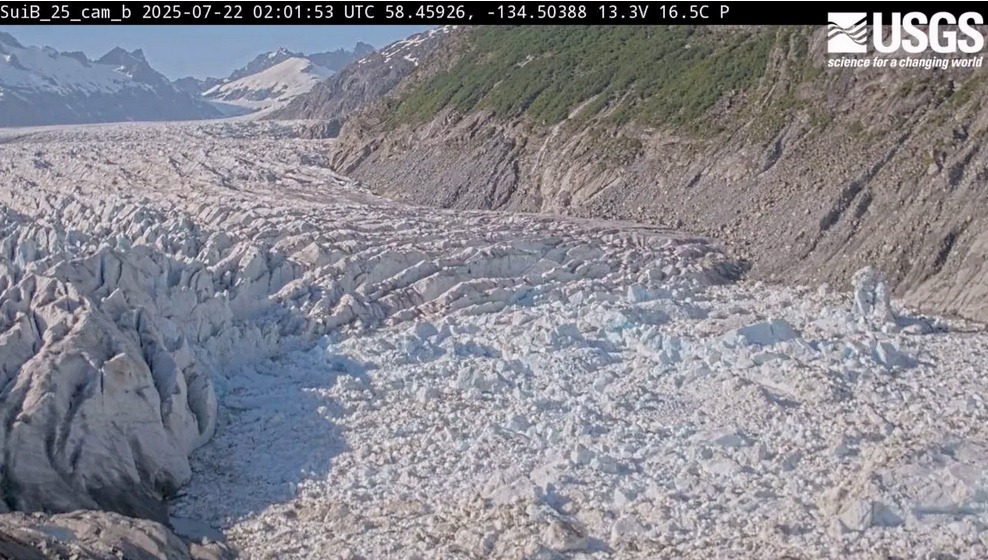
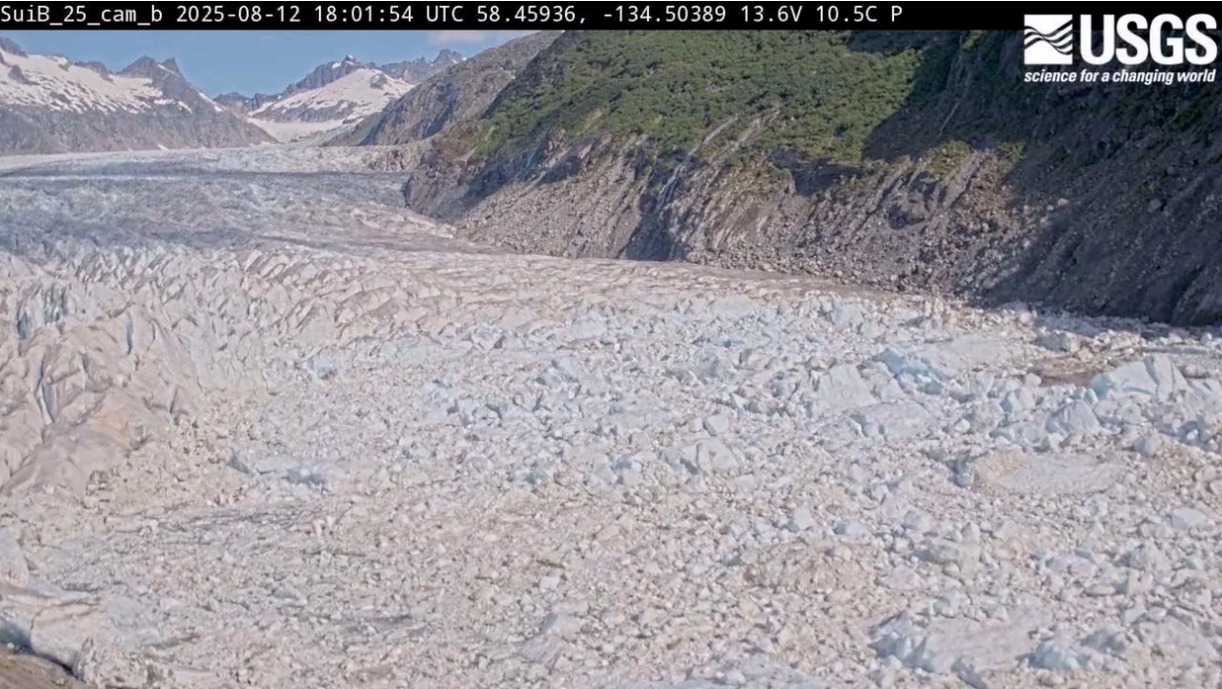
Before-and-after shots of Suicide Basin “popping its cork.” In the first, a small, fractured section of glacier holds back millions of gallons of water, both behind and beneath it. In the next, it’s gone.

Suicide Basin Ice Damn BeforeSuicide Basin After Outburst

The National Weather Service (NWS) Juneau office issued a flood warning for areas along the Mendenhall River near Auke Bay. The released water from this glacial outburst is flowing downstream, putting riverside homes and properties at immediate risk. As of Tuesday afternoon local time, river levels were measured at 9.85 feet, with major flooding classified at 14 feet. Officials expect the river to crest Wednesday afternoon at near-record levels of 16.3 to 16.8 feet, setting a new historic high. NWS meteorologist Nicole Ferrin stated, “This will be a new record, based on all of the information that we have.” The City and Borough of Juneau issued a public advisory confirming that the glacial outburst originated from Suicide Basin. Flooding is expected to continue along Mendenhall Lake and River from late Tuesday through Wednesday. Residents in areas at risk are strongly encouraged to evacuate immediately. A Red Cross shelter is open at Floyd Dryden Gymnasium (3800 Mendenhall Loop Road). Important notices for pet owners: The Red Cross shelter cannot accommodate pets. Evacuated animals should be taken to Juneau Animal Rescue at (907) 789-6997. Safety warning: Do not approach the river. Floodwaters are extremely dangerous, and entering the area endangers both residents and first responders. Stay away from the river to allow safe evacuations and emergency response efforts.

The Mendenhall River crested today at a record-setting 16.65 feet deep as of 7:15 a.m. Alaska time (12:15 Eastern).

Ignite a Domino Effect: Albedo, Brown Carbon, AMOC, Permafrost, Amazon Rainforest Dieback, Outbursts and Sea Level Rise Pulses, Hydroclimate Whiplash, and Arctic Sea Ice Brouse and Mukherjee (2025)

Tipping points and feedback loops drive the acceleration of climate change. When one tipping point is toppled and triggers others, the cascading collapse is known as the Domino Effect.

The Human Induced Climate Change Experiment

From the album “Real Eyes

bookmark_borderUpper Atmosphere

Upper-Atmosphere.mp3
Upper-Atmosphere.mp4
Upper-Atmosphere-Unplugged-Underground-XXIV.mp3
Upper-Atmosphere-Unplugged-Underground-XXIV.mp4
Upper-Atmosphere-intro.mp3

[Verse 1]
Decided to rise to the top
Gonna fly high
(Never gonna stop)
Come, see what’s in store
Spread our wings (and soar)

[Bridge]
(I’m outta here)

[Chorus]
Rising through the atmosphere
(Mesosphere and thermosphere)
Up the upper atmosphere
(To clear the exosphere)

[Verse 2]
Give a smile and laugh
As we catch an updraft
(Try to fly high)
Welcome to see some more
Spread our wings (and soar)

[Bridge]
(We’re outta here)

[Chorus]
Rising through the atmosphere
(Mesosphere and thermosphere)
Up the upper atmosphere
(To clear the exosphere)

[Bridge]
As the rooftops clear
(Sayin’ outta here)

[Chorus]
Rising through the atmosphere
(Mesosphere and thermosphere)
Up the upper atmosphere
(To clear the exosphere)

[Outro]
Come, see what’s in store
Spread our wings (and soar)

A SCIENCE NOTE
The upper atmosphere is the region of Earth’s atmosphere above the troposphere, extending into space. It encompasses several layers, including the mesosphere, thermosphere, and exosphere, and is characterized by decreasing air density and increasing temperatures (except in the mesosphere) as altitude increases. The upper atmosphere also includes the ionosphere, a layer of charged particles created by solar radiation.

Atmospheric circulation together with ocean circulation is how thermal energy is redistributed throughout the world. Chaos theory offers insights into the complex, nonlinear dynamics of climate systems role in the redistribution of thermal energy. The Earth’s climate is a highly complex and dynamic system, influenced by various factors such as ocean currents, atmospheric circulation, and feedback loops.

General Circulation Models (GCMs) of Earth’s climate are nonlinear and highly teleconnected. That means a small change in temperature or pressure or humidity in one small area on the globe can cause _large_ changes in conditions _anywhere_ on the globe. This phenomenon is often referred to as the Butterfly Effect — the idea that a butterfly flapping its wings in China could ultimately contribute to a hurricane forming in the Atlantic. The complexity of these models can lead to chaotic behavior. Climate science must grapple with these models and extract results in spite of the mathematical difficulties, and there have been remarkable successes in some cases and sad failures in others. Nevertheless we must proceed.

* Our probabilistic, ensemble-based climate model — which incorporates complex socio-economic and ecological feedback loops within a dynamic, nonlinear system — projects that global temperatures could rise by up to 9°C (16.2°F) within this century. This far exceeds earlier estimates of a 4°C rise over the next thousand years, highlighting a dramatic acceleration in global warming. We are now entering a phase of compound, cascading collapse, where climate, ecological, and societal systems destabilize through interlinked, self-reinforcing feedback loops.

We examine how human activities — such as deforestation, fossil fuel combustion, mass consumption, industrial agriculture, and land development — interact with ecological processes like thermal energy redistribution, carbon cycling, hydrological flow, biodiversity loss, and the spread of disease vectors. These interactions do not follow linear cause-and-effect patterns. Instead, they form complex, self-reinforcing feedback loops that can trigger rapid, system-wide transformations — often abruptly and without warning. Grasping these dynamics is crucial for accurately assessing global risks and developing effective strategies for long-term survival.

Explore the fundamentals of chaos theory in Edge of Chaos — where order meets unpredictability.

Understand the fundamentals of Statistical Mechanics and Chaos Theory in Climate Science.

Tipping points and feedback loops drive the acceleration of climate change. When one tipping point is toppled and triggers others, the cascading collapse is known as the Domino Effect.

From the album “Lofty

bookmark_borderCatching Rays

Catching-Rays.mp3
Catching-Rays.mp4
Catching-Rays-Unplugged-Underground-XXIV.mp3
Catching-Rays-Unplugged-Underground-XXIV.mp4
Catching-Rays-intro.mp3

[Verse 1]
Consider the exposure
(All who’ll come to see)
To be at your leisure
(Under the sun, happily)

[Bridge]
Imagine your future
In the spotlight (UV)
… you… and me

[Chorus]
Catching rays
(Catching ra, ra, radiation)
More n’ more these days
(We’re catching rays)
Ra, Ra, radiation

[Verse 2]
Don’t wear your welcome thin
Letting the sun under your skin
In the Age of Damage
You’ll have no next of kin

[Bridge]
Imagine your future
In the spotlight (UV)
… you… and me

[Chorus]
Catching rays
(Catching ra, ra, radiation)
More n’ more these days
(We’re catching rays)
Ra, Ra, radiation

[Bridge]
Immune system suppression
(Physical regression)
Premature aging
(Skin is sagging)
Fade to the shade
(Fa, fa, fa fade)
To the shade

[Chorus]
Catching rays
(Catching ra, ra, radiation)
More n’ more these days
(We’re catching rays)
Ra, Ra, radiation

[Outro]
Didn’t mean to be catching rays
(These days)
Fade to the shade
(Fa, fa, fa fade)
Fade to the shade
(Fa, fa, fa fade)
To the shade
(Fade)

A SCIENCE NOTE

Climate feedbacks are causing increased UV alerts because warming temperatures and changing atmospheric chemistry reduce the protective ozone layer in some regions and alter cloud cover. Less ozone and fewer clouds allow more ultraviolet (UV) radiation to reach the surface. Additionally, higher levels of ground-level pollutants like nitrogen oxides (from fossil fuel combustion) can interact with warming to worsen stratospheric ozone depletion, especially during heatwaves.

Photon radiation refers to energy carried by photons, the fundamental particles of light. UV photons have high energy and short wavelengths. When they penetrate the skin, they can damage DNA, leading to:

  • Skin cancer (e.g., melanoma)

  • Premature aging

  • Eye damage (like cataracts)

  • Immune system suppression

UV alerts are a public warning that dangerous levels of solar radiation are reaching the ground—often amplified by climate-related feedbacks.

Tipping points and feedback loops drive the acceleration of climate change. When one tipping point is toppled and triggers others, the cascading collapse is known as the Domino Effect.

From the album “Phoron

bookmark_borderWhy It Matters

Why-It-Matters-Best-Of.mp3
Why-It-Matters-Best-Of.mp4
Why-It-Matters.mp3
Why-It-Matters.mp4
Why-It-Matters-intro.mp3

[Intro]
(Why does it matter?)
If they’re all interconnected
(We’re all interconnected)
Phased and tattered

[Verse 1]
Taken together..
we are exponentially accelerating
the collapse of Earth’s climate regulators
We’re the multiplier agitators

[Chorus]
As we toss our care to the side
(Exploitation cannot hide)
How to forgive “live”
(When it’s “make to take”)

[Bridge]
Why it matters?
(Why — it matters!)
(Why does it matter?)
If they’re all interconnected
(We’re all interconnected)
Phased and tattered
(Fa, fa, fa) Phased
And (Ta, ta, tattered)

[Verse 2]
And we’re actively toppling
every one of these dominoes…
(Right now!) Who knows?
That’s not just a cascade —
it’s a full-blown chain reaction.
(For our own self-satisfaction)

[Chorus]
As we toss our care to the side
(Exploitation cannot hide)
How to forgive “live”
(When it’s “make to take”)

[Bridge]
Why it matters?
(Why — it matters!)
It’s a full-blown chain reaction
(Curse of the damned demand — self-satisfaction)
(Why does it matter?)
If they’re all interconnected
(We’re all interconnected)
Phased and tattered
(Fa, fa, fa) Phased
And (Ta, ta, tattered)

Why it matters?
(Why — it matters!)

[Outro]
It’s a full-blown chain reaction
(Curse of the damned demand — self-satisfaction)
(Why does it matter?)
If they’re all interconnected
(We’re all interconnected)
Phased and tattered
(Fa, fa, fa) Phased
And (Ta, ta, tattered)

A SCIENCE NOTE

Research and development incorporating complex social-ecological feedback loops within a dynamic, non-linear system is profoundly challenging. A small window into this complexity can be seen in the interactions among the Albedo Feedback Loop, Brown Carbon Feedback Loop, Freshwater-AMOC Disruption Loop, Permafrost-Methane Feedback Loop, Amazon Rainforest Dieback Feedback Loop, Sudden Sea Level Rise Pulses (“Cork Release” Events), Hydroclimate Whiplash, and Arctic Sea Ice Feedback.

Combined Consequences

These interlinked, reinforcing feedbacks can:

  • Drive non-linear, abrupt climate shifts.

  • Cause sudden sea level rise pulses (feet per year for consecutive years).

  • Collapse the AMOC, disrupting weather, food systems, and rainfall patterns.

  • Trigger Amazon dieback, increasing global CO2.

  • Result in mass displacement, famine, and water crises.

Tipping Points Igniting a Domino Effect

We knew tipping points would eventually trigger self-sustaining feedback loops in the climate system–and now, they have arrived. I was prepared for that part.

What I could not fully envision was how rapidly the interplay among these tipping points would ignite a domino effect–so, so fast.

Now, I see it clearly: the nonlinear, dynamic dance of economic, physical, and ecological systems unfolding in real time. Abstract models are transforming into undeniable, measurable reality before our eyes.

Cascading System Failures

The breakdown of climate subsystems will not follow a smooth, linear decline. Instead, as one subsystem fails, it accelerates the failure of others, creating cascading, compounding effects across the entire climate system.

There are too many interconnected subsystems to list exhaustively, but consider one example:
The collapse of the AMOC slows ocean circulation, leading to hotter tropics and a warmer Arctic. This accelerates polar ice melt, causing sea levels to rise more rapidly while injecting large volumes of freshwater into the North Atlantic, further destabilizing the AMOC in a reinforcing loop.

At the same time, a disrupted climate system increases droughts in the Amazon, pushing the rainforest toward dieback and desertification. As the Amazon loses its ability to recycle rainfall and sequester carbon, it further amplifies global warming, which then accelerates ice melt, sea level rise, and AMOC collapse.

This example is just one piece of a much larger mosaic of cascading feedback loops already unfolding, shifting the climate system from a stable state to a chaotic, accelerating collapse.

Why It Matters

The Albedo Feedback Loop, Brown Carbon Feedback, Freshwater-AMOC Disruption, Permafrost-Methane Release, Amazon Rainforest Dieback, Sudden Sea Level Rise Pulses (the ‘Cork Release’ effect), Hydroclimate Whiplash, and Arctic Sea Ice collapse are all interconnected. And we’re actively toppling every one of these dominoes right now. That’s not just a cascade — it’s a full-blown chain reaction.

Taken together, we are exponentially accelerating the collapse of Earth’s climate regulators — threatening global food security, weather stability, and the planet’s long-term habitability.

* Our probabilistic, ensemble-based climate model — which incorporates complex socio-economic and ecological feedback loops within a dynamic, nonlinear system — projects that global temperatures could rise by up to 9°C (16.2°F) within this century. This far exceeds earlier estimates of a 4°C rise over the next thousand years, highlighting a dramatic acceleration in global warming. We are now entering a phase of compound, cascading collapse, where climate, ecological, and societal systems destabilize through interlinked, self-reinforcing feedback loops.

We examine how human activities — such as deforestation, fossil fuel combustion, mass consumption, industrial agriculture, and land development — interact with ecological processes like thermal energy redistribution, carbon cycling, hydrological flow, biodiversity loss, and the spread of disease vectors. These interactions do not follow linear cause-and-effect patterns. Instead, they form complex, self-reinforcing feedback loops that can trigger rapid, system-wide transformations — often abruptly and without warning. Grasping these dynamics is crucial for accurately assessing global risks and developing effective strategies for long-term survival.

Understand the fundamentals of Statistical Mechanics and Chaos Theory in Climate Science.

Explore the fundamentals of chaos theory in Edge of Chaos — where order meets unpredictability.

From the album “Wormhole

bookmark_borderStatistical Mechanics

Statistical-Mechanics-Best-Of.mp3
Statistical-Mechanics-Best-Of.mp4
Statistical-Mechanics.mp3
Statistical-Mechanics.mp4
Statistical-Mechanics-intro.mp3

[Verse 1]
Is your savior
Macroscopic behavior
Dynamical laws
Tooth and claws

[Bridge]
Chaos combined with statistical mechanics
Is music…
To the mind

[Chorus]
Systems with many bodies
(All moving about… in and out)
Yet no one body… can account for it all
(No, know nobody)
Can calculate the fall
(All fall, all all)

[Verse 2]
To be sure to figure your future…
The probability of improbability
To calculate the rate of our fate
As the human race races

[Bridge]
Faster and faster
(Into disaster)
Chaos combined with statistical mechanics
Is music…
To the mind

[Chorus]
Systems with many bodies
(All moving about… in and out)
Yet no one body… can account for it all
(No, know nobody)
Can calculate the fall
(All fall, all all)

[Bridge]
Shout:
(We gotta figure it out)
Chaos combined with statistical mechanics
Is music…
To the mind

[Chorus]
Systems with many bodies
(All moving about… in and out)
Yet no one body… can account for it all
(No, know nobody)
Can calculate the fall
(All fall, all all)

[Outro]
But taken together
We can do the math
Whether we’ll weather
(Or take a bath)

A SCIENCE NOTE
Besides his famous work on relativity, Albert Einstein also made significant contributions to quantum theory, statistical mechanics, and had a hand in the early stages of the Manhattan Project. He also explored a unified field theory, worked on a noiseless refrigerator, and had a patent for a light intensity self-adjusting camera.

Statistical Mechanics (SM) is the third pillar of modern physics, next to quantum theory and relativity theory. Its aim is to account for the macroscopic behavior of physical systems in terms of dynamical laws governing the microscopic constituents of these systems and the probabilistic assumptions made about them.

Statistical Mechanics (SM), chaos theory, and climate science are deeply interconnected, especially in the study of complex, dynamic systems like Earth’s climate. Here’s how they relate:

1. Statistical Mechanics (SM): Understanding Many-Body Systems

SM connects the microscopic behavior of individual particles to macroscopic properties like pressure or entropy. It handles massive numbers of interactions through probabilities and ensemble averages, making it essential for describing bulk climate behavior—like temperature gradients or energy flux—without tracking every molecule.

2. Chaos Theory: Sensitivity and Nonlinear Dynamics

Chaos theory explores how deterministic systems can behave unpredictably, especially when small changes in initial conditions lead to vastly different outcomes. This is particularly relevant for climate variability, such as hurricane formation or abrupt shifts in atmospheric circulation.

3. The Bridge Between SM and Chaos in Climate Science

Ensemble modeling in climate science arises from this intersection—running multiple simulations to assess statistical distributions of outcomes. Concepts like phase transitions and entropy production help analyze tipping points like Arctic sea ice loss or AMOC collapse.

4. Practical Examples from the Climate System

Albedo Effect and Arctic Amplification

As ice melts and darker surfaces absorb more heat, this positive feedback loop amplifies warming. SM helps quantify energy redistribution; chaos theory explains timing and severity.

Brown Carbon and Aerosol Feedback

Brown carbon reduces albedo, warms the atmosphere, and influences precipitation. SM models radiative transfer; chaos explains regional unpredictability.

AMOC (Atlantic Meridional Overturning Circulation)

AMOC regulates global heat. A slowdown from Greenland meltwater could cause abrupt changes. SM tackles heat transport; chaos theory explains potential bifurcation and collapse scenarios.

Permafrost Thaw and Methane Bursts

Thawing releases greenhouse gases, accelerating warming. SM models emissions under warming; chaos theory helps explain rapid, cascading releases.

Amazon Rainforest Dieback

Deforestation and heat could turn the Amazon into a carbon source. SM addresses carbon fluxes; chaos explains local-to-global threshold behavior.

Sea Level Rise Pulses

Glacial collapses cause irregular sea-level jumps. SM models thermodynamics of melt; chaos theory explores sudden cliff failures or calving events.

Hydroclimate Whiplash

Whiplash—rapid shifts between drought and flood—stems from atmospheric chaos. SM models moisture and pressure systems; chaos explains regime shifts in weather patterns.

Why It Matters

These examples represent interlinked tipping points—a shift in one (like Arctic ice loss) can destabilize others (like AMOC), creating a domino effect. This is illustrated in Ignite a Domino Effect.

Statistical Mechanics provides the math to evaluate ensemble behaviors, energy flows, and system equilibria. Chaos Theory adds the insight that some shifts may be sudden and irreversible, triggered by seemingly small changes in input or feedback.

Conclusion

Earth’s climate is a fragile balance of feedbacks and nonlinear dynamics. Understanding it through the dual lenses of Statistical Mechanics and Chaos Theory reveals how interconnected and sensitive the system really is. From ice-albedo loops to permafrost thaw and jet stream chaos, the science shows we’re toppling multiple tipping points.

Recognizing these risks is critical—not only for modeling the future, but for guiding urgent climate action today.

* Our probabilistic, ensemble-based climate model — which incorporates complex socio-economic and ecological feedback loops within a dynamic, nonlinear system — projects that global temperatures could rise by up to 9°C (16.2°F) within this century. This far exceeds earlier estimates of a 4°C rise over the next thousand years, highlighting a dramatic acceleration in global warming. We are now entering a phase of compound, cascading collapse, where climate, ecological, and societal systems destabilize through interlinked, self-reinforcing feedback loops.

We examine how human activities — such as deforestation, fossil fuel combustion, mass consumption, industrial agriculture, and land development — interact with ecological processes like thermal energy redistribution, carbon cycling, hydrological flow, biodiversity loss, and the spread of disease vectors. These interactions do not follow linear cause-and-effect patterns. Instead, they form complex, self-reinforcing feedback loops that can trigger rapid, system-wide transformations — often abruptly and without warning. Grasping these dynamics is crucial for accurately assessing global risks and developing effective strategies for long-term survival.

Explore the fundamentals of chaos theory in Edge of Chaos — where order meets unpredictability.


Tipping points and feedback loops drive the acceleration of climate change. When one tipping point is toppled and triggers others, the cascading collapse is known as the Domino Effect.

From the album “Wormhole

bookmark_borderEarthworms Emerge

Earthworms-Emerge-Best-Of.mp3
Earthworms-Emerge-Best-Of.mp4
Earthworms-Emerge.mp3
Earthworms-Emerge.mp4
Earthworms-Emerge-intro.mp3

[Verse 1]
The worms crawl in
The worms crawl out
What’s happenin’
Gonna find out

[Chorus]
Earthworms emerge
Under violent rain
The harms of submerge
Under oxygen strain

[Bridge]
Air’s depletion
(Nears completion)
Coming out from hiding
(Numbers subsiding)

[Verse 2]
The worms crawl out
Crawling all about
No reburrowing
Only scurrying

[Chorus]
Earthworms emerge
Under violent rain
The harms of submerge
Under oxygen strain

[Bridge]
Air’s depletion
(Nears completion)
Coming out from hiding
(Numbers subsiding)

[Chorus]
Earthworms emerge
Under violent rain
The harms of submerge
Under oxygen strain

[Outro]
Air’s depletion
(Nears completion)
Coming out from hiding
(Numbers subsiding)

A SCIENCE NOTE
When heavy rains saturate the soil, earthworms often emerge to the surface. Here’s what happens and why many of them die in these events:

1. Why They Come Out

  • Oxygen Depletion: Earthworms breathe through their skin, which must stay moist to absorb oxygen. But during prolonged or intense rainfall, water fills the soil’s air spaces, reducing available oxygen. To avoid suffocation, worms head for the surface.

  • Mobility Opportunity (in theory): Some species may use wet conditions to migrate or mate more easily on the surface. Moisture allows them to travel further without drying out, though this benefit is outweighed during extreme rain.

2. Why Many Die

  • Exposure to Predators: On the surface, worms become easy prey for birds and other animals.

  • UV and Heat Exposure: If the rain is followed by sun, worms dry out quickly since they can’t stay moist in direct light or heat.

  • Floodwaters: In cases of standing water or flooding, many drown or are washed away.

  • Lack of Cover: Urban areas and compacted soil give worms few options for reburrowing, leaving them stranded.

3. Ecological Impact

  • Localized Die-Offs: Frequent die-offs during extreme weather reduce soil biodiversity and may impact soil health, since worms play a critical role in aeration, decomposition, and nutrient cycling.

  • Climate Feedback Loop: As climate change drives more intense rain events, these mass worm deaths could become more common—disrupting soil systems that help store carbon and support agriculture.

The Human Induced Climate Change Experiment

From the album “Wormhole