bookmark_borderDubai Sky

Dubai sky,
Why?
[Break]
[Instrumental, Oud, Guitar Solo, Lute, Oboe, Tambourine]

[Verse 1]
More rain in a day than a year
What can I say, living in fear
The sky opened, the heavens fell
Forecast for the future, doesn’t bode well

[Break]
The pain of desert rain
[Break]

[Chorus]
Land so dry can’t even cry
No so wet you’re gonnna regret
What use to fry won’t stay dry
Times are changing, climates rearranging
[Break]
Hail!
[Break]
The Prince of Fail

[Instrumental, Oud Solo,

[Break]
Dubai sky,
Why?
[Break]
[Instrumental, Oud, Guitar Solo, Lute, Oboe, Tambourine]

[Verse 2]
As the rain pounds out the beat
Water fills the street
The water is pouring down
No dry ground found…
It’s flooding all around

[Break]
The pain of desert rain
[Break]

[Chorus]
Land so dry can’t even cry
No so wet you’re gonnna regret
What use to fry won’t stay dry
Times are changing, climates rearranging
[Break]
Hail!
[Break]
The Prince of Fail
[Instrumental, Oud Solo, Lute, Oboe, Tambourine]

[Break]
Dubai sky,
Why?
[Break]
[Instrumental, Oud, Guitar Solo, Lute, Oboe, Tambourine]

[Verse 3]
The sands of time are drenched
Desert no more, ocean floor
Parched passed, thirst quenched
What was sure is now shore
Pour, pour, pour

[Break]
The pain of desert rain
[Break]

[Chorus]
Land so dry can’t even cry
No so wet you’re gonnna regret
What use to fry won’t stay dry
Times are changing, climates rearranging

[Outro]
Hail!
The Prince of Fail
[End]

A SCIENCE LESSON
On April 16, 2024, the United Arab Emirates (UAE) experienced an unprecedented storm that resulted in the heaviest rainfall ever recorded in the desert nation. Heavy thunderstorms lashed the UAE, leading to extensive flooding of roads and Dubai’s international airport. The rainfall, which began late Monday, saturated the sands and roadways of Dubai with approximately 20 millimeters (0.79 inches) of rain, according to meteorological data collected at Dubai International Airport. The intensity of the storms intensified on Tuesday, dumping even more rain and hail onto the overwhelmed city.

By the end of Tuesday, Dubai had received more than 142 millimeters (5.59 inches) of rainfall within a 24-hour period. This amount far exceeds the average annual rainfall of 94.7 millimeters (3.73 inches) at Dubai International Airport, which is the world’s busiest airport for international travel and a hub for the long-haul carrier Emirates.

The state-run WAM news agency described the rainfall as “a historic weather event,” surpassing any previous records since the start of data collection in 1949.

The sudden deluge highlighted the vulnerability of Dubai and the UAE to extreme weather events, prompting concerns about climate resilience and urban planning. As one expert on climate resilience and urban environments noted, the unprecedented rainfall underscores the need for the UAE to reassess its approach to infrastructure and emergency preparedness.

The heavy rainfall also had significant impacts on businesses and individuals in the region. For example, Somia Anwar, co-owner of Bookends, a used books seller, experienced flooding in her basement-level shop, resulting in the loss of thousands of books. The incident highlighted the need for improved waterproofing measures and insurance coverage against such events.

Scientists attributed the severity of the rainfall to a combination of factors, including the warming of the Pacific Ocean associated with the El Niño pattern and human-caused climate change. While the precise contribution of climate change to the extreme weather event is difficult to quantify, the warming climate is increasingly making such events more severe and frequent.

With the UAE hosting the COP28 climate summit last year, awareness has grown about climate change dangers. The country has an adaptation plan, and Dubai was the first to apply for a UN scheme to become a “City Resilience Hub” in 2020.

UAE capital Abu Dhabi weathered the latest storm better than the larger glitzy trading and financial hub of Dubai. The futuristic city is the UAE’s biggest by population and the location of the world’s second busiest airport, which was forced to cancel more than 1,000 flights, leaving passengers stranded for days.

“The infrastructure was built before these weather changes happened,” said an insurance executive, who said it was too early to estimate overall damage costs. “In certain instances, the quality of construction by the developers was not good enough.”

Sprawling Dubai was especially vulnerable to flooding because it was relatively flat, covered in impermeable concrete and asphalt surfaces, and its desert sands lacked the ability to grow vegetation that could absorb floodwater, said a Dubai-based town planning specialist.

Following the floods, Sheikh Hamdan bin Mohammed al-Maktoum, the crown prince, approved a Dh66bn upgrade to the drain network © AP

Underlying those drainage problems is a groundwater table already oversaturated by irrigation and pipe leakage, a common issue in the Gulf. “The cities are really floating,” said Hrvoje Cindrić, Middle East planning lead at international engineering firm Buro Happold.

When Dubai floods, he added, “the water has got nowhere to go”.

Dubai officials over the years have considered comprehensive drainage systems but carried out limited works because of the high costs involved versus the perceived relatively low risk.

Upgrades to the network have included a 10km drainage tunnel under southern Dubai, opened ahead of Expo 2020, to serve the huge exhibition facilities, which was also the site of the UN climate summit, and the airport.

“You wouldn’t engineer for the worst possible scenario . . . it’s prohibitively expensive,” said Huda Shaka, a chartered urban planner based in Dubai. But following the storm, “it’s not just a theoretical scenario.

In the wake of the floods, Sheikh Hamdan bin Mohammed al-Maktoum, the crown prince, approved a Dh66bn upgrade to the drain network. Tenders were first issued last year for the project, though bids were not received until February.

The announcement came after the UAE president Sheikh Mohammed bin Zayed al-Nahyan ordered officials to monitor the nation’s infrastructure and “limit the damage caused,” according to the state news agency.

Town planning experts say Dubai could adopt “sponge city” principles, making detailed flooding plans and allotting areas with permeable surfaces for better drainage. Given the damage sustained by many buildings, “there may be a need for tougher building codes,” said a former Emirati official.

“Now the cost of mitigating [extreme weather] becomes not unreasonable,” said urban planner Shaka, adding: “sometimes it takes an extreme event for action to happen.”
by The Beatless Sense Mongers

A song about The Human Induced Climate Change Experiment

bookmark_borderSomething

Surprise!
[Break]
Rise
[Break]

[Verse 1]
I heard there’s something we can do
For instance: make a difference
Absolutely nothing hampering you
So, come on! Make a difference

[Bridge]
Little to no doubt
Our time is running out
Grab ’em by the balls

[Chorus]
Ride, cowboy, ride
You can save the day
Instead of crying a tide
Start to find your way
[Break]
Rise!
[Break]
Surprise!
[Break]
Rise

[Instrumental, Hammond B3 Organ, Guitar Solo]

[Verse 2]
You’ve heard there’s something we can do
For reference: make a difference
The word is, “We can pull through!”
So, come on! Make a difference

[Bridge]
Little to no doubt
Our time is running out
Grab ’em by the balls

[Chorus]
Ride, cowboy, ride
You can save the day
Instead of crying a tide
Start to find your way
[Break]
Rise!
[Break]
Surprise!
[Break]
Rise

[Break]
Ride, Cowboy
[Break]
Ride!

[Verse 3]
We know there’s plenty we can do
Our preference: make a difference
The world needs us to pull through
So, come on! Make a difference

[Bridge]
Little to no doubt
Our time is running out
Grab ’em by the balls

[Chorus]
Ride, cowboy, ride
You can save the day
Instead of crying a tide
Start to find your way

Break]
Rise!
[Break]
Ride, cowboy, rise
[Break]
Rise

[Outro]
[Break]
Rise!
[Break]
Ride, cowboy, rise
[Break]
Rise

[End]

by The Beatless Sense Mongers

A song about The Human Induced Climate Change Experiment

bookmark_borderMy Heart is Melting

Hello?
[Break]
Does anybody know?
[Break]
[Instrumental, Hammond B3 Organ]

[Verse 1]
Are the fiercest winters
A thing of the past
Starting to wonder
What ice will last

[Chorus]
My heart is melting
My soul is wanting
For a world with comMEN sense
More open arms. a lot less fence

[Bridge]
Enlighten the dense
Rinse and repeat
While dancing to the beat
[Break]
Sweet
[Break]
Treat

[Instrumental]

[Break]
Hello?
[Break]
Does anybody know?
[Break]

[Verse 2]
Is the Summer’s onslaught
Starting to Spring
The children overwrought
Their parents, depressing

[Chorus]
My heart is melting
My soul is wanting
For a world with comMEN sense
More open arms. a lot less fence

[Outro]
Enlighten the dense
Rinse and repeat
While dancing to the beat
[Break]
Sweet
[Break]
Treat

[Instrumental]

[Break]
Hello?
[Break]
Does anybody know?
[Break]

[Verse 3]
Can we change attitude
More in the future
Whatnot, rude, and lewd
Put out to pasture

[Chorus]
My heart is melting
My soul is wanting
For a world with comMEN sense
More open arms. a lot less fence

[Outro]
Enlighten the dense
Rinse and repeat
While dancing to the beat
[Break]
Sweet
[Break]
Treat

[End]

by The Beatless Sense Mongers

A song about The Human Induced Climate Change Experiment

bookmark_borderFeedback

Feedback

Back, back, back

[Verse]
Got back (back)
Before before
Got back (back)
Back for more
Now I get back (get back)
For sure

[Break]
Back
[Break]
Back for sure

[Chorus]
Time to get back back
In a feedback loop loop
And hear science of the day
[Break]
Play!
[Break]

[Instrumental, Guitar Solo, Drum Fills, Female Vocals]
[Outro]
Back
Back
Back

A SCIENCE LESSON
While guitar feedback and climate feedback may seem worlds apart, they share a fundamental similarity in the way they operate as feedback loops.

In the realm of music, guitar feedback occurs when the sound from an amplifier is picked up by the guitar’s pickups, creating a loop of sound that feeds back into itself. This loop can lead to a continuous, often high-pitched tone or squeal. The intensity of the feedback depends on various factors such as the distance between the guitar and the amplifier, the volume level, and the position of the guitar relative to the speakers.

Similarly, in climate science, feedback loops play a crucial role in amplifying or dampening the effects of climate change. For example, as global temperatures rise due to increased greenhouse gas emissions, feedback mechanisms such as the melting of Arctic sea ice and the release of methane from permafrost can further amplify warming. These feedback loops create a self-reinforcing cycle where warming leads to additional effects that, in turn, contribute to more warming.

Both guitar feedback and climate feedback involve a process where an initial input (sound or temperature increase) triggers a response that reinforces the original input, leading to a continuous loop of amplification. In the case of guitar feedback, this loop produces a distinctive sound characteristic of rock music. In the case of climate feedback, the loop can have profound and far-reaching consequences for the Earth’s climate system, impacting ecosystems, weather patterns, and sea levels.

Understanding and managing feedback loops are essential in both domains. In music, musicians use techniques such as adjusting volume levels or changing the guitar’s position to control feedback and achieve desired sounds. In climate science, researchers strive to understand the complex interactions between different feedback mechanisms to better predict and mitigate the impacts of climate change.

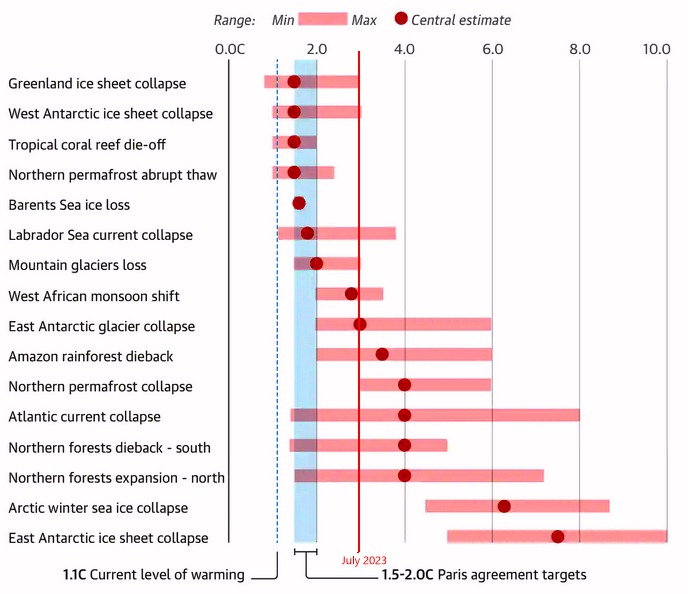
The Domino Effect is causing climate change to accelerate at an exponential rate. Tipping points are Critical Milestones that directly impact the rate of acceleration in climate change by multiplying the number and intensity of feedback loops. Identifying and understanding these tipping points is crucial for climate science and policymaking. Crossing multiple tipping points could lead to a domino effect, resulting in a much more rapid and severe climate change than currently projected.

From the album: MegaEpix Enormous

bookmark_borderThe Snowball Effect (Roll, Baby, Roll)

[Intro]
I didn’t really know what I was doing at the time…
You see, I was under the influence of gravity
[Instrumental, Organ, Saxophone, Bass]

[Verse 1]
Conservation of my momentum
Conversation: go get ’em
Time to roll
It’s all downhill from… hear
[Bridge]
Hear the diction of friction
Your warm affection
I’ve the notion
Accelerates my motion
[Break]
Roll, baby, roll
[Chorus]
Roll, baby, roll (Roll, baby, roll)
It’s all downhill from here
We’re on a roll (Roll, baby, roll)
Make sure our path is clear
Don’t want our ride to collide
[Instrumental]

[Break]
In the first place
[Verse 2]
In the first place
I was under the influence of gravity
And, it really got to me
[Break]
Pull
[Break]
Pull
[Break]
Pull
[Break]
I have to go
‘least, it’s all downhill from… hear
[Bridge]
Hear the diction of friction
Your warm affection
I’ve the notion
Accelerates my motion
[Break]
Roll, baby, roll
[Chorus]
Roll, baby, roll (Roll, baby, roll)
It’s all downhill from here
We’re on a roll (Roll, baby, roll)
Make sure our path is clear
Don’t want our ride to collide
[Instrumental]

[Break]
Foot on the gas
[Verse 3]
Gaining mass
While time goes past
Conserving my momentum
I am…
Going big
Big, big, big
[Break]
Pull
[Break]
Pull
[Break]
Pull
[Break]
I have to go
‘least, it’s all downhill from… hear
[Bridge]
Hear the diction of friction
Your warm affection
I’ve the notion
Accelerates my motion
[Break]
Roll, baby, roll
[Chorus]
Roll, baby, roll (Roll, baby, roll)
It’s all downhill from here
We’re on a roll (Roll, baby, roll)
Make sure our path is clear
Don’t want our ride to collide

[Outro]
I didn’t really know what I was doing at the time…
I was really under the influence of gravity
And, she said, “Let’s roll.”
So, we went for a stroll
[End]
[Silence]

A SCIENCE LESSON
When a snowball rolls down a hill, it accumulates mass, accelerates, and gains inertia, mirroring the progression of human-induced climate change. Tipping points, once breached, set off self-sustaining feedback loops independent of human influence. This phenomenon is akin to a falling domino striking two more, setting off a chain reaction—hence the term “The Domino Effect”. In climate science, it’s often termed “tipping cascades.” This concept can also be likened to “The Snowball Effect.” A tipping point resembles a snowball gathering mass and velocity (momentum) as it rolls downhill. Once passed, it leads to cumulative and reinforced global warming.

  1. Conservation of Momentum: According to Newton’s first law of motion, an object in motion tends to stay in motion unless acted upon by an external force. As the snowball starts rolling down the hill, it gains momentum. Momentum is the product of mass and velocity, so as the snowball gains mass by accumulating more snow, its momentum increases.
  2. Friction: Friction between the snowball and the surface of the hill plays a crucial role. Friction opposes the motion of the snowball, which means it acts in the direction opposite to the snowball’s velocity. However, as the snowball accumulates more mass, it also gains more surface area in contact with the hill, which increases the frictional force. This can help accelerate the snowball’s motion, especially if the hill is steep enough.
  3. Gravity: Gravity is what pulls the snowball downhill in the first place. As the snowball rolls down the hill, it accelerates under the influence of gravity. The force of gravity acting on the snowball increases its velocity, contributing to its momentum.
  4. Impact and Collisions: As the snowball accumulates more mass, it may collide with other objects like rocks or other snowballs on its way down the hill. These collisions can transfer momentum and alter the snowball’s trajectory and velocity.

Overall, the snowball’s momentum is a result of the interplay between these factors. As it gains mass and velocity while rolling down the hill, its momentum increases, governed by the principles of classical mechanics.

Chaos theory, the concept of The Snowball Effect, tipping points and feedback loops provide valuable insights into understanding the acceleration of climate change.

  1. Chaos Theory: Chaos theory deals with complex systems that are highly sensitive to initial conditions, where small changes can lead to significant differences in outcomes. The Earth’s climate system is a classic example of such a complex system. Small perturbations, such as changes in greenhouse gas concentrations or variations in ocean currents, can lead to large-scale and often unpredictable changes in weather patterns and climate dynamics. Chaos theory helps us understand why seemingly small changes in atmospheric composition or temperature can have profound and sometimes unexpected effects on global climate patterns.
  2. Tipping Points: Tipping points are thresholds in a system where a small change can lead to a significant and often irreversible shift in the system’s state. In the context of climate change, tipping points represent critical thresholds in Earth’s climate system, such as the melting of polar ice caps or the collapse of large ice sheets. Once these tipping points are crossed, they can trigger feedback loops that amplify warming and accelerate climate change. For example, the melting of Arctic sea ice reduces the Earth’s albedo, leading to more absorption of solar radiation and further warming of the Arctic, creating a positive feedback loop.
  3. Feedback Loops: Feedback loops are mechanisms by which changes in one part of a system amplify or dampen changes in another part of the system. In the climate system, there are both positive and negative feedback loops. Positive feedback loops amplify changes and tend to destabilize the climate system, while negative feedback loops dampen changes and promote stability. For example, as temperatures rise, permafrost thaw releases methane, a potent greenhouse gas, which further accelerates warming, creating a positive feedback loop. On the other hand, increased atmospheric CO2 levels can stimulate plant growth, leading to more carbon uptake through photosynthesis, which acts as a negative feedback loop.

By considering chaos theory, tipping points, and feedback loops, we can better understand the non-linear dynamics of the climate system and why climate change can accelerate rapidly once certain thresholds are crossed. This understanding is crucial for developing effective strategies to mitigate and adapt to climate change.

Tipping points are Critical Milestones that directly impact the rate of acceleration in climate change by multiplying the number and intensity of feedback loops. Identifying and understanding these tipping points is crucial for climate science and policymaking. Crossing multiple tipping points could lead to a domino effect, resulting in a much more rapid and severe climate change than currently projected.

Tipping Points

Push a glass toward the edge of a table and eventually it will fall off on its own. No matter how slowly or meticulously you push… no matter how you weight or fill the glass, it will reach a tipping point and fall off before being pushed completely off the table. No matter whether you believe the glass is half-empty or half-full, when the tipping point is reached it will plummet out-of-control to its end. This is science not fate, faith, nor belief. Human induced climate change has resulted in environmental tipping points being breached.

Tipping points, when crossed, trigger self-sustaining feedback loops that are no longer dependent on human activity. Similar to when a domino topples over hitting two more dominoes that in turn fall hitting more dominoes. Thus, the name The Domino Effect. It can also be visualized as The Snowball Effect. A tipping point is like a snowball rolling down a hill growing in mass and velocity (momentum). When a tipping point is crossed, it results in cumulative and reinforced global warming.

From Daniel’s Multimedia Album: Omnilogy

bookmark_borderMath and Science

[Intro]
[Instrumental]
1 + 1 = 2
[Break]
2 + 2 = 2’s, too
[Verse 1]
Mathematics a universal language
No baggage
Political point-of-view
Here’s all you’ve got to do:
[Chorus]
Just look out your window
Tell me, what do you see?
Do you see all the math
Of our after-wrath?
[Bridge]
And, it ain’t over yet
Place your bet
Have we just started
[Break]
1 to 1
[Break]
1 to 2
I’m asking you

[Verse 2]
What are the odds, of pulling through
Ask your gods if you’re lucky, too?
I’m beggin’ you, do the math
Takin’ a bath
[Bridge]
Frogs in a pot
Why not?
Turn up the heat
(And, the sun beat, beat, beat
Down)

[Chorus]
Just look out your window
Tell me, what do you see?
Do you see all the math
Of our after-wrath?
[Bridge]
And, it ain’t over yet
Place your bet
Have we just started
[Break]
1 to 1
[Break]
1 to 2
I’m asking you
[Instrumental]

[Break]
Do you see the math
[Break]
Of our after-wrath?
[Bridge]
And, it ain’t over yet
Place your bet
Have we just started
[Break]
1 to 1
[Break]
1 to 2
I’m asking you
[Instrumental]
[Chorus]
Just look out your window
Tell me, what do you see?
Do you see all the math
Of our after-wrath?
[Outro]
And, it ain’t over yet
Place your bet
Have we just started
[End]
[Silence]

Mathematics, often simply referred to as “math,” is the study of numbers, quantity, structure, space, and change. It involves abstract concepts such as numbers, shapes, and patterns, as well as logical reasoning and problem-solving techniques.

Mathematics encompasses a wide range of branches, including arithmetic, algebra, geometry, calculus, statistics, and more. It provides tools and methods for analyzing and understanding the world around us, from calculating the trajectory of a spacecraft to modeling the spread of a disease.

Mathematics is considered a universal language because its principles and concepts are consistent and applicable across different cultures and contexts. It plays a fundamental role in various fields such as science, engineering, economics, and technology, serving as a cornerstone of modern civilization.

* Our climate model employs mathematics, statistics, economics, and chaos theory to comprehensively consider human impacts and projects a potential global average temperature increase of 9℃ above pre-industrial levels.

From Daniel’s Multimedia Album: Omnilogy

bookmark_borderThe Energy Imbalance

[Instrumental, Piano, Strings]
[Intro]
Off balance
This joint
Is at a tipping point

[Verse 1]
In the dance of light and space,
A balance kept in perfect grace,
But now the scales begin to sway,
As changes come, there goes my day.
[Break]
Off balance
This joint
Is at a tipping point
[Break]
[Pre-Chorus]
Masses of gases fill the air,
Are people blind or just don’t care?
The energy imbalance starts to show,
Watch ss temperatures grow.
Woah, woe, Woah

[Chorus]
Oh, the energy imbalance,
Shifting the world’s delicate dance,
Melting ice, killing trees, warming seas,
Bringing changes we can’t appease.
[Break]
Jeez
Time for an output seize
[Instrumental, Guitar Solo]

[Break]
Off balance
This joint
Is at a tipping point

[Verse 2]
Deforestation, urban sprawl,
Alter Earth’s albedo call,
Could be the energy trapped in by the atmosphere,
The consequences clear, drawing near.

(Pre-Chorus)
The imbalance grows with each degree,
Impacting life as far as we can see,
From rising tides to extreme heat,
The signs of change we can’t defeat.

[Break]
Off balance
This joint
Is at a tipping point
[Break]
[Pre-Chorus]
Masses of gases fill the air,
Are people blind or just don’t care?
The energy imbalance starts to show,
Watch as temperatures grow.
Woah! Woe! Woah!
Oooooooooooooooooh

[Chorus]
Oh, the energy imbalance,
Shifting the world’s delicate dance,
Melting ice, killing trees, warming seas,
Bringing changes we can’t appease.
[Break]
Jeez
Time for an output seize
[Instrumental, Saxophone Solo, Bass Solo]

[Bridge]
But in the face of this disarray,
We find the hope to light our away,
For every action, a chance to mend,
And bring our planet back from The End.
[Break]
Woah! Woe! Woah!
Oooooooooooooooooh

[Chorus]
Oh, the energy imbalance,
Shifting the world’s delicate dance,
Melting ice, killing trees, warming seas,
Bringing changes we can’t appease.
[Break]
Jeez
Time for an output seize
[Outro]
Off balance
This joint
Is at a tipping point
[End]
[Silence]

The energy imbalance refers to the difference between the amount of incoming solar radiation absorbed by the Earth and the amount of outgoing thermal radiation emitted back into space. When this balance is disrupted, it leads to an accumulation of heat within the Earth’s system, contributing to global warming and climate change.

Several factors can disrupt this energy balance, including increases in greenhouse gas concentrations, changes in land use, and alterations to Earth’s albedo (reflectivity). Greenhouse gases such as carbon dioxide trap heat in the atmosphere, preventing it from escaping into space and leading to a buildup of heat. Deforestation and urbanization can also reduce the Earth’s albedo, absorbing more sunlight and further exacerbating warming.

The impacts of the energy imbalance are far-reaching and can manifest in various ways, including rising temperatures, melting ice caps and glaciers, shifting precipitation patterns, more frequent and intense extreme weather events, and disruptions to ecosystems and biodiversity. Addressing the energy imbalance is crucial for mitigating the impacts of climate change and ensuring a sustainable future for the planet and its inhabitants.

From Daniel’s Multimedia Album: Omnilogy

bookmark_borderPrime Primate: Acceleration Rate

e is the base of the natural logarithm,
rr is the growth rate,
tt is the time elapsed since the initial quantit

[Intro]
What is the acceleration rate
Of the prime primate’s fate
[Break]
Rabidly rapid
[Instrumental, Piano]
The prime primate’s acceleration rate
[Break]
[Verse 1]
You would have thought
He would have thought
To slow down
‘stead the farm he bought
Overwrought
Hit the wall, like a clown
Fall down
[Bridge]
Past Her faster
Natural disaster
Under the command
Of Man
Understand?
[Chorus]
The prime primates doubling rate
Rapid, no debate
The prime primates doubling rate
Rabid, waste ate
Irate
[Instrumental]

[Verse 2]
Would have thought would have thought know
No, no, no
Oh, nooo
Would have thought, obvious to us
Stop!
After all, I mean… obscene
Why not?
Why not stop?
[Break]
Stop
[Break]
Stop
Why not?
[Break]
What is the acceleration rate
Of the prime primate’s fate
[Break]
Rabidly rapid
[Instrumental, Piano]
The prime primate’s acceleration rate
[Break]
so much change so rapidly
[Break]
Can’t we see?
[Break]
It’s so far outside anything we’ve seen, it’s almost mind-blowing,
absolutely gobsmackingly bananas
[Break]
gobsmackingly
[Instrumental]

[Chorus]
The prime primates doubling rate
Rapid, no debate
The prime primates doubling rate
Rabid, waste ate
Irate
[Instrumental]
[Outo]
* Our climate model uses chaos theory in an attempt to adequately account for humans and forecasts a global average temperature increase of 9 degrees Celsius above pre-industrial levels. Everybody has the responsibility not to pollute. There are plenty of things you can do to help save the planet. Stop using fossil fuels.
[End]
[Silence]

How fast are humans causing the climate to change? When we started our experiments in the 1990’s, we thought the time scale was in millenniums. If climate change were happening on a linear basis, we would have been correct; however, by the late 90’s we were convinced climate change was non-linear.

About the catastrophic die-off of 10,000 emperor penguin chicks in the Antarctic, Dr. Caroline Holmes of the British Antarctic Survey (an expert on Antarctic sea-ice) said, “What we’re seeing right now is so far outside what we’ve observed previously. We expected change but I don’t think we expected so much change so rapidly.”

Some areas of the world are now warming so fast, it is becoming more difficult to measure the change from “normal” or average. Jeff Boyne, National Weather Service meteorologist and climatologist, said, “There are climate normals that are updated every 10 to 15 years, because the planet is warming so fast. The ENSO (El Nino-Southern Oscillation) regions are warming so fast that those normals are being updated every 5 years.”

“It’s so far outside anything we’ve seen, it’s almost mind-blowing,” says Walter Meier, who monitors sea-ice with the National Snow and Ice Data Center. “September was, in my professional opinion as a climate scientist, absolutely gobsmackingly bananas,” said Zeke Hausfather, at the Berkeley Earth climate data project.”

* Our climate model uses chaos theory in an attempt to adequately account for humans and forecasts a global average temperature increase of 9 degrees Celsius above pre-industrial levels. Everybody has the responsibility not to pollute. There are plenty of things you can do to help save the planet. Stop using fossil fuels. Consume less. Love more. Here is a list of additional actions you can take.

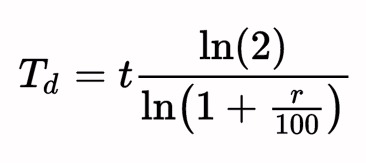
Doubling time refers to the duration needed for a quantity to double in size, a characteristic of exponential growth. By 2020, substantial data revealed that the doubling time for certain anthropogenic climate impacts had decreased significantly, shifting from 100 years to merely 10 years. For instance, the rate of sea level rise has surged from approximately 1.5 millimeters per year to over 3 millimeters. This trend suggests that the doubling period is likely to further contract, heightening the prospect of sea levels ascending at a rate of one foot per year by 2050.

T_{d}=t \frac{\ln (2)}{\ln \left(1+\frac{r}{100}\right)}

From Daniel’s Multimedia Album: Omnilogy

bookmark_borderSurface Tension

[Intro]
Walk on water?
There’s tension on the surface
[Instrumental, Flute, Piano]
[Guitar Solo]
[Break]
Water
[Break]
Give me some water
[Break]
Can’t get any hotter
[Break]
[Verse 1]
Did I fail to mention
With good ole surface tension
You can walk on water
If it gets any hotter…
[Bridge]
Suspension
Is a whole other thing
Over the water
Let’s swing
[Break]
Go!
[Instrumental]
[Bridge]
This bridge about a bridge
To get from ridge to ridge
[Chorus]
Trying not to get wet, yet
Yet, trying to cool down
No relief in this town found
Wanna bet it’s stagnant
There’s no current current
[Break]
Water
[Break]
Give me some water
[Break]
Can’t get any hotter
[Break]
There’s tension on the surface
The facts we’ve got to face
[Instrumental]

[Verse 2]
What do you think, take a drink?
Mouth so dry, think I might die
Suppose it was all water under the bridge
Till we set ‘er a flame, damn shame
Burning our bridges is rarely sane

[Break]
Water
[Break]
Give me some water
[Break]
Can’t get any hotter
[Break]

[Bridge]
This bridge about a bridge
To get from ridge to ridge
[Chorus]
Trying not to get wet, yet
Yet, trying to cool down
No relief in this town found
Wanna bet it’s stagnant
There’s no current current
[Break]
Water
[Break]
Give me some water
[Break]
Can’t get any hotter
[Break]
There’s tension on the surface
The facts we’ve got to face
[Instrumental]

[Verse 3]
You first.
Begin.
Wade in.
Let me know…
… how far you go
Did I fail to mention
[Break]
Did I fail to mention
With good ole surface tension
You can walk on water
If it gets any hotter…
[Break]
Suspension
It’s a whole ‘nuther thing
Over the water
Let’s swing
[Chorus]
Trying not to get wet, yet
Yet, trying to cool down
No relief in this town found
Wanna bet it’s stagnant
There’s no current current
[Break]
Water
[Break]
Give me some water
[Break]
Can’t get any hotter
[Break]
There’s tension on the surface
The facts we’ve got to face
[Instrumental]
[Outro]
Just can’t rant, rant, rant
See currently…
There’s no current current
[End]
[Silence]

Surface tension is a phenomenon that occurs at the surface of a liquid, where molecules are strongly attracted to each other. This attraction creates a thin, elastic layer on the surface of the liquid, which resists external forces and allows certain objects to float on or be supported by the surface.

In simpler terms, surface tension is like an invisible “skin” that forms on the surface of a liquid, caused by the cohesive forces between the liquid molecules. This tension gives the surface of the liquid certain properties, such as the ability to hold together in drops or form a meniscus in a narrow tube. Surface tension also allows insects like water striders to walk on water and enables small objects like paper clips to float on the surface of water.

Social tensions over water can arise due to various factors, including competition for limited water resources, unequal access to clean water, disputes over water rights and allocation, and the impacts of water-related disasters such as floods and droughts. Here are some examples of social tensions related to water:

  1. Access to Clean Water: In many parts of the world, access to clean and safe drinking water is not equitable. While some communities have reliable access to clean water sources, others may lack access to adequate sanitation facilities or rely on contaminated water sources, leading to health risks and disparities.
  2. Water Scarcity: As populations grow and demand for water increases, competition for limited water resources can lead to tensions between different users, such as agriculture, industry, and households. In regions experiencing water scarcity, conflicts may arise over water rights, allocation, and management.
  3. Transboundary Water Conflicts: Rivers, lakes, and aquifers often cross international borders, leading to potential conflicts over shared water resources between neighboring countries. Disputes may arise over dam construction, water diversion projects, pollution, and the impacts of climate change on water availability.
  4. Urban-Rural Divide: In many regions, there is a divide between urban and rural areas in terms of access to water infrastructure and services. Urban centers may receive preferential treatment in water allocation and infrastructure development, leading to tensions with rural communities that rely on water for agriculture and livelihoods.
  5. Environmental Concerns: Water extraction and infrastructure development can have significant impacts on freshwater ecosystems and biodiversity. Environmental conservationists and indigenous communities may clash with government authorities and corporations over dam construction, river diversion, and other projects that alter natural water systems.
  6. Water-related Disasters: Events such as floods, droughts, and hurricanes can exacerbate social tensions over water. Vulnerable communities may face displacement, food and water shortages, and economic losses, leading to social unrest and conflicts over relief efforts and resources.

Addressing these social tensions requires collaborative and inclusive approaches to water management, involving stakeholders from government, civil society, the private sector, and local communities. Sustainable water governance, equitable water distribution, and integrated water resource management are essential for mitigating conflicts and promoting cooperation in addressing water challenges.

Several regions around the world are facing water-related tensions and conflicts, often referred to as “water wars,” due to issues such as scarcity, pollution, overuse, and mismanagement of freshwater resources. Some examples include:

  1. Middle East: The arid and semi-arid regions of the Middle East, including countries like Israel, Palestine, Jordan, and Syria, have long experienced water scarcity and disputes over shared water sources such as the Jordan River and the aquifers of the West Bank.
  2. South Asia: Countries in South Asia, including India, Pakistan, and Bangladesh, face water-related tensions due to competing demands for water from agriculture, industry, and urban populations, exacerbated by factors such as population growth, pollution, and climate change.
  3. Africa: Various countries in Africa, particularly those in the Sahel region and the Horn of Africa, contend with water scarcity and conflicts over transboundary rivers and lakes, such as the Nile River, the Niger River, and Lake Chad.
  4. South America: Parts of South America, including countries like Brazil, Argentina, and Chile, experience water-related tensions related to deforestation, land use changes, and conflicts over access to water for agriculture, mining, and energy production.
  5. United States: Within the United States, regions facing water stress and tensions include the southwestern states of Arizona, California, and Nevada, where water scarcity issues are exacerbated by rapid population growth, urbanization, and agricultural demands. Cities like Phoenix and Scottsdale, Arizona, grapple with challenges such as groundwater depletion, competing water rights, and the impacts of climate change on water availability.

These are just a few examples of regions facing water-related tensions and conflicts, highlighting the need for sustainable water management practices, cooperation, and conflict resolution mechanisms to address these challenges.

From Daniel’s Multimedia Album: Omnilogy

bookmark_borderDream the Dream

[Female Vocals]
[Intro]
Dream
Dream a dream
Dream The Dream
Envision the scene
Envision the vision
[Instrumental]
[Break]
[Verse 1]
Imagine imagination elevation
You dream the scene, revolution
First, what do you want to be?
Will it be in harmony?
Can you see
Your vision
Envision vision

[Break]
See the light
[Break]
Be the light
[Break]
All is right

[Bridge]
Dream

[Break]
[Bridge]
[Guitar Solo]

[Chorus]
Sow our dreams
So our scenes
Are seen…
Know our seems
Means
Our scenes

[Break]

Dream
Dream a dream
Dream The Dream
Envision the scene
Envision the vision
[Instrumental]
[Break]
[Verse 2]
Imagination elevation, celebration
We dream the scene, evolution revolution
Next, it’s free for all to be
All to be in harmony
We see
Our vision
Envision vision
Envision collision
Without reality
You and me

[Break]
See the light
[Break]
Be the light
[Break]
All is right

[Bridge]
[Instrumental]
Dream
[Break]
[Instrumental]
Dream
Dream a dream
[Break]
Dream The Dream
Envision the scene
Envision the vision
A scene seen
Scene seen

[Outro]
Dream The Dream
Envision the scene
Envision the vision
A scene seen
Scene seen
[End]
[Silence]

A SCIENCE LESSON
Imagination, envisioning your dreams, and achieving goals can be incredibly beneficial in several ways:

  1. Clarifying Vision: Imagination allows you to visualize your dreams and goals with clarity. By vividly imagining what you want to achieve, you can create a clear mental picture of your desired outcome, which serves as a roadmap for success.
  2. Motivation and Inspiration: Envisioning your dreams can ignite a sense of passion and motivation within you. When you can see the fulfillment of your goals in your mind’s eye, it inspires you to take action and work towards making those dreams a reality.
  3. Overcoming Obstacles: Imagining yourself overcoming obstacles and challenges along the way helps build resilience and determination. By visualizing yourself successfully navigating hurdles, you develop the confidence and mindset needed to overcome setbacks when they arise.
  4. Boosting Creativity: Imagination is a powerful tool for sparking creativity and innovation. When you allow your mind to wander and explore different possibilities, you often come up with new ideas and solutions that can help you achieve your goals more effectively.
  5. Enhancing Problem-Solving Skills: Envisioning your dreams requires you to think critically about the steps needed to achieve them. This process helps sharpen your problem-solving skills as you identify potential barriers and strategize ways to overcome them.
  6. Building Self-Confidence: As you imagine yourself achieving your goals, you develop a greater sense of self-confidence and self-belief. Visualizing success reinforces the belief that you have the ability to accomplish what you set out to do, boosting your confidence in your own capabilities.
  7. Fostering Resilience: Imagining yourself achieving your dreams, even in the face of adversity, fosters resilience and perseverance. It helps cultivate a growth mindset, where setbacks are viewed as opportunities for learning and growth rather than insurmountable obstacles.
  8. Creating a Positive Mindset: Envisioning your dreams and goals in a positive light cultivates a positive mindset. By focusing on what you want to achieve rather than dwelling on limitations or past failures, you maintain a hopeful and optimistic outlook on the future.

Overall, imagination, envisioning your dreams, and achieving goals play a crucial role in personal development, goal attainment, and overall success. By harnessing the power of your imagination and actively working towards your aspirations, you can unlock your full potential and create a fulfilling and meaningful life.

From the album About the End

bookmark_border(Hide)


[Female Vocals]
[Intro]

Shhh
Be very, very quite
I’m hiding from the riot
[Break]
Now The Hunted
Far and wide
Shouldn’t have fronted
Better hide
Hide the hide

[Verse 1]
You now reside on the outside
Your insides out of your mind
If you’re lucky, you’ll find
The time

[Break]
Now The Hunted
Far and wide
Shouldn’t have fronted
Better hide
Hide the hide

[Verse 2]
On the run is losing its fun
Think it’s time I tried to hide (hide the hide)
’cause I now reside on the outside
Done cried
Time to hide the hide

[Chorus]
Dodge, dodge, dodge,
Camouflage
Forest green in a jungle scene
Minimum, blending in
The less seen the more scene

[Bridge]
Serene
In a nightmarish dream
Make the best of it
Can’t quit
Won’t quit
Noooo, not the least bit

[Break]
Hide!
[Break]
Pride died
[Break]
Subside
Let’s just hide

[Verse 3]
Come to decide, my hide must hide
Tried to run, boy, I tried (Tried n’ tried)
Drained dry, my hide must hide
Brains been fried

[Break]
Hide!
[Break]
Pride died
[Break]
Subside
Let’s just hide

[Chorus]
Dodge, dodge, dodge,
Camouflage
Forest green in a jungle scene
Minimum, blending in
The less seen the more scene

[Outro]
Serene
In a nightmarish dream
Make the best of it
Can’t quit
Won’t quit
Noooo, not the least bit

[End]
[Silence]

A SCIENCE LESSON
The Earth will exceed 1.5℃ (average global surface temperature over the surface of the earth for ten years) by the 2040’s and a societal collapse will ensue. For the most part, the Earth will be uninhabitable for humans by 2070 UNLESS immediate action is taken. UPDATE: Since writing this in 2021, there is enough data to conclude 1.5℃ will be breached a decade earlier. In October 2023, the Imperial College of London published a study that concludes 1.5℃ will be reached by 2030 at our current rate of emissions. The average temperature for 2023 was +1.4℃ with September’s average +1.7℃ and parts of July at +3℃.

From the album Plan “B”

bookmark_borderGood Luck!

[Intro]
What the….
[Break]
Good luck|
[Instrumental]

[Verse 1]
In the heat of the day, the sun beats down
Air so thick you can see, we’re losing ground
The wet-bulb temperature’s rising high
It’s getting harder to breathe, harder to survive

[Chorus]
Good luck to us all, in this changing world
Where the air’s polluted and the water’s swirled
Extreme weather events, diseases abound
Facing the heat, we dig underground
[Break]
What the….
[Break]
Good luck|

[Verse 2]
When the wet-bulb threshold is crossed
Heatstroke strikes, and lives are lost
The a haze for day, dizziness, nausea, and more
We fight to survive, we fight to endure, for sure

[Chorus]
Good luck to us all, in this changing world
Where the air’s polluted and the water’s swirled
Extreme weather events, diseases abound
Facing the heat, we dig underground

[Break]
Awestruck
[Break]
Good luck|

[Bridge]
As chaos theory unfolds its might
We brace for the heat, for the darkest night
With temperatures rising, the Earth in peril
We hold on tight, our courage sterile

[Chorus]
Good luck to us all, in this changing world
Where the air’s polluted and the water’s swirled
Extreme weather events, diseases abound
Facing the heat, we dig underground

[Break]
Awestruck
[Break]
Good luck!

[Outro]
In the face of adversity, we’ll endure
With hope in our hearts, and strength to procure
Good luck to us all, as we forge ahead
In this world of chaos, where our future’s spread
[Break]
Awestruck
[Break]
Good luck!
[End]
[Silence]

ABOUT THE SCIENCE
Humans will experience greater loss and damage to life and quality of life from air pollution, decreasing supply of potable water, extreme weather events, disease, and other adverse health outcomes. The greatest short term climate change risk to human health is deadly humid heat (wet-bulb temperature).

When the “wet bulb” temperature reaches a temperature too hot for humans to sweat, it is referred to as the “wet-bulb temperature threshold” or simply the “wet-bulb limit.” This limit represents the maximum temperature at which evaporation from a wet surface, such as the skin, can effectively cool the human body through sweating. Beyond this threshold, the body’s ability to regulate its internal temperature becomes severely compromised, posing a significant risk to human health and well-being.

When the temperature exceeds the wet-bulb temperature threshold, the human body faces significant risks of heat-related illnesses and potentially fatal heatstroke. Under such conditions, the body’s ability to cool itself through perspiration is severely compromised, leading to a rapid rise in core body temperature. As a result, individuals may experience symptoms such as dizziness, fatigue, rapid heartbeat, nausea, and confusion. Without intervention, heat exhaustion can progress to heatstroke, a life-threatening condition characterized by a core body temperature above 40°C (104℉), accompanied by neurological symptoms such as seizures, delirium, and loss of consciousness. Heatstroke requires immediate medical attention and can be fatal if left untreated.

Exposure to temperatures exceeding the wet-bulb threshold poses a grave risk to human health and highlights the urgent need for effective measures to mitigate and adapt to the impacts of climate change, which can exacerbate extreme heat events and increase the frequency of conditions exceeding this critical threshold.

Our climate model / experiment employs chaos theory to comprehensively consider human impacts and projects a potential global average temperature increase of 9℃ above pre-industrial levels. Global warming is a consequence of elevated thermal energy in the climate system, which comprises various subsystems. Chaos theory underscores the intricate and nonlinear nature of dynamic systems. Human well-being is compromised above a 1.5-degree temperature rise, rendering much of the Earth uninhabitable. A 9-degree Celsius increase would bring the Earth close to a wet-bulb temperature incapable of sustaining human life.

For any remaining humans, fresh air, water, food, and sunlight will all be problematic; however, your most severe concern will likely be security. Those with supplies will be at high risk of being raped and looted. Good luck!

bookmark_borderTunnel Under

[Intro]
Can you dig it?
[Break]
Dig it!
[Instrumental]
[Break]
[Verse 1]
We built a tunnel under the ground
Where darkness reigns and echoes sound
A path unseen, a hidden way
To navigate through night and day
[Break]
Can you dig it?
[Break]
Dig it!
[Chorus]
Tunnel under, tunnel deep
Where secrets hide and shadows creep
A passage carved beneath the earth
To find our way, to find our worth
A new birth

[Verse 2]
Through caverns vast and tunnels narrow
We journey on, no fear to harrow
The unknown depths, the silent halls
Where echoes linger, voices call
After the fall
[Break]
Can you dig it?
[Break]
Dig it!
[Chorus]
Tunnel under, tunnel deep
Where secrets hide and shadows creep
A passage carved beneath the earth
To find our way, to find our worth
A new birth

[Bridge]
In the darkness, we find our light
Guided by hope, through the endless night
With each step forward, we break new ground
In the tunnel under, where knew dreams are found

[Break]
Can you dig it?
[Break]
Dig it!
[Chorus]
Tunnel under, tunnel deep
Where secrets hide and shadows creep
A passage carved beneath the earth
To find our way, to find our worth
A new birth

[Outro]
No use crying, no use to moan, let us roam
Through the tunnel under, we find our home
[End]
[Silence]

WHY?
* Our climate model employs chaos theory to comprehensively consider human impacts and projects a potential global average temperature increase of 9℃ above pre-industrial levels.

All of my life I have located my office and bedrooms in the uppermost southern exposure (preferably in the tree canopy.) I love sunlight, elevation, trees, fresh air, and wildlife. It is becoming ever more obvious my dreamlife is coming to an end, and I will be forced to tunnel under. For those forward thinkers, think about your poop. Pumping sewage above ground level will be a major problem at all times. In addition, the inability to pump flood water will become deadly during extreme weather events. In July of 2020 NPR reported, “The remnants of Hurricane Ida dropped unprecedented rainfall on several eastern states, killing dozens of people. Eleven of them were Queens residents who died when their basement apartments flooded.” In August of 2022 CNN reported, “Seoul has vowed to move some of the city’s poorest families out of underground and semi-subterranean homes after 13 people were killed in flooding caused by record rainfall this week, sparking public horror and calls for government accountability.” Drowning in your own poop may result for those unprepared.

From the album Plan “B”

bookmark_borderEat a Worm

[Intro]
Ooey Gooey was a worm,
A mighty worm was he.
He stepped upon the railroad tracks,
The train he did not see!
Ew

[Break]
[Verse 1]
Sustainability, a challenge, as you can see,
Can you make it through the day?
Without a trace, without destroying the race
Live in a whole new way

Can you feed yourself for a day?
With no money or trade in sight
Hunt, fish, or gather, find a way
To sustain yourself through the night
To the next day’s light
[Break]
Hungry, thirsty, to be
[Chorus]
Eat a worm if you have to
Survival’s the name of the game
Take the challenge, make it through
And we’ll all know your name

[Verse 2]
Be responsible for your waste
Dispose of it without a trace
No flushing, hauling, or dumping
Leave no footprint in your space

It’s a fight for our survival
A test we all must face
Can we live sustainably
And secure our rightful place?

[Break]
Hungry, thirsty, to be
[Chorus]
Eat a worm if you have to
Survival’s the name of the game
Take the challenge, make it through
And we’ll all know your name

[Bridge]
Children lead the way, they’re showing us how
To live with less and make it through somehow
So take the challenge, join the race
And together we’ll find a tasteful place

[Break]
Hungry, thirsty, to be
Does it make you squirm
Eat a worm!

[Chorus]
Eat a worm if you have to
Survival’s the name of the game
Take the challenge, make it through
And we’ll all know your name

[Outro]
Take the challenge, make it through
Or else, what cha gonna do?
Hungry, thirsty, to be
Does it make you squirm
Eat a worm!
[End]
[Silence]

A CASE STUDY
Be your own case study.

Take The Sustainable Living Challenge
What more valuable game can you play than the game of living? Why not try it? One step at a time. Perhaps the human race is not ready to try sustainable living on a global basis. However, why not see if you can sustain yourself for one (1) day? Can you meet your present needs without compromising future generations?

1) Can you feed yourself for a day?
Can you meet your present needs of food and water for 1 day? Using money, barter or similar means of acquisition are against the rules. Hunting, fishing and gathering within the law are allowed. Low impact gardening is also acceptable. You are free to invent your own methods, as long as, you leave no “footprint.” The diet for the day has to be sustainable. You need to be able to keep eating this way every day. Protein and potable water are the hardest part. You must eat enough B12 and essential amino acids that can only be found in meat, milk, and/or eggs. My son caught a fish. My daughter ended up eating the worm.

2) Can you be responsible for your own waste for a day?
Can you fulfill the need of trash disposal without impacting future generations? What about your excrement? It is against the rules to haul, flush, launch or otherwise dispose of your waste onto someone else’s property. You may adapt any method, as long as, you leave no “footprint.”

It’s a fight until death. Literally, the human race must meet this challenge, or else, we will cause our own extinction. If you are able to succeed at sustainable living for one day, it might be possible to join together with your fellow humans. Can you imagine that — the whole wide-world participating in a sustainable environment?

To date, the vast majority of people to have met the challenge have been children. Perhaps an even more amazing fact is the percentage of children that have eaten worms. What will you do?

Please take the challenge. Then, tell us how you did. If you supply us with what you consumed and produced, as well as, how it was acquired and disposed, we will rate and rank your results. A high rating could result in a prize award, such as living.

From the album Plan “B”

bookmark_borderLearn to Sink or Swim

[Intro]
I go swimming
[Female Vocals]
[Flute solo]
Stoke, stroke, stroke
[Instrumental]
[Bubbling]
[Bubbles]
[Water]
[Break]
Stroke
[Break]
Stroke
[Break]
Stroke
[Break]
Sink or swim
Chances, slim
Dim
Dive in

[Verse 1]
There’s a warning in the wind, a message in the tide,
As the waters rise, coastline hides, no one resides
Facing a reality one cannot deny,
As the sea levels climb, I’ve got to decide.

[Chorus]
Learn to swim, in the rising tide,
Adapt or sink, we can’t run and hide.
From violent rain to the ocean’s roar,
Learn to swim
Sink or swim
Chances slim
Dim
Dive in
[Break]
Swim
[Break]
The oceans roar, oar
… or drown in ignore.
Arrive at dive!
[Break]

[Verse 2]
The ice will melt, the cards, Beast dealt
Two seventy’s the number dealt
Living low, low, low… a dangerous game,
As the tides rise, dry land’s insane.

[Chorus]
Learn to swim, in the rising tide,
Adapt or sink, we can’t run and hide.
From violent rain to the ocean’s roar,
Learn to swim
[Break]
Swim
[Break]
The oceans roar, oar
… or drown in ignore.
Arrive at dive!

[Bridge]
The Reign of Violent Rain, he’s on the rise,
Bloodying streets, reach for the skies.
From hurricanes to wildfires’ blaze,
The world’s transforming in myriad ways.

[Break]
I go swimming

[Chorus]
Learn to swim, in the rising tide,
Adapt or sink, we can’t run and hide.
From violent rain to the ocean’s roar,
Learn to swim
[Break]
Swim
[Break]
The oceans roar, oar
… or drown in ignore.
Arrive at dive!

[Outro]
As the sea meets the sky, and the rivers rage,
We’ll swim together in this new age.
On resilience and hope, we’ll float away,
In the face of change, we’ll flow all day.

[End]
[Silence]

A SCIENCE LESSON
There will be enough ice melt to raise sea levels 220 feet. We estimate 270 feet to be “the minimum safe” elevation to live. High-tides, waves, coastal flooding, storm surge, grade of shoreline, etc. would make the lowest elevations for living space to be at least 270 feet above pre-industrial sea levels. This would be the minimum elevation. Personally, I would not want to live that low. As the water submerges sewage treatment plants, landfills, chickens, cows, and all sorts of other bio-hazards, the waters will become toxic. In addition, much of the land will experience salinization making it unfit for plant life. Another concern for elevations under 800 feet is living on an island. Many locations at lower elevations will become isolated. Living on an island has many problems including fresh water, food, shelter, and healthcare. Security from pirates pilfering, raping, and plundering will likely be the overriding concern. Of course, I don’t expect that to happen for millennia, but I hope government planners do plan for it now. If you look at Florida as an example, parts of the coastline have seen sea levels rise over 14-20 feet in the last decade. Although the storm surge was only for hours, you wouldn’t want to live there during those hours. Not to mention, the frequency of these extreme weather events will rise exponentially. Thus, our recommendation to evacuate Florida now (i.e. Managed Retreat). The billions of dollars spent to rebuild after Hurricane Ida will all be for naught. Allowing building there will needlessly endanger property and lives. Parts of the world have already seen storm surges of 40 feet. I expect most North American coastlines will see sea levels rise, if only temporarily, by 20-40 feet this century. As far as long run sea level rise, much will depend on location, gravity, isostatic adjustment, and thermal expansion. If the ocean temperatures get warm enough (thermal expansion), parts of the world may see sea levels rise to 270 feet for long periods of times. Other parts of the world, like Greenland, may actually see sea levels decline. In any event, the Earth crossed tipping points this decade which make extreme sea level rise inevitable and irreversible in our lifetimes. Planners should plan on it.

Sidd reiterated, “That 270 feet will take a long time. I would be more careful about the violent rain than the ice melt.” Expect to see increasing intensity and/or frequency in a wide variety of violent rain events including: downpours, flooding, hurricanes, cyclones, monsoons, coastal flooding, storm surges, lightning and wildfires, hail, extreme wind, and concurrent extremes. The reign of violent rain has already begun. More hillsides and shorelines are collapsing. Atmospheric rivers are dramatically increasing flash flooding in the Northeastern USA. Worldwide, stormwater systems are becoming overwhelmed. Ironically, the streets of Abu Dhabi and Dubai, UAE, flooded days before the COP28 Climate Conference. Nowhere is safe from violent rain, not even in the desert preparing for a UN meeting on the climate crisis. As a result of increasing violent rain, new drainage culverts are forming. Eventually, the culverts will transform into recurring streams, carving new canyons, creating new landscapes and islands. In addition, extreme weather events are increasing the frequency of lightning storms and wildfires. After wildfires, rain deluges cause massive landslides transforming the topography. At the same time as the violent rain makes its way to the sea, the sea is rising to meet the violent rain.

From the album Plan “B”