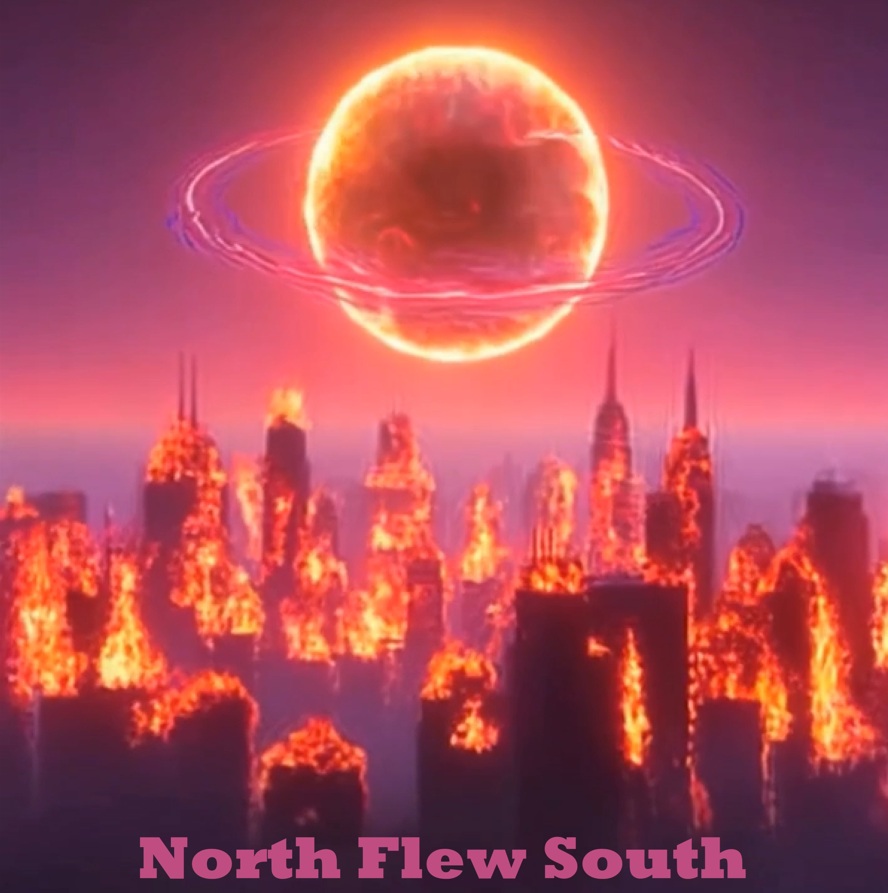
[Intro]
[Instrumental Intro: Pulsing Bass, Organ Swell, Muted Guitar Chops, Rising Synth Filter]
[Minimal Beat, Sub Bass, Spoken Vocal]
Paleoclimate
(Meets the primate)
What will be the shape
(Of the hairless ape)
[Instrumental]
[Bass Solo]
[Organ Stabs, Driving Bass, Snare March]
[Verse 1]
Oh, why, why, why
(Deny, deny, deny)
Better if we try
(Not to die)
[Chorus]
Paleoclimate
(Meets the primate)
What will be the shape
(Of the hairless ape)
[Bridge – Breakdown]
[Percussion, Sub Bass, Spoken Vocal]
Bringing on mass extinction
(Termination)
[Instrumental, Saxophone Solo]
[Verse 2]
And, once more
(What about nuclear war)
And, if you please
(Out of control disease)
[Chorus]
Paleoclimate
(Meets the primate)
What will be the shape
(Of the hairless ape)
[Bridge – Breakdown]
[Percussion, Sub Bass, Spoken Vocal]
Bringing on mass extinction
(Termination)
[Outro]
Maybe it’s time you woke
(‘Cause this ain’t no joke)
Bringing on mass extinction
(Our eradication)
ABOUT THE SONG
Paleoclimate evidence shows that during rapid warming events in Earth’s history, approximately 66–80% of species were lost during major mass extinctions. The major difference between past paleoclimatic transitions and today is the presence of human civilization — and the behavioral, technological, and geopolitical dynamics that now influence the system. When we began our research, we assumed a baseline level of cooperation in response to clear scientific evidence. Unfortunately, that assumption has not held.
Continued denial and politicization of climate change — coupled with intensified competition over water, food, and migration — could trigger large-scale conflict, including the potential for nuclear war. Such a collapse of human systems could lead to near-term extinction, even though the climate physics alone do not make that outcome likely.
Research highlights another layer of risk: climate change aggravates infectious disease. Camilo Mora, data analyst and associate professor at the University of Hawaii at Manoa, found that climatic hazards exacerbate 58% of all known human pathogen — over half of the infectious diseases discovered since the end of the Roman Empire. Mora called this “shocking,” emphasizing that movement of humans and animals, as well as milder winters at higher latitudes allowing pathogen survival, are key factors.
In short, while the physical limits of the Earth system constrain the ultimate magnitude of warming, human behavior, social instability, and geopolitical failures could still produce catastrophic outcomes far beyond what climate physics alone would dictate.
[Instrumental, Acoustic Guitar, Electric Piano, Organ, Synth, Bass, Percussion, Drums]
[Intro]
[Instrumental Intro: Pulsing Bass, Organ Swell, Muted Guitar Chops, Rising Synth Filter]
[Minimal Beat, Sub Bass, Spoken Vocal]
What is the meaning
(Of illusional greening)
[Instrumental]
[Bass Solo]
[Organ Stabs, Driving Bass, Snare March]
[Verse 1]
What was tall
(Is getting small)
Growing up
(To dangle and strangle)
[Bridge]
[Instrumental, Pulsing Bass, Organ Swell, Muted Guitar Chops, Rising Synth Filter]
[Minimal Beat, Sub Bass, Spoken Vocal]
What is the meaning
(… the illusional of greening)
[Instrumental]
[Bass Solo]
[Organ Stabs, Driving Bass, Snare March]
[Chorus]
The hotter we go
(The less green to show)
Gonna fade to black
(Never coming back)
[Instrumental, Saxophone Solo]
[Verse 2]
As the green
(Grows lean)
Gotta come clean
(Know what I mean)
[Bridge]
[Instrumental, Pulsing Bass, Organ Swell, Muted Guitar Chops, Rising Synth Filter]
[Minimal Beat, Sub Bass, Spoken Vocal]
What is the meaning…
(It’s just an illusional of greening)
[Instrumental]
[Bass Solo]
[Organ Stabs, Driving Bass, Snare March]
[Chorus]
The hotter we go
(The less green to show)
Gonna fade to black
(Never coming back)
[Outro]
[Instrumental, Pulsing Bass, Organ Swell, Muted Guitar Chops, Rising Synth Filter]
[Minimal Beat, Sub Bass, Spoken Vocal]
What is the meaning
(An illusional greening)
Best start conceding
(It’s an illusion of greening)
ABOUT THE SONG
The Illusion of “Greening”
Short-term vegetation increases following forest die-off can create the appearance of ecological recovery.
When mature trees die, fast-growing vines, shrubs, and annual plants often proliferate. However, these species
typically store far less carbon than old-growth forests and cycle carbon rapidly back to the atmosphere through
decay and fire. In many cases, dense vine growth can further stress or accelerate mortality in remaining trees.
As a result, apparent “greening” does not necessarily translate into durable carbon sequestration or long-term
climate stabilization.
Polar Greening vs. Albedo Loss
In parts of Greenland and Antarctica, retreating ice has exposed new land surfaces, allowing mosses and limited
vegetation to expand. This localized biological carbon uptake does increase photosynthetic activity.
However, the simultaneous loss of highly reflective ice and snow reduces surface albedo, increasing solar absorption
and amplifying regional warming. Current radiative balance assessments indicate that the warming effect from albedo
reduction substantially outweighs the carbon uptake benefit, though precise quantification remains an active area of research.
Net Feedback Balance
Opposing feedbacks do exist within the Earth system. Some processes partially counteract warming.
However, the balance of evidence suggests these stabilizing mechanisms are unlikely to offset the dominant amplifying
feedbacks at scale. Preliminary analyses indicate that the net radiative imbalance remains strongly positive — not marginal —
meaning the system continues to accumulate energy.
The key scientific question is not whether negative feedbacks exist, but whether they are large and persistent enough
to counteract accelerating warming. Current data suggest they are not.
Permafrost sighs
(Methane replies)
Forest to flame
(Carbon inflamed)
[Pre-Chorus]
Pathogens travel
(Warmth unravels)
Vectors expand
(No safe land)
[Chorus – Driving]
How close is collapse?
(Closer than maps)
Systems entwined
(Converging lines)
Push past the brink
(Faster than we think)
Cascading failure
(Linked behavior)
[Bridge – Spoken / Percussive Breakdown]
[Minimal Beat, Sub Bass Pulse]
Fifty-eight percent
(Of known disease)
Aggravated
(By shifting seas)
Migration stress
(Resource distress)
Water and grain
(Amplify pain)
[Snare March → rising synth arpeggio]
Entropy climbs
(Outruns the times)
Institutions strain
(Under the chain)
[Instrumental Break]
[Saxophone Solo – tense, angular]
[Guitar Solo – escalating distortion]
[Organ Stabs, Driving Bass]
When food runs thin
(Conflict begins)
One spark misread
(Millions dead)
[Chorus – Harder]
How near is the line?
(Fragile design)
Deterrence thin
(Weapons within)
Human behavior
(Overrides nature)
Cascading failure
(Self-made crater)
[Full band crash back in]
(Can you see)
Turn the key
(Reverse entropy?)
Shape up and grow
(We already know)
… on with the show!
[Final sustained organ chord → silence]
[Intro – Sparse, Focused]
[Low Drone → Gradual Pulse]
[Soft Piano Motif, like a steady signal]
[Spoken Vocal – calm, deliberate]
Non-linear systems
(Respond to force)
Feedbacks amplify (I) I
(Change their course)
Small inputs matter
(At critical mass)
Phase transitions
(Can come to pass)
[Sub bass enters, heartbeat tempo]
[Verse 1]
Runaway heat
(Can be slowed)
Policy shifts
(Change the mode)
Markets adapt
(Signals align)
Carbon priced
(Redraw the line)
Permafrost thaw
(Is not fate)
Methane curves
(Can decelerate)
[Pre-Chorus – Building]
Thresholds cut both ways
(Collapse or rise)
Instability
(Also stabilizes)
When networks learn
(And nodes engage)
System behavior
(Leaves the cage)
[Chorus – Driving but Uplifting]
Tipping point
(Reversal)
Positive feedback
(Can go universal)
Bend the curve
(Shift the frame)
Change the rules
(Change the game)
Complex systems
(Reorganize)
Hope is conditional
(But so are the skies)
[Instrumental Break]
[Organ Swell → Clean Guitar Arpeggios]
[Sax Solo – less angular, more melodic]
[Drums move from march to forward-driving groove]
[Verse 2 – Explicitly Scientific]
Entropy rises
(Locally true)
But order forms
(When energy flows through)
Solar flux
(External source)
Drives negentropy
(Alters course)
[Verse 2]
When it comes to war
(Say “no more!”)
Time for the fool
(To go to school)
[Chorus]
How near is our situation
(To near extinction)
Getting closer day-by-day
(Time to change our way)
[Outro]
[Percussion, Sub Bass, Spoken Vocal]
Sooo… (let’s go!)
[Guitar Solo]
Yo! (We know)
Shape up the shhh (it) show
ABOUT THE SONG
Continued denial and politicization of climate change — coupled with intensified competition over water, food, and migration — could trigger large-scale conflict, including the potential for nuclear war. Such a collapse of human systems could lead to near-term extinction, even though the climate physics alone do not make that outcome likely.
Much of the world could become uninhabitable. Billions of people might be reduced to millions, with severely diminished quality of life and drastically shortened life expectancy.
Research highlights another layer of risk: climate change aggravates infectious disease. Camilo Mora, data analyst and associate professor at the University of Hawaii at Manoa, found that climatic hazards exacerbate 58% of all known human pathogens — over half of the infectious diseases discovered since the end of the Roman Empire. Mora called this “shocking,” emphasizing that movement of humans and animals, as well as milder winters at higher latitudes allowing pathogen survival, are key factors.
Mora notes:
“The human pathogenic diseases and transmission pathways aggravated by climatic hazards are too numerous for comprehensive societal adaptation, highlighting the urgent need to work at the source of the problem: reducing greenhouse gas emissions.”
He further explained:
“The magnitude of the vulnerability — when you think about one or two diseases, okay, we can deal with that. But when 58% of diseases can be affected or triggered in a thousand different ways, it’s clear we are not going to be able to adapt to climate change.”
In short, while the physical limits of the Earth system constrain the ultimate magnitude of warming, human behavior, social instability, and geopolitical failures could still produce catastrophic outcomes far beyond what climate physics alone would dictate.
The constant 5.35 comes from line-by-line radiative transfer calculations
This formula captures the logarithmic relationship: each doubling of CO₂ produces roughly the same increase in radiative forcing (~3.7 W/m² per doubling).
Other gases:
CH₄ (methane): short-lived but ~25× more potent than CO₂ over 100 years.
N₂O (nitrous oxide): ~298× more potent than CO₂ over 100 years.
The total forcing is the sum of all anthropogenic contributions:
ΔFtotal=ΔFCO₂+ΔFCH₄+ΔFN₂O+…
Explanation:
ΔFtotal = total radiative forcing from all greenhouse gases
ΔFCO₂ = forcing due to carbon dioxide
ΔFCH₄ = forcing due to methane
ΔFN₂O = forcing due to nitrous oxide
“…” indicates contributions from other greenhouse gases (e.g., CFCs, HFCs)
We’re near
(The end of the line)
The end of our time
[Outro]
[Instrumental, Pulsing Bass, Organ Solo, Guitar Riffs, Rising Synth Filter]
Isotopic Signature
(Are you sure)
We’re sure
(Can we endure)
… er, a… not so sure
ABOUT THE SONG: Human Contribution via CO₂
Humans have increased atmospheric CO₂ from ~280 ppm (pre-industrial) to ~420 ppm today. This increase is not from natural sources but primarily from burning fossil fuels (coal, oil, gas) and land-use changes. The isotopic signature of carbon identifies the source:
¹²C, ¹³C, ¹⁴C isotopes are key:
Fossil fuels are depleted in ¹³C because plants preferentially absorb ¹²C during photosynthesis.
Fossil fuels contain no ¹⁴C (radiocarbon), as it decays over millions of years.
The observed decline in ¹³C/¹²C ratio and ¹⁴C content confirms that the excess CO₂ comes from fossil carbon, not volcanoes or oceans.
[Bridge]
In effect
[Minimal Beat, Sub Bass, Spoken Vocal]
Human neglect
(The greenhouse effect)
[Instrumental, Pulsing Bass, Organ Swell, Muted Guitar Chops, Rising Synth Filter]
[Chorus]
The net result
(Incoming less outgoing)
Environmental assault
(Net radiation)
… the situation
[Instrumental]
[Bass Solo]
[Organ Stabs, Driving Bass, Snare March]
[Verse 2]
More, more, more
(Mass consumption)
Mine to the core
(Till extinction)
[Bridge]
In effect
[Minimal Beat, Sub Bass, Spoken Vocal]
Human neglect
(The greenhouse effect)
[Instrumental, Pulsing Bass, Organ Swell, Muted Guitar Chops, Rising Synth Filter]
[Chorus]
The net result
(Incoming less outgoing)
Environmental assault
(Net radiation)
… the situation
[Instrumental]
[Bass Solo]
[Organ Stabs, Driving Bass, Snare March]
[Outro]
The end result
(A total assault)
Rape Mother Nature
(Till we don’t endure)
… the situation
(Devastation)
ABOUT THE SONG
Human-induced climate change, also called anthropogenic global warming, is a physical phenomenon rooted in the radiative properties of greenhouse gases (GHGs), especially CO₂, CH₄, and N₂O, and their interaction with Earth’s energy balance.
The Greenhouse Effect
Earth receives energy from the Sun primarily in the form of shortwave radiation (visible light and near-infrared). The planet absorbs this energy and re-emits it as longwave infrared radiation. Greenhouse gases in the atmosphere absorb some of this infrared radiation and re-emit it, warming the lower atmosphere and surface. This is the greenhouse effect, and it is governed by fundamental physics:
[Intro]
er, ahhhh…
(Comin’ at ya)
Sola, la, la
(Solastalgia)
Yeah, yeah, yeah)
[Refrain]
Homesick
(Missing the music)
Though “You’re right here”
(Is what I hear)
[Bridge]
Unaware (I’m already there)
er, ahhhh…
(Comin’ at ya)
Sola, la, la
(Solastalgia)
Yeah, yeah, yeah)
[Refrain]
Homesick
(Missing the music)
Though “You’re right here”
(Is what I hear)
[Bridge]
Unaware (I’m already there)
er, ahhhh…
(Comin’ at ya)
Sola, la, la
(Solastalgia)
Yeah, yeah, yeah)
[Outro]
Who’s to blame
(From losing the game)
The need for greed
(To “succeed”)
While the children bleed
(It’s a shame)
… in deed
(Indeed)
ABOUT THE SONG
“Recognizing adult responsibility in driving this crisis may be uncomfortable. Yet acknowledging that responsibility may be the first step toward restoring both ecological stability and psychological resilience.”
Widespread Distress and Solastalgia
A defining feature of this crisis is the phenomenon of solastalgia — often described as “homesickness while still at home.”
Unlike eco-anxiety, which is anticipatory fear about future environmental collapse, solastalgia arises when one’s immediate home environment is visibly degraded. It is the distress of watching familiar landscapes burn, flood, dry, or decay.
Approximately 50% of mental health burden appears to stem from direct trauma exposure. The remaining burden relates to agency — or lack thereof.
Children and adolescents possess the cognitive capacity to understand the existential dimensions of climate destabilization. Their distress is amplified not by ignorance, but by insight. What compounds the trauma is the recognition that decision-making power rests largely with adults whose responses are often perceived as insufficient, dismissive, or delayed.
The psychological strain thus reflects both trauma and moral injury.
Recognizing adult responsibility in driving this crisis is essential for our children.
Recent observational evidence from the Arctic–North Atlantic system indicates that climate change is not proceeding linearly but is accelerating through interacting feedback mechanisms. Arctic amplification has intensified beyond earlier projections, coinciding with destabilization of large-scale atmospheric circulation patterns, increased Greenland Ice Sheet mass loss, nonlinear cryospheric events, and measurable geophysical responses such as rapid isostatic rebound. This paper synthesizes multi-decadal satellite, atmospheric, oceanographic, and cryospheric observations through early 2026, arguing that the collapse of doubling times across key indicators—Arctic temperature anomalies, sea-ice loss, ice mass balance, and circulation variability—confirms a regime shift toward accelerated climate disruption.
[Intro]
er, ahhhh…
(Comin’ at ya)
Sola, la, la
(Solastalgia)
Yeah, yeah, yeah)
[Refrain]
Homesick
(Missing the music)
Though “You’re right here”
(Is what I hear)
[Bridge]
Unaware (I’m already there)
er, ahhhh…
(Comin’ at ya)
Sola, la, la
(Solastalgia)
Yeah, yeah, yeah)
[Refrain]
Homesick
(Missing the music)
Though “You’re right here”
(Is what I hear)
[Bridge]
Unaware (I’m already there)
er, ahhhh…
(Comin’ at ya)
Sola, la, la
(Solastalgia)
Yeah, yeah, yeah)
[Outro]
Who’s to blame
(From losing the game)
The need for greed
(To “succeed”)
While the children bleed
(It’s a shame)
… in deed
(Indeed)
ABOUT THE SONG
“Recognizing adult responsibility in driving this crisis may be uncomfortable. Yet acknowledging that responsibility may be the first step toward restoring both ecological stability and psychological resilience.”
Widespread Distress and Solastalgia
A defining feature of this crisis is the phenomenon of solastalgia — often described as “homesickness while still at home.”
Unlike eco-anxiety, which is anticipatory fear about future environmental collapse, solastalgia arises when one’s immediate home environment is visibly degraded. It is the distress of watching familiar landscapes burn, flood, dry, or decay.
Approximately 50% of mental health burden appears to stem from direct trauma exposure. The remaining burden relates to agency — or lack thereof.
Children and adolescents possess the cognitive capacity to understand the existential dimensions of climate destabilization. Their distress is amplified not by ignorance, but by insight. What compounds the trauma is the recognition that decision-making power rests largely with adults whose responses are often perceived as insufficient, dismissive, or delayed.
The psychological strain thus reflects both trauma and moral injury.
Recognizing adult responsibility in driving this crisis is essential for our children.
[Intro]
er, ahhhh…
(Comin’ back now)
Sola, la, la
(Solastalgia)
Yeah, yeah, yeah
(Still here somehow)
[Verse 1]
The river’s thinner
(Than I remember)
The summers longer
(Each September)
The fields I ran through
(Burned to ember)
But I’m still standing
(I still remember)
[Refrain]
Homesick
(Missing the music)
Though “You’re right here”
(Is what I hear)
Homesick
(For how it used to feel)
But home is changing
(And so are we)
[Bridge]
Unaware
(I was already there)
The loss in the air
(The weight we share)
er, ahhhh…
(Comin’ around now)
Sola, la, la
(Not backing down now)
[Verse 2]
You said it’s weather
(Not the design)
You said it’s cycles
(It will be fine)
But children notice
(The warning signs)
They read the science
(Between the lines)
They feel the fracture
(Of trust and tone)
They carry questions
(We should have owned)
The moral injury
(Is overgrown)
When home keeps shifting
(Beneath their bones)
[Refrain]
Homesick
(Missing the music)
Though “You’re right here”
(Is what I hear)
Homesick
(For a steady sky)
But we’re not powerless
(If we decide)
[Bridge – Turning]
Who’s to blame
(We know the name)
Delay and greed
(Disguised as need)
While children plead
(For grown-up deeds)
Recognize
(We set the pace)
Recognize
(We shape this place)
Responsibility
(Is not disgrace)
It’s how we come home
(It’s how we face)
[Chorus – Lift]
Coming home
(Is not retreat)
Coming home
(Is change on our feet)
Home is not memory
(Alone in the past)
Home is the future
(We build to last)
Homesick
(But not alone)
We can restore
(What we have known)
Agency
(Seeds are sown)
We come back stronger
(We come back home)
[Outro]
er, ahhhh…
(Comin’ at ya)
Sola, la, la
(Solastalgia)
Yeah, yeah, yeah
(But listen closer)
The music’s faint
(But it’s not gone)
It’s in the will
(To carry on)
If home is hurting
(We don’t withdraw)
We heal the breach
(With what we saw)
Homesick…
(And wide awake)
Coming home
(Is what we make)
[Intro]
What is the price of will…
(Is it free?)
What is the weight of choice
(On you and me?)
Will…
(Still free?)
Freewill?
(Or chained by history?)
[Verse 1]
I will stand for the river
(When the tide gets higher)
I will stand for the forest
(When it’s under fire)
I will stand for tomorrow
(Though today feels dire)
If will is a spark
(Then let me be the wire)
[Chorus]
Will…
(It isn’t free still)
Freewill?
(It costs resolve and skill)
Freewill
(But we can bend it still)
We will
(We will, we will)
[Bridge]
The price of delay
(Is paid in decay)
The price of denial
(Compounds by the mile)
Maybe it’s time we see
(Choice is velocity)
History turns
(When we turn the key)
We!
[Verse 2]
I will stand for justice
(Not someday — today)
I will stand for children
(Who cannot yet say)
I will stand for science
(Though lies flood the way)
The future is shaped
(By the risks that we weigh)
[Chorus]
[Bridge – Turning Point]
[Minimal Beat, Sub Bass]
Not fate —
(But feedback)
Not doom —
(But pivot and act)
North and South
(Can realign)
When human will
(Shifts the design)
We determine destiny
(Collectively)
We determine destiny
(Responsibly)
[Final Chorus – Lift]
Will…
(Now we see it clearly)
Freewill?
(It grows when we act sincerely)
Freewill
(Not passive — but dearly)
We will
(We will, together)
[Outro]
Oh for tranquility
(Not fantasy)
Oh for a livable sea
(And breathable city)
The price of will
(Is paid in courage)
The gift of will
(Is collective leverage)