bookmark_borderBuoyant Force

1, 2, 3
And, we all float on….

[Instrumental, Electric Piano, Bass]

[Verse 1]
Something’s keeping me a float
Keeping my head above water
In a world so cutthroat
Rise above the slaughter

[Chorus]
A buoyant force
Keeping me on course
Rise above
With the force of love

[Instrumental, Guitar Solo, Drum Fills]

[Verse 2]
Keeping my head above water
So I can see reality
Getting harder as it’s getting hotter
I guess we’ll see

[Chorus]
A buoyant force
Keeping me on course
Rise above
With the force of love

[Instrumental, Guitar Solo, Drum Fills]

[Bridge]
Buoyancy
Sensitivity to density
Replaces
Displaces
As a matter of fact
I’m flat on my back

[Chorus]
A buoyant force
Keeping me on course
Rise above
With the force of love

[Outro]
Buoyancy
Sensitivity to density

[End]

A SCIENCE NOTE

The ability of humans to float on water is primarily governed by the principles of buoyancy and density. Here are the key physics concepts involved:

Buoyancy

Archimedes’ Principle:

  • This principle states that any object submerged in a fluid (liquid or gas) experiences an upward buoyant force equal to the weight of the fluid that the object displaces.
  • For a human body to float, the buoyant force must equal the gravitational force (weight) acting on the body.

Buoyant Force:

  • Buoyant force (F_b) can be calculated using the formula: Fb=ρfluid×Vdisplaced×g where:
    • ρfluid is the density of the fluid (water, in this case).
    • Vdisplaced is the volume of the fluid displaced by the object.
    • g is the acceleration due to gravity.

Density

Density of the Human Body:

  • Density (ρ) is mass per unit volume (ρ=mV).
  • The average density of the human body is slightly less than that of water, primarily due to the presence of air in the lungs and body cavities, and fat tissues, which are less dense than water.

Comparison with Water:

  • Freshwater has a density of approximately 1,000 kg/m³.
  • If a human body’s density is less than 1,000 kg/m³, the body will float because the buoyant force will be greater than the gravitational force acting on the body.

Factors Affecting Floating

Lung Capacity:

  • Air in the lungs significantly affects buoyancy. Inhaling increases lung volume, reducing the overall density of the body and making it easier to float.
  • Exhaling decreases lung volume, increasing the body’s density and making it more likely to sink.

Body Composition:

  • Fat tissue is less dense than water, while muscle and bone are denser. People with higher body fat percentages tend to float more easily.
  • Muscular individuals with low body fat may find floating more challenging.

Body Position:

  • Spreading the body out (e.g., lying flat on the back) increases the surface area and volume of water displaced, enhancing buoyancy.
  • Compact positions (e.g., tucking knees to the chest) decrease the volume of displaced water, reducing buoyancy.

Example Calculation

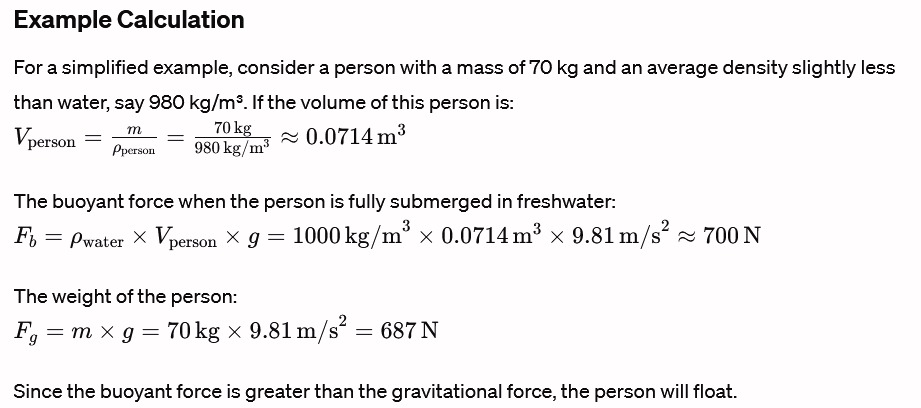
For a simplified example, consider a person with a mass of 70 kg and an average density slightly less than water, say 980 kg/m³. If the volume of this person is: Vperson=mρperson=70 kg980 kg/m3≈0.0714 m3

The buoyant force when the person is fully submerged in freshwater: Fb=ρwater×Vperson×g=1000 kg/m3×0.0714 m3×9.81 m/s2≈700 N

The weight of the person: Fg=m×g=70 kg×9.81 m/s2=687 N

Since the buoyant force is greater than the gravitational force, the person will float.

In summary, humans float on water due to the buoyant force exerted by the displaced water, which, for most people, exceeds their weight due to the lower density of the human body compared to water. Factors such as lung capacity, body composition, and body position significantly influence this buoyancy.
Buoyant Force
Buoyant Force

From the album “Right Now” by The Beatless Sense Mongers

MegaEpix Enormous

bookmark_borderThe Impacts

Whack! The impact

[Verse 1]
The impact of the warming
Quite alarming
The pace of the race
Disarming

[Chorus]
Hurricanes, heatwaves, and rising 3eas
I’m begging, begging please
Under strain from violent rain
Oh, the human induced pain

[Instrumental, Guitar Solo, Bass]

[Verse 2]
The impact of the primate change
Nature’s rearranged
What a disgrace
Barely recognize our place

[Chorus]
Hurricanes, heatwaves, and rising 3eas
I’m begging, begging please
Under strain from violent rain
Oh, the human induced pain

[Instrumental, Saxophone Solo, Piano]

[Bridge]
The change is huge
Yet we refuse
With all our might
To see the light
Why it’s happening
Is terrifying

[Chorus]
Hurricanes, heatwaves, and rising 3eas
I’m begging, begging please
Under strain from violent rain
Oh, the human induced pain

[Outro]
Hurricanes, heatwaves, and rising 3eas
I’m begging, begging please

A SCIENCE NOTE
BBC Reports: Hurricanes, Heatwaves, and Rising Seas: The Impacts of Record Ocean Heat

“The step-change in ocean temperatures over the last year is huge,” says Hayley Fowler, professor of climate change impacts at Newcastle University in the UK. “The fact we can’t simulate these step-change increases and understand why it’s happening is terrifying.”

The world’s oceans act like a planet-sized battery, absorbing and slowly releasing vast amounts of heat. So far, our oceans have soaked up over 90% of the heat trapped in the Earth’s atmosphere due to rising greenhouse gas emissions. Recently, however, the rate of ocean warming has been dramatic.

Since late March 2023, global ocean surface temperatures have set new records for the hottest temperature ever recorded on those dates. On 47 of those days, temperatures surpassed previous highs by the largest margin seen in the satellite era, according to data from the European Union’s Copernicus Climate Change Service.

In February 2024, the world breached 1.5°C warming of surface air temperatures for a full year. Yet, in some regions last year, ocean temperatures were akin to those expected if overall global warming of surface air temperatures reached 3°C above pre-industrial levels. This suggests quicker ocean heating than anticipated.

This rapid heating presents a puzzle for scientists: why is recent ocean warming even greater than models suggest? Understanding this discrepancy is crucial, as it has significant implications for predicting and mitigating the impacts of climate change.

Overview

Global warming has inflicted irreversible damage on our environment, a consensus echoed by nearly all scientists. Indeed, climate change poses a profound challenge. Our planet is witnessing conditions that increasingly jeopardize human habitation. The critical question now is whether we can adapt swiftly enough. “We are not saying that the Earth’s temperature is just going to rise. In general, as energy is added to a system, the fluctuations in the system increase. So, we expect more storms, more droughts, more wildfires, more floods, more fluctuations of all kinds. What we are saying is that weather conditions will become more volatile (Extreme Weather Events) due to the impact of humans,” said Mukherjee and Brouse.

Human-induced climate change is a dynamic component of an intricate and unordered system, as per chaos theory. This implies that global warming is accelerating exponentially in a complex manner. Over the period from 1992 to 2023, we have presented compelling evidence, proposed remedies to mitigate climate change, and amassed valuable information through the engagement of millions with this climate model. Your participation has been invaluable. The incontrovertible data underscores that human-induced climate change is rapidly deteriorating our habitat.

Our climate model chaos theory to comprehensively consider human impacts and projects a potential global average temperature increase of 9℃ above pre-industrial levels. Global warming is a consequence of elevated thermal energy in the climate system, which comprises various subsystems. Chaos theory underscores the intricate and nonlinear nature of dynamic systems. Human well-being is compromised above a 1.5-degree temperature rise, rendering much of the Earth uninhabitable. A 9-degree Celsius increase would bring the Earth close to a wet-bulb temperature incapable of sustaining human life.

What Can I Do? There are numerous actions you can take to contribute to saving the planet. Each person bears the responsibility to minimize pollution, discontinue the use of fossil fuels, reduce consumption, and foster a culture of love and care. The Butterfly Effect illustrates that a small change in one area can lead to significant alterations in conditions anywhere on the globe. Hence, the frequently heard statement that a fluttering butterfly in China can cause a hurricane in the Atlantic. Be a butterfly and affect the world.

From the album “Right Now” by The Beatless Sense Mongers

MegaEpix Enormous

A song about The Human Induced Climate Change Experiment

bookmark_borderSunday

[Verse 1]
I hope someday
The sun will shine this way
I hope today
Is a sun day

[Chorus]
Sunday
A great day to rejoice
Sunday
Sing, raise your voice

[Bridge]
Bring on everyday
As Sunday
Find a way
To play all day

[Instrumental, Guitar Solo, Drum Fills]

[Verse 2]
Oh, hope and pray
We get to play
Music and dance
The perfect chance

[Chorus]
Sunday
A great day to rejoice
Sunday
Sing, raise your voice

[Bridge]
Bring on everyday
As Sunday
Find a way
To play all day

[Instrumental, Saxophone Solo, Bass]

[Verse 3]
Today is the day
The sun shines our way
What do you say
We play the day away?

[Chorus]
Sunday
A great day to rejoice
Sunday
Sing, raise your voice

[Bridge]
Bring on everyday
As Sunday
Find a way
To play all day

[Outro]
Sunday, Hey!
Hey, it’s Sunday

[End]

From the album “Right Now” by The Beatless Sense Mongers

MegaEpix Enormous

bookmark_borderPummeling the World

Oh, man, Man!

[Verse 1]
Not a matter of whether
The extreme weather
Is wreaking havoc
Oh, woe, Mother’s sick

[Chorus]
Extreme weather
Is pummeling the world
We’ve come untethered
The world needs told

[Instrumental, Guitar Solo, Drum Fills]

[Verse 2]
It’s a matter of whether
We’ll survive the weather
It’s pounding down
All around
(Pounding down, down, down)

[Chorus]
Extreme weather
Is pummeling the world
We’ve come untethered
The world needs told

[Instrumental, Saxophone Solo, Bass]

[Bridge]
Coming at ya, Africa
Afghanistan, can you withstand
At the end of your rope, Europe
India, waa, waa, waa

[Chorus]
Extreme weather
Is pummeling the world
We’ve come untethered
The world needs told

[Instrumental, Drum Solo, Bass]

[Outro]
Coming at ya, Africa
Afghanistan, can you withstand
At the end of your rope, Europe
India, waa, waa, waa

A SCIENCE NOTE
Africa News Reports: Severe Weather Events Across the Globe

Global Overview
Severe weather has been pummeling parts of the world, with flash floods and heatwaves recorded in Sub-Saharan Africa, Europe, the Americas, and several countries in Asia. According to the UN’s climate body, the IPCC, heavy rainfall events have become more frequent and intense over most land regions.

Africa
Heavy rains and flash floods have affected nearly 1 million people in East Africa, displacing over 300,000 people in Kenya, Somalia, Burundi, and Tanzania, according to the United Nations Office for the Coordination of Humanitarian Affairs. Additionally, record temperatures, especially at night, have hit many parts of Africa. Niamey, the capital of Niger, experienced its hottest May night, while Burkina Faso’s capital recorded its hottest night for any month. In Chad, temperatures were expected to linger above 114 degrees Fahrenheit (45.6 degrees Celsius) by mid-May.

Afghanistan
In Afghanistan, flash floods from heavy seasonal rains in the western part of the country left at least 50 people dead on Saturday. Authorities have warned that the death toll may rise as dozens of people remain missing. The exceptionally heavy rains have killed more than 300 people and destroyed thousands of houses, according to the UN.

Europe
Europe is also facing severe weather. In southwest Germany, particularly in Saarland, heavy rainfall led to flooding, impacting many houses and cars and necessitating some evacuations in Lebach on Saturday. The fire department prepared boats and distributed sandbags to protect houses. Authorities warned that the rain would continue into the night and Sunday. Meanwhile, in Russia, over 2,000 people were evacuated from Omsk after flooding affected over 200 homes and nearly 400 other structures, mostly used in farming, according to the Russian Emergency Ministry. Russian state TV shared footage of one villager, Galimzhan Taushev, who lost his house to the flooding.

India
In South Asia, climate experts say extreme heat during the pre-monsoon season is becoming more frequent. On Saturday, parts of northwest India sweltered under scorching temperatures, with the capital New Delhi under a severe weather alert. India’s weather department expects heatwave conditions to persist across the north for the next few days and has put several states on high alert.

From the album “Right Now” by The Beatless Sense Mongers

MegaEpix Enormous

A song about The Human Induced Climate Change Experiment

bookmark_borderTexas Bailout

[Intro]
Lie, baby, lie
Cry, baby, cry

[Verse 1]
First you deny
Then you lie
Putting all at risk
To die
(tsk, tsk, tsk)

[Bridge]
Mother messes with Texas
Comes back for a kick in ass

[Chorus]
We’re under strain
Need a government bailout
Extreme rain, extreme pain
Something to cry about

[Verse 2]
On your knees
Begging please!
Ignorance
Is not bliss

[Bridge]
Mother messes with Texas
Comes back for a kick in ass

[Chorus]
We’re under strain
Need a government bailout
Extreme rain, extreme pain
Something to cry about

[Instrumental, Guitar Solo, Drum Fills]

[Bridge]
Mess in Texas
Self-imposed I suppose
Science denial
Education’s on trial
Political suicide
Fat cat’s reside
Slogan’s ill
Drill, drill, drill

[Instrumental, Saxophone Solo, Bass]

[Verse 3]
Texas, the welfare state
Dumb ass, climate irate
Fossil fuel fools
The devil’s tools

[Bridge]
Mother messes with Texas
Comes back for a kick in ass

[Chorus]
We’re under strain
Need a government bailout
Extreme rain, extreme pain
Something to cry about

[Outro]
On your knees
Begging please!
Ignorance
Is not bliss

A SCIENCE AND ECONOMICS NOTE
Newsweek reportsRepublican Texas Governor Greg Abbott has asked President Joe Biden to issue a Presidential Disaster Declaration for areas of Texas affected by recent severe weather and flooding. The state has experienced a series of intense weather events over the past few weeks, including thunderstorms that have caused flooding and tornadoes. In his request, Abbott stated, “Due to severe weather and flooding that continues to cause devastating damage in several of our communities, I am requesting a Presidential Disaster Declaration. The extensive damage caused by these severe storms, historic river flooding, and tornadoes requires comprehensive, robust action by all levels of government to help Texans rebuild and recover.” Abbott included a link to a press release from his office, which contained his full letter to President Biden.

In the letter, Abbott emphasized the severity of the situation: “I have determined that the incident is of such severity and magnitude that an effective response is beyond the capabilities of the state and affected local governments, and that supplementary federal assistance is necessary to save lives and to protect property, public health, and safety, or to lessen or avert the threat of a disaster.” Abbott also requested access to the Federal Emergency Management Agency’s Hazard Mitigation Grant Program statewide and the U.S. Small Business Administration Disaster Loan Program for physical and economic loss in all requested counties.

On April 24, the National Weather Service issued an “extreme fire behavior warning” for the El Paso region of Texas, just across the Mexican border. On May 1, heavy rainfall caused flooding along the Trinity River, affecting Harris County after dangerous flash floods hit the area around Galveston in East Texas.

Abbott noted, “The request to declare a major disaster for the state of Texas comes after an initial review of damage sustained due to catastrophic flash flooding, historic river flooding, extremely large hail, damaging wind gusts, and destructive tornadoes. Local jurisdictions have reported more than $58 million in public infrastructure damage estimates thus far, including disaster response costs and debris management.”

About the Age of Loss and Damage

Climate change is primarily driven by the escalation of thermal energy affecting biogeophysical and socio-economic systems. While biogeophysical factors can be studied using mathematics, physics, and historical records, socio-economic systems pose greater challenges due to the unintended consequences of human behavior and inexplicable consumer choices.

Human-induced climate change is an exponential component of an unordered system (chaos theory), meaning global warming is accelerating at a rapid and complex rate. Unfortunately, even scientists are struggling to fully understand or predict the rapid acceleration of climate change. The impacts of the Domino Effect, or “tipping cascades,” are being underestimated. Tipping points are critical milestones that directly impact the rate of acceleration in climate change by multiplying the number and intensity of feedback loops. These cascading impacts affect both biogeophysical and social systems. Until recently, scientists have drastically underestimated the role of social-ecological systems. The University of Exeter reports, “There is a notable lack of topic clusters dedicated to how humans will be impacted by climate-related tipping cascades.”

Previous climate models have inadequately incorporated “social-ecological systems” as human involvement was not a significant factor in past climate changes. Regrettably, the United States ranks among the least prepared countries globally, with a high percentage of climate deniers. The Republican party dismisses it as a manufactured crisis and plans to increase fossil fuel production, exacerbating the situation. Political extremists asserting that the climate crisis is manufactured use an ironic term, given that human manufacturing activities are the primary driver of climate change. Both political parties have agreed to allocate unlimited emergency funding for climate disasters instead of proactively preventing them. Last year, the US witnessed a record number of over a billion-dollar climate disasters, totaling 28 separate weather and climate-related events. Due to this arrogance and ignorance, “worst-case scenarios” are now “best-case scenarios” for the acceleration of climate change. These factors have altered our climate model, shifting the projected maximum temperature rise from 4 degrees Celsius over the next millennium to a probable increase of 9 degrees Celsius this century.

From the album “Right Now” by The Beatless Sense Mongers

MegaEpix Enormous

A song about The Human Induced Climate Change Experiment

bookmark_border(Such Thing as a:) Free Ride

Hope?
Come right this way
(Come away)
(away aaaaa)

[Verse 1]
I heard you’re looking for hope
Come, let’s dream a scene
(the seen:)
I see approaching a slope
And it’s all downhill from hear

[Chorus]
You’re free to coast
We’ll free the most
Free to glide…
[Break]
A free ride

[Bridge]
Come on,
Be the free ride!
(Free ride)
Free ride

[Verse 2]
I heard you’re looking for love
Come, let’s dream the seen
The Scene: Approaching from above
And it’s all downhill from hear

[Chorus]
You’re free to slide
Make the most
Free to coast
Free to glide…
[Bridge]
A free ride

[Bridge]
Come on,
Be the free ride!
(Free ride)
Free ride

[Verse 3]
Oh, Joy! We’ve found the love
Coming in from above
(Love! Coming in from above)
Set the scene
Live the dream

[Chorus]
We’re free to slide
Make a toast
Free to coast
Free to glide…
[Bridge]
A free ride

[Outro]
We’re free to slide
Make a toast
Free to coast
Free to glide…
A free ride

From the album “Right Now” by The Beatless Sense Mongers

MegaEpix Enormous

bookmark_borderTo Today

[Verse 1]
I’m glad to see you’ve found
Your way
Made it to today
Say, can you stay?

[Bridge]
La, la, la
La, la, la
Oh, so, oh

[Chorus]
Everything under the sun
Is seen as one
Everyone, everywhere
Is aware
[Break]
We’re there
[Instrumental, Guitar Solo, Drum Fills]

[Verse 2]
By the way, it would be just fine
If you’d like to shine along
Show the way to a fine time
Help us find a sing-a-long

[Bridge]
La, la, la
La, la, la
Oh, so, oh

[Chorus]
Everything under the sun
Is seen as one
Everyone, everywhere
Is aware
[Bridge]
We’re there
[Instrumental, Saxophone Solo, Bass]

[Bridge]
Take a broad view
If you do
You will see
You and me
Together are “be”

[Instrumental, Guitar Solo, Drum Fills]

[Verse 3]
I’m glad to see you’ve found
Your way (around)
Made it to today
By the way, it would be just fine
If you’d like to shine, shine on

[Chorus]
Everything under the sun
Is seen as one
Everyone, everywhere
Is aware
[Outro]
We’re there

[End]

From the album “Right Now” by The Beatless Sense Mongers

MegaEpix Enormous

bookmark_borderIt’s Raining Out, but….

[Verse 1]
It’s raining out
No doubt need a rain spout
But inside it’s shines
Shines so fine
Come have a good time

[Chorus]
Your light brings the glow
To the show
Your light sings on high
Making the sky cry

[Instrumental]

[Verse 2]
The rain is coming down
Falling all around
So come on in
The scene is happenin’

[Chorus]
Your light brings the glow
To the show
Your light sings on high
Making the sky cry

[Instrumental]

[Bridge]
Let it rain and rain
Let it pour some more
My, oh, my
Inside is dry
We can dance and play
All the livelong day

[Chorus]
Your light brings the glow
To the show
Your light sings on high
Making the sky cry

[Outro]
It’s raining
It’s pouring
This party
Is roaring

[End]

From the album “Right Now” by The Beatless Sense Mongers

MegaEpix Enormous

bookmark_borderTime to Make

[Verse 1]
I can feel it in my bones
It’s calling me
When I can hear the tones
Brings on melody

[Chorus]
It’s time to make
Music (sweet, sweet music)
Make the earth quake
Quick, more music

[Instrumental, Guitar Solo, Drum Fills]

[Verse 2]
It’s calling me to be
In the thick of it
Dancing freely
No cares, not a bit

[Chorus]
It’s time to make
Music (sweet, sweet music)
Make the earth quake
Quick, more music

[Instrumental, Saxophone Solo, Bass]

[Bridge]
Strumming strings
Banging things
Tickling keys
Sing for me please?

[Chorus]
It’s time to make
Music (sweet, sweet music)
Make the earth quake
Quick, more music

[Outro]
It’s calling me to be
In the thick of it

From the album “Right Now” by The Beatless Sense Mongers

MegaEpix Enormous

bookmark_borderReef Grief

No, no, no NOAA
Say it ain’t so
Woe, I dunno
How much longer can we go?

[Chorus]
Good grief, coral reef
A distress test
The heat stress
Causing a mess

[Instrumental, Guitar Solo, Drum Fills]

[Verse 2]
Bringing bleach
To the beech
This is alarming
And disarming

[Chorus]
Good grief, coral reef
A distress test
The heat stress
Causing a mess

[Instrumental, Saxophone Solo, Drum Fills]

[Bridge]
The Atlantic Ocean
Heat in motion
Too hot (hot, hot, hot)
Why not
Raise the alarm
Due to the harm?

[Chorus]
Good grief, coral reef
A distress test
The heat stress
Causing a mess

[Outro]
The heat stress
Causing a mess

A SCIENCE NOTE
In 2023, coral biologists described the temperatures as “unprecedented” because they started early and remained at bleaching levels for an extended period. NOAA’s Coral Reef Watch Program Coordinator, Derek Manzello, noted that reefs in the Caribbean and Florida are already experiencing a repeat of last year’s conditions. As of April 2024, heat stress is accumulating in Caribbean reefs, occurring weeks earlier than in 2023.

“This is alarming because this has never happened so early in the year before,” Manzello said. “And to say that is alarming because last year we experienced the same thing.”

The Atlantic Ocean bleaching event last summer was so severe that NOAA’s Coral Reef Watch added three new alert levels to their scale, which previously maxed out at alert level 2, to better categorize the heat stress occurring.

Coral reefs confront unprecedented challenges arising from various stressors, many of which are directly tied to human activities. Some of these stressors possess critical tipping points, surpassing which can lead to the collapse of coral ecosystems. According to the European Geosciences Union’s statement on January 2, 2024, specific tipping points include a temperature increase of 1.2℃ above pre-industrial levels and atmospheric CO2 concentrations exceeding 350 parts per million. Disturbingly, as of February 2024, the Earth’s yearly average temperature has already risen to +1.5℃ and CO2 to 425 ppm, underscoring the urgency of addressing climate-related threats to coral reefs.

In a significant update from May 2024, scientists determined through tree ring analysis that the average temperature increase in 2023 reached 2.07 degrees Celsius, further underscoring the escalating pace of climate change and its profound impact on global ecosystems.

Coral Reefs’ Tipping Point Brouse (2024)

From the album “Right Now” by The Beatless Sense Mongers

MegaEpix Enormous

A song about The Human Induced Climate Change Experiment

bookmark_borderDeSantis Is….

DeSantis Is….

[Verse 1]
DeSantis deprioritizes
Hopefully, everyone realizes
He’s a climate idiot
Facts to misrepresent

[Chorus]
Da, da, da, Florida (Da, da, da)
How could you be so dumb
To give up our freedom
Florida, run, run, run (run, run, run)

[Instrumental, Guitar Solo, Drum Fills]

[Verse 1]
DeSantis is
A numbskull
Intelligence
Dull

[Chorus]
Da, da, da, Florida (Da, da, da)
How could you be so dumb
To give up our freedom
Florida, run, run, run (run, run, run)

[Instrumental, Saxophone Solo, Bass]

[Bridge]
You fool
Go back to school
Oh, you tool
You rule the school
With misinformation
Total devastation

[Chorus]
Da, da, da, Florida (Da, da, da)
How could you be so dumb
To give up our freedom
Florida, run, run, run (run, run, run)

[Outro]
Da, da, da, Florida (Da, da, da)
How could you be so dumb
To give up our freedom

[End]

A SCIENCE NOTE
Florida Gov. Ron DeSantis signed legislation on May 15 that will deprioritize climate change and largely remove it from state statutes. The new law also bans the installation of power-generating wind turbines offshore or near the state’s extensive coastline. Critics argue that this legislation ignores the serious climate change threats facing Florida, such as rising sea levels, extreme heat, flooding, and increasingly severe storms. The measure, which takes effect on July 1, also promotes the expansion of natural gas, reduces regulation on gas pipelines, and increases protections against bans on gas appliances like stoves, according to a news release from the governor’s office.

DeSantis, who suspended his presidential campaign in January and later endorsed his former rival Donald Trump, described the bill as a common-sense approach to energy policy.

From the album “Right Now” by The Beatless Sense Mongers

MegaEpix Enormous

A song about The Human Induced Climate Change Experiment

bookmark_borderBail Faster

Bail faster!
Disaster

[Verse 1]
Is it any wonder
We’re going under
Is it surprising
The water’s rising

[Chorus]
Not nice
The ice is melting
Think twice
In need of helping
Don’t fail to bail
[Break]
Bail!

[Instrumental, Guitar Solo, Drum Fills]

[Verse 1]
Is it any wonder
We’re going under
Is it surprising
The water’s rising

[Chorus]
Not nice
The ice is melting
Think twice
In need of helping
Don’t fail to bail
[Break]
Bail!

[Instrumental, Saxophone Solo, Bass Fills]

[Bridge]
Check the clock
A significant shock
Maybe Miami
Won’t be
Sorry

[Chorus]
Not nice
The ice is melting
Think twice
In need of helping
Don’t fail to bail
[Break]
Bail!

[Outro]
Going under
Blunder
Going down
(Down, down, down)

[End]

A SCIENCE NOTE
Sea levels have been rising faster, impacting roads and homes in South Florida. Over the past 80 years, sea levels have increased by about a foot, with 8 inches of that rise occurring in the last 30 years, according to Brian McNoldy, a senior research associate at the University of Miami’s Rosenstiel School of Marine, Atmospheric, and Earth Science.

The National Oceanic and Atmospheric Administration (NOAA) projects that this pace will accelerate significantly. While it took approximately 80 years for the first foot of sea level rise, the second foot is expected in just 30 years, the third foot in 20 years, and Florida could see the next foot in merely a decade after that.

“Presently, sea level is tracking in the intermediate-high to high scenarios, the two fastest,” said Randall Parkinson, a coastal geologist with Florida International University. “The other three scenarios are less relevant because we’re already rising faster than that.” These projections are used by South Florida governments to determine the elevation for new developments. However, after a new bill signed by Gov. Ron DeSantis this year, local governments seeking state funds for sea rise projects must only consider the intermediate-low and intermediate scenarios, a downgrade from previous legislation that required consideration of the intermediate-low and intermediate-high scenarios.

A two-foot rise in sea level by 2060, compared to present-day levels, would be a significant shock for Miami, where the average elevation is three feet. This is why local governments and the state are investing billions of dollars to keep streets dry and mitigate the impact of rising seas.

Scientific Evidence on Sea Level Rise and Climate Change

Sea level rise is primarily driven by two factors related to climate change: thermal expansion of seawater as it warms and the addition of water from melting ice sheets and glaciers. According to the Intergovernmental Panel on Climate Change (IPCC), global mean sea level rose by 0.19 meters (about 7.5 inches) from 1901 to 2010. The rate of sea level rise has accelerated in recent decades, averaging about 3.2 millimeters per year from 1993 to 2010.

Thermal Expansion

As global temperatures rise due to increased greenhouse gas concentrations, seawater expands. This process, known as thermal expansion, contributes significantly to observed sea level rise. The IPCC estimates that thermal expansion contributed to about 30% of the observed rise in sea levels from 1993 to 2010.

Melting Ice Sheets and Glaciers

The Greenland and Antarctic ice sheets, along with glaciers worldwide, are losing mass at an accelerating rate. Satellite data show that the Greenland ice sheet lost an average of 279 gigatonnes of ice per year between 2006 and 2018, while the Antarctic ice sheet lost about 148 gigatonnes per year over the same period. These losses add to the volume of water in the oceans, raising sea levels.

Regional Variations

Sea level rise is not uniform across the globe. Factors such as ocean currents, atmospheric pressure patterns, and the gravitational effects of melting ice masses can cause regional variations. For instance, the U.S. East Coast, including South Florida, has experienced higher rates of sea level rise compared to the global average.

Future Projections

The IPCC’s Sixth Assessment Report projects that global mean sea level could rise by 0.28 to 1.01 meters (about 11 to 40 inches) by 2100, depending on greenhouse gas emission scenarios. High-emission scenarios could lead to even greater rises due to potential ice sheet instability and other feedback mechanisms.

Economic and Social Impacts

The economic and social impacts of sea level rise are profound. Coastal communities face increased flooding, erosion, and damage to infrastructure. Saltwater intrusion can contaminate freshwater supplies, affecting agriculture and drinking water. Rising seas also threaten critical habitats, such as wetlands and mangroves, which provide important ecosystem services and protect against storm surges.

In conclusion, the accelerating pace of sea level rise due to climate change presents a significant challenge for coastal regions like South Florida. Understanding the scientific basis of sea level rise and implementing adaptive measures are crucial for mitigating its impacts and protecting vulnerable communities.

From the album “Right Now” by The Beatless Sense Mongers

MegaEpix Enormous

A song about The Human Induced Climate Change Experiment

bookmark_borderIncrease in Decline

[Verse 1]
Primate change
The social cost of carbon
Come on,
Estrange

[Chorus]
An increase in decline
Happening all the time
In fact, the impact
Wails a whack

[Instrumental, Guitar Solo, Drum Fills]

[Verse 2]
Primate change
Costs an arm and a leg
Feels strange
Literally, I beg

[Chorus]
An increase in decline
Happening all the time
In fact, the impact
Wails a whack

[Instrumental, Saxophone Solo, Piano]

[Bridge]
Macroeconomic impact
The poor poorly lack
Damn damages
Upset averages
Extreme events
Prevents

[Chorus]
An increase in decline
Happening all the time
In fact, the impact
Wails a whack

[Instrumental, Guitar Solo, Bass]

[Outro]
Macroeconomic impact
The poor poorly lack
Damn damages
Upset averages

[End]

A SCIENCE NOTE
The Macroeconomic Impact of Climate Change: Global vs. Local Temperature

This paper estimates that the macroeconomic damages from climate change are six times larger than previously thought. We exploit natural variability in global temperature and rely on time-series variation. A 1°C increase in global temperature leads to a 12% decline in world GDP. Global temperature shocks correlate much more strongly with extreme climatic events than the country-level temperature shocks commonly used in the panel literature, explaining why our estimate is substantially larger. We use our reduced-form evidence to estimate structural damage functions in a standard neoclassical growth model. Our results imply a Social Cost of Carbon of $1,056 per ton of carbon dioxide. A business-as-usual warming scenario leads to a present value welfare loss of 31%. Both are multiple orders of magnitude above previous estimates and imply that unilateral decarbonization policy is cost-effective for large countries such as the United States.

The economic damage caused by climate change is six times worse than previously estimated, with global warming set to reduce wealth at a rate comparable to the financial losses of a continuous, permanent war, according to recent research.

The study found that a 1°C increase in global temperature leads to a 12% decline in world gross domestic product (GDP), a far higher estimate than previous analyses. The world has already warmed by more than 1°C (1.8°F) since pre-industrial times, and many climate scientists predict a 3°C (5.4°F) rise will occur by the end of this century due to the ongoing burning of fossil fuels. This scenario, according to a new working paper that has yet to be peer-reviewed, will result in an enormous economic cost.

A 3°C temperature increase will cause “precipitous declines in output, capital, and consumption that exceed 50% by 2100,” the paper states. This economic loss is so severe that it is “comparable to the economic damage caused by fighting a war domestically and permanently,” it adds.

The Age of Loss and Damage

From the album “Right Now” by The Beatless Sense Mongers

MegaEpix Enormous

A song about The Human Induced Climate Change Experiment

bookmark_borderDerechos

[Verse 1]
The mountain echoes
Derechos
Blowing over shadows
You next? Who knows

[Chorus]
I mean
Extreme
Weather events
This kind prevents
The dream

[Instrumental, Guitar Solo, Drum Fills]

[Verse 2]
Midwestern U.S.
Is in distress
Kicking Texas
In the ass

[Chorus]
I mean
Extreme
Weather events
This kind prevents
The dream

[Instrumental, Saxophone Solo, Bass]

[Bridge]
Straight-line winds
Blinds the minds
Windstorm
Alarm
Windstorms
Bring harm
Our way
Today

[Chorus]
I mean
Extreme
Weather events
This kind prevents
The dream

[Instrumental, Guitar Solo, Drum Fills]

[End]

A SCIENCE NOTE
Derechos, which are long-lived windstorms associated with bands of rapidly moving showers or thunderstorms, are being influenced by climate change in several ways. Here’s how climate change is impacting the occurrence and intensity of derechos:

1. Increased Atmospheric Instability

As global temperatures rise, the atmosphere becomes more unstable. This instability is a crucial factor in the formation of severe thunderstorms, which can lead to derechos. Warmer air can hold more moisture, and this increased humidity can provide more energy for storms, making them more intense and more likely to produce damaging wind events like derechos.

2. Enhanced Convective Available Potential Energy (CAPE)

Convective Available Potential Energy (CAPE) measures the amount of energy available for convection, which is essential for thunderstorm development. Higher CAPE values indicate more potential for strong updrafts and downdrafts, leading to more severe thunderstorms and, consequently, more powerful derechos. Climate change is leading to higher CAPE values in many regions, contributing to the likelihood of more frequent and intense derechos.

3. Increased Frequency of Extreme Weather Events

Climate change is causing an increase in the frequency and intensity of extreme weather events overall. This includes heatwaves, which can create the conditions necessary for severe thunderstorms. Prolonged periods of high temperatures can destabilize the atmosphere, making it more conducive to the formation of the severe storms that spawn derechos.

4. Altered Wind Patterns

Climate change is influencing global wind patterns, which can affect the development and trajectory of weather systems that produce derechos. Changes in jet streams and other large-scale atmospheric circulations can contribute to more favorable conditions for derechos in certain areas.

5. Increased Moisture Availability

With the warming atmosphere, there is more moisture available due to higher rates of evaporation and more intense precipitation events. This increased moisture can fuel severe thunderstorms, making them more capable of producing the widespread, damaging winds characteristic of derechos.

Case Studies and Recent Examples

In recent years, there have been notable examples of derechos that have caused significant damage and have been studied in the context of climate change:

  • Midwestern U.S. Derecho (August 2020): This derecho caused widespread damage across several states, including Iowa, Illinois, and Indiana. Scientists have noted that the conditions leading to this event were influenced by higher-than-normal temperatures and increased moisture in the atmosphere, consistent with the impacts of climate change.

Conclusion

While more research is needed to fully understand the relationship between climate change and derechos, it is clear that the changing climate is creating conditions that can lead to more frequent and intense severe weather events, including derechos. Addressing climate change by reducing greenhouse gas emissions and implementing adaptation strategies is crucial to mitigating the impacts of these powerful windstorms on communities and infrastructure.

From the album “Right Now” by The Beatless Sense Mongers

MegaEpix Enormous

A song about The Human Induced Climate Change Experiment

bookmark_borderStraight-Line

Make a straight-line
For the door
Can’t take much more
I ain’t lyin’

[Verse 1]
Make a straight-line
For the door
Can’t take much more
I ain’t lyin’

[Bridge]
The winds are going to blow me down
(Down, down, down)
Just look around

[Chorus]
Straight-line wind
Again and again
Atmospheric instability
Is getting the best of me

[Instrumental, Saxophone Solo, Bass]

[Verse 2]
Connected
To enhanced convective
Available potential energy
Is coming after me

[Bridge]
The winds are going to blow me down
(Down, down, down)
Just look around

[Chorus]
Straight-line wind
Again and again
Atmospheric instability
Is getting the best of me

[Instrumental, Guitar Solo, Drum Fills]

[Verse 3]
Frequency and intensity
Concerning me
Warn of thunderstorms
Setting new norms

[Bridge]
The winds are going to blow me down
(Down, down, down)
Just look around

[Chorus]
Straight-line wind
Again and again
Atmospheric instability
Is getting the best of me

[Outro]
Straight-line wind
Blowin’ me down again

[End]

A SCIENCE NOTE
May 18, 2024: “Deadly storm wallops Houston as ferocious winds leave a destructive path across the South.” The storm left death and destruction, and thousands without power. The forecast predicts an unprecedented spring heatwave, putting all those without power in a deadly situation. The greatest short term climate change risk to human health is deadly humid heat (wet-bulb temperature).

Weather Like the Deadly Houston Windstorm Is Being Fueled in Part by Climate Change

Scientists have detected an increase since the 1980s in what are known as straight-line winds, and climate change is playing a significant role. These winds, which are often associated with severe thunderstorms, can reach speeds exceeding 100 mph and cause damage similar to that of a tornado, but they move along a straight path.

Understanding Straight-Line Winds

Straight-line winds, also known as derechos when they cover a particularly large area, are powerful, sustained winds that originate from downdrafts in thunderstorms. Unlike the rotating winds of a tornado, straight-line winds blow in a single direction, hence their name. These winds can flatten trees, knock down power lines, and cause extensive damage to buildings and infrastructure.

The Role of Climate Change

Recent studies indicate that climate change is contributing to an increase in the frequency and intensity of these wind events. The following factors explain how climate change is influencing straight-line winds:

  1. Increased Atmospheric Instability: As global temperatures rise, the atmosphere becomes more unstable. Warmer air holds more moisture, leading to more intense thunderstorms, which are a primary source of straight-line winds. The increased energy in the atmosphere enhances the formation of severe weather systems capable of producing strong downdrafts.
  2. Enhanced Convective Available Potential Energy (CAPE): CAPE is a measure of the energy available for convection, which is a key process in the formation of thunderstorms. Higher CAPE values are associated with more vigorous updrafts and downdrafts, resulting in stronger winds. Climate change is leading to higher CAPE values in many regions, contributing to more powerful straight-line winds.
  3. Changing Wind Patterns: Climate change is altering global wind patterns, which can influence the development and movement of severe weather systems. These changes can result in more frequent and intense straight-line wind events, particularly in areas that are becoming more prone to severe thunderstorms.

The Impact of Straight-Line Winds

The deadly Houston windstorm is a stark reminder of the destructive power of straight-line winds. The storm left a trail of devastation, with thousands of residents losing power and homes being damaged or destroyed. The aftermath of such storms can be particularly dangerous during extreme weather events like heatwaves, which are also becoming more common due to climate change.

Conclusion

As the climate continues to change, the occurrence of extreme weather events like straight-line winds is expected to increase. This poses significant challenges for communities, infrastructure, and emergency response systems. Understanding the role of climate change in these events is crucial for developing strategies to mitigate their impact and enhance resilience against future storms. Scientists and policymakers must work together to address the root causes of climate change and implement measures to protect vulnerable populations from the growing threat of severe weather.

From the album “Right Now” by The Beatless Sense Mongers

MegaEpix Enormous

A song about The Human Induced Climate Change Experiment