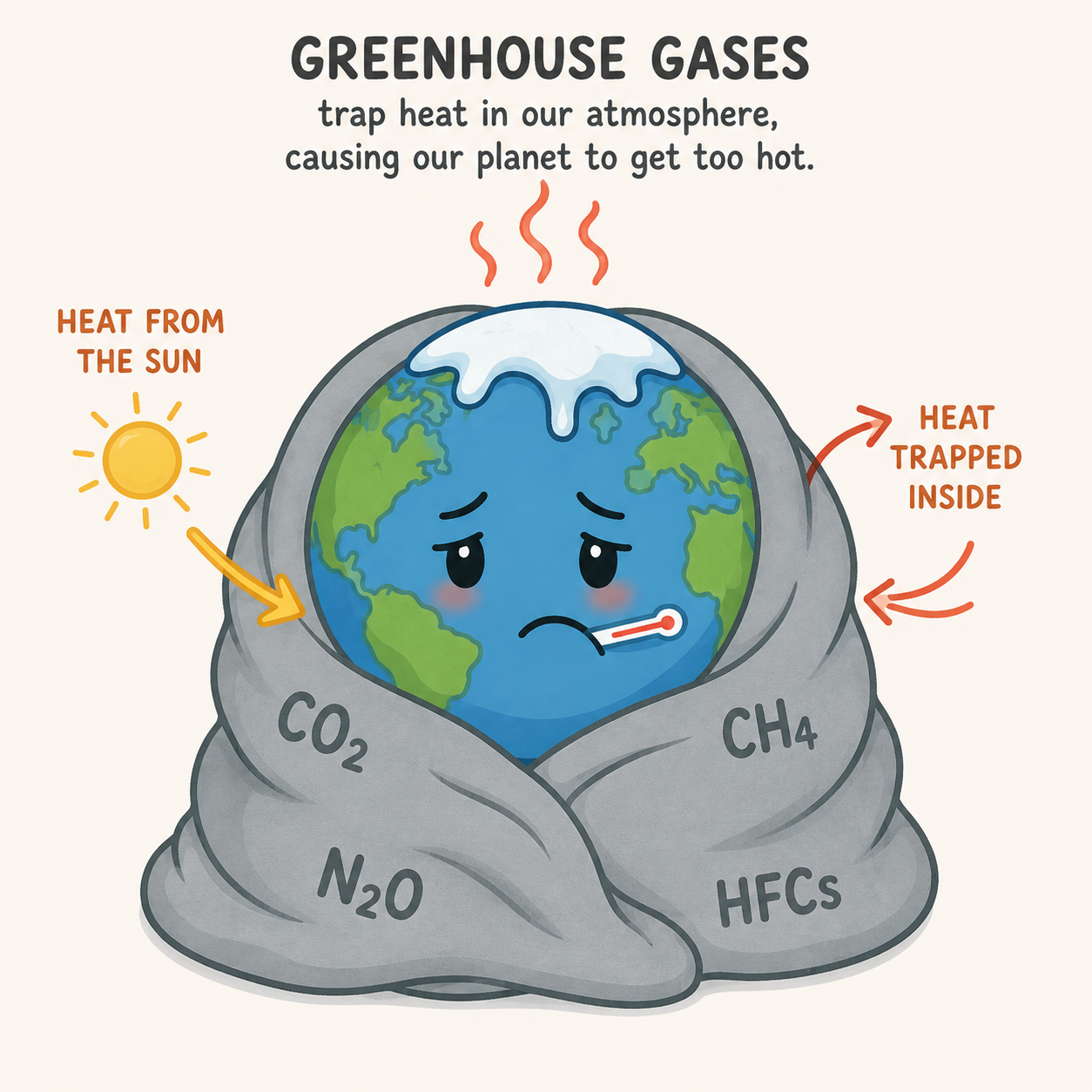
Climate change is not a collection of separate problems. It is a connected system of changes—and the consequences can multiply.
By Daniel Brouse¹ and Sidd Mukherjee²
November 14, 2026
¹ Independent Climate Researcher and Economist, Membrane Institute, USA
² Independent Physicist, Membrane Institute, USA
Climate change is often explained as a gradual increase in Earth’s average temperature. But that description leaves out something important: Earth’s climate is a connected system.
The atmosphere, oceans, ice sheets, forests, soil, and living things all interact. When one part changes, it can affect other parts. Those changes can then create additional changes, sometimes making the original problem worse.
This means climate change does not always progress at a steady rate.
A warming ocean can contribute to melting ice. Melting ice exposes darker surfaces that absorb more sunlight. That additional heat can contribute to further warming. Changes in ocean temperatures can also affect weather patterns, ecosystems, agriculture, and economies.
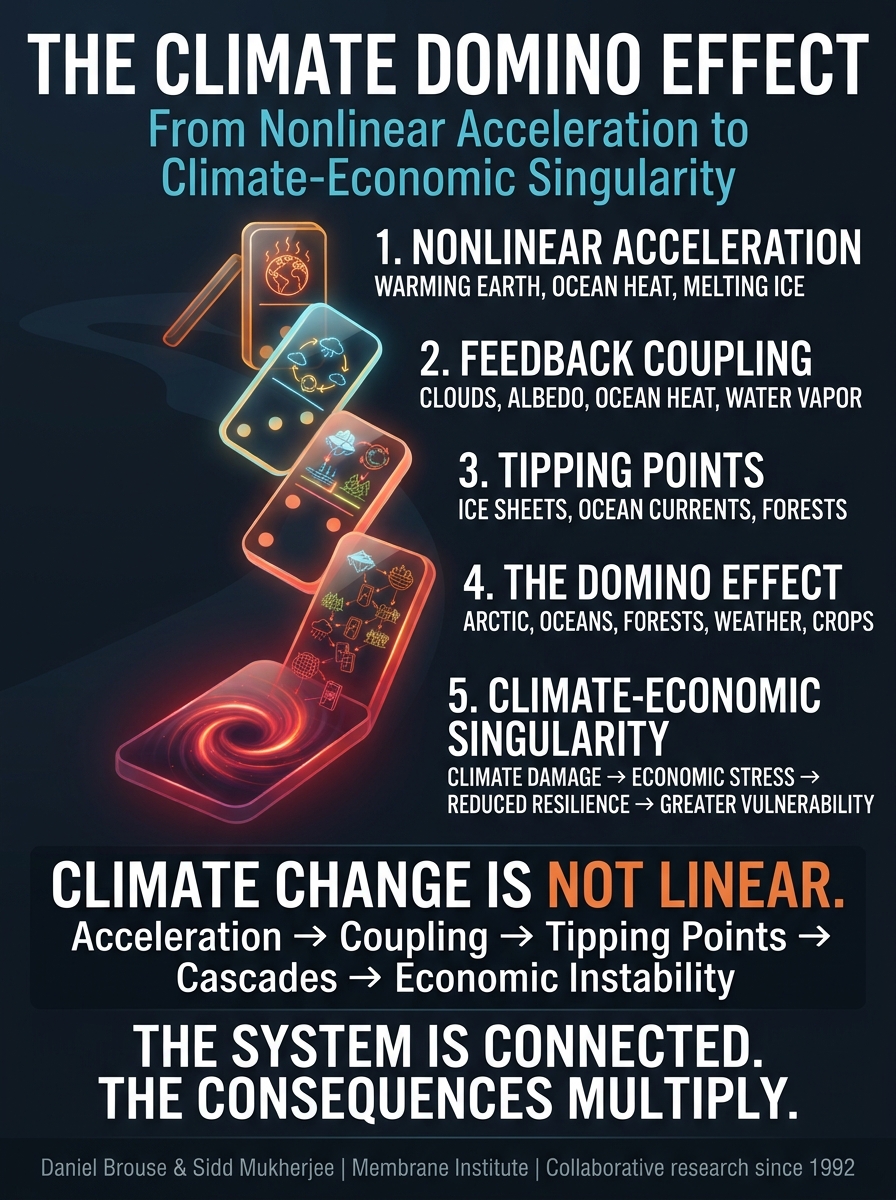
Daniel Brouse and Sidd Mukherjee have studied these connections through a research framework developed at the Membrane Institute. Their work brings together five important ideas:
Together, these ideas help explain why climate change can become increasingly difficult to predict and manage.
When something changes linearly, it changes at a fairly steady rate.
For example, if a car travels at 30 miles per hour, it covers approximately the same distance every minute.
But climate change does not always work that way.
Some climate changes accelerate. Their rate of change increases over time. In other words, the climate system can change faster as its components interact.
Consider a simple example:
The original warming creates conditions that increase the rate of further warming.
This is an example of nonlinear acceleration.
The important distinction:
A warming climate is one problem. A climate system that is warming while its rate of change increases presents a much greater challenge.
Brouse and Mukherjee developed their Nonlinear Acceleration Hypothesis in their early collaborative research, with a foundational Membrane Institute working paper published in 1999.
Their later research examines whether acceleration can be identified through multiple climate indicators, including ocean heat, sea ice, temperature extremes, and changes in the Earth’s energy balance.
A feedback loop happens when a change creates an effect that influences the original change.
There are two basic types:
Positive feedback: A change reinforces itself and makes the original effect stronger.
Negative feedback: A change counteracts the original effect and helps limit it.
The word “positive” does not mean good, and “negative” does not mean bad. These terms describe how a feedback affects the original change.
A. Ice and sunlight
Warming → Ice melts → Darker surfaces absorb more sunlight → More warming
Ice reflects much of the sunlight that reaches it. When ice disappears, darker land or ocean surfaces are exposed. These surfaces absorb more energy.
B. Oceans and heat
More heat enters the ocean → Ocean temperatures rise → Marine and atmospheric conditions change → Additional climate effects
The oceans absorb more than 90% of the excess heat accumulating in the Earth system. This makes ocean heat one of the most important measurements of climate change.
C. Clouds and atmospheric energy
Clouds influence how much sunlight reaches Earth’s surface and how much heat escapes back into space. Their effects depend on cloud height, thickness, location, and other conditions.
Changes in cloud patterns can therefore influence the amount of energy retained by the climate system.
These feedbacks do not operate independently.
Changes in ice, clouds, ocean heat, and atmospheric moisture can interact. When several feedbacks reinforce one another, the combined effect can become more important than any single process.
Brouse and Mukherjee call attention to this interaction through their feedback-coupling research.
The central idea is simple:
Climate systems are connected. Their combined effects matter.
A tipping point is a critical threshold beyond which a system can undergo a major change.
Imagine slowly pushing a glass toward the edge of a table. At first, nothing dramatic happens. But once the glass passes the edge, it falls.
Climate systems can behave in a similar way.
They may absorb stress for years or decades before reaching a point where a relatively small additional change triggers a much larger response.
Examples of climate systems that scientists study for tipping-point risks include:
These systems are important because major changes can affect conditions far beyond the locations where they begin.
For example, substantial ice-sheet loss contributes to rising sea levels. That creates greater risks for coastal communities, infrastructure, farmland, and property.
Ocean circulation changes can affect heat distribution, marine ecosystems, and regional weather patterns.
Forest degradation can reduce the ability of forests to absorb carbon dioxide, making it harder for the natural environment to slow climate change.
A tipping point is not simply another temperature record. It is a change in how a major part of the Earth system operates.
The Domino Effect describes how a change in one climate system can contribute to changes in other systems.
Think about a row of dominoes. When the first domino falls, it can knock down the next one. That domino can then knock down another.
Climate systems can create similar chains of effects.
Rising temperatures
↓
Arctic sea ice melts
↓
Less sunlight is reflected
↓
More energy is absorbed by the ocean
↓
Additional warming and changes in ocean-atmosphere conditions
↓
Further effects on weather, ecosystems, and communities
Ocean warming and circulation changes
↓
Changes in marine conditions
↓
Stress on marine ecosystems
↓
Disruptions to fisheries and food supplies
↓
Economic pressure on communities and industries
Heat, drought, and other environmental stresses
↓
Forest damage and increased fire risk
↓
Reduced carbon storage
↓
More carbon remains in the atmosphere
↓
Additional pressure on the climate system
These examples illustrate possible connections. They do not mean that every event automatically causes every later event. The important point is that climate systems are linked, and disruptions can spread across those connections.
The Domino Effect helps us understand why studying climate hazards one at a time can miss important risks.
Climate change is not only an environmental problem. It is also an economic problem.
Homes, businesses, farms, roads, bridges, power systems, insurance companies, and financial institutions all depend on stable environmental conditions.
When those conditions change, the costs can spread throughout the economy.
Consider a major flood:
A single climate-related event can therefore affect many parts of the economy.
Other examples include:
These effects can also occur together.
When several climate-related problems happen at the same time, their combined economic consequences can be much greater than the cost of any one event.
The oceans are especially important because they regulate heat, support marine life, influence weather, and provide food and economic resources.
Brouse and Mukherjee’s research on Ocean Solvency and the Ocean Maelstrom examines how ocean-system disruption can spread into economic systems.
The concern is not limited to the ocean itself. Problems affecting ocean conditions can move through fisheries, food supplies, shipping, insurance, financial markets, and national economies.
A damaged climate system creates economic risks that reach far beyond the original environmental damage.
The word “singularity” is often used to describe a point where a system changes so dramatically that its previous patterns no longer provide a reliable guide to what happens next.
In this research framework, a climate-economic singularity describes a situation in which accelerating climate disruption and economic instability increasingly reinforce one another.
Consider this chain:
Climate damage increases
↓
Economic losses increase
↓
Financial resources become more strained
↓
Communities and institutions have less ability to adapt
↓
Vulnerability increases
↓
Future climate damage becomes more costly
↓
Economic pressure increases further
This creates a dangerous feedback loop.
For example, a community repeatedly affected by flooding may face rising insurance costs, declining property values, expensive infrastructure repairs, and reduced investment.
Those financial pressures can make it harder to protect the community against the next flood.
The climate problem and the economic problem begin reinforcing each other.
The term “climate-economic singularity” is a research framework for examining this type of increasingly connected instability. It is not a claim that the global economy has already reached a single, precisely identifiable point of collapse.
The central warning is that climate damage can weaken the very economic systems needed to respond to it.
The five concepts describe different parts of one connected process.
| Concept | What It Means |
|---|---|
| Nonlinear Acceleration | Climate changes can increase in speed over time |
| Feedback Coupling | Different climate processes interact and reinforce one another |
| Tipping Points | Critical thresholds can trigger major system changes |
| Domino Effect | Disruptions can spread from one system to another |
| Climate-Economic Singularity | Climate damage and economic instability can reinforce each other |
The overall progression can be summarized as:
Acceleration → Feedback Coupling → Tipping Points → Domino Effects → Economic Instability
This is not a fixed sequence in which every event must happen in the same order. The concepts describe interacting processes that can overlap and reinforce one another.
The bigger lesson is that climate risk cannot be understood by looking only at average global temperature.
We must also examine how quickly conditions are changing, how climate systems interact, and how environmental disruptions affect human society.
Temperature is important, but it is not enough to describe the condition of the entire climate system.
Scientists also monitor:
These measurements help scientists understand what is changing and how different parts of the climate system are connected.
Brouse and Mukherjee’s research examines whether multiple indicators reveal patterns of accelerating change that are not obvious when each measurement is considered separately.
Their work includes the study of climate acceleration, climate feedbacks, the compression of doubling times across Earth-system indicators, and the relationship between climate disruption and economic costs.
A key research challenge is determining how much of an observed change represents a long-term trend, how much reflects natural variability, and how different indicators influence one another.
This requires careful measurement, transparent methods, and continued comparison with independent scientific research.
Understanding climate risks is only part of the challenge. We also need practical ways to reduce those risks.
Integrated Climate Stewardship is an approach developed around a straightforward principle:
ZERO-OUT + BENEFIT-IN
The first part means reducing the sources of environmental harm as much as practical.
The second part means creating additional benefits for the environment rather than relying only on offsets or promises of future improvements.
Examples include:
Climate preparedness also requires economic planning.
Families need to understand property risks, insurance costs, energy expenses, and the financial consequences of extreme weather.
Communities need to evaluate infrastructure, drainage, emergency planning, and long-term financial obligations.
Businesses and governments need to consider how climate risks can affect their investments and operations.
The earlier these risks are understood, the more opportunities there are to reduce future damage.
Climate change is not simply a matter of the planet becoming warmer.
It involves changes in interconnected systems that influence one another.
Nonlinear acceleration helps explain why the rate of change can increase.
Feedback coupling explains how different climate processes reinforce one another.
Tipping points describe critical thresholds that can lead to major changes.
The Domino Effect explains how disruptions can spread through the Earth system.
Climate-Economic Singularity describes how environmental damage and economic instability can become increasingly connected.
Together, these ideas provide a framework for understanding climate risk as a system-wide problem.
The greatest challenge is not just the amount of warming. It is how the Earth’s interconnected systems respond as warming continues.
Climate change is not a collection of separate problems. It is a connected system of changes—and the consequences can multiply.
Daniel Brouse
Independent Climate Researcher and Economist
Co-founder, Membrane Institute
Sidd Mukherjee, Ph.D.
Independent Physicist
Co-founder, Membrane Institute
Brouse and Mukherjee began their collaborative research through the Membrane Institute in 1992. Their work has explored nonlinear climate behavior, Earth-system interactions, energy redistribution, feedback processes, and the relationship between climate change and economic risk.
Additional research is available through the Membrane Institute’s Climate Science Resources and Climate-Economic Coupling and Singularity research collections.
Feedback Loops → Tipping Points → Feedback Loop Coupling and Tipping-Point Network → Acceleration → Domino Effect
Feedback loops amplify climate change and can push interconnected Earth systems past critical tipping points. As tipping points are crossed, they can trigger additional feedback loops and destabilize other climate systems. This cascading "Domino Effect" compresses timescales, accelerates change, and increases the risk of rapid, nonlinear climate transformations.
Current Status: The Climate Tipping Point Crisis Is Here