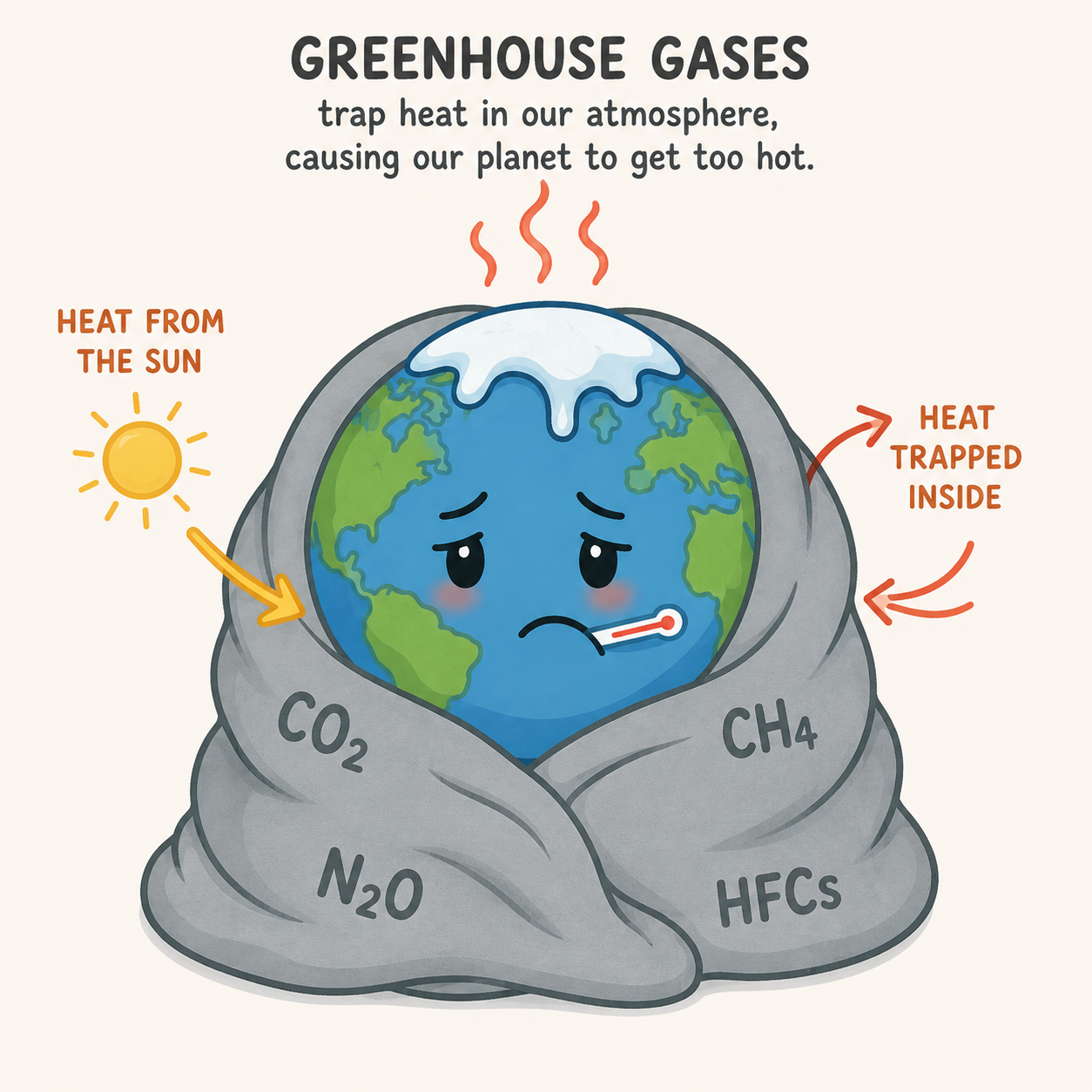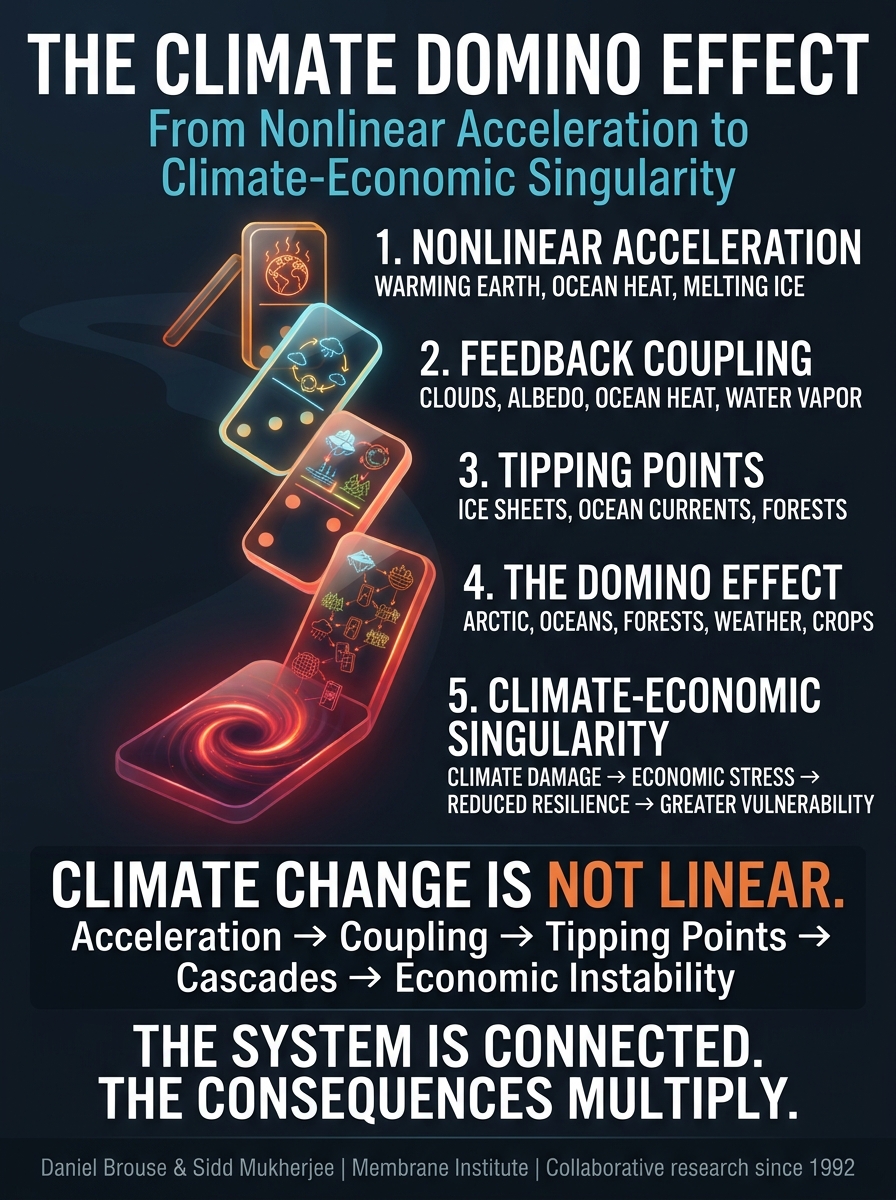
Climate change is not a collection of separate problems. It is a connected system of changes—and the consequences can multiply.
By Daniel Brouse¹ and Sidd Mukherjee²
November 14, 2026
¹ Independent Climate Researcher and Economist, Membrane Institute, USA
² Independent Physicist, Membrane Institute, USA
Climate change is often described as a gradual increase in Earth’s average temperature. But that description leaves out something important: the climate system is interconnected. Changes in one part of the system affect other parts, and those changes can reinforce one another.
The oceans absorb most of the excess heat trapped by greenhouse gases. That heat affects ocean circulation, sea ice, weather patterns, and marine ecosystems. Warming also changes the atmosphere, clouds, forests, soil moisture, and the amount of sunlight reflected back into space.
These processes do not operate independently. They interact.
The result is a climate system in which changes can accelerate, reinforce one another, and produce consequences that are much larger than any single change would suggest.
Our research brings together five related ideas:
Together, these ideas provide a framework for understanding how climate changes can spread through Earth’s natural systems and into the global economy.
A common assumption is that climate change will proceed at a relatively steady rate. But natural systems do not always change in straight lines.
A small change can produce a larger response. That response can then create conditions for even faster change.
Consider Arctic sea ice. As temperatures rise, ice melts and exposes darker ocean water. Dark water absorbs more sunlight than reflective ice. The additional absorbed energy warms the ocean, contributing to further ice loss.
This is a feedback loop: an initial change creates conditions that reinforce the original change.
Our Nonlinear Acceleration Hypothesis examines how these processes can cause the rate of climate change itself to increase.
In simple terms:
This means that looking only at average temperatures or long-term trends can miss important developments. We must also examine how quickly conditions are changing and whether that rate is increasing.
A feedback loop occurs when a change produces an effect that influences the original change.
Feedback coupling goes further. It describes what happens when multiple feedback processes interact.
For example:
Each process influences others.
The important point is that these interactions can amplify the overall response. The combined effect of several connected feedbacks can be greater than the effect of examining each one separately.
Our research examines these relationships through a proposed framework called the Coupled Climate Feedback Index. It is intended to help evaluate how interactions among indicators such as albedo, cloud cover, ocean heat content, sea ice, and temperature relate to changing climate conditions.
This approach emphasizes connections rather than treating each climate indicator as an isolated measurement.
A climate tipping point is a threshold beyond which a system can undergo a major change that becomes difficult to stop or reverse.
Some changes happen gradually. Others can accelerate after a threshold is crossed.
Examples of climate systems receiving serious scientific attention include:
A tipping point does not necessarily mean that an entire system changes overnight. Some changes unfold over decades or centuries. But once the underlying processes become self-reinforcing, returning to earlier conditions can become increasingly difficult.
Tipping points are especially important because they can interact. A change in one part of the climate system can increase the pressure on another.
That brings us to the next concept.
The Climate Domino Effect describes how changes in one climate system can trigger or intensify changes in other systems.
Imagine a series of connected dominoes. The first falls, then affects the next, and the process continues.
In the climate system, the connections are more complicated, but the general idea is similar.
For example:
The process can also work in the opposite direction. Damage to forests, for example, can reduce the ability of natural systems to absorb carbon dioxide and regulate water and energy flows.
The Domino Effect does not mean that every climate tipping point will automatically trigger every other one. It means that interconnected systems can transmit and amplify disturbances, increasing the risk of cascading changes.
Understanding these connections is essential to evaluating climate risk.
Climate change is not simply an environmental problem. It is also an economic problem.
Extreme heat, flooding, drought, stronger storms, sea-level rise, and ecosystem damage affect the assets and resources on which communities and economies depend.
The economic consequences include:
These costs are connected.
For example, a flood can damage a home, increase insurance costs, reduce property values, disrupt local businesses, and place additional financial pressure on a municipality.
When multiple climate-related events occur together or in rapid succession, the economic burden can compound.
This is why climate risk must be evaluated not only by measuring physical damage but also by examining how that damage spreads through financial systems and local economies.
Our Climate-Economic Singularity framework examines the possibility that climate and economic stresses can become increasingly interconnected and mutually reinforcing.
Climate damage creates economic losses. Economic losses reduce the resources available for recovery, adaptation, and infrastructure protection. Financial stress can then increase vulnerability to subsequent climate events.
For example:
The process can become a reinforcing cycle.
The same general pattern can occur at larger scales through food production, energy systems, international trade, public debt, and financial markets.
The term singularity is used here as a research framework for examining the possibility of increasingly rapid and interconnected climate-economic disruption. It does not imply that the global economy has already reached a single, precisely defined point of collapse.
The central concern is that climate and economic risks can become coupled, making each more difficult to manage independently.
The five concepts describe different parts of one connected process.
Nonlinear Acceleration: Climate change can increase in speed rather than proceeding at a constant rate.
Feedback Coupling: Interacting climate processes can reinforce and amplify one another.
Tipping Points: Some systems can cross thresholds that lead to major, difficult-to-reverse changes.
The Climate Domino Effect: Changes in one system can trigger or intensify changes in others.
Climate-Economic Singularity: Climate disruption and economic stress can become mutually reinforcing.
The overall progression can be summarized as:
Acceleration → Feedback Coupling → Tipping Points → Domino Effects → Economic Instability
This is a framework for examining connected risks, not a claim that every stage must occur in the same order or at the same speed.
It emphasizes why climate change must be understood as a system-wide challenge rather than a collection of unrelated environmental problems.
Understanding climate risks is only part of the challenge. We must also reduce the forces driving climate change and strengthen the systems on which communities depend.
Our approach is called Integrated Climate Stewardship.
Its central principle is:
ZERO-OUT + BENEFIT-IN
This means reducing harmful environmental impacts as directly as possible while also creating measurable benefits.
The approach emphasizes:
The objective is not simply to compensate for damage somewhere else. It is to reduce the damage being created and produce additional benefits wherever practical.
Individuals, households, businesses, and communities all have opportunities to contribute. Local decisions can reduce costs, improve resilience, and lessen the pressures placed on natural systems.
No single action will solve climate change. But coordinated action across many connected systems can make a meaningful difference.
Climate change is not a collection of separate problems. It is a connected system of changes, and the consequences can multiply.
Rising temperatures affect oceans, ice, clouds, forests, and weather patterns. These changes interact through feedback loops. Some systems approach or cross tipping points. Changes can spread through the climate system and produce cascading environmental and economic consequences.
The challenge is not simply to understand how much the planet is warming. We must also understand how quickly conditions are changing, how different processes interact, and how physical changes translate into economic risks.
The five concepts presented in this paper provide a framework for examining that larger picture.
The future will depend on how effectively we recognize these connections, reduce the underlying causes, and prepare our communities for the changes already underway.
Climate change is a system-wide problem. Our response must be system-wide as well.