[Silence]
[Arrangement: Up-tempo piano rock with pulsing bass, organ swells, blues guitar riffs, and layered call-and-response vocals; urgent but reflective, building toward a driving final chorus]
[Intro]
… waited
(As the future came)
… left
(Without a name)
[Verse 1]
The river climbed
(Above the mark)
The power failed
(And left the dark)
The road gave way
(The bridge went too)
One broken link
(Then another one through)
The crops dried out
(Then the rains arrived)
The ground cracked open
(Then came the tide)
What once was home
(Began to bend)
And every refuge
(Reached its end)
[Chorus]
Is that what you meant?
(Displacement)
Are we really hellbent?
(Displacement)
How many losses
(Before consent?)
Is that what you meant?
(Displacement)
[Verse 2]
A flooded field
(A shuttered store)
A water line
(At the kitchen door)
A job gone missing
(A school shut down)
A train of reasons
(To leave the town)
The map still says
(That people stay)
But the facts on the ground
(Have drifted away)
You don’t just move
(Because it rains)
You move when the whole
(System pains)
[Chorus]
Is that what you meant?
(Displacement)
Are we really hellbent?
(Displacement)
How many losses
(Before consent?)
Is that what you meant?
(Displacement)
[Bridge]
[Instrumental]
[Piano Solo]
[Organ Solo]
[Breakdown]
Move again
(Begin again)
Pack it up
(Pack it in)
Move again
(Begin again)
[Final Chorus]
Is that what you meant?
(Displacement)
Are we really hellbent?
(Displacement)
Not one disaster
(But a system spent)
Not one collapse
(But a continent bent)
Is that what you meant?
(Displacement)
[Final Refrain]
Forced to move
(Displacement)
No place left
(Displacement)
Threshold crossed
(Displacement)
What was lost?
(Displacement)
[Outro]
Where do we go?
(And the wind said)
You already know
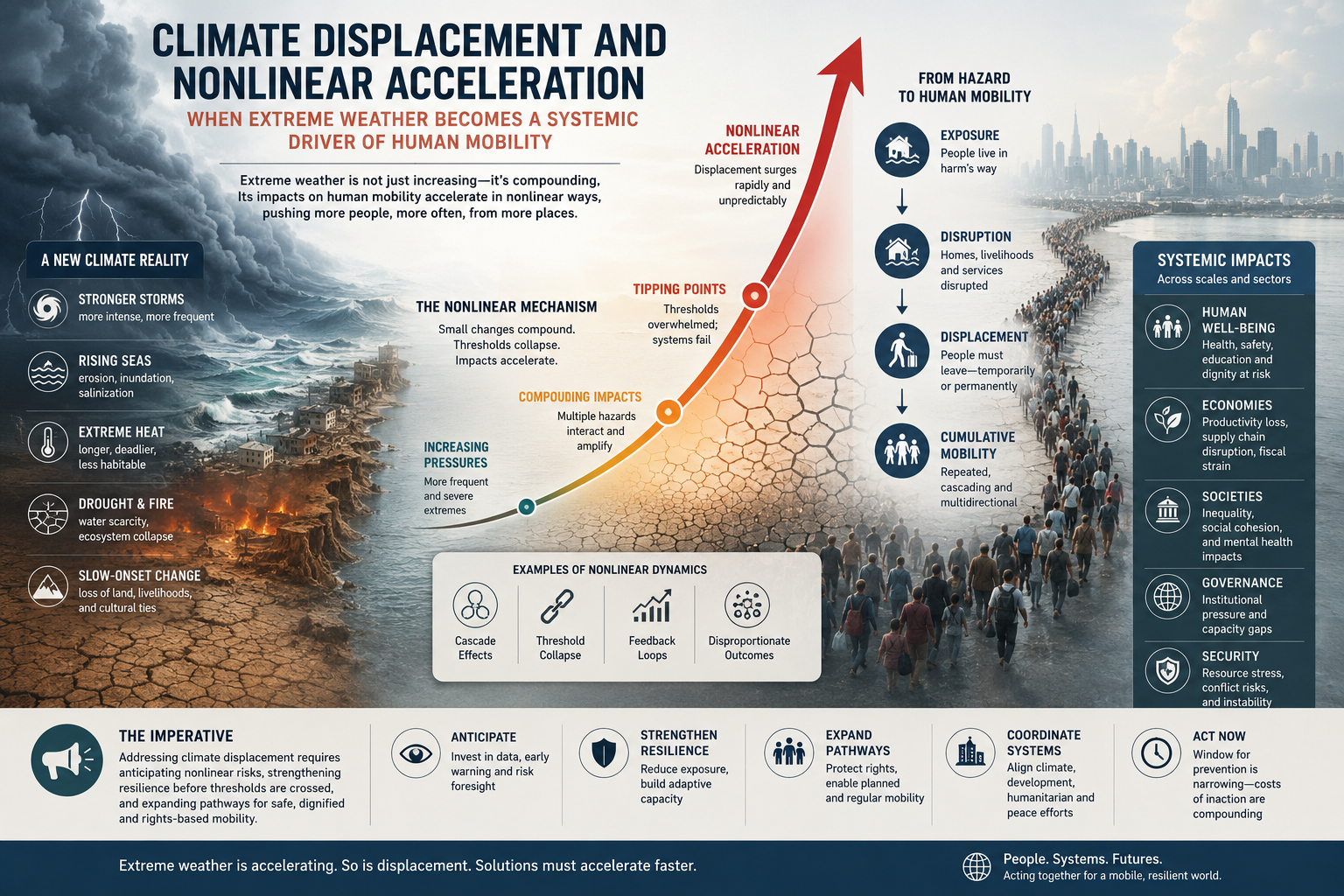
About the Song: When Extreme Weather Becomes a Systemic Driver of Human Mobility
Displacement is increasingly best understood as a systems-level indicator. It measures not only the physical impact of a storm, flood, drought, wildfire, or heatwave, but also the failure of social and ecological buffers that once absorbed those shocks. When households are forced to move, it means a threshold has been crossed: infrastructure failed, livelihoods failed, food systems failed, water systems failed, governance failed, or some combination of the above failed at once.
The 2026 Global Report on Internal Displacement provides a stark snapshot of this process. By the end of 2025, 82.2 million people were living in internal displacement across 104 countries and territories. Of those, 68.6 million were displaced by conflict and violence and 13.6 million by disasters.
A linear view of climate displacement assumes a relatively simple chain of causation:
warming → more extreme weather → more damage → more displacement
But the real system increasingly looks more like this:
warming → hydrologic intensification → drought/flood volatility → crop loss + infrastructure damage + water insecurity + economic stress + conflict risk → repeated displacement → prolonged displacement → social destabilization
In other words, displacement is not driven by one variable. It emerges from coupled feedbacks.
The latest year-over-year increase implies an effective doubling time of roughly 2.2 years.
From the album “Displacement“