[Intro]
[Instrumental Intro: Twisting Guitar Riff, Deep Bass Pulse, Organ Swells, Spiral Synth Effects, Building Drums]
[Minimal Beat, Sub Bass, Spoken Vocal]
Round and round…
(Spinning faster)
Up and down…
(Weather master)
[Intro]
[Instrumental Intro: Crackling Fire FX, Heavy Bass Pulse, Distorted Guitar, Organ Swell, Building Drums]
[Minimal Beat, Sub Bass, Spoken Vocal]
One spark…
(Starts the fall)
One flame…
(Becomes a wall)
Through the trees
(Across the land)
Changing lives
(Out of hand)
Higher heat
(Longer dry)
Watch the flames
(Reach the sky)
Wow! That’s wild…
(Fire!)
[Outro]
[Instrumental Outro: Crackling Fire, Echo Guitar, Deep Organ Fade, Wind Effects]
Wild fire…
(Wild fire…)
Still burning…
…higher and higher…!
About the Song
Wildfires are no longer seasonal events confined to traditionally fire-prone regions. In many parts of the world, wildfire seasons are starting earlier, lasting longer, and burning with unprecedented intensity. Areas that historically experienced only occasional fires are increasingly facing repeated and severe wildfire outbreaks.
Global Impact
Catastrophic climate shifts have dramatically increased wildfire risk worldwide. Since 1980, the frequency of socially disastrous wildfires has approximately quadrupled globally. Rising temperatures, prolonged droughts, declining snowpack, and increasingly erratic precipitation patterns are creating landscapes that are hotter, drier, and more combustible than at any time in modern history.
Escalating Boreal Wildfires and Climate Feedbacks
Satellite observations indicate that extreme wildfires in Canada and Siberia have approximately doubled in both frequency and intensity over the past two decades. Driven by rising temperatures, changing precipitation patterns, and thawing permafrost, these regions are experiencing unprecedented increases in burn severity.
Global Impacts of Boreal Wildfires
Air Quality and Health: Smoke from major boreal fires travels across international boundaries, routinely degrading air quality for millions of people throughout North America and Eurasia.
Carbon Emissions: Massive releases of greenhouse gases from burning peatlands and forests can temporarily transform northern ecosystems from carbon sinks into net carbon sources.
Climate Feedbacks: While wildfire smoke can temporarily cool the Arctic by blocking incoming sunlight, it also deposits soot on snow and ice, accelerating melting and reinforcing long-term warming.
Interconnected Climate Feedback Loops
The intensification of wildfires in Siberia and Canada initiates a series of interconnected feedback mechanisms that amplify both regional destruction and global climate change.
[Verse 2]
The ridge grows taller overhead
Storms are pushed away instead
Rain goes somewhere else to fall
Leaving heat to cover all
An Omega fills the sky
Like a giant question: why?
Weather stalls for days on end
Waiting for the winds to bend
[Pre-Chorus]
Blocking high
(Standing still)
Nature follows
(Physics’ will)
[Bridge]
One place burns
(Another floods)
One place dries
(Another muds)
Around the world
(The pattern flows)
Following where
(The jet stream goes)
Wave by wave
(It circles free)
Connecting one
(To many seas)
[Breakdown]
[Minimal Beat, Deep Sub Bass, Spoken Vocal]
Where ever I may roam
(Under a heat dome)
Oh, that Rossby wave
(Just won’t behave)
[Final Chorus]
Where ever I may roam
(Under a heat dome)
Oh, that Rossby wave
(Just won’t behave)
Higher highs
(Longer stays)
Day by day
(The endless blaze)
Heat builds up
(Above our home)
Beneath another
(Heat dome)
Ride the ridge…
(Feel the heat…)
Until the pattern…
(Finds retreat…)
[Outro]
[Instrumental Outro: Slow Guitar Echoes, Organ Fade, Warm Synth Pad, Soft Wind Effects]
Wherever I may roam…
(Under a heat dome…)
Rossby waves…
(Misbehaves)
Waiting… for the sky to rearrange…
…for the wind to change.
About the Song: Heat Domes & Atmospheric Blocking
Large-scale atmospheric energy accumulations that trap heat, amplify temperature extremes, and create dangerous persistence.
Jet Stream Destabilization and Rossby-Wave Amplification
Under historically stable conditions, the jet stream generally flowed in a relatively progressive west-to-east pattern across the United States and southern Canada.
As thermal gradients weaken:
zonal winds slow,
the jet stream elongates,
Rossby waves become more amplified,
wave propagation slows,
and atmospheric blocking becomes increasingly persistent.
The result is a circulation regime characterized by “stuck” weather patterns and amplified climatic extremes.
Observed Consequences Include:
persistent heat domes,
prolonged cold-air outbreaks,
stalled storm systems,
multi-day severe weather outbreaks,
extreme rainfall persistence,
prolonged droughts,
and compound climate disasters.
Many of the most extreme recent weather events globally exhibit these characteristics.
Omega Block Ω
An omega block is essentially an extreme, highly amplified Rossby-wave pattern where the jet stream bends into the shape of the Greek letter Ω. These blocking patterns slow atmospheric circulation dramatically and can “lock” weather systems in place for days or even weeks.
That is a major factor behind persistent heat domes in the central U.S. Instead of weather systems moving progressively west-to-east as they historically did, the amplified wave stalls, allowing heat to continuously build beneath the ridge while storms and cooler air are diverted around it.
As these amplified Rossby waves meander around the hemisphere, similar blocking impacts can propagate into other regions at comparable latitudes — including the UK, Europe, and parts of Asia. That is why we increasingly see synchronized extremes globally: prolonged heatwaves in one region while other areas experience stalled flooding, cold intrusions, or drought.
Create an infographic with three side-by-side panels illustrating three ways climate change accelerates through interconnected feedback mechanisms. Use a clean, scientific style with bold titles, arrows, and simple labels. The overall theme should emphasize accelerating nonlinear change rather than isolated events.
Panel 1: Climate Change as a Domino Effect
Illustrate a vast, complex maze of dominoes representing climate tipping points. A single falling domino triggers a chain reaction that spreads through multiple pathways, knocking over many other tipping points simultaneously.
Include examples of dominoes labeled:
Arctic Sea Ice Loss
Permafrost Thaw
Greenland Ice Sheet Melt
Boreal Forest Dieback
Amazon Rainforest Dieback
Ocean Warming
Wildfires
Methane Release
Extreme Weather
Water Scarcity
Food Insecurity
Human Migration
The image should convey that one feedback loop can trigger many others, producing cascading climate tipping points throughout the Earth system.
Panel 2: Climate Change as a Snowball Effect
Show a small snowball beginning at the top of a mountain slope. As it rolls downhill, it becomes dramatically larger, faster, and more powerful, symbolizing increasing momentum.
As the snowball grows, illustrate climate impacts accumulating around it:
Rising temperatures
Ice melt
Reduced albedo
Ocean heat accumulation
Atmospheric water vapor
Stronger storms
Floods
Droughts
Wildfires
Sea-level rise
Use arrows to emphasize positive feedback, showing that each new impact increases the size and momentum of the snowball.
The final snowball at the bottom should appear enormous, illustrating how crossing climate tipping points leads to cumulative, self-reinforcing global warming that becomes increasingly difficult to slow or reverse.
Panel 3: Climate Change as a Complex Web of Feedback Loops
Create a network diagram centered on Global Warming, with interconnected nodes linked by arrows in multiple directions.
Organize the nodes into three interconnected categories:
Ecological Feedbacks
Ice-Albedo Feedback
Permafrost Methane
Ocean Warming
Forest Dieback
Wildfires
Carbon Cycle Changes
Economic Feedbacks
Rising Energy Demand
Infrastructure Damage
Insurance Losses
Agricultural Decline
Supply Chain Disruptions
Resource Scarcity
Social Feedbacks
Human Migration
Public Health Impacts
Conflict
Political Instability
Food Insecurity
Water Scarcity
Use numerous looping arrows to show that these ecological, economic, and social systems continually reinforce one another rather than operating independently.
The overall visual should resemble a dynamic interconnected network, emphasizing that climate change is not a single linear process but a complex adaptive system of mutually reinforcing feedback loops that accelerate global warming.
Feedback Loops → Tipping Points → Acceleration → Domino Effect
Feedback loops amplify climate change and can push interconnected Earth systems past critical tipping points. As tipping points are crossed, they can trigger additional feedback loops and destabilize other climate systems. This cascading “Domino Effect” compresses timescales, accelerates change, and increases the risk of rapid, nonlinear climate transformations.
[Verse 2]
Storms don’t vote or pick a side
Floods don’t stop because of pride
Heat keeps building day by day
While excuses blow away
The gust can tell the truth
The season offers proof
Watch the sky instead of spin
That’s where the story begins
[Bridge]
Bluster louder
(If you must)
Strong opinions
(Turn to dust)
When the evidence appears
It outlasts the loudest cheers
[Breakdown]
[Minimal Beat, Deep Bass, Spoken Vocal]
The wind…
…doesn’t care what you believe.
Can you conceive…
…the laws of physics?
[Final Chorus]
What does the blowhard
(Have to say today?)
As the winds blow hard
(Watch him get blow away)
Hey! Hey! Hey!
Talk is easy
(Proving’s hard)
Nature you’ll see
(Plays the card)
Storm by storm
(Day by day)
The truth keeps blowing
(Anyway)
[Outro]
[Instrumental Outro: Wind FX, Echo Guitar, Organ Fade, Snare Rolls]
[Refrain]
What does the blowhard
(Have to say today?)
As the winds blow hard
(Watch him get blow away)
[Intro]
[Instrumental Intro: Driving Guitar Riff, Rolling Bass, Organ Swells, Thunder FX, Building Drums]
[Minimal Beat, Spoken Vocal]
Climb aboard…
(Here we go)
Winds are rising…
(Feel them blow)
[Refrain]
Ridin’ the storm
(To the new norm)
Is it any surprise
(Rise of the thrillin’ ride)
Ride, ride, ride
[Verse 1]
Clouds are stacking mile on mile
Nature’s wearing a different smile
Heat becomes the driving force
Sending weather off its course
[Chorus]
Ridin’ the storm
(To the new norm)
Winds are stronger
(Longer, longer)
Rain comes down
(Harder still)
Nature climbs
(Another hill)
[Verse 2]
The winds don’t ask which road you take
The floods don’t choose which levees break
Yes, the system seeks release
Until the forces find their peace
More energy within the air
Means more power everywhere
What was steady yesterday
Can be swept away today
[Pre-Chorus]
Watch the signs
(Read the sky)
Don’t assume
(It passes by)
[Bridge]
Preparation
(Beats surprise)
Listen well
(Open your eyes)
Heed the warning
(Know its name)
Learn the lesson
(Play the game)
Respect the power
(Respect the force)
Nature follows
(Its own course)
[Breakdown]
[Minimal Beat, Deep Bass, Spoken Vocal]
You don’t negotiate…
…with physics.
(Are you aware…)
You prepare.
[Final Chorus]
Sooo… you might
(Wanna hold on tight)
Cause the fright
(Might ignite)
Hold on tight
(Stay aware)
Changing weather
(Is everywhere)
Plan for whether
(Through the night)
Face tomorrow
(In the light)
Sooo… you might
(Wanna hold on tight)
[Outro]
[Instrumental Outro: Echo Guitar, Organ Sustain, Rolling Drums Fade, Soft Synth]
Hold on…
(Hold on…)
[Intro]
[Instrumental Intro: Deep Ocean Bass Pulse, Rising Synth Atmosphere, Distant Thunder, Tremolo Guitar, Heavy Drums Building]
[Minimal Beat, Sub Bass, Spoken Vocal]
The waters warm…
(The pressure falls)
The winds begin…
(The ocean calls)
A season starts…
(That never ends)
A cycle turns…
(Again, again)
[Refrain]
What’s the reason
(For an extended season)
Name
(That hurricane)
A past Z
(Way too easy)
Are we so vain
(Takin’ on a hurricane)
[Verse 1]
The ocean holds the hidden key
Energy beneath the sea
Heat rises through the atmosphere
Feeding storms that draw near
A little more, a little fast
Breaking records from the past
What was once a distant threat
Now becomes a closer bet
[Pre-Chorus]
Warmer water
(Fuels the fire)
Rising pressure
(Climbs higher)
Latent heat
(Releases the force)
Storms accelerate
(Along their course)
[Chorus]
Hurricane season
(Changing the reason)
Stronger storms
(Coming ashore)
More intensity
(More energy)
More than we’ve seen before
A hurricane
(A spinning engine)
Powered by heat
(From the ocean within)
[Instrumental]
[Guitar Solo]
[Heavy Bass Groove, Organ Swells, Driving Drums, Synth Sounds Like Rotating Storm Bands]
[Verse 2]
Pressure drops and winds increase
The storm grows stronger piece by piece
Clouds rise high, the rainfall grows
Following where the warm water flows
Rapid changes near the shore
Stronger than the storms before
Less time left to understand
Before the winds reach land
[Pre-Chorus]
Lower pressure
(Stronger winds)
More moisture
(Storm begins)
Ocean mixing
(Feeds the flow)
Where it ends
(We don’t know)
[Bridge]
Is it only weather?
(Or something more?)
Is the pattern changing?
(From shore to sure)
Watch the waters
(Watch the skies)
Watch the storms
(As they rise)
The engine turns
(The cycle spins)
A warmer world
(The storm begins)
[Breakdown]
[Minimal Beat, Deep Sub Bass, Spoken Vocal]
A hurricane is not just wind.
It is energy moving.
Heat becomes pressure.
Pressure becomes motion.
Motion becomes destruction.
(Nature’s revolution)
[Final Chorus]
What’s the reason
(For an extended season)
Name
(That hurricane)
A past Z
(Way too easy)
Are we so vain
(Takin’ on a hurricane)
Hurricane season
(Changing the reason)
Storms arise
(Before our eyes)
More energy
(More intensity)
Under changing skies…
[Outro]
[Instrumental Outro: Thunder Rolls, Echo Guitar, Deep Organ Fade, Synth Storm Dissolves]
Hurricane…
(Season)
Hurricane…
(Reason)
The waters turn…
The winds return…
Again… and again… and again…
About the Song
Hurricanes / Tropical Cyclones: Among Earth’s most powerful heat engines, converting ocean heat into enormous wind fields, storm surge, extreme rainfall, and destructive energy release.
[Intro]
[Instrumental Intro: Deep Rolling Bass, Water-Like Synth Pulses, Echo Guitar, Distant Thunder, Rising Organ Swell]
[Minimal Beat, Sub Bass, Spoken Vocal]
The water rises…
(Beyond the line)
The old predictions…
(Left behind)
[Refrain]
Flooded
(With emotion)
As our home
(Flooded)
… in the flood zone
(I’ve a notion)
Going down
(Down, down, down)
Don’t wanna drown
(Going down)
Down, down, down
[Verse 1]
Once they called it once in time
A rare event beyond the line
Five hundred years before it came
A number written in the name
But the numbers started changing
As the climate kept rearranging
What was rare began to show
More often than we used to know
[Chorus]
Flooded
(Overrun)
Water rising
(One by one)
Through the streets
(Across the ground)
Where the dry land
(Used to be found)
[Refrain]
Flooded
(With emotion)
As our home
(Flooded)
… in the flood zone
(I’ve a notion)
Going down
(Down, down, down)
Don’t wanna drown
(Going down)
Down, down, down
[Instrumental]
[Guitar Solo]
[Heavy Bass Groove, Rolling Drums, Organ Waves, Synth Sounds Like Rising Water]
[Verse 2]
The atmosphere can hold more weight
More moisture building while we wait
When the skies release the load
Rivers surge beyond the road
[Pre-Chorus]
Ten-year storms
(Return again)
Hundred-year floods
(Became the trend)
[Bridge]
Statistics move
(When systems change)
Probability
(Rearranges)
The past is not
(The same guide)
When the future
(Changes tide)
[Breakdown]
[Minimal Beat, Deep Sub Bass, Spoken Vocal]
A flood is not only water.
It is probability.
It is energy.
It is a reality.
[Refrain]
Flooded
(With emotion)
As our home
(Flooded)
… in the flood zone
(I’ve a notion)
Going down
(Down, down, down)
Don’t wanna drown
(Going down)
Down, down, down
[Final Chorus]
Flooded
(With emotion)
As our home
(Flooded)
… in the flood zone
(I’ve a notion)
Going down
(Down, down, down)
Don’t wanna drown
(Going down)
Down, down, down
Flooded
(Feel the tide)
Changing currents
(Changing lives)
What was rare
(Is now near)
What was distant
(Is now here)
[Outro]
[Instrumental Outro: Water Effects, Echo Guitar, Deep Organ Chords, Slow Synth Fade]
Going down…
(Down, down, down)
Don’t wanna drown…
Flooded…
(Flooded…)
About the Song
One of the simplest ways to understand climate change is through the changing frequency of extreme events.
Climate change is not merely causing temperatures to rise. It is fundamentally altering the probability of extreme weather. Events that were once considered extraordinarily rare are becoming increasingly common.
In the 1990s, what was considered a 500-year flood had only a 0.2 percent chance of occurring in any given year.
By the early 2000s, many of these same events were being reclassified as 100-year floods. By the 2020s, they increasingly resembled 10-year floods. Today, in some regions, comparable flood events are occurring every few years.
This does not mean that every flood is becoming larger than previous floods. Rather, the statistical framework itself is changing. The atmosphere and oceans now contain significantly more energy and moisture than they did several decades ago, increasing the likelihood of extreme rainfall events.
[Intro]
[Instrumental Intro: Deep Thunder Bass, Rolling Drums, Dark Piano Chords, Rising Synth Atmosphere, Distorted Guitar Swells]
[Minimal Beat, Sub Bass, Spoken Vocal]
The clouds gather…
(Energy rising)
The waters come…
(No more hiding)
[Refrain]
The rain…
(Is gonna reign over me)
All pain
(No gain)
The troubles we could see
If we let the violent reign
(… remain…)
[Verse 1]
Rain has always fallen down
Rivers flow through every town
But the energy has changed
And the balance rearranged
When the clouds release their load
Floods begin to overflow
[Pre-Chorus]
More water
(More force)
More motion
(Off course)
[Chorus]
Violent reign
(Pouring down)
Turns a smile
(Intо a frown)
Heavy drops
(Falling fast)
Changing futures
(Changing past)
Not just rain
(Not the same)
Energy
(Feeds the game)
[Verse 2]
Wind and water carry weight
Small increases escalate
Raindrops growing, rivers rise
Floodwaters take by surprise
What was once a passing storm
Now can break the strongest form
[Pre-Chorus]
Higher heat
(More supply)
More moisture
(In the sky)
When it falls
(From above)
Comes with force
(Not just love)
[Bridge]
Temperature
(Is the clue)
Energy
(Is what moves through)
Heat becomes
(The storm and sea)
Changing what
(The world can be)
Not only warmer…
(Not only hot…)
But more powerful
(Than we thought)
[Breakdown]
[Minimal Beat, Deep Sub Bass, Spoken Vocal]
Violent rain…
Not just more drops.
More energy.
More water.
More force.
(Change our course)
[Final Chorus]
The rain…
(Is gonna reign over me)
More strain
(To gain)
The troubles we could see
If we let the violent reign
(… remain…)
More intense
(More extreme)
More destructive
(Than it seems)
Storms arrive
(From above)
On the drive
(Drowning out the love)
[Outro]
[Instrumental Outro: Heavy Rain Effects, Echo Guitar, Deep Organ, Thunder Rolls Fading Into Silence]
The rain…
(Is gonna reign…)
The rain…
(Will remain…)
Unless we change…
(The violent reign.)
The Reign of Violent Rain
About the Song
“Climate change is increasing the amount of energy violent rain events contain, amplifying how much damage they can inflict.”
The physics of wind and rain are important to understand: their destructive force increases nonlinearly with velocity and is further amplified by density and mass. Even relatively small increases in wind speed or rainfall intensity can produce disproportionately larger impacts and damage.
Many people equate global warming solely with increasing temperatures. This is a deadly misunderstanding. The additional energy accumulating within Earth’s climate system does not remain simply as heat. It is redistributed throughout the atmosphere and oceans, manifesting in many forms of extreme weather, including floods, stronger storms, atmospheric rivers, and increasingly destructive episodes of violent rain.
Violent rain is not merely heavier rainfall. It is rainfall intensified by the additional energy and moisture now present in the climate system, producing larger raindrops, higher rainfall rates, more intense runoff, and more destructive flooding and erosion.
[Verse 2]
More potential, more release
Less assurance, less peace
Small increases, larger cost
Power gained and power lost
Storms that seemed ordinary
Suddenly become extraordinary
[Bridge]
Not just warmer
(More alive)
Not just hotter
(More drive)
… it gathers, concentrates
And arrives without debate
[Breakdown]
[Minimal Beat, Deep Bass Pulse, Spoken Vocal]
Time to test:
(Evaporated.)
Concentrated.
(Released.)
The beast.
(Manifest.)
Put to the test
(Manifest.)
[Final Chorus]
Microburst
(Bust!)
… through…
(Raining down on you)
Microburst
(Gust!)
… blew…
(Right over you)
What seemed calm
(Became severe)
What seemed distant
(Is now here)
More energy
(More extremes)
More surprises
(Than it seems)
(Released.)
The beast.
(Manifest.)
Put to the test
(Manifest.)
About the Song
Microbursts illustrate a fundamental principle of climate physics: a warmer world is a more energetic world. As greenhouse gases trap additional heat, the atmosphere holds more moisture, stores more potential energy, and increasingly creates conditions favorable for powerful convective storms.
Because the relationship between energy and damage is nonlinear, relatively modest increases in storm intensity can lead to disproportionately larger consequences. A short-lived microburst can transform an ordinary summer storm into a destructive event capable of flattening trees, crippling power infrastructure, and threatening lives within minutes.
Microbursts therefore serve as a reminder that climate change is not simply a story of gradually rising temperatures. It is also a story of how additional energy in Earth’s system increasingly manifests through sudden, concentrated, and extreme weather events. Understanding these processes is essential for improving forecasting, strengthening infrastructure resilience, and adapting to a climate system that is becoming progressively more volatile and energetic.
Microbursts: Violent Downdraft Spreading in All Directions
<– ← WIND ← IMPACT → WIND → –>
Explodes Outward
Storm surge (Feel the force)
No longer distant (Now the course)
[Outro]
[Instrumental Outro: Massive Drums, Echoing Guitar, Ocean Waves, Dark Organ Fade]
Storm surge… (Storm surge…)
Energy purge…
On the verge… (On the edge…)
Over the ledge.
About the Song: Climate Change and Storm Surges
Climate change is dramatically worsening storm surges by raising baseline sea levels and creating conditions that favor more intense coastal storms. As the planet warms, the combination of rising oceans and increasingly energetic weather systems allows seawater to penetrate farther inland with greater destructive force, placing millions of people and billions of dollars in coastal infrastructure at increasing risk.
Key Drivers of Worsening Storm Surges
Rising Sea Levels: This is the primary driver of increasing coastal flood risk. Global warming melts land-based ice sheets and glaciers while also causing seawater to expand as it warms. Because sea levels are higher than they were a century ago, today’s storm surges begin from an elevated baseline, allowing floodwaters to reach much farther inland.
Increased Storm Intensity: Warmer ocean temperatures provide additional energy for tropical cyclones, effectively increasing their potential intensity. Stronger storms generate more powerful winds that pile up and push enormous volumes of water toward coastlines, producing higher and more destructive storm surges.
Rapid Intensification: The accumulation of heat in the upper ocean has increased the likelihood of rapid intensification events, in which hurricane wind speeds increase by at least 35 mph within a 24-hour period. This accelerated strengthening dramatically reduces the time available for forecasts, evacuations, and emergency preparations.
Slower-Moving Storms: Some studies suggest that climate change may contribute to a reduction in the forward speed of certain tropical cyclones. When storms move more slowly, they remain over coastal areas longer, generating prolonged storm surges, heavier rainfall, and repeated wave impacts that compound flooding and infrastructure damage.
The Bottom Line
Storm surges are becoming more dangerous because they are increasingly occurring on top of a rising ocean and, in many cases, are being driven by more energetic storms. The result is deeper flooding, greater inland penetration of seawater, longer-lasting impacts, and rapidly escalating economic and human costs.
[Refrain]
Extreme Energy Events
(Presents:)
More!
(Rain)
More!
(Pain)
[Verse 1]
People hear the phrase “warming world”
Think the change is neatly curled
Just a number climbing slow
One degree or two to go
But heat won’t sit in place
Energy runs the race’s pace
Stored and shifted, pushed around
Turning sky and sea and ground
[Pre-Chorus]
Heat goes in
(Then transforms)
Changing shape
(Into storms)
[Chorus]
Extreme Energy Events
(Presents:)
More!
(Waves)
Who
(Saves?)
More!
(Heat)
More!
(Beat)
Energy finds another street
[Verse 2]
Winds accelerate and race
Storms intensify their pace
Moisture rises, clouds expand
Heavy rains sweep through the land
Latent heat and ocean flow
Feed the systems as they grow
Lightning flashes through the sky
Wildfires spread and glaciers slide
Watch the joules begin to roam
Far away… now close to home
[Instrumental]
[Guitar Solo]
[Driving Bass, Organ Chords, Synth Arpeggios]
[Bridge]
Kinetic energy
(Moving air)
Potential energy
(Rising there)
Latent heat
(Hidden force)
Electrical energy
(Changing course)
Mechanical work
(Shaping shore)
Chemical feedbacks
(And more… and more…)
[Breakdown]
[Minimal Beat, Deep Sub Bass, Spoken Vocal]
Global warming…
(Is only the beginning.)
Temperature is the signal.
Energy…
(Is the story after all)
[Final Chorus]
Extreme Energy Events
(Presents:)
More!
(Rain)
More!
(Strain)
More!
(Fire)
Dire
(Higher)
More extreme
(Now what I mean)
Think not only in degrees
(Think in motion)
Think in gradients and seas
(Think in oceans)
Think in forces, flows, and streams
(And momentum)
Think in joules and what it means
(Where they send them)
Extreme Energy Events
(Presents:)
[Outro]
[Instrumental Outro: Echo Guitar, Rolling Drums, Organ Sustain, Synth Slowly Dissolving]
Extreme energy…
(In motion)
Extreme energy…
(Transformation)
Extreme event
(… in the present)
About the Song
The phrase global warming is widely misunderstood. While it correctly describes a rise in average surface temperature, it understates the real risk: a rapid increase in total system energy. Temperature is only the initial signal. Once excess energy accumulates, it is transferred, converted, and expressed through atmospheric circulation, ocean dynamics, hydrological cycling, and ecological responses.
Global warming is therefore the beginning of climate change — not its endpoint.
Extreme Energy Events
Excess trapped thermal energy is continually transformed into other forms, including:
Kinetic Energy (stronger winds, faster storm systems)
Gravitational Potential Energy (enhanced vertical convection, intensified precipitation)
Latent Heat (phase changes driving hurricanes and atmospheric rivers)
Radiant Energy (infrared trapping and feedback amplification)
Chemical Energy (biogeochemical feedbacks, wildfire combustion)
Electrical Energy (increased lightning frequency in convective systems)
Mechanical Work (coastal erosion, glacier flow acceleration, ocean mixing)
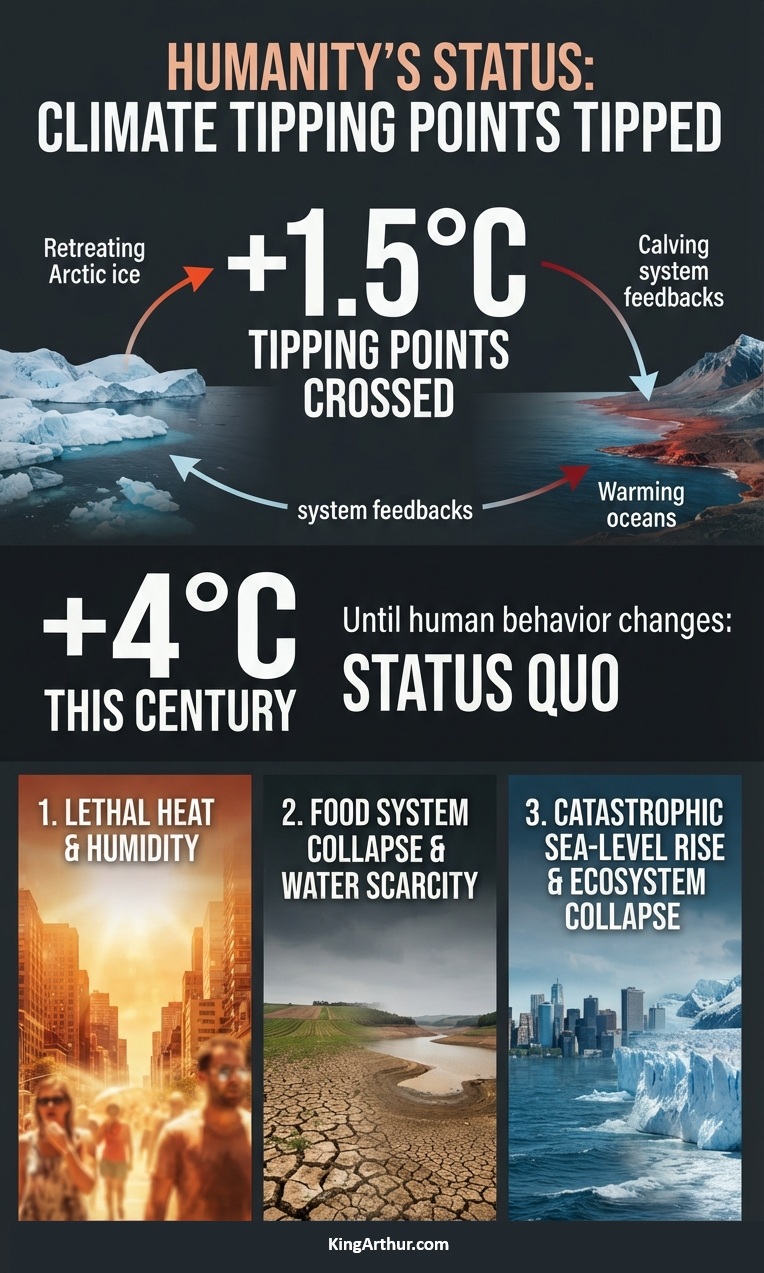
In 2025, global mean temperatures exceeded the long-recognized 1.5°C threshold. To a casual observer, that number may sound small. In a nonlinear system, it is not.
Small shifts in average temperature translate into large, destabilizing shifts in gradients — temperature gradients, pressure gradients, and moisture gradients. Those gradient changes alter circulation patterns, intensify convection, amplify hydrological extremes, and increase momentum transfer.
What emerges are not merely “weather events,” but what are more accurately described as:
Extreme energy events.
Understanding climate change requires thinking not in degrees —
but in joules.
“We are not saying that the Earth’s temperature is just going to rise. In general, as energy is added to a system, the fluctuations in the system increase. So, we expect more storms, more droughts, more wildfires, more floods, more fluctuations of all kinds. What we are saying is that weather conditions will become more volatile due to the impact of humans,” said Sidd Mukherjee and Daniel Brouse (2004)
“What used to be a once-in-a-hundred-year event is now an annual event.” (2017)
Q:“Has Earth ever experienced a climate change with this combination of speed, acceleration, and simultaneous disruption across Earth?”
A: No.
Extreme Weather: Where We Are
There is no comparison in the geological record. The present is revealing a system changing at a rate that may be outside the range experienced throughout human civilization and perhaps for millions of years.
Q: “What Are the Immediate Impacts?”
A: More extreme weather.
Severe weather is becoming more frequent, more intense, and more persistent, with extreme events lasting longer and affecting larger areas.
Bottom line: We cannot control the laws of physics, but we can control the amount of heat-trapping gases we add to the atmosphere. The most effective action is to phase out fossil fuel combustion as quickly as possible. (2026)