[Silence]
[Instrumental Intro: sly blues-rock guitar, bass, piano, and a steady cash-register rhythm]
[Intro]
They said it was distant
(Too far away)
Something for tomorrow
(Not today)
But tomorrow came knocking
(On the front door)
And suddenly the mocking
(Costs a little more)
[Verse 1]
The roof needs fixing
(The storm came through)
The premium’s rising
(What can you do?)
The insurer’s nervous
(So am I)
The policy’s canceled
(Well, goodbye!)
[Refrain]
What will change you, honey?
(Money!)
Need some assurance
(About insurance)
And the fate
(Of the interest rate)
Taxes are taxing me
(Climate reality)
What will change you, honey?
(Money!)
[Verse 2]
Mortgage payment climbing
(The rate went high)
Climate risk pricing
(You wonder why)
The lender’s calculating
(The risk in the loan)
Location, exposure
(You’re on your own?)
Higher cost of capital
(Higher cost of debt)
When risk gets repriced
(You ain’t seen nothing yet)
A house isn’t just a house
(It’s an asset, you see)
It’s weather, water, wildfire
(And geography)
[Pre-Chorus]
You can ignore
(A temperature chart)
You can debate
(The science part)
But when the bill
(Comes through the door)
You start asking
(What was this for?)
[Refrain]
What will change you, honey?
(Money!)
Need some assurance
(About insurance)
And the fate
(Of the interest rate)
Taxes are taxing me
(Climate reality)
What will change you, honey?
(Money!)
[Bridge]
Climate change
(Prices rearrange)
Risk becomes
(A financial cost)
And the cost becomes
(A consumer loss)
[Break]
What happens
(When the wallet feels it?)
What happens
(When the market reveals it?)
What happens
(When the numbers don’t lie?)
You can close your eyes
(But when the bill comes… you cry!)
[Refrain]
What will change you, honey?
(Money!)
Need some assurance
(About insurance)
And the fate
(Of the interest rate)
Taxes are taxing me
(Climate reality)
What will change you, honey?
(Money!)
[Instrumental: cash-register percussion, blues guitar solo, piano stabs]
[Final Chorus]
Climate short changed
(Short changed!)
Paying for the weather
(Again and again)
Climate short changed
(Short changed!)
Everywhere you turn
(It’s the cost of the trend)
[Final Refrain]
What will change you, honey?
(Money!)
Need some assurance
(About insurance)
And the fate
(Of the interest rate)
Taxes are taxing me
(Climate reality)
[Outro]
What will change you, honey?
(Money!)
Climate short changed
(Deranged!)
You don’t need to love it
(You don’t need to hate)
You don’t even have to
(Participate)
But if the price keeps rising
(You’ll probably find)
Climate change
(Has changed your mind)
Climate short changed
(Short changed…)
Money…
(Honey…)
See…
(Climate reality.)
About the Song
When Climate Change Hits the Wallet: Insurance, Interest Rates, and Taxes
What will actually change consumer behavior when it comes to climate change?
đ° Money.
Insurance. Interest rates. Taxes.
For years, climate change was largely treated as an environmental issue. But that is changing as climate risk increasingly enters the household economy.
đ Insurance premiums and availability are being affected by rising climate risks.
đ° Climate-related economic and fiscal pressures are affecting the cost of capital.
đ§Ÿ The growing costs of climate damage, adaptation, infrastructure, and energy transition are increasingly flowing through tax systems.
These forces can reinforce one another:
Climate change â financial disruption â higher household costs â changed consumer behavior
Consumers may ignore a temperature graph. They are much less likely to ignore an insurance cancellation, a higher mortgage payment, or a rising tax bill.
Climate change does not have to be universally accepted before it changes behavior.
These feedbacks donât operate independently. They interact, couple, and reinforce one another.
That changes the mathematics of climate change.
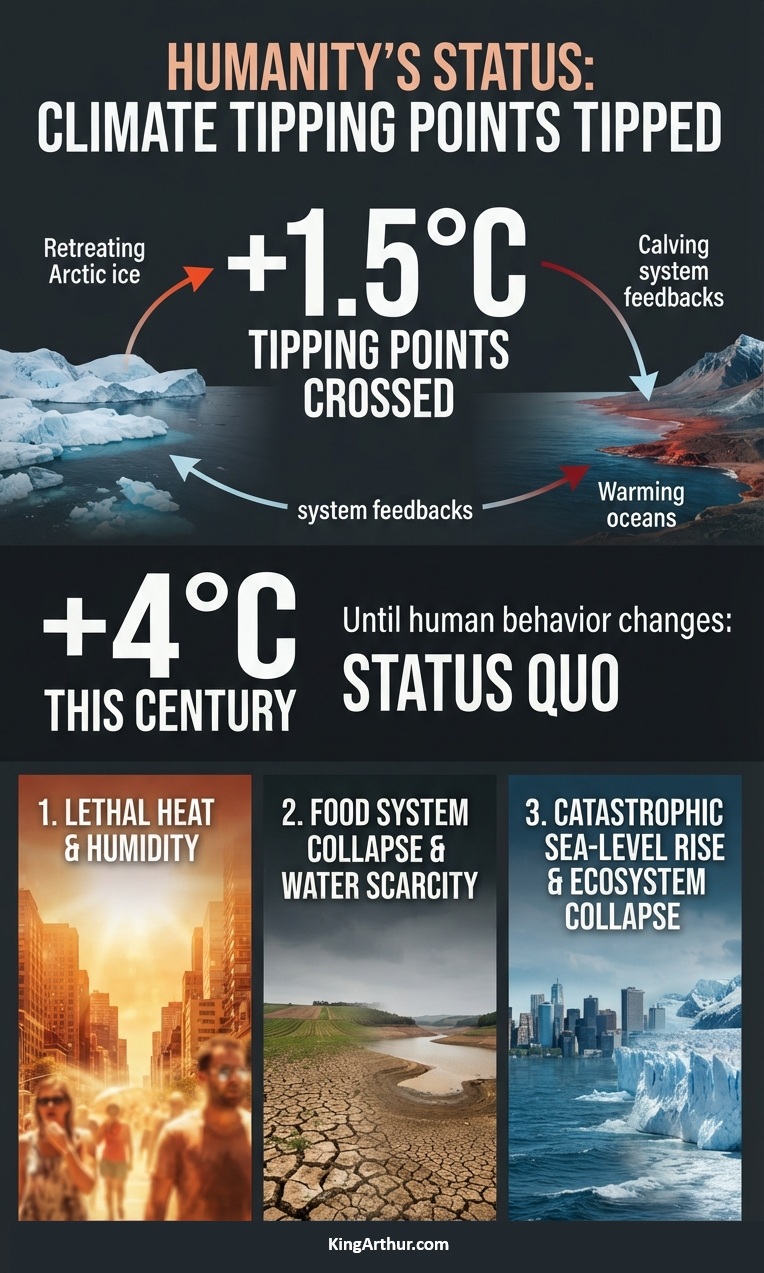
The 1.5°C threshold is not simply a number on a thermometer. It is a tripwire for a climate system increasingly dominated by feedbacks and nonlinear responses.
The result is a new climate reality:
ACCELERATION + COUPLING + INERTIA
The question is no longer simply how much greenhouse gas humans emit. It is how quickly the climate system begins amplifying the warming we have already created.
Having tripped the 1.5°C tripwire, both the acceleration and inertia of climate change have created a new reality. The most likely scenario is global warming of approximately 4°C this century. If humanity does not reach net zero by 2035, approximately 4â7°C of warming by 2150 becomes the most likely scenario.
There’s no denying
(Your denying is lying)
Causing harm
(Turning off the alarm)
[Outro]
The situation’s dire
(Fire! Fire! Fire!)
Temperatures going higher
(Fire! Fire! Fire!)
Domino…
(After domino)
Down we go
(Down below)
[Silence]
[End]
About the Song
UK Climate Security: From Suppression to the Domino Effect
Climate change is increasingly moving from the category of environmental problem into the category of systemic risk.
A recently reported UK national-security assessment warned that climate and ecological disruption can cascade across bordersâaffecting food security, economies, migration, and political stability.
The problem is not simply the initial climate shock.
That is the Domino Effect. Denialism has become part of the feedback loopâdelaying recognition, obstructing action, weakening resilience, and ultimately amplifying the consequences and accelerating the climate crisis.
The four stages of climate information failure are also important:
About the Song
Climate change and coastal impacts are becoming a big problem along the Southern Jersey Shore, with the barrier-island towns taking the brunt of the punishment. Federal funding for beach nourishment has also become much more limited, and sand itself is becoming a finite commodity.
The next couple of days should be an interesting experiment. A powerful, rare September norâeaster is hitting the Jersey Shore tonight, bringing widespread coastal flood warnings, dangerous surf, and wind gusts up to 50 mph. The National Weather Service has issued a Coastal Flood Warning for Atlantic, Cape May, Ocean, and southeastern Burlington counties from Wednesday afternoon through early Saturday morning. The system is also coinciding with an approaching full moon, which can significantly exacerbate tidal flooding across vulnerable shorelines, coastal roadways, and back bays.
At some point, weâre going to reach a hard physical and economic limit. You can keep pumping sand onto a beach, but you canât manufacture an unlimited supply of sediment or indefinitely out-engineer rising seas and increasingly energetic storms.
The question may eventually stop being, âHow much will it cost to save the beach?â and become, âHow long can we realistically keep trying?â
Ride that tide
(See ya on the flipside)
Feedin’ back
(Way back, back, back)
[Fade out]
Feedin’ back
(Way back, back, back)
Ride that tide…
(See ya on the flipside)
[Surf Guitar Fade]
[Silence]
[End]
About the Song: Why Hasnât There Been a Hurricane?
Climate Energy Is Being Redistributed
The absence of hurricanes isnât evidence that the climate system is becoming less energetic. It is the opposite: climate energy is being redistributed in ways that produce very different outcomes in different parts of the planet.
As of September 23, the Atlantic has produced six named storms but still has produced zero hurricanesâan exceptionally delayed first hurricane. NOAAâs current summary shows Atlantic ACE about 92% below the 1991â2020 average at this point in the season.
The alarming part isnât simply the lack of hurricanes. Itâs the apparent coupling of climate patterns that historically operated more independently. I first warned about this Pacific El NiñoâAtlantic Niña coupling back in May. Now, as we progress this far into the season, the observations are providing an unusually clear real-world example of how teleconnections can link distant parts of the climate system.
The simultaneous occurrence of an extreme Pacific El Niño and an anomalous Atlantic Niña represents a significant disruption of the historical baseline. NOAA reports that the El Niño is strengthening, with eastern equatorial Pacific sea-surface temperatures already more than 3°C above average.
An Atlantic Niña can suppress Atlantic hurricane development through increased atmospheric stability and wind shear. So there is a relatively straightforward physical explanation for the quiet Atlantic. But I think the deeper question is why these large-scale oceanâatmosphere patterns are coupling so strongly in the first place.
Thatâs where climate-acceleration research comes in. I see this as evidence worth watching for increasingly interconnected feedbacks and teleconnectionsâchanges in ocean circulation, atmospheric circulation, energy redistribution, and the hydrologic and carbon cycles that can influence one another across ocean basins.
In other words, the absence of hurricanes isnât evidence that the climate system is becoming less energetic. It is the opposite: climate energy is being redistributed in ways that produce very different outcomes in different parts of the planet.
It may manifest as a powerful, rare September norâeaster hitting the Jersey Shore.
[Verse 1]
Here we are
(And here we go)
Another song
(Another show)
Just in time
(To sing a rhyme)
Pick-up a beat
(To move your feet)
[Refrain]
This song…
(Is not so long)
No, not so long
(Not goodbye)
Not see you later
(Why not try)
A lover… not a hater
(And sing along:)
This song…
(Is not so long)
[Verse 2]
So long
(So wrong!)
Don’t make it sad
(It ain’t that bad)
A wave goodbye
(Can still be high)
A smile can say
(Come back someday)
[Pre-Chorus]
Don’t close the door
(We want some more)
Don’t turn away
(Just press replay)
[Refrain]
This song…
(Is not so long)
No, not so long
(Not goodbye)
Not see you later
(Why not try)
A lover… not a hater
(And sing along:)
This song…
(Is not so long)
[Bridge]
So…
(Long?)
So long!
(How long?)
Not very long!
(How long?)
Long enough
(To sing this song!)
[Break]
Not goodbye!
(No!)
Not farewell!
(Still dwell)
Not see you later!
(We here to cater)
We’re doing well!
So long!
(So long!)
So long!
(Not too long!)
So long!
(Along!)
Sing along!
[Final Refrain]
This song…
(Is not so long)
No, not so long
(Not goodbye)
Not see you later
(Why not try)
A lover… not a hater
(And sing along:)
This song…
(Is not so long)