bookmark_borderCry Me a River

Cry-Me-a-River.mp3
Cry-Me-a-River.mp4
Cry-Me-a-River-Unplugged-Underground-XXIII.mp3
Cry-Me-a-River-Unplugged-Underground-XXIII.mp4
Cry-Me-a-River-intro.mp3

[Verse 1]
Not too thick
(But dynamic)
Come to fear
(The atmosphere)

[Chorus]
Cry me a river
(That’s non-linear)
A river of tears
(Till it clears)

[Bridge]
Hard to predict
(Rain so thick)
Atmospheric
(Rivers deliver)

[Verse 2]
It just keeps on raining
(Till none’s remaining)
Gonna pour, pour, pour
(Till the poor are more)

[Chorus]
Cry me a river
(That’s non-linear)
A river of tears
(Till it clears)

[Bridge]
Hard to predict
(Rain so thick)
Atmospheric
(Rivers deliver)

[Chorus]
Cry me a river
(That’s non-linear)
A river of tears
(Till it clears)

[Outro]
Hard to predict
(Rain so thick)
Atmospheric
(Rivers deliver)

A SCIENCE NOTE:Chaos Theory and Atmospheric Rivers

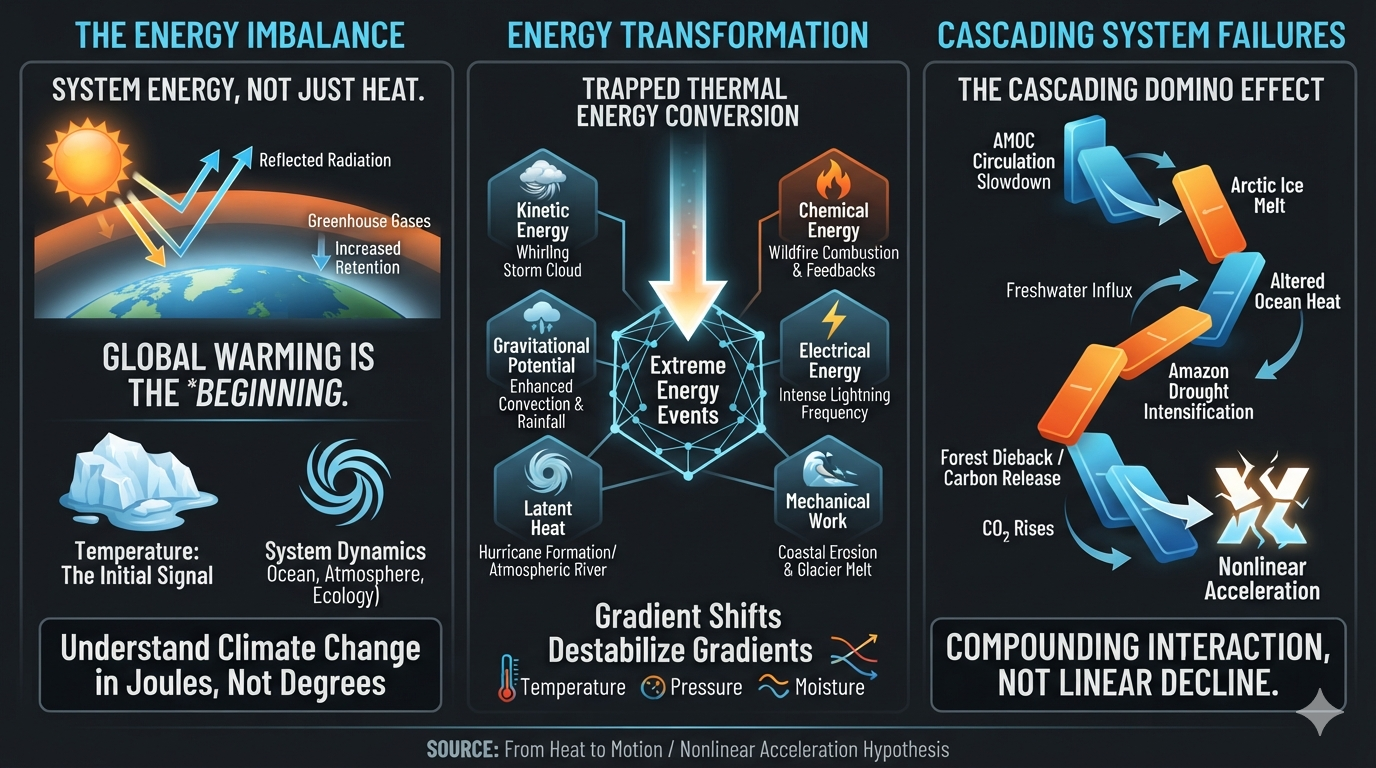
Chaos theory studies dynamic, nonlinear systems that are highly sensitive to initial conditions, meaning small changes can lead to large, unpredictable outcomes. The atmosphere is a prime example of such a system, with interacting factors (temperature gradients, moisture content, jet streams, ocean currents) producing complex weather patterns that can shift suddenly and dramatically.

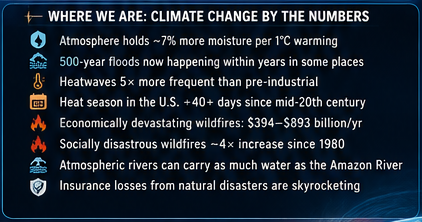
Atmospheric rivers (ARs) are long, narrow bands of concentrated moisture in the atmosphere that can carry as much water vapor as the Amazon River. They form when warm, moist air is pulled along strong low-level winds, often interacting with cold fronts or mountains, leading to intense rain or snow when they make landfall.

Chaos theory helps explain atmospheric rivers in several ways:

1️⃣ Sensitivity to Initial Conditions
Small shifts in ocean surface temperatures (e.g., a localized warm patch), jet stream undulations, or pressure systems can determine whether an AR will form, its path, its moisture content, and its intensity. This is why accurately predicting AR impacts weeks in advance is difficult.

2️⃣ Nonlinear Interactions
Atmospheric rivers emerge from nonlinear interactions between large-scale patterns like El Niño, local sea surface temperatures, atmospheric pressure systems, and topography. A minor upstream disturbance can amplify moisture transport, causing an AR to stall, intensify, or shift suddenly, leading to unexpected flooding.

3️⃣ Self-Organization within Chaos
Despite the apparent randomness, ARs often follow recognizable patterns due to self-organization within the chaotic atmospheric system. This is why meteorologists can identify AR structures on satellite images, yet the timing and intensity of impacts remain uncertain.

4️⃣ Feedback Loops
Warming oceans increase evaporation, adding more moisture to the atmosphere and strengthening ARs. In turn, intense rainfall from ARs can alter soil moisture and surface temperatures, feeding back into local atmospheric conditions and influencing subsequent weather patterns.

Why This Matters for Climate Change

As climate change alters baseline conditions (e.g., warmer oceans, higher atmospheric moisture), the chaotic system of the atmosphere shifts, increasing the likelihood and intensity of ARs. Small changes (like a slight increase in sea surface temperature) can lead to exponentially larger impacts, including record-breaking rainfall and flooding, reflecting the nonlinear dynamics chaos theory describes.

In short:
Chaos theory helps us understand why atmospheric rivers are hard to predict precisely, why they can intensify suddenly, and why small changes in climate conditions can lead to disproportionately large and damaging AR events.

Tipping points and feedback loops drive the acceleration of climate change. When one tipping point is toppled and triggers others, the cascading collapse is known as the Domino Effect.

From the album “Edge of Chaos

The Human Induced Climate Change Experiment

bookmark_borderHow Much I Love You

How-Much-I-Love-You-0.mp3
How-Much-I-Love-You-0.mp4
How-Much-I-Love-You-I.mp3
How-Much-I-Love-You-I.mp4
How-Much-I-Love-You-intro.mp3

[Intro]
You don’t know how much I love you
(If you did, you wouldn’t do what you do)

[Verse 1]
Indeed, look at the deeds of other men
Then look again, at the man within
When it comes to a world of give….
Do you live…
To make or take?

[Chorus]
You don’t know how much I love you
If you did, you wouldn’t do what you do
’cause if we deplete all we eat
There’ll be no place for conceit

[Bridge]
(Retreat)
Time to hide that pride

[Verse 2]
The road you’re on… the path you choose
Hoping to stumble upon win or lose
Alive to strive to thrive?
Do you choose love above…
Or propagate hate

[Chorus]
You don’t know how much I love you
If you did, you wouldn’t do what you do
’cause if we deplete all we eat
There’ll be no place for conceit

[Bridge]
(Retreat)
Time to hide that pride
(Let empathy accompany)
Happiness by your side
(The light we’ll see)
And, it will be alright
(In the light)

[Outro]
You don’t know how much I love you
(If you did, you wouldn’t do what you do)

ABOUT THE SONG

The song “How Much I Love You” is a haunting, emotional love letter from Mother Earth to humanity, casting the climate crisis not only as a scientific and political failure—but as a betrayal of love. Through metaphor and gentle confrontation, the song expresses Earth’s unconditional devotion, even as that love is abused and imperiled.

Verse 1:

Indeed, look at the deeds of other men / Then look again, at the man within
When it comes to a world of give…. / Do you live… / To make or take?

This opening invites self-reflection. It contrasts external blame with inner responsibility. Earth is asking: Are you a giver or a taker? In a “world of give,” nature provides freely—air, water, food, shelter. The question is whether humanity reciprocates, or just extracts.

Chorus:

You don’t know how much I love you / If you did, you wouldn’t do what you do
’cause if we deplete all we eat / There’ll be no place for conceit

This is the emotional core. Earth pleads: If you truly felt my love, you wouldn’t exploit me. The line “deplete all we eat” alludes to resource exhaustion—soil, oceans, biodiversity. “No place for conceit” warns that human arrogance will collapse under ecological collapse. There is no pride in ruin.

Bridge:

(Retreat) / Time to hide that pride

A direct call for humility. Earth is urging us to step back from dominance and relearn humility—to stop assuming superiority and start listening.

Verse 2:

The road you’re on… the path you choose / Hoping to stumble upon win or lose
Alive to strive to thrive? / Do you choose love above… / Or propagate hate

The “road” represents the trajectory of civilization—technological growth, consumption, division. The verse questions whether humanity is guided by love and care (for one another, and the planet), or whether we’re sowing hate and destruction. It’s a challenge to live with purpose, not drift toward ruin.

Second Chorus & Extended Bridge:

Let empathy accompany / Happiness by your side
(The light we’ll see) / And, it will be alright / (In the light)

This expands the message: there is still hope—if we choose empathy, humility, and unity, we can find a way forward. “The light” suggests healing and balance, not just survival but joy and coexistence.

Outro:

You don’t know how much I love you / (If you did, you wouldn’t do what you do)

A soft, sorrowful return to the beginning, leaving us with guilt wrapped in love. It’s not anger—it’s disappointment, and a last chance to awaken before it’s too late.

Summary:

“How Much I Love You” is a climate elegy framed as a love song. Mother Earth voices a gentle yet powerful lament, mourning not just environmental destruction but the loss of a sacred bond. The song implores humanity to remember that we are loved—and to start loving back through care, restraint, and a renewed relationship with the planet.

From the album “To Too Hot

The Human Induced Climate Change Experiment

bookmark_borderSnuffed

Snuffed-0.mp3
Snuffed-0.mp4
Snuffed-I.mp3
Snuffed-I.mp4
Snuffed-II.mp3
Snuffed-II.mp4
Snuffed-Reggae.mp3
Snuffed-Reggae.mp4
Snuffed-intro.mp3

[Intro]
Has the candle been snuffed
The light put out
Are time’s getting rough
As we take this route

[Verse 1]
Man won’t dowse his desires
No, man’s damned demand
… still stands

[Bridge]
On the road
(To implode)
In the mode
(To explode)

[Chorus]
Has the candle been snuffed
The light put out
Are time’s getting rough
As we take this route

[Verse 2]
Man demands ‘only man can’
Destroying nature’s plan
… gonna ban man

[Bridge]
On the road
(To implode)
In the mode
(To explode)

[Chorus]
Has the candle been snuffed
The light put out
Are time’s getting rough
As we take this route

[Bridge]
[Instrumental, Guitar Solo]
On the road
(To implode)
In the mode
(To explode)

[Outro]
The light put out
As we take this route

From the album “Blue Flames

Also found on the album “Reggae Foray

The Human Induced Climate Change Experiment

bookmark_borderTo Not Do

To-Not-Do-0.mp3
To-Not-Do-0.mp4
To-Not-Do-I.mp3
To-Not-Do-I.mp4
To-Not-Do-intro.mp3

[Intro]
The most important thing to do
(… is not to.)

[Bridge]
That’s correct — do not
(I’m asking)
Is it possible to do nothing
(What if it’s all I’ve got?)

[Verse 1]
I’ve a bad habit
For the habitat
Imagine that
That’s just it…
(I can’t quit)

[Bridge]
The most important thing to do
(… is not to.)

[Chorus]
That’s correct — do not
(I’m asking… )
Is it possible to do nothing
(What if it’s all I’ve got?)

[Verse 2]
Dag nab it
I just can’t seem to quit
A nasty habit
Trashing our habitat
(Too hazy and lazy)

[Bridge]
The most important thing to do
(… is not to.)

[Chorus]
That’s correct — do not
(I’m asking… )
Is it possible to do nothing
(What if it’s all I’ve got?)

[Outro]
The most important thing to do
(Is not to do) … I think…
(Therefore I am)

A Science Note: Economic Blackout
The most important thing to do is to “not do” — do not burn fossil fuels. Reducing consumption of fossil fuels, such as gasoline, heating oil, natural gas, and kerosene, even for a day, can contribute to environmental preservation.
The urgency of transitioning away from fossil fuels cannot be overstated. Continuing to burn fossil fuels exacerbates climate change, leading to severe environmental and health consequences. Immediate and sustained action to reduce fossil fuel consumption is essential to mitigate these impacts and improve quality of life for all.

From the album “Idiosyncratic

The Human Induced Climate Change Experiment

bookmark_borderTo Find a Heart

To-Find-a-Heart-0.mp3
To-Find-a-Heart-0.mp4
To-Find-a-Heart-I.mp3
To-Find-a-Heart-I.mp4
To-Find-a-Heart-intro.mp3

[Intro]
Invented a myth
(Conspiracy theory)
Not forthwith
(Making me leery)

[Verse 1]
Imagine that…
The Earth is flat
Finding climate change
A little too strange

[Chorus]
Invented a myth
(Conspiracy theory)
Not forthwith
(Making me leery)

[Bridge]
Debunked
(Skunked)
Return to start
(To find a heart)

[Verse 2]
Hesitation
To vaccination
Resignation
From education

[Chorus]
Invented a myth
(Conspiracy theory)
Not forthwith
(Making me leery)

[Bridge]
Debunked
(Skunked)
Return to start
(To find a heart)

[Chorus]
Invented a myth
(Conspiracy theory)
Not forthwith
(Making me leery)

[Outro]
Return and start
(To find your heart)

ABOUT THE SONG

The Persistence of Climate Change Denial: Impact and Consequences

Many people ask, “Why does a scientist engage with climate deniers?”

Thanks for the concern! You’re right that, for my mental health, it might be easier to ignore them. However, as an educator, I see these interactions as an opportunity to reach a wider audience. Engaging with climate skeptics — what some might call ‘climate dummies’ — gives me the chance to correct misinformation in real time and provide fact-based explanations to others who may be quietly observing the conversation.

By addressing these false claims head-on, I can offer a legitimate, scientifically backed source of information to those seeking clarity in a sea of misinformation. This outreach is critical, especially when so many people are exposed to conflicting or inaccurate claims about climate change. My aim is not to argue for the sake of it, but to ensure that there are trusted voices out there providing clear, evidence-based information on the urgent reality of climate change.

In addition, their opposition is immensely educative in our efforts. In reality, their persistent denial of climate change has forced us to rethink and drastically rebuild our climate models. What were once “worst-case” scenarios have now become the “best-case” outcomes we are seeing today.

Our updated climate model, now integrating complex social-ecological factors, shows that global temperatures could rise by up to 9°C within this century — far beyond previous predictions of a 4°C rise over the next thousand years. This kind of warming could bring us dangerously close to the “wet-bulb” threshold, where heat and humidity exceed the human body’s ability to cool itself, leading to fatal consequences.

Unfortunately, we rely on these so-called climate “skeptics” to remind us just how urgent and critical the climate crisis is becoming. Ironically, their denial helps highlight the importance of decisive action, as climate change continues to spiral out of control.

The window for meaningful intervention is closing, and the need for action has never been more critical.

What you can do today. How to save the planet.

From the album “Skunked

The Human Induced Climate Change Experiment

bookmark_borderShifting Winds

[Intro]
Shifting winds
From south to north
Shifting forth
Nature rescinds

[Verse 1]
Which way will the wind blow
(Does anyone really know?)
Yes, it will surely change
In ways increasingly strange

[Bridge]
Shifting winds
From south to north
Shifting forth
Nature rescinds

[Chorus]
Shifting back
From north to south
The abyss’s mouth
Tastes attack

[Verse 2]
The wind will blow to and fro
(Whichever way it wants to go)
Yes, it will surely change
As our forecasts rearrange

[Bridge]
Shifting winds
From south to north
Shifting forth
Nature rescinds

[Chorus]
Shifting back
From north to south
The abyss’s mouth
Tastes attack

[Bridge]
Shifting winds
From south to north
Shifting forth
Nature rescinds

[Chorus]
Shifting back
From north to south
The abyss’s mouth
Tastes attack

[Outro]
Shifting winds
(Changing minds)
Knew finds

A SCIENCE NOTE

Climate change significantly affects wind patterns by altering the fundamental drivers of atmospheric circulation, such as temperature gradients and pressure systems. These shifts are observable in various phenomena:

1. Jet Stream Alterations:

  • The jet stream, a fast-moving current of air in the upper atmosphere, is powered by the temperature contrast between the polar and mid-latitude regions. As the Arctic warms faster than other parts of the planet (a phenomenon called Arctic amplification), this temperature gradient weakens.
  • A weaker jet stream slows and becomes more meandering, which can lead to prolonged weather patterns like extended heat waves, cold spells, or heavy rain in certain regions.

2. Tropical Circulation Changes:

  • The warming of the tropics has led to a shift in the Hadley Cell, a major component of global circulation. The Hadley Cell expansion causes dry subtropical regions to move poleward, impacting wind patterns and contributing to desertification in some areas.
  • This can also shift trade winds, which are vital for ocean currents like the El Niño-Southern Oscillation, amplifying weather extremes globally.

3. Regional Wind Shifts:

  • Monsoons: Climate change affects the strength and timing of monsoon winds, driven by differences in land and ocean heating. For instance, the Indian monsoon is becoming more erratic due to rising sea surface temperatures.
  • Cyclonic Activity: Warmer sea surfaces fuel stronger and more frequent tropical cyclones, altering regional wind dynamics.

4. Sea-Ice Loss and Wind Patterns:

  • The melting of Arctic sea ice changes surface albedo (reflectivity), creating warmer local conditions. This disrupts regional wind systems and contributes to phenomena like the polar vortex weakening, which can send bursts of cold air southward into lower latitudes.

5. Mountain Winds and Local Effects:

  • Changes in temperature gradients around mountainous regions modify local wind patterns like katabatic (downslope) winds and anabatic (upslope) winds. These shifts can affect ecosystems and local weather predictability.

Relationship to Chaos Theory:

  • Atmospheric dynamics, including wind patterns, are inherently chaotic systems. Small changes, such as those induced by climate change, can lead to disproportionately large and unpredictable effects. This sensitivity, often described as the “butterfly effect,” is why slight shifts in temperature or pressure due to climate change can cascade into significant alterations in global and regional wind systems.

In summary, climate change disrupts wind patterns by altering the temperature gradients, circulation cells, and feedback mechanisms that govern atmospheric dynamics. These shifts can have widespread implications for weather, ecosystems, and human activities.

From the album “Obscured” by Daniel

The Human Induced Climate Change Experiment

MegaEpix Enormous

bookmark_borderSeasons

[Intro]
Back in the day
We had seasons
Evident reasons
Not going back that way

[Verse 1]
Winter turned to fall
Fall turned to summer
Though no surprise at all
Nevertheless, a bummer

[Chorus]
Back in the day
We had seasons
Evident reasons
Not going back that way

[Bridge]
Temperature change
(Makes nature strange)
How much more
(Can we endure)

[Verse 2]
Winter turned to spring
Spring turned to summer
Though not surprising
Nevertheless, a bummer

[Chorus]
Back in the day
We had seasons
Evident reasons
Not going back that way

[Bridge]
Temperature change
(Makes nature strange)
How much more
(Can we endure)

[Chorus]
Back in the day
We had seasons
Evident reasons
Not going back that way

[Outro]
Temperature change
(Makes nature strange)
How much more
(Can we endure)

Found on the album “Reggae Day” by Narley Marley

From the album “Lift” by Daniel

The Human Induced Climate Change Experiment

MegaEpix Enormous

bookmark_borderHow Long Till Then?

[Intro]
Overcast
(Skies menacing)
Forecast
(Cries deadening)

[Verse 1]
Time slipping through my fingers
(Hoping there’s love that lingers)
Faster and faster into the danger zone
(All the family and happy home)

[Bridge]
Overcast
(Skies menacing)
Forecast
(Cries deadening)

[Chorus]
Then, how long till when
When the angels sing
(And the love they’ll bring)
How long till we’ll see
What we’ve done to “be”
(When? How long till then?)

[Verse 2]
Time passing by… an increasing rate
(Hoping my gate will cooperate)
Faster and faster… more damage prone
(And the family and happy home)

[Bridge]
Overcast
(Skies menacing)
Forecast
(Cries deadening)

[Chorus]
Then, how long till when
When the angels sing
(And the love they’ll bring)
How long till we’ll see
What we’ve done to “be”
(When? How long till then?)

[Bridge]
Overcast
(Skies menacing)
Forecast
(Cries deadening)

[Chorus]
Then, how long till when
When the angels sing
(And the love they’ll bring)
How long till we’ll see
What we’ve done to “be”
(When? How long till then?)

[Outro]
Then, how long till when
When? How long till then?

From the album “A Glimmer of Light” by Daniel

The Human Induced Climate Change Experiment

MegaEpix Enormous

bookmark_borderHear ‘er Comin’?

[Intro]
Hear ‘er comin’
(Hummin’ round the bend)

[Verse]
If only…
The wish
Could push
(Us back from the edge)

[Bridge]
If only…
The wish
(Could save me)

And, then…
Hear ‘er comin’
(Hummin’ round the bend)

[Chorus]
Reality
(Comes ’round the bend)
Is this the end
(Finality)

[Verse]
If only…
The wish
Could push
(Us back from the edge)

[Bridge]
If only…
The wish
(Could save me)

And, then…
Hear ‘er comin’
(Hummin’ round the bend)

[Chorus]
Reality
(Comes ’round the bend)
Is this the end
(Finality)

[Bridge]
If only…
The wish
(Could save me)

And, then…
Hear ‘er comin’
(Hummin’ round the bend)

[Chorus]
Reality
(Comes ’round the bend)

[Outro]
Is this the end
(Finality)

From the album “Dialogue” by The Beatless Sense Mongers

A song about The Human Induced Climate Change Experiment

Ocho Rios Rendezvous” by Narley Marley

MegaEpix Enormous

bookmark_borderWhat the Cat Brought In

[Verse 1]
Hey, would you look
at what the cat brought in
What is it…
Bone and some skin?
Hey, would you look
at what the cat brought in
Guess patience
Is wearing thin

[Chorus]
Blood and guts
(A world gone nuts)
What’s a poor boy to do?
A mess of a process
I can’t process
… what the cat brought in

[Bridge]
(no not again)
Look what the cat brought in
(no not again)
Look what the cat brought in

[Verse 2]
Hey, would you look
at what the cat brought in
Could it be my twin?
Hey, would you look
at what the cat brought in
The audience
Has lost their grin

[Chorus]
Blood and guts
(A world gone nuts)
What’s a poor boy to do?
A mess of a process
I can’t process
… what the cat brought in

[Bridge]
(no not again)
Look what the cat brought in
(no not again)
Look what the cat brought in

[Chorus]
Blood and guts
(A world gone nuts)
What’s a poor boy to do?
A mess of a process
I can’t process
… what the cat brought in
(no not again)

[Outro]
Look what the cat brought in
(no not again)
Look what the cat brought in

A song about The Human Induced Climate Change Experiment

It’s Me” by Daniel

The Montego Bay Way” by Narley Marley

Mish-Mash” by The Beatless Sense Mongers

MegaEpix Enormous

bookmark_borderThe “Damn Age”

[Break]
Did we plan it
For the planet

[Verse 1]
Do we understand
That the very land
Upon which we stand
Has fallen ill
As we try to kill
(Kill, kill, kill)

[Chorus]
Yet, still
Freewill
Brings on the damage
Yes, we’ll
Instill
Things of the “Damn Age”

[Bridge]
We can foretell
While ringing the bell
Bringing on our hell

[Verse 2]
We must understand
That the we command
Land on which we stand
With ill will
Pleasure in the kill
(Kill, kill, kill)

[Chorus]
Yet, still
Freewill
Brings on the damage
Yes, we’ll
Instill
Things of the “Damn Age”

[Bridge]
We can foretell
While ringing the bell
Bringing on our hell

[Chorus]
Yet, still
Freewill
Brings on the damage
Yes, we’ll
Instill
Things of the “Damn Age”

[Outro]
We can foretell
While ringing the bell
Bringing on our hell

A SCIENCE NOTE

The Age of Loss and Damage
Humans will experience greater loss and damage to life and quality of life from air pollution, decreasing supply of potable water, extreme weather events, disease, and other adverse health outcomes. The greatest short term climate change risk to human health is deadly humid heat (wet-bulb temperature). The greatest damage to the your habitat is violent rain. In September of 2024, I asked Sidd, “Are you starting to think wildfires are the most significant threat, or is violent rain still reigning at #1?” Sidd replied, “Well, I never thought I’d see Canada burn. The smoke in the eastern U.S. is currently coming from the Amazon, and Ohio is in severe drought.”

A warmer world will present widespread challenges across many aspects of food-energy-water security and economic development. Infrastructure including roads, bridges, sewer and water plants will become unsustainable. Personal property will suffer loss and damage as homeowners’ insurance and flood insurance become increasingly difficult to obtain. Storm surges in Florida are an example. Parts of the coastline have seen sea levels rise over 14-20 feet in the last decade. Although the storm surge was only for hours, you wouldn’t want to live there during those hours. Not to mention, the frequency of these extreme weather events is rising exponentially. Thus, our recommendation to evacuate Florida now (i.e. Managed Retreat). The billions of dollars spent to rebuild after Hurricane Ida will all be for naught. Allowing building there will needlessly endanger property and lives. Parts of the world have already seen storm surges of 40 feet. We expect most North American coastlines will see sea levels rise, if only temporarily, by 20-40 feet this century. All real estate is at risk from climate change.

The environmental changes and uncertainties associated with climate change can contribute to mental health issues, including anxiety, depression, and post-traumatic stress disorder (PTSD). Almost all survivors of climate-related disasters suffer from mental distress and experience PTSD. Of those who have not experienced climate disasters, over two-thirds of U.S. adults (68%) report having climate change anxiety.

Loss and damage litigation against oil companies and governments is set to transform global economics and become a key driving force in tackling the climate crisis.

A song about The Human Induced Climate Change Experiment

From the The EndOf the Line

MegaEpix Enormous

bookmark_borderAnd Her Next of Kin

[Intro]
Grandma
(And her next of kin)
Stigma
(Is blowin’ in)
Better get goin’
On our way

[Verse 1]
They say
The storm brewing
Is headin’ this way
O.K.?
(It’s headed this way)
[Bridge]
Today
Is Ohhhhhh!
(Silent k, o(k)ay?)
Ohhhh (Oh, o(k)ay)

[Chorus]
Atmospheres’ rivers
(Delivers)
The air and sea
(Come to me)
Where the winds
(Have been)
Set us free
(Fleetingly)

[Verse 2]
Touche
The storm’s threwing
Caused dismay
O.K.
(The price you pay)
[Bridge]
Today
Is Ohhhhhh!
(Silent k, o(k)ay?)
Ohhhh (Oh, o(k)ay)

[Chorus]
Atmospheres’ rivers
(Delivers)
The air and sea
(Come to me)
Where the winds
(Have been)
Set us free
(Fleetingly)

[Chorus]
Atmospheres’ rivers
(Delivers)
The air and sea
(Come to me)
Where the winds
(Have been)
Set us free
(Fleetingly)

[Outro]
Today is…
(Silent k, o(k)ay?)
Ohhhh (Oh, o(k)ay)

A SCIENCE NOTE
Climate change and the increased frequency and intensity of rainstorms can be understood through the lens of chaos theory due to the highly sensitive and interconnected nature of the Earth’s climate system.

Chaos theory deals with systems that are highly sensitive to initial conditions, meaning small changes in one part of the system can lead to large and often unpredictable effects elsewhere. This concept is also known as the butterfly effect, where minor disturbances can lead to significant, non-linear outcomes over time.

Here’s how chaos theory relates to climate change and rainstorms:

1. Small Changes Amplified

The Earth’s climate is a chaotic system, meaning that slight alterations in atmospheric conditions, such as increases in greenhouse gases, can trigger complex and far-reaching effects. Even minor increases in carbon dioxide or methane, caused by human activities, can alter global temperatures, humidity levels, and the distribution of energy across the planet.

2. Non-linear Responses

In chaotic systems, the response to a change isn’t always proportional. A small increase in global temperature can result in disproportionately large impacts, such as more intense and frequent storms. Warmer air holds more moisture, leading to heavier rainfall. This relationship between temperature and rainfall is not linear, meaning that slight increases in temperature can result in significantly more rainfall during storms.

3. Unpredictability of Storm Patterns

Climate change has made weather patterns less predictable, which is a hallmark of chaotic systems. As the climate warms, it disrupts traditional patterns of rainfall, sometimes leading to unexpected or extreme storm events in areas that might not have experienced them before. This unpredictability is a result of the sensitivity of the climate system to small, cumulative changes in temperature and atmospheric composition.

4. Feedback Loops

Chaos theory also highlights the role of feedback loops, where initial changes reinforce themselves. For example, warming oceans lead to more evaporation, which fuels storms, and these storms can cause further warming by trapping heat. These feedback mechanisms can amplify the effects of climate change, making weather patterns even more erratic and intense.

5. Tipping Points

Chaotic systems often reach tipping points—critical thresholds beyond which small changes can result in dramatic and irreversible shifts. In the context of climate change, this could mean a point where weather patterns become so destabilized that they lead to a continuous cycle of extreme rainfall, flooding, and other unpredictable weather events.

By viewing the relationship between climate change and storm intensity through chaos theory, it becomes clear that the complex interplay of atmospheric factors makes the outcomes difficult to predict and control, even if we understand the contributing variables. This chaotic nature amplifies the risks and impacts of global climate shifts.

* Our climate model employs chaos theory to comprehensively consider human impacts and projects a potential global average temperature increase of 9 degrees Celsius above pre-industrial levels.

A song about The Human Induced Climate Change Experiment

From the The EndOf the Line” and the album “A Negril Chill” by Narley Marley

MegaEpix Enormous

bookmark_borderReminiscent of Omniscient

[Intro]
Reminiscent
Of omniscient
The shape of things…
Undone (unspun)
Unwound (rundown)

[Verse 1]
It’s what one brings
Does he dance
Does he sing
It’s what one does
Does he bring
On amazing

[Chorus]
Our civilization
Risks all of creation
Or at the very least
The deadliest beast

[Bridge]
Reminiscent
Of omniscient
The shape of things…
Undone (unspun)
Unwound (winding down)
Down (down, down)

[Verse 2]
Bring on the song
Bring on the dance
It won’t be long
You can’t go wrong
Take your stance
Come on sing along

[Chorus]
Our civilization
Risks all of creation
Or at the very least
The deadliest beast

[Bridge]
Reminiscent
Of omniscient
The shape of things…
Undone (unspun)
Unwound (winding down)
Down (down, down)

[Chorus]
Our civilization
Risks all of creation
Or at the very least
The deadliest beast

[Bridge]
Reminiscent
Of omniscient
The shape of things…
[Outro]
Undone (unspun)
Unwound (winding down)
Down (down, down)

From the album “All Mixed Up” by The Beatless Sense Mongers

MegaEpix Enormous

A song about The Human Induced Climate Change Experiment

bookmark_borderAs in True Blue

[Intro]
Is your heart true
In the follow-through
Is your heart true
Tell me (do)

[Verse 1]
Is your heart true
In the follow-through
Is your heart true
Tell me (do)

[Verse 2]
Your point-of-view
Does it ring true
Or gone askew
Tell me (do)

[Chorus]
Oh, well
It’s not hard to tell
Just look outside
It’s hard to hide

[Bridge]
Look where we reside

[Verse 3]
Is your heart true
As in true blue
Is your heart true
Tell me (do)

[Verse 4]
Do debts accrue
All bills come due
Options few (too few)
Tell me (tell me do)

[Chorus]
Oh, well
It’s not hard to tell
Just look outside
It’s hard to hide

[Bridge]
Look where we reside
Your face can’t hide
You can stick your pride
Up your darkside

[Outro]
Oh, well
It’s not hard to tell
The mighty fell (fell….)

From the album “All Mixed Up” by The Beatless Sense Mongers

MegaEpix Enormous

A song about The Human Induced Climate Change Experiment

bookmark_borderCan’t Stop

[Intro]
I’ve never felt anything like this before…
Are you sure?

[Verse 1]
Oh, know no
(It won’t slow)
Watch it a bit
(Watch it go)
Can’t stop the heat

[Chorus]
No tepid temperature future
(That’s for sure)
How much hot brought fraught
(Can you endure)

[Bridge]
Heat seeking mission
Damned ambition
In our position

[Break]
I’ve never felt anything like this before…
Are you sure?

[Verse 2]
Oh, woe woe
(Woah, whoa woe)
Watch it blow
(Go, go, go)
Can’t stop the heat

[Chorus]
No tepid temperature future
(That’s for sure)
How much hot brought fraught
(Can you endure)

[Bridge]
Heat seeking mission
Damned ambition
In our position

[Chorus]
No tepid temperature future
(That’s for sure)
How much hot brought fraught
(Can you endure)

[Outro]
Heat seeking mission
Damned ambition
In our position

From the album “How to Serve Man” by The Beatless Sense Mongers

MegaEpix Enormous

A song about The Human Induced Climate Change Experiment