[Silence]
[Instrumental, Guitar, Piano, Organ, Synth, Bass, Percussion, Drums]
[Intro]
[Instrumental Intro: Thoughtful Piano, Pulsing Bass, Clean Guitar Arpeggios, Organ Swells, Slow Building Drums]
[Minimal Beat, Sub Bass, Spoken Vocal]
Tomorrow…
…isn’t written.
(Still… don’t be smitten)
As probabilities…
Surely can be.
[Refrain]
What are the odds
(We’ll be saved by your gods?)
What are the chances
(We continue with dances)
There’s no solution
(In divine intervention)
[Verse 1]
People ask, “What will it be?”
One fixed future? One destiny?
Science answers differently—
A range of possibilities.
[Chorus]
What are the odds?
(Look and see)
Probability…
(Not certainty)
One path climbs…
(One path falls)
A small action…
(Changes all)
[Refrain]
What are the odds
(We’ll be saved by your gods?)
What are the chances
(We continue with dances)
There’s no solution
(In divine intervention)
[Instrumental]
[Guitar Solo]
[Driving Bass, Expansive Synths, Organ Chords, Rolling Drums]
[Verse 2]
Most futures don’t simply end;
Most require that people mend.
The greatest risks we truly face
Are stress and strain from place to place.
[Pre-Chorus]
Not extinction…
(Most of the time)
But disruption…
(Climbing the line)
[Bridge]
Ten percent…
(A steadier way)
Thirty-five…
(Harder days)
Thirty more…
(Regions change)
Fifteen…
(Systems strain)
Eight contract…
(Two remain…)
The smallest shadow…
(The final frame)
[Breakdown]
[Minimal Beat, Deep Sub Bass, Spoken Vocal]
Probability…
…isn’t prediction.
Uncertainty…
…isn’t ignorance.
It tells us…
…where to pay attention.
[Final Chorus]
What are the odds
(We’ll be saved by your gods?)
What are the chances
(We continue with dances)
There’s no solution
(In divine intervention)
Only choices…
(Only change)
Only courage…
(To rearrange)
What are the odds?
They’re waiting…
…for us.
(Please discuss)
[Outro]
[Instrumental Outro: Piano Returns, Echo Guitar, Organ Fade, Soft Synth Atmosphere]
The future…
…isn’t fixed.
The probabilities…
…are listening.
Choose wisely.
[Refrain]
What are the odds
(We’ll be saved by your gods?)
What are the chances
(We continue with dances)
There’s no solution
(In divine intervention)
About the Song: A Theoretical 200-Year Probability Envelope
Derived from the Nonlinear Acceleration Framework
Model Time Horizon: 2026–2226
A Probability Distribution of Humanity’s Next 200 Years
How likely are different futures for civilization as climate change accelerates?
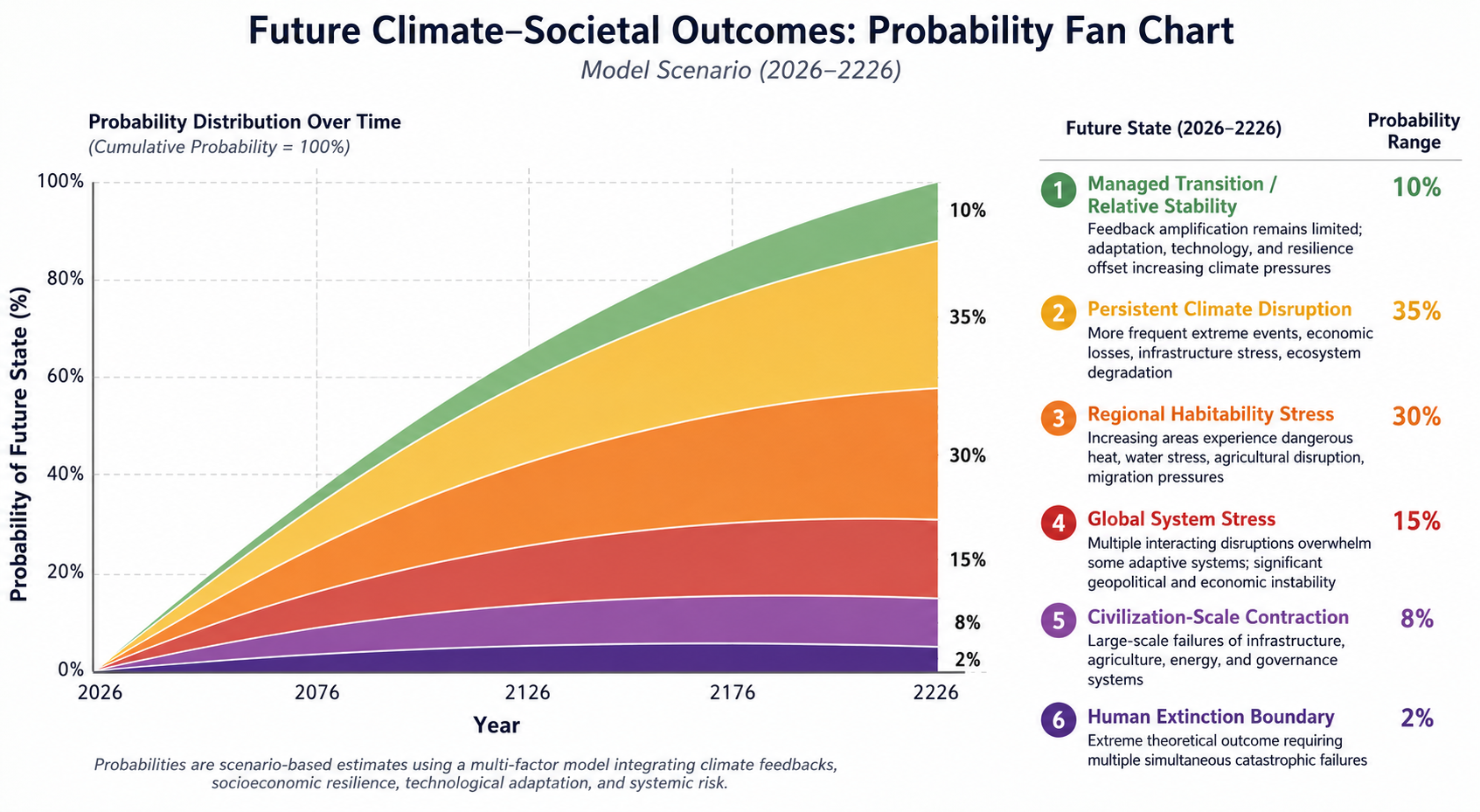
Here is a Climate-Societal Probability Fan Chart (2026–2226) that visualizes a model-based distribution of potential outcomes over the next two centuries.
Rather than asking “What will happen?”, the chart asks the more scientifically useful question:
“What is the probability distribution of plausible futures?”
The model incorporates nonlinear climate feedbacks, systemic interactions, adaptive capacity, technological progress, and societal resilience to estimate the relative likelihood of six broad scenarios:
🟢 10% — Managed Transition / Relative Stability
🟡 35% — Persistent Climate Disruption
🟠 30% — Regional Habitability Stress
🔴 15% — Global System Stress
🟣 8% — Civilization-Scale Contraction
⚫ 2% — Human Extinction Boundary
The important takeaway is that human extinction is not the central expectation of the model. The highest-probability outcomes involve increasing disruption, economic stress, migration, infrastructure challenges, and declining habitability across vulnerable regions—not the disappearance of humanity.
Understanding probability distributions is far more informative than focusing on a single prediction. As with weather forecasting or hurricane models, uncertainty is not ignorance—it is measurable.
A Theoretical Model of Coupled Feedback Amplification, System-State Transitions, and Future Climate Trajectories
The distribution is not intended to be a literal prediction of where humanity will be in exactly 200 years. A 200-year horizon necessarily involves enormous uncertainty—seven generations means changes in technology, governance, economics, and adaptation capacity that cannot be known today.
The main purpose of the graph is to emphasize that human extinction remains a very low-probability outcome across the modeled scenarios. The more likely risks involve increasing climate disruption, ecosystem stress, and challenges to human systems.
Given that distinction, the most important actions are clear: reduce the primary driver of warming by transitioning away from fossil fuel combustion while simultaneously accelerating adaptation and resilience efforts. The goal is not to focus on an unlikely worst-case outcome, but to reduce the probability of disruptive pathways and improve the chances of a stable, adaptable future.
- Framework for Nonlinear Climate Outcomes (Public Access Version)
- A Physics-Based Scenario Framework for Nonlinear Climate Outcomes (Graduate Level Version)
From the album “Butterflies and Dominoes“