bookmark_borderWhen the Levee Breaks

Bonus Tracks

By Memphis Minnie

[Female Vocals]
[Backing Vocals]
[Intro]
[Break]

[Verse 1]
If it keeps on rainin’, levee’s goin’ to break
And the water gonna come in, have no place to stay

[Verse 2]
Well all last night I sat on the levee and moan
Thinkin’ ’bout my baby and my happy home

[Bridge]
If it keeps on rainin’, levee’s goin’ to break
And all these people have no place to stay

[Break]

[Chorus]
Now look here mama what am I to do
I ain’t got nobody to tell my troubles to
I works on the levee mama both night and day
I ain’t got nobody, keep the water away

[Verse 3]
Oh cryin’ won’t help you, prayin’ won’t do no good
When the levee breaks, mama, you got to lose

[Chorus]
I works on the levee, mama both night and day
I works so hard, to keep the water away
I had a woman, she wouldn’t do for me
I’m goin’ back to my used to be

[Break]

[Outro]
I’s a mean old levee, cause me to weep and moan
Gonna leave my baby, and my happy home

[End]
[Silence]

ABOUT THE SONG AND SCIENCE
When blues musical duo Kansas Joe McCoy and Memphis Minnie composed “When the Levee Breaks,” the memory of the Great Mississippi Flood of 1927 was still fresh in people’s minds. This devastating flood submerged 26,000 square miles of the Mississippi Delta, resulting in the loss of hundreds of lives and the displacement of hundreds of thousands of residents. The event inspired numerous blues songs, including “Backwater Blues” by Bessie Smith (1927) and “Mississippi Heavy Water Blues” by Barbecue Bob (1928).

Ethel Douglas, Minnie’s sister-in-law, recounted that Minnie was residing with her family near Walls, Mississippi, when the levee broke in 1927. The poignant lyrics of “When the Levee Breaks” depict the personal tragedy endured by a man who lost his home and family in the flood. However, biographers also interpret the song as a testament to resilience and renewal amidst adversity.

Climate change is impacting the Mississippi Delta in several ways:

  1. Sea Level Rise: The Mississippi Delta is already experiencing the effects of sea level rise, which is exacerbating coastal erosion and land loss. As sea levels continue to rise due to global warming, low-lying areas of the delta are becoming increasingly vulnerable to inundation and saltwater intrusion, threatening freshwater resources, ecosystems, and communities.
  2. Increased Flooding: Climate change is contributing to more frequent and intense rainfall events, leading to increased flooding in the Mississippi Delta. This flooding can overwhelm levees and other flood control infrastructure, exacerbating erosion and land loss while posing risks to human safety and livelihoods.
  3. Saltwater Intrusion: Rising sea levels and reduced freshwater flow from upstream are causing saltwater to intrude further inland in the Mississippi Delta. This saltwater intrusion threatens the availability of freshwater for drinking, agriculture, and industry, as well as the health of freshwater ecosystems and wetlands.
  4. Loss of Habitat: Climate change is altering habitat conditions in the Mississippi Delta, affecting wildlife populations and biodiversity. Sea level rise, increased flooding, and saltwater intrusion are causing the loss of crucial habitat types such as marshes, swamps, and estuaries, which support diverse plant and animal species.
  5. Impacts on Agriculture: The Mississippi Delta is a major agricultural region, producing crops such as cotton, soybeans, rice, and corn. Climate change is posing challenges to agriculture in the delta by increasing the frequency of extreme weather events, reducing crop yields, and altering growing conditions. Farmers are facing greater uncertainty and risks due to changes in temperature, precipitation patterns, and pest pressures.

Overall, climate change is posing significant challenges to the Mississippi Delta, threatening its natural ecosystems, communities, and economy. Addressing these impacts will require coordinated efforts to mitigate greenhouse gas emissions, adapt to changing conditions, and protect vulnerable areas and populations.
To Cause a Change: Philadelphia Experiment

4D Music: Songs About Science

A song about The Human Induced Climate Change Experiment

bookmark_borderDiscover Over

[Verse 1]
After the clouds pass over, pass over, over
I love to discover, discover over
Blue sky for my eye
Blue sky for my I
Delight in sunlight

[Verse 2]
Once the storm has passed
To discover at last
Blue sky for my eye
Blue sky for my I
Delight in sunlight

[Bridge]
Insight in sight
Insight incite
Incite insight
Insight in sight

[Chorus]
Ohhhh, I see the light
I see the light
Once again
Agin’ my skin
Ohhhh, I love the light
Love delight

[Bridge]
Insight in sight
Insight incite
Incite insight
Insight in sight

[Break]

[Verse 3]
Having weathered the storm
What did we learn?
Blue sky for my eye
Blue sky for my I
Delight in sunlight

[Bridge]
Insight in sight
Insight incite
Incite insight
Insight in sight

[Chorus]
Ohhhh, I see the light
I see the light
Once again
Agin’ my skin
Ohhhh, I love the light
Love delight

[Outro]
Insight in sight
Insight incite
Incite insight
Insight in sight

[End]
[Silence]

ABOUT THE SONG
This song tries to capture the experience of weathering violent rain, finding solace in the aftermath, and reflecting on the lessons learned about climate change and its impacts.

[Verse 1] and [Verse 2] evoke a sense of relief and wonder as the storm clouds pass and reveal the blue sky once more. There’s a celebration of the sunlight and the beauty of nature returning after the turmoil of the storm.

The [Bridge] delves into introspection, suggesting that the experience of weathering the storm has provided insight and a deeper understanding of the world around us. The repetition of “Insight in sight” emphasizes the importance of reflection and learning from our experiences.

The [Chorus] expresses gratitude for the return of light and warmth, symbolizing resilience in the face of adversity. There’s a sense of joy and appreciation for the beauty of nature, even after enduring the storm.

[Verse 3] reflects on the lessons learned from the storm, posing the question of what we have gained from the experience. Despite the challenges, there’s a recognition of the value in facing adversity and emerging stronger and wiser.

The [Outro] echoes the sentiment of introspection and insight, emphasizing the importance of reflecting on our experiences and finding meaning in the face of hardship.

Overall, the song captures the journey of weathering extreme weather events, finding solace and beauty in their aftermath, and reflecting on the lessons learned about climate change and resilience.

To Cause a Change: Philadelphia Experiment

4D Music: Songs About Science

A song about The Human Induced Climate Change Experiment

bookmark_borderPhiladelphia: Land of Freedom

[Intro]
Dum, de, dum, do, dum, de, dum, dum

[Verse 1]
In the Land of Freedom
The rule of the fool
Is the selfish act
React
React, act, ack, ack, ack, ack
[Break]

[Bridge]
Dum, de, dum, do, dum, de, dum, dum

[Chorus]
Time to pass a law
Responsibility for all
That claim the right
See the light?
Alright, right? Right!

[Bridge]
Dum, de, dum, do, dum, de, dum, dum

[Verse 2]
When you misunderstand: Free Dumb, de, dum, dum
The rule of the fool
Is the selfish act
React
React, act, ack, ack, ack, ack
[Break]

[Bridge]
Dum, de, dum, do, dum, de, dum, dum

[Chorus]
Time to pass a law
Responsibility for all
That claim the right
See the light?
Alright, right? Right!

[Verse 3}
Is it time to succumb to freedom?
he rule of the fool
Is the selfish act
React
React, act, ack, ack, ack, ack
[Break]

ECONOMICS LESSON
Climate change is primarily driven by the escalation of thermal energy affecting biogeophysical and socio-economic systems. While biogeophysical factors can be studied using math, physics, and historical records, socio-economic systems pose greater challenges due to the unpredictable consequences of human behavior and inexplicable consumer choices, exacerbating tipping points and feedback loops.

Human rights, social responsibility, and climate change are interconnected in several ways:

  1. Human Rights Impacts: Climate change disproportionately affects marginalized and vulnerable communities, often violating their human rights. For example, extreme weather events, sea-level rise, and food insecurity can lead to displacement, loss of livelihoods, and inadequate access to clean water and sanitation, all of which are fundamental human rights issues.
  2. Social Responsibility: Addressing climate change requires collective action and social responsibility. Individuals, businesses, governments, and organizations have a responsibility to reduce greenhouse gas emissions, mitigate the impacts of climate change, and ensure equitable access to resources and opportunities. Socially responsible actions, such as investing in renewable energy, supporting climate adaptation projects, and advocating for policy changes, can help mitigate the effects of climate change and protect human rights.
  3. Interconnected Systems: Climate change is not just an environmental issue but also a social and economic one. Its impacts intersect with various aspects of society, including health, education, employment, and poverty. By addressing climate change, societies can promote human rights, social justice, and sustainable development simultaneously. Conversely, failure to address climate change can exacerbate existing inequalities and threaten human rights.
  4. Policy and Governance: Governments have a duty to protect the human rights of their citizens, including the right to a healthy environment. This includes implementing policies and regulations to mitigate climate change, adapt to its impacts, and ensure that vulnerable populations are not disproportionately affected. Social responsibility frameworks can inform decision-making processes, encouraging governments to prioritize climate action and uphold human rights.

In summary, human rights, social responsibility, and climate change are deeply intertwined, with each influencing and shaping the others. By recognizing these interconnections and taking concerted action, societies can work towards a more just and sustainable future for all.

To Cause a Change: Philadelphia Experiment

4D Music: Songs About Science

A song about The Human Induced Climate Change Experiment

bookmark_borderThe Philadelphia Violent Rain Experiment


[Verse 1]
In Philadelphia, where the skies turn dark,
Violent rainstorms leave their mark,
From Nor’easters fierce to Gulf’s embrace,
Each deluge brings a stronger embrace.

[Bridge]
Hurricane Ida, a tempest grand,
From Category 1 to 4, it ran,
Warm Gulf air, a moisture surge,
Turned Vine Street to a canal’s verge.

[Chorus]
Oh, Philadelphia, in the storm’s embrace,
Tales of rain and fury we face,
From derailed trains to cars swept away,
In the violence of rain, we find dismay.

[Break]

[Verse 2]
Plymouth Meeting, Washington Crossing too,
Witnessed floods, a tragic brew,
Drenched in rain, the land did yield,
Sinkholes exposed, under Route 202’s shield.

[Bridge]
Tropical Storm Ophelia, a relentless pour,
Soaking streets, flooding shores,
Winter’s grip with rivers’ flow,
January’s fury, a historic blow.

[Chorus]
Oh, Philadelphia, in the storm’s embrace,
Tales of rain and fury we face,
From record March days to winds that roar,
In nature’s rage, we find no shore.

[Break]

[Chorus]
Oh, Philadelphia, in the storm’s embrace,
Tales of rain and fury we face,
From record March days to winds that roar,
In nature’s rage, we find no shore.

[Outro]
From Delaware’s creeks to Rio’s plight,
In rain’s dance, we fear the night,
The Philadelphia Violent Rain Experiment,
A tale of nature’s relentless lament.

[End]
[Silence]

SCIENCE LESSON

The Philadelphia Violent Rain Experiment

The Greater Philadelphia Area serves as our focal point for studying non-coastal violent rain events. Although situated 78 miles from the nearest coast, Philadelphia has experienced a surge in violent rainstorms since 2021, with each episode yielding more precipitation than the typical monthly average. In addition to enduring Nor’easters and tropical storms from the Southeast, Philadelphia is increasingly subjected to deluges originating from the Gulf of Mexico.

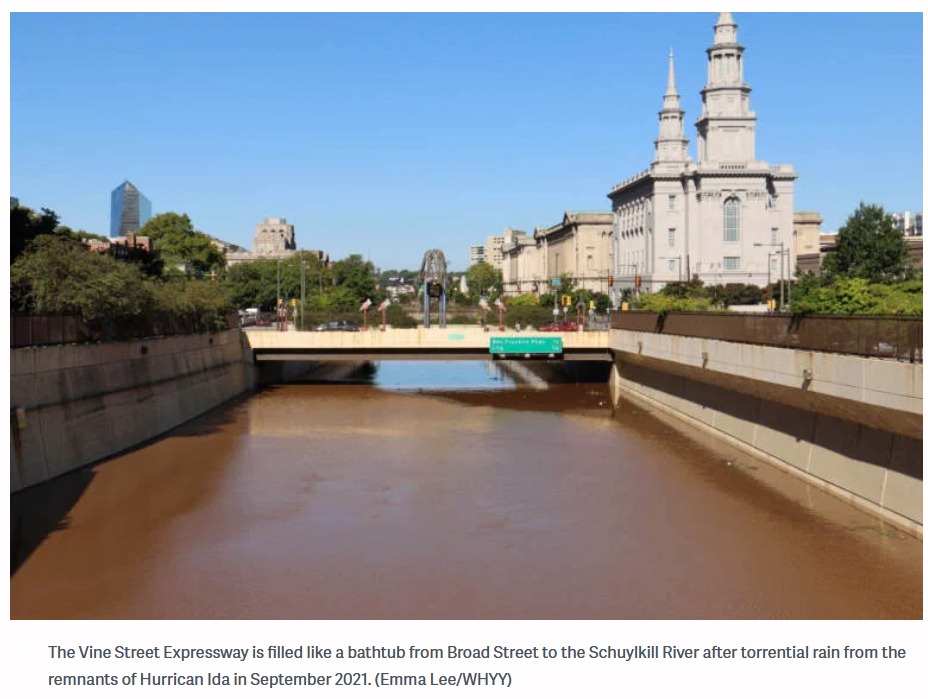
Vine Street Expressway Flooded

Hurricane Ida in the summer of 2021 is a good example. Because of the 85 degrees Fahrenheit Gulf of Mexico ocean temperature, Ida rapidly gained strength right before it made landfall jumping from a Category 1 to a Category 4 storm. The warm air allowed more moisture to be carried as rain. The storm was so large that it was able to pick up more moisture from the Atlantic Ocean. After destroying parts of Florida, the ocean moisture was carried inland and dumped over places like Pennsylvania and New York. Ida caused record flood damage in parts of Pennsylvania. The Philadelphia Inquirer reported, “The remnants of Hurricane Ida destroyed or damaged hundreds of homes in Southeastern Pennsylvania and caused more than $100 million in public infrastructure damage across the state.” There were more deaths in the Northeastern USA than where the storm made landfall in Louisiana. The New York Times reported, “The remnants of Hurricane Ida caused flash flooding and a number of deaths and disrupted transit across parts of New York and New Jersey. The storm killed at least 43 people in New York, New Jersey, Pennsylvania and Connecticut and left more than 150,000 homes without power.” Ida’s Philadelphia area destruction included 5 deaths, 7 tornadoes, record flooding, hundreds of water rescues, and “one incredibly soggy mess.” The violent rain in Philadelphia was so extreme that the main road across the city from the Delaware River to the Schuylkill River, the Vine Street Expressway, was turned into a canal. “You could’ve swam from 22nd Street to about 15th Street,” said Justin Galbreath, a district maintenance manager at the Pennsylvania Department of Transportation. As climate change intensifies, the frequency of Vine Street becoming a river will likely increase until such time as it becomes permanent.

The train derailment in Plymouth Meeting (July 17, 2023), the eleven vehicles swept away, and the seven people drowned by flood waters in Washington Crossing (July 15, 2023) were caused by a deluge of rain and flash flooding. “In my 44 years, I’ve never seen anything like it,” Upper Makefield Fire Chief Tim Brewer said. “When the water came up, it came up very swiftly. We do not think that anybody drove into it, that they were actively on that road when it happened.” CBS news reported, “Over 6 inches of rain in an hour caused the flash flooding according to Brewer. The fire department was dispatched in that area for a lightning strike and just by happenstance they found 11 cars. Eight people were rescued from the cars and two from the creek.” In July and December of 2023, extreme rainfall resulted in sinkholes being exposed in the carbonate rock under Route 202 in nearby King of Prussia, PA.

In September of 2023, the Philadelphia Inquirer reported, “The remnants of Tropical Storm Ophelia soaked the entire Philadelphia region with episodic downpours on Saturday, the first day of fall, conspiring to incite 60-mph wind gusts at the Shore and high-tide flooding that closed numerous roads in beach and back-bay towns.” There were up to 8 inches of rain recorded throughout the Philadelphia region over the three day event.

The winter of 2023 saw near weekly atmospheric river flash flooding events. On January 9, the Greater Philadelphia Region incurred an historic winter tropical violent rain event. CBS news reported, “If it feels like it’s been an abnormally rainy few weeks, you’re right. Normal rainfall totals between Dec. 1 and Jan. 9 amount to about 4.78 inches. Between December 2023 and Tuesday, we’d already recorded more than 9 inches of rain, an amount normally recorded in December, January and February combined.” The January 9 storm brought over 4 inches of rain to many areas. The Delaware River peaked at its highest level ever. There were hurricane strength winds with wind gusts over 70mph.

On March 23, 2024, Philadelphia witnessed its wettest March day on record. The rain gauge at the airport measured over 3 inches of rainfall, with parts of New Castle County, Delaware, also receiving over 3 inches. Some areas in Gloucester County and Camden County, New Jersey, recorded rainfall exceeding 4 inches. The precipitation observed on that day was roughly equivalent to the typical rainfall for the entire month. A young girl was swept away by the rapidly rising and swift moving waters of the Chester Creek in Delaware County, PA. On the same day, an atmospheric river event brought heavy rains to Brazil’s Rio de Janeiro state, resulting in at least nine fatalities, with Petropolis being the hardest hit. A staggering 270 mm (11 inches) of rain fell within 24 hours, significantly impacting the region and leading to numerous incidents, including landslides and house collapses.

Between April 1 and 4, 2024, Southeastern Pennsylvania experienced another severe weather event attributed to atmospheric rivers and strong winds. Rainfall accumulation exceeded 3 inches, accompanied by wind gusts ranging from 35 to 45 mph. Tragically, two individuals lost their lives in unrelated incidents, one in Montgomery County and the other in Delaware County, when trees collapsed onto their vehicles.

To Cause a Change: Philadelphia Experiment

4D Music: Songs About Science

A song about The Human Induced Climate Change Experiment

bookmark_borderTo Cause a Change (Theme Song)

LYRICS
I heard you ranting
I heard you rave
Does it leave you wanting
To go out and save
Hey! How about now
We make a change anyhow?
Or will the will stand still
Will it?
Will it!

I heard you screaming
I heard you shout
Does it have meaning
What’s it about
Hey! How about now
We make a change anyhow?
Or will the will stand still
Will it?
Will it!

I heard you swearing
I heard you curse
Is the frown you’re wearing
Making things worse
Hey! How about now
We make a change anyhow?
Or will the will stand still
Will it?
Will it!

Uppercase delta (Δ) means “change” or “the change” in math. An example in which a variable x stands for the movement of an object: “Δx” means “the change in movement.” Scientists make use of this mathematical meaning of delta in various branches of science. (So do artists and musicians)

This song is the theme song for the audio / visual experience known as To Cause a Change (With the Delta Force) — a multimedia experiment about how we can help change the world!

Chords: Fm Cm Fm / Db Bb Bb Db F / Fm Db Eb F/m; Electric Version @ 120 BPM
Instrumentation: Vocals, Acoustic Guitar, Electric Guitar, Bass, Keyboards (Korg PS60, Casio WK-500, Korg N364, MiniNova, MicroKorg)

A song about The Human Induced Climate Change Experiment