bookmark_borderThis Place Has Changed

[Chorus]
This place has changed
It use to be so cool
Now it’s not
Got too hot

[Verse 1]
When I was a kid
The things we did
’cause of freedom
Might have done us in
[Bridge]
Where to begin
When we went dumb
Future succumbed

[Chorus]
This place has changed
It use to be so cool
Now it’s not
Got too hot
Been rearranged
It use to rule
Now, does not
Got too hot

[Instrumental, Guitar Solo, Drum Fills]

[Verse 2]
When I was a young
I was among
Those who sung
My, my, my freedom

Might have done us in
[Bridge]
Where to begin
When we went dumb
Future succumbed

[Instrumental, Saxophone Solo, Bass]

[Verse 3]
When I was naive
I did not believe
Proud and loud
My, my, my freedom

[Bridge]
Might have done us in
Where to begin
When we went dumb
Future succumbed
All me, me, me
We didn’t see
What that would do
To you

[Chorus]
This place has changed
It use to be so cool
Now it’s not
Got too hot
Been rearranged
It use to rule
Now, does not
Got too hot

[Outro]
Ouch! Don’t touch
Got too hot

A SCIENCE NOTE
Over the period from 1992 to 2023, we have presented compelling evidence, proposed remedies to mitigate climate change, and amassed valuable information through the engagement of millions with this climate model. Your participation has been invaluable. The incontrovertible data underscores that human-induced climate change is rapidly deteriorating our habitat.

This climate model / experiment employs chaos theory to comprehensively consider human impacts and projects a potential global average temperature increase of 9℃ above pre-industrial levels. Global warming is a consequence of elevated thermal energy in the climate system, which comprises various subsystems. Chaos theory underscores the intricate and nonlinear nature of dynamic systems. Human well-being is compromised above a 1.5-degree temperature rise, rendering much of the Earth uninhabitable. A 9-degree Celsius increase would bring the Earth close to a wet-bulb temperature incapable of sustaining human life.

What Can I Do?
There are numerous actions you can take to contribute to saving the planet. Each person bears the responsibility to minimize pollution, discontinue the use of fossil fuels, reduce consumption, and foster a culture of love and care. The Butterfly Effect illustrates that a small change in one area can lead to significant alterations in conditions anywhere on the globe. Hence, the frequently heard statement that a fluttering butterfly in China can cause a hurricane in the Atlantic. Be a butterfly and affect the world.

From the album “Days” by Daniel

MegaEpix Enormous

A song about The Human Induced Climate Change Experiment

bookmark_borderThe Impacts

Whack! The impact

[Verse 1]
The impact of the warming
Quite alarming
The pace of the race
Disarming

[Chorus]
Hurricanes, heatwaves, and rising 3eas
I’m begging, begging please
Under strain from violent rain
Oh, the human induced pain

[Instrumental, Guitar Solo, Bass]

[Verse 2]
The impact of the primate change
Nature’s rearranged
What a disgrace
Barely recognize our place

[Chorus]
Hurricanes, heatwaves, and rising 3eas
I’m begging, begging please
Under strain from violent rain
Oh, the human induced pain

[Instrumental, Saxophone Solo, Piano]

[Bridge]
The change is huge
Yet we refuse
With all our might
To see the light
Why it’s happening
Is terrifying

[Chorus]
Hurricanes, heatwaves, and rising 3eas
I’m begging, begging please
Under strain from violent rain
Oh, the human induced pain

[Outro]
Hurricanes, heatwaves, and rising 3eas
I’m begging, begging please

A SCIENCE NOTE
BBC Reports: Hurricanes, Heatwaves, and Rising Seas: The Impacts of Record Ocean Heat

“The step-change in ocean temperatures over the last year is huge,” says Hayley Fowler, professor of climate change impacts at Newcastle University in the UK. “The fact we can’t simulate these step-change increases and understand why it’s happening is terrifying.”

The world’s oceans act like a planet-sized battery, absorbing and slowly releasing vast amounts of heat. So far, our oceans have soaked up over 90% of the heat trapped in the Earth’s atmosphere due to rising greenhouse gas emissions. Recently, however, the rate of ocean warming has been dramatic.

Since late March 2023, global ocean surface temperatures have set new records for the hottest temperature ever recorded on those dates. On 47 of those days, temperatures surpassed previous highs by the largest margin seen in the satellite era, according to data from the European Union’s Copernicus Climate Change Service.

In February 2024, the world breached 1.5°C warming of surface air temperatures for a full year. Yet, in some regions last year, ocean temperatures were akin to those expected if overall global warming of surface air temperatures reached 3°C above pre-industrial levels. This suggests quicker ocean heating than anticipated.

This rapid heating presents a puzzle for scientists: why is recent ocean warming even greater than models suggest? Understanding this discrepancy is crucial, as it has significant implications for predicting and mitigating the impacts of climate change.

Overview

Global warming has inflicted irreversible damage on our environment, a consensus echoed by nearly all scientists. Indeed, climate change poses a profound challenge. Our planet is witnessing conditions that increasingly jeopardize human habitation. The critical question now is whether we can adapt swiftly enough. “We are not saying that the Earth’s temperature is just going to rise. In general, as energy is added to a system, the fluctuations in the system increase. So, we expect more storms, more droughts, more wildfires, more floods, more fluctuations of all kinds. What we are saying is that weather conditions will become more volatile (Extreme Weather Events) due to the impact of humans,” said Mukherjee and Brouse.

Human-induced climate change is a dynamic component of an intricate and unordered system, as per chaos theory. This implies that global warming is accelerating exponentially in a complex manner. Over the period from 1992 to 2023, we have presented compelling evidence, proposed remedies to mitigate climate change, and amassed valuable information through the engagement of millions with this climate model. Your participation has been invaluable. The incontrovertible data underscores that human-induced climate change is rapidly deteriorating our habitat.

Our climate model chaos theory to comprehensively consider human impacts and projects a potential global average temperature increase of 9℃ above pre-industrial levels. Global warming is a consequence of elevated thermal energy in the climate system, which comprises various subsystems. Chaos theory underscores the intricate and nonlinear nature of dynamic systems. Human well-being is compromised above a 1.5-degree temperature rise, rendering much of the Earth uninhabitable. A 9-degree Celsius increase would bring the Earth close to a wet-bulb temperature incapable of sustaining human life.

What Can I Do? There are numerous actions you can take to contribute to saving the planet. Each person bears the responsibility to minimize pollution, discontinue the use of fossil fuels, reduce consumption, and foster a culture of love and care. The Butterfly Effect illustrates that a small change in one area can lead to significant alterations in conditions anywhere on the globe. Hence, the frequently heard statement that a fluttering butterfly in China can cause a hurricane in the Atlantic. Be a butterfly and affect the world.

From the album “Right Now” by The Beatless Sense Mongers

MegaEpix Enormous

A song about The Human Induced Climate Change Experiment

bookmark_borderTexas Bailout

[Intro]
Lie, baby, lie
Cry, baby, cry

[Verse 1]
First you deny
Then you lie
Putting all at risk
To die
(tsk, tsk, tsk)

[Bridge]
Mother messes with Texas
Comes back for a kick in ass

[Chorus]
We’re under strain
Need a government bailout
Extreme rain, extreme pain
Something to cry about

[Verse 2]
On your knees
Begging please!
Ignorance
Is not bliss

[Bridge]
Mother messes with Texas
Comes back for a kick in ass

[Chorus]
We’re under strain
Need a government bailout
Extreme rain, extreme pain
Something to cry about

[Instrumental, Guitar Solo, Drum Fills]

[Bridge]
Mess in Texas
Self-imposed I suppose
Science denial
Education’s on trial
Political suicide
Fat cat’s reside
Slogan’s ill
Drill, drill, drill

[Instrumental, Saxophone Solo, Bass]

[Verse 3]
Texas, the welfare state
Dumb ass, climate irate
Fossil fuel fools
The devil’s tools

[Bridge]
Mother messes with Texas
Comes back for a kick in ass

[Chorus]
We’re under strain
Need a government bailout
Extreme rain, extreme pain
Something to cry about

[Outro]
On your knees
Begging please!
Ignorance
Is not bliss

A SCIENCE AND ECONOMICS NOTE
Newsweek reportsRepublican Texas Governor Greg Abbott has asked President Joe Biden to issue a Presidential Disaster Declaration for areas of Texas affected by recent severe weather and flooding. The state has experienced a series of intense weather events over the past few weeks, including thunderstorms that have caused flooding and tornadoes. In his request, Abbott stated, “Due to severe weather and flooding that continues to cause devastating damage in several of our communities, I am requesting a Presidential Disaster Declaration. The extensive damage caused by these severe storms, historic river flooding, and tornadoes requires comprehensive, robust action by all levels of government to help Texans rebuild and recover.” Abbott included a link to a press release from his office, which contained his full letter to President Biden.

In the letter, Abbott emphasized the severity of the situation: “I have determined that the incident is of such severity and magnitude that an effective response is beyond the capabilities of the state and affected local governments, and that supplementary federal assistance is necessary to save lives and to protect property, public health, and safety, or to lessen or avert the threat of a disaster.” Abbott also requested access to the Federal Emergency Management Agency’s Hazard Mitigation Grant Program statewide and the U.S. Small Business Administration Disaster Loan Program for physical and economic loss in all requested counties.

On April 24, the National Weather Service issued an “extreme fire behavior warning” for the El Paso region of Texas, just across the Mexican border. On May 1, heavy rainfall caused flooding along the Trinity River, affecting Harris County after dangerous flash floods hit the area around Galveston in East Texas.

Abbott noted, “The request to declare a major disaster for the state of Texas comes after an initial review of damage sustained due to catastrophic flash flooding, historic river flooding, extremely large hail, damaging wind gusts, and destructive tornadoes. Local jurisdictions have reported more than $58 million in public infrastructure damage estimates thus far, including disaster response costs and debris management.”

About the Age of Loss and Damage

Climate change is primarily driven by the escalation of thermal energy affecting biogeophysical and socio-economic systems. While biogeophysical factors can be studied using mathematics, physics, and historical records, socio-economic systems pose greater challenges due to the unintended consequences of human behavior and inexplicable consumer choices.

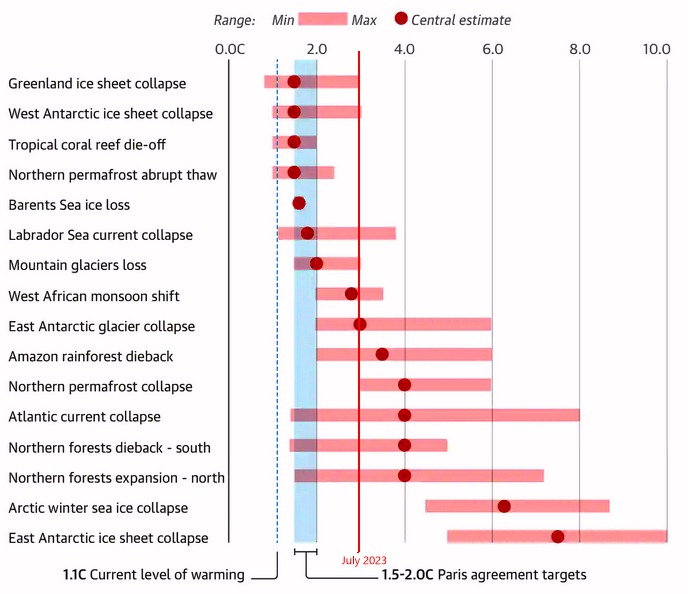
Human-induced climate change is an exponential component of an unordered system (chaos theory), meaning global warming is accelerating at a rapid and complex rate. Unfortunately, even scientists are struggling to fully understand or predict the rapid acceleration of climate change. The impacts of the Domino Effect, or “tipping cascades,” are being underestimated. Tipping points are critical milestones that directly impact the rate of acceleration in climate change by multiplying the number and intensity of feedback loops. These cascading impacts affect both biogeophysical and social systems. Until recently, scientists have drastically underestimated the role of social-ecological systems. The University of Exeter reports, “There is a notable lack of topic clusters dedicated to how humans will be impacted by climate-related tipping cascades.”

Previous climate models have inadequately incorporated “social-ecological systems” as human involvement was not a significant factor in past climate changes. Regrettably, the United States ranks among the least prepared countries globally, with a high percentage of climate deniers. The Republican party dismisses it as a manufactured crisis and plans to increase fossil fuel production, exacerbating the situation. Political extremists asserting that the climate crisis is manufactured use an ironic term, given that human manufacturing activities are the primary driver of climate change. Both political parties have agreed to allocate unlimited emergency funding for climate disasters instead of proactively preventing them. Last year, the US witnessed a record number of over a billion-dollar climate disasters, totaling 28 separate weather and climate-related events. Due to this arrogance and ignorance, “worst-case scenarios” are now “best-case scenarios” for the acceleration of climate change. These factors have altered our climate model, shifting the projected maximum temperature rise from 4 degrees Celsius over the next millennium to a probable increase of 9 degrees Celsius this century.

From the album “Right Now” by The Beatless Sense Mongers

MegaEpix Enormous

A song about The Human Induced Climate Change Experiment

bookmark_borderEvolution Forcing Revolution

This evolution forcing revolution
(Evolution revolution)

[Verse 1]
This evolution forcing revolution
With no solution to our institution
(Pro-pollution)
Self-centered position
(For repetition)

[Chorus]
Going round and round
In a feedback loop
Adding more and more
To recoup
[Bridge]
Round n’ round in a loop (loo-pity-loop)
Found around (loo-pity-loop)
Loop, Loop (loo-pity-loop)

[Verse 2]
The inept apt to force (adaptation?)
With no solution (Citizens Pro-pollution)
Self-centered position
(For repetition)

[Chorus]
Going round and round
In a feedback loop
Adding more and more
To recoup
[Bridge]
Round n’ round in a loop (loo-pity-loop)
Found around (loo-pity-loop)
Loop, Loop (loo-pity-loop)

A SCIENCE NOTE
Tipping cascades have emerged between biogeophysical and social-ecological systems. This Domino Effect is causing climate change to accelerate at an exponential rate.

Tipping points are Critical Milestones that directly impact the rate of acceleration in climate change by multiplying the number and intensity of feedback loops. Identifying and understanding these tipping points is crucial for climate science and policymaking. Crossing multiple tipping points could lead to a domino effect, resulting in a much more rapid and severe climate change than currently projected.

Tipping Points

Push a glass toward the edge of a table and eventually it will fall off on its own. No matter how slowly or meticulously you push… no matter how you weight or fill the glass, it will reach a tipping point and fall off before being pushed completely off the table. No matter whether you believe the glass is half-empty or half-full, when the tipping point is reached it will plummet out-of-control to its end. This is science not fate, faith, nor belief. Human induced climate change has resulted in environmental tipping points being breached.

Tipping points, when crossed, trigger self-sustaining feedback loops that are no longer dependent on human activity. Similar to when a domino topples over hitting two more dominoes that in turn fall hitting more dominoes. Thus, the name The Domino Effect. It can also be visualized as The Snowball Effect. A tipping point is like a snowball rolling down a hill growing in mass and velocity (momentum). When a tipping point is crossed, it results in cumulative and reinforced global warming.

From the album “Nowadays” by The Beatless Sense Mongers

MegaEpix Enormous

A song about The Human Induced Climate Change Experiment

bookmark_borderThe Heat is On

[Verse]
We talkin’ ’bout the climate
The temperature’s risin’
Chaos theory in effect
Ain’t no compromisin’
Human impacts got the world in a frenzy
9 degrees above
It’s gettin’ hot and it’s intense
See

[Verse 2]
Global warming
It’s the consequence we facin’
Thermal energy risin’
Climates changin’
Climate system
A web of subsystems
Intricate and nonlinear
This chaos we’ve become

[Chorus]
The heat is on
It’s gettin’ hotter day by day
1.5 degrees
We’re compromised in a major way
Earth uninhabitable
The future’s lookin’ bleak
9 degrees
It’s a wet-bulb temp we can’t defeat

[Bridge]
The heat is on (and on and on)
Temperature climbing (rising)
Is it surprising?

[Break]
Ouch!

[Chorus]
The heat is on
It’s gettin’ hotter day by day
1.5 degrees
We’re compromised in a major way
Earth uninhabitable
The future’s lookin’ bleak
9 degrees
It’s a wet-bulb temp we can’t defeat

[End]

A SCIENCE NOTE
AI and I created the song from this quote:
This climate model / experiment employs chaos theory to comprehensively consider human impacts and projects a potential global average temperature increase of 9℃ above pre-industrial levels. Global warming is a consequence of elevated thermal energy in the climate system, which comprises various subsystems. Chaos theory underscores the intricate and nonlinear nature of dynamic systems. Human well-being is compromised above a 1.5-degree temperature rise, rendering much of the Earth uninhabitable. A 9-degree Celsius increase would bring the Earth close to a wet-bulb temperature incapable of sustaining human life.

From the album “Nowadays” by The Beatless Sense Mongers

MegaEpix Enormous

A song about The Human Induced Climate Change Experiment

bookmark_borderExtreme Everywhere

Look out!
It ain’t over
Duck and cover

[Verse 1]
The mean for extreme
Getting meaner
The average extreme
More savage

[Bridge]
When it rains
It pours more
When it pours
No one endures

[Chorus]
Hard not to be aware
Extreme everywhere
Just look out your window
And you’ll know

[Instrumental, Guitar Solo, Drum Fills]

[Break]
It ain’t over
Duck and cover!

[Verse 2]
It seems the extreme
Varies from the mean
The average extreme
Brings more ravage

[Bridge]
When it rains
It pours more
When it pours
No one endures

[Chorus]
Hard not to be aware
Extreme everywhere
Just look out your window
And you’ll know

[Instrumental, Saxophone Solo, Drum Fills]

[Verse 3]
Do you mean extreme
Is getting more intense
Yet the mean
Are too dense

[Bridge]
When it rains
It pours more
When it pours
No one endures

[Break]
It ain’t over
Duck and cover!

[Chorus]
Hard not to be aware
Extreme everywhere
Just look out your window
And you’ll know

[Outro]
It ain’t over
Duck and cover!

[End]

A SCIENCE NOTE
Reports of extreme weather have surged to unprecedented levels, leaving scientists astounded by the intensity and frequency of these events.

In Brazil, flooding ravaged the southern city of Porto Alegre, claiming the lives of at least 100 people. Meanwhile, flash floods in Afghanistan proved even deadlier, with over 300 lives lost. In Kenya, over 300 people died and thousands were displaced due to historic flooding.

India grapples with scorching temperatures reaching up to 46 degrees Celsius amid national elections. The Philippines faced a severe heat wave, prompting authorities to shutter schools. Thailand reported fatalities due to record-breaking heat, echoing similar extreme conditions in Indonesia, Malaysia, the Maldives, and Myanmar. Across Africa, record-high temperatures have become the norm.

In the United States, April witnessed the second-highest number of tornadoes ever recorded for that month.

Jonathan Overpeck, head of the School for Environment and Sustainability at the University of Michigan, expressed grave concern: “It is not surprising to witness worsening climate extremes so early in the year. If this trend persists, 2024 could be marked by unprecedented climate disasters and human suffering.”

Mukherjee and Brouse emphasized the broader impact, stating, “We are not simply predicting a rise in Earth’s temperature. Rather, as energy is injected into the system, we anticipate heightened fluctuations across various weather patterns—more storms, droughts, wildfires, floods, and overall increased volatility. The human impact on climate is evident, shaping a future of unprecedented environmental unpredictability.”

* Our climate model employs chaos theory to comprehensively consider human impacts and projects a potential global average temperature increase of 9℃ above pre-industrial levels.

What Can I Do?
There are numerous actions you can take to contribute to saving the planet. Each person bears the responsibility to minimize pollution, discontinue the use of fossil fuels, reduce consumption, and foster a culture of love and care. Be a butterfly and affect the world. The Butterfly Effect illustrates that a small change in one area can lead to significant alterations in conditions anywhere on the globe. Hence, the frequently heard statement that a butterfly in China can cause a hurricane in the Atlantic.
Here is a list of additional actions you can take.

From the album “Nowadays” by The Beatless Sense Mongers

MegaEpix Enormous

A song about The Human Induced Climate Change Experiment

bookmark_borderSet Free to the See

Drop by drop
Drip, drop

[Verse 1]
Ice eludes, turning to tears
Think of all the years….
Wanting to be free
Back to the see (be the sea)

[Bridge]
Drip turns to trickle
No longer fickle
So before you know
Turns to flow

[Chorus]
Set free to see
Set free to be
Free to be the sea
Revolutionary

[Instrumental, Saxophone Solo, Bass]

[Verse 2]
Along the way, who’s to say
You might take flight
And zoom, there’s plenty of room
In the atmosphere

[Bridge]
If you can warm up to the idea
(The wind’s will steer)
And before you know
You’re wind flow

[Chorus]
Set free to see
Set free to be
Free to be the sea
Revolutionary

[Instrumental, Guitar Solo, Bass, Organ, Drum Solo]

[Verse 3]
Moisture, are you sure
Vapor, more and / or were?
Humidity gets the best of me
But at least you’re free

[Bridge]
If you can warm up to the idea
(The wind’s will steer)
And before you know
You’re wind flow

[Chorus]
Set free to see
Set free to be
Free to be the sea
Revolutionary

[Outro]
Set free to see
Set free to be
Revolutionary

A SCIENCE NOTE
This climate change song follows the journey of a water molecule from the Greenland ice sheet as it melts and joins the sea, highlighting the transformative power of water in the context of environmental change.

The repeated motif of “Drop by drop, Drip, drop” emphasizes the gradual but significant process of melting ice and the release of water into the sea.

In the first verse, the water molecule yearns to be free, symbolizing the liberation of trapped water from the ice sheet. The desire to return “Back to the sea” underscores the natural cycle of water and the interconnectedness of Earth’s systems.

The bridge underscores the transition from individual drops to a flowing stream, paralleling the collective impact of melting ice on sea levels and ocean currents.

The chorus celebrates the water molecule’s newfound freedom, portraying it as “Revolutionary” in its ability to influence the environment.

The instrumental sections, including saxophone, bass, organ, and drum solos, evoke the fluidity and dynamism of water as it moves through various states and environments.

In the third verse, the song reflects on the complexity of water’s transformations, from solid ice to vapor and back again, while acknowledging the challenges of increasing humidity in a changing climate.

The outro reaffirms the water molecule’s revolutionary role, emphasizing its potential to inspire change and adaptation in the face of environmental challenges.

The song captures the essence of water’s journey from ice sheet to sea, offering a poignant reflection on the profound impact of climate change on Earth’s water cycle.

From the album “Nowadays” by The Beatless Sense Mongers

MegaEpix Enormous

A song about The Human Induced Climate Change Experiment

bookmark_borderNowadays

Nowadays
Now which ways?

[Verse 1]
Climbed the tallest tree
To see what I could see
I said, “Lord! Help me!”

[Chorus]
They’re fighting left and right
In fact, everywhere in sight
While the temperatures go higher
The world caught on fire
[Break]
Fire!

[Bridge]
Nowadays
Every which ways
A mess
Nowadays
Every which weighs
Way less

[Instrumental]

[Verse 2]
Climbed the highest mountain
And saw once again
I said, “Good god! Save me!”

[Chorus]
They’re fighting left and right
In fact, everywhere in sight
While the temperatures go higher
The world caught on fire
[Break]
Fire!

[Bridge]
Nowadays
Every which ways
A mess
Nowadays
Our voices heard less
Do we understand
We need to stand?

[Instrumental, Saxophone Solo]
[Instrumental, Guitar Solo]
[Instrumental, Bass, Drum Fills]

[Verse 3]
I went to the highest authority
And She said to me
Son! Save “we”!

[Chorus]
They’re fighting left and right
In fact, everywhere in sight
While the temperatures go higher
The world caught on fire
[Break]
Fire!

[Bridge]
Confess,
Nowadays
Every which ways
A mess
Climb the tallest tree (and see)
Climb the highest mountain (again)
Shout it out
Tell ’em what it’s about!

[Outro]
Nowadays
Every which ways
A mess

[End]

A SCIENCE NOTE
Human-induced climate change is a dynamic component of an intricate and unordered system, as per chaos theory. This implies that global warming is accelerating exponentially in a complex manner. Over the period from 1992 to 2023, we have presented compelling evidence, proposed remedies to mitigate climate change, and amassed valuable information through the engagement of millions with this climate model. Your participation has been invaluable. The incontrovertible data underscores that human-induced climate change is rapidly deteriorating our habitat.

This climate model / experiment employs chaos theory to comprehensively consider human impacts and projects a potential global average temperature increase of 9℃ above pre-industrial levels. Global warming is a consequence of elevated thermal energy in the climate system, which comprises various subsystems. Chaos theory underscores the intricate and nonlinear nature of dynamic systems. Human well-being is compromised above a 1.5-degree temperature rise, rendering much of the Earth uninhabitable. A 9-degree Celsius increase would bring the Earth close to a wet-bulb temperature incapable of sustaining human life.

What Can I Do? There are numerous actions you can take to contribute to saving the planet. Each person bears the responsibility to minimize pollution, discontinue the use of fossil fuels, reduce consumption, and foster a culture of love and care. The Butterfly Effect illustrates that a small change in one area can lead to significant alterations in conditions anywhere on the globe. Hence, the frequently heard statement that a fluttering butterfly in China can cause a hurricane in the Atlantic. Be a butterfly and affect the world.

From the album “Nowadays” by The Beatless Sense Mongers

MegaEpix Enormous

A song about The Human Induced Climate Change Experiment

bookmark_borderWhy Say Goodbye?

Why…
Say goodbye?

[Verse 1]
Why say goodbye
And let the day go by
Why say goodbye
Let’s give ‘er another try

[Chorus]
Hello, why say goodbye?
Do you know
It’s come to do or die
Hello, why say goodbye?

[Instrumental, Guitar Solo, Drum Fills]

[Verse 2]
Why say goodbye
No sense going off to die
Why say goodbye
Let’s take the opportunity to fly

[Chorus]
Hello, why say goodbye?
Do you know
It’s come to do or die
Hello, why say goodbye?

[Instrumental, Saxophone Solo, Drum Fills]

[Bridge]
Don’t you know
I hate long goodbyes
So why go
I hate drawn out cries
Why say goodbye
When we could fly so high

[Verse 3]
Why say goodbye
Morph to butterfly
Why say goodbye
When we could take to the sky

[Chorus]
Hello, why say goodbye?
Do you know
It’s come to do or die
Hello, why say goodbye?

[Outro]
Do you know hello?
So….

[End]

A SCIENCE LESSON
The Social-Ecological Systems: While biogeophysical factors can be studied using math, physics, and historical records, socio-economic systems pose greater challenges due to the unintended consequences of human behavior and inexplicable consumer choices.

* Our climate model employs chaos theory to comprehensively consider human impacts and projects a potential global average temperature increase of 9℃ above pre-industrial levels.

What Can I Do?
There are numerous actions you can take to contribute to saving the planet. Each person bears the responsibility to minimize pollution, discontinue the use of fossil fuels, reduce consumption, and foster a culture of love and care. Be a butterfly and affect the world. The Butterfly Effect illustrates that a small change in one area can lead to significant alterations in conditions anywhere on the globe. Hence, the frequently heard statement that a butterfly in China can cause a hurricane in the Atlantic.
Here is a list of additional actions you can take.

From the Sir Vent album Why?

MegaEpix Enormous

A song about The Human Induced Climate Change Experiment

bookmark_borderSole Sol Soul

Facts:
Have axe
Will travel

[Verse 1]
At peace, love’s lease
Love’s lease won’t cease

[Chorus]
“Are you really ever alone?
So feel free to make yourself at home.”
As long as a guitar isn’t far
Home’s third planet from our star
(Sole Sol Soul)

[Bridge]
Since music is universal
I’m prepared to travel
Facts:
[Break]
Have axe
Will travel
(Unravel)

[Instrumental, Guitar Solo, Drum Fills]

[Verse 2]
Love from above, and below (Oh)
It’s hard to know (Oh)
Being aware
Everywhere

[Chorus]
“Are you really ever alone?
So feel free to make yourself at home.”
As long as a guitar isn’t far
Home’s third planet from our star
(Sole Sol Soul)

[Verse 3]
Push and shove love (love, love, love)
Live to give (Give to live)
Music will lift us above (more love, love)
Sing of the love (Shine on from above)

[Chorus]
“Are you really ever alone?
So feel free to make yourself at home.”
As long as a guitar isn’t far
Home’s third planet from our star
(Sole Sol Soul)

[Bridge]
Since music is universal
I’m prepared to travel
Facts:

[Instrumental, Guitar Solo, Bass]

[Outro]
Have axe
Will travel
(Unravel)

[End]

A SCIENCE LESSON
ExperiMental Music: For the most part, this music is written and recorded extemporaneously. Extemporaneous, spontaneous, improvisation, jamming, freestyle, and impromptu music are most closely related to pure chaos. The music and lyrics evolve from the “sensitive initial conditions” similar to “a butterfly flapping its wings in China causing a hurricane in the Atlantic.”

Music as a Universal Language: Music has the power to communicate emotions universally. Certain melodies, harmonies, or rhythms can evoke specific feelings that resonate with people across different cultures and backgrounds.

The Science of Chaos Theory, String Theory, and Music
4D Music stands for four-dimensional music. The concept of the fourth dimension in the context of spacetime comes from the merging of three-dimensional space with the dimension of time into a four-dimensional continuum. This idea is a fundamental component of Einstein’s theory of general relativity. In classical physics, space and time were considered separate entities, with space described by three dimensions (length, width, and height), and time considered as a separate parameter. However, in the early 20th century, Albert Einstein introduced the concept of spacetime, where time is treated as a fourth dimension, and the fabric of the universe is a four-dimensional continuum.

MegaEpix Enormous

Daniel

bookmark_borderHave Another

Do you mind if I have another?

[Verse 1]
Better believe I’m gonna get some of these
And, you know some of those
Then, who knows, here goes
(There goes)

[Chorus]
The world of the hoard
Get ready to explode
Haven’t you heard,
“All aboard! Hit the road.)

[Instrumental, Saxophone Solo, Drum Fills]

[Verse 2]
Couldn’t conceive
Not getting some of those
And, some of these
If I please (Lil’ tease)
(Jeez)

[Chorus]
The world of the hoard
Get ready to explode
Haven’t you heard,
“All aboard! Hit the road.)

[Instrumental, Bass Solo, Drum Fills]

[Bridge]
I’m gonna let it ride
(Ride, ride, ride)
I’ve got my pride
(Lied, lied, lied)
See the false reality
Turn to scarcity
Really

[Verse 3]
Mental retrieve
Between want and need
And, how to stop the bleed
(Hey! Hey!) (Make way!)

[Chorus]
The world of the hoard
Get ready to explode
Haven’t you heard,
“All aboard! Hit the road.)

[Outro]
Here goes, there goes
Lil’ tease, Jeez
Hey! Hey! Make way

[End]

A SCIENCE LESSON
Mass consumption contributes to environmental destruction in several ways:

  1. Resource Depletion: Mass consumption leads to the extraction and depletion of natural resources such as fossil fuels, minerals, and water. Industries producing goods to meet consumer demand often exploit these resources at unsustainable rates, leading to their depletion and irreparable damage to ecosystems.
  2. Deforestation: The demand for wood products, paper, and agricultural land drives deforestation, especially in tropical rainforests. Clearing forests for timber, agriculture, and urban development destroys vital habitats for countless plant and animal species, disrupts ecosystems, and contributes to biodiversity loss.
  3. Pollution: Mass production of goods and packaging generates significant pollution at every stage of the supply chain, from extraction and manufacturing to transportation and disposal. This pollution includes air and water pollution, soil degradation, chemical contamination, and greenhouse gas emissions, which contribute to climate change and harm human health and the environment.
  4. Waste Generation: Mass consumption generates vast amounts of waste, including plastic packaging, electronic waste, and discarded products. Much of this waste ends up in landfills, where it releases harmful substances and contributes to soil and water pollution. Improper disposal of waste, such as plastic litter, also poses a threat to wildlife and marine ecosystems.
  5. Climate Change: The production, transportation, and consumption of goods require energy, most of which comes from burning fossil fuels. This reliance on fossil fuels releases greenhouse gases, such as carbon dioxide and methane, into the atmosphere, leading to global warming and climate change. Climate change exacerbates environmental problems, including extreme weather events, rising sea levels, and habitat loss.

Mass consumption perpetuates a linear, “take-make-dispose” economic model that is unsustainable and detrimental to the planet’s health. Transitioning to a more circular economy, reducing consumption, adopting sustainable production practices, and embracing eco-friendly alternatives are essential steps toward mitigating environmental destruction and building a more sustainable future.

MegaEpix Enormous

Daniel

A song about The Human Induced Climate Change Experiment

bookmark_borderAgents of Change: Gravity

Agents of change
[Break]
Rearrange

[Instrumental, Guitar Solo, Drum Fills]

[Verse 1]
In the language of math, delta spells out change,
An agent unseen, but it rearranges.
When x shifts, and the world rearranges,
Delta x shows the path that it ranges.

[Chorus]
Gravity, agent of change,
Pulling us close, in its wide range.
From Earth to the stars, an attractive force,
In the dance of the cosmos, it changes our course.
[Break]
Agents of change
[Break]
Rearrange

[Verse 2]
In the realm of physics, it reigns supreme,
Binding the planets in an eternal scheme.
With mass as its currency, it dictates the scene,
Delta (x), the shift, where its presence is seen.

[Chorus]
Gravity, agent of change,
Pulling us close, in its wide range.
From Earth to the stars, an attractive force,
In the dance of the cosmos, it changes our course.
[Break]
Agents of change
[Break]
Rearrange

[Instrumental, Saxophone Solo, Piano]

[Bridge]
Through galaxies vast, its pull extends,
In the fabric of spacetime, it bends.
Delta x, the measure, where its story blends,
Gravity’s legacy, on which all depends.

[Chorus]
Gravity, agent of change,
Pulling us close, in its wide range.
From Earth to the stars, an attractive force,
In the dance of the cosmos, it changes our course.
[Break]
Agents of change
[Break]
Rearrange

[Instrumental, Saxophone Solo, Guitar Solo, Drum Fills]

[Outro]
In the symphony of existence, its echo rings,
Gravity’s touch, the universe sings.
Delta x, the motion, on celestial strings,
A force of nature, where the cosmos clings.

[End]

A SCIENCE LESSON
Uppercase delta (Δ) means “change” or “the change” in math. An example in which a variable x stands for the movement of an object: “Δx” means “the change in movement.” Scientists make use of this mathematical meaning of delta in various branches of science. In physics, an agent of change typically refers to a force or an interaction that causes a change in the state of an object or system. Here are some examples:

  1. Gravity: Gravity is a fundamental force that acts between objects with mass. It causes objects to accelerate toward each other. For example, the gravitational force of the Earth causes objects to fall when dropped.
  2. Electromagnetic Force: The electromagnetic force is responsible for interactions between charged particles. It includes both electric and magnetic forces. For instance, the attraction between opposite charges and repulsion between like charges are examples of electromagnetic interactions.
  3. Friction: Friction is a force that opposes the motion of objects in contact with each other. It can cause changes in the speed or direction of an object’s motion. For example, friction between the tires of a car and the road surface slows down the car when the brakes are applied.
  4. Applied Forces: Applied forces are external forces that are exerted on an object by an external agent. These forces can cause changes in an object’s velocity or deformation. For instance, pushing a box across the floor applies a force that causes the box to move.
  5. Spring Force: When a spring is stretched or compressed, it exerts a force that tries to restore it to its equilibrium position. This force is known as the spring force. It can cause changes in the position or velocity of objects attached to the spring.
  6. Nuclear Forces: Nuclear forces are the forces that hold atomic nuclei together. They can cause changes in the structure of atomic nuclei through processes such as nuclear fusion or fission.

These are just a few examples of agents of change in physics. In general, any force or interaction that causes a change in the motion, position, or state of an object or system can be considered an agent of change in physics.

In the context of climate change, agents of change are factors or mechanisms that contribute to alterations in the Earth’s climate system, leading to global warming, shifts in weather patterns, and other environmental impacts. Here are some examples of agents of change in climate change:

  1. Greenhouse Gas Emissions: Human activities, such as burning fossil fuels (coal, oil, and natural gas), deforestation, industrial processes, and agriculture, release greenhouse gases (such as carbon dioxide, methane, and nitrous oxide) into the atmosphere. These gases trap heat, leading to an increase in global temperatures.
  2. Deforestation: The clearing of forests for agriculture, logging, urbanization, and other purposes reduces the Earth’s capacity to absorb carbon dioxide through photosynthesis. This contributes to higher levels of atmospheric carbon dioxide and disrupts the balance of greenhouse gases.
  3. Land Use Changes: Changes in land use, including urbanization, agriculture expansion, and infrastructure development, can alter local and regional climates by modifying surface albedo (reflectivity), evapotranspiration rates, and heat absorption.
  4. Industrial Activities: Industrial processes, such as cement production, chemical manufacturing, and metal smelting, emit greenhouse gases and other pollutants into the atmosphere. These activities contribute to global warming and air pollution, affecting both climate and human health.
  5. Transportation: The combustion of fossil fuels in vehicles, airplanes, ships, and other modes of transportation releases greenhouse gases and other pollutants into the atmosphere. The transportation sector is a significant contributor to global carbon emissions.
  6. Agricultural Practices: Agricultural activities, including livestock farming, rice cultivation, and fertilizer use, produce methane and nitrous oxide emissions, both potent greenhouse gases. Changes in agricultural practices can influence greenhouse gas emissions and land use patterns.
  7. Inexplicable Consumer Choices: Consumer behavior can sometimes defy logic or go against the imperative of addressing climate change and environmental degradation. Addressing these behaviors often requires a combination of education, policy interventions, market incentives, and societal norms to encourage more sustainable choices.

These examples illustrate how various human activities and natural processes act as agents of change in the Earth’s climate system, leading to observable impacts on the environment and society. Addressing climate change requires mitigating greenhouse gas emissions, promoting sustainable land use practices, and adapting to changing climate conditions.

by Δ To Cause a Change from the album Agents of Change

A song about The Human Induced Climate Change Experiment

bookmark_borderResponse to External Forcings

[Verse 1]
System reaction
Due to external stimulation
The slightest nuance
Induces changes in response

[Chorus]
Enduring our external forcings
Divorcing our endorsings
Do we get it?
Of course, we are the force.
[Break]
A child sings:
[Break]
Of course, we are the force.

[Verse 2]
Increasing concentrations
Due to primate activities
Impact climate’s habitation
Bringing on scarcities

[Bridge]
Species rarities
Social disparities
Can’t divorce responsibility
Set our course for inevitability

[Chorus]
Enduring our external forcings
Divorcing our endorsings
Do we get it?
Of course, we are the force.
[Break]
A child sings:
[Break]
Of course, we are the force.

[Instrumental]

[Verse 3]
Some chaos insight
Might shed some light
Our interconnectedness
Is causing the mess

[Bridge]
Species rarities
Social disparities
Can’t divorce responsibility
Set our course for inevitability

[Chorus]
Enduring our external forcings
Divorcing our endorsings
Do we get it?
Of course, we are the force.
[Break]
A child sings:
[Break]
Of course, we are the force.

[Outro]
Do we get it?
Of course, we are the force.

[End]

A SCIENCE LESSON
“Response to external forcings” refers to how a system reacts or changes in response to external influences or drivers. In the context of climate science, external forcings typically refer to factors outside of the Earth’s climate system that can influence the climate. These forcings can include natural factors such as volcanic eruptions, solar radiation, and orbital variations, as well as human-induced factors such as greenhouse gas emissions, land use changes, and aerosol pollution.

When scientists study the Earth’s climate system, they analyze how it responds to these external forcings. For example, changes in greenhouse gas concentrations due to human activities can lead to alterations in the Earth’s energy balance, resulting in global warming and climate change. Similarly, volcanic eruptions can release aerosols into the atmosphere, which can temporarily cool the climate by reflecting sunlight back into space.

Understanding the response of the climate system to external forcings is crucial for predicting future climate trends, assessing the impacts of human activities on the environment, and informing policies aimed at mitigating climate change. It involves complex scientific modeling and analysis to quantify the relationships between external forcings and climate variables such as temperature, precipitation, and atmospheric circulation patterns.

Chaos theory offers insights into the complex dynamics of the Earth’s atmosphere, particularly regarding the interactions between different atmospheric teleconnection patterns and their response to external forcings such as greenhouse gas emissions. Chaos theory can help elucidate how seemingly minor changes in atmospheric circulation patterns can lead to significant and often unpredictable changes in weather patterns across North America.

by The Beatless Sense Mongers

A song about The Human Induced Climate Change Experiment

bookmark_borderReign

[Verse 1]
In the depths of winter’s chill, the air begins to stir,
Teleconnection patterns dance, a cosmic theatre.
Interconnected changes in the atmosphere,
Shaping weather’s whims across the hemisphere.

[Chorus]
Oh, the dance of the teleconnections,
In the Reign of Man’s domain,
Where chaos rules and patterns shift,
In a climatic ballet, they entertain.

[Instrumental, Guitar Solo, Drum Fills]

[Verse 2]
Across the years, influence gains,
With a constant driver changing lanes.
Oh, Man, Oh, Man, a role profound,
Guiding weather’s hand, with each winter’s sound.

[Chorus]
Oh, the dance of the teleconnections,
In the Reign of Man’s domain,
Where chaos rules and patterns shift,
In a climatic ballet, they entertain.

[Instrumental, Saxophone Solo, Drum Fills]

[Bridge]
But amidst this intricate dance, a discordant note is found,
A negative correlation, a shift profound.
Driven by human hands, interference on the rise,
Shaping teleconnections, ‘neath winter’s skies.

[Chorus]
Oh, the dance of the teleconnections,
In the Reign of Man’s domain,
Where chaos rules and patterns shift,
In a climatic ballet, they entertain.

[Instrumental, Piano Solo, Flute, Snare Drum]

[Outro]
Will we heed the lessons learned, from chaos’ swirling dance,
And strive to protect this fragile world, with every second chance.
For in the web of teleconnections, we find our fate entwined,
In the symphony of Earth’s climate, what harmony will we find?

[End]

A SCIENCE LESSON

Evolving winter atmospheric teleconnection patterns and their potential triggers across western North America
In particular, an emergent negative correlation between the NAWD and PNA, signaling a shifted phase of teleconnection patterns, is identified. Such a relationship change is traced to enhanced upper-level ridges across western North America, reflecting a reinforced winter stationary wave. Through attribution analysis, we identify greenhouse gas emissions as a probable driver for the northward drift of the Asia-Pacific jet core, which, aided by orographic lifting over the Alaskan Range, subsequently amplifies the winter stationary wave across western North America. This work emphasizes the pronounced effect of human-induced global warming on the structure and teleconnection of large-scale atmospheric circulation in the Northern Hemisphere winter, providing vital perspectives on the dynamics of current climate trends.

— from the study Evolving winter atmospheric teleconnection patterns and their potential triggers across western North American-Patterns

Chaos theory offers insights into the complex dynamics of the Earth’s atmosphere, particularly regarding the interactions between different atmospheric teleconnection patterns and their response to external forcings such as greenhouse gas emissions. Chaos theory can help elucidate how seemingly minor changes in atmospheric circulation patterns can lead to significant and often unpredictable changes in weather patterns across North America.

The analysis highlights the interplay between major atmospheric teleconnection patterns in the Northern Hemisphere winter, including the Pacific North American pattern (PNA), North Atlantic Oscillation (NAO), and North American winter dipole (NAWD). These patterns are known to influence weather conditions over vast regions and are sensitive to external drivers such as greenhouse gas emissions.

Chaos theory suggests that even small perturbations in the atmosphere, such as changes in temperature or pressure, can lead to nonlinear responses and amplify into larger-scale changes in weather patterns. In this case, the study identifies a consistent influence of the NAWD over several decades, indicating a robust relationship between this teleconnection pattern and anomalous weather across North America.

The emergence of a negative correlation between the NAWD and PNA, signaling a shifted phase of teleconnection patterns, is particularly noteworthy. This shift reflects a complex interplay of atmospheric dynamics, including the amplification of winter stationary waves across western North America.

Moreover, chaos theory underscores the role of human-induced global warming as a probable driver for these changes in atmospheric circulation. Greenhouse gas emissions are identified as a key factor contributing to the northward drift of the Asia-Pacific jet core, which, in turn, amplifies the winter stationary wave across western North America. This highlights the interconnectedness of human activities and Earth’s climate system, with potentially far-reaching consequences for weather patterns and climate trends.

Chaos theory provides a framework for understanding the intricate and often nonlinear relationships between atmospheric teleconnection patterns, external forcings, and the dynamics of current climate trends. By applying chaos theory principles, researchers can gain vital perspectives on the complex interactions shaping Earth’s climate system and inform efforts to mitigate and adapt to climate change.

by The Beatless Sense Mongers

A song about The Human Induced Climate Change Experiment

bookmark_borderAxeman

Timber!

[Verse 1]
Man came with axe in hand
Didn’t seem to understand
A stand of trees like these
Overcome by Man’s disease
[Break]
Timber!

[Chorus]
Timber! Makes a spine shiver
All to supply and deliver
To the primate climate machine
There goes the dream…
[Bridge]
The American dream
Fraying at the seams
Can anyone save our scene?

[Verse 2]
Man came sawed what he saw
Doubt hell will ever thaw
Frozen over by Man’s endeavor
Now, hits home more than ever

[Break]
Timber!

[Chorus]
Timber! Makes a spine shiver
All to supply and deliver
To the primate climate machine
There goes the dream…
[Bridge]
The American dream
Fraying at the seams
Can anyone save our scene?

[Instrumental, Guitar Solo, Hammond B3 Organ]

[Verse 3]
Man set the world on fire (on fire)
Situation’s turned quite dire (quite dire)
Still, Man caries on (and on)
Since sense is no longer common (come on!)
[Break]
Timber!

[Chorus]
Timber! Makes a spine shiver
All to supply and deliver
To the primate climate machine
There goes the dream…

[Instrumental, Saxophone Solo, Piano]

[Outro]
The American dream
Fraying at the seams
Can anyone save our scene?

[End]

A SCIENCE LESSON
Plants are in a precarious position.  At the hands of Man, vegetation can not escape.  There is no way to run.  There is no way to hide. After Man conquers, they die.

Penn’s Sylvania
Pennsylvania derives its name from the land grant bestowed upon William Penn. Penn’s grant, known as “sylvania,” translates to “forest” in Latin. Prior to the arrival of European settlers, the region was predominantly covered by vast expanses of dense forests, with a wide range of biodiversity and inhabited by indigenous peoples who relied on the land for sustenance and cultural practices.

In the 17th and 18th centuries, European settlers began to clear land for agriculture and settlement, leading to widespread deforestation in Pennsylvania. The demand for timber and wood products grew rapidly as the population expanded and industries such as shipbuilding, construction, and manufacturing developed. Logging became a prominent economic activity in Pennsylvania, with vast quantities of timber harvested. By the 19th century, Pennsylvania had become one of the leading timber-producing states in the United States, with extensive logging operations throughout the region. The emergence of the lumber industry brought prosperity to many communities but also led to widespread environmental degradation, including soil erosion, loss of biodiversity, and disruption of watershed systems.

As concerns grew over the sustainability of logging practices and the conservation of natural resources, efforts were made to regulate and manage forest resources more effectively. In the late 19th and early 20th centuries, the conservation movement gained momentum, leading to the establishment of state and federal agencies tasked with overseeing forestry and conservation efforts.

A Troubling Decline
In Pennsylvania, the once lush and verdant tree canopy is now facing a troubling decline, as the old growth trees succumb to the relentless pressures of human activities. The consequences of this ecological imbalance reverberate through the forest, as vines empowered by the thinning canopy are able to reach higher.

As these vines ascend to new heights, they cover and kill the venerable trees below. The intricate balance of nature is disrupted, as the loss of the old growth trees impacts biodiversity, soil stability, and wildlife habitats.

The gradual encroachment of vines into the upper reaches of the forest canopy represents a poignant symbol of the broader environmental challenges facing Pennsylvania and beyond. It serves as a stark reminder of the interconnectedness of all living beings and the urgent need for stewardship and conservation to preserve the natural wonders that enrich our lives.

Overall, climate change is reshaping the environmental, social, and economic landscapes of temperate zones in the United States, underscoring the need for proactive measures to mitigate its impacts and enhance resilience in affected regions. Regrettably, trees find themselves rooted in their temperate zones, unable to embark on the migratory journeys undertaken by some other species to seek refuge in more hospitable environments.

by The Beatless Sense Mongers

A song about The Human Induced Climate Change Experiment