bookmark_borderTill Tomorrow

LYRICS
Sitting on high
Looking below
On days gone by
Till tomorrow
As days go past
Can’t help but ask
How can this last
Till tomorrow?
I don’t know
[Don’t listen to the voices in your head
Don’t listen. You’ve choices.
In your head
Position
Straight ahead
In your head
Straight ahead]
Let it be said:
Get it on high
Just look below
it’s do or die
Till tomorrow
As days go past
Can’t help but ask
How can this last
Till tomorrow?
I don’t know
[Don’t listen to the voices in your head
Don’t listen. You’ve choices.
In your head
Position
Straight ahead
In your head
Straight ahead]
Let it be said:
Turn love on high
Above below
Give our best try
Till tomorrow
As days go past
Can’t help but ask
How can this last
Till tomorrow?
I don’t know
[Don’t listen to the voices in your head
Don’t listen. You’ve choices.
In your head
Position
Straight ahead
In your head
Straight ahead]
Let it be said

Chords: Em C D Em / Em Bm A7 Em / Em/7
Instrumentation: Vocals, Takamine Acoustic Guitar, Kurzweil PC88 Electric Piano
Written and recorded at Lake Wynonah, Pennsylvania during sunset.

What will the “End of Times” look like?

“The era of global warming has ended and the era of ‘global boiling’ has arrived. Climate change is here. It is terrifying. And it is just the beginning”, UN secretary general, António Guterres, said after scientists confirmed July 2023 was on track to be the world’s hottest month on record.

In 2023, we wrote about having crossed tipping points in the paper, “Climate Change: How Long Is ‘Ever’?“. When we wrote the Tunnel Under Thesis in 1995, we forecast crossing these tipping points would not happen for centuries. We underestimated Man’s ignorance and arrogance. Fossil fuel consumption and greenhouse gas emissions have continued to set record highs. Humans have caused chain-reactions resulting in toppled tipping points, feedback loops, and The Domino Effect.

There will be enough ice melt to raise sea levels 220 feet. We estimate 270 feet to be “the minimum safe” elevation to live. High-tides, waves, coastal flooding, storm surge, grade of shoreline, etc. would make the lowest elevations for living space to be at least 270 feet above pre-industrial sea levels. This would be the minimum elevation. Personally, I would not want to live that low. As the water submerges sewage treatment plants, landfills, chickens, cows, and all sorts of other bio-hazards, the waters will become toxic. In addition, much of the land will experience salinization making it unfit for plant life. Another concern for elevations under 800 feet is living on an island. Many locations at lower elevations will become isolated. Living on an island has many problems including fresh water, food, shelter, and healthcare. Security from pirates pilfering, raping, and plundering will likely be the overriding concern. Of course, I don’t expect that to happen for millennia, but I hope government planners do plan for it now. If you look at Florida as an example, parts of the coastline have seen sea levels rise over 14-20 feet in the last decade. Although the storm surge was only for hours, you wouldn’t want to live there during those hours. Not to mention, the frequency of these extreme weather events will rise exponentially. Thus, our recommendation to evacuate Florida now (i.e. Managed Retreat). The billions of dollars spent to rebuild after Hurricane Ida will all be for naught. Allowing building there will needlessly endanger property and lives. Parts of the world have already seen storm surges of 40 feet. I expect most North American coastlines will see sea levels rise, if only temporarily, by 20-40 feet this century. As far as long run sea level rise, much will depend on location, gravity, isostatic adjustment, and thermal expansion. If the ocean temperatures get warm enough (thermal expansion), parts of the world may see sea levels rise to 270 feet for long periods of times. Other parts of the world, like Greenland, may actually see sea levels decline. In any event, the Earth crossed tipping points this decade which make extreme sea level rise inevitable and irreversible in our lifetimes. Planners should plan on it.

Sidd reiterated, “That 270 feet will take a long time. I would be more careful about the violent rain than the ice melt.” Expect to see increasing intensity and/or frequency in a wide variety of violent rain events including: downpours, flooding, hurricanes, cyclones, monsoons, coastal flooding, storm surges, lightning and wildfires, hail, extreme wind, and concurrent extremes. The reign of violent rain has already begun. More hillsides and shorelines are collapsing. Atmospheric rivers are dramatically increasing flash flooding in the Northeastern USA. Worldwide, stormwater systems are becoming overwhelmed. Ironically, the streets of Abu Dhabi and Dubai, UAE, flooded days before the COP28 Climate Conference. Nowhere is safe from violent rain, not even in the desert preparing for a UN meeting on the climate crisis. As a result of increasing violent rain, new drainage culverts are forming. Eventually, the culverts will transform into recurring streams, carving new canyons, creating new landscapes and islands. In addition, extreme weather events are increasing the frequency of lightning storms and wildfires. After wildfires, rain deluges cause massive landslides transforming the topography. At the same time as the violent rain makes its way to the sea, the sea is rising to meet the violent rain.

In the article “Violent Rain and the Substrate,” Greg Laden, coastal archaeologist, said, “With a little erosion, the Hudson, Lake Champlain, and the St. Lawrence could become contiguous, so New England becomes an Island.”

For any remaining humans, fresh air, water, food, and sunlight will all be problematic; however, your most severe concern will likely be security. Those with supplies will be at high risk of being raped and looted. Good luck!
— from Climate Change: The End of Times / Brouse and Mukherjee (2023)
What you can do today. How to save the planet.

bookmark_borderMy Slice of Pi

LYRICS
Ready to help with everything I know
Ready to help from the get-go
Eager to spur imagination to grow
From the thoughts we’re about to sow
Here we go!
Are you sure?
Do you ask why?
What’s the pi of our pie
Do you know
The ratio
The circumstance
Of the circumference
To the diameter
For sure
3.14 forever more

Yes, I yearn to learn to know
Start the heart and let it go
Eager to spur imagination to grow
From the thoughts we’re about to sow
Here we go!
Are you sure?
Do you ask why?
What’s the pi of our pie
Do you know
The ratio
The circumstance
Of the circumference
To the diameter
For sure
3.14 forever more

Mind’s a terrible thing to waste
Open the world and take a taste!
Eager to spur imagination to grow
From the thoughts we’re about to sow
Here we go!
Are you sure?
Do you ask why?
What’s the pi of our pie
What’s your piece
Being at peace?
What’s your slice?
Ain’t no game of dice
Do you know
The ratio
The circumstance
Of the circumference
To the diameter
For sure
3.14 forever more

Chords: F# A / F# B A / F# D E F# / A F# / F# A B C#7 N.C. F#; Part II @ 109 Beats Per Minute
Instrumentation: Vocals (TC-Helicon VOICELIVE and MiniNova Vocorder), Ibanez Acoustic Guitar, Ibanez RG Series Electric Guitar (Boss Digital Delay), Fender Jazz Bass (Boss Digital Delay), Keyboards (Korg PS60, Casio WK-3500, Yamaha PSR-740, MiniNova, MicroKorg)

ABOUT THE SONG
Are you doing everything you can to help make the world a better place? Are you trying to learn everything you can… or are you only worried about your own slice of the pie? Do you even know what your slice of the pie is?

Circles are mathematically similar. The circumference divided by the diameter equals the same value regardless of their size — 3.14. The value of the ratio of the circumference to the diameter is called π (Pi). Ironically, pi is called an irrational number. Pi a real number that cannot be written as a simple fraction. Pi has an “infinite decimal.” After the decimal point, the digits go on forever and ever — 3.141592653589793238462643383279502884197, etc. (but is usually rounded down to 3.14.)

Now you can figure out your slice of the pi.

What Can I Do?
There are plenty of things you can do to help save the planet. Stop using fossil fuels. Consume less. Love more. Here is a list of additional actions you can take.

bookmark_borderAny More

LYRICS
Not that sure
Any more
What’s in store
For your future
All depends
On what we do
Who up-ends the classic view
Decisions that we make
Give versus take
Will we wake?
(Gotta wake up. I’ve gotta wake up. You’ve gotta wake up. We’ve gotta wake up.)\

What came before
May come no more
What’s in store
For your future
All depends
On what we do
Who up-ends the classic view
Decisions that we make
Give versus take
Will we wake?
(Gotta wake up. I’ve gotta wake up. You’ve gotta wake up. We’ve gotta wake up.)\

The rains pour
More and more
What’s in store
For your future
All depends
On what we do
Who up-ends the classic view
Decisions that we make
Give versus take
Will we wake?
(Gotta wake up. I’ve gotta wake up. You’ve gotta wake up. We’ve gotta wake up.)

Chords: E7sus4 E / C D A C D E / E6 E E G A E / E G A / A G E; Part II @ 120 Beats Per Minute
Instrumentation: Vocals (TC-Helicon VOICELIVE and MiniNova Vocorder), Ibanez Acoustic Guitar, Ibanez RG Series Electric Guitar (Boss Digital Delay), Fender Jazz Bass (Boss Digital Delay), Keyboards (Korg PS60, Casio WK-3500, Yamaha PSR-740, MiniNova, MicroKorg)

What will be the changing topography caused by extreme rain events? You can kind-of imagine Eastern and Western North America as giant beaches with ever increasing atmospheric waves splashing down on us. The Gulf Coast will be hit from both sides. We to see increasing intensity and/or frequency in a wide variety of violent rain events including: downpours, flooding, hurricanes, cyclones, monsoons, coastal flooding, storm surges, lightning and wildfires, hail, extreme wind, and concurrent extremes. The reign of violent rain has already begun. More hillsides and shorelines are collapsing. Atmospheric rivers are dramatically increasing flash flooding in the Northeastern USA. Worldwide, stormwater systems are becoming overwhelmed. Ironically, the streets of Abu Dhabi and Dubai, UAE, flooded days before the COP28 Climate Conference. Nowhere is safe from violent rain, not even in the desert preparing for a UN meeting on the climate crisis. As a result of increasing violent rain, new drainage culverts are forming. Eventually, the culverts will transform into recurring streams, carving new canyons, creating new landscapes and islands. Increased wildfires and landslides will transform topography. At the same time as the violent rain makes its way to the sea, the sea is rising to meet the violent rain. What do you think will happen to the floodplains in North America?

— from The Reign of Violent Rain Brouse and Mukherjee (2023)

What Can I Do?
There are plenty of things you can do to help save the planet. Stop using fossil fuels. Consume less. Love more. Here is a list of additional actions you can take.

A song about The Human Induced Climate Change Experiment

bookmark_borderChange the Dial

LYRICS
The future that’s right ahead
Does it give us reason to dread?
Water over our head
At the rate it’s rising
Won’t be surprising
If lowlifes wind up dead
The moral of the story
Up to the neck in glory
Forever in denial
Upon dwindling isle
No sense waiting a while
Go on change the dial

Try a new station instead
The airwaves are overhead
Water upon our head
At the rate it’s rising
Won’t be surprising
If lowlifes wind up dead
The moral of the story
Up to the neck in glory
Forever in denial
Upon dwindling isle
No sense waiting a while
Go on change the dial

“Should have listened,” the wise man said
You can’t make drink…
… though you have led
Water feeding our head
At the rate it’s rising
Won’t be surprising
If lowlifes wind up dead
The moral of the story
Up to the neck in glory
Forever in denial
Upon dwindling isle
No sense waiting a while
Go on change the dial

Chords: A Bb A C A / C D A / A C E B E / G Bm E; Part II @ 100 Beats Per Minute
Instrumentation: Vocals (TC-Helicon VOICELIVE and MiniNova Vocorder), Ibanez Acoustic Guitar, Ibanez RG Series Electric Guitar (Boss Digital Delay), Fender Jazz Bass (Boss Digital Delay), Keyboards (Korg PS60, Casio WK-3500, Yamaha PSR-740, MiniNova, MicroKorg)

ABOUT THE SONG
Do you know what happens if you drink too much water? You drown.

The first part of the song is about sea level rising. In general, the shorelines and waterways that are seeing the largest storm surges are the same areas that are experiencing the fastest rate of sea level rise. The sea level does not rise at the same rate along most coasts. Some of the conditions that determine the relative sea level at any given location include: water temperature (thermal expansion), circulation, ocean floor contour, ice melt, ocean dynamics, and Earth’s uneven gravity field.

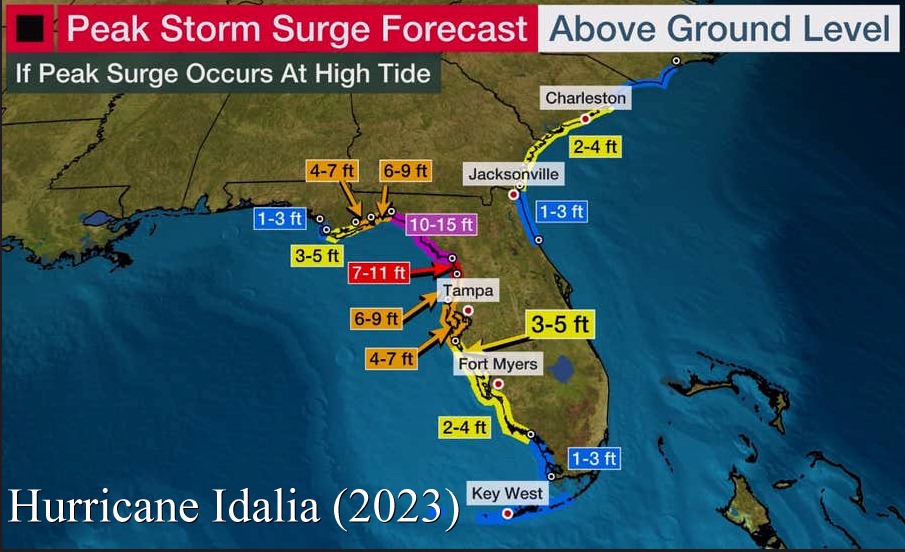
Idalia Storm Surge 2023

The Shape of Things to Come
For the foreseeable future, storm surges will offer a good forecast of future sea level rise. Hurricane Idalia’s storm surge (pictured / 2023), brought a 10-15 storm surge to the northern coast of Florida. In 2022, Hurricane Ida brought a 14-20 foot storm surge to the southern coast of Florida. Ida also made landfall in Southeastern USA. Plaquemines Parish on the east bank of the Mississippi River had an estimated storm surge of at least 14 feet. Grand Isle, Louisiana, which was located just east of a landfall, was struck by 10.2 feet and rendered uninhabitable after the storm.

We know these areas of the United States will see sea levels rise at least 10-15 feet because it has already happened. Although it was only for hours, you wouldn’t want to live there during those hours. Not to mention, the frequency of these extreme weather events is rising exponentially. Thus, our recommendation to evacuate Florida now (i.e. Managed Retreat). The billions of dollars spent to rebuild after Hurricane Ida will all be for naught. Allowing building will needlessly endanger property and lives. Parts of the world have already seen storm surges of 40 feet. I expect most North American coastlines will see sea levels rise, if only temporarily, by 20-40 feet this century. Within a generation, these areas could be submerged most of the time.

— from Measuring Sea Level Rise, Storm Surge, and Gravity Brouse and Mukherjee (2024)

The second part of the song “The airwaves are overhead, Water upon our head” is about violent rain and Atmospheric Rivers. “You can kind-of imagine Eastern and Western North America as giant beaches with ever increasing atmospheric waves splashing down on us. The Gulf Coast will be hit from both sides.”

Human induced climate change is an exponential component of an unordered system (chaos theory). That means global warming is accelerating at a rapid rate in a complex way.

What Can I Do?
There are plenty of things you can do to help save the planet. Stop using fossil fuels. Consume less. Love more. Here is a list of additional actions you can take.

A song about The Human Induced Climate Change Experiment

bookmark_borderUp or Down?

LYRICS
Woke up this morning
The way I usually do
Start of exploring
Learn something new
The Earth is spinning round and round
Giving birth to up and down
’til Man’s damn plan
Turns upside down

Liquid fossils
Stole from the store
We did fools bills
Forever more
… and our kids will pay
For our Judgement Day
Anticipate…
… a long wait
At the Pearly Gate

Look back on the day
The way I usually do
Have to say
“Take gravity’s view”
The Earth is spinning round and round
Giving birth to up and down
’til Man’s damn plan
Turns upside down

Chords: E A C D / D A C E C E / E A C B7 E; Part II @ 130 Beats Per Minute
Instrumentation: Vocals (TC-Helicon VOICELIVE and MiniNova Vocorder), Ibanez Acoustic Guitar, Ibanez RG Series Electric Guitar (Boss Digital Delay), Fender Jazz Bass (Boss Digital Delay), Keyboards (Korg PS60, Casio WK-3500, Yamaha PSR-740, MiniNova, MicroKorg)

Gravity causes an attraction between Man and Earth. We call the pull on Man toward Earth “down”, and Man’s pull on Earth “up”. For some unknown reason, Man insists on turning the world upside down.

Human induced climate change is an exponential component of an unordered system (chaos theory). That means global warming is accelerating at a rapid rate in a complex way.

How fast are humans causing the climate to change? When we started our experiments in the 1990’s, we thought the time scale was in millenniums. If climate change were happening on a linear basis, we would have been correct; however, by the late 90’s we were convinced climate change was non-linear.

Doubling time is the amount of time it takes for a quantity to double in size (exponential growth). By 2020, there was enough data to see the doubling time of some anthropogenic climate affects had gone from 100 years to 10 years. For instance the rate of sea level rise has gone from about 1.5 millimeters per year to over 3 millimeters. We expect to see the doubling period to continue to shrink raising the possibility of sea levels rising a foot/year by 2050.

At what rate is climate change accelerating?
A: Rapidly
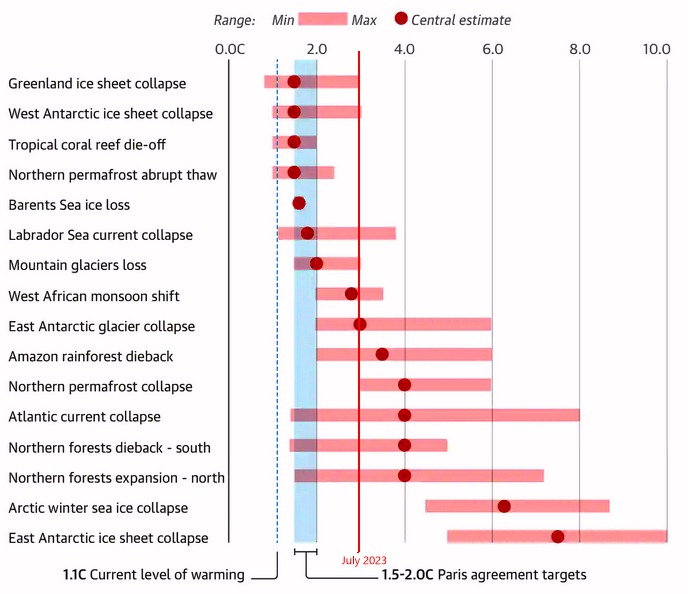
As described above, we do not know the rate of acceleration other than to say it is more rapid than previously thought. In the summer of 2023, the extreme temperatures left most climate scientists shocked. The average earth surface temperature recorded record highs for months reaching over 3 degrees Celsius above pre-industrial levels. The Paris Agreement calls for keeping temperatures below 1.5 degrees. Scientists concur that a rise of 2 degrees will trigger feedback loops and tipping points. Triggering these tipping points results in the CO2 stored in nature to be released at an exponential growth rate. How extreme the acceleration will be depends on tipping points toppling other tipping points in what is known as The Domino Effect. Toppled tipping points will continue to shrink the doubling time and exponentially increase the rate of global warming. Though we do not know how much carbon is stored in nature, it would be reasonable to assume that the temperature could be pushed from 3 degrees to 6 degrees above pre-industrial levels. Humans can not thrive above a rise of 1.5 degrees. Humans can not survive if the temperature rises 6 degrees.

About the 2023 wildfires in Hawaii, Governor Josh Green said, “For perspective, we’ve had six fire emergencies this August, we had six fire emergencies between 1953 and 2003. That’s how- how fast things are changing. I know that there is debate out there whether we should be talking about climate change or not. Well, let’s be real world, climate change is here we are in the midst of it with a hotter planet, and fiercer storms.”

About the catastrophic die-off of 10,000 emperor penguin chicks in the Antarctic, Dr. Caroline Holmes of the British Antarctic Survey (an expert on Antarctic sea-ice) said, “What we’re seeing right now is so far outside what we’ve observed previously. We expected change but I don’t think we expected so much change so rapidly.”

Some areas of the world are now warming so fast, it is becoming more difficult to measure the change from “normal” or average. Jeff Boyne, National Weather Service meteorologist and climatologist, said, “There are climate normals that are updated every 10 to 15 years, because the planet is warming so fast. The ENSO (El Nino-Southern Oscillation) regions are warming so fast that those normals are being updated every 5 years.”

“It’s so far outside anything we’ve seen, it’s almost mind-blowing,” says Walter Meier, who monitors sea-ice with the National Snow and Ice Data Center. “September was, in my professional opinion as a climate scientist, absolutely gobsmackingly bananas,” said Zeke Hausfather, at the Berkeley Earth climate data project.”

— from Climate Change: Rate of Acceleration Brouse and Mukherjee (2023)

What Can I Do?
There are plenty of things you can do to help save the planet. Stop using fossil fuels. Consume less. Love more. Here is a list of additional actions you can take.

A song about The Human Induced Climate Change Experiment

bookmark_borderPay the Piper!

LYRICS
“What’s up, Bigshot?”
They’re asking you
How ’bout “why not?”
Do’s have come due
Did you hear them say
“The piper demands pay!”
Ohh…
It’s on the way?
I swear…
It’s on the way
Put it in the post today
It’s on the way

Keep on drilling
As illing comes on
The sick get thick
And it won’t be long
Did you hear them say
“The piper demands pay!”
Ohh…
It’s on the way?
I swear…
It’s on the way
Put it in the post today
It’s on the way

Shot down Biggun
No place to run
Not bones nor hide
Have place to hide
Did you hear them say
“The piper demands pay!”
Ohh…
It’s on the way?
I swear…
It’s on the way
Put it in the post today
It’s on the way

Curtains falling
End of the show
Music’s over
Discover know
Or didn’t you hear the say
No help is on the way

“The piper demands pay!”
Ohh…
It’s on the way?
I swear…
It’s on the way
Put it in the post today
It’s on the way

Chords: G A G A / C E A / C D A; Part II @ 120 Beats Per Minute / fourth verse slowdown, speedup, slowdown.
Instrumentation: Vocals (TC-Helicon VOICELIVE and MiniNova Vocorder), Ibanez Acoustic Guitar, Ibanez RG Series Electric Guitar (Boss Digital Delay), Fender Jazz Bass (Boss Digital Delay), Keyboards (Korg PS60, Casio WK-3500, Yamaha PSR-740, MiniNova, MicroKorg)

ABOUT THE SONG
These lyrics use The Pied Piper as a metaphor to convey a sense of impending consequences, particularly related to environmental issues and climate change. The lines “What’s up, Bigshot?” and “They’re asking you, how ’bout ‘why not?'” suggest a confrontational tone directed at someone in authority or power, challenging their actions or inaction.

The reference to “The piper demands pay!” implies that there will be consequences for past actions, and the repeated refrain “It’s on the way” emphasizes the inevitability of these consequences. The urgency is heightened with the lines “Keep on drilling, as illing comes on,” linking environmental exploitation (drilling) with detrimental effects on health and well-being (illing).

The mention of being “shot down Biggun” and having “no place to run” paints a picture of dire circumstances with no escape, possibly reflecting the irreversible damage caused by human activities. The repeated assertion that “It’s on the way” underscores a sense of accountability and a reckoning for the actions taken.

The concluding lines, “Curtains falling, end of the show, music’s over, discover know,” convey a sense of finality and a realization that time is running out. The phrase “No help is on the way” suggests a lack of external assistance or redemption, reinforcing the idea that the consequences must be faced.

Overall, these lyrics utilize The Pied Piper narrative to convey a warning about the impending repercussions of environmental degradation and the urgent need for accountability and change.

The phrase “pay the piper” originates from the story of the Pied Piper of Hamelin. The town of Hamelin agrees to pay the Piper to get rid of all the rats. When they fail to pay him, he steals their kids. Similarly, Man has failed to pay the price of human induced climate change. Now the human race will pay the price with our children and our children’s children.

Human induced climate change is an exponential component of an unordered system (chaos theory). That means global warming is accelerating at a rapid rate in a complex way. From 1992 through 2023, we presented evidence and suggested remedies to mitigate climate change. By 2023, the data was undeniable that human induced climate change is destroying our habitat at a rapidly increasing rate.

“For people, for other species, for the ecosystems, for the world we live in, we’ve entered the Age of Loss and Damage, but we’re just at the start. What we are seeing already just makes you want to cry,” said Dr. Christopher Trisos (BBC Interview / MP3 Format) from the University of Cape Town.

Tipped Tipping Points, Feedback Loops, and the Domino Effect

Tipping points are Critical Milestones that directly impact the rate of acceleration in climate change by multiplying the number and intensity of feedback loops.

Tipping Points

Push a glass toward the edge of a table and eventually it will fall off on its own. No matter how slowly or meticulously you push… no matter how you weight or fill the glass, it will reach a tipping point and fall off before being pushed completely off the table. No matter whether you believe the glass is half-empty or half-full, when the tipping point is reached it will plummet out-of-control to its end. This is science not fate, faith, nor belief. Human induced climate change has resulted in environmental tipping points being breached.

Tipping points, when crossed, trigger self-sustaining feedback loops that are no longer dependent on human activity. Similar to when a domino topples over hitting two more dominoes that in turn fall hitting more dominoes. Thus, the name The Domino Effect. It can also be visualized as The Snowball Effect. A tipping point is like a snowball rolling down a hill growing in mass and velocity (momentum). When a tipping point is crossed, it results in cumulative and reinforced global warming.

By 2024, six (6) of the multiple tipping points show the proverbial snowball is already rolling. The first dominoes have fallen and will continue to knock down more tiles with each escalating step.

  • Mountain Glacier Loss
  • Greenland Ice Sheet Collapse
  • Antarctic Ice Sheet Collapse
  • Collapse of AMOC (Atlantic Meridional Overturning Circulation)
  • Amazon Rainforest Dieback
  • Northern Permafrost Collapse

Crossing even a single tipping point is alarming. For instance, crossing the tipping point for ‘mountain glacier loss‘ has immediate consequences: millions of people in Europe will be impacted by the lack of fresh water. Billions of people that live along coasts will be impacted by the saline infiltration and eventually by the submerging of their property. In September of 2022, UNESCO reported accelerated melting of glaciers in World Heritage sites, with glaciers in a third of sites set to disappear by 2050. In September of 2023, the GLAMOS glacier monitoring center found 10% of Swiss glaciers had disappeared in the last 2 years. They do not expect any Swiss glaciers will be left by 2050 no matter what actions are taken. If extreme measures are taken, they anticipate we may be able to save some polar glaciers.

This in and of itself should be alarming; however, it gets worse. Tipping points are parts of feedback loop systems. The ice-albedo feedback loop is an expression of the ability of surfaces to reflect sunlight (heat from the sun). Any loss of ice over a darker surface means the surface will absorb more heat and reflect less heat. This process makes the Earth warmer causing more loss of ice, which in turn causes more warming of the Earth. So, yes, the mountain ice tipping point is quite alarming for both its immediate impact as well as its self-sustaining growth to global warming; but wait, it gets more alarming. The increasing temperatures due to crossing a tipping point cause other tipping points to be toppled (The Domino Effect).

Long run sea level rise New Jersey Coast

By the Autumn of 2023, it had become evident the West Antarctic and Greenland ice sheets will completely melt. The process is irreversible and inevitable. The cool water from the melting ice at the poles is being drawn toward the center of the Earth and getting warmed to record high temperatures. The warm, moist air is circulating and moving over land. These changes in climate systems will cause other areas to experience unprecedented drought. We expect sea level rise will total about 270 feet over the next several millennia. It is episodic, and in the fast bits it can go up 3 feet every twenty years for five hundred years. The melting Arctic and Antarctic have multiple feedback loops including: enhanced oceanic heating and ice-albedo, Planck feedback, lapse-rate feedback, and cloud feedback.
— from Toppled Tipping Points: The Domino Effect / Brouse and Mukherjee (2023)

In 2023, we wrote about having crossed tipping points in the paper, “Climate Change: How Long Is ‘Ever’?“. When we wrote the Tunnel Under Thesis in 1995, we forecast crossing these tipping points would not happen for centuries. We underestimated Man’s ignorance and arrogance. Fossil fuel consumption and greenhouse gas emissions have continued to set record highs. Humans have caused chain-reactions resulting in toppled tipping points, feedback loops, and The Domino Effect.

Events we thought would not happen in our lifetimes are happening now. My last resort emergency plan was to escape to Canada. This summer that plan literally went up in smoke. “Beginning in March 2023, and with increased intensity starting in June, Canada has been affected by an ongoing, record-setting series of wildfires.” — Wikipedia

All of my life I have located my office and bedrooms in the uppermost southern exposure (preferably in the tree canopy.) I love sunlight, elevation, trees, fresh air, and wildlife. It is becoming ever more obvious my dreamlife is coming to an end, and I will be forced to tunnel under. For those forward thinkers, think about your poop. Pumping sewage above ground level will be a major problem at all times. In addition, the inability to pump flood water will become deadly during extreme weather events. In July of 2020 NPR reported, “The remnants of Hurricane Ida dropped unprecedented rainfall on several eastern states, killing dozens of people. Eleven of them were Queens residents who died when their basement apartments flooded.” In August of 2022 CNN reported, “Seoul has vowed to move some of the city’s poorest families out of underground and semi-subterranean homes after 13 people were killed in flooding caused by record rainfall this week, sparking public horror and calls for government accountability.” Drowning in your own poop may result for those unprepared.

There will be enough ice melt, water redistribution, and extreme weather events to raise sea levels as much as 270 feet.  Sidd reiterated, “That 270 feet will take a long time. I would be more careful about the violent rain than the ice melt.”

“For any remaining humans, fresh air, water, food, and sunlight will all be problematic; however, your most severe concern will likely be security. Those with supplies will be at high risk of being raped and looted. Good luck!”
— from Climate Change: The End of Times / Daniel Brouse and Sidd Mukherjee (2023)

What Can I Do?
There are plenty of things you can do to help save the planet. Stop using fossil fuels. Consume less. Love more. Here is a list of additional actions you can take.

From the album: The Echoes of Earth’s Wrath:
A Musical Journey Through Mythical Metaphors on Human-Induced Climate Change

A song about The Human Induced Climate Change Experiment

bookmark_borderYou Bet Your Life

LYRICS
You bet your life
Kids n’ wife
How the lost wager
But all in danger
When you…
Bet your life
Live in strife

Took the extra trip
Let the faucet drip
Left the light switch on
Say “did nothing wrong”
Propagating lies
While the climate cries
When you…
Bet your life
Live in strife

Had a role in coal
A fossil fuel fool
Left the light switch on
Say “did nothing wrong”
Propagating lies
While the climate cries
When you…
Bet your life
Live in strife

Then, took “one” more trip
By both plane and ship
Left the light switch on
Say “did nothing wrong”
Propagating lies
While the climate cries
When you…
Bet your life
Live in strife

Chords: D G E / A D / D G E / E C E; Part II @ 112 Beats Per Minute
Instrumentation: Vocals (TC-Helicon VOICELIVE and MiniNova Vocorder), Ibanez Acoustic Guitar, Ibanez RG Series Electric Guitar (Boss Digital Delay), Fender Jazz Bass (Boss Digital Delay), Keyboards (Korg PS60, Casio WK-3500, Yamaha PSR-740, MiniNova, MicroKorg)

Human induced climate change is an exponential component of an unordered system (chaos theory). That means global warming is accelerating at a rapid rate in a complex way. From 1992 through 2023, we presented evidence and suggested remedies to mitigate climate change. By 2023, the data was undeniable that human induced climate change is destroying our habitat at a rapidly increasing rate.

“For people, for other species, for the ecosystems, for the world we live in, we’ve entered the Age of Loss and Damage, but we’re just at the start. What we are seeing already just makes you want to cry,” said Dr. Christopher Trisos (BBC Interview / MP3 Format) from the University of Cape Town. “We can’t eliminate loss and damage. It is here. That said, there is a lot we can do to limit it.”

The 20th-century surface temperature average for Earth was 13.9℃. In the first weeks of July of 2023, the average temperature was 17℃.
Q: Is it possible for humans to survive at temperatures greater than 3℃?
A: Probably not long. Humans have never done it before.

September 6, 2023: “Climate breakdown has begun,” the United Nations Secretary-General Antonio Guterres warned the world after the World Meteorological Organization (WMO) reported the world endure its hottest Northern Hemisphere summer in human history. “The dog days of summer are not just barking, they are biting,” the UN chief said in a statement after the report’s release.

“What we are observing, are not only new extremes but the persistence of these record-breaking conditions, and the impacts these have on both people and planet, are a clear consequence of the warming of the climate system,” C3S’s Climate Change Service Director Carlo Buontempo said.

Climate Breakdown is the most concerning development. Climate breakdown happens when feedback loops are created and tipping points are crossed. Plants will become extinct and many carbon sinks will vanish. The Earth’s temperature will continue to accelerate at an exponential rate no matter what humans do. Food, fresh water, and breathable air will cease to exist. Humans will likely follow in short order.

In October of 2023, the European Space Agency’s Copernicus Climate Change Service calculated that the average temperature for September was 16.38 degrees Celsius (61.48 degrees Fahrenheit) breaking the previous record set in September 2020 by a half-degree Celsius (0.9 degrees Fahrenheit). This is the largest increase in a monthly record high ever.

“It’s just mind-blowing really,” said Copernicus Director Carlo Buontempo. “Never seen anything like that in any month in our records.”

“This is not a fancy weather statistic. It’s a death sentence for people and ecosystems. It destroys assets, infrastructure, harvest,” Imperial College of London climate scientist Friederike Otto said.

“September was, in my professional opinion as a climate scientist, absolutely gobsmackingly bananas,” said Zeke Hausfather, at the Berkeley Earth climate data project.”

— from Climate Change: How Long Is “Ever”? / Brouse (2023)

In 2023, we wrote about having crossed tipping points in the paper, “Climate Change: How Long Is ‘Ever’?“. When we wrote the Tunnel Under Thesis in 1995, we forecast crossing these tipping points would not happen for centuries. We underestimated Man’s ignorance and arrogance. Fossil fuel consumption and greenhouse gas emissions have continued to set record highs. Humans have caused chain-reactions resulting in toppled tipping points, feedback loops, and The Domino Effect.

Events we thought would not happen in our lifetimes are happening now. My last resort emergency plan was to escape to Canada. (I am a dual citizen.) This summer that plan literally went up in smoke. “Beginning in March 2023, and with increased intensity starting in June, Canada has been affected by an ongoing, record-setting series of wildfires.” — Wikipedia

All of my life I have located my office and bedrooms in the uppermost southern exposure (preferably in the tree canopy.) I love sunlight, elevation, trees, fresh air, and wildlife. It is becoming ever more obvious my dreamlife is coming to an end, and I will be forced to tunnel under. For those forward thinkers, think about your poop. Pumping sewage above ground level will be a major problem at all times. In addition, the inability to pump flood water will become deadly during extreme weather events. In July of 2020 NPR reported, “The remnants of Hurricane Ida dropped unprecedented rainfall on several eastern states, killing dozens of people. Eleven of them were Queens residents who died when their basement apartments flooded.” In August of 2022 CNN reported, “Seoul has vowed to move some of the city’s poorest families out of underground and semi-subterranean homes after 13 people were killed in flooding caused by record rainfall this week, sparking public horror and calls for government accountability.” Drowning in your own poop may result for those unprepared.

There will be enough ice melt to raise sea levels 220 feet. We estimate 270 feet to be “the minimum safe” elevation to live. High-tides, waves, coastal flooding, storm surge, grade of shoreline, etc. would make the lowest elevations for living space to be at least 270 feet above pre-industrial sea levels. This would be the minimum elevation. Personally, I would not want to live that low. As the water submerges sewage treatment plants, landfills, chickens, cows, and all sorts of other bio-hazards, the waters will become toxic. In addition, much of the land will experience salinization making it unfit for plant life. Another concern for elevations under 800 feet is living on an island. Many locations at lower elevations will become isolated. Living on an island has many problems including fresh water, food, shelter, and healthcare. Security from pirates pilfering, raping, and plundering will likely be the overriding concern. Of course, I don’t expect that to happen for millennia, but I hope government planners do plan for it now. If you look at Florida as an example, parts of the coastline have seen sea levels rise over 14-20 feet in the last decade. Although it was only for hours, you wouldn’t want to live there during those hours. Not to mention, the frequency of these extreme weather events will rise exponentially. (Thus, our recommendation to evacuate Florida now i.e. Managed Retreat.) The billions of dollars spent to rebuild after Hurricane Ida will all be for naught. Allowing building there will needlessly endanger property and lives. Parts of the world have already seen storm surges of 40 feet. I expect most North American coastlines will see sea levels rise, if only temporarily, by 20-40 feet this century. As far as long run sea level rise, much will depend on location, gravity, isostatic adjustment, and thermal expansion. If the ocean temperatures get warm enough (thermal expansion), parts of the world may see sea levels rise to 270 feet for long periods of times. Other parts of the world, like Greenland, may actually see sea levels decline. In any event, the Earth crossed tipping points this decade which make extreme sea level rise inevitable and irreversible in our lifetimes. Planners should plan on it.

Sidd reiterated, “That 270 feet will take a long time. I would be more careful about the violent rain than the ice melt.”

For any remaining humans, fresh air, water, food, and sunlight will all be problematic; however, your most severe concern will likely be security. Those with supplies will be at high risk of being raped and looted. Good luck!

— from Climate Change: The End of Times / Daniel Brouse and Sidd Mukherjee (2023)

What Can I Do?
There are plenty of things you can do to help save the planet. Stop using fossil fuels. Consume less. Love more. Here is a list of additional actions you can take.

A song about The Human Induced Climate Change Experiment

bookmark_borderGetting Crowded Up Here

LYRICS
Better move over
Getting crowded up here
Late to discover
But it’s coming clearer
Reality sets in
Watchin’ the future dim
Past time to begin
And try again
And try, try, try
Try again

See sea keep rising
Getting deep down there
Shouldn’t be surprising
Yet, caught unaware?
Better move over
Getting crowded up here
Late to discover
But it’s coming clearer
Reality sets in
Watchin’ the future dim
Past time to begin
And try again
And try, try, try
Try again

Can’t understand
What happened to land
We left in the hand…
… the hand of Man
See sea keep rising
Getting deep down there
Shouldn’t be surprising
Yet, caught unaware?
Better move over
Getting crowded up here
Late to discover
But it’s coming clearer
Reality sets in
Watchin’ the future dim
Past time to begin
And try again
And try, try, try
Try again

Chords: Em B7 / C D / D C Em / Em improv.; Part II @ 156 Beats Per Minute
Instrumentation: Vocals (TC-Helicon VOICELIVE and MiniNova Vocorder), Ibanez Acoustic Guitar, Fender Squire Mini Electric Guitar (Boss Digital Delay), Fender Jazz Bass (Boss Digital Delay), Keyboards (Korg PS60, Casio WK-3500, Yamaha PSR-740, MiniNova, MicroKorg)

Human induced climate change is an exponential component of an unordered system (chaos theory). That means global warming is accelerating at a rapid rate in a complex way.

What do we expect to happen?
The Long Run

Long run sea level rise New Jersey Coast

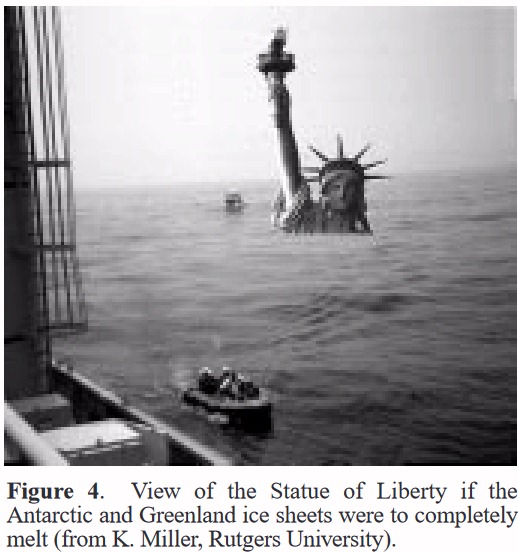
We expect sea level rise will total about 270 feet over the next several millennia. In 1998, the State of New Jersey published Sea Level Rise in New Jersey with a depiction of the Statue of Liberty with 270 feet in sea level rise.

In the last melting of the glacial maximum, the first 500 years saw a “pulse” of high rate sea level rise of about 500 years duration resulting in about a 66 foot rise in sea levels.

A high rate of sea-level rise starting at ∼14.5 ka BP of ∼500 y duration. The onset occurs at the start of the Bølling−Allerød warm period. Its duration could be <500 y because of uncertainties in chronology, and the globally averaged rise in sea level of ∼20 m occurs at a rate of ∼40 mm⋅y−1 or greater. This pulse, MWP-1A, has been identified separately in the records of Barbados, Sunda , and Tahiti. Spatial variation in its amplitude can be expected because of the planet’s elastic and gravitational response to rapid unloading of ice in either or both of the two hemispheres with, based on the ice−earth models used here, model-predicted values ranging from ∼14 m for Barbados to ∼20 m for Tahiti. This compares with observational values of ∼15–20 m for Barbados and 12–22 m for Tahiti. Observational uncertainties remain large, including differences in the timing of this event as recorded at the different localities, and it is not possible from this evidence to ascertain the relative importance of the contribution of the two hemispheres to MWP-1A.

We expect to see a similar pattern in the long run.

Our estimate of 270 feet is based on “the safe” elevation to live… high-tide, waves, storm surge, grade of shoreline, etc. would make me want my living space to be at least 270 feet above pre-industrial sea levels. Of course, I don’t expect that to happen for millennia… but, I do hope government planners do plan for it now. If you look at Florida as an example, parts of the coastline have seen sea levels rise over 14-20 feet in the last decade… although it was only for hours, you wouldn’t want to live there during those hours. Not to mention, the frequency of these extreme weather events will rise exponentially. (Thus, our recommendation to evacuate Florida now i.e. Managed Retreat.) The billions of dollars spent to rebuild after Ida will all be for naught. Allowing building there will needlessly endanger property and lives. Parts of the world have already seen storm surges of 40 feet. I expect most North American coastlines will see sea levels rise, if only temporarily, by 20-40 feet this century. As far as long run sea level rise, much will depend on location, gravity, isostatic adjustment, and thermal expansion. If the ocean temperatures get warm enough (thermal expansion), parts of the world may see sea levels rise to 270 feet for long periods of times. Other parts of the world, like Greenland, may actually see sea levels decline. In any event, the Earth crossed tipping points this decade which make extreme sea level rise inevitable and irreversible in our lifetimes. Planners should plan on it.

Sidd reiterated, “That 270 feet will take a long time. I would be more careful about the violent rain than the ice melt.”

— from Sea Level Rise: Then and Now / Mukherjee and Brouse (2023)

The Song: Violent Rain

What Can I Do?
There are plenty of things you can do to help save the planet. Stop using fossil fuels. Consume less. Love more. Here is a list of additional actions you can take.

A song about The Human Induced Climate Change Experiment

bookmark_borderWe Need You!

LYRICS
The choices of the fuel
Determine the fool
The voices of the few
Simply will not do.
Come true!
Still drill to fill til there is nil?

Those without a clue
Do what they do
There’s no doubt about
Few voices coming through.
We need you!
Still drill to fill til there is nil?

Turned us on to bake
Is anyone awake?
Burned, we never learned
Is a mistake
… we made the Earth quake
Still drill to fill til there is nil?
Of all the gall
Cull all til null
Still drill to fill til there is nil?

Chords: G Em C D / G / Em / Em Bm G Em; Part II @ 78 to 111 Beats Per Minute
Instrumentation: Vocals (TC-Helicon VOICELIVE and MiniNova Vocorder), Ibanez Acoustic Guitar, Fender Squire Mini Electric Guitar (Boss Digital Delay), Fender Jazz Bass (Boss Digital Delay), Keyboards (Korg PS60, Casio WK-3500, Yamaha PSR-740, MiniNova, MicroKorg)

Human induced climate change is an exponential component of an unordered system (chaos theory). That means global warming is accelerating at a rapid rate in a complex way.

Sidd said, “Do you remember back in the early 2000’s when we thought we wouldn’t live to see the extreme changes due to global warming?”

Daniel replied, “I think 2023 is the most significant year so far. We saw confirmation of tipping points being crossed for Mountain Glacier Loss, Greenland Ice Sheet Collapse, Antarctic Ice Sheet Collapse, and potentially the Collapse of AMOC.”

Sidd continued, “We already knew that. It was Canada catching on fire that I could not believe. I never thought I’d live to see the day.”

Daniel asked, “Do you think the permafrost and peatlands will have zombie fires and cause the permafrost tipping point?”

Sidd responded, “Yes. They are gone, too. We already know from the permafrost peatland fires in Siberia.”

Daniel ponders, “Hmmmm… I guess that means my plan went up in smoke? My worst case scenario / last resort emergency plan was to escape to Canada.”

What Can I Do?
There are plenty of things you can do to help save the planet. Stop using fossil fuels. Consume less. Love more. Here is a list of additional actions you can take.

A song about The Human Induced Climate Change Experiment

bookmark_borderInstead

LYRICS
Are you feeling kind-of low
Is it cause you just don’t know
Which way the wind will blow
Ohhh.. Whoa woe… Oh, no
You can hang your head
Live in dread
Or rise above instead
Let’s rise above
Spread the love
Before we wake-up dead

Are you moving kind-of slow
As if you just don’t know
Which way that you should go
Ohhh.. Whoa woe… Oh, no
You can hang your head
Live in dread
Or rise above instead
Let’s rise above
Spread the love
Before we wake-up dead

Are you tired of the show
Talking heads blow-by-blow
Surely people come to know
Ohhh.. Whoa woe… Oh, no
You can hang your head
Live in dread
Or rise above instead
Let’s rise above
Spread the love
Before we wake-up dead

Are you feeling death’s blow
All your friends had to go
As you cry out, “No! No! No!”
Ohhh.. Whoa woe… Oh, no
You can hang your head
Live in dread
Or rise above instead
Let’s rise above
Spread the love
Before we wake-up dead

Chords: E slide to F / F slide to E / A7 C / C E; Part II @ 102 Beats Per Minute
Instrumentation: Vocals (TC-Helicon VOICELIVE and MiniNova Vocorder), Ibanez Acoustic Guitar, Fender Squire Mini Electric Guitar (Vox Sound Lab and Boss Digital Delay), Fender Jazz Bass (Boss Digital Delay), Keyboards (Korg PS60, Casio WK-3500, Yamaha PSR-740, MiniNova, MicroKorg)

Global warming has caused irreparable damage to our environment. Almost all scientists agree that IN FACT climate change is a problem. Our planet is becoming unfit for human life. Now the question is can we adapt in time? (1999)

Human induced climate change is an exponential component of an unordered system (chaos theory). That means global warming is accelerating at a rapid rate in a complex way. From 1992 through 2023, we presented evidence and suggested remedies to mitigate climate change. By 2023, the data was undeniable that human induced climate change is destroying our habitat at a rapidly increasing rate.

By 2024, at least five Tipping points had been crossed:

  • Mountain Glacier Loss
  • Greenland Ice Sheet Collapse
  • Antarctic Ice Sheet Collapse
  • Collapse of AMOC (Atlantic Meridional Overturning Circulation)
  • Northern Permafrost Collapse

Humans have caused these events to be inevitable; however, it is the “unknown” that frightens most people. Instead, now that you know you can prepare.

What will the “End of Times” look like?

“The era of global warming has ended and the era of ‘global boiling’ has arrived. Climate change is here. It is terrifying. And it is just the beginning”, UN secretary general, António Guterres, said after scientists confirmed July 2023 was on track to be the world’s hottest month on record.

In the 1990’s, we wrote a paper on the worst-case scenario entitled, “The Impact of Governance & Globalization on Forecasting (The Tunnel Under Thesis).” The theory predicted that forecasting would become increasingly difficult. “The result — a figurative, as well as, literal tunneling underground.”

Since that time, forecasting has become increasing more difficult. “In general, as energy is added to a system, the fluctuations in the system increase. So, we expect more storms, more droughts, more wildfires, more floods, more fluctuations of all kinds. What we are saying is that weather conditions will become more volatile due to the impact of humans,” said Mukherjee and Brouse. (2004)

In a report published in Nature entitled Over half of known human pathogenic diseases can be aggravated by climate change, data analyst and associate professor in the Department of Geography and Environment at the University of Hawaii Manoa, Camilo Mora, said climate hazards aggravated 58% of all known human pathogens. That is over half of infectious diseases discovered since the end of the Roman Empire. 58% of an authoritative list of infectious diseases documented to have impacted humanity have already been shown to be aggravated by climatic hazards — a finding the researchers found “shocking,” Mora said.

Movement of people and animals caused by climate is one factor. Warming at higher latitudes allowed vectors and pathogens to survive winter is another factor. The report goes on to say, “The human pathogenic diseases and transmission pathways aggravated by climatic hazards are too numerous for comprehensive societal adaptations, highlighting the urgent need to work at the source of the problem: reducing GHG (Greenhouse Gas) emissions.”

This research reveals more evidence that humans will have difficulty adapting to climate change, especially those in developing countries, Mora said. “The magnitude of the vulnerability when you think about one or two diseases — okay, sure, we can deal with that,” he said. “But when you’re talking about 58% of the diseases, and 58% of those diseases can be affected or triggered in 1,000 different ways. So that, to me, was also revealing of the fact that we’re not going to be able to adapt to climate change.”

In 2023, we wrote about having crossed tipping points in the paper, “Climate Change: How Long Is ‘Ever’?“. When we wrote the Tunnel Under Thesis in 1995, we forecast crossing these tipping points would not happen for centuries. We underestimated Man’s ignorance and arrogance. Fossil fuel consumption and greenhouse gas emissions have continued to set record highs. Humans have caused chain-reactions resulting in toppled tipping points, feedback loops, and The Domino Effect.

— from Climate Change: The End of Times / Brouse and Mukherjee (2023)
What Can I Do?
There are plenty of things you can do to help save the planet. Stop using fossil fuels. Consume less. Love more. Here is a list of additional actions you can take.

A song about The Human Induced Climate Change Experiment

bookmark_borderAll You’ve Hoped For

LYRICS
I heard the Wisemen said
“Follow the light, ahead!”
Stellar star map read
Fill your head
Till the wonder
Fulfills splendor
All you’ve hoped for
Shines divine

I heard his mother wed
Yet never laid to bed
Bore son who rose and led
Fill your head
Till the wonder
Fulfills splendor
All you’ve hoped for
Shines divine

I heard the prophets’ dread
Nailed… left for dead
Instead the thin skin shed
Fill your head
Till the wonder
Fulfills splendor
All you’ve hoped for
Shines divine

Chords: F#m D B / C#m F#m / D E F#m; Part II @ 92 Beats Per Minute
Instrumentation: Vocals (TC-Helicon VOICELIVE and MiniNova Vocorder), Ibanez Acoustic Guitar, Ibanez RG Series Electric Guitar (Vox Sound Lab and Boss Digital Delay), Fender Jazz Bass (Boss Digital Delay), Keyboards (Korg PS60, Casio WK-3500, Yamaha PSR-740, MiniNova, MicroKorg)

From the Christmas album of music Merry Christmas!

bookmark_borderIn for a Change (Ghouls and Fools)

LYRICS
Along the way
Went astray
To this day
The price we pay
The world’s aflame
Never be the same
We’re in for a change
The ghoulish primate
Foolish of climate
The ghouls we have met
Are fools of the climate

Along the way
Left O.K.
Our own prey
The price we pay
The world’s aflame
Never be the same
We’re in for a change
The ghoulish primate
Foolish of climate
The ghouls we have met
Are fools of the climate

Push to play
Would not say
Go away
The price we pay
The world’s aflame
Never be the same
We’re in for a change
The ghoulish primate
Foolish of climate
The ghouls we have met
Are fools of the climate

As we may
Our last day
In decay
The price we pay
The world’s aflame
Never be the same
We’re in for a change
The ghoulish primate
Foolish of climate
The ghouls we have met
Our fools of the climate

Chords: Em G Esus4 / FM7 Em Am / Am D7 / D7 Em; Part II @ 68 to 78 to 88 to 118 Beats Per Minute
Instrumentation: Vocals (TC-Helicon VOICELIVE and MiniNova Vocorder), Ibanez Acoustic Guitar, Fender Squire Mini Electric Guitar (Boss Digital Delay), Fender Jazz Bass (Boss Digital Delay), Keyboards (Korg PS60, Casio WK-3500, Yamaha PSR-740, MiniNova, MicroKorg)

Human induced climate change is an exponential component of an unordered system (chaos theory). That means global warming is accelerating at a rapid rate in a complex way.

Time is no longer running out to act on climate change; it’s up,” reports Deloitte.

The Age of Loss and Damage

Humans will experience greater loss and damage to life and quality of life from air pollution, decreasing supply of potable water, extreme weather events, and disease. The greatest short term climate change risk to human health is deadly humid heat (wet-bulb temperature).

A warmer world will present widespread challenges across many aspects of food-energy-water security and economic development. Infrastructure including roads, bridges, sewer and water plants will become unsustainable. Personal property will suffer loss and damage as homeowners and flood insurance become increasingly difficult to obtain.

Almost all survivors of climate-related disasters suffer from mental distress. Of those who have not experienced climate disasters, more than two-thirds of U.S. adults (68%) have reported climate change anxiety.

Tipping points are Critical Milestones that directly impact the rate of acceleration in climate change by multiplying the number and intensity of feedback loops.

At what rate is climate change accelerating?
A: Rapidly
As described above, we do not know the rate of acceleration other than to say it is more rapid than previously thought. In the summer of 2023, the extreme temperatures left most climate scientists shocked. The average earth surface temperature recorded record highs for months reaching over 3 degrees Celsius above pre-industrial levels. The Paris Agreement calls for keeping temperatures below 1.5 degrees. Scientists concur that a rise of 2 degrees will trigger feedback loops and tipping points. Triggering these tipping points results in the CO2 stored in nature to be released at an exponential growth rate. How extreme the acceleration will be depends on tipping points toppling other tipping points in what is known as The Domino Effect. Toppled tipping points will continue to shrink the doubling time and exponentially increase the rate of global warming. Though we do not know how much carbon is stored in nature, it would be reasonable to assume that the temperature could be pushed from 3 degrees to 6 degrees above pre-industrial levels. Humans can not thrive above a rise of 1.5 degrees. Humans can not survive if the temperature rises 6 degrees.

About the 2023 wildfires in Hawaii, Governor Josh Green said, “For perspective, we’ve had six fire emergencies this August, we had six fire emergencies between 1953 and 2003. That’s how- how fast things are changing. I know that there is debate out there whether we should be talking about climate change or not. Well, let’s be real world, climate change is here we are in the midst of it with a hotter planet, and fiercer storms.”

About the catastrophic die-off of 10,000 emperor penguin chicks in the Antarctic, Dr. Caroline Holmes of the British Antarctic Survey (an expert on Antarctic sea-ice) said, “What we’re seeing right now is so far outside what we’ve observed previously. We expected change but I don’t think we expected so much change so rapidly.”

Some areas of the world are now warming so fast, it is becoming more difficult to measure the change from “normal” or average. Jeff Boyne, National Weather Service meteorologist and climatologist, said, “There are climate normals that are updated every 10 to 15 years, because the planet is warming so fast. The ENSO (El Nino-Southern Oscillation) regions are warming so fast that those normals are being updated every 5 years.”

“It’s so far outside anything we’ve seen, it’s almost mind-blowing,” says Walter Meier, who monitors sea-ice with the National Snow and Ice Data Center. “September was, in my professional opinion as a climate scientist, absolutely gobsmackingly bananas,” said Zeke Hausfather, at the Berkeley Earth climate data project.”

What Can I Do?
There are plenty of things you can do to help save the planet. Stop using fossil fuels. Consume less. Love more. Here is a list of additional actions you can take.

A song about The Human Induced Climate Change Experiment

bookmark_borderOur Home Away From Home

LYRICS
Do you have a home
Or…
Are you all alone
This Christmas?
Why not make here your home
You being “hear”
We’re not alone
Comfort zone

Would you like to play
Sing and dance away
On holiday?
Why not make here your home
You being “hear”
We’re not alone
Comfort zone

Should you like to say
“I am on my way”
This Christmas
Why not make here your home
You being “hear”
We’re not alone
Comfort zone
[jam]

Chords: E slide to F / F slide to E / A7 C / C E; Part II @ 102 Beats Per Minute
Instrumentation: Vocals (TC-Helicon VOICELIVE and MiniNova Vocorder), Ibanez Acoustic Guitar, Fender Squire Mini Electric Guitar (Vox Sound Lab and Boss Digital Delay), Fender Jazz Bass (Boss Digital Delay), Keyboards (Korg PS60, Casio WK-3500, Yamaha PSR-740, MiniNova, MicroKorg)

Are you feeling lonely for the holidays? Let music be your home. When you hear, you are here with your music loving family.

From the Christmas album of music Merry Christmas!

bookmark_borderInto the Solstice

LYRICS
Limited volume
Maximum used some
Halfway between night and day
Out of the equinox
To the school of hard knocks
Roll on

Limited volume
Maximum used some
Day after day thrown away
Looks lie we lost this
Into the solstice
Lights out
(No doubt)

Under the human hex (Parts 1a, 1b, 1c)
Done in a sex hex (Part 2)
Fall of might
Spun in a vortex
Lost our sight
Drag of the funnel
Is there light
At The End of the tunnel?

Chords: E G A / C Esus4 / Esus4 A7 / Em E /D9 EbM7 Em/E / A7 C D Em; Part 2 @ 133 Beats Per Minute
Instrumentation: Vocals (TC-Helicon VOICELIVE and MiniNova Vocorder), Ibanez Acoustic Guitar, Fender Squire Mini Electric Guitar (Vox Sound Lab and Boss Digital Delay), Fender Jazz Bass (Boss Digital Delay), Keyboards (Korg PS60, Casio WK-3500, Yamaha PSR-740, MiniNova, MicroKorg)

The song is an analogy of the Winter Solstice and human induced climate change. Figuratively, 2023 saw darker and darker days for the future of the Earth.

Human induced climate change is an exponential component of an unordered system (chaos theory). That means global warming is accelerating at a rapid rate in a complex way. From 1992 through 2023, we presented evidence and suggested remedies to mitigate climate change. By 2023, the data was undeniable that human induced climate change is destroying our habitat at a rapidly increasing rate.

“For people, for other species, for the ecosystems, for the world we live in, we’ve entered the Age of Loss and Damage, but we’re just at the start. What we are seeing already just makes you want to cry,” said Dr. Christopher Trisos (BBC Interview / MP3 Format) from the University of Cape Town. “We can’t eliminate loss and damage. It is here. That said, there is a lot we can do to limit it.”

The 20th-century surface temperature average for Earth was 13.9℃. In the first weeks of July of 2023, the average temperature was 17℃.
Q: Is it possible for humans to survive at temperatures greater than 3℃?
A: Probably not long. Humans have never done it before.

September 6, 2023: “Climate breakdown has begun,” the United Nations Secretary-General Antonio Guterres warned the world after the World Meteorological Organization (WMO) reported the world endure its hottest Northern Hemisphere summer in human history. “The dog days of summer are not just barking, they are biting,” the UN chief said in a statement after the report’s release.

“What we are observing, are not only new extremes but the persistence of these record-breaking conditions, and the impacts these have on both people and planet, are a clear consequence of the warming of the climate system,” C3S’s Climate Change Service Director Carlo Buontempo said.

Climate Breakdown is the most concerning development. Climate breakdown happens when feedback loops are created and tipping points are crossed. Plants will become extinct and many carbon sinks will vanish. The Earth’s temperature will continue to accelerate at an exponential rate no matter what humans do. Food, fresh water, and breathable air will cease to exist. Humans will likely follow in short order.

In October of 2023, the European Space Agency’s Copernicus Climate Change Service calculated that the average temperature for September was 16.38 degrees Celsius (61.48 degrees Fahrenheit) breaking the previous record set in September 2020 by a half-degree Celsius (0.9 degrees Fahrenheit). This is the largest increase in a monthly record high ever.

“It’s just mind-blowing really,” said Copernicus Director Carlo Buontempo. “Never seen anything like that in any month in our records.”

“This is not a fancy weather statistic. It’s a death sentence for people and ecosystems. It destroys assets, infrastructure, harvest,” Imperial College of London climate scientist Friederike Otto said.

About the 2023 wildfires in Hawaii, Governor Josh Green said, “For perspective, we’ve had six fire emergencies this August, we had six fire emergencies between 1953 and 2003. That’s how- how fast things are changing. I know that there is debate out there whether we should be talking about climate change or not. Well, let’s be real world, climate change is here we are in the midst of it with a hotter planet, and fiercer storms.”

About the catastrophic die-off of 10,000 emperor penguin chicks in the Antarctic, Dr. Caroline Holmes of the British Antarctic Survey (an expert on Antarctic sea-ice) said, “What we’re seeing right now is so far outside what we’ve observed previously. We expected change but I don’t think we expected so much change so rapidly.”

Some areas of the world are now warming so fast, it is becoming more difficult to measure the change from “normal” or average. Jeff Boyne, National Weather Service meteorologist and climatologist, said, “There are climate normals that are updated every 10 to 15 years, because the planet is warming so fast. The ENSO (El Nino-Southern Oscillation) regions are warming so fast that those normals are being updated every 5 years.”

“September was, in my professional opinion as a climate scientist, absolutely gobsmackingly bananas,” said Zeke Hausfather, at the Berkeley Earth climate data project.”

Climate Change Review 2023

Sidd said, “Do you remember back in the early 2000’s when we thought we wouldn’t live to see the extreme changes due to global warming?”

Daniel replied, “I think 2023 is the most significant year so far. We saw confirmation of tipping points being crossed for Mountain Glacier Loss, Greenland Ice Sheet Collapse, Antarctic Ice Sheet Collapse, and potentially the Collapse of AMOC.”

Sidd continued, “We already knew that. It was Canada catching on fire that I could not believe. I never thought I’d live to see the day.”

Daniel asked, “Do you think the permafrost and peatlands will have zombie fires and cause the permafrost tipping point?”

Sidd responded, “Yes. They are gone, too. We already know from the permafrost peatland fires in Siberia.”

Daniel ponders, “Hmmmm… I guess that means my plan went up in smoke? My worst case scenario / last resort emergency plan was to escape to Canada.”

What Can I Do?
There are plenty of things you can do to help save the planet. Stop using fossil fuels. Consume less. Love more. Here is a list of additional actions you can take.

From the Christmas album of music Merry Christmas!

A song about The Human Induced Climate Change Experiment