bookmark_borderWormhole

Wormhole-Best-Of.mp3
Wormhole-Best-Of.mp4
Wormhole.mp3
Wormhole.mp4
Wormhole-intro.mp3

[Break]
Imagine a tunnel
Linking two separate locations
In different parts of the universe
At different points in time

[Break]
Into the funnel
(Speculations)
Chapter and verse
(The time is prime)

[Chorus]
Will it take a toll
(Wormhole)
Or reach our goal
(Wormhole)
I’m…
(Slipping into space-time)

[Verse 2]
A hypothetical topological feature
(Take me to the future)
Potential to surpass the speed of light
(Alright! Gaining light’s insight)

[Bridge]
What sort-of creature
(Oh, I’m no sure)
Will it put up a fight
(Or bring on delight)

[Chorus]
Will it take a toll
(Wormhole)
Or reach our goal
(Wormhole)
I’m…
(Slipping into space-time)

[Outro]
Will it take a toll
(Wormhole)
Or reach our goal
(Wormhole)
At this pace I’m…
(Slipping into space-time)

A SCIENCE NOTE
A wormhole, in the context of physics, is a hypothetical topological feature of spacetime that would connect two separate points in the universe, potentially allowing for faster-than-light travel or time travel. It’s often visualized as a tunnel through space-time.

Hypothetical Structure: Wormholes are theoretical constructs, solutions to Einstein’s field equations in general relativity, that suggest the possibility of connecting distant points in spacetime.

Visualizing a Wormhole: Imagine a tunnel or a shortcut that links two separate locations, possibly even in different parts of the universe or at different points in time.

Faster-than-Light Travel: One of the most fascinating aspects of wormholes is their potential to allow for faster-than-light travel, as the distance through the wormhole could be significantly shorter than the distance through normal space.

Einstein-Rosen Bridge: Wormholes are sometimes referred to as Einstein-Rosen bridges, named after Albert Einstein and Nathan Rosen, who explored the concept in 1935.

Quantum Gravity and Information Paradox: Research into wormholes also relates to quantum gravity and the information paradox, which explores the fate of information that falls into a black hole according to Polytechnique Insights.

From the album “Wormhole

bookmark_borderICE Heat

ICE-Heat-Best-Of.mp3
ICE-Heat-Best-Of.mp4
ICE-Heat.mp3
ICE-Heat.mp4
ICE-Heat-intro.mp3

[Verse 1]
For being ice cold
You’re way too hot
Story’s getting old
Is that all you’ve got?

[Chorus]
Oh, no, no… ice heat
(Taking over the street)
Oh, what a tragic cost
(Thermal energy loss)
Whoa! Being so lazy
(Is driving me crazy)

[Bridge]
Can we endure
(Upping the temperature)

[Verse 2]
Firing on all cylinders
In a mad race to waste
You and your parishioners
All praying in haste

[Chorus]
Oh, no, no… ice heat
(Taking over the street)
Oh, what a tragic cost
(Thermal energy loss)
Whoa! Being so lazy
(Is driving me crazy)

[Bridge]
Can we endure
(Upping the temperature)
No, no! (That’s for sure)

[Chorus]
Oh, no, no… ice heat
(Taking over the street)
Oh, what a tragic cost
(Thermal energy loss)
Whoa! Being so lazy
(Is driving me crazy)

[Outro]
Say no! (Know more)
(Stopping the temperature)
No, no! We can’t endure
(That’s for sure)

A SCIENCE NOTE
The thermal energy loss difference between an internal combustion engine (ICE) vehicle and an electric vehicle (EV) is dramatic.

🔥 ICE (Internal Combustion Engine) Vehicle:

  • Efficiency: ~20% to 30% of the energy in gasoline is converted into motion.

  • Thermal Energy Loss: About 70% to 80% of the energy is lost as heat — through the engine block, exhaust, radiator, and friction.

    • For every 100 units of gasoline energy:

      • 70–80 units are wasted as heat.

      • Only 20–30 units move the car.


Electric Vehicle (EV):

  • Efficiency: ~85% to 95% of battery energy is converted into motion.

  • Thermal Energy Loss: Only about 5% to 15% is lost as heat — primarily in the inverter, motor windings, and battery.

    • For every 100 units of electricity:

      • 85–95 units move the car.

      • Only 5–15 units are lost as heat.


🔁 Implications for Climate and Efficiency:

  • ICE cars waste up to 4 times more energy as heat than EVs.

  • This waste adds to urban heat, air pollution, and greenhouse gas emissions (especially when factoring in upstream refining and oil transport).

  • EVs, even when powered by fossil-fueled grids, remain more efficient overall, and they benefit further as grids get cleaner.

From the album “Upward

The Human Induced Climate Change Experiment

bookmark_borderNonlinear Trajectory

Nonlinear-Trajectory-Best-Of.mp3
Nonlinear-Trajectory-Best-Of.mp4
Nonlinear-Trajectory.mp3
Nonlinear-Trajectory.mp4
Nonlinear-Trajectory-intro.mp3

[Verse 1]
Hey! Did you hear
(Isn’t it clear)
We’re on a nonlinear
(Trajectory)
You and me… (we)

[Bridge]
Whether or not you know
(Here we go)
Weather the weather
(Below, low, low)

[Chorus]
In the thick of dynamic
(Watch which way the flow will go)
Lo and behold
(System nears a critical threshold)
At a loss (on the edge of chaos)

[Verse 2]
Accelerating (interacting)
All the joints (tipping points)
The variability of vectors
Burning millions of hectare
(Acres of ache ‘ers)

[Bridge]
Whether or not you know
(Here we go)
Weather the weather
(Below, low, low)

[Chorus]
In the thick of dynamic
(Watch which way the flow will go)
Lo and behold
(System nears a critical threshold)
At a loss (on the edge of chaos)

[Outro]
Whether or not you know
(Here we go)
Weather the weather
(Below, low, low)
Oh, know no (know no)

A SCIENCE NOTE

Chaos Theory Explains Why Climate Collapse Feels Sudden

  1. Long period of relative stability (homeostasis in chaos theory terms).

  2. Hidden stresses build slowly (greenhouse gases, deforestation, pollution).

  3. System nears a critical threshold (edge of chaos).

  4. Seemingly small trigger (like a bad El Nino year) causes cascading failures.

Climate change is not a slow, linear shift — it is a dynamic, nonlinear process governed by complex systems and feedback loops. Traditional notions of averages and incremental change can be dangerously misleading when applied to climate science. The true nature of climate disruption lies in tipping points: critical thresholds beyond which change accelerates irreversibly.

To visualize this, imagine a glass sitting at the center of a table. You begin to push it slowly toward the edge. At first, it moves just millimeters per minute. But over time, the pace quickens — centimeters per second — as momentum builds. Eventually, the glass reaches a point where no amount of caution or force can stop it from falling. The tipping point has been crossed; the fall is inevitable.

Climate tipping points operate in much the same way. They aren’t about any one extreme event, but rather the cumulative impact of stress over time — on ice sheets, forests, oceans, and atmospheric systems. Once crossed, these thresholds unleash rapid, self-reinforcing changes like runaway ice melt, forest dieback, or ocean current disruption. These are not hypothetical outcomes — they are grounded in peer-reviewed science and unfolding in real time. Just look out your window.

Understanding the nonlinear nature of climate change is essential for anticipating its consequences and acting to limit the irreversible damage being done. It is not a matter of opinion or debate, but of scientific urgency.

Health feedback loops, violent rain, and deadly humid heat are fueling an exponential rise in climate-related deaths. This lethal triad — disease, extreme heat, and intense rainfall — demonstrates that climate change is not a distant threat but a rapidly accelerating public health emergency. These stressors interact and amplify one another, creating a cascade of compounding impacts that demand urgent intervention.

All 50 U.S. states — including Alaska — are already experiencing deadly humid heat advisories. Large regions of the country are becoming uninhabitable for weeks or even months each year due to extreme heat. Wet-bulb temperatures are approaching 31°C (87.8°F) in multiple states — a physiological threshold beyond which sustained outdoor survival is impossible, even with water and shade. Meanwhile, violent rain events are killing hundreds and causing billions in annual damage. Climate-driven health feedback loops have become the leading cause of mortality in the United States — fueled by systemic interactions between temperature extremes, air quality degradation, disease vectors, and infrastructure collapse. Addressing climate change is no longer just an environmental imperative — it is a public health necessity.

Our climate model — which incorporates complex socio-economic and ecological feedback loops within a dynamic, nonlinear system — projects that global temperatures could rise by up to 9°C (16.2°F) within this century. This far exceeds earlier estimates of a 4°C rise over the next thousand years, highlighting a dramatic acceleration in global warming. We are now entering a phase of compound, cascading collapse, where climate, ecological, and societal systems destabilize through interlinked, self-reinforcing feedback loops.

We analyze how human activities (such as deforestation, fossil fuel use, mass consumption, and land development) interact with ecological processes (including carbon cycling, water availability, disease vectors, and biodiversity loss) in ways that amplify one another. These interactions do not follow simple cause-and-effect patterns; instead, they create cascading, interconnected impacts that can rapidly accelerate system-wide change, sometimes abruptly. Understanding these dynamics is essential for assessing risks and designing effective survival strategies.

Ignite a Domino Effect: Albedo, Brown Carbon, AMOC, Permafrost, Amazon Rainforest Dieback, Sea Level Rise Pulses, Hydroclimate Whiplash, and Arctic Sea Ice Brouse and Mukherjee (2025)

Tipping Cascades: The Nonlinear Dominoes of Climate Collapse Brouse and Mukherjee (2025)

The Domino Collapse: Amazon Rainforest Dieback and the Ozone Feedback Loop Brouse and Mukherjee (2025)

Tipping points and feedback loops drive the acceleration of climate change. When one tipping point is toppled and triggers others, the cascading collapse is known as the Domino Effect.

From the album “Upward

bookmark_borderStormy Whether

Stormy-Whether.mp3
Stormy-Whether.mp4
Stormy-Whether-Unplugged-Underground-XXIV.mp3
Stormy-Whether-Unplugged-Underground-XXIV.mp4
Stormy-Whether-intro.mp3

[Intro]
Looks like we’re in for stormy whether?
(Forecaster of weather says disaster)

[Verse 1]
Chaos may appear near
(Deterministic underneath)
Random may appear clear
(Past the lips… into the teeth)

[Chorus]
The weather predictability
Is getting harder (and harder) to see
As for longevity (and survivability)
Could be “we” (get the best of me)

[Bridge]
Should know
(When to say no)
Go sow, sow
(No so-so)
Looks like we’re in for stormy whether?
(The last forecast the forecaster forecast disaster)

[Verse 2]
Random… in the eye of the beholder
(Deterministic underneath)
Getting wiser or only older
(Into the jaws… into the teeth)

[Chorus]
The weather predictability
Is getting harder (and harder) to see
As for longevity (and survivability)
Could be “we” (get the best of me)

[Bridge]
Should know
(When to say no)
Way less woe
(Way more whoa)
Let’s go!
Looks like we’re in for nasty weather?
(The last forecast — accurate — forecast disaster)

[Chorus]
The weather predictability
Is getting harder (and harder) to see
As for longevity (and survivability)
Could be “we” (get the best of me)

[Outro]
Should know
(When to say no)
Way less woe
(Way more whoa)
The last forecast
(Let’s go!)

A SCIENCE NOTE: Chaos Theory Basics
Chaos theory studies how small changes in initial conditions can lead to wildly different outcomes in complex systems. This is often called sensitive dependence on initial conditions — or famously, the butterfly effect.

In chaotic systems:

  • Behavior looks random, but is deterministic underneath.

  • Predictability breaks down over time.

  • Feedback loops accelerate instability.

  • Thresholds or tipping points matter more than averages.

Our climate model — which incorporates complex socio-economic and ecological feedback loops within a dynamic, nonlinear system — projects that global temperatures could rise by up to 9°C (16.2°F) within this century. This far exceeds earlier estimates of a 4°C rise over the next thousand years, highlighting a dramatic acceleration in global warming. We are now entering a phase of compound, cascading collapse, where climate, ecological, and societal systems destabilize through interlinked, self-reinforcing feedback loops.

We examine how human activities—such as deforestation, fossil fuel combustion, mass consumption, industrial agriculture, and land development—interact with ecological processes like thermal energy redistribution, carbon cycling, hydrological flow, biodiversity loss, and the spread of disease vectors. These interactions do not follow linear cause-and-effect patterns. Instead, they form complex, self-reinforcing feedback loops that can trigger rapid, system-wide transformations—often abruptly and without warning. Grasping these dynamics is crucial for accurately assessing global risks and developing effective strategies for long-term survival.

Tipping points and feedback loops drive the acceleration of climate change. When one tipping point is toppled and triggers others, the cascading collapse is known as the Domino Effect.

The Human Induced Climate Change Experiment

From the album “Upward

bookmark_borderWhirling Around

Whirling-Around-Best-Of.mp3
Whirling-Around-Best-Of.mp4Whirling-Around.mp3
Whirling-Around.mp4
Whirling-Around-intro.mp3

[Intro]
(What I said)
Keeps whirling around
(In my head)
Round and round (going down)

[Verse 1]
A complex subject
That did perplex
Is now my object
Which I reflect

[Bridge]
(What does it mean?)
Time to come clean

[Chorus]
(What I said)
Keeps whirling around
(In my head)
Round and round (going down)

[Bridge]
(What does it mean?)
Man’s obscene machine

[Verse 2]
Calculus and physics
To the mind is music
Given half a chance
You can watch ’em dance

[Bridge]
(What does it mean?)
Time to come clean

[Chorus]
(What I said)
Keeps whirling around
(In my head)
Round and round (going down)

[Bridge]
(What does it mean?)
Man’s obscene machine

[Chorus]
(What I said)
Keeps whirling around
(In my head)
Round and round (going down)

[Outro]
(What I said)
Keeps whirling around
(In my head)
Round and round
(As it goes down)

A SCIENCE NOTE
Research and Development Incorporating Complex Social-Ecological Feedback Loops Within a Dynamic, Non-Linear System is an extremely complex subject. A small example of this complexity can be seen in the interaction of the Albedo Feedback Loop, Brown Carbon Feedback Loop, Freshwater-AMOC Disruption Loop, Permafrost-Methane Feedback Loop, Amazon Rainforest Dieback Feedback Loop, Sudden Sea Level Rise Pulses (“Cork Release” Events), Hydroclimate Whiplash, and Arctic Sea Ice Feedback.

Lately, my deep reflection has centered on how tipping points have triggered self-sustaining feedback loops within the climate system. We knew this was coming–and now it is here. I was prepared for that part.

What I could not fully envision was how quickly the interplay of these tipping points would ignite a domino effect–so, so fast.

Now, I can see it clearly: the nonlinear, dynamic dance of economic, physical, and ecological systems in real time. This is pure math and science visibly unfolding, transforming abstract models into undeniable, measurable reality.

Humans will accelerate the collapse of one of Earth’s most critical climate regulators, impacting global food systems, weather stability, and habitability.

* Our climate model — incorporating complex social-ecological feedback loops within a dynamic, non-linear system — projects that global temperatures could rise by up to 9°C (16.2°F) within this century. This far exceeds earlier estimates, which predicted a 4°C rise over the next thousand years, and signals a dramatic acceleration of warming.

Tipping points and feedback loops drive the acceleration of climate change. When one tipping point is breached and triggers others, the cascading collapse is known as the Domino Effect.

The Human Induced Climate Change Experiment

From the album “Upward

bookmark_borderUpending Upwelling

Upending-Upwelling-Best-Of.mp3
Upending-Upwelling-Best-Of.mp4
Upending-Upwelling.mp3
Upending-Upwelling.mp4
Upending-Upwelling-intro.mp3

[Intro]
Upending (Upwelling)
Oh, welling?

[Verse 1]
Climate change causes changes
(In ocean stratification)
Rearranges with multiplication
(Feeding back n’ back n’ back)

[Bridge]
Upending (Upwelling)
Oh, welling?

[Chorus]
So farewell to oh, well
(Upwelling)
To late to sell best not to dwell
(Underwhelming)
Upwelling

[Verse 2]
In fact, the impact on feedback
(Can be overwhelming)
Feeding back n’ back n’ back
(Foretelling the overwhelming of upwelling)
Rendering upwelling underwhelming
(Repeating, repeating, repeating)

[Bridge]
Upending (Upwelling)
Oh, welling?

[Chorus]
So farewell to oh, well
(Upwelling)
To late to sell best not to dwell
(Underwhelming)
Upwelling

[Outro]
So farewell to oh, well
(Upwelling)
To late to sell best not to dwell
(Underwhelming)
Upwelling

A SCIENCE NOTE
Upwelling is a process where deep, cold, and nutrient-rich ocean water rises to the surface, typically replacing surface water that has been moved away by wind or currents. This nutrient-rich water fuels the growth of phytoplankton, which forms the base of the marine food web and supports productive fisheries.

Climate Change Causes Changes in Ocean Stratification
Increased Surface Warming: As the ocean surface warms due to climate change, the water column becomes more stratified, with warmer, less dense water overlying cooler, denser water.

Impact on Upwelling: This stratification can make it more difficult for deep, nutrient-rich water to be brought to the surface by upwelling.

Feedback Loop: While increased upwelling can bring cold water to the surface, surface warming can also enhance stratification, potentially creating a negative feedback loop that limits the effectiveness of upwelling.

Tipping points and feedback loops drive the acceleration of climate change. When one tipping point is toppled and triggers others, the cascading collapse is known as the Domino Effect.

The Optimism Paradox: Climate Collapse and Capitalism Collapse

The Human Induced Climate Change Experiment

From the album “Upward

bookmark_borderUpped Updraft

Upped-Updraft.mp3
Upped-Updraft.mp4
Upped-Updraft-Pt-2.mp3
Upped-Updraft-Pt-2.mp4
Upped-Updraft-intro.mp3

[Intro]
Upped updraft

[Verse 1]
Under more and more strain
(Here comes more violent rain)
The price we pay to play
(A self-centered way)

[Chorus]
Mass and velocity
(Increase intensity)
More momentum
(And then some)

[Bridge]
Upped updraft
(Increase frequency)
The updraft’s been upped
(The reign hammers down)
Down, down, down

[Verse 2]
Why do we welcome pain
(Praying for violent rain)
The price we pay today
(Is taking a math bath)

[Chorus]
Mass and velocity
(Increase intensity)
More momentum
(And then some)

[Bridge]
Upped updraft
(Increase frequency)
The updraft’s been upped
(The reign hammers down)
Down, down, down
(Rain on the brain)

[Chorus]
Mass and velocity
(Increase intensity)
More momentum
(And then some)

[Outro]
Upped updraft
(Rain on the brain)
Upped updraft
(The reign hammers down)
Coming down, down, down
(Falling down all around)
Falling down, down, down

A SCIENCE NOTE

What is Violent Rain?

Many people equate “global warming” solely with an increase in heat. This is a deadly mistake. The additional energy in our climate system does not remain simply as heat; it manifests in many forms, with great weight and gravity — most notably in the intensification of extreme weather events, including violent rain.

Multiple factors drive the physics of violent rain, starting with the moisture content of the air.

As the Earth warms, warmer air can physically hold more water than cooler air. For every 1°C (1.8°F) increase in temperature, the atmosphere can hold about 7% more moisture, increasing the potential for heavy rainfall. Over a 10°C increase, this capacity nearly doubles, amplifying the intensity and frequency of extreme rain events.

One physical result of warming is the formation of larger raindrops, as well as an increase in the number of raindrops falling per square foot. Momentum of Rain is defined by the equation p = mv (where p = momentum, m = mass, and v = velocity). As raindrop mass increases, so does momentum, and part of this increasing momentum transfers to the air, intensifying wind turbulence and updrafts.

The Human Induced Climate Change Experiment

From the album “Upward

bookmark_borderMobility

Mobility-Best-Of.mp3
Mobility-Best-Of.mp4
Mobility.mp3
Mobility.mp4
Mobility-intro.mp3

[Intro]
(Yup) We’re move up?

[Verse 1]
Oh, can’t you see
(It’s all about me, me, me)
All will suffer strife
(Due to my way of life)

[Chorus]
Upward mobility
(Adding to morbidity)
Upward mobility
(At the expense of fragility)

[Bridge]
On the rise
(To our demise)

[Verse 2]
It’s all about us
(Increased social status)
Our dues of come due
(Due to rude attitude)

[Chorus]
Upward mobility
(Adding to morbidity)
Upward mobility
(At the expense of fragility)

[Bridge]
On the rise
(To our demise)

[Chorus]
Upward mobility
(Adding to morbidity)
Upward mobility
(At the expense of fragility)

[Outro]
It’s no surprise
(We’re on the rise)
On the rise
(To our demise)

A SCIENCE NOTE

Unintended Consequences and Consumer Behavior

Climate change is driven by rising thermal energy affecting biogeophysical and socio-economic systems. While physical systems are predictable, human behaviors often create unexpected challenges, tipping points, and feedback loops.

Examples of Inexplicable Consumer Behavior

  • Overconsumption despite environmental awareness.
  • Preference for unsustainable products due to convenience or price.
  • Ignoring energy efficiency in homes and appliances.
  • Continued single-use plastic consumption.
  • Reliance on inefficient transportation methods.
  • Wasting food despite environmental impacts.
  • Supporting fast fashion.
  • Resistance to adopting sustainable practices due to inertia or perceived inconvenience.

Examples of Unintended Consequences

  • Biofuels and ethanol added to gasoline increase low level ozone.
  • Deforestation for biofuel crops releases stored carbon.
  • Land use changes reduce the Earth’s carbon absorption capacity.
  • Methane leaks during natural gas extraction worsen warming.
  • Urbanization lowers albedo, increasing local temperatures.
  • Feedback loops like melting ice caps and thawing permafrost amplify climate change.

Addressing climate change requires policies and technologies that account for these behaviors and unintended effects. The choices we make individually and collectively can either accelerate climate breakdown or help stabilize the system for future generations.

Thank you. Our lives depend on it.

The Optimism Paradox: Climate Collapse and Capitalism Collapse

From the album “Upward

bookmark_borderKnock-On Effect

Knock-On-Effect-Best-Of.mp3
Knock-On-Effect-Best-Of.mp4
Knock-On-Effect.mp3
Knock-On-Effect.mp4
Knock-On-Effect-intr..>

[Verse 1]
Breathe in
(It’ll begin)
Breath out
(Find out about)

[Bridge]
The knock-on effect
(Impact!)

[Chorus]
Changes to the genes means
(Decay is coming this way)
Epigenetic tragic and sick
(Compounding astounding)

[Verse 2]
Pathogens
(Again and again)
Breeding and feeding
(Making me hard to be)

[Bridge]
The knock-on effect
(Impact!)

[Chorus]
Changes to the genes means
(Decay is coming this way)
Epigenetic tragic and sick
(Compounding astounding)

[Bridge]
The knock-on effect
(Impact!)
Tisk-tisk
(The risk is rising)
It’s not surprising

[Chorus]
Changes to the genes means
(Decay is coming this way)
Epigenetic tragic and sick
(Compounding astounding)

[Outro]
The knock-on effect
(Impact!)
Tisk-tisk
(The risk is rising)
It’s not surprising

A SCIENCE NOTE: The Compounding Feedback Loops of Disease, Pollution, and Extreme Weather

Climate change is not just an environmental issue — it is a cascading health crisis. As rising global temperatures disrupt natural systems, they initiate multiple interconnected health feedback loops that reinforce and amplify one another. These loops do not operate in isolation, nor do they follow a predictable or linear trajectory. Instead, the breakdown of one subsystem accelerates the collapse of others, resulting in nonlinear, compounding effects that degrade both the quality and quantity of human life.

Health Feedback Loops: Not Just Additive — Exponential

There are at least three major categories of climate-related health stressors that interact and reinforce each other:

1. Infectious Disease Pathogens

  • Zoonotic diseases such as COVID-19, Ebola, and avian influenza are spreading more rapidly due to deforestation, warming temperatures, and habitat loss — conditions that increase human-animal contact and vector range.

  • Climate-sensitive vectors (like mosquitoes) expand into new regions, introducing dengue, malaria, and Zika to previously unaffected populations.

2. Environmental Pathogens & Pollution

  • Ground-level ozone, particulate matter (PM2.5), and wildfire smoke directly damage lungs and weaken immune response.

  • Air pollution is responsible for millions of premature deaths annually and is a major co-factor in cardiovascular disease, chronic obstructive pulmonary disease (COPD), asthma, and cancer.

  • Pollution exposure also increases the risk of infection, as seen with COVID-19 morbidity patterns.

3. Climate Extremes & Cellular Breakdown

  • Prolonged exposure to extreme heat accelerates biological aging, damaging tissues and shortening telomeres at a cellular level.

  • These changes increase the likelihood of chronic diseases such as cancer, dementia, and diabetes — all of which are also made worse by pollution and infection.

  • Heat stress also undermines mental health and increases rates of depression, anxiety, and even suicide.

Epigenetic Changes: The Molecular Convergence of Climate Stressors

A critical link between these health risks is the role of epigenetic changes — chemical modifications that influence how genes are expressed without altering the DNA sequence itself. These changes act like a dimmer switch or on/off toggle for genes, activating or silencing certain genetic pathways.

  • Extreme heat, ozone exposure, and COVID-19 infection are all known to trigger epigenetic modifications.

  • These shifts can activate high-risk genes linked to cancer, diabetes, cardiovascular conditions, and neurological disorders.

  • When multiple stressors are present, these epigenetic changes do not just add up — they compound, increasing long-term vulnerability across multiple organ systems.

This molecular-level disruption represents a shared mechanism across climate-related health threats, amplifying the feedback loops that push individuals toward chronic illness and premature death. It also raises concerns about transgenerational impacts, where stress-induced epigenetic changes in one generation may increase disease risk in the next.

Climate-Driven Health Collapse: The Compounding Feedback Loops of Disease, Pollution, and Extreme Weather Brouse (2025)

Tipping points and feedback loops drive the acceleration of climate change. When one tipping point is toppled and triggers others, the cascading collapse is known as the Domino Effect.

From the album “Upward

The Human Induced Climate Change Experiment

bookmark_borderFeedback Attack

Feedback-Attack.mp3
Feedback-Attack.mp4
Feedback-Attack-Pt-2.mp3
Feedback-Attack-Pt-2.mp4
Feedback-Attack-intro.mp3

[Chorus]
A small example
(Just a sample)
Of Dynamic
(Feedback attack)

[Bridge]
Thick n’ quick
(Feedback, back, back)
In a feedback attack
(Amplification smack!)
Feedback (… back, back)

[Verse]
(Research and Development Incorporating Complex Social-Ecological Feedback Loops Within a Dynamic, Non-Linear System)
Say what?!?!
(A small example of this complexity can be seen in the interaction of the Albedo Feedback Loop, Brown Carbon Feedback Loop, Freshwater-A-moc Disruption Loop, Permafrost-Methane Feedback Loop, Amazon Rainforest Dieback Feedback Loop, Sudden Sea Level Rise Pulses “Cork Release” Events, Hydroclimate Whiplash, and Arctic Sea Ice Feedback.)
Get back!
Oh, OK, I hear you say

[Chorus]
A small example
(Just a sample)
Of Dynamic
(Feedback attack)

[Bridge]
Thick n’ quick
(Feedback, back, back)
In a feedback attack
(Amplification smack!)
Feedback (… back, back)

[Verse 2]
Lately, my deep reflection has centered on how tipping points have triggered self-sustaining feedback loops within the climate system. We knew this was coming–and now it is here. I was prepared for that part.

What I could not fully envision was how quickly the interplay of these tipping points would ignite a domino effect–so, so fast.

Now, I can see it clearly: the nonlinear, dynamic dance of economic, physical, and ecological systems in real time. This is pure math and science visibly unfolding, transforming abstract models into undeniable, measurable reality.

(Dance!) Dynamic dance

[Chorus]
A small example
(Just a sample)
Of Dynamic
(Feedback attack)

[Bridge]
Thick n’ quick
(Feedback, back, back)
[Outro]
In a feedback attack
(Amplification smack)
Feedback (… back, back)

Based on Expanded Explanation of the Key Climate Feedback Loops Fueling the Amazon Collapse Brouse and Mukherjee (2025)

Tipping points and feedback loops drive the acceleration of climate change. When one tipping point is toppled and triggers others, the cascading collapse is known as the Domino Effect.

From the album “Edge of Chaos

The Human Induced Climate Change Experiment

bookmark_borderPop My Cork

Pop-My-Cork-Best-Of.mp3
Pop-My-Cork-Best-Of.mp4
Pop-My-Cork.mp3
Pop-My-Cork.mp4
Pop-My-Cork-intro.mp3

[Intro]
Drip, drip, drop
(Now it won’t stop)

[Verse 1]
She might dawdle along
(You never know)
Exactly how long
(Before the flow)

[Bridge]
Drip, drip, drop
(Now it won’t stop)
Drip, drip, plop

[Chorus]
Come on! (Pop my cork)
Watch ‘er spill over
Come on! (Pop my cork)
(Surprise rise discover)

[Verse 2]
One never knows
(Gettin’ in the flow)
Might start off slow
(There she blows)

[Bridge]
Drip, drip, drop
(Now it won’t stop)
Drip, drip, plop

[Chorus]
Come on! (Pop my cork)
Watch ‘er spill over
Come on! (Pop my cork)
(Surprise rise discover)

[Bridge]
Drip, drip, drop
(Now it won’t stop)
Drip, drip, drop
(Need a mop)
Oh, no
(Overflow)

[Outro]
Come on! (Pop my cork)
Watch ‘er spill over
Come on! (Pop my cork)
(Surprise rise discover)

A SCIENCE NOTE: Sudden Sea Level Rise Pulses (“Cork Release” Events)
Many people don’t realize that Greenland and Antarctica contain giant “corks” holding back enormous quantities of fresh water in the form of ice and meltwater lakes. These corks, created by the underlying topography and ice dams, are precarious. For example, Greenland is shaped like a bowl, with meltwater pooling inside it. Once these corks break, we could see sudden pulses of sea level rise–potentially 1-3 feet per year for several consecutive years.

At that point, we truly do not know what will happen to the AMOC and other climate systems, as nothing like this has occurred within human history. What is clear is that as these cascading, nonlinear feedback loops accelerate, the climate system will become increasingly unstable, with each tipping point amplifying the next. We could likely see this within the next 50 years.

Sidd estimates:

  • Greenland: Effectively lost, will melt in place over 100-300 years, raising sea levels by ~20 feet.

  • West Antarctica: Also lost, could collapse rapidly–within decades to a century–adding ~10 feet.

  • Combined, this suggests ~20-30 feet of sea level rise over the next century, translating to an average of ~2 inches per year (10x the current rate).

However, Sidd highlights the pulse nature of collapse:

“We could dawdle along at half an inch a year, then see a few years at a foot per year.”

Tipping points and feedback loops drive the acceleration of climate change. When one tipping point is toppled and triggers others, the cascading collapse is known as the Domino Effect.

From the album “Edge of Chaos

The Human Induced Climate Change Experiment

bookmark_borderHydroclimate Whiplash

Hydroclimate-Whiplash.mp3
Hydroclimate-Whiplash.mp4
Hydroclimate-Whiplash-Unplugged-Underground-XXIV.mp3
Hydroclimate-Whiplash-Unplugged-Underground-XXIV.mp4
Hydroclimate-Whiplash-intro.mp3

[Verse 1]
Atmospheric rivers deliver
The water flow whoa (woe, oh)
Then no doubt into drought
(Way to dry to even cry)

[Bridge]
Do you know why?

[Chorus]
Dry to wet that fast?
(Hydroclimate whiplash)
Drought to flood
(Dust to mud)

[Verse 2]
Complex, chaotic interaction
(Mother Nature’s reaction)
Increase plant mortality
(Becomes a reality)

[Bridge]
Are you starting to see?

[Chorus]
Gonna make a splash
(Hydroclimate whiplash)
Drought to flood
(Dust to mud)

[Bridge]
Future to past
(Whiplash)
Intense present
(I mean extreme

[Chorus]
Gonna make a splash
(Hydroclimate whiplash)
Drought to flood
(Dust to mud)

[Outro]
Ride the tide
(Spit out dirt)
Drought to flood
(Dust to mud)

A SCIENCE NOTE: Hydroclimate Whiplash Example
Atmospheric rivers–narrow corridors of concentrated moisture–can bring intense rainfall, while prolonged droughts arise from complex, chaotic interactions between atmospheric and oceanic systems. Small shifts in conditions can trigger rapid swings between drought and flooding, known as hydroclimate whiplash. These extremes erode soil, hinder vegetation recovery, and increase plant mortality, leading to additional CO2 emissions that fuel further warming. This creates a self-reinforcing feedback loop: more warming intensifies weather extremes, which in turn amplify carbon emissions, driving even greater instability in thermal energy redistribution.

Tipping points and feedback loops drive the acceleration of climate change. When one tipping point is toppled and triggers others, the cascading collapse is known as the Domino Effect.

From the album “Edge of Chaos

The Human Induced Climate Change Experiment

bookmark_borderNevertheless

Nevertheless.mp3
Nevertheless.mp4
Nevertheless-Pt-2.mp3
Nevertheless-Pt-2.mp4
Nevertheless-intro.mp3

[Verse 1]
Will I…
(Dampen or amplify)
Emergent patterns
(Merging what matters)

[Chorus]
Teleconnections
(Demand further reflections)
Thermal inertia
(Feedback vice versa)

[Bridge]
Nevertheless
(We must proceed)
Better for progress
(But I digress)

[Verse 2]
Madden-Julian Oscillation
(Takes no vacation)
Don’t you know
(The El Nino flow)

[Chorus]
Teleconnections
(Demand further reflections)
Thermal inertia
(Feedback vice versa)

[Bridge]
Nevertheless
(We must proceed)
Better for progress
(But I digress)

[Chorus]
Teleconnections
(Demand further reflections)
Thermal inertia
(Feedback vice versa)

[Ouro]
Nevertheless
(We must proceed)
Better for progress
(But I digress)

A SCIENCE NOTE
The Earth is a climate system. Global warming is driven by an increase in thermal energy within the Earth’s climate system. This system is made up of interconnected subsystems, including the atmosphere, oceans, and land. Chaos theory highlights the complexity and nonlinearity of these dynamic systems, and this complexity is particularly evident in the intricate interactions between soil, the atmosphere, and the oceans.

Atmospheric circulation together with ocean circulation is how thermal energy is redistributed throughout the world. Chaos theory offers insights into the complex, nonlinear dynamics of climate systems role in the redistribution of thermal energy. The Earth’s climate is a highly complex and dynamic system, influenced by various factors such as ocean currents, atmospheric circulation, and feedback loops.

General Circulation Models for the earth climate are nonlinear and teleconnected. That means a small change in temperature or pressure or humidity in one small area on the globe can cause _large_ changes in conditions _anywhere_ on the globe. This is sometimes called the Butterfly effect. The complexity of these models can lead to chaotic behavior. Climate science must grapple with these models and extract results in spite of the mathematical difficulties, and there have been remarkable successes in some cases and sad failures in others. Nevertheless we must proceed.

Soil-Atmosphere Interaction:

  1. Thermal Energy Exchange:
    • Soil plays a crucial role in the exchange of thermal energy with the atmosphere. The temperature of the soil surface affects the transfer of heat to the atmosphere through processes such as conduction and convection. The thermal properties of soil, including its composition and moisture content, influence this energy exchange.
  2. Carbon Storage and Cycling:
    • Soil acts as a reservoir for carbon in the form of organic matter. This carbon storage is dynamic and involves complex interactions between plants, microorganisms, and the soil matrix. Soil organic carbon contributes to the global carbon cycle, affecting atmospheric CO2 concentrations.
  3. Feedback Mechanisms:
    • Nonlinear feedback mechanisms between soil and atmosphere can influence climate dynamics. For example, changes in temperature and precipitation patterns may impact soil moisture, affecting vegetation growth and altering the surface energy balance.

Soil-Ocean Interaction:

  1. Carbon Storage and Sequestration:
    • Oceans play a crucial role in global carbon storage. Dissolved carbon dioxide is absorbed by the ocean, forming carbonic acid. Additionally, organic matter from marine life contributes to carbon storage in ocean sediments. The exchange of carbon between soil and oceans is interconnected and can influence atmospheric CO2 levels.
  2. Thermal Inertia:
    • Oceans have a high thermal inertia, meaning they can absorb and store large amounts of heat. This property moderates temperature extremes, influencing atmospheric temperature patterns. Changes in ocean temperatures can, in turn, impact regional and global climate dynamics.
  3. Ocean Circulation and Climate:
    • Ocean circulation patterns, such as the Atlantic Meridional Overturning Circulation (AMOC), play a role in redistributing heat around the globe. Changes in ocean circulation can have cascading effects on atmospheric circulation patterns, influencing climate on a large scale.

Atmosphere-Soil-Ocean Coupling:

  1. Teleconnections:
    • Chaos theory recognizes the concept of teleconnections, where seemingly unrelated events in one part of the Earth system influence conditions in another. For instance, changes in sea surface temperatures (linked to ocean dynamics) can affect atmospheric circulation patterns, leading to variations in precipitation and temperature on land.
  2. Climate Variability:
    • The complex interactions between soil, atmosphere, and oceans contribute to climate variability. Chaos theory helps to understand the sensitivity of the climate system to initial conditions and how small perturbations in one component can lead to significant and sometimes unpredictable outcomes.

Chaos theory underscores the intricate, nonlinear, and interconnected nature of the relationships between soil, atmosphere, and oceans in the context of thermal energy and carbon storage. These interactions contribute to the Earth’s climate system’s complexity, and understanding these dynamics is crucial for accurately modeling and predicting climate changes. In addition, thermal energy and carbon are redistributed throughout the world.

Tipping points and feedback loops drive the acceleration of climate change. When one tipping point is toppled and triggers others, the cascading collapse is known as the Domino Effect.

From the album “Edge of Chaos

The Human Induced Climate Change Experiment

bookmark_borderHeart Rate Variability

Heart-Rate-Variability-Best-Of.mp3
Heart-Rate-Variability-Best-Of.mp4
Heart-Rate-Variability.mp3
Heart-Rate-Variability.mp4
Heart-Rate-Variability-intro.mp3

[Intro]
Lub, a dub, dub

[Verse 1]
You make my heart race
(Love’s trying to keep pace)
Adaptable to the radical
(The complexity of reality)

[Chorus]
Heart rate variability
(The H R V in me)
Heart rate variability
(You’ve the ability)

[Bridge]
Lub, a dub, dub
(Who do you love?)

[Verse 2]
My heart skips a beat
(When you come around)
It’s a natural feat
(Can’t quite calm me down)

[Chorus]
Heart rate variability
(The H R V in me)
Heart rate variability
(You’ve the ability)

[Bridge]
Lub, a dub, dub
(Who do you love?)

[Chorus]
Heart rate variability
(The H R V in me)
Heart rate variability
(You’ve the ability)

[Outro]
Lub, a dub, dub
(Who do you love?)

A SCIENCE NOTE
Chaos theory, which deals with complex and seemingly random systems, can be applied to the cardiovascular system to understand and analyze heart rate variability, blood pressure regulation, and the dynamics of electrical activity within the heart. While seemingly random, these processes exhibit underlying patterns and can be analyzed using concepts from chaos theory to potentially predict and prevent cardiovascular events.

1. Heart Rate Variability (HRV)
Normal HRV is chaotic: A healthy heart doesn’t beat with perfect regularity; it exhibits fluctuations in its rhythm, which is often referred to as HRV. This seemingly random variability is actually a sign of a healthy, adaptable system.
Chaos and adaptation: Chaotic systems are sensitive to initial conditions and can quickly change their state. In the cardiovascular system, this means the heart can rapidly adjust its rate in response to changing demands, like exercise or stress.
Reduced HRV in disease: In some cardiovascular diseases, like heart failure, the HRV decreases, suggesting a loss of the system’s ability to respond dynamically.
Potential for prediction: By analyzing the chaotic patterns in HRV, researchers can potentially identify early markers of cardiovascular risk and predict the onset of certain conditions.

2. Blood Pressure Regulation
Stochastic blood pressure: Blood pressure is not a constant value; it fluctuates constantly. This fluctuation can be seen as a form of homeostasis, where the body maintains a stable internal environment despite external changes.
Complexity and prediction: Analysis of blood pressure fluctuations using chaos theory can reveal information about the complexity of the regulatory system. This information can potentially be used to predict cardiovascular events.
Age-related changes: Age-related decreases in HRV and changes in blood pressure variability can be analyzed using chaos theory to understand the underlying mechanisms and potential interventions.

3. Cardiac Arrhythmias
Chaos and fibrillation: Chaos theory can help explain the transition from normal heart rhythm to chaotic rhythms seen in atrial and ventricular fibrillation.
Spatiotemporal chaos: In fibrillation, the electrical wave that coordinates heartbeats becomes chaotic, leading to a disorganized and ineffective contraction.
Arrhythmia mechanisms: Chaos theory can provide insights into the mechanisms underlying both the triggers and the maintenance of arrhythmias, potentially leading to new therapeutic strategies.

From the album “Edge of Chaos

The Human Induced Climate Change Experiment

bookmark_borderDoubling Time

Doubling-Time-Best-Of.mp3
Doubling-Time-Best-Of.mp4
Doubling-Time.mp3
Doubling-Time.mp4
Doubling-Time-intro.mp3

[Verse 1]
Acceleration
(Becomes a thing of the past)
At last at last
(The past piles up so fast)

[Bridge]
Our you sure
(Of a future?)

[Chorus]
The trouble with doubling time
Is it’s half of half-the-time
(All the time)
Like per second per second… I reckon…
It just keeps going and growing
(Shorter and shorter)

[Bridge]
Faster and faster
(Into disaster)

[Verse 2]
100 years goes to 10
(Then… to two)
Not a matter of when
(It’s happening to you)

[Bridge]
Our you sure
(Of a future?)

[Chorus]
The trouble with doubling time
Is it’s half of half-the-time
(All the time)
Like per second per second… I reckon…
It just keeps going and growing
(Shorter and shorter)

[Bridge]
Drastic (disorder)
Faster and faster
(Into disaster)

[Chorus]
The trouble with doubling time
Is it’s half of half-the-time
(All the time)
Like per second per second… I reckon…
It just keeps going and growing
(Shorter and shorter)

[Outro]
Drastic (disorder)
Faster and faster
(Into disaster)
[Instrumental, Whistle Solo]

A SCIENCE NOTE

Beyond Linear Change: The Reality of Exponential Acceleration

When we began our climate experiments in the 1990s, we assumed significant change would occur over millennia. If climate change progressed linearly, this would hold. However, by the late 1990s, our findings–and global observations–began to show that climate impacts were accelerating exponentially.

Doubling time — the period required for a quantity to double — is a critical marker of exponential growth. For anthropogenic climate impacts, this period has collapsed at an alarming rate. By 2020, the doubling time for key impacts such as sea level rise had shrunk from 100 years to just 10 years, with rates increasing from about 1.5 mm/year to over 3 mm/year. If left unchecked, this trajectory could result in sea-level increases of up to one foot per year by 2050.
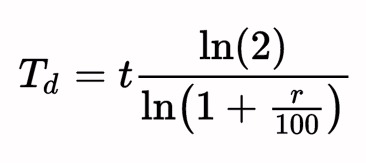
Doubling Time Formula

Extreme Events: The New Normal

Extreme weather events are intensifying and occurring with alarming frequency as warming oceans, disrupted jet streams, and accelerating atmospheric rivers destabilize the climate system. What were once “500-year” events now occur every 5-10 years, and in many places, annually.

  • Heatwaves are now 5x more likely, projected to become 10x more likely within 5 years and 20x within a decade, consistent with the shrinking climate doubling period.
  • Storms and flooding are not only more frequent but also exponentially more destructive due to physics: wind and water forces scale with the square of velocity (v²) and, in the case of water, with 800x the density of air, making even modest increases in flow speed dramatically more damaging.
  • Wildfires, fueled by heat, lightning, and brown carbon feedback loops, are igniting with greater speed and ferocity, as seen during Canada’s record-breaking 2023 wildfire season.

Non-linear acceleration is now confirmed: The 2-7°F rise in temperatures during recent European heatwaves translated to a tripling of heat deaths, demonstrating the amplified sensitivity of human and natural systems to seemingly small increases in mean temperatures. For every 1°C (1.8°F) increase, the atmosphere can hold 7% more water vapor, intensifying storms and the humidity of heatwaves, compounding mortality risk.

2025 Update: Doubling Period Shrinks Further

Originally estimated at 100 years, the climate doubling period–how quickly climate impacts double in intensity–contracted to 10 years. By 2024, new observations confirmed the doubling period had shortened further to just 2 years. 100 years → 10 years → 2 years. This means the damage caused by climate change today is already double what it was just two years ago. If this trend continues, it could be four times worse in two years, eight times worse in four years, and up to 64 times worse within a decade. Critically, these estimates are conservative, assuming the doubling period does not continue to shrink even further as tipping points and feedback loops accelerate the crisis.

The surge in persistent heat domes and resonance patterns in the jet stream confirms that critical thresholds in the climate system are being crossed faster than models predicted. As warming oceans and a destabilized jet stream lock in planetary wave patterns, heat domes and extreme weather events persist longer, amplifying both frequency and intensity.

In 2023, Earth’s surface temperatures averaged over 3°C above pre-industrial levels–double the Paris Agreement’s 1.5°C ceiling. Scientists agree that a 2°C rise will trigger tipping points and feedback loops, releasing carbon from permafrost, weakening the AMOC, and destabilizing polar ice sheets. This cascading “Domino Effect” could push global temperatures toward 6°C, rendering large regions of the planet uninhabitable within this century.

As climate change accelerates, what was once a 1,000-year flood now occurs as a 100-year or even 10-year event. Violent rain, flash flooding, and catastrophic water events are rewriting our understanding of “normal,” with Chapel Hill’s recent “1,000-year” flood serving as a stark warning that the climate system is entering a phase of nonlinear, runaway change that threatens human systems, infrastructure, and global stability.

Ignite a Domino Effect: Albedo, Brown Carbon, AMOC, Permafrost, Amazon Rainforest Dieback, Sea Level Rise Pulses, Hydroclimate Whiplash, and Arctic Sea Ice Brouse and Mukherjee (2025)

Tipping Cascades: The Nonlinear Dominoes of Climate Collapse Brouse and Mukherjee (2025)

The Domino Collapse: Amazon Rainforest Dieback and the Ozone Feedback Loop Brouse and Mukherjee (2025)

Climate Change, Doubling Time, and the Eroding Value of Jersey Shore Real Estate Brouse (2025)

Tipping points and feedback loops drive the acceleration of climate change. When one tipping point is toppled and triggers others, the cascading collapse is known as the Domino Effect.

From the album “Edge of Chaos

The Human Induced Climate Change Experiment