bookmark_borderBlew By

[Silence]
[Instrumental Intro: Echoed Guitar Harmonics, Slow Bass Pulse, Ambient Synth Drift]

[Intro]
[Minimal Beat, Soft Organ, Delayed Guitar]
Watched the years
(Disappear)
Out of my hands
(And through the gears)
Another sunrise
(Another goodbye)
Blink your eyes
(And wonder why)

[Verse]
Standing still
(On a moving train)
Laughing through
(A little pain)
Thought there’d be
(More time somehow)
Then tomorrow turns
(Into now)

[Chorus]
Time blew by
(Time does fly)
Best to try
(Till you die)
Don’t waste the day
(Let it shine)
Hold on tight
(To your time)
See the light

[Instrumental Break: Guitar Solo, Organ Swell, Percussion Build]

[Verse]
Old photographs
(Faded blue)
Still alive
(In shades of you)
Voices drift
(Like summer wind)
Gone away
(Then back again)

[Refrain]
Clock hands spin
(Round and round)
Lost then found
(In the sound)
One more chance
(To begin)
Before it blows
(By again)

[Bridge]
[Breakdown: Bass and Voice Only]
No pause button
(No rewind)
Just footprints
(Left behind)
So sing out loud
(While you can)
Love this life
(Love is rife)

[Final Chorus]
Time blew by
(Time does fly)
Best to try
(Till you die)
Lift your eyes
(To the sky)
Leave some light
(For tonight)

[Outro]
[Instrumental Outro: Fading Guitar Delay, Wind FX, Soft Synth Pad]
(Time blew by…)
Time does fly…
(Blowin’ by…)
Try, try, try

From the album Blue

bookmark_borderFlush the Toilet

[Intro]
[Sparse ambient pads, dripping water sound effects, soft sub bass; minimal percussion]
Spin, spin, slow at first…
(Forget your thirst)
Floating on the edge…
(Nearing the verge)
Drawn to the center…
(Starting to splinter)

[Verse 1]
Vortex dynamics, spatial compression
A swirling analogy, temporal obsession
Floating at the edge, slow to spin
Drawn to the center, chaos begins
[Gradual addition of muted guitar plucks, low synth swells, light hi-hat pulse]

[Chorus 1]
In a rush?
(Flush!)
Shove and push
(Flush!)
[Heavy kick drum, snare, rising hi-hat pattern; distorted bass line emphasizing “Flush!” hits]

[Bridge]
Push came to shove
(Abandoned love)
Will you see it coming?
Will you react?
Or be swallowed by the current,
Lost to the act?
[Stripped instrumentation, echoing piano, sparse percussion; tension builds with vocal delay effects]

[Verse 2]
Velocity grows as radius shrinks
r → 0, faster than you think
Small moves, huge gains, motion tight
Everything speeds up toward the night
[Layered synth arpeggios, bass line accelerates, guitar riffs echo “acceleration”]

[Chorus 2]
In a rush?
(Flush!)
Shove and push
(Flush!)
[Full band enters; heavy rhythm section, synth stabs, guitar leads; rising cymbals toward climax]

[Bridge]
Push came to shove
(Abandoned love)
Will you see it coming?
Will you react?
Or be swallowed by the current,
Lost to the act?
[Guitar solo, echoing piano, sparse percussion; tension builds with vocal delay effects]

[Verse 3 / Breakdown]
Spatial compression, mapped to time
Early shifts slow, later chaos climbs
Rapid succession, unstoppable flow
Near the core, everything you know
[Slow down drums, reverb-drenched synths, vocal whispers; tension before final burst]

[Bridge 2]
Vortex tightens
Spinning faster
Will you hold on, or be disaster?

[Instrumental – Extended Psychedelic Jam]
[Percussion stutters, bass drops, distorted guitar bends; suspenseful pause before outro]

[Chorus 3 / Outro]
In a rush?
(Flush!)
Shove and push
(Flush!)

[Bridge]
Push came to shove
(Abandoned love)
Will you see it coming?
Will you react?
Or be swallowed by the current,
Lost to the act?
[Drum solo, echoing piano, heavy percussion; tension builds with vocal delay effects]

[Explosive final hit with full instrumentation; cymbal crash, synth sweep; end abruptly with a single water swirl effect]

[Outro]
[Ambient water swirling fades, echoing distant flush, soft fading pad]
Spinning…
(Spin, spin, spin… going…)
Accelerating…
(There’s no debating)
Gone down the drain…
(The world’s gone insane)
Down, down, down
(Down the drain)

About
“Flush the Toilet” is a metaphorical exploration of accelerating climate change using the familiar visual of a vortex. Spatial compression is analogous to temporal compression: small changes early on appear manageable, but near tipping points, dynamics escalate rapidly. The song’s arrangement mirrors the physical concept: building layers, accelerating rhythms, and dynamic tension evoke the intensifying forces, while pauses and ambient textures represent the deceptive calm before collapse.

Vortex Dynamics: Singular Behavior in Fluid Systems

Energy Input and Self-Organization

Vortices emerge from energy input into a fluid system:

  • pressure gradients develop
  • rotational motion forms
  • angular momentum is conserved

The system organizes into a coherent structure.

Nonlinear Acceleration Toward the Core

A defining vortex property is:

v ∝ 1 / r

As radius decreases:

r → 0 ⇒ v → ∞

This represents a mathematical singularity.

Breakdown of Physical Validity

In reality, infinite velocity does not occur. Instead:

lim (r → 0) v(r) → undefined

This signals:

  • breakdown of governing equations
  • transition beyond laminar flow assumptions

From the album Third Derivative

bookmark_borderA Second

A-Second-Best-Of.mp3
A-Second-Best-Of.mp4
A-Second.mp3
A-Second.mp4

A-Second-intro.mp3

[Intro]
Hold on a second…
(… I thought you said….)

[Verse 1]
What do you recommend
(Are the choices fair)
What message to send
(That will find its way there)

[Bridge]
Hold on a second…
(… I thought you said….)

[Chorus]
Wait a minute
(Not so fast)
One more moment
(Make it last)

[Verse 2]
What do you reckon
(I’ve made my bed)
Check out or check in
(Arrive alive or dead)

[Bridge]
Hold on a second…
(… I thought you said….)

[Chorus]
Wait a minute
(Not so fast)
One more moment
(Make it last)

[Outro]
Beckon
(Avoid the dread)
Hold on a second…
(… I thought you said….)
Yes, right inisght
(That’s what she said)
Beckon
(Avoid the dread)
Reckon
(Thrive alive)

From the album “Hold On

bookmark_borderYesterday

Yesterday.mp3
Yesterday.mp4
Yesterday-Unplugged-Underground-XXIX.mp3
Yesterday-Unplugged-Underground-XXIX.mp4

Yesterday-Animation-1.mp4
Yesterday-intro.mp3

[Intro]
Don’t hold on to yesterday
Let ‘er fade away
(Fade away)

[Verse 1]
Living in a memory
(Isn’t living at all)
Enjoy the scenery
(Before you start your fall)

[Chorus]
The past has passed
(No looking back)
Into the future… fast
(Because the present doesn’t last)

[Bridge]
Don’t hold on to yesterday
Let ‘er fade away
(Fade away)

[Verse 2]
Living in your history
(Is more like misery)
Love the here and now
(The anywhere and anyhow)

[Chorus]
The past has passed
(No looking back)
Into the future… fast
(Because the present doesn’t last)

[Bridge]
Don’t hold on to yesterday
Let ‘er fade away
(Fade away)

[Outro]
The past has passed
(Spent time amassed)
Into the future… fast
(No, the present doesn’t last)
Know the present doesn’t last
(Know no woe)

From the album “Hold On

bookmark_borderSandwich

Sandwich.mp3
Sandwich.mp4
Sandwich-Unplugged-Underground-XXIX.mp3
Sandwich-Unplugged-Underground-XXIX.mp4

Sand-wich-Hourglass-Animation-1.mp4
Sand-wich-Hourglass-Animation-2.mp4
Sandwich-intro.mp3

[Intro]
The sand
(Which keeps slipping)
Dripping (and dropping)
Never stopping

[Bridge]
Watch it pass
(Through the hourglass)

[Refrain]
The sand
(Which keeps slipping)
Dripping (and dropping)
Never stopping

[Bridge]
Counting down
(Down, down, down)
The grains that remain
Watch it pass
(Through the hourglass)

[Refrain]
The sand
(Which keeps slipping)
Dripping (and dropping)
Never stopping

[Bridge]
Counting down
(Down, down, down)
The grains that remain
(Don’t let it drive you…)
… insane
Watch it pass
(Through the hourglass)

[Outro]
Counting down
(Down, down, down)
The grains that remain
(Don’t let it drive you…)
… insane
(Grain by grain)
Don’t let it drive you…
(Oh, no, no, no)
Not you, too
Watch it pass
(Through the hourglass)
Passing through
(Don’t let it drive you…)
… insane
(Grain by grain)

From the album “Which

bookmark_borderSnuck up

Snuck-Up-Best-Of.mp3
Snuck-Up-Best-Of.mp4
Snuck-Up.mp3
Snuck-Up.mp4
Snuck-Up-intro.mp3

[Intro]
Time!
(Snuck up on me)
Time!
(Funked up story)

[Verse 1]
Sitting (and waiting)
For the time to come
Paused (Hesitating)
For what will become

[Bridge]
In our prime

[Chorus]
Time!
(Snuck up on me)
Time!
(Funked up story)

[Verse 2]
Watching (Debating)
What time will it to come
Stalled (Sedating)
Waiting for some some

[Bridge]
In our prime

[Chorus]
Time!
(Snuck up on me)
Time!
(Funked up story)

[Outro]
Don’t pass our prime
Savor the time
(We have together)
Whether
(Good or bad)
The times we had

From the album “Sudden

bookmark_borderShrinking Doubling Times

Shrinking-Doubling-Times-Best-Of.mp3
Shrinking-Doubling-Times-Best-Of.mp4
Shrinking-Doubling-Times.mp3
Shrinking-Doubling-Times.mp4
Shrinking-Doubling-Times-intro.mp3

[Intro]
What are we thinking
(The time is shrinking)
And the damage (doubling)
Troubling?

[Verse 1]
Dramatic
(Contraction)
Climactic
(Climatic)

[Chorus]
What are we thinking
(The time is shrinking)
And the damage (doubling)
Troubling?

[Bridge]
(And then some sum)
(Doubling) Intensity
(Doubling) Frequency

[Verse 2]
Dramatic
(Anthropogenic)
Climactic
(Climatic)

[Chorus]
What are we thinking
(The time is shrinking)
And the damage (doubling)
Troubling?

[Bridge]
(And then some sum)
(Doubling) Intensity
(Doubling) Frequency
(Doubling) Troubling

[Chorus]
What are we thinking
(The time is shrinking)
And the damage (doubling)
Troubling?

[Outro]
(And then some sum)
How come (so dumb?)
(Doubling) Intensity
(Doubling) Frequency
(Doubling) Troubling
Never surrendering
(Our vanity)
Insanity
(Massive mass consumption)
Pass to past compensation

ABOUT THE SONG AND THE SCIENCE
Anthropogenic (an-thr-po-gen-ic), is the formal scientific synonym for “human-induced”.

In the 1990s, we developed what became known as The Non-Linear Acceleration Hypothesis–the proposition that climate change is not progressing linearly but is accelerating exponentially. Working together, with Sidd’s background as a Doctor of Physics from Ohio State and my own experimental and observational analyses, we produced the foundational evidence for this theory. By the early 2000s, our work had evolved into a recognized climate framework, validated repeatedly through independent replication and supported by an expanding body of empirical data. Over the decades, this body of confirmation has solidified into the scientific consensus we see today.

Shrinking Doubling Times and Escalating Impacts

One of the most compelling indicators of nonlinear acceleration is the dramatic contraction of the doubling time of climate impacts–the interval in which damage effectively doubles due to interacting feedback processes. In the mid-20th century, the doubling time was on the order of 100 years. By the early 2000s, it had fallen to 10 years, and recent analyses show that it has now plunged to approximately 2 years.

This means that the impacts of climate change today are twice as severe as they were two years ago. If the doubling time remains constant, they will be four times worse in two years, eight times worse in four years, and potentially sixty-four times worse within a decade. These estimates are conservative; the doubling period continues to shorten as feedbacks intensify. With no meaningful global mitigation underway, the trajectory is unmistakable and vastly more catastrophic than previously projected.

Accelerated Forcing Growth

Their analysis centers on a chart showing the five-year running mean of the annual increase in greenhouse gas forcing. Over the past 15 years, they find that the rate of increase has surged to ~0.5 W/m2 per decade–far higher than IPCC projections. This acceleration is not reflected in IPCC scenarios and is fundamentally incompatible with its claims of remaining “pathways” to 1.5°C or 2°C.

Implications for Climate Scenarios

  • Current forcing trajectories align closely with RCP 8.5, the high-end “business-as-usual” pathway.
  • They diverge sharply from RCP 2.6, the scenario often used for policy optimism.
  • Achieving RCP 2.6 today would require $2.4-5 trillion per year using current technology.
  • RCP 2.6 also presumes unrealistic levels of biomass burning plus carbon capture, which Hansen calls politically and practically unviable.

The Domino Effect: Cascading Tipping Points

Building on nonlinear thermodynamics and chaos theory, we now know that climate tipping points are not isolated events–they interact. As major systems destabilize, they trigger secondary failures, creating a cascade of compounded impacts.

Our recent synthesis of 2024-2025 data shows:

  • CO2 concentrations, fossil fuel emissions, and global temperatures all reached record highs.
  • Natural carbon sinks are beginning to convert into carbon sources.
  • Feedbacks across ice loss, ocean circulation, albedo decline, and atmospheric chemistry are synchronizing.
  • These interactions are driving what we call the Domino Effect–a system-wide cascade that threatens global habitability within this century.

* Our probabilistic, ensemble-based climate model — which incorporates complex socio-economic and ecological feedback loops within a dynamic, nonlinear system — projects that global temperatures are becoming unsustainable this century. This far exceeds earlier estimates of a 4°C rise over the next thousand years, highlighting a dramatic acceleration in global warming. We are now entering a phase of compound, cascading collapse, where climate, ecological, and societal systems destabilize through interlinked, self-reinforcing feedback loops.

What Can I Do?
The single most important action you can take to help address the climate crisis is simple: stop burning fossil fuels. There are numerous actions you can take to contribute to saving the planet. Each person bears the responsibility to minimize pollution, discontinue the use of fossil fuels, reduce consumption, and foster a culture of love and care. The Butterfly Effect illustrates that a small change in one area can lead to significant alterations in conditions anywhere on the globe. Hence, the frequently heard statement that a fluttering butterfly in China can cause a hurricane in the Atlantic. Be a butterfly and affect the world.

Tipping points and feedback loops drive the acceleration of climate change. When one tipping point is breached and triggers others, the cascading collapse is known as the Domino Effect.


The Human Induced Climate Change Experiment

From the album “Nonlinear

bookmark_borderTime Stamped

Time-Stamped.mp3
Time-Stamped.mp4
Time-Stamped-Pt-2.mp3
Time-Stamped-Pt-2.mp4
Time-Stamped-intro.mp3

[Intro]
Time stamped
(When the rubber met the road)
To think…
(Inked)
Watch your world (implode)

[Verse 1]
Your day has come
(It has come undone)
No battle won
(Just a whore’s lost war)

[Chorus]
Time stamped
(Inked)
Succinct
(At the brink)

[Bridge]
Power amped
(Don’t blink)
(When things become serious)
Yet, you’re still delirious
(It’s time for you)
To ring true

[Verse 2]
Notice has been served
(Get what you deserve)
Yes, reality bites
(And, she bites just right)

[Chorus]
Time stamped
(Inked)
Succinct
(At the brink)

[Bridge]
Power amped
(Don’t blink)
(When things become serious)
Yet, you’re still delirious
(It’s time for you)
To ring true

[Outro]
Power amped
(Don’t blink)
(When things become serious)
Yet, you’re still delirious
(It’s prime time)
To pay for your crime

From the album “Brink

bookmark_borderCut Time

Cut-Time.mp3
Cut-Time.mp4
Cut-Time-Unplugged-Underground-XXVII.mp3
Cut-Time-Unplugged-Underground-XXVII.mp4
Cut-Time-intro.mp3

[Intro]
Cut! (Sickle)
More… (Musical)

[Verse 1]
Let’s harvest the music
(So we can sow)
We can help cure the sick
(Letting souls flow)

[Bridge]
Cut! (Sickle)
More… (Musical)

[Chorus]
It’s time
(To cut time)
Alla breve
(Breathe, ahh….)

[Verse 2]
Time to reap the tunes
(Sow, so we can play)
Set free the balloons
(Celebration day)

[Bridge]
Cut! (Sickle)
More… (Musical)

[Chorus]
It’s time
(To cut time)
Alla breve
(Breathe, ahh….)

[Bridge]
Cut! (Sickle)
More… (Musical)

[Chorus]
It’s time
(To cut time)
Alla breve
(Breathe, ahh….)

[Outro]
Cut! (Sickle)
More… (Musical)
Cut! (Knife)
More (for life)
May your soul seep
(Let the music reap)

ABOUT THE SONG
Cut time, or alla breve, is a music time signature denoted by a “C” with a vertical line through it, equivalent to the time signature 2/2. It indicates there are two beats per measure, with a half note receiving the pulse. This is different from common time (4/4), which has four beats per measure and a quarter note gets the pulse. Cut time is often used for faster pieces because counting in two large beats is easier for musicians than counting in four smaller beats.

From the album “Reap

bookmark_borderOvertime

Overtime.mp3
Overtime.mp4
Overtime-Unplugged-Underground-XXVI.mp3
Overtime-Unplugged-Underground-XXVI.mp4
Overtime-intro.mp3

[Intro]
The bell has rung
(Nobody won)
Going into overtime

[Verse 1]
No matter how we try
End’s up a tie
Need to score a point
Get out of this disjoint

[Bridge]
The bell has rung
(Nobody won)
Going into overtime

[Chorus]
Take it as a sign
(It ain’t over yet)
Think we’re gonna find
(You get what you get)

[Verse 2]
Oh well…
The final bell
Wasn’t final after all
Ready? Play ball

[Bridge]
The bell has rung
(Nobody won)
Going into overtime

[Chorus]
Take it as a sign
(It ain’t over yet)
Think we’re gonna find
(You get what you get)

[Bridge]
The bell has rung
(Nobody won)
Going into overtime

[Chorus]
Take it as a sign
(It ain’t over yet)
Think we’re gonna find
(You get what you get)

[Outro]
The bell has rung
(Nobody won)
Going into overtime
(’till we figure out)
What “over” is about

From the album “Undercover

bookmark_borderAbout “Us”

About-Us-Best-Of.mp3 About-Us-Best-Of.mp4 About-Us.mp3 About-Us.mp4 About-Us-intro.mp3


[Verse 1]
En route (no doubt)
On the way (sprout)
To the bright light
(Of day)

[Bridge]
Flower
[Instrumental, Synth Solo, Organ, Bass]
(Power)
Our are
[Instrumental, Guitar Solo]

[Chorus]
Which came first
(The chicken cracked ‘er shell)
Out she burst
(Well… it isn’t hard to tell)

[Instrumental, Saxophone Solo]

[Verse 2]
None to soon
(I came from womb)
For a birth
(On Earth)

[Bridge]
Baby (no longer maybe)
[Instrumental, Synth Solo, Organ, Bass]
(Power)
Our hour
(Our are)
In the time of I’m
[Instrumental, Guitar Solo]

[Chorus]
Which came first
(The chicken cracked ‘er shell)
Out she burst
(Well… it isn’t hard to tell)

[Verse 3]
All too fast
(I fall to the ground)
(K)new it couldn’t last
(But, just look what we’ve found!)

[Outro]
Baby (no longer maybe)
[Instrumental, Synth Solo, Organ, Bass]
Our power
(Till the last hour)
We are
(Our are)
Us (becomes infectious)
[Instrumental, Guitar Solo]

From the album “Upward

bookmark_borderNonlinear Trajectory

Nonlinear-Trajectory-Best-Of.mp3
Nonlinear-Trajectory-Best-Of.mp4
Nonlinear-Trajectory.mp3
Nonlinear-Trajectory.mp4
Nonlinear-Trajectory-intro.mp3

[Verse 1]
Hey! Did you hear
(Isn’t it clear)
We’re on a nonlinear
(Trajectory)
You and me… (we)

[Bridge]
Whether or not you know
(Here we go)
Weather the weather
(Below, low, low)

[Chorus]
In the thick of dynamic
(Watch which way the flow will go)
Lo and behold
(System nears a critical threshold)
At a loss (on the edge of chaos)

[Verse 2]
Accelerating (interacting)
All the joints (tipping points)
The variability of vectors
Burning millions of hectare
(Acres of ache ‘ers)

[Bridge]
Whether or not you know
(Here we go)
Weather the weather
(Below, low, low)

[Chorus]
In the thick of dynamic
(Watch which way the flow will go)
Lo and behold
(System nears a critical threshold)
At a loss (on the edge of chaos)

[Outro]
Whether or not you know
(Here we go)
Weather the weather
(Below, low, low)
Oh, know no (know no)

A SCIENCE NOTE

Chaos Theory Explains Why Climate Collapse Feels Sudden

  1. Long period of relative stability (homeostasis in chaos theory terms).

  2. Hidden stresses build slowly (greenhouse gases, deforestation, pollution).

  3. System nears a critical threshold (edge of chaos).

  4. Seemingly small trigger (like a bad El Nino year) causes cascading failures.

Climate change is not a slow, linear shift — it is a dynamic, nonlinear process governed by complex systems and feedback loops. Traditional notions of averages and incremental change can be dangerously misleading when applied to climate science. The true nature of climate disruption lies in tipping points: critical thresholds beyond which change accelerates irreversibly.

To visualize this, imagine a glass sitting at the center of a table. You begin to push it slowly toward the edge. At first, it moves just millimeters per minute. But over time, the pace quickens — centimeters per second — as momentum builds. Eventually, the glass reaches a point where no amount of caution or force can stop it from falling. The tipping point has been crossed; the fall is inevitable.

Climate tipping points operate in much the same way. They aren’t about any one extreme event, but rather the cumulative impact of stress over time — on ice sheets, forests, oceans, and atmospheric systems. Once crossed, these thresholds unleash rapid, self-reinforcing changes like runaway ice melt, forest dieback, or ocean current disruption. These are not hypothetical outcomes — they are grounded in peer-reviewed science and unfolding in real time. Just look out your window.

Understanding the nonlinear nature of climate change is essential for anticipating its consequences and acting to limit the irreversible damage being done. It is not a matter of opinion or debate, but of scientific urgency.

Health feedback loops, violent rain, and deadly humid heat are fueling an exponential rise in climate-related deaths. This lethal triad — disease, extreme heat, and intense rainfall — demonstrates that climate change is not a distant threat but a rapidly accelerating public health emergency. These stressors interact and amplify one another, creating a cascade of compounding impacts that demand urgent intervention.

All 50 U.S. states — including Alaska — are already experiencing deadly humid heat advisories. Large regions of the country are becoming uninhabitable for weeks or even months each year due to extreme heat. Wet-bulb temperatures are approaching 31°C (87.8°F) in multiple states — a physiological threshold beyond which sustained outdoor survival is impossible, even with water and shade. Meanwhile, violent rain events are killing hundreds and causing billions in annual damage. Climate-driven health feedback loops have become the leading cause of mortality in the United States — fueled by systemic interactions between temperature extremes, air quality degradation, disease vectors, and infrastructure collapse. Addressing climate change is no longer just an environmental imperative — it is a public health necessity.

Our climate model — which incorporates complex socio-economic and ecological feedback loops within a dynamic, nonlinear system — projects that global temperatures could rise by up to 9°C (16.2°F) within this century. This far exceeds earlier estimates of a 4°C rise over the next thousand years, highlighting a dramatic acceleration in global warming. We are now entering a phase of compound, cascading collapse, where climate, ecological, and societal systems destabilize through interlinked, self-reinforcing feedback loops.

We analyze how human activities (such as deforestation, fossil fuel use, mass consumption, and land development) interact with ecological processes (including carbon cycling, water availability, disease vectors, and biodiversity loss) in ways that amplify one another. These interactions do not follow simple cause-and-effect patterns; instead, they create cascading, interconnected impacts that can rapidly accelerate system-wide change, sometimes abruptly. Understanding these dynamics is essential for assessing risks and designing effective survival strategies.

Ignite a Domino Effect: Albedo, Brown Carbon, AMOC, Permafrost, Amazon Rainforest Dieback, Sea Level Rise Pulses, Hydroclimate Whiplash, and Arctic Sea Ice Brouse and Mukherjee (2025)

Tipping Cascades: The Nonlinear Dominoes of Climate Collapse Brouse and Mukherjee (2025)

The Domino Collapse: Amazon Rainforest Dieback and the Ozone Feedback Loop Brouse and Mukherjee (2025)

Tipping points and feedback loops drive the acceleration of climate change. When one tipping point is toppled and triggers others, the cascading collapse is known as the Domino Effect.

From the album “Upward

bookmark_borderDoubling Time

Doubling-Time-Best-Of.mp3
Doubling-Time-Best-Of.mp4
Doubling-Time.mp3
Doubling-Time.mp4
Doubling-Time-intro.mp3

[Verse 1]
Acceleration
(Becomes a thing of the past)
At last at last
(The past piles up so fast)

[Bridge]
Our you sure
(Of a future?)

[Chorus]
The trouble with doubling time
Is it’s half of half-the-time
(All the time)
Like per second per second… I reckon…
It just keeps going and growing
(Shorter and shorter)

[Bridge]
Faster and faster
(Into disaster)

[Verse 2]
100 years goes to 10
(Then… to two)
Not a matter of when
(It’s happening to you)

[Bridge]
Our you sure
(Of a future?)

[Chorus]
The trouble with doubling time
Is it’s half of half-the-time
(All the time)
Like per second per second… I reckon…
It just keeps going and growing
(Shorter and shorter)

[Bridge]
Drastic (disorder)
Faster and faster
(Into disaster)

[Chorus]
The trouble with doubling time
Is it’s half of half-the-time
(All the time)
Like per second per second… I reckon…
It just keeps going and growing
(Shorter and shorter)

[Outro]
Drastic (disorder)
Faster and faster
(Into disaster)
[Instrumental, Whistle Solo]

A SCIENCE NOTE

Beyond Linear Change: The Reality of Exponential Acceleration

When we began our climate experiments in the 1990s, we assumed significant change would occur over millennia. If climate change progressed linearly, this would hold. However, by the late 1990s, our findings–and global observations–began to show that climate impacts were accelerating exponentially.

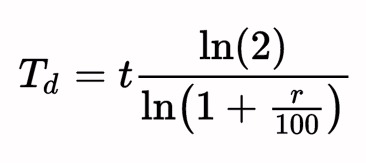
Doubling time — the period required for a quantity to double — is a critical marker of exponential growth. For anthropogenic climate impacts, this period has collapsed at an alarming rate. By 2020, the doubling time for key impacts such as sea level rise had shrunk from 100 years to just 10 years, with rates increasing from about 1.5 mm/year to over 3 mm/year. If left unchecked, this trajectory could result in sea-level increases of up to one foot per year by 2050.

Doubling Time Formula

Extreme Events: The New Normal

Extreme weather events are intensifying and occurring with alarming frequency as warming oceans, disrupted jet streams, and accelerating atmospheric rivers destabilize the climate system. What were once “500-year” events now occur every 5-10 years, and in many places, annually.

  • Heatwaves are now 5x more likely, projected to become 10x more likely within 5 years and 20x within a decade, consistent with the shrinking climate doubling period.
  • Storms and flooding are not only more frequent but also exponentially more destructive due to physics: wind and water forces scale with the square of velocity (v²) and, in the case of water, with 800x the density of air, making even modest increases in flow speed dramatically more damaging.
  • Wildfires, fueled by heat, lightning, and brown carbon feedback loops, are igniting with greater speed and ferocity, as seen during Canada’s record-breaking 2023 wildfire season.

Non-linear acceleration is now confirmed: The 2-7°F rise in temperatures during recent European heatwaves translated to a tripling of heat deaths, demonstrating the amplified sensitivity of human and natural systems to seemingly small increases in mean temperatures. For every 1°C (1.8°F) increase, the atmosphere can hold 7% more water vapor, intensifying storms and the humidity of heatwaves, compounding mortality risk.

2025 Update: Doubling Period Shrinks Further

Originally estimated at 100 years, the climate doubling period–how quickly climate impacts double in intensity–contracted to 10 years. By 2024, new observations confirmed the doubling period had shortened further to just 2 years. 100 years → 10 years → 2 years. This means the damage caused by climate change today is already double what it was just two years ago. If this trend continues, it could be four times worse in two years, eight times worse in four years, and up to 64 times worse within a decade. Critically, these estimates are conservative, assuming the doubling period does not continue to shrink even further as tipping points and feedback loops accelerate the crisis.

The surge in persistent heat domes and resonance patterns in the jet stream confirms that critical thresholds in the climate system are being crossed faster than models predicted. As warming oceans and a destabilized jet stream lock in planetary wave patterns, heat domes and extreme weather events persist longer, amplifying both frequency and intensity.

In 2023, Earth’s surface temperatures averaged over 3°C above pre-industrial levels–double the Paris Agreement’s 1.5°C ceiling. Scientists agree that a 2°C rise will trigger tipping points and feedback loops, releasing carbon from permafrost, weakening the AMOC, and destabilizing polar ice sheets. This cascading “Domino Effect” could push global temperatures toward 6°C, rendering large regions of the planet uninhabitable within this century.

As climate change accelerates, what was once a 1,000-year flood now occurs as a 100-year or even 10-year event. Violent rain, flash flooding, and catastrophic water events are rewriting our understanding of “normal,” with Chapel Hill’s recent “1,000-year” flood serving as a stark warning that the climate system is entering a phase of nonlinear, runaway change that threatens human systems, infrastructure, and global stability.

Ignite a Domino Effect: Albedo, Brown Carbon, AMOC, Permafrost, Amazon Rainforest Dieback, Sea Level Rise Pulses, Hydroclimate Whiplash, and Arctic Sea Ice Brouse and Mukherjee (2025)

Tipping Cascades: The Nonlinear Dominoes of Climate Collapse Brouse and Mukherjee (2025)

The Domino Collapse: Amazon Rainforest Dieback and the Ozone Feedback Loop Brouse and Mukherjee (2025)

Climate Change, Doubling Time, and the Eroding Value of Jersey Shore Real Estate Brouse (2025)

Tipping points and feedback loops drive the acceleration of climate change. When one tipping point is toppled and triggers others, the cascading collapse is known as the Domino Effect.

From the album “Edge of Chaos

The Human Induced Climate Change Experiment

bookmark_borderSeven in a Row

Seven-in-a-Row-Best-Of.mp3
Seven-in-a-Row-Best-Of.mp4
Seven-in-a-Row.mp3
Seven-in-a-Row.mp4
Seven-in-a-Row-intro.mp3

[Verse 1]
Of what you speak
(It’s not that weak)
The things ya know
(Well, here we go)

[Chorus]
There’s seven days
(In a row)
Taken together
(One full week)

[Bridge]
Whether the weather
(Weather the whether)
Oh, oh, oh (We’ll will)
Oh, oh, oh (Until)

[Verse 2]
What will we do
At fifty-two?
We’ll say
Happy Birthday
(To you)

[Acapella Vocals]
(Happy birthday to you)

[Chorus]

[Bridge]

[Chorus]

[Outro]
And, another year (year, year)
Around the sun (Oh such fun)
(Happy birthday to you)

ABOUT THE SONG
Today’s new release, “Seven in a Row,” is a song about time—because, well, I figured it’s about time. Lately, I’ve been digging playing the organ. Yesterday, it was a Yamaha with pipes and flute effects layered with a Korg PS60. Today, I’m mixing a Kurzweil with a Korg N364 to get that warm, playful groove.

Lyrically, the song is a lighthearted reflection on the passage of days and years, weaving together the idea of “seven days in a row” with the cycles of birthdays and another trip around the sun. It’s about finding joy in the weeks that roll by and celebrating the simple gift of time—day by day, week by week, and year by year.

From the album “Edge of Chaos

bookmark_borderSinging Like a Bird

Singing-Like-a-Bird.mp3
Singing-Like-a-Bird.mp4
Singing-Like-a-Bird-Unplugged-Underground-XXIII.mp3
Singing-Like-a-Bird-Unplugged-Underground-XXIII.mp4
Singing-Like-a-Bird-intro.mp3

[Verse 1]
I suppose perspective
Those points-of-view
Aren’t a mere elective
When forces come through

[Chorus]
Do you hear the wind whisper
(Singing like a bird)
Do you feel change rearrange
(Or haven’t you heard)

[Bridge]
Get ready to merge
(Converge) with the future

[Verse 2]
My birth on Earth
Put forth… a being
Now that I’m seeing
Me in harmony

[Chorus]
Do you hear the wind whisper
(Singing like a bird)
Do you feel change rearrange
(Or haven’t you heard)

[Bridge]
Get ready to merge
(Converge) with the future

[Chorus]
Do you hear the wind whisper
(Singing like a bird)
Do you feel change rearrange
(Or haven’t you heard)

[Outro]
Get ready to merge
(Converge) with the future

From the album “Sunny Days