bookmark_borderSemi-Dystopian

Wow… just sayin’
… semi-dystopian

[Verse 1]
The world is frying
They’re not lying
The experts know
Where we’re going to go

[Bridge]
If we don’t stop
The fossil fuels
We’re going to top
The temperature… beat by heat
[Break]
Stop the top!

[Chorus]
Semi-dystopian
The “oh, no!” scenario
Livin’ semi-dystopian
Is barely livin’

[Instrumental, Guitar Solo, Drum Fills]

[Break]
Wow… just sayin’
… semi-dystopian

[Verse 2]
Have you been looking
The world is cooking
The experts know
It’s getting tough to grow

[Bridge]
If we don’t stop
The fossil fuels
We’re going to top
The temperature… beat by heat
[Break]
Stop the top!

[Chorus]
Semi-dystopian
The “oh, no!” scenario
Livin’ semi-dystopian
Is barely livin’

[Instrumental, Saxophone Solo, Drum Fills]

[Break]
Wow… just sayin’
… semi-dystopian

[Verse 3]
Have we gone blind
Not a kind kind
Don’t we know
The situation’s gonna blow?

[Bridge]
If we don’t stop
The fossil fuels
We’re going to top
The temperature… beat by heat
[Break]
Stop the top!

[Chorus]
Semi-dystopian
The “oh, no!” scenario
Livin’ semi-dystopian
Is barely livin’

[Outro]
Wow… just sayin’
… semi-dystopian

[End]

A SCIENCE NOTE
The Guardian reports, “Many of the scientists envisage a ‘semi-dystopian’ future, with famines, conflicts and mass migration, driven by heatwaves, wildfires, floods and storms of an intensity and frequency far beyond those that have already struck.”

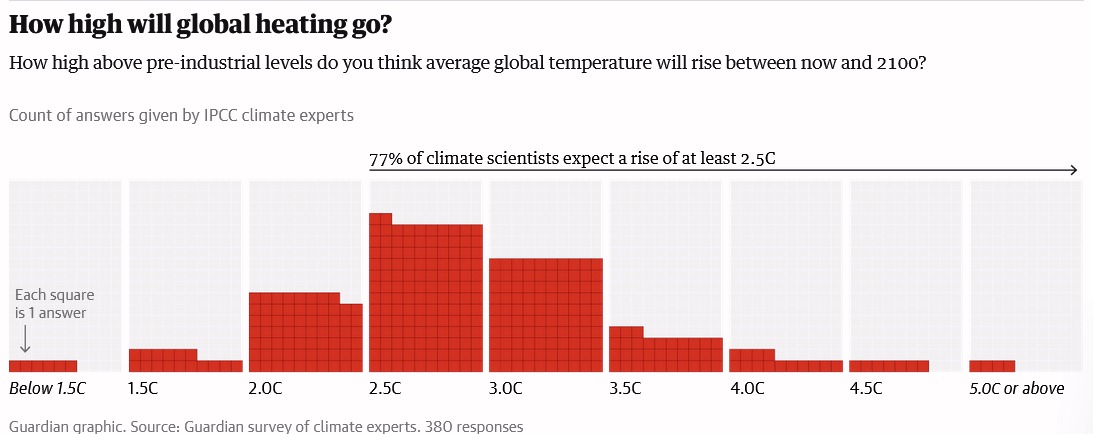
Top climate scientists anticipate that global temperatures will surpass the 1.5-degree Celsius target, reaching at least 2.5 degrees Celsius above preindustrial levels by the end of this century, according to an exclusive Guardian survey.

Nearly 80% of the respondents, comprising experts from the Intergovernmental Panel on Climate Change (IPCC), anticipate a global heating of at least 2.5 degrees Celsius, with almost half predicting a rise of at least 3 degrees Celsius. Merely 6% believe that the internationally agreed 1.5-degree Celsius limit will be achieved.

Many scientists paint a grim picture of the future, envisioning a “semi-dystopian” scenario characterized by famines, conflicts, and mass migration triggered by extreme weather events such as heatwaves, wildfires, floods, and storms.

Expressing a mixture of despair and frustration, Gretta Pecl from the University of Tasmania remarked, “I think we are headed for major societal disruption within the next five years. [Authorities] will be overwhelmed by extreme event after extreme event, food production will be disrupted. I could not feel greater despair over the future.”
Survey of Climate Scientists

From the album “Nowadays” by The Beatless Sense Mongers

MegaEpix Enormous

A song about The Human Induced Climate Change Experiment

bookmark_borderAnd the Survey Says….

And the survey says….

[Verse 1]
And the survey says
Fry and die
The experts know
Which way we’re going to go

[Bridge]
The urgency for action is dire
Will we let this transpire?
The world’s on fire
[Break]
Fire!

[Chorus]
The future seems increasingly bleak
What solutions do we seek?
The mighty roll over the meek
Can we put it off till next weak?

[Instrumental, Guitar Solo, Drum Fills]

[Break]
And the survey says….

[Verse 2]
And the survey says
We should have paid attention in class
The experts know (Oh, no!)
We spew too much greenhouse gas

[Bridge]
The urgency for action is dire
Will we let this transpire?
The world’s on fire
[Break]
Fire!

[Chorus]
The future seems increasingly bleak
What solutions do we seek?
The mighty roll over the meek
Can we put it off till next weak?

[Instrumental, Saxophone Solo, Drum Fills]

[Break]
And the survey says….

[Verse 3]
And the survey says
We forgot to stop the hot
The experts know (Oh, no!)
Why don’t we stop? (Why not!)

[Bridge]
The urgency for action is dire
Will we let this transpire?
The world’s on fire
[Break]
Fire!

[Chorus]
The future seems increasingly bleak
What solutions do we seek?
The mighty roll over the meek
Can we put it off till next weak?

[Outro]
And the survey says
We gotta go (I know)

[End]

A SCIENCE NOTE
The Guardian reports, “Many of the scientists envisage a ‘semi-dystopian’ future, with famines, conflicts and mass migration, driven by heatwaves, wildfires, floods and storms of an intensity and frequency far beyond those that have already struck.”

In a recent survey of climate scientists, the consensus suggests that global warming is on track to exceed 2.5 degrees Celsius this century, with some projections indicating a rise of over 5 degrees.

“I foresee significant societal upheaval within the next five years,” stated Gretta Pecl from the University of Tasmania. “We’ll face overwhelming challenges as extreme events become the norm, disrupting food production and beyond. The future seems increasingly bleak.”

Peter Cox from the University of Exeter emphasized, “Climate change isn’t waiting to become dangerous at 1.5 degrees Celsius – it already poses severe risks. Surpassing 2 degrees Celsius won’t signal ‘game over,’ but the urgency for action is dire.”

Nathalie Hilmi, representing the Monaco Scientific Centre, echoed the sentiment, asserting, “Limiting warming to 1.5 degrees Celsius is imperative. We cannot afford to exceed this threshold.”

The experts unanimously stressed the urgent need for extensive preparations to safeguard communities from impending climate catastrophes. Leticia Cotrim da Cunha from the State University of Rio de Janeiro expressed deep concern, particularly regarding the potential human toll.

The 1.5 degrees Celsius target, intended to avert the worst impacts of the climate crisis, has served as a crucial reference point in global climate negotiations. However, with current policies setting the world on a trajectory for around 2.7 degrees Celsius of warming, the survey indicates widespread skepticism among IPCC experts regarding the likelihood of sufficient action to curb emissions.

Survey of Climate Scientists

From the album “Nowadays” by The Beatless Sense Mongers

MegaEpix Enormous

A song about The Human Induced Climate Change Experiment

bookmark_borderFree to Fly

Free to fly…
Bye-bye

[Verse 1]
The flight prize
Bones pneumatized
I just realized
Free to fly to the sky

[Bridge]
Spread your wings
The wind sings
Hollow bones
Make you flight prone

[Chorus]
I take to the sky
I love to fly
Spread your wings and try
Is it any wonder why?
[Break]
Fly!

[Instrumental, Guitar Solo, Drum Fills]

[Break]
Free to fly…
Bye-bye

[Verse 2]
Keel and sternum
If I only had some
I could feel inside
I could feel the glide

[Bridge]
Spread your wings
The wind sings
Breastbone
Makes you flight prone

[Chorus]
I take to the sky
I love to fly
Spread your wings and try
Is it any wonder why?
[Break]
Fly!

[Instrumental, Guitar Solo, Drum Fills]

[Break]
Free to fly…
Bye-bye

[Verse 3]
Remiges lift and thrust
A must (Lift and thrust)
Contour aerodynamics
Atmospheric music

[Bridge]
Spread your wings
The wind sings
Breastbone
Makes you flight prone

[Chorus]
I take to the sky
I love to fly
Spread your wings and try
Is it any wonder why?
[Break]
Fly!

[Outro]
Take to the sky
Fly! (Bye-bye)

[End]

A SCIENCE NOTE
A bird’s anatomy is uniquely adapted for flight, and several key features contribute to their ability to fly:

  1. Hollow Bones: Birds have lightweight skeletons with hollow bones that reduce their overall weight while maintaining strength. These hollow bones are reinforced with struts and air sacs, providing structural support without adding unnecessary mass.
  2. Keel and Sternum: The keel is a prominent ridge along a bird’s breastbone (sternum) to which flight muscles attach. Strong flight muscles are necessary for powering the flapping motion of the wings. The size and shape of the keel vary among bird species based on their flight capabilities and requirements.
  3. Large Flight Muscles: Birds have large, powerful flight muscles that are attached to their wings and breastbone. These muscles provide the force needed to move the wings through the air during the upstroke and downstroke of flight.
  4. Wing Shape: The shape of a bird’s wing is optimized for aerodynamic efficiency. Most birds have long, narrow wings with a curved leading edge and a tapered trailing edge. This design helps generate lift and reduce drag during flight.
  5. Feathers: Feathers play a crucial role in flight. Flight feathers (remiges) are specialized for generating lift and thrust, while contour feathers provide streamlined aerodynamics and protection. Birds can manipulate their feathers to control their flight, adjusting their angle and shape as needed.
  6. Tail Feathers: The tail feathers (rectrices) help birds maintain stability and control during flight. By adjusting the position and angle of their tail feathers, birds can make rapid changes in direction and speed.
  7. Efficient Respiratory System: Birds have a highly efficient respiratory system that enables them to extract oxygen from the air more effectively than mammals. This is crucial for sustaining the high energy demands of flight.

These adaptations, along with other physiological and behavioral traits, enable birds to achieve powered flight and navigate through the air with agility and precision.

From the album “Nowadays” by The Beatless Sense Mongers

MegaEpix Enormous

bookmark_borderClearing

What did She say?
“Huff and puff
And blow it all away”

[Break]

[Verse 1]
The wind came in
And blew the clouds away
Forecast: clearing all day
Game on

[Bridge]
The wind shear
Dropped near
Forcing the sky to clear

[Chorus]
All my troubles blown away
At for the day
All my troubles on their way
To yesterday

[Instrumental, Guitar Solo, Bass]

[Break]
What did She say?
“Huff and puff
And blow it all away”

[Verse 2]
The wind blew by
Clearing away the sky
Forecast: clear and dry
Kiss your troubles goodbye
(Goodbye)

[Bridge]
The wind shear
Dropped near
Forcing the sky to clear

[Chorus]
All my troubles blown away
At for the day
All my troubles on their way
To yesterday

[Instrumental, Saxophone Solo, Drum Fills]

[Break]
What did She say?
“Huff and puff
And blow it all away”

[Verse 3]
The wind blows and flows
The sky turns crystal blue
And maybe, who knows
She’ll blow yours away, too

[Bridge]
The wind shear
Dropped near
Forcing the sky to clear

[Chorus]
All my troubles blown away
At for the day
All my troubles on their way
To yesterday

[Outro]
What did She say?
“Huff and puff
And blow your troubles away”

A SCIENCE NOTE
Wind shear refers to the variation in wind speed and direction over a relatively short distance in the atmosphere. It can have significant effects on cloud formation and cloud cover in several ways:

  1. Disruption of Cloud Formation: Wind shear can disrupt the vertical development of clouds by causing turbulence and mixing in the atmosphere. This turbulence can inhibit the upward motion of air necessary for cloud formation, leading to reduced cloud cover in regions affected by strong wind shear.
  2. Cloud Orientation: Wind shear can tilt or distort the shape of developing clouds. When wind shear is strong, it can cause clouds to stretch horizontally instead of building vertically. This can result in elongated or lenticular cloud formations rather than the typical cumulus or cumulonimbus clouds.
  3. Cloud Dissipation: In areas with strong vertical wind shear, clouds may be sheared apart or dispersed. This can lead to the breakup or dissipation of clouds as they are stretched or torn apart by the varying wind speeds and directions at different altitudes.
  4. Formation of Anvil Clouds: Wind shear can contribute to the formation of anvil-shaped clouds, particularly in thunderstorms. Strong upper-level winds can blow the tops of developing cumulonimbus clouds horizontally, creating the characteristic anvil shape seen in mature thunderstorm clouds.

Wind shear plays a crucial role in shaping the structure and distribution of clouds in the atmosphere. Its effects can vary depending on the strength and direction of the shear, as well as other atmospheric conditions such as temperature and humidity.

MegaEpix Enormous

A song about The Human Induced Climate Change Experiment

bookmark_borderSet Free to the See

Drop by drop
Drip, drop

[Verse 1]
Ice eludes, turning to tears
Think of all the years….
Wanting to be free
Back to the see (be the sea)

[Bridge]
Drip turns to trickle
No longer fickle
So before you know
Turns to flow

[Chorus]
Set free to see
Set free to be
Free to be the sea
Revolutionary

[Instrumental, Saxophone Solo, Bass]

[Verse 2]
Along the way, who’s to say
You might take flight
And zoom, there’s plenty of room
In the atmosphere

[Bridge]
If you can warm up to the idea
(The wind’s will steer)
And before you know
You’re wind flow

[Chorus]
Set free to see
Set free to be
Free to be the sea
Revolutionary

[Instrumental, Guitar Solo, Bass, Organ, Drum Solo]

[Verse 3]
Moisture, are you sure
Vapor, more and / or were?
Humidity gets the best of me
But at least you’re free

[Bridge]
If you can warm up to the idea
(The wind’s will steer)
And before you know
You’re wind flow

[Chorus]
Set free to see
Set free to be
Free to be the sea
Revolutionary

[Outro]
Set free to see
Set free to be
Revolutionary

A SCIENCE NOTE
This climate change song follows the journey of a water molecule from the Greenland ice sheet as it melts and joins the sea, highlighting the transformative power of water in the context of environmental change.

The repeated motif of “Drop by drop, Drip, drop” emphasizes the gradual but significant process of melting ice and the release of water into the sea.

In the first verse, the water molecule yearns to be free, symbolizing the liberation of trapped water from the ice sheet. The desire to return “Back to the sea” underscores the natural cycle of water and the interconnectedness of Earth’s systems.

The bridge underscores the transition from individual drops to a flowing stream, paralleling the collective impact of melting ice on sea levels and ocean currents.

The chorus celebrates the water molecule’s newfound freedom, portraying it as “Revolutionary” in its ability to influence the environment.

The instrumental sections, including saxophone, bass, organ, and drum solos, evoke the fluidity and dynamism of water as it moves through various states and environments.

In the third verse, the song reflects on the complexity of water’s transformations, from solid ice to vapor and back again, while acknowledging the challenges of increasing humidity in a changing climate.

The outro reaffirms the water molecule’s revolutionary role, emphasizing its potential to inspire change and adaptation in the face of environmental challenges.

The song captures the essence of water’s journey from ice sheet to sea, offering a poignant reflection on the profound impact of climate change on Earth’s water cycle.

From the album “Nowadays” by The Beatless Sense Mongers

MegaEpix Enormous

A song about The Human Induced Climate Change Experiment

bookmark_borderEnergy, Space, Time, Matter

Stretch, ch, ch, ch, ch
Changes, as, as, as, as

Stretch, ch, ch, ch, ch
Changes, as, as, as, as

[Verse 1]
Who says nope?
Let’s stretch the envelope
Push, stretch above
Pull, shove more love

[Bridge]
For that matter
Energy, space, time, matter
Matter of fact
There and back

[Chorus]
Find the time
For your Einstein rhyme
Find the space
To trace your race
[Bridge]
On the continuum (Om, Om, Om)

[Instrumental, Bass, Toms, Claves]

[Verse 2]
Intertwined, not much of a vacuum
Can’t assume, what’s your outcome
Intertwined in the vine
Of space-time

[Bridge]
For that matter
Energy, space, time, matter
Matter of fact
There and back

[Chorus]
Find the time
For your Einstein rhyme
Find the space
To trace your race
[Bridge]
On the continuum (Om, Om, Om)

[Instrumental, Drum Solo]

[Bridge]
For that matter
Energy, space, time, matter
Matter matters
As a matter of fact
[Break]
(To me)
Relatively
(To me)
Relativity

[Chorus]
Find the time
For your Einstein rhyme
Find the space
To trace your race
[Bridge]
On the continuum (Om, Om, Om)
[Outro]
On the continuum (Om, Om, Om)

[End]

A SCIENCE NOTE
The concepts of the space-time continuum and the Theory of Relativity do not have physical envelopes in the traditional sense. However, the “envelope” metaphor might be used in a figurative sense to describe the bounds or limits within which these theories operate. In this context, the envelope could refer to the framework or constraints imposed by the theories on the behavior of space, time, and matter. For example, the Theory of Relativity describes how space and time are interwoven into a single continuum and sets the boundaries for the relationships between matter, energy, space, and time. Similarly, the concept of the space-time continuum encompasses the entirety of space and time as a unified entity, within which all physical events occur. So, while these theories don’t have literal envelopes, the metaphorical use of the term can help convey the conceptual boundaries and implications of these profound scientific ideas.

From the album “Nowadays” by The Beatless Sense Mongers

MegaEpix Enormous

bookmark_borderStill Floating

Going under
Is it any wonder

[Verse 1]
The state is still floating
The water so high
Only choice is boating
Or to fly

[Bridge]
The days go by
Yet, we can’t get dry

[Chorus]
Brazil, still, under water
More than a week and still the havoc
Send in god’s blotter
The state of the state — a wreck

[Instrumental, Sub-bass, Berimbau, Atabaque Drum, Pandeiro]

[Verse 2]
Inundated, shouldn’t have waited
Confessing it’s distressing
Inundated, isolated
More storms on the way
Will we last another day

[Bridge]
The days go by
Yet, we can’t get dry

[Chorus]
Brazil, still, under water
More than a week and still the havoc
Send in god’s blotter
The state of the state — a wreck

[Instrumental, Sub-bass, Berimbau, Atabaque Drum, Pandeiro]

[Verse 3]
The state is still floating
The only access there, by air
Recovery after discovery
Of land (Do you understand?)

[Bridge]
The days go by
Yet, we can’t get dry

[Chorus]
Brazil, still, under water
More than a week and still the havoc
Send in god’s blotter
The state of the state — a wreck

[End]

A SCIENCE NOTE
On May 10, 2024, when a representative of Brazil’s Rio Grande do Sul was asked about “recovery” after weeks of historic flooding, she responded, “The state is still floating.”

From the album “Nowadays” by The Beatless Sense Mongers

MegaEpix Enormous

A song about The Human Induced Climate Change Experiment

bookmark_borderApt to Adapt?

[Verse]
In the thick of the jungle
A battle’s begun
Climate adaptation
We’re out in the sun
Frictions and uncertainties
They’re tearing us apart
Lower technology adoption
It’s a poison dart

[Verse 2]
Beliefs are inaccurate
It’s a dangerous game
Monetary losses
They’re causing us pain
We’re stuck in a cycle
We can’t break free
The cost of ignorance
It’s plain to see

[Chorus]
Apt to Adapt
The road is rough
Jungle rock revival
We’ve had enough
Frictions and losses
They’re driving us mad
It’s time to rise up
Take a stand

[Bridge]
Apt to adapt
Pick yourself up by the bootstrap

[Instrumental, Saxophone Solo]

[Verse 3]
Beliefs just are not true
What are you going to do
Losses mount
Can’t you count?

[Chorus]
Apt to Adapt
The road is rough
Jungle rock revival
We’ve had enough
Frictions and losses
They’re driving us mad
It’s time to rise up
Take a stand

[Outro]
Crap!
Can I adapt?

[End]

A SCIENCE NOTE

As the climate changes, efficient climate policy requires a better understanding of how individuals adapt. Despite extensive research on various climate adaptation frictions, including financial and technological constraints, models of adaptive decision-making assume that agents have perfect information and accurate beliefs about climate. Combining rural household data in Bangladesh with a meteorological measure of dryness, this paper studies the role of individual drought beliefs and their accuracy in irrigation decisions as a key adaptive margin. In a theoretical model, I introduce a behavioral friction to document how heterogeneous beliefs differentially influence responsiveness to the same meteorological signal in dryness. The empirical analysis reveals an asymmetric response to dry shocks in irrigation conditional on the accuracy of prior beliefs. A counterfactual analysis shows lower technology adoption levels and higher monetary losses when beliefs are inaccurate.
— from “Adapting to climate change accounting for individual beliefs”

From the album “Nowadays” by The Beatless Sense Mongers

MegaEpix Enormous

A song about The Human Induced Climate Change Experiment

bookmark_borderMount Washington

[Verse]
In the land where the winds howl and tear
Mount Washington
Don’t you dare compare
To the calm and serene
This ain’t no joke
Blistering cold like a hit from a sledgehammer stroke

[Verse]
Minus forty-three
I can’t even breathe
But I won’t back down
I won’t concede
Mother Nature’s wrath
She’s got her own plan
Winds over two hundred
Rippin’ through this land

[Verse]
Frozen air pierces like a dagger in my chest
But I ain’t no quitter
I’ll endure the test
Mount Washington
You’re the baddest of the bad
The world’s extreme
Weather runnin’ wild and mad

[Instrumental, Guitar Solo, Drum Fills]

[Break]
I mean… Extreme!

[Bridge]
Trying to mount the mount
Does effort count?
I mean extreme….

[Chorus]
Blow me down
I’m gonna climb up
Freeze the breeze
My brain is gonna seize

[Outro]
On the summit
Made it
Full of an awe-inspiring spectacle

[End]

A SCIENCE NOTE
Nestled within the rugged terrain of the White Mountains in New Hampshire, Mount Washington stands as a formidable testament to the raw power of nature, renowned for its unparalleled display of extreme weather phenomena. Situated at its summit, an unforgiving environment unfolds, characterized by bone-chilling temperatures plummeting to staggering lows of -43°F (-42°C), capable of freezing one’s breath in mid-air.

But it’s not just the biting cold that defines Mount Washington’s reputation; it’s the relentless fury of its winds, which can whip and roar with ferocity unmatched by most other places on Earth. Gusts exceeding 200 miles per hour (320 km/h) tear through the mountain’s craggy landscape, testing the limits of endurance and challenging even the most seasoned explorers.

In the annals of meteorological history, Mount Washington holds a notorious record: the highest recorded wind speed ever observed on land. In the tempestuous year of 1934, an anemometer perched atop the summit captured a staggering gust of 231 mph (372 km/h), a testament to the mountain’s unrivaled ability to unleash nature’s fury in its most potent form.

As visitors brave the ascent to Mount Washington’s summit, they are met with an awe-inspiring spectacle, where the elements reign supreme and the forces of nature command respect. In this harsh yet majestic realm, Mount Washington stands as a beacon of resilience, a reminder of the awe-inspiring power and unforgiving beauty that define our planet’s most extreme environments.

From the album “Nowadays” by The Beatless Sense Mongers

MegaEpix Enormous

bookmark_borderFingers in My Ears

[Verse]
Got the rhythm of rock
Spitting beats in your ears
But I ain’t here to talk about your foolish fears
I see the signs
The world’s running out of time
But I got my fingers in my ears
Blocking out the rhymes

[Verse 2]
Can’t you see the smoke
The planet’s going up in flames
But you keep on playing these mindless games
You’re blind to the truth
You’re living in a lie
While mother nature’s screaming
But you just deny

[Chorus]
Fingers in my ears
I refuse to hear the cries
Blind to the truth
While the world slowly dies
But I won’t back down
I won’t stay silent
Gonna scream and shout
’til the earth is defiant

A SCIENCE NOTE
“Fingers in My Ears” depicts the act of climate change denial through the metaphor of covering one’s ears to avoid hearing uncomfortable truths. The song portrays a sense of urgency and frustration as the singer confronts those who refuse to acknowledge the reality of the environmental crisis.

In the first verse, the lyrics describe the singer’s awareness of the signs of impending disaster, symbolized by the “rhythm of rock” and “beats in your ears.” Despite recognizing the urgency of the situation, the subject chooses to block out the truth by metaphorically putting their “fingers in [their] ears.” This represents a deliberate act of denial and avoidance of reality.

The second verse further emphasizes the severity of the situation, highlighting the destructive consequences of environmental degradation. The imagery of smoke and flames symbolizes the planet’s deterioration due to human activities, such as deforestation and fossil fuel combustion. Despite the clear evidence of environmental harm, the subject remains willfully ignorant and continues to prioritize their own comfort over acknowledging the truth.

The chorus reinforces the theme of denial and resistance to facing the reality of climate change. The repeated phrase “Fingers in my ears” serves as a metaphor for the subject’s refusal to listen to reason or accept responsibility for their role in the crisis. However, the defiant tone of the chorus suggests a determination to challenge this denial and advocate for action to address the environmental crisis. Ultimately, the song calls for a collective awakening and commitment to confronting climate change denial in order to protect the planet and secure a sustainable future.

From the album “Fingers in My Ears” by Listening Deficit

MegaEpix Enormous

A song about The Human Induced Climate Change Experiment

bookmark_borderRevolution of Clarity

[Verse]
Can’t hear the truth through your blinded ears
Your ignorance grows with each passing year
Claiming global warming is just a myth
But the evidence is here
Can’t you see it
Man?

[Verse]
You say it’s a natural cycle
That we’ll be fine
But the earth is dying
Can’t you read the signs?
Ozone depleting
Ice caps melting
But you turn a blind eye
Your ego swelling

[Verse]
It’s a listening deficit
You can’t comprehend
The science
The facts
You just don’t understand
But we won’t stand silent
We’ll shout it loud
Global warming is real
We’re breaking through the cloud

A SCIENCE NOTE
“Revolution of Clarity” is a passionate anthem that confronts climate change denial head-on. In the verses, the song addresses the willful ignorance and refusal to accept scientific evidence exhibited by climate change deniers. The lyrics emphasize the frustration of those who recognize the urgency of the environmental crisis but are met with resistance from skeptics.

The first verse highlights the inability of deniers to perceive the truth, likening their ears to being “blinded” by ignorance. Despite overwhelming evidence of global warming, deniers persist in dismissing it as a myth, refusing to acknowledge the reality of climate change.

In the second verse, the song dismantles common arguments used by deniers, such as attributing climate change to natural cycles. The lyrics vividly depict the devastating consequences of environmental degradation, including ozone depletion and melting ice caps. Despite the mounting evidence, deniers continue to ignore the signs of environmental distress, their arrogance and self-assurance only exacerbating the crisis.

The final verse serves as a rallying cry for action and advocacy. It rejects the silence and complacency surrounding climate change denial, urging listeners to speak out boldly against ignorance and misinformation. The phrase “Revolution of Clarity” encapsulates the idea of breaking through the clouds of denial and ignorance to achieve a collective understanding of the urgency of addressing climate change.

From the album “Fingers in My Ears” by Listening Deficit

MegaEpix Enormous

A song about The Human Induced Climate Change Experiment

bookmark_borderRevolution Reborn

[Verse]
Politician on the throne
A listening deficit he’s shown
Clutching onto power
While our world’s turning to stone
Denying climate change
While kids suffer the pain
It’s time to rise up
Scream out in disdain

[Verse 2]
His pockets lined with gold
While the future’s being sold
Children bear the cost
Their innocence is tossed
We won’t stay silent
We won’t back down
Gonna shake the foundations
Bring this madness to the ground

[Chorus]
We won’t be silenced
We won’t be deceived
This revolution reborn
It’s time to achieve
Stand up for justice
For our planet’s sake
No more denial
It’s time to awake

A SCIENCE NOTE
“Revolution Reborn” is a rallying cry for action and change in the face of political indifference and denial regarding climate change. The song portrays a vivid picture of a world where politicians prioritize their own interests over the well-being of the planet and its inhabitants.

In the first verse, the lyrics paint a portrait of a politician who is deaf to the cries of those affected by climate change. Despite overwhelming evidence and the suffering of children, the politician clings to power and denies the reality of the crisis. The verse calls for a response from the people, urging them to rise up and demand accountability from their leaders.

The second verse delves deeper into the consequences of political inaction, highlighting the disparity between the politician’s wealth and the struggles faced by future generations. Children are depicted as the most vulnerable victims of environmental degradation, their innocence sacrificed for the sake of profit and power. The verse emphasizes the need for collective action and resistance against the status quo.

The chorus serves as a defiant declaration of resilience and determination. It rejects the idea of complacency and passive acceptance, urging listeners to stand up for justice and the protection of the planet. The phrase “Revolution Reborn” symbolizes a renewed commitment to fighting for change and holding those in power accountable for their actions. Overall, the song inspires hope and mobilization in the face of adversity, advocating for a brighter future built on environmental stewardship and social justice.

From the album “Fingers in My Ears” by Listening Deficit

MegaEpix Enormous

A song about The Human Induced Climate Change Experiment

bookmark_borderDenial

[Verse]
He’s a climate change denier
Can’t see the flames get higher
With his listening deficit
Ignorance won’t let him get it
Keeps on denying the facts
Living in his own abstract
Thinking he’s got it all figured out
But he’s just spreading doubt

[Verse 2]
He’s got his head in the sand
Can’t comprehend
Won’t understand
Blinded by his own stubborn pride
While the world is starting to slide
He’s got no time for science
He’s caught up in defiance
Thinking he’s above it all
While the planet’s taking a fall

[Chorus]
Hey
Climate change denier
Can you feel the fire?
Your ears are deaf
Your mind is blind
The truth you’ll never find
Ignoring the warning signs
You’re playing with our time
But we won’t be silent
We’ll stand up and keep on fighting

A SCIENCE NOTE
“Denial” paints a vivid portrait of a climate change denier who remains obstinate in the face of overwhelming evidence. In the verses, the denier is depicted as someone who refuses to acknowledge the escalating environmental crisis, choosing instead to ignore the “flames” of climate change as they intensify. Despite a “listening deficit” and an inability to grasp the severity of the situation, the denier persists in denying the scientific facts, clinging to their own abstract beliefs.

The imagery of having “his head in the sand” symbolizes the denier’s willful ignorance and refusal to confront the truth. While the world faces dire consequences, the denier remains steadfast in their denial, driven by stubborn pride and defiance. The chorus serves as a direct call-out to the denier, urging them to recognize the urgency of the situation and the need for action. Despite their reluctance to listen, the song emphasizes the determination of others to continue fighting for environmental justice and awareness.

From the album “Fingers in My Ears” by Listening Deficit

MegaEpix Enormous

A song about The Human Induced Climate Change Experiment

bookmark_borderDenying the Heat

[Verse]
He’s a climate change denier
With a skull full of fire
Blinded by his ego
Can’t see the world’s getting dire
Got a listening deficit
Ain’t hearing no facts
Living in a bubble
Ignorance is his only act

He’s screaming out loud
“It’s all a bunch of lies!”
Turns a blind eye
While the planet slowly dies
But the truth is out there
In the rising tides and heat
The signs are all around
Can’t you feel the heartbeat?

[Verse 2]
His head’s buried in the sand
Can’t face the harsh reality
Ain’t no time for games
We’re running out of sanity
With each passing day
The earth cries in distress
But he just keeps denying
Fueling the world’s mess

A SCIENCE NOTE
This song paints a vivid picture of a climate change denier who stubbornly refuses to acknowledge the reality of the environmental crisis. The first verse describes the denier as someone who is consumed by their own ego and unable to comprehend the severity of the situation. They are depicted as having a “listening deficit” and living in a self-imposed bubble of ignorance.

Despite overwhelming evidence, the denier adamantly rejects the truth, dismissing climate change as “a bunch of lies” and choosing to ignore the signs of environmental degradation. Meanwhile, the planet suffers, with rising temperatures and sea levels symbolized by “the rising tides and heat.”

In the second verse, the song emphasizes the denier’s willful ignorance and avoidance of reality. Metaphorically, their “head’s buried in the sand,” indicating a refusal to confront the truth. While the world faces unprecedented challenges, the denier remains steadfast in their denial, contributing to the worsening state of the planet.

The song serves as a poignant commentary on the damaging impact of climate change denial and the urgent need for collective action to address the crisis before it’s too late.

From the album “Fingers in My Ears” by Listening Deficit

MegaEpix Enormous

A song about The Human Induced Climate Change Experiment

bookmark_borderNowadays

Nowadays
Now which ways?

[Verse 1]
Climbed the tallest tree
To see what I could see
I said, “Lord! Help me!”

[Chorus]
They’re fighting left and right
In fact, everywhere in sight
While the temperatures go higher
The world caught on fire
[Break]
Fire!

[Bridge]
Nowadays
Every which ways
A mess
Nowadays
Every which weighs
Way less

[Instrumental]

[Verse 2]
Climbed the highest mountain
And saw once again
I said, “Good god! Save me!”

[Chorus]
They’re fighting left and right
In fact, everywhere in sight
While the temperatures go higher
The world caught on fire
[Break]
Fire!

[Bridge]
Nowadays
Every which ways
A mess
Nowadays
Our voices heard less
Do we understand
We need to stand?

[Instrumental, Saxophone Solo]
[Instrumental, Guitar Solo]
[Instrumental, Bass, Drum Fills]

[Verse 3]
I went to the highest authority
And She said to me
Son! Save “we”!

[Chorus]
They’re fighting left and right
In fact, everywhere in sight
While the temperatures go higher
The world caught on fire
[Break]
Fire!

[Bridge]
Confess,
Nowadays
Every which ways
A mess
Climb the tallest tree (and see)
Climb the highest mountain (again)
Shout it out
Tell ’em what it’s about!

[Outro]
Nowadays
Every which ways
A mess

[End]

A SCIENCE NOTE
Human-induced climate change is a dynamic component of an intricate and unordered system, as per chaos theory. This implies that global warming is accelerating exponentially in a complex manner. Over the period from 1992 to 2023, we have presented compelling evidence, proposed remedies to mitigate climate change, and amassed valuable information through the engagement of millions with this climate model. Your participation has been invaluable. The incontrovertible data underscores that human-induced climate change is rapidly deteriorating our habitat.

This climate model / experiment employs chaos theory to comprehensively consider human impacts and projects a potential global average temperature increase of 9℃ above pre-industrial levels. Global warming is a consequence of elevated thermal energy in the climate system, which comprises various subsystems. Chaos theory underscores the intricate and nonlinear nature of dynamic systems. Human well-being is compromised above a 1.5-degree temperature rise, rendering much of the Earth uninhabitable. A 9-degree Celsius increase would bring the Earth close to a wet-bulb temperature incapable of sustaining human life.

What Can I Do? There are numerous actions you can take to contribute to saving the planet. Each person bears the responsibility to minimize pollution, discontinue the use of fossil fuels, reduce consumption, and foster a culture of love and care. The Butterfly Effect illustrates that a small change in one area can lead to significant alterations in conditions anywhere on the globe. Hence, the frequently heard statement that a fluttering butterfly in China can cause a hurricane in the Atlantic. Be a butterfly and affect the world.

From the album “Nowadays” by The Beatless Sense Mongers

MegaEpix Enormous

A song about The Human Induced Climate Change Experiment