bookmark_borderEdge of the Glass

[Silence]

[Instrumental, Guitar, Piano, Organ, Synth, Bass, Percussion, Drums]

[Intro]
[Instrumental Intro: Pulsing Bass, Rising Arpeggios, Tense Synth Pads]
[Minimal Beat, Sub Bass, Spoken Vocal]
Push the glass…
(Millimeters first)
Momentum builds…
(Centimeters per second)
In a flash (Smash!)

[Verse 1]
Small change, big swing
(Butterfly flaps)
Arctic melts, storms bring
(Chaos snaps)

Ice sheets wobble, forests die
(CO₂ rises)
Currents shift, oceans sigh
(Energy flies)

Feedback loops accelerate
(Positive, negative)
The system tips…
(No time to wait)

[Chorus]
Edge of the glass
(Tipping points move fast)
Nonlinear chaos
(The die is cast)
Sensitive dependence
(Small pushes, huge reaction)
Edge of the glass
(Human action or inaction)

[Bridge – Breakdown]
In a flash (Smash!)
[Percussion, Sub Bass, Spoken Vocal]
Not random, deterministic
(Underneath the noise)
Thresholds matter more than averages
(Every stress, every choice)

[Instrumental – Extended Jam]
[Guitar Solo — angular, restless]
[Organ Stabs, Driving Bass, Snare March]

[Verse 2]
Droughts and floods synchronize
(Extreme swings)
Jets meander, heat amplifies
(Storms cling)

Every fraction of energy
(Every joule)
Shifts attractors, destabilizes
(A new state to rule)

[Chorus – Bigger, Anthemic]
Edge of the glass
(Tipping points move fast)
Nonlinear chaos
(The die is cast)
Sensitive dependence
(Small pushes, huge reaction)
Edge of the glass
(Human action or inaction)
In a flash (Smash!)

[Outro]
Watch carefully…
(Every change counts)
The glass teeters…
(Feedback mounts)
Once it falls…
(Irreversible amounts)
In a flash (Smash!)

About the Song – Edge of the Glass
“Edge of the Glass” explores the climate system as a chaotic, nonlinear system governed by feedback loops, tipping points, and sensitive dependence on initial conditions. Just as a glass pushed slowly toward the edge accelerates unpredictably as it nears the tipping point, Earth’s climate exhibits thresholds where small changes can trigger disproportionately large effects.

The song translates the complex physics of climate change into musical form, emphasizing cumulative stress on ice sheets, forests, oceans, and atmospheric systems. It conveys how local events, like minor Arctic ice loss, can propagate globally through atmospheric and oceanic circulation—illustrating the butterfly effect in real-time climate phenomena.

By framing climate change as a deterministic but nonlinear process, “Edge of the Glass” underscores the urgency of monitoring feedbacks and acting before critical thresholds are crossed. The track encourages awareness and citizen observation as we navigate the precarious state of our planet.

Chaos Theory Basics (Quick Refresher)

From the album “Joules

bookmark_borderThe Network Problem

[Silence]

[Instrumental, Guitar, Piano, Organ, Synth, Bass, Percussion, Drums]

[Intro]
[Instrumental Intro: Slow Synth Pulse, Distant Guitar Harmonics]
[Minimal Beat, Sub Bass, Spoken Vocal]
Not one disaster…
Not one collapse…

A network waking.

[Instrumental]
[Bass enters slowly]
[Organ drone rising]

[Verse 1]
Boreal forests breathing
(Carbon turning back)
Once a silent reservoir
(Now leaking through the cracks)

Ocean layers settling
(Stratified and still)
The carbon pumps weakening
(Biology uphill)

Soil microbes shifting
(Heat rewrites the code)
Invisible empires
(Change the carbon load)

[Chorus]
It’s a network problem
(Nodes ignite)
Signals traveling
(Left and right)

Every system talking
(Every loop alive)
The climate’s not a line
(It’s a web that thrives)

[Verse 2]
Aerosols and clouds
(Change the falling rain)
Tiny particles deciding
(Where the rivers drain)

Jet streams slowing
(Loops that never break)
Drought becomes flood
(Every season shakes)

Hydroclimate snapping
(Whiplash through the land)
Deserts spreading outward
(Grain slipping through the sand)

[Chorus]
It’s a network problem
(Nodes ignite)
Signals traveling
(Left and right)

Every feedback whispering
(Every loop awake)
Small changes multiplying
(Every pathway shakes)

[Bridge – Spoken / Atmospheric]
[Percussion drops out]
We may never map them all…
Every loop… every link…

But patterns emerge.

Acceleration.

Nonlinear motion.

Planetary scale.

[Instrumental swell]
[Synth Arpeggios + Guitar Delay]

[Verse 3]
First of its kind
(Human hands involved)
A planetary shift
(The system evolves)

Not warming alone
(Not just degrees)
But interacting forces
(A storm of feedback keys)

[Final Chorus]
It’s a network problem
(How many now?)
How tightly coupled?
(Where and how?)

How fast they amplify
(Through air and sea)
The climate speaking
(In complexity)

[Outro]
[Instrumental fade: Bass + Piano]
The question has changed…
Not if the loops exist.

But how many
Are already alive.
[Soft synth fade]

ABOUT THE SONG
The Network Problem explores a key insight from modern climate science: the climate system is not controlled by a single variable like temperature. Instead, it behaves as a complex network of interacting physical, chemical, and biological systems exchanging energy and matter across the atmosphere, oceans, land, and biosphere. Human greenhouse gas emissions increase the planet’s radiative energy imbalance, and that excess energy moves through the system—driving winds, altering ocean circulation, shifting ecosystems, and activating feedback processes that can amplify the original change.

Many of these feedbacks are already being studied. Boreal forests that once absorbed carbon may begin releasing it through wildfire, heat stress, and insect outbreaks. Ocean warming strengthens stratification, weakening the biological carbon pump that normally moves carbon to deep waters. Soil microbial communities can shift under heat and moisture stress, accelerating decomposition and releasing stored carbon. Meanwhile, aerosol–cloud interactions, jet stream persistence, and “hydroclimatic whiplash” can reshape rainfall patterns, intensify drought–flood cycles, and destabilize regional climates.

The challenge is that these processes do not operate independently. Each one can influence the others: wildfires affect atmospheric particles and clouds; ocean warming alters atmospheric circulation; soil carbon loss increases greenhouse gases and further warms the planet. In physics terms, this is a coupled nonlinear system, where small disturbances can propagate through multiple connected pathways and produce unexpectedly large outcomes.

The central question of this century may not simply be how much the planet warms, but how many feedbacks are already active, how tightly they are coupled, and how quickly they are amplifying change. The Network Problem turns that scientific challenge into sound—capturing the uneasy reality that we are still learning how the planet’s interconnected systems respond to the energy we have added.

From the album “Joules

bookmark_borderExtreme Feedbacks (From Heat to Motion Pt. II)

[Silence]

[Instrumental, Guitar, Piano, Organ, Synth, Bass, Percussion, Drums]

[Intro]
[Instrumental Intro: Distorted Bass Pulse, Rapid Synth Stabs, Dissonant Guitar Chops]
[Minimal Beat, Sub Bass, Spoken Vocal]
Joules… unbound.
Energy… runaway.

[Instrumental]
[Bass Solo – aggressive, overdriven]
[Organ Stabs, Chaotic Percussion, Snare Rolls]

[Verse 1]
Kinetic storms
(Winds tearing skies)
Pressure gradients rising
(Fury multiplies)

Gravitational surge
(Clouds climb higher)
Vertical convection
(Pouring rain, never tire)

Latent heat unleashed
(Hurricanes roar)
Atmospheric rivers
(Flood every shore)

[Chorus]
From heat to chaos
(Joules on fire)
Energy surging
(Unleashed desire)

Chemical, electrical
(Fires, lightning collide)
Mechanical work
(Glaciers, coasts, collide)

[Verse 2]
Radiant energy trapped
(Infrared amplifies)
Feedback loops spinning
(System multiplies)

Wildfire smoke travels
(Aerosols darken)
Algal blooms spread
(Ice sheets weaken)

Ocean mixing furious
(Mechanical upheaval)
Every joule accelerating
(No reprieve)

[Bridge – Breakdown]
[Percussion, Sub Bass, Spoken Vocal]
This is no gentle rise…
(It’s runaway)
Every subsystem feeding
(Every joule consumed)

[Instrumental – Extended Chaos Jam]
[Guitar: angular, screaming, high gain]
[Synth: glitchy, rapid arpeggios]
[Drums: polyrhythmic, rolling snare]

[Chorus – Massive, Frenetic]
From heat to chaos
(Joules on fire)
Energy surging
(Unleashed desire)

Chemical, electrical
(Fires, lightning collide)
Mechanical work
(Glaciers, coasts, collide)

[Outro]
Feel the momentum…
(System unbound)
See the extremes…
(Everywhere around)

From heat to motion…
(Joules runaway)
Earth responds
(Feedbacks play)

About This Song
Extreme Feedbacks (From Heat to Motion Pt-2) is a sonic exploration of climate change as a system of cascading energy transformations. Building on the concepts introduced in the original From Heat to Motion, this companion track dramatizes the extreme consequences of excess thermal energy in Earth’s coupled systems.

The song tracks how trapped heat is converted into kinetic energy (storms), latent heat (hurricanes, atmospheric rivers), gravitational potential (convection and precipitation), chemical energy (wildfires), electrical energy (lightning), and mechanical work (glacial flow, ocean mixing, coastal erosion). Each verse, chorus, and instrumental jam represents one of these transformations, turning abstract scientific processes into a dramatic musical experience.

Pt-2 emphasizes the feedback loops that amplify instability, illustrating that global warming is not a single event but the beginning of a chain reaction. The track embodies the urgency and intensity of extreme energy events, urging listeners to recognize the interconnectedness of climate systems and the consequences of unchecked energy accumulation.

It is both a warning and a tribute to the scientists tracking these changes, transforming joules of energy into sound and awareness, and making the invisible processes of our planet tangible and immediate.

From the album “Joules

bookmark_borderOzone Zone

[Silence]

[Instrumental, Guitar, Piano, Organ, Synth, Bass, Percussion, Drums]

[Intro]
[Instrumental Intro: Low Drone, Distorted Bass Pulse, Rising Synth Static]
[Minimal Beat, Sub Bass, Spoken Vocal]

Runaway feedback
(Not abstract)
Permafrost burning
(That’s a fact)

[Organ Stabs, Driving Bass, Snare March]

Old assumption
(Slow thaw)
Observed reality
(Year-round fire, no law)

[Verse 1]
Frozen ground
(Not so sound)
Carbon locked
(Now unbound)

Thousands of years
(That was the claim)
Now it’s flame
(Changing the game)

Methane rising
(Some burns bright)
Natural flare?
(Not quite right)

Some converts
(CH4 to CO2)
Still heats the sky
(Still pushes through)

But much escapes
(Unburned release)
Radiative forcing
(Doesn’t cease)

[Chorus]
Welcome to the Ozone Zone
(Feedbacks fully grown)
Nonlinear
(Not overblown)
Orders of magnitude
(Faster than shown)
We’re past hypothetical
(It’s operational)

[Instrumental – Guitar Solo, Angular and Urgent]

[Verse 2]
Combustion adds
(Not just CO2)
NOx and VOCs
(Form something new)

Tropospheric ozone
(Ground-level harm)
Not the shield
(That blocks UV alarm)

Phytotoxic gas
(Leaves in distress)
Photosynthesis
(Less and less)

Ten to forty percent
(Growth decline)
Twenty to seventy
(In sensitive line)

Net primary productivity
(Undermined)
Carbon sinks
(Resigned)

[Bridge – Breakdown]
[Percussion Drops to Sub Bass Heartbeat]
[Spoken Vocal]

Forests once absorbed
(Now they emit)
Two short years
(The balance flipped)

Old-growth canopy
(Forty percent gone)
Vertical structure
(Shortened and drawn)

[Build: Synth Arpeggio Rising, Tension Climbing]

Wildfire feeds
(Ozone breeds)
Ozone weakens
(Resilience recedes)

[Chorus]
Welcome to the Ozone Zone
(Compound and prone)
Systems coupled
(Overthrown)
Sink to source
(The die is thrown)
Cascading instability
(Globally known)

[Verse 3]
Asthma rising
(Lungs inflamed)
Cardio stress
(Children blamed)

Heat plus ozone
(Deadly blend)
Public health
(On a bend)

Nonlinear math
(Threshold crossed)
Gradual change?
(Irreversible cost)

Century-scale
(Compressed to years)
Model spread
(Meets real fears)

[Bridge – Scientific Interlude]
[Minimal Beat, Spoken Vocal, Clinical Tone]

Carbon combustion
(Increases forcing)
Ozone formation
(Secondary sourcing)

Permafrost thaw
(Wildfire ignition)
Feedback loops
(Self-amplification)

Mapping the frontier
(Not just emission)
Quantifying tipping
(System transition)

[Final Chorus – Intensified]
Welcome to the Ozone Zone
(Feedbacks unknown)
Nonlinear Earth
(Overthrown)
Track the pace
(Quantify the zone)
Civilization’s margin
(Narrowly sown)

[Outro]
[Instrumental – Sustained Organ, Slow Drum Pulse]

Runaway feedback
(Not theory alone)
We’re living inside
(The Ozone Zone)

Measure the scale
(Define the line)
Before abrupt
(Becomes the sign)

[Fade – Low Bass Pulse Dissolves into Static]

From the album “Rewilding

bookmark_borderMacroscopic Perspective (Album)

From the album “Macroscopic Perspective

The Macroscopic Perspective
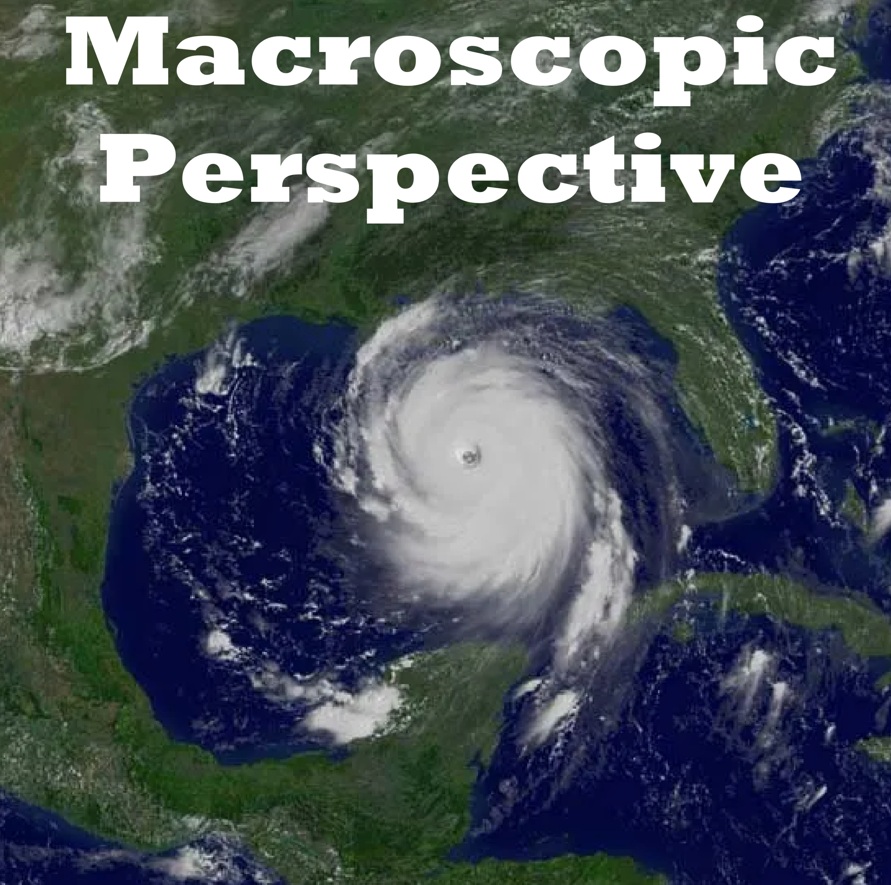
In science, when you stop looking at individual particles (the “microscopic”) and start looking at the system as a whole (the “macroscopic”), you are taking a Macroscopic View.

The Hurricane Example: While individual air molecules move chaotically and appear random at small scales, the macroscopic view reveals organized structures — such as the hurricane’s eye and its spiral bands.

The Human Induced Climate Change Experiment

Macroscopic Perspective

[Intro]
As a matter of fact
(Pull back)

[Verse 1]
Can’t see the knows on your face
(Can’t keep up with the human race)
Blinded by the chaos
(In the face of all of us)

[Bridge]
As a matter of fact
(Pull back)

[Chorus]
Macroscopic (Perspective)
Take a look and see
Macroscopic (Perspective)
The fallacy of destiny

[Verse 2]
Can’t see the forest through the trees
(How warming results in a freeze)
Reminded of the chaos
(In the face of all of us)

[Bridge]
As a matter of fact
(Pull back)

[Chorus]
Macroscopic (Perspective)
Take a look and see
Macroscopic (Perspective)
The fallacy of destiny

[Outro]
As a matter of fact
(Pull back)
[Bridge – Breakdown]
[Minimal Beat, Sub Bass, Spoken Vocal]
Look and see
(Reality)
… really….

Like a Hurricane

[Intro]
Reign!
(Like a hurricane)

[Verse 1]
Can you see
(Where you stand)
Can you fly
(Above the land)

[Bridge]
Reign!
(Like a hurricane)

[Chorus]
Can you see
(If I’s in the eye)
Could it be
(The answer’s from on high)

[Verse 2]
The wind and rain
(Whirl and swirl)
Hard to explain
(Low n’ the blow)

[Bridge]
Reign!
(Like a hurricane)

[Chorus]
Can you see
(If I’s in the eye)
Could it be
(The answer’s from on high)

[Bridge – Breakdown]
Look large
(Pull back)
Enlarge
(Pull back)
Out of the twirl

[Chorus]
Can you see
(If I’s in the eye)
Could it be
(The answer’s from on high)

[Outro]
Can you tell
(If all is well)
Could it be
(From above we’ll see)

ABOUT THE SONG
From inside a hurricane, it is hard to tell what it going on.

From a macroscopic perspective, a hurricane is analyzed as a massive, organized, and self-sustaining atmospheric heat engine, often spanning hundreds of kilometers, that converts heat energy from warm ocean waters into mechanical energy (wind). This large-scale, top-down view focuses on the system’s overall structure, including the central eye, surrounding eyewall, and spiraling rain bands.

You need to “pull back” to see the what’s going on.

What Begins

[Intro]
Hey, man
(Butterfly)
In what begins…
Tiny motion, motion, motion (wide)
Butterfly

[Verse 1]
Shift a grain
(Change the sky)
Drop of rain
(Multiply)
Small mistake
(Big cascade)
Lines that break
(Rippled braid)
Hey, man
(Butterfly)

[Bridge]
In what begins…

[Chorus]
Hey, man
(Can’t you see?)
Every move
(Seeds the sea)
Bend the curve
(Set it free)
Strange attractor
(Entropy)

[Bridge]
In what begins…

[Verse 2]
Loop the loop
(Feedback hum)
Future’s group
(Where we’re from)
Edge of phase
(Flip the state)
Simple phrase
(Complicate)
Hey, man
(Butterfly)

[Bridge]
Come on, man
(Nonlinear)
Order hiding in the blur (there)
Amplify!
(Classify!)

[Chorus]
Hey, man
(Can’t predict)
What begins
(Interconnects)
Every spark
(Architects)
Strange attractor
(What’s next?)

[Breakdown]
Fractal fire
(Self-similar)
Climb the wire
(Regular)
Near and far
(Spiral tight)
Chaos theory
(Holds it right)

[Outro]
Hey, man
(Butterfly)
[Minimal Beat, Whispered Vocal]
Trace the pattern (in the sky)
Hardwired?
(Amplified)
From a whisper
(Worldwide)

Hardwired

[Intro]
Hey, man
(Hardwired)
Static, static, static (clear)
Hardwired

[Verse 1]
Crossed a wire
(Sparks will fly)
Feed the fire
(Question why)
Short the fuse
(Burn it down)
Blame the news
(Spin it round)
Hey, man
(Hardwired)

[Chorus]
Hey, man
(Change the plan)
Flip the switch
(Understand)
No more fryin’
(In demand)
We’re hardwired
(To take a stand)

[Bridge]
Come on, man
(Reset, reset)
Dial it back, back, back (now)
Hardwired!
(Sing along)
Rewired!

[Verse 2]
Loop the blame
(Again, again)
Fuel the flame
(Where’s it end?)
Break the chain
(Cut the feed)
Feel the strain
(Plant the seed)
Hey, man
(Hardwired)

[Chorus]
Hey, man
(Change the plan)
Hear the tone
(From the band)
No more livin’
(Slip and slide)
We’re hardwired
(From inside)

[Breakdown]
Static fades
(Clear the line)
Raise the gauge
(Realign)
Not haywire
(Not today)
Hardwired
(Find the way)

[Outro]
Hey, man
(Hardwired)
Cool the fire
[Scream Vocal]
(Rewired!)
Sing along
(Hardwired!)
Sound the choir
(As for haywire!)

ABOUT THE SONG

The term “hardwired” can relate to chaos theory in an interesting conceptual way, especially when you consider systems, patterns, and predictability. Let me break it down carefully:


1. Hardwiring = Fixed Initial Conditions

  • In chaos theory, small differences in initial conditions can lead to vastly different outcomes — the classic “butterfly effect.”

  • Something that is hardwired can be thought of as a fixed parameter or rule in a system.

  • If a system is “hardwired,” it may follow a deterministic rule, but chaos can still emerge if the system is sensitive to initial conditions.

  • Example: The equations governing a double pendulum are fixed (hardwired), yet their motion is highly unpredictable.


2. Hardwiring = Constraints on a Chaotic System

  • Hardwiring sets the boundaries or structure of a system.

  • Chaos doesn’t imply total randomness; it arises within deterministic rules.

  • The “hardwired” aspects define the rules the chaos operates under.

  • Example: In weather systems, physical laws (thermodynamics, fluid dynamics) are hardwired, but the outcomes are chaotic and difficult to predict beyond a certain time horizon.


3. Hardwiring = Feedback Loops

  • Many chaotic systems include feedback loops that amplify small changes.

  • These loops are often “hardwired” into the system structure.

  • Example: In a population model (predator-prey dynamics), the rules governing reproduction and predation are fixed, but the population sizes over time can fluctuate unpredictably.


4. Psychological/Behavioral Analogy

  • If you think of humans as a system, “hardwired” tendencies (genetic or neurological) can interact with the environment in complex ways.

  • Even with “hardwired” behavior, chaotic outcomes can appear due to environmental sensitivity.

  • This is analogous to deterministic chaos: predictable rules, unpredictable outcomes.


In short:

  • Hardwired = deterministic rules or fixed structures in a system.

  • Chaos theory = sensitive dependence on initial conditions within deterministic systems.

  • The connection: hardwired rules can produce chaotic behavior, because fixed rules interacting with small changes can create complex, unpredictable dynamics.

Microscopic Reflection

[Intro]
As a matter intact
(Look close)
[Muted Guitar Harmonics]
Trace it back
(So close)

[Verse 1]
See the lines upon your hand
(Every choice a grain of sand)
Tiny fractures in the glass
(Where the moments slowly pass)
Hidden in the smallest act
(Consequences compact)

[Bridge]
As a matter intact
(Look close)

[Chorus]
Microscopic (Reflection)
Take a closer view
Microscopic (Connection)
The little things we do

Microscopic (Correction)
Shift a point or two
Microscopic (Direction)
Becomes the world you knew

[Verse 2]
In a whisper lies a storm
(In a norm, the break from norm)
Heat begins at minor degrees
(Seeds become the tallest trees)
What appears so small, so slight
(Turns the day or bends the night)

[Bridge]
As a matter intact
(Look close)

[Chorus]
Microscopic (Reflection)
Take a closer view
Microscopic (Connection)
The little things we do

Microscopic (Inflection)
Changes what is true
Microscopic (Perception)
Defines the wider view

[Outro]
As a matter intact
(Look close)
Look within
(Reality)
Begin…
(And see)
…clearly.

Think Big

[Intro]
Think big
(Bigger, bigger, bigger)

[Verse 1]
How big is your world
(Do you orbit the sun)
Understand what’s been told
(Or just in it for the fun)

[Bridge]
Think big
(Bigger, bigger, bigger)

[Chorus]
Take a broad view
(See the whole picture)
See if what you do
(Endangers “to endure”)

[Verse 2]
How big is your home
(Rotating on its axis?)
Is humanity prone
(To greed taxes)

[Bridge]
Think big
(Bigger, bigger, bigger)

[Chorus]
Take a broad view
(See the whole picture)
See if what you do
(Endangers “to endure”)

[Bridge]
Think big
(Bigger, bigger, bigger)

[Outro]
Look at the big picture
(Consider the future)
Will we endure
(Some more)

Think Big

[Intro]
Think big
(Bigger, bigger, bigger)

[Verse 1]
How big is your world
(Do you orbit the sun)
Understand what’s been told
(Or just in it for the fun)

[Bridge]
Think big
(Bigger, bigger, bigger)

[Chorus]
Take a broad view
(See the whole picture)
See if what you do
(Endangers “to endure”)

[Verse 2]
How big is your home
(Rotating on its axis?)
Is humanity prone
(To greed taxes)

[Bridge]
Think big
(Bigger, bigger, bigger)

[Chorus]
Take a broad view
(See the whole picture)
See if what you do
(Endangers “to endure”)

[Bridge]
Think big
(Bigger, bigger, bigger)

[Outro]
Look at the big picture
(Consider the future)
Will we endure
(Some more)

Zoom Out

[Intro]
Zoom out
(Farther, farther, farther)
Beyond doubt
(Wider than we are)

[Verse 1]
From mountain height
(To continental drift)
From city lights
(To tectonic shift)
See the lines connect
(Invisible threads)
Cause and effect
(In what we’ve said)

[Bridge]
Zoom out
(Farther, farther, farther)
Count the cost
(Measure the matter)

[Chorus]
Take the long view
(Time is the teacher)
See what we do
(Shapes every feature)
Every small act
(Fractals the whole)
Pull back the map
(And measure the soul)

[Verse 2]
How vast is the frame
(Generations deep?)
Is fortune and fame
(All we mean to keep?)
Empires rise
(Entropy wins)
Scale implies
(Where truth begins)

[Bridge – Breakdown]
Perspective shifts (lift)
[Soft Piano Motif]
We are brief
(But not without weight)

[Chorus]
Take the long view
(Time is the teacher)
See what we do
(Shapes every feature)
Every small spark
(Ignites the chain)
Wide as the dark
(We’re all contained)

[Final Chorus – Expanded]
Take the broad view
(See the whole picture)
Scale what is true
(Bigger than scripture)
From atom to star
(The pattern repeats)
Who we are
(Is what we keep)

[Outro]
Zoom out
(Farther, farther)
Hold doubt
(Light as a feather)
Macroscopic
(We belong)
The whole topic
(Is one song)

Statistical Mechanic Music

[Intro]
Without tracking every molecule.
(Nor sole soul)
This thing is running sick
(Maybe we need a mechanic)

[Verse 1]
Entropy of empathy
(Easy to see)
Energy flux
(And “run amuck’s”)

[Bridge]
This thing is running sick
(Maybe we need a mechanic)

[Chorus]
Connecting microscopic behavior
(With macroscopic properties)
Double checking to make sure
(Of all claimed realities)

[Bridge – Breakdown]
Statistical mechanics
(My minds music)
Statistical mechanics
(Mathematical fix)

[Verse 2]
Entropy of humanity
(Obviously)
Could end tragically
(… the probabilities)

[Bridge]
This thing is running sick
(Maybe we need a mechanic)

[Chorus]
Connecting microscopic behavior
(With macroscopic properties)
Double checking to make sure
(Of all claimed realities)

[Outro – Breakdown]
Statistical mechanics
(My minds music)
Mathematical fixer
(Mental elixir)
… not tracking every molecule…
(Nor souls’ role)

ABOUT THE SONG
Statistical Mechanics (SM), chaos theory, and climate science are deeply interconnected, especially in the study of complex, dynamic systems like Earth’s climate.

SM connects the microscopic behavior of individual particles to macroscopic properties like pressure or entropy. It handles massive numbers of interactions through probabilities and ensemble averages, making it essential for describing bulk climate behavior—like temperature gradients or energy flux—without tracking every molecule.

Ensemble Theory (Statistical Mechanic Music Pt. 2)

[Intro]
We don’t need every path
(Just the pattern)
We don’t trace every math
(Just what matters)

Grand canonical
(Open system)

[Verse 1]
Billions collide
(Random motion)
Order inside
(The commotion)
Probability waves
(Quietly speak)
Averages behave
(When extremes leak)

Microstates whisper
(Under the hood)
Macro gets crisper
(Understood)

[Bridge]
Partition function
(Sum it up)
Energy junction
(Fill the cup)
This engine hums
(Heat exchange)
When threshold comes
(Phase will change)

[Chorus]
From countless collisions
(Emerges design)
Statistical vision
(Reveals the line)
You don’t need precision
(Down to the bone)
Just distribution
(To see what’s grown)

[Verse 2]
Feedback loops
(Amplify)
Small perturbations
(Multiply)
Critical mass
(Tipping point)
Structures that pass
(Out of joint)

Entropy climbs
(Arrow of time)
But islands arise
(Structure in rhyme)

Fluctuations flare
(Short and bright)
Average them there
(Truth in sight)

[Bridge – Breakdown]
Ensemble theory
(Plural truth)
Micro uncertainty
(Macro proof)

Not every detail
(Needs inspection)
Just scale
(And direction)

[Chorus – Expanded]
From microscopic motion
(To planetary spin)
Local commotion
(Global trend)
Track the dispersion
(Measure the drift)
Statistical version
(Of the rift)

[Final Chorus – Climactic]
Countless collisions
(One equation)
Layered decisions
(Whole creation)
Entropy rising
(Still we choose)
Pattern surprising
(Win or lose)

[Outro – Dissolve]
We don’t track every molecule
(Nor every soul)
We read the rule
(Of the whole)

Statistical mechanics
(Mind’s music)
Dynamic balance
(Harmonic physics)

The Picture

[Intro]
Are you sure
(That’s the whole picture?)

[Verse 1]
With your face in the mess
(Confess)
Can you see the light
(Through the night)

[Bridge]
[Instrumental, Pulsing Bass, Organ Swell, Muted Guitar Chops, Rising Synth Filter]
Are you sure
(That’s the whole picture?)

[Chorus]
The big picture view
(Is it coming to you)
If perspective you lack
(Take a step back)

[Verse 2]
Caught in a storm
(That’s not the norm)
Is light in sight
(Delight in insight)

[Bridge]
Are you sure
(That’s the whole picture?)

[Chorus]
The big picture view
(Is it coming to you)
If perspective you lack
(Take a step back)

[Outro]
Make sure
(It’s the whole picture)
You can begin
(To take it all in)

The Frame

[Intro]
Look again
(What’s outside the frame?)

[Verse 1]
Edges we trim
(To make it fit)
Colors we dim
(Bit by bit)
Zoomed in tight
(Lose the sight)
What you defend
(Depends)

[Bridge]
Hold still
(Feel the distortion)
Tilt the lens
(Change proportion)

[Chorus]
The hidden view
(Is breaking through)
If angles deceive
(Shift what you believe)
The story you claim
(Is shaped by the frame)

[Verse 2]
Lines intersect
(Connect)
Shadows reveal
(What’s real)
Step to the side
(Let it widen)
Truth’s not flat
(It’s layered like that)

[Bridge – Breakdown]
Are you sure
(You saw it all?)
Lift the veil
(Scale the wall)

[Chorus]
The broader view
(Is waiting for you)
If focus distracts
(Consider the facts)
The picture you name
(Is shaped by the frame)

[Outro]
Look again
(Outside the frame)
Take it in
(Reclaim the whole)
Now begin
(To see control)
The picture grows
(When the border goes)

In the Foray

[Intro]
Are you OK?
(In the foray)
Best step away

[Verse]
Got caught up
(In the rigamarole)
Strange stuff
(These humans dole)

[Bridge]
Are you OK?
(In the foray)
Best step away

[Verse]
Got swept up
(In the palaver)
Weird stuff
(Headed toward cadaver)

[Bridge]
Are you OK?
(In the foray)
Best step away

[Verse]
Got wrapped up
(In the song and dance)
Till we had enough
(Of the pony prance)

[Bridge]
Are you OK?
(In the foray)
Best step away

[Outro]
Are you OK?
(In the foray)
Best step back
(And relax)
… step away

Through the Fray

[Intro]
Can you see?
(Through the fray)
Take a small step back
(Away from the attack)

[Verse 1]
Caught in the spin
(The chatter, the din)
Strange faces
(Moments thin)
Step to the side
(Observe the tide)
Let patterns unfold
(Stories told)

[Bridge 1]
Can you see?
(Through the fray)
Step back, just a bit
(So you can see it)

[Verse 2]
Words collide
(The noise outside)
Odd motions
(Confusion tied)
Notice the pulse
(The hidden waltz)
Watch how it bends
(Beginning to end)

[Bridge 2]
Are you aware?
(Through the fray)
Take a breath, step clear
(You’re a bit too near)

[Verse 3]
Tangles unwind
(The chaos behind)
Observe the dance
(Not caught by chance)
Feel the rhythm shift
(Grasp the gift)
Ease into the flow
(As moments go)

[Bridge 3]
Can you see?
(Through the fray)
Step lightly back
(Avoid the attack)

[Outro]
Are you aware?
(Through the fray)
Step back, relax
(And watch it sway)
…through the fray

Net Radiation

[Intro]
Human neglect
(The greenhouse effect)

[Verse 1]
Buy, buy, buy
(Consume sky high)
Drill, baby, Drill
(Kill, kill, kill)

[Bridge]
In effect
Human neglect
(The greenhouse effect)

[Chorus]
The net result
(Incoming less outgoing)
Environmental assault
(Net radiation)
… the situation

[Verse 2]
More, more, more
(Mass consumption)
Mine to the core
(Till extinction)

[Bridge]
In effect
Human neglect
(The greenhouse effect)

[Chorus]
The net result
(Incoming less outgoing)
Environmental assault
(Net radiation)
… the situation

[Outro]
The end result
(A total assault)
Rape Mother Nature
(Till we don’t endure)
… the situation
(Devastation)

ABOUT THE SONG

Human-induced climate change, also called anthropogenic global warming, is a physical phenomenon rooted in the radiative properties of greenhouse gases (GHGs), especially CO₂, CH₄, and N₂O, and their interaction with Earth’s energy balance.

 The Greenhouse Effect

Earth receives energy from the Sun primarily in the form of shortwave radiation (visible light and near-infrared). The planet absorbs this energy and re-emits it as longwave infrared radiation. Greenhouse gases in the atmosphere absorb some of this infrared radiation and re-emit it, warming the lower atmosphere and surface. This is the greenhouse effect, and it is governed by fundamental physics:

Net Radiation=4S(1α)σT4

Where:

  • SS = solar constant (~1361 W/m²)

  • α\alpha = Earth’s albedo (~0.3)

  • σ\sigma = Stefan-Boltzmann constant (~5.67×10⁻⁸ W/m²K⁴)

  • TT = Earth’s effective radiating temperature

Without GHGs, Earth’s surface would average ~255 K (-18°C). With current GHG levels, it averages ~288 K (~15°C).

From: Anthropogenic Global Warming: Evidence and Mechanisms of Human-Induced Climate Change 

Isotopic Signature

[Intro]
Isotopic Signature
(Are you sure)
We’re sure

[Verse 1]
Burn, baby, burn
(Combustion engine)
Nooo… never learn
(Do it again and again)

[Bridge]
Isotopic Signature
(Are you sure)
We’re sure

[Chorus]
It’s clear
(The atmosphere)
Isn’t clear

We’re near
(The end of the line)
The end of our time

[Verse 2]
Turn up the heat
(Environmental cheat)
Maybe we better not
(Crank it too hot)

[Bridge]
Isotopic Signature
(Are you sure)
We’re sure

[Chorus]
It’s clear
(The atmosphere)
Isn’t clear

We’re near
(The end of the line)
The end of our time

[Outro]
Isotopic Signature
(Are you sure)
We’re sure
(Can we endure)
… er, a… not so sure

ABOUT THE SONG: Human Contribution via CO₂

Humans have increased atmospheric CO₂ from ~280 ppm (pre-industrial) to ~420 ppm today. This increase is not from natural sources but primarily from burning fossil fuels (coal, oil, gas) and land-use changes. The isotopic signature of carbon identifies the source:

  • ¹²C, ¹³C, ¹⁴C isotopes are key:

    • Fossil fuels are depleted in ¹³C because plants preferentially absorb ¹²C during photosynthesis.

    • Fossil fuels contain no ¹⁴C (radiocarbon), as it decays over millions of years.

  • The observed decline in ¹³C/¹²C ratio and ¹⁴C content confirms that the excess CO₂ comes from fossil carbon, not volcanoes or oceans.

Radiative Forcing

[Verse 1]
The balance between
(In and out)
Heatin’ the scene
(There’s no doubt)

[Chorus]
Radiative forcing
(Humans coercing)
Radiative forcing
(Dunce’s endorsing)

[Bridge]
Delta F
(Man’s gone deaf)

[Verse 2]
Oh, where to begin
(The balance within)
Our greenhouse
(Turning hothouse)

[Chorus]
Radiative forcing
(Humans coercing)
Radiative forcing
(Dunce’s endorsing)

[Bridge]
Delta F
(Man’s gone deaf)

[Outro]
The radiative force
(Oh, of course)
Turning up the heat
(Till we’re beat)

ABOUT THE SONG

Radiative Forcing

Radiative forcing (ΔF\Delta F) quantifies how much a GHG changes the balance between incoming and outgoing radiation:

Explanation:

  • ΔF\Delta F = radiative forcing (in watts per square meter, W/m²)

  • CC = current atmospheric CO₂ concentration (ppm)

  • C0C_0 = reference (pre-industrial) CO₂ concentration (ppm)

  • ln⁡\ln = natural logarithm

Where:

  • CC = current CO₂ concentration (ppm)

  • C0C_0 = pre-industrial CO₂ concentration (~280 ppm)

  • The constant 5.35 comes from line-by-line radiative transfer calculations

This formula captures the logarithmic relationship: each doubling of CO₂ produces roughly the same increase in radiative forcing (~3.7 W/m² per doubling).

Other gases:

  • CH₄ (methane): short-lived but ~25× more potent than CO₂ over 100 years.

  • N₂O (nitrous oxide): ~298× more potent than CO₂ over 100 years.

The total forcing is the sum of all anthropogenic contributions:

Explanation:

  • ΔFtotal = total radiative forcing from all greenhouse gases

  • ΔFCO₂ = forcing due to carbon dioxide

  • ΔFCH₄ = forcing due to methane

  • ΔFN₂O = forcing due to nitrous oxide

  • “…” indicates contributions from other greenhouse gases (e.g., CFCs, HFCs)

Feedback Attack

[Intro]
Feedback (Attack, attack, attack)

[Verse 1]
Hotter air
(More vapor there)
Earth’s reflectivity
(Increased intensity)

[Chorus]
Do you know
(Ice-albedo)
And, for sure
(Water vapor)

[Bridge]
Feedback (Attack, attack, attack)

[Verse 2]
Is the permafrost
(Lost, lost, lost)
At what cost
(Humanity’s tossed)

[Chorus]
Do you know
(Ice-albedo)
And, for sure
(Water vapor)

[Bridge]
Feedback (Attack, attack, attack)

[Outro]
Know no lack
(Feedback) Attack, attack, attack
Feedback (Attack, attack, attack)
Societal crack
(Feedback) Attack, attack, attack

ABOUT THE SONG: Feedbacks Amplifying Warming

Initial radiative forcing is amplified by feedbacks:

  • Water vapor feedback: warmer air holds more water → more greenhouse effect

  • Ice-albedo feedback: melting ice lowers reflectivity → more absorption

  • Permafrost carbon release: thawing peat releases CO₂ and CH₄ → additional forcing

This creates nonlinear acceleration: warming triggers processes that produce more warming — a key insight in the “Domino Effect” hypothesis.

Observational Evidence

[Intro]
Are you surprised
(It’s right before your eyes)

[Verse 1]
For sure:
(Rising temperatures)
Proof twice:
(Melting ice)

[Chorus]
Are you surprised
(It’s right before your eyes)
Observational evidence
(Proof’s elements)

[Bridge]
Have you realized
(It’s right before your eyes)

[Verse 2]
Look and see:
(The rising sea)
See how thick:
(The isotopic)

[Chorus]
Are you surprised
(It’s right before your eyes)
Observational evidence
(Proof’s elements)

[Bridge]
Have you realized
(It’s right before your eyes)

[Outro]
Check you science book
(And take a look)
Only a fool denies
(It’s right before your eyes)

ABOUT THE SONG: Observational Evidence
1. Rising global temperatures (surface and ocean heat content)
2. Melting glaciers and ice sheets (Greenland, Antarctica, Arctic sea ice)
3. Rising sea levels
4. Atmospheric CO₂ increase with fossil fuel isotopic signature
5. Measured radiative forcing matches predictions from CO₂ and other GHGs

Summary
* Fossil fuel combustion increases CO₂ → higher radiative forcing → warming.
* The isotopic composition confirms the carbon source is anthropogenic.
* Feedback loops accelerate the warming beyond the direct effect of CO₂ alone.

Measured Response

[Intro]
Did you record
(What you observed?)
Numbers align
(Over time)

[Verse 1]
Data streams
(Not just dreams)
Trend lines rise
(No disguise)
Signal clear
(Year by year)
Margins thin
(We’re closing in)

[Chorus]
Measured response
(Follows the evidence)
Lines on a graph
(More than coincidence)
Plot the change
(It’s rearranged)
Measured response
(Against the nonsense)

[Bridge]
Did you compare
(The baseline there?)
Run it again
(Independent)

[Verse 2]
Carbon traced
(Time and place)
Oceans warm
(Storm by storm)
Acid shifts
(Current drifts)
Feedback loops
(Raising roofs)

[Chorus]
Measured response
(Follows the evidence)
Layer by layer
(Strong convergence)
Check the scale
(It won’t fail)
Measured response
(No divergence)

[Bridge – Breakdown]
Have you graphed
(The aftermath?)
Peer review
(Confirms it too)

[Outro]
Open your book
(Just take a look)
Replicate
(Validate)
Only denial pretends
(There are no trends)
Measured response
(Science defends)

ABOUT THE SONG
This pairs naturally with Observational Evidence:
“Observational Evidence” = What we see.
“Measured Response” = What we quantify and confirm.

Upward Curves and Converging Lines

[Intro]
A different path
(Same aftermath)
Separate signs
(Converging lines)

[Verse 1]
Glaciers retreat
(Record heat)
Oceans rise
(No surprise)
Atmospheres thin
(Tracing carbon in)
Pressure climbs
(Through the times)

[Pre-Chorus]
Independent streams
(Separate teams)
Different tools
(Same rules)

[Chorus]
Upward curves
(Undisturbed)
Across the charts
(In every part)
Multiple ways
(All display)
Upward curves
(Converging lines)

[Verse 2]
Isotopes speak
(Peak to peak)
Coral fades
(Acid waves)
Storm tracks bend
(Start to trend)
Signals align
(Design by design)

[Bridge – Breakdown]
Run it twice
(Still precise)
Change the frame
(Same result)
Shift the scale
(It won’t fail)

[Chorus]
Upward curves
(Undeterred)
From pole to shore
(And more and more)
Lines once apart
(Now interlocked)
Upward curves
(Converging lines)

[Final Chorus – Expanded]
Upward curves
(Undeniable)
Across domains
(Repeatable)
Every test
(Confirms the rest)
Upward curves
(Converging lines)

[Outro]
Different paths
(Same math)
Look again
(And then again)
Only denial declines
(Converging lines)

This completes the trilogy structurally and thematically:
Observational Evidence — It’s visible.
Measured Response — It’s quantified.
Upward Curves and Converging Lines — Independent datasets reinforce one conclusion.

Wide Angle

[Intro]
Have you tried
(Wide)
… angle

[Verse 1]
Have you thought it through
(With a wide field of view)
From side to side
(Real wide eyed)

[Chorus]
Have you tried
(Wide)
… angle
(Try to untangle)

Begin…
(To take it all in)

[Verse 2]
Have you considered it all
(Short and narrow to the tall)
From side to side
(Real wide eyed)

[Chorus]
Have you tried
(Wide)
… angle
(Try to untangle)

[Bridge – Breakdown]
Begin…
(To take it all in)

[Outro]
Open wide
(Inside)
Open wide
(Outside)

Light Speed

[Intro]
One hundred and eighty-six thousand
(Miles per second)

[Verse 1]
So here we go
(Where?)
I do not know
(There.)

[Chorus]
One hundred and eighty-six thousand
(Miles per second)
Imagine how far we are
(In an hour)

[Bridge – Breakdown]
669,600,000 miles
(Won’t be back for a while)
The mind… it riles

[Verse 2]
We just might
(Hit the speed of light)
Don’t think we’ll get past
(Our relativistic mass)

[Chorus]
One hundred and eighty-six thousand
(Miles per second)
Imagine how far we are
(In an hour)

[Bridge – Breakdown]
[Minimal Beat, Sub Bass, Spoken Vocal]
669,600,000 miles
(Won’t be back for a while)
The mind… it riles

[Outro]
One hundred and eighty-six thousand
(Miles per second)
Near the speed of light
(Fear the need of slight)

Relativistic You

[Intro]
(Don’t forget)
The closer you get
(To light speed)
If you wanna live
(Something must give)
… indeed

Frames divide
(Inside)

[Verse 1]
Clocks slow down
(Not a sound)
Your heartbeat stays
(But Earth delays)
Seconds stretch
(Time won’t match)
You age less fast
(The future passed)

[Chorus]
As you approach the speed of light
(Time slips out of sight)
What they see
(Is not what you’ll be)
Relativistic view
(Changes you)

[Bridge – Breakdown]
Gamma climbs
(Through spacetime)
Mass and energy
(Equivalency)

[E = mc² — whispered vocal layer]

[Verse 2]
Lengths contract
(Front to back)
Stars draw near
(Disappear)
Space compress
(Motion stress)
Forward sight
(Tunnels tight)

[Pre-Chorus]
Energy cost
(Explodes across)
Push harder still
(Never will)

[Chorus]
As you approach the speed of light
(Time yields to flight)
From their side
(You slow and glide)
From your frame
(Not the same)

[Bridge 2 – Radiation]
Cosmic rays
(Amplify)
Blue-shift blaze
(In your eye)

Microwaves turn
(X-ray burn)
Front-end glow
(Danger zone)

[Verse 3]
You won’t reach
(The limit breach)
Infinite need
(For finite speed)
The closer you try
(The more you defy)
Massive demand
(Out of hand)

[Final Chorus – Expanded]
One hundred and eighty-six thousand
(Miles per second)
Closer you race
(Time distorts its face)
Across the divide
(No universal stride)
Relativistic you
(Breaks what you knew)

[Outro]
From your seat
(Complete)
The journey seems brief
(A moment’s relief)
But back at home
(You’ve overflown)

Light speed nears
(Bends your years)
bookmark_borderStatistical Mechanic Music

[Silence]

[Instrumental, Guitar, Piano, Organ, Synth, Bass, Percussion, Drums]

[Intro]
[Minimal Beat, Sub Bass, Spoken Vocal]
Without tracking every molecule.
(Nor sole soul)
[Instrumental Intro: Pulsing Bass, Organ Swell, Muted Guitar Chops, Rising Synth Filter]
This thing is running sick
(Maybe we need a mechanic)
[Instrumental]
[Bass Solo]
[Organ Stabs, Driving Bass, Snare March]

[Verse 1]
Entropy of empathy
(Easy to see)
Energy flux
(And “run amuck’s”)

[Bridge]
[Instrumental, Bass, Organ Solo, Muted Guitar Chops, Rising Synth Filter]
This thing is running sick
(Maybe we need a mechanic)
[Instrumental]
[Guitar Solo]
[Organ Stabs, Driving Bass, Snare March]

[Chorus]
Connecting microscopic behavior
(With macroscopic properties)
Double checking to make sure
(Of all claimed realities)

[Bridge – Breakdown]
[Minimal Beat, Sub Bass, Spoken Vocal]
Statistical mechanics
(My minds music)
Statistical mechanics
(Mathematical fix)

[Instrumental]
[Bass Solo]
[Organ Stabs, Driving Bass, Snare March]

[Verse 2]
Entropy of humanity
(Obviously)
Could end tragically
(… the probabilities)

[Bridge]
[Instrumental, Bass, Organ Solo, Muted Guitar Chops, Rising Synth Filter]
This thing is running sick
(Maybe we need a mechanic)
[Instrumental]
[Guitar Solo]
[Organ Stabs, Driving Bass, Snare March]

[Chorus]
Connecting microscopic behavior
(With macroscopic properties)
Double checking to make sure
(Of all claimed realities)

[Outro – Breakdown]
[Minimal Beat, Sub Bass, Spoken Vocal]
Statistical mechanics
(My minds music)
Mathematical fixer
(Mental elixir)
… not tracking every molecule…
(Nor souls’ role)

ABOUT THE SONG
Statistical Mechanics (SM), chaos theory, and climate science are deeply interconnected, especially in the study of complex, dynamic systems like Earth’s climate.

SM connects the microscopic behavior of individual particles to macroscopic properties like pressure or entropy. It handles massive numbers of interactions through probabilities and ensemble averages, making it essential for describing bulk climate behavior—like temperature gradients or energy flux—without tracking every molecule.

Tipping points and feedback loops drive the acceleration of climate change. When one tipping point is toppled and triggers others, the cascading collapse is known as the Domino Effect.

The Human Induced Climate Change Experiment

From the album “Macroscopic Perspective

bookmark_borderWhat Begins

[Silence]

[Instrumental, Guitar, Whistle, Organ, Synth, Bass, Percussion, Drums]

[Intro]
Hey, man
(Butterfly)
In what begins…
[Minimal Beat, Sub Bass, Whispered Vocal]
Tiny motion, motion, motion (wide)
Butterfly
[Instrumental — Syncopated Bass Pulse, Organ Flickers, Delayed Guitar Echo]
[Guitar Riff — fractured, off-beat]
[Snare March — slightly staggered]

[Verse 1]
Shift a grain
(Change the sky)
Drop of rain
(Multiply)
Small mistake
(Big cascade)
Lines that break
(Rippled braid)
Hey, man
(Butterfly)

[Bridge]
In what begins…
[Instrumental, Whistle Hook — playful but slightly off-time]

[Chorus]
Hey, man
(Can’t you see?)
Every move
(Seeds the sea)
Bend the curve
(Set it free)
Strange attractor
(Entropy)

[Bridge]
In what begins…
[Instrumental — Organ Swell, Rising Synth Filter]

[Verse 2]
Loop the loop
(Feedback hum)
Future’s group
(Where we’re from)
Edge of phase
(Flip the state)
Simple phrase
(Complicate)
Hey, man
(Butterfly)

[Bridge]
Come on, man
(Nonlinear)
[Minimal Beat Drops Out — Sub Bass Alone]
Order hiding in the blur (there)
[Scream Vocal]
Amplify!
(Classify!)
[Instrumental Build — Drums Re-enter Polyrhythmic, Guitar Ascends in Uneven Phrases]

[Chorus]
Hey, man
(Can’t predict)
What begins
(Interconnects)
Every spark
(Architects)
Strange attractor
(What’s next?)

[Breakdown]
[Organ Drone, Bass Oscillation]
Fractal fire
(Self-similar)
Climb the wire
(Regular)
Near and far
(Spiral tight)
Chaos theory
(Holds it right)

[Instrumental — Extended Jam, Guitar & Organ in Call-and-Response, Rhythm Slightly Shifting Time Feel]

[Outro]
Hey, man
(Butterfly)
[Minimal Beat, Whispered Vocal]
Trace the pattern (in the sky)
Hardwired?
(Amplified)
From a whisper
(Worldwide)

From the album “Macroscopic Perspective

bookmark_borderMacroscopic Perspective

[Silence]

[Instrumental, Guitar, Piano, Organ, Synth, Bass, Percussion, Drums]

[Intro]
[Instrumental Intro: Pulsing Bass, Organ Swell, Muted Guitar Chops, Rising Synth Filter]
As a matter of fact
(Pull back)
[Instrumental, Guitar Solo]

[Verse 1]
Can’t see the knows on your face
(Can’t keep up with the human race)
Blinded by the chaos
(In the face of all of us)

[Bridge]
[Instrumental, Pulsing Sub Bass, Organ Swell, Muted Guitar Chops, Rising Synth Filter]
As a matter of fact
(Pull back)
[Instrumental, Guitar Solo]

[Chorus]
Macroscopic (Perspective)
Take a look and see
Macroscopic (Perspective)
The fallacy of destiny

[Instrumental, Saxophone Solo]
[Guitar Solo — sharper, angular]
[Organ Stabs, Driving Bass, Snare March]

[Verse 1]
Can’t see the forest through the trees
(How warming results in a freeze)
Reminded of the chaos
(In the face of all of us)

[Bridge]
[Instrumental, Pulsing Sub Bass, Organ Swell, Muted Guitar Chops, Rising Synth Filter]
As a matter of fact
(Pull back)
[Instrumental, Guitar Solo]

[Chorus]
Macroscopic (Perspective)
Take a look and see
Macroscopic (Perspective)
The fallacy of destiny

[Instrumental, Saxophone Solo]
[Guitar Solo — sharper, angular]
[Organ Stabs, Driving Bass, Snare March]

[Outro]
As a matter of fact
(Pull back)
[Bridge – Breakdown]
[Minimal Beat, Sub Bass, Spoken Vocal]
Look and see
(Reality)
… really….

ABOUT THE SONG
The Macroscopic Perspective
In science, when you stop looking at individual particles (the “microscopic”) and start looking at the system as a whole (the “macroscopic”), you are taking a Macroscopic View.

From the album “Macroscopic Perspective

bookmark_borderLike a Hurricane

[Silence]

[Instrumental, Guitar, Piano, Organ, Synth, Bass, Percussion, Drums]

[Intro]
[Instrumental Intro: Pulsing Bass, Organ Swell, Muted Guitar Chops, Rising Synth Filter]
Reign!
(Like a hurricane)
[Instrumental, Guitar Solo]

[Verse 1]
Can you see
(Where you stand)
Can you fly
(Above the land)

[Bridge]
[Build: Synth Arpeggio Rising]
[Organ Stabs, Driving Bass, Snare March]
[Breakdown]
Reign!
(Like a hurricane)
[Instrumental, Guitar Solo]

[Chorus]
Can you see
(If I’s in the eye)
Could it be
(The answer’s from on high)

[Instrumental]
[Guitar Solo — sharper, angular]
[Organ Stabs, Driving Bass, Snare March]

[Verse 2]
The wind and rain
(Whirl and swirl)
Hard to explain
(Low n’ the blow)

[Bridge]
[Build: Synth Arpeggio Rising]
[Organ Stabs, Driving Bass, Snare March]
[Breakdown]
Reign!
(Like a hurricane)
[Instrumental, Guitar Solo]

[Chorus]
Can you see
(If I’s in the eye)
Could it be
(The answer’s from on high)

[Instrumental]
[Guitar Solo — sharper, angular]
[Organ Stabs, Driving Bass, Snare March]

[Bridge – Breakdown]
[Minimal Beat, Sub Bass, Spoken Vocal]
(Whirl and swirl)
[Build: Synth Arpeggio Rising]
Look large
(Pull back)
Enlarge
(Pull back)
Out of the twirl

[Chorus]
Can you see
(If I’s in the eye)
Could it be
(The answer’s from on high)

[Outro]
Can you tell
(If all is well)
Could it be
(From above we’ll see)

ABOUT THE SONG
From inside a hurricane, it is hard to tell what it going on.

From a macroscopic perspective, a hurricane is analyzed as a massive, organized, and self-sustaining atmospheric heat engine, often spanning hundreds of kilometers, that converts heat energy from warm ocean waters into mechanical energy (wind). This large-scale, top-down view focuses on the system’s overall structure, including the central eye, surrounding eyewall, and spiraling rain bands.

You need to “pull back” to see the what’s going on.

From the album “Macroscopic Perspective

bookmark_borderStrange Attractor

[Silence]

[Instrumental, Guitar, Piano, Organ, Synth, Bass, Percussion, Drums]

[Intro]
Fa, fa, fa
(phase space)
[Instrumental Intro: Pulsing Bass, Reverse Cymbal Swell, Angular Guitar Harmonics, Low Synth Drift]
Random spin
(Spiral in)
Fractured grin
(Where to begin?)
[Instrumental, Guitar Solo — sharp, syncopated]

[Verse 1]
Feedback loops
(Circlin’ tight)
Phase shifts
(Day to night)
Tiny push
(Mass effect)
Loose thread
(Disconnect)

[Bridge]
Nonlinear
(Crystal clear?)
Sensitive
(Interference)
[Minimal Beat, Sub Bass, Spoken Vocal]
Order hides inside the doubt.
(Spreading out)
Fa, fa, fa
(phase space)
[Build: Organ Swell, Rising Synth Filter]

[Chorus]
Strange attractor
(Pullin’ us in)
Hidden factor
(Beneath the din)
Through the fracture
(New patterns begin)
Start to map it out
(From within)

[Instrumental – Sax Riff over Driving Bass]

[Verse 2]
Edge of phase
(Tipping point)
Joint arrays
(Every joint)
Teleconnections hum
(Across the sky)
What seems undone
(Ties you and I)

[Bridge]
Dynamic
(Not static)
Chaotic
(But not tragic)
[Minimal Beat, Sub Bass, Spoken Vocal]
Noise becomes a voice—if you listen.
(Within)
Without
(Shout)
Fa, fa, fa
(phase space)
[Instrumental Break – Guitar Solo, angular then resolving]

[Chorus]
Strange attractor
(Pullin’ us in)
Hidden factor
(Beneath the spin)
Through the fracture
(We begin again)
Start to figure it out
(Where we’ve been)

[Bridge – Breakdown]
Fa, fa, fa
(phase space)
[Minimal Beat, Sub Bass, Distant Organ Pad]
Not random—
Responsive.
Not broken—
Expansive.
[Snare March Enters, Bass Pulse Builds]

[Final Chorus]
Strange attractor
(Out of the storm)
Hidden factor
(Changing form)
Through the fracture
(A new norm)
Now we see what it’s about
(Reform)

[Outro]
[Instrumental – Piano Motif Repeats, Guitar Harmonics, Organ Sustain]
From the doubt
(Comes a route)
From the spin
(We begin)
Startin’ to figure it out
(That’s what it’s about)
Chaos breathing in and out
… and out … and out.
(La, la, la)
Fa, fa, fa
(phase space)

ABOUT THE SONG
Strange attractors are complex, fractal-shaped, bounded regions in phase space that nonlinear, chaotic systems are drawn toward over time. They represent a unique form of order within chaos, characterized by extreme sensitivity to initial conditions (the butterfly effect) and a positive Lyapunov exponent, meaning nearby trajectories diverge exponentially. Common examples include the Lorenz attractor in weather modeling.

From the album “Wayward

bookmark_borderChaotic

[Silence]

[Instrumental, Guitar, Piano, Organ, Synth, Bass, Percussion, Drums]

[Intro]
Too complex
(Too sensitive)
Perplex initiative
(Can’t figure it out)
[Instrumental, Guitar Solo]

[Verse 1]
Nonlinear
(That’s for sure)
Butterfly wings
(And little things)

[Bridge]
Dynamic
[Minimal Beat, Sub Bass, Spoken Vocal]
Thick (in chaotic)
[Instrumental, Pulsing Bass, Organ Swell, Muted Guitar Chops, Rising Synth Filter]

[Chorus]
Too complex
(Too sensitive)
Perplex initiative
(Can’t figure it out)

[Bridge – Breakdown]
[Minimal Beat, Sub Bass, Spoken Vocal]
That’s what this is about
[Instrumental]
[Guitar Solo — sharper, angular]
[Organ Stabs, Driving Bass, Snare March]

[Verse 2]
Upon reflection
(Teleconnection)
Butterfly wings
(And little things)

[Bridge]
Dynamic
[Minimal Beat, Sub Bass, Spoken Vocal]
Thick (in chaotic)
[Instrumental, Pulsing Bass, Organ Swell, Muted Guitar Chops, Rising Synth Filter]

[Chorus]
Too complex
(Too sensitive)
Perplex initiative
(Can’t figure it out)

[Bridge – Breakdown]
[Minimal Beat, Sub Bass, Spoken Vocal]
That’s what this is about
[Instrumental]
[Guitar Solo — sharper, angular]
[Organ Stabs, Driving Bass, Snare March]

[Outro]
Startin’ to figure it out
(What it’s all about)
How to remove the doubt

ABOUT THE SONG
In physics, “unpredictability” can mean either that a system is fundamentally probabilistic (indeterministic) or that it is too complex or sensitive for long-term forecasting (chaotic). While classical physics suggests a “clockwork” universe, modern physics has revealed several fundamental areas where prediction is impossible, either in principle or in practice.

From the album “Wayward

bookmark_borderCracked Fractals

[Verse 1]
A pebble hit the windshield
(It was only a nick)
But the physics did yield
(The bubble’s prick)

[Bridge]
Crystal ball
(Cracked fractal)

[Chorus]
Why it matters:
(Fracture lines spread)
Find out about branching
(Dread – the glass shatters)

[Verse 2]
What do you know…
(The crack will grow, grow, grow)
What was just a little stress
(Is now a significant mess)

[Bridge]
[Chorus]
[Bridge]
[Outro]
After all
(Watch the fall)
Crystal ball
(Cracked fractal)
Like a broken glass
(Fell on our….)

ABOUT THE SONG
Cracked Fractals: Climate Thermodynamics, Insurance Instability, and Sovereign Debt Transmission in Late-Stage Capitalism

The relationships between climate physics and modern financial structure are complex, dynamic, and fundamentally non-linear. This paper examines the transmission mechanisms linking climate destabilization to structural fragility within advanced capitalist economies. Drawing on thermodynamics, actuarial science, and sovereign debt dynamics, it argues that the insurance sector functions as the primary systemic tripwire between physical climate risk and financial abstraction. Evidence from Florida and California demonstrates how accelerating climate losses are already migrating from private balance sheets to public backstops. As these liabilities propagate through municipal bonds, mortgage-backed securities, and ultimately federal debt, the system begins to exhibit the instability patterns characteristic of complex systems nearing critical thresholds—what I describe as “cracked fractals.” In physics, this phenomenon is analogous to a small crack appearing in a pane of glass, where the fracture lines progressively spread and branch out until the entire glass ultimately shatters. The convergence of climate acceleration and fiscal overextension suggests not isolated sectoral stress, but the emergence of systemic collapse dynamics.

The Human Induced Climate Change Experiment

From the album “North Flew South

bookmark_borderExtreme Energy Events

Extreme-Energy-Events-Best-Of.mp3
Extreme-Energy-Events-Best-Of.mp4
Extreme-Energy-Events.mp3
Extreme-Energy-Events.mp4
Extreme-Energy-Events-Pt-2.mp3
Extreme-Energy-Events-Pt-2.mp4
Extreme-Energy-Events-Reggae.mp3
Extreme-Energy-Events-Reggae.mp4

Extreme-Energy-Events-Animation-1.mp4
Extreme-Energy-Events-Animation-2.mp4
Extreme-Energy-Events-Animation-3.mp4
Extreme-Energy-Events-Animation-4.mp4
Extreme-Energy-Events-intro.mp3

[Intro]
Hail from hell
(Violent precipitation)
Whipped whiplash
(Involuntary participation)

[Verse 1]
Small increases
(Destabilizing changes)
Increases… never ceases
(Habitat rearranges)

[Chorus]
Hail from hell
(Violent precipitation)
Whipped whiplash
(Involuntary participation)

[Bridge]
In any event,
I mean (extreme)
Energy event

[Verse 2]
Testified:
Transformed
(Transferred)
(And amplified)

[Chorus]
Hail from hell
(Violent precipitation)
Whipped whiplash
(Involuntary participation)

[Bridge]
In any event,
I mean (extreme)
Energy event

[Outro]
Energy
(You moved me)
Energy
(Our legacy)
We store more
(We whored hoard)

ABOUT THE SONG AND THE SCIENCE
The phrase global warming is widely misunderstood. While it accurately describes a rise in Earth’s average temperature, it fails to capture the true source of risk: a rapid increase in total energy within the Earth system. Heat is only the entry point. Once added, that energy is transformed, transferred, and amplified through atmospheric, oceanic, and terrestrial processes.

In 2025, global mean temperatures exceeded the long-recognized 1.5°C threshold. To a lay observer, this may sound insignificant. It is not. Earth’s climate is a nonlinear system. Small average increases translate into large, destabilizing changes in circulation, moisture, pressure, and momentum–producing what are better described as extreme energy events.

What Are Extreme Energy Events?

Terms like heat waves or extreme weather describe symptoms, not mechanisms. The real driver is energy–thermal, kinetic, latent, and gravitational–moving through a destabilized system.

Extreme energy events include:

  • Violent precipitation and flash flooding
  • Extreme winds and pressure-gradient-driven storms
  • Rapid thermal and moisture swings (“climate whiplash”)
  • Coastal storm surge and marine heatwaves
  • Convective, solid, and chemical energy releases (hail, microbursts, wildfire)

These events are becoming more frequent and more destructive because energy scales nonlinearly.

Alignment With Tipping Points and Cascading Collapse

This framework of extreme energy events directly aligns with–and physically underpins–tipping-point theory and cascading-collapse dynamics.

Extreme Energy as the Mechanism of Tipping Points

Tipping points are not abstract thresholds; they are energy thresholds. A system appears stable while excess energy is absorbed internally–through ocean heat uptake, cryosphere melt, soil moisture loss, or atmospheric moisture loading. Once buffering capacity is exhausted, the system reorganizes abruptly.

Examples include:

  • Jet stream destabilization once polar amplification erodes the equator-to-pole temperature gradient
  • AMOC weakening as freshwater input disrupts density-driven circulation
  • Cryosphere collapse when latent heat thresholds are exceeded and albedo feedbacks flip sign

Extreme energy events are therefore the observable phase transition–the moment when stored energy is released into motion, flow, and force.

Cascading Collapse: When One Failure Accelerates the Next

Earth’s climate is a tightly coupled system. When one component crosses a tipping point, it injects energy or removes stability from adjacent systems, accelerating their failure.

For example:

  • Arctic amplification weakens the jet stream → stalled Rossby waves → prolonged heat domes and floods → soil moisture loss → wildfire → atmospheric aerosol loading → further circulation disruption.
  • Ocean heat uptake delays surface warming → stratification increases → circulation slows → marine heatwaves intensify → ecosystem collapse → reduced carbon uptake → accelerated atmospheric warming.

Each collapse feeds energy forward, amplifying stress on the next subsystem. This is why observed change is no longer sequential–it is simultaneous.

Nonlinearity: Why Change Appears Sudden

In nonlinear systems, stress accumulates invisibly. The release is abrupt.

Extreme energy events mark the transition from:

  • Energy accumulationenergy expression
  • Bufferingbreakdown
  • Variabilityinstability

This explains why multiple “once-in-1,000-year” events are now occurring within the same season, across unrelated regions, and through different physical mechanisms.

From Climate Risk to Systems Failure

Our tipping-point and cascading-collapse work emphasizes a critical insight: the danger is not the magnitude of warming alone, but the synchronization of failures.

Extreme energy events are the connective tissue between:

  • Climate physics
  • Infrastructure collapse
  • Economic destabilization
  • Ecological failure
  • Human habitability limits

They are how abstract thresholds become lived reality.

The Core Reality

Climate change is not simply warming the planet–it is pushing multiple Earth systems past energetic thresholds simultaneously.

Once tipping points are crossed, the system no longer returns to its prior state. Energy flows reconfigure permanently, cascades accelerate, and collapse becomes self-reinforcing.

We are no longer approaching this phase.

We are inside it.


* Our probabilistic, ensemble-based climate model — which incorporates complex socio-economic and ecological feedback loops within a dynamic, nonlinear system — projects that global temperatures are becoming unsustainable this century. This far exceeds earlier estimates of a 4°C rise over the next thousand years, highlighting a dramatic acceleration in global warming. We are now entering a phase of compound, cascading collapse, where climate, ecological, and societal systems destabilize through interlinked, self-reinforcing feedback loops.

We examine how human activities — such as deforestation, fossil fuel combustion, mass consumption, industrial agriculture, and land development — interact with ecological processes like thermal energy redistribution, carbon cycling, hydrological flow, biodiversity loss, and the spread of disease vectors. These interactions do not follow linear cause-and-effect patterns. Instead, they form complex, self-reinforcing feedback loops that can trigger rapid, system-wide transformations — often abruptly and without warning. Grasping these dynamics is crucial for accurately assessing global risks and developing effective strategies for long-term survival.

What Can I Do?
The single most important action you can take to help address the climate crisis is simple:
stop burning fossil fuels. There are numerous actions you can take to contribute to saving the planet. Each person bears the responsibility to minimize pollution, discontinue the use of fossil fuels, reduce consumption, and foster a culture of love and care. The Butterfly Effect illustrates that a small change in one area can lead to significant alterations in conditions anywhere on the globe. Hence, the frequently heard statement that a fluttering butterfly in China can cause a hurricane in the Atlantic. Be a butterfly and affect the world.

Tipping points and feedback loops drive the acceleration of climate change. When one tipping point is breached and triggers others, the cascading collapse is known as the Domino Effect.

The Climate Crisis: Violent Rain | Deadly Humid Heat | Health Collapse | Extreme Weather Events | Insurance Collapse | Forest Collapse | Soil Collapse | Rising Sea Level | Food and Water Collapse | Updates

The Human Induced Climate Change Experiment

From the album “Sudden
Also found on the album “Reggae Getaway

bookmark_borderNeuronal Networks

Neuronal-Networks-Best-Of.mp3
Neuronal-Networks-Best-Of.mp4
Neuronal-Networks.mp3
Neuronal-Networks.mp4
Neuronal-Networks-Animation-1.mp4
Neuronal-Networks-Animation-2.mp4
Neuronal-Networks-Animation-3.mp4
Neuronal-Networks-Animation-4.mp4
Neuronal-Networks-Animation-5.mp4
Neuronal-Networks-Animation-6.mp4
Neuronal-Networks-intro.mp3

[Intro]
Does it strain
(The brain)
Thinkin’ neuronal
(Non-linear)
Is normal
(After all)

[Bridge]
It’s said:
(From the head)
To the feet
(Dance to the beat)
Nonlinear interaction
(Neurons’ reaction)
Synchronized firing
(Chaotic dynamics)
Desire a higher thing
(By name: the music)

[Refrain]
Does it strain
(The brain)
Thinkin’ neuronal
(Non-linear)
Is normal
(After all)
Beyond (the skull)

[Bridge]
It’s said:
(From the head)
To the feet
(Dance to the beat)
Nonlinear interaction
(Neurons’ reaction)
Synchronized firing
(Chaotic dynamics)
Desire a higher thing
(By name: the music)

[Refrain]
Does it strain
(The brain)
Thinkin’ neuronal
(Non-linear)
Is normal
(After all)
Beyond (the skull)

[Bridge]
It’s said:
(From the head)
To the feet
(Dance to the beat)
Nonlinear interaction
(Neurons’ reaction)
Synchronized firing
(Chaotic dynamics)
Desire a higher thing
(By name: the music)

[Outro]
So we danced through the night
(Into a new dawn’s light)
Not nervous at all
(As I recall)
Firing
(Desiring)
Light
(… and the dynamic of music)

ABOUT THE SONG AND THE SCIENCE
Nonlinear phenomena are ubiquitous in nature, appearing in systems where the output is not directly proportional to the input, leading to complex and often unpredictable behavior.

“Yes, the human nervous system—which functions as a biological “neural network”—extends from the head (brain) to the tips of the toes and every part of the body in between.”

Biological Rhythms and Pattern Formation:
* Neuronal Networks: The brain and nervous system operate through complex, nonlinear interactions between neurons, exhibiting behaviors like synchronized firing and even chaotic dynamics.

From the album “Nonlinear

bookmark_borderWith the Ease of Disease

With-the-Ease-of-Disease-Best-Of.mp3;
With-the-Ease-of-Disease-Best-Of.mp4
With-the-Ease-of-Disease.mp3
With-the-Ease-of-Disease.mp4
With-the-Ease-of-Disease-Animation-1.mp4
With-the-Ease-of-Disease-Animation-2.mp4
With-the-Ease-of-Disease-intro.mp3

[Intro]
With the ease of disease
(She’ll do as she please)

[Verse 1]
Hector,
Are you off on…
(Another vector)
You, mutant, you
(What are ya gonna do?)

[Chorus]
Spread, baby, spread
(On her death bed)
Dread, baby, dread
(Your baby’s dead)

[Bridge]
With the ease of disease
(She’ll do as she please)

[Verse 2]
If you tell 2 friends
(And they tell 2 friends)
And, so, woe… no whoa
(You know how it ends)

[Chorus]
Spread, baby, spread
(On her death bed)
Dread, baby, dread
(Your baby’s dead)

[Outro]
So, let it be said:
(Stop the spread!)
Why refrain…
(Doesn’t take a brain)
(Just a heart)
… to start
With the ease of disease
(She’ll do as she please)
… ‘less we bring ‘er to her knees
(Bring ‘er to her knees!)

ABOUT THE SONG AND THE SCIENCE

Disease spread is fundamentally a non-linear process because the number of new infections isn’t constant; it accelerates rapidly as the number of infected individuals increases. This is a classic example of an exponential growth curve, much like the “J-curve” shape previously discussed [1].  This means the growth rate itself grows over time, leading to a dramatic increase in cases, rather than a steady, linear progression. 
The Mechanism of Non-Linear Transmission 
The non-linear nature is best explained by how infections multiply within a population: 
    1. Linear Growth: If one infected person always infected exactly one other person (a rate of 1:1), the growth would be linear (1, 2, 3, 4, 5 infections).
    2. Exponential/Non-Linear Growth: In most infectious diseases, one person infects more than one person. The number of new cases compounds with each cycle of transmission. 

The classic exponential pattern is: 
    • Generation 1: 1 person is infected.
    • Generation 2: 1 person infects 2 others (Total: 3 people infected).
    • Generation 3: Those 2 people each infect 2 more (Total: 7 people infected).
    • Generation 4: Those 4 people each infect 2 more (Total: 15 people infected).
    • Generation 5: Those 8 people each infect 2 more (Total: 31 people infected). 

The total number of cases quickly jumps from 1 to 31 in just a few cycles, illustrating the rapid upward curve of the “hockey stick” shape. 
The Role of R0
Epidemiologists use a key metric called the basic reproduction number (R0) to measure this spread rate.
R0  is the average number of people that one infected person will pass the disease onto in a population where no one is immune. 

Non-Linearity in Vectors and Mutations 
The non-linear dynamics extend beyond just the number of cases to the biological characteristics of the disease itself: 
1. Mutations and Variants 
Genetic mutations accumulate over time, often randomly. The critical non-linearity comes from natural selection and viral fitness. While mutations are linear events (one change at a time), the impact can be highly non-linear: 
    • A single, seemingly minor mutation might suddenly confer a massive advantage, such as higher transmissibility or immune escape (e.g., a new variant becomes dominant very quickly).
    • This sudden shift in transmission dynamics dramatically alters the slope of the exponential growth curve. 

2. Transmission (Vectors) 
Vectors (carriers, which can be humans, mosquitoes, etc.) facilitate transmission. The overall spread rate is non-linear because the more vectors that are infected and interacting, the greater the probability of encounters that lead to new infections. It’s not just the number of infected people that matters, but also how densely they interact and how likely their interactions are to cause secondary infections. 

[1] The shape is called an exponential curve in calculus because the rate of growth is proportional to the current number of cases, which is the definition of exponential behavior.

From the album “Nonlinear